Point-of-Care (POC) devices such as glucose meters and test strips can facilitate triaging and screening of patients at sites of care during crises in which temperature and humidity can fluctuate and may exceed the manufacturer's storage and operating specifications. Environmental stress can cause erroneous measurements and jeopardize patient management, treatment, and safety.Reference Louie, Sumner, Belcher, Mathew, Tran and Kost 1 – Reference Vanholder, Borniche and Claus 9
Responders at recent disasters, such as Hurricane Katrina in New Orleans and the earthquake in Haiti, reported POC reagents and instruments failing in austere conditions.Reference Vanholder, Borniche and Claus 9 , Reference Kost, Tran, Tuntideelert, Kulrattanamaneeporn and Peungposop 10 Reagent test strips typically are packaged in vials or individually sealed in foil or polyester film (Mylar) packaging. Therefore, the objective of the study was to evaluate the effectiveness of foil and vial packaging in safeguarding and preserving the performance of glucose and lactate test strips when stored and operated in an environment with high humidity.
Materials and Methods
Point-of-Care Systems
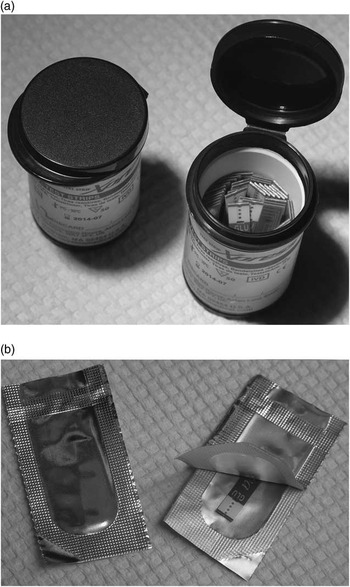
A commercial glucose meter and a lactate meter system were used for the study. Two lots of glucose test strips, 1 packaged in vials and 1 in foil (Figure 1), and 1 lot of lactate strips in vials were used. Lactate strips were not available in foil packaging.
Vial (A) and Foil (B) Test Strip Packaging.

Test Sample
This study received approval from the local ethics committee, University of California, Davis, institutional review board (IRB #294372-4). Venous whole blood samples (16 mL) were collected in lithium heparin evacuated collection tubes from healthy adult volunteers. Donor blood was pooled and tested to determine the initial baseline glucose concentration. The sample was partitioned into 3 tubes to create 3 different test concentrations.
To achieve a low glucose concentration (level 1), the sample was allowed to glycolyze in an environmental chamber at 37°C. High glucose concentration (level 3) was achieved by spiking the samples with either 10% or 20% dextrose solution. Lactate levels in the samples were not adjusted.
Experimental Design
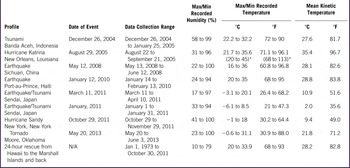
Glucose strips in vial and foil packaging and lactate test strips were split into control and stressed groups. Control test strips were unstressed and kept at room temperature conditions (mean temperature, 24.3 ± 0.5°C; relative humidity, 37.1 ± 7.4%). A set of vial and foil glucose test strips was placed in an environmental chamber (Tenney BTRC) for stressing. The chamber was programmed to maintain a set temperature of 20°C and static humidity of 95% relative humidity (RH). The humidity level was selected based on observed conditions from recent emergencies and disasters (Table 1).Reference Louie, Ferguson, Curtis, Vy and Kost 4 , Reference Klein and Nagel 11 , Reference Kline 12 The actual documented mean temperature and humidity in the chamber were 19.0 ± 0.1°C and 97.0 ± 1.1% (n = 6110). Two calibrated data loggers (MadgeTech) were placed inside the chamber to record temperature and humidity at 5-minute intervals for the duration of the experiment.
Emergency and Disaster Profiles

*Based on anecdotal temperatures observed inside hospitalsReference Klein and Nagel 11 , Reference Kline 12
Data were collected from the National Climatic Data Center (NCDC) unless otherwise referenced. Table adapted and modified from Louie etal.Reference Louie, Ferguson, Curtis, Vy and Kost 4 with permission.
A total of 60 stressed test strips (30 vial and 30 foil) were removed 1 at a time from the chamber at 24, 72, and 168 hour time points and tested in pairs with control strips. Glucose strips were tested with whole blood samples spiked to 3 glucose concentrations (levels 1, 2, and 3). The mean glucose concentrations for levels 1, 2, and 3 were 53.6 ± 9.4 mg/dL, 94.5 ± 12.8 mg/dL, and 248.8 ± 16.0 mg/dL (n = 160 per level), respectively. Lactate strips were tested in parallel with the same blood sample. The testing order for the strips and meters was randomized. The initial and end of experiment plasma glucose concentration of each test sample was determined on the Stat Profile Critical Care Xpress reference analyzer (Nova Biomedical). Ambient temperature and relative humidity outside the chamber were measured using a thermohygrometer (Fisher) and recorded during the test time point along with each pair of stress and control measurements at each test concentration. In total, the experiments were performed twice.
Open-Vial Experiment
A separate experiment with open vials was performed in which glucose test strip vials were left uncapped and stressed under the same high humidity condition (97% RH) as described for up to 72 hours. Thirty stressed strips were removed 1 at a time at each of 3 time points (24, 48, and 72 hours) and tested in pairs with control strips. The open-vial experiment was performed with 3 levels of aqueous quality control solutions provided by the manufacturer. The control solutions were stored at room temperature. The mean glucose concentration of the aqueous quality control solutions were 62.2 ± 3.0 mg/dL, 110.6 ± 4.2 mg/dL, and 291.8 ± 12.5 mg/dL (n = 38 per level of concentration), respectively. One trial of the open-vial experiment was performed.
Data Analysis
We compared glucose and lactate measurements obtained from stressed test strips to measurements from unstressed strips of the same packaging and calculated mean and median glucose paired differences (stress minus control) for each packaging type. AWilcoxon signed-rank test was performed to compare stressed and unstressed strips of each design because the data were not normally distributed. Statistical significance was indicated by P < .05 and P < .01 (see Figures 2-4).
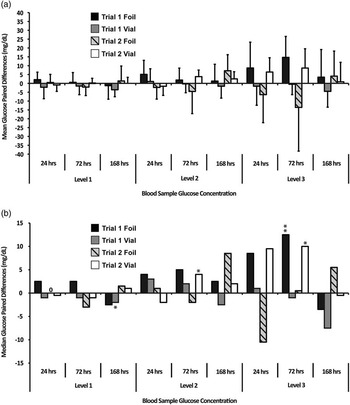
Effects of High Humidity on the Performance of Glucose Test Strips in Foil and Vial Packaging. A, mean glucose paired differences. B, median glucose paired differences between stressed and unstressed glucose test strips from both experimental trials. Paired differences were plotted against stress duration for glucose test concentration. Mean glucose concentrations for levels 1, 2, and 3 were 53.6 ± 9.4 mg/dL, 94.5 ± 12.8 mg/dL, and 248.8 ± 16.0 mg/dL (n = 160 per level), respectively. Single asterisks indicate statistically significant results at P < .05; double asterisks indicate P < .01.

Results
Effects on Glucose Test Strips
Glucose measurements between stressed and unstressed test strips differed significantly in 4 cases. The differences were observed in both foil and vial packaging, but not consistently between repeated experimental trials (Figure 2A and B). In trial 1, the median paired difference was -2 mg/dL (3.7%, −2 mg/dL/53.6 mg/dL; P < .05) after 168 hours of exposure at the low test sample concentration (level 1), while trial 2 had median paired differences of 4 mg/dL (4.2%, 4/94.5; P < .05) and 10 mg/dL (4.0%, 10/248.8; P < .05) after 72 hours of exposure at test levels 2 and 3, respectively (Figure 2B).
Foil packaged test strip measurements were elevated significantly, with a median glucose paired difference of 12.5 mg/dL (5.0%, 12.5/248.8; P < .01) after 72 hours of exposure at test concentration level 3. Stressed test strips in vial packaging produced a median bias as high as 9.8 mg/dL. In spite of statistical significance, differences (≤5.0% bias) were not necessarily clinically significant. Three stressed glucose strips packaged in vials and 7 stressed glucose strips packaged in foil failed to produce results.
Effects on Lactate Test Strips
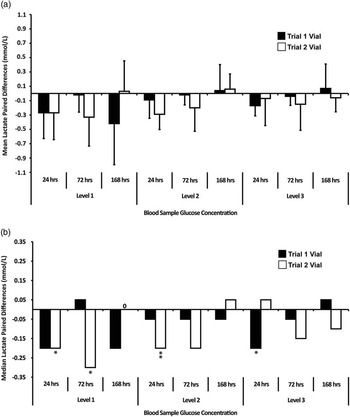
Stressed lactate strips produced significantly lower results compared to unstressed strips after 24 hours of exposure in both trials. Median lactate paired differences were −0.2 mmol/L (P < .05) in trial 2 when testing samples at glucose levels 1 and 2, and −0.2 mmol/L (P < .01) in trial 1 at level 3 (Figure 3). Median lactate paired difference of −0.3 mmol/L (P < .05) was also observed after 72 hours of exposure in trial 2 at level 1.
Effects of High Humidity on the Performance of Lactate Test Strips in Vial Packaging. A, mean lactate paired differences. B, median lactate paired differences between stressed and unstressed lactate test strips from both experimental trials. Paired differences were plotted against stress duration for glucose test concentration. Single asterisks indicate statistically significant results at P < .05; double asterisks indicate P < .01.

Effect of Open Vials on Glucose Test Strips
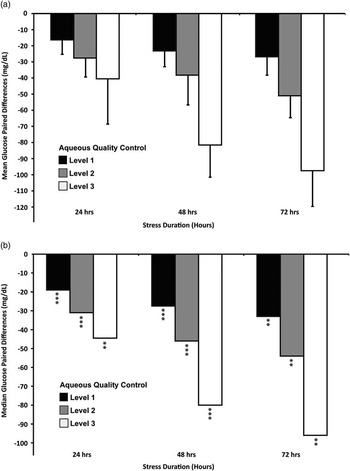
Glucose strips stored in open vials in high humidity conditions produced significantly lower results compared to strips stored in closed vials at room condition (mean 40.6 ± 12.3% RH) for each of the time points (24, 48, and 72 hours; P < 0.01). The mean glucose concentrations obtained with test strips from open vials were 34.3 ± 16.1 mg/dL (level 1), 63.3 ± 29.7 mg/dL (level 2), and 184.1 ± 90.9 mg/dL (level 3) (n = 28, at each level). Median glucose paired differences between strips in open vials and closed vials were −26 mg/dL for level 1, −37.5 mg/dL for level 2, and −72 mg/dL for level 3 (Figure 4). Twelve strips from open vials failed to produce results.
Effects of High Humidity on the Performance of Glucose Test Strips in Open Vials. A, mean glucose paired differences. B, median glucose paired differences between stressed and unstressed glucose test strips from both experimental trials. Paired differences were plotted against stress duration for glucose test concentration. Mean glucose concentration of the aqueous quality control solutions were 62.2 ± 3.0 mg/dL, 110.6 ± 4.2 mg/dL, and 291.8 ± 12.5 mg/dL (n = 38 per level of concentration). Double asterisks indicate statistically significant results at P < .01; triple asterisks indicate P < .001.

Discussion
To our knowledge, this is the first study to evaluate the effectiveness of commercial vial- and foil-based packaging in preserving the performance of POC glucose and lactate reagent test strips in high humidity conditions. A previous study showed that dynamic temperature and humidity stress can affect the performance glucose meter systems differently. Findings showed overestimated results on 1 system and underestimated results on the other.Reference Louie, Ferguson, Sumner, Yu, Curtis and Kost 13 While the conventional vial design is widely used to encapsulate test strip reagents by several medical device manufacturers, the foil design may provide additional benefits. These benefits are ease of storage, portability, and enhanced biohazard control, as individualized strip packaging minimizes the introduction of environmental contaminants to the entire batch of test strips during use.
A glucose test strip contains a lyophilized enzyme that catalyzes a reaction with the glucose in the blood while an electrochemical reaction produces a current that is measured by the accompanying meter to obtain glucose level readings.Reference Tonyushkina and Nichols 14 The use of test strips in humid disaster settings leaves the strips exposed to moisture that can potentially reanimate the enzymes before they are dosed with blood.Reference Tonyushkina and Nichols 14 , Reference Fleming 15 This situation may reduce stability of the reagents and hinder enzymatic reactions, producing reagent test failures or erroneous measurements.Reference Tonyushkina and Nichols 14 , Reference Fleming 15 As reported in the open-vial experiment, test strips exposed to high humidity (97% RH) reported significantly lower results. Therefore, a moisture barrier is essential to the preservation of test strips.
Test strip vials are constructed of molten plastic injected into 2 molds that create the body and cap (Figure 1A).Reference Abrams and Garren 16 Robotics interlock both parts together before the plastic material cools, allowing the body and cap to conform with each other and producing the desired hermetic seal.Reference Abrams and Garren 16 Although this design provides an airtight and water-resistant closure, the test strips are vulnerable to moisture once the vials are opened. A desiccant made of mixed polymer and channeling agents layers the inside of the vial to absorb the entering moisture and keep the strips dry. 17 Our experimental results showed that the construct of vials was effective in protecting glucose test strips from humidity stress effects. Compared to closed vials, test strips in open vials produced significantly lower results, with 12 strip failures.
Adhering to good laboratory practice by capping test strip vials immediately after each use preserves strip stability, shelf-life, and performance. Clinical Laboratory Standards Institute guideline POCT 12-A3 recommends that unused POC test supplies (eg, test strips) taken to a patient's bedside during finger-stick monitoring should not be used for another patient because of possible inadvertent contamination. 18 The foil packaging (Figure 1B) compartmentalizes and isolates each test strip and provides the potential advantage for limiting environmental exposure to moisture, contaminants, and biohazards. In addition, as the strips are individually wrapped rather than stored in 1 vial, contamination from usage with other patients is minimized. While the foil packaging is also made of a moisture impermeable material,Reference Eikmeier, Sacherer and Schreiber 19 we found 7 foil-sealed strip failures in comparison to 3 vial-packaged strip failures. Strip failures may be attributed to defective packaging or the packaging process. Impaired foil packages may allow the test strips to become vulnerable to the surrounding conditions, causing destabilization of on-board reagents.Reference Fleming 15 , Reference Bamberg, Schulman, MacKenzie, Moore and Olchesky 20 – Reference Haller, Shuster, Schatz and Melker 22
In spite of test strip failures, our experimental data showed that both foil and vial packaging designs adequately protected test strips for at least 1 week of simulated high humidity. POC glucose meters and strips are essential for patient care in disasters in which conditions can be extreme (eg, high and low temperature and high humidity). Therefore, safeguarding POC instruments and reagents represents an essential part of the planning and execution of emergency response.
Conclusions and Recommendations
Both vial and foil packaging provided glucose and lactate strips with adequate protection against at least 1 week of high humidity stress (97% RH) when packaging remained unopened in the case of foil packaging or the vial was closed immediately after the removal of a test strip. Humidity stresses on both packaging designs for both glucose and lactate test strips produced varied and inconsistent results. In spite of statistically significant results, the differences did not appear to be clinically significant. However, the observation of 3 vial-packaged and 7 foil-sealed strip failures is concerning and may reflect a need for improved packaging design or better manufacturing methods.
Improvements in test reagent packaging will help prepare and assure the protection of POC reagents and quality of test results used in treatment decisions, enabling patient management in whatever environmental conditions patient care is performed, including complex emergencies and disasters. To that end, we recommend the following:
-
• Health care providers and POC device operators should be aware of device vulnerability, especially in the environment in which the device will be deployed to and operated.
-
• Health professionals should incorporate temperature and humidity monitoring procedures for POC test reagents and instruments in storage or in use.
-
• Industry should enhance current packaging designs to protect not only against humidity but also thermal stress.
Funding and Support
This research was supported by a grant from the National Institute of Biomedical Imaging and Bioengineering, National Institutes of Health (U54EB007959; Dr Kost). Nova Biomedical donated reagents and instruments for the project. Tables and figures were provided with courtesy and permission of Knowledge Optimization®.
Disclaimer
The content of this manuscript is solely the responsibility of the authors and does not necessarily represent the official views of the National Institute of Biomedical Imaging and Bioengineering or the National Institutes of Health.