I. INTRODUCTION
Thermal behavior studies of cyclotriphosphates associated with barium alone and with ammonium and thallium, Ba3(P3O9)2·nH2O (n = 6 and 4) (Averbuch-Pouchot and Durif, Reference Averbuch-Pouchot and Durif1986; Belaaouad et al., Reference Belaaouad, Lahrir, Sarhane and Tridane2009) and BaM IP3O9·2H2O (M I = NH4 and Tl) (Belaaouad et al., Reference Belaaouad, Sbai, Kenz and Pierrot2000; Belaaouad, Reference Belaaouad2002) reported a new form of cyclotriphosphate BaTlP3O9. This study reports the chemical preparation and the XRD data for four cyclotriphosphates associated with barium alone and with ammonium and thallium, Ba3(P3O9)2·4H2O (Averbuch-Pouchot and Durif, Reference Averbuch-Pouchot and Durif1986), BaNH4P3O9·2H2O (Belaaouad et al., Reference Belaaouad, Sbai, Kenz and Pierrot2000; Belaaouad et al., Reference Belaaouad, Sbai, Kenz and Pierrot2001; Belaaouad, Reference Belaaouad2002), BaTlP3O9·2H2O (Sbai and Belaaouad, Reference Sbai and Belaaouad2003), and BaTlP3O9 (Sbai and Belaaouad, Reference Sbai and Belaaouad2003). The thermal behavior of Ba3(P3O9)2·nH2O (n = 6 and 4) (Averbuch-Pouchot and Durif, Reference Averbuch-Pouchot and Durif1986; Belaaouad et al., Reference Belaaouad, Lahrir, Sarhane and Tridane2009) was studied in our laboratory. BaNH4P3O9·2H2O and BaTlP3O9·2H2O are isostructural. The crystal structure of BaTlP3O9 has not been previously reported in the literature. The four condensed phosphates are stable in normal conditions of temperature and hygrometry.
II. EXPERIMENTAL
A. Synthesis
1. Ba3 (P3O9)2·4H2O
Chemical preparation of pure Ba3(P3O9)2·4H2O is difficult to optimize. Large crystals of cyclotriphosphate tetrahydrate of barium, Ba3(P3O9)2·4H2O, were prepared by mixing 30 g of BaCl2·2H2O and 6 g of Na3P3O9 (Ba/Na = 2) in 50 ml of water without stirring for 5 h, as shown in the following chemical reaction:

Ba3(P3O9)2·4H2O is stable until its melting point at 870 °C.
2. BaNH4P3O9·2H2O
Single crystals of BaNH4P3O9·2H2O were prepared by slowly adding dilute cyclotriphosphoric acid, H3P3O9, to an aqueous solution of barium carbonate, BaCO3, and ammonium carbonate, (NH4)2CO3, with a stoichiometric ratio Ba/NH4 = 1, according to the following chemical reaction:

The solution was then slowly evaporated at room temperature until large rectangular prisms of BaNH4P3O9·2H2O were obtained. The cyclotriphosphoric acid, H3P3O9, used in this reaction was prepared from an aqueous solution of Na3P3O9 passed through an ion-exchange resin “Amberlite IR 120” (Jouini and Durif, Reference Jouini and Durif1983). Na3P3O9 was obtained by thermal treatment of sodium dihydrogenomonophosphate, at 530 °C for 5 h in air, according to the following chemical reaction:

The weight loss, as a result of slowly heating up to a temperature of 200 °C, confirmed the compound to be dihydrate. BaNH4P3O9·2H2O is stable in air for many months under normal conditions of temperature and humidity.
3. BaTlP3O9·2H2O
Single crystals of BaTlP3O9·2H2O were prepared by slowly adding dilute cyclotriphosphoric acid, H3P3O9, to an aqueous solution of barium carbonate, BaCO3, and thallium carbonate, Tl2CO3, with a stoichiometric ratio Ba/Tl = 1, according to the following chemical reaction:

The solution was then slowly evaporated at room temperature until single crystals of BaTlP3O9·2H2O were obtained. The cyclotriphosphoric acid, H3P3O9, used in this reaction was prepared by the same process as described for the preparation of BaNH4P3O9·2H2O.
The weight loss, as a result of slowly heating up to a temperature of 250 °C, confirmed the compound to be dihydrate. BaTlP3O9·2H2O is stable in air for many months under normal conditions of temperature and humidity.
4. BaTlP3O9
Polycrystalline samples of BaTlP3O9 were prepared by total dehydration of BaTlP3O9·2H2O under atmospheric pressure between 300 and 500 °C according to the following chemical reaction:

BaTlP3O9 was found to be stable with further increase in temperature and melted at 560 °C.
B. Data collection and reduction
Powder diffraction patterns for the four compounds were collected with a SIEMENS D 5000 diffractometer using Cu Kα 1 radiation (λ = 1.5406 Å). The experimental 2θ range was 10–70° with a step size of 0.01° and a counting time of 30 s per step.
The program of graphic tool for powder diffraction named WinPLOTR (Version 2010) was used to determine the observed diffraction peak positions for the four compounds.
The unit-cell parameters and the figures of merit, M and F, were calculated using the computer program TREOR (Louër and Louër, Reference Louër and Louër1972; Louër and Vargas, Reference Louër and Vargas1982).
III. RESULTS
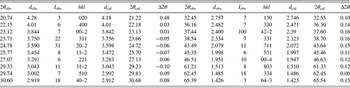
Ba3(P3O9)2·4H2O is monoclinic, space group C2/m, Z = 2, with a = 16.090(1), b = 8.368(5), c = 7.717(3) Å, β = 95.380(5)°, V = 1034.6(3) Å3, M(20) = 10, and F(20) = 6(0.009 337, 280). The powder diffraction pattern of Ba3(P3O9)2·4H2O is plotted in Figure 1(a), and the powder diffraction data for the compound are reported in Table I.
X-ray powder diffraction patterns for four cyclotriphosphates: (a) Ba3(P3O9)2·4H2O, (b) BaNH4P3O9·2H2O, (c) BaTlP3O9·2H2O, and (d) BaTlP3O9.

Powder diffraction data of Ba3(P3O9)2·4H2O.

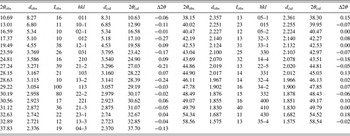
BaNH4P3O9·2H2O is monoclinic, space group P21/n, Z = 4, with a = 7.547(1), b = 12.065(1), c = 11.697(1) Å, β = 101.111(1)°, V = 1045.1(3) Å3, M(20) = 9 (AV.EPS = 0.000 116 9), and F(20) = 14(0.028 706, 53). The powder diffraction pattern of BaNH4P3O9·2H2O is plotted in Figure 1(b), and the powder diffraction data for the compound are reported in Table II.
Powder diffraction data of BaNH4P3O9·2H2O.

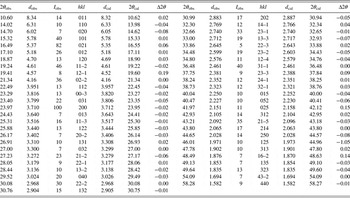
BaTlP3O9·2H2O is monoclinic, space group P21/n, Z = 4, with a = 7.546(3), b = 12.105(4), c = 11.649(4) Å, β = 100.340(3)°, V = 1046.8(2) Å3, M(20) = 81, and F(20) = 117(0.003 419, 50). BaNH4P3O9·2H2O and BaTlP3O9·2H2O are isostructural. The powder diffraction pattern of BaTlP3O9·2H2O is plotted in Figure 1(c), and the powder diffraction data for the compound are reported in Table III.
Powder diffraction data of BaTlP3O9·2H2O.

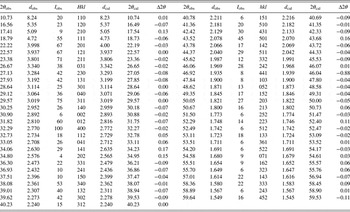
BaTlP3O9 is orthorhombic, space group P212121, Z = 4, with a = 11.086(2), b = 12.283(2), c = 5.786(1) Å, V = 787.9(4) Å3, M(20) = 10(AV.EPS = 0.000 116 9), and F (20) = 14(0.026 955, 56). The powder diffraction pattern of BaTlP3O9 is plotted in Figure 1(d), and the powder diffraction data for the compound are reported in Table IV.
Powder diffraction data of BaTlP3O9.