Implications
Grazed grass is the cheapest feed available. Increasing its proportion in the diet of dairy cow will ensure lower costs of production, which is essential, given the current milk price volatility. Two major limitations to increasing the quantity of grazed grass in the diet are soil conditions and inclement weather. This study has shown that by restricting dairy cow's access to pasture, during periods of inclement weather, high levels of grass utilisation can be achieved, and that there is no reduction in milk production performance or dry matter intake.
Introduction
Soil conditions and inclement weather are two of the biggest limitations affecting the extension of the grazing season on Irish dairy farms (Creighton et al., Reference Creighton, Kennedy, Shalloo, Boland and O’ Donovan2011). Over 50% of soils in the Republic of Ireland are classified as Podzols, Gleysols or Histosols (Gardiner and Radford, Reference Gardiner and Radford1980). These soils are slow draining and practically impervious, thereby preventing full-time turnout to pasture in early spring and late autumn, owing to a high risk of poaching damage. In the last few years, rainfall levels have been above the 50-year average (www.met.ie). Very high levels of rainfall over an extended period, even on more favourable soil types, have reduced the number of grazing days that can be achieved, limiting the proportion of grazed grass, the cheapest feed available (Shalloo et al., Reference Shalloo, Dillon, O'Loughlin, Rath and Wallace2004), which can be included in the grazing ruminants’ diet.
Traditionally, during periods of adverse weather, dairy cows are either maintained indoors on a full-time basis, offered a grass silage-based diet, or are turned out to pasture by day and housed by night and offered grass silage. The objective of these practices is to minimise or eliminate poaching damage. Nevertheless, there is abundant evidence that supplementation with grass silage has negative effects on milk protein concentration (Phillips and Leaver, Reference Phillips and Leaver1985) and that the milk yield response can range from −0.75 to +1.1 kg milk/kg forage supplement DM depending on the availability of pasture (Phillips, Reference Phillips1988). Allocating animals’ limited access to pasture for a few hours per day has previously been shown to increase milk production and milk protein concentration when compared with cows housed on a full-time basis (Dillon et al., Reference Dillon, Crosse, O'Brien and Mayes2002). Restricting access to pasture, as a grazing management tool, has previously been shown to have variable effects on milk production and composition; some studies have found no effect (Kennedy et al., Reference Kennedy, McEvoy, Murphy and O'Donovan2009), whereas others have found that restricting access time to pasture reduces milk yield and composition (Kristensen et al., Reference Kristensen, Oudshoorn, Munksgaard and Segaard2007; Pérez-Ramírez et al., Reference Pérez-Ramírez, Delagarde and Delaby2008), but results are perhaps related to the level of restriction imposed.
Previous studies have found that under grazing conditions two main grazing bouts are normally observed in dairy cows, one in the morning and another in the evening (Rook et al., Reference Rook, Huckle and Penning1994; Linnane et al., Reference Linnane, Brereton and Giller2001). A considerable amount of time elapses each day when the dairy cow is not grazing, and during this period – when poor underfoot conditions are present – pasture damage can occur. The grazing behaviour of ruminants can, however, be manipulated, and Greenwood and Demment (Reference Greenwood and Demment1988) found that steers fasted for 36 h grazed 27% faster than unfasted steers. Pérez-Ramírez et al. (Reference Pérez-Ramírez, Delagarde and Delaby2008) reported that when pasture access was reduced from 8 h to 4 h, for maize silage-supplemented dairy cows, there were minimal effects on animal performance, owing to behavioural adaptation. Kennedy et al. (Reference Kennedy, McEvoy, Murphy and O'Donovan2009) clearly showed that restricting pasture access to two 3 h periods (6 h) resulted in mid-lactation dairy cows grazing for 96% of their time at pasture, whereas cows at pasture full time grazed for 42% of the time. In addition, cows allocated restricted access to pasture achieved 95% of the dry matter intake (DMI) of cows grazing full time, resulting in no difference in the milk production performance of mid-lactation dairy cows. However, there is limited information on the effect of restricted access to pasture on early lactation dairy cow behavioural adaptation and milk production performance; it is possible that early lactation dairy cows may not be as responsive to pasture access restrictions. Previous studies (Kennedy et al., Reference Kennedy, O'Donovan, Murphy, O'Mara and Delaby2006; McEvoy et al., Reference McEvoy, Delaby, Kennedy, Boland and O'Donovan2009) have shown that when a dairy cow's diet is restricted in early lactation (<90 DIM) milk production is reduced during the restriction period. If animals cannot adapt their grazing behaviour during periods of pasture restriction to achieve a high DMI, a higher feed allowance, through silage supplementation, may negate the effects of a low grass DMI (GDMI). However, there is a cost associated with supplementing dairy cows with grass silage.
The main objective of this study was to investigate the effect of restricting pasture access time on grazing behaviour and establish the subsequent effects on milk production and composition, body weight (BW), body condition score (BCS) and DMI of spring calving dairy cows in early lactation. A secondary objective of the study was to establish the effect of supplementing dairy cows in early lactation with grass silage when they return indoors after a limited period of access to pasture on animal production performance and grazing behaviour.
Material and methods
The study was conducted at Moorepark Research Centre, Fermoy, Co. Cork, Ireland (50°07′N; 8°16′W) from 25 February to 26 March 2008 (30 days). The soil type was an acid brown earth with a sandy loam-to-loam texture. The experimental area was a permanent grassland site containing more than 80% perennial ryegrass (Lolium perenne) and the majority of the remaining 20% comprised annual meadow grass (Poa annua). There was no clover present in the sward.
Animals and experimental design
The experiment was a randomised block design with four grazing treatments. In all, 52 Holstein–Friesian dairy cows were selected from the Moorepark spring calving herd. Of these, 20 cows were primiparous, whereas the remaining 32 were pluriparous (12 cows in their second lactation and 20 cows in their third or greater lactation). All animals were balanced on calving date (31 January, s.d. = 11.0 days): previous lactation cumulative milk yield (554, 1 s.d. = 920.6 kg; dam's first lactation milk yield (first 35 weeks) in the case of primiparous animals; 4450 (s.d. = 796.4) kg); daily milk yield of the first 10 days of the present lactation (24.5, s.d. = 4.53 kg); parity number (2.4, s.d. = 1.43); pre-experimental live weight (509; s.d. = 69.5 kg); and pre-experimental BCS (3.31, s.d. = 0.533).
Before assignment to treatment, all cows were offered ad-libitum pasture and 4 kg DM/day of concentrate.
Description of treatments and grazing management
Cows were balanced, blocked into groups of four and randomly assigned to one of the following four grazing treatments: (i) 22 h (full-time) access to pasture (22H; control); (ii) Two 4.5-h periods of access to pasture after both milkings (2 × 4.5H); (iii) Two 3-h periods of access to pasture after both milkings (2 × 3H); and (iv) Two 3-h periods of access to pasture after both milkings with silage supplementation by night (2 × 3SH).
All animals were allocated a common daily herbage allowance (DHA) and 3 kg DM/cow per day of concentrate, which was offered in two equal feeds at a.m. and p.m. milking in the milking parlour. Concentrate composition on a fresh weight basis was 50% citrus pulp and 50% maize gluten feed. No supplementary feed was offered to three treatments (22H, 2 × 4.5H and 2 × 3H) when animals were removed from pasture at different times and returned indoors. The 2 × 3SH group were offered 4 kg DM/cow of grass silage in a single feed when they returned indoors by night. The feed face was 9.2 m in length, with each cow having 0.77 m of head space for feeding, 0.31 m/cow greater than that recommended by Albright (Reference Albright1993). The grass silage was dispensed by a Keenan diet feeder (Keenan Holdings Limited, Borris, Co. Carlow, Ireland), ensuring even distribution of feed.
A new allocation of herbage was offered to all treatments after each milking. The total grazing area (23 ha) was randomised into four distinct farmlets. Each treatment grazed separately. The experiment was conducted during the first grazing rotation, and therefore all swards offered were primary pasture.
Subsequent to the 31-day period when treatments were imposed, all animals grazed as a single herd and were allocated 15 kg DM/cow per day of herbage (>4 cm) and 3 kg DM/cow per day of concentrate for a further 2-week period (carry-over period).
Sward measurements
Herbage mass determination and sampling
Paddock herbage mass (>4 cm) was determined twice weekly by harvesting two strips (1.2 m × 10 m) per treatment with an Agria machine (Etesia UK Ltd, Warwick, UK). Ten grass height measurements were recorded before and after cutting on each cut strip using an electronic plate metre (Urban and Caudal, Reference Urban and Caudal1990) with a plastic plate (30 cm × 30 cm and 4.5 kg/m2; Agrosystèmes, Choiselle, France). This allowed the calculation of mass of herbage/cm (herbage mass (DM/ha)/(pre-cutting height – post-cutting height); kg DM/cm per ha). All mown herbage from each strip was collected, weighed and sampled. A sub-sample of approximately 0.1 kg was dried for 48 h at 40°C in a drying oven for determination of DM content.
Herbage, representative of that selected by the 22H, 2 × 4.5H, 2 × 3H and 2 × 3SH treatments, was sampled weekly with a Gardena (Accu 60, Gardena International GmbH, Germany) hand shears, taking cognisance of the previous defoliation height recorded from each treatment. A sub-sample was stored at −20°C before being freeze-dried and milled before chemical analysis.
Pre- and post-grazing sward heights and herbage utilisation
The pre-grazing sward height was determined daily in each plot by recording 30 measurements across the two diagonals of the paddock, using the electronic plate metre described above. Pre-grazing values were recorded for each of the four treatments. The measured pre-grazing sward height, multiplied by the mean mass of herbage/cm, was used to calculate the DHA required. Post-grazing sward height was measured daily for each of the four individual treatments.
As this was a 30-day study, herbage utilisation was calculated by expressing mean group DMIs, measured using the n-alkane technique, as a proportion of the DHA offered.
Animal measurements
Milk production
Individual milk yields (kg) were recorded at each milking. Milk fat, protein and lactose concentrations were determined from one successive a.m. and p.m. milking sample taken weekly. The concentrations of these constituents were determined using Milkoscan 203 (Foss Electric DK-3400, Hillerød, Denmark). Solids-corrected milk yield was calculated using the equation of Tyrell and Reid (Reference Tyrell and Reid1965). All cows were weighed weekly. BW was recorded electronically using a portable weighing scale and Winweigh software package (Tru-test Limited, Auckland, New Zealand). BCS was recorded weekly during the study on a 1 to 5-point scale (1 = emaciated, 5 = extremely fat), with 0.25 increments (Lowman et al., Reference Lowman, Scott and Somerville1976), and was measured by an experienced independent observer throughout the study.
Intake estimation
Individual (GDMI, silage DMI and total DMI (TDMI)) were estimated during the third week of the experimental period using the n-alkane technique (Mayes et al., Reference Mayes, Lamb and Colgrove1986) as modified by Dillon and Stakelum (Reference Dillon and Stakelum1989). All cows were dosed twice daily, before milking, for 12 consecutive days with a paper filter (Carl Roth, GmbH and Co. KG, Karlesruhe, Germany) containing 500 mg of dotriacontane (C32). From day 7 of dosing, faecal grab samples were collected from each cow twice daily for the remaining 6 days. The faecal grab samples were then bulked (12 g of each collected sample) and dried for 48 h in a 40°C oven in preparation for chemical analysis.
In conjunction with the faecal collection, the diet of the animals was also sampled. Herbage representative of that grazed (taking cognisance of the previous defoliation height recorded from each treatment) was collected from each paddock before a.m. grazing on days 6 to 11 (inclusive) of the intake measurement period. Two samples of approximately 25 individual grass snips were taken from each paddock with a Gardena hand shears. Silage samples were collected daily from the feed face immediately after the silage was dispensed.
The n-alkane contents (C25 to C36) of the faeces, herbage, silage and concentrate were analysed using a modification of the method of Mayes et al. (Reference Mayes, Lamb and Colgrove1986), which used direct saponification (Dillon, Reference Dillon1993). The intakes of DM of grass, silage and concentrate were estimated from the concentrations of the n-alkanes (C27 to C35) in the DM of faeces, grass, silage and concentrate, and the daily dose rate of C32. A least-squares optimisation procedure was used (Microsoft Excel SOLVER); this was a modification of the ‘Eatwhat’ method of Dove and Moore (Reference Dove and Moore1995). The method minimised the sum of the squared discrepancies for each alkane between the actual faecal n-alkane concentration (corrected for incomplete recovery) and calculated faecal n-alkane concentration in DM as follows:
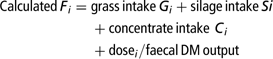
where Fi, Gi, Si and Ci were the respective concentrations of n-alkane i in the faeces, grass, silage and concentrate DM, respectively, and Dosei was the amount of n-alkane i in the daily dose. In the above equation, the intakes of DM of grass and silage, and the faecal DM output, were the unknown variables determined using the optimisation method; all other parameters were known variables. Dosei was zero for all alkanes except C32-alkane. The recovery correction factors used to adjust the actual n-alkane concentrations in the DM of faeces were those reported by Dillon (Reference Dillon1993); they were 0.618, 0.686, 0.722, 0.769, 0.777, 0.844 and 0.891 for heptacosane (C27-alkane), octacosane (C28-alkane), nonacosane (C29-alkane), triacontane (C30-alkane), hentriacosane (C31-alkane), tritriacosane (C33-alkane) and pentatriacontane (C35-alkane), respectively. The recovery factor for C32-alkane was assumed to be the same as that of C33-alkane. The intake of DM of silage by 2 × 3SH cows was estimated using the same least-squares procedure described above (Hameleers and Mayes, Reference Hameleers and Mayes1998; Dillon et al., Reference Dillon, Crosse, O'Brien and Mayes2002).
Grazing behaviour
Grazing behaviour data were collected on two separate days from 32 cows across each of the four grazing treatments during the intake measurement period. Animals were selected by randomisation block taking cognisance of lactation number. Data were collected over two 24 h periods. Following a.m. milking, eight cows from each grazing treatment were fitted with IGER (Institute of Grassland and Environmental Research) behaviour recorders (Rutter et al., Reference Rutter, Champion and Penning1997). If the data obtained from a cow was deemed unreadable following the 24 h period, the animal had a recorder fitted for a further 24 h. Fifty-six usable individual grazing behaviour recordings were obtained. Recorded jaw movements were analysed using the ‘Graze’ analysis software (Rutter, Reference Rutter2000). Total grazing, ruminating and idling times, as well as the number of bites and mastications, were measured using this software. The number of grazing and ruminating bouts, as well as the number of boli within each ruminating bout, was also counted. Eating time is the sum of grazing time and silage eating time for the 2 × 3SH. Handling time was calculated as eating time plus ruminating time; intake/min was calculated as (GDMI (kg/day) × 1000)/grazing time; and intake/bite was calculated as (GDMI (kg/day) × 1000)/number of grazing bites/day. Individual GDMI values of the cows from which grazing behaviour measurements were recorded were used to calculate intake/min and intake/bite.
Chemical analyses
The herbage samples for each treatment were freeze-dried and milled through a 1-mm sieve. Samples were analysed for DM, ash (Association of Official Analytical Chemists (AOAC), 1995; method 942.05), ADF and NDF (determined using the procedures of AOAC, 1995; method 973.18; using sodium sulphate for the NDF; ANKOM™ technology, Macedon, NY, USA), CP (Leco FP-428; Leco Australia Pty Ltd, Baulkham Hills B.C. NSW, Australia) and organic matter digestibility (OMD; using the method described by Morgan et al., Reference Morgan, Stakelum and Dwyer1989; Fibertec™ Systems, FOSS, Ballymount, Dublin 12, Ireland). The concentrate offered was analysed for DM content, nitrogen, crude fibre and ash concentrations. The silage samples were analysed using NIRS (Foss 6500 NIR; Slangerupgade, Hillerød, Denmark).
Statistical analyses
All statistical analyses were carried out using SAS (Statistical Analysis Systems Institute, 2002).
All the herbage data were analysed using the following model:

where μ = mean, Ti = treatment (i = 1 to 4); Wj = week (j = 1 to 4) and eij = residual error term.
All animal variables were analysed as 52 individual variables. Data from weeks 2 to 4 only were used in the analyses, week 1 data were excluded as this was considered an adaptation week. Daily milk yield, milk constituent yield, milk composition, BW and BCS were analysed with the following model:

where Yijk represents the response of the animal in parity i to treatment j; μ = mean; Pi = parity (i = 1 to 2); Tj = treatment (j = 1 to 4); Pi × Tj = the interaction between parity and treatment; b 1Xijk = block and eijk = residual error term. DMI and grazing behaviour were analysed using the same model as above. For comparison purposes, only two levels of parity were used, that is, primiparous animals were compared with animals that were in their second or greater lactation.
Results
Weather
Rainfall during the experimental period was 0.37 higher than the 10-year average (81 mm), whereas mean air temperature was 1°C lower than the 10-year average (7.1°C). Total grass growth was 8% less than the 10-year average (1116 kg DM/ha).
Chemical analyses
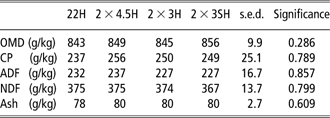
There was no significant difference in the chemical composition of the herbage offered to the four treatments (Table 1). The mean OMD was 848 g/kg, whereas the crude protein (CP), ADF, NDF and ash were 248, 231, 373 and 80 g/kg, respectively. The composition of the silage offered to the 2 × 3SH treatment was 142 (±7.2) g/kg CP, 328 (±19.2) g/kg ADF, 509 (±40.4) g/kg NDF and 75 (±6.8) g/kg ash. The chemical composition of the concentrate was CP 173 (±9.6) g/kg, NDF 287 (±9.94) g/kg, ash 82 (±1.6) g/kg and crude fibre 9.4 (±0.63) g/kg.
Chemical analysis of spring herbage offered to spring calving dairy cows allocated restricted access to pasture during a 30-day period
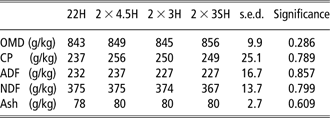
OMD = organic matter digestibility; 22H = 22 h access to pasture; 2 × 4.5H = Two 4.5 h periods of access to pasture; 2 × 3H = Two 3 h periods of access to pasture; 2 × 3SH = Two 3 h periods of access to pasture with 4 kg dry matter/cow silage supplementation.
Grazing management
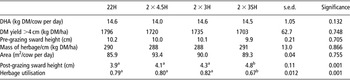
A similar DHA was allocated to each of the four treatments (14.4 kg DM/cow per day; Table 2). There was no significant difference between the four treatments in terms of pre-grazing DM yield >4 cm (1739 kg DM/ha), pre-grazing sward height (10.1 cm), mass of herbage/cm (290 kg DM/ha) and area offered per cow per day (89.7 m2/cow per day).
Effect of restricted access to pasture on sward measurements over a 30-day period

22H = 22 h access to pasture; 2 × 4.5H = Two 4.5 h periods of access to pasture; 2 × 3H = Two 3 h periods of access to pasture; 2 × 3SH = Two 3 h periods of access to pasture with 4 kg DM/cow silage supplementation; DHA = daily herbage allowance; DM = dry matter.
abValues in the same row not sharing a common superscript are significantly different.
Post-grazing sward height was higher (P < 0.001; +0.7 cm) for the 2 × 3SH treatment than all other treatments (4.1 cm). Herbage utilisation was also significantly lower (P < 0.001) for the 2 × 3SH treatment (0.67) than all other treatments (0.80).
Animal production
Milk production
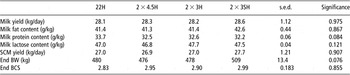
Treatment had no effect on milk yield (28.3 kg/cow per day; Table 3) or solids-corrected milk yield (27.2 kg/cow per day). Milk protein concentration tended to be lower (P = 0.08; 32.2 g/kg) for the 2 × 3SH animals when compared with the 22H animals (33.7 g/kg). There was no difference in milk protein concentration between the 22H, 2 × 4.5H and 2 × 3H (32.9 g/kg). There was no effect of treatment on milk fat or lactose concentration (41.7 and 47.3 g/kg, respectively).
Effect of restricted access to pasture on milk production over a 30-day period

22H = 22 h access to pasture; 2 × 4.5H = Two 4.5 h periods of access to pasture; 2 × 3H = Two 3 h periods of access to pasture; 2 × 3SH = Two 3 h periods of access to pasture with 4 kg dry mater/cow silage supplementation; SCM = solids-corrected milk yield; BCS = body condition score.
End BW tended to be higher (P = 0.07) for animals allocated to the 2 × 3SH treatment (+31 kg) compared with the other three treatments (478 kg). Restricting pasture access time did not affect BCS over the experimental period (2.92).
No differences were observed between treatments during the carry-over period.
DMI
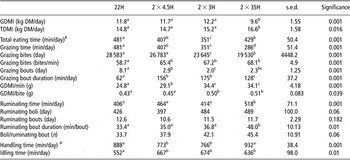
There was no significant difference between the 24H, 2 × 4.5H and 2 × 3H in terms of TDMI (14.9 kg DM/cow per day; Table 4), yet it was significantly lower (P < 0.01) than the 2 × 3SH treatment (16.6 kg DM/cow per day). The GDMI of the 2 × 3SH treatment was significantly lower (−2.3 kg DM/cow per day; P < 0.001) than all other treatments (11.9 kg DM/cow per day). The mean silage DMI for the 2 × 3SH treatment was 4 kg DM/cow per day. There was a large variation in silage DMI between animals; the SD for the individual intakes was 1.1 kg DM/cow per day, the maximum DMI was 6.0 kg DM/cow per day and the minimum was 2.7 kg DM/cow per day. However, if primiparous and multiparous animals were considered as two separate groups, there was less variation. When NDF intake was considered, the 2 × 3SH treatment animals had a higher (P < 0.001; +1.1 kg/cow per day) DMI than all other treatments (4.5 kg DM NDF/cow per day).
Effect of restricted access to pasture on DMI and grazing behaviour over a 30-day period

DMI = dry matter intake; DM = dry matter; GDMI = grass DMI; TDMI = total DMI; 22H = 22 h access to pasture; 2 × 4.5H = Two 4.5 h periods of access to pasture; 2 × 3H = Two 3 h periods of access to pasture; 2 × 3SH = Two 3 h periods of access to pasture with 4 kg DM/cow silage supplementation.
abcValues in the same row not sharing a common superscript are significantly different.
Eating time and handling time include concentrate eating time.
GDMI/min was lowest (P < 0.001) for the 22H animals (24.8 g/min). Allocating two 3-h periods of access to pasture, regardless of whether silage was allocated, significantly increased GDMI/min compared with all other treatments (34.3 g/min), and the 2 × 4.5H treatment were intermediate (29.1 g/min). The 2 × 3H and 2 × 3SH had higher GDMI/bite (+0.07 g/bite; P < 0.05) than the 22H and 2 × 4.5H (0.44 g/bite).
Grazing behaviour
Grazing time was greatest (P < 0.001; Table 4) for the cows allocated full-time access to pasture (481 min/cow per day; 8 h), followed by the 2 × 4.5H treatment cows (407 min/cow per day; 6.8 h). Although the 2 × 3H and 2 × 3SH were allocated equal amounts of time at pasture, the 2 × 3H animals grazed for a longer period of time (P < 0.001; +65 min/cow per day) than their 2 × 3SH counterparts (286 min/cow per day; 4.8 h). However, the 2 × 3SH cows spent an additional 143 min/cow per day (2.4 h) eating silage. There was no significant difference in the number of grazing bites between the 24H and the 2 × 4.5H treatments (27 683 bites/cow per day). The 2 × 3SH treatment had significantly more (P < 0.001) grazing bites than the 2 × 3H treatment (23 645 and 19 530 bites/cow per day, respectively), yet both treatments had a lesser number of bites per day than the 22H and the 2 × 4.5H.
Offering 4 kg DM/cow per day of grass silage significantly increased rumination time (P < 0.001; +90 min) compared with all other treatments (428 min; 7.1 h). Ruminating bout duration was also significantly longer (P < 0.001; +12.9 min/bout per day) for the 2 × 3SH treatment animals than all other treatments (35.1 min/bout per day). There was no significant difference between the treatments in the number of ruminating boli, ruminating bouts and the number of boli per ruminating bout (449 boli, 11.6 bouts and 39.8 boli/ruminating bout, respectively).
Idling time was significantly lower for the 24H treatment (P < 0.01; 552 min/cow per day; 9.2 h) compared with all other treatments (659 min/cow per day; 10.9 h).
Discussion
This study provides a valuable insight into the effect of restricting pasture access time of lactating dairy cows in early lactation on production performance. In addition, it presents an opportunity to understand the effect of including grass silage in the diet of lactating cows offered a pasture-based diet on a restricted access basis. Furthermore, it permits an enhanced understanding of the mechanisms that govern an animal's response to restrictions imposed with limited pasture access time.
Effect of restricted access to pasture on animal production and grazing behaviour
The lack of treatment difference in milk production between the 22H, 2 × 4.5H and 2 × 3H may be attributable to the high levels of herbage utilisation achieved (80%) and the high nutritive value of the primary spring herbage offered in this study (OMD 848 g/kg; CP 248 g/kg; NDF 373 g/kg). Pérez-Ramírez et al. (Reference Pérez-Ramírez, Delagarde and Delaby2008) observed reductions in animal production when restricted access to pasture was undertaken on a mid-summer pasture that was 770 g/kg OMD and 225 g/kg CP. The grazing conditions in which this study was undertaken are comparable to Kennedy et al. (Reference Kennedy, McEvoy, Murphy and O'Donovan2009), as both studies were conducted during the first grazing rotation when the plant was in a vegetative state and when high levels of sward utilisation were achieved, whereas the study by Pérez-Ramírez et al. (Reference Pérez-Ramírez, Delagarde and Delaby2008) was carried out later in the grazing season when the grass plant was in a reproductive growth stage.
Similar to Kennedy et al. (Reference Kennedy, McEvoy, Murphy and O'Donovan2009), who found no difference in the milk yield of mid-lactation cows, this study found no effect of restricted access to pasture on the milk yield of early lactation dairy cows (28.3 kg/cow per day). Previous studies by Pérez-Ramírez et al. (Reference Pérez-Ramírez, Delagarde and Delaby2008) and Kristensen et al. (Reference Kristensen, Oudshoorn, Munksgaard and Segaard2007) have shown a reduction in milk yield (1.1 kg/day and 2.1 kg/day, respectively) when pasture access time was restricted. These authors hypothesised that this was due to insufficient time at pasture, which resulted in reduced DMI. Pérez-Ramírez et al. (Reference Pérez-Ramírez, Delagarde and Delaby2008) found a 1.7 kg DM/cow per day reduction in TDMI (9 kg DM herbage and 7.5 kg DM supplement, offered) when pasture access time was reduced from 8 to 4 h. Similarly, Kristensen et al. (Reference Kristensen, Oudshoorn, Munksgaard and Segaard2007) reported a 1.8 kg DM/cow per day reduction in TDMI (11.5 kg DM herbage and ad-libitum supplement, offered) when pasture access time was reduced from 9 to 4 h. This study does not agree with these findings, as the animals from the 2 × 3H and 2 × 4.5H treatments had similar TDMI to the 22H treatment animals (11.9 kg DM/cow per day). The lack of differences in TDMI reported in this study are probably because of the adaptation of the cows’ grazing behaviour to their imposed treatment, because as grazing time reduced GDMI/min increased, owing to differences in GDMI/bite. It is possible that the results achieved by Pérez-Ramírez et al. (Reference Pérez-Ramírez, Peyraud and Delagarde2009) and Kristensen et al. (Reference Kristensen, Oudshoorn, Munksgaard and Segaard2007) were due to the fact that animals were given access to pasture in one continuous block rather than dividing the time into two distinct periods. Kennedy et al. (Reference Kennedy, McEvoy, Murphy and O'Donovan2009) and Pérez-Ramírez et al. (Reference Pérez-Ramírez, Peyraud and Delagarde2009) have previously shown that when access time to pasture is split into two distinct periods for cows with restricted access, there is no effect on DMI and milk production when compared with cows grazing full time.
The findings of Chilibroste et al. (Reference Chilibroste, Tamminga and Boer1997) were in agreement with this study, as the longest grazing time was recorded for animals with the greatest access to pasture (22H). It is clear from this study that allocating a greater amount of pasture access time decreases grazing efficiency or the proportion of time at pasture spent grazing. The 2 × 3H animals spent the least amount of time at pasture, yet were the most efficient grazers, grazing for 0.98 of their time at pasture. The 2 × 4.5H treatment grazed for 0.75 of their time at pasture, and offering silage by night decreased the grazing efficiency of the 2 × 3SH treatment by 0.19 compared with the 2 × 3H. Animals with full-time access to pasture (22H) only spent 0.36 of their time grazing at pasture. These results are comparable to the results achieved by Kennedy et al. (Reference Kennedy, McEvoy, Murphy and O'Donovan2009) and Pérez-Ramírez et al. (Reference Pérez-Ramírez, Peyraud and Delagarde2009). Iason et al. (Reference Iason, Mantecon, Sim, Gonzalez, Foreman, Bermudez and Elston1999) have shown that regardless of food availability, sheep with restricted pasture access grazed for almost all of the available grazing time by grazing for fewer, longer foraging bouts, but still had a much shorter total grazing time than sheep with continuous access to pasture. This trend was also observed in this study, as the 2 × 3H animals had two grazing bouts, one for each period of pasture access each lasting 2.9 h. In comparison, the 22H animals had eight grazing bouts lasting approximately 1 h, showing a more sporadic grazing pattern.
Effect of silage supplementation on animal performance
A strong association between grazing behaviour, herbage intake and milk production has previously been reported (Pulido and Leaver, Reference Pulido and Leaver2003). Supplementing animals with grass silage (0.23 of total diet) significantly decreased grazing time, when compared with animals that had identical pasture access time (2 × 3H), and hence grazing time of the 2 × 3SH was reduced by 0.19. It can be concluded that greater rumen fill, as a result of silage supplementation in this study, decreases motivation to graze. Furthermore, the rumination time of the 2 × 3SH animals was 17% longer than all other treatments (428 min). Phillips and Leaver (Reference Phillips and Leaver1985) reported that the replacement of herbage with silage led to increased rumination times, owing to an increase in fibre intake. This is confirmed in this study when the NDF intakes are considered, as the 2 × 3SH had a 0.24 higher NDF intake than the treatments that were not supplemented with silage. The similarity in rumination time between the 22H, 2 × 4.5H and 2 × 3H treatments is probably because of the postponement of ruminating activity by the animals with restricted access to pasture until they were removed from pasture. Greenwood and Demment (Reference Greenwood and Demment1988) previously showed that fasted animals compromise rumination to sustain high instantaneous intake rate.
Supplementing with silage reduced the GDMI of the 2 × 3SH animals by 2.3 kg/cow when compared with all other treatments. This resulted in a substitution rate of 0.58 kg of grass for each 1 kg of grass silage DM consumed, which is similar to that achieved by Morrison and Patterson (Reference Morrison and Patterson2007; 0.56 kg of grass/kg DM grass silage) but is almost double the substitution rate of 0.31 kg DM herbage/kg DM silage observed by Phillips (Reference Phillips1988). The difference is probably because of the high level of restriction that the animals in the studies reviewed by Phillips were under, indicating that the animals in this study were not restricted, which may be a critical factor if the cows are to adapt their grazing behaviour and attain similar intakes to cows grazing full time.
In contrast to numerous studies that have shown increased milk production from higher feed allowances (Peyraud et al., Reference Peyraud, Comeron, Wade and Lemaire1996; Kennedy et al., Reference Kennedy, O'Donovan, O'Mara, Murphy and Delaby2007), offering additional feed to the 2 × 3SH animals did not increase milk yield. Phillips (Reference Phillips1988) reported that a synergistic effect has previously been observed in many studies in which combinations of grass silage and herbage were offered. It was concluded that this was most likely due to the provision of a nutrient that was deficient in one feed (e.g. protein in silage or fibre in spring grass) but surplus in another. The spring herbage offered in this study was of extremely high quality (Table 1), and the inclusion of grass silage in the diet reduced the nutritive quality of the overall diet offered to the 2 × 3SH, thereby negating the effect of a higher feed intake. The fibrous nature of the grass silage compared with the grazed grass (509 and 373 g/kg NDF, respectively) in this study may have increased rumen fill, thereby reducing the animal's propensity to adjust their grazing behaviour to attain high levels of GDMI. This concurs with the study by Llamas-Lamas and Combs (Reference Llamas-Lamas and Combs1991), who reported that diets with higher levels of NDF result in greater rumen fill and, consequently, lower DMI.
Rego et al. (Reference Rego, Regalo, Rosa, Alves, Borba, Bessa, Cabrita and Fonseca2008) found that cows offered 20 h access to pasture had a higher milk protein concentration (+1.3 g/kg) compared with cows allocated 7 h access to pasture and 13 h ad-libitum access to grass silage (31.3 g/kg). In this study, animals allocated full-time access to pasture (22H) tended to have a higher milk protein concentration (33.7 g/kg) than the 2 × 3SH treatment animals (32.2 g/kg). Previous studies have shown that milk protein content tended to be reduced when grass silage was included in the diet (Phillips, Reference Phillips1988). This arises from either a reduction in total energy intake or the low protein content and low nitrogen retention of grass silage compared with fresh herbage. Similar to that of Phillips and Leaver (Reference Phillips and Leaver1985), total energy intake in this study was increased by supplementing cows with grass silage; however, the CP of the grass silage offered in this study was 106 g/kg lower than that of the herbage offered. Furthermore, the grass silage was higher in NDF than the grazed grass, which resulted in a higher NDF intake by the 2 × 3SH animals, resulting in a lower overall diet quality being consumed by these animals in comparison with all other treatments.
The 2 × 3SH animals tended to be heavier (+31 kg/cow) than all other treatments at the end of the experimental period, which may be due to gut fill.
Practical application
Although the length of the target grazing season in Ireland is 300 days (Kennedy et al., Reference Kennedy, McEvoy, Murphy and O'Donovan2009), Irish dairy farmers are currently achieving approximately 240 days at grass (Creighton et al., Reference Creighton, Kennedy, Shalloo, Boland and O’ Donovan2011). Dillon et al. (Reference Dillon, Roche, Shalloo and Horan2005) clearly showed that a 0.10 increase in grazed grass in the diet will significantly reduce the costs of production associated with the dairy enterprise, thereby enhancing overall profitability. The results from this study indicate that a more flexible approach such as incorporating restricted access to pasture into the grazing management programme can increase the length of the grazing season. The extra days at grass can be achieved not only by grazing during inclement weather, but also by using the technique as a strategy to turn cows out to pasture in areas where heavy soils predominate. If sufficient grass is not available, either in early spring or late autumn, restricting pasture access can also be used to incorporate a proportion of grass in the diet, as Dillon et al. (Reference Dillon, Crosse, O'Brien and Mayes2002) have shown the benefits of low proportions of grass in the diet compared with a grass silage-based diet. In contrast, if there is sufficient grass available on the farm, dairy cows should not be supplemented with grass silage when they return indoors, as no additional milk production performance is achieved.
Conclusion
The results from this study indicate that manipulating the behaviour of dairy cows by restricting pasture access between 22H and 2 × 3H has no effect on the milk or solids-corrected milk yield of high-yielding early lactation dairy cows, producing approximately 28 kg/cow per day. No benefits were achieved by feeding an additional 4 kg DM/cow per day, in the form of grass silage, when compared with all other treatments. Although supplementing with grass silage increased TDMI, it resulted in lower GDMI and tended to reduce milk protein concentration and increase post-grazing sward height when compared with cows grazing full time. The results of this study indicate that restricting the pasture access time of dairy cows to 2 × 3 h periods in early lactation does not affect milk production performance. Furthermore, cows supplemented with grass silage when they return indoors have reduced grazing efficiency.
Acknowledgements
The authors thank Mr G. Hanrahan, B. Hutchings and F. Kearney for their help with the movement of animals throughout the experiment. They also thank Mr M. Feeney, F. Flynn, J. Nash and Ms C. Fleming and N. Galvin for their technical assistance, as well as all the other members of the Moorepark farm staff for their care of the experimental animals and assistance with measurements taken during the study.