


Modern parliamentary government is at once cabinet government and party government. It is cabinet government in that the legislative agenda is set by majority party leaders negotiating in private rather than by members voting on the chamber floor. It is party government in that backbenchers generally operate as members of disciplined and programmatic organizations, not as free agents. These two aspects of parliamentary government are intimately linked (Cox Reference Cox1987a; Döring Reference Döring1995): Party discipline helps the cabinet to enact its legislative program, whereas the delegation of power to party leaders solves party members’ collective action problems and frees them from the chaos of unstructured majority rule. Both consequences help to create policy outcomes that party members prefer to what would be possible in the absence of authoritative cabinets and party discipline.
Scholars of parliamentary government largely agree that the delegation of power to individual ministers that is fundamental to parliamentary government creates a principal–agent problem in which the principals must work to ensure that their ministers (or their shadow equivalents in opposition) are behaving as faithful agents behind the closed doors of the cabinet office or the central party's headquarters.Footnote 1 However, there is considerable debate over the nature of the problem. On the one hand, some scholars advocate what we term a “leadership hypothesis,” describing the ministerial appointment process as being under the control of the party leader, making this individual the principal. Importantly, this description contradicts more conventional approaches that cast parliamentary politics as a chain of delegation that runs from voters to MPs, from MPs to party leaders, and from leaders to the civil servants who ultimately implement public policies (Strøm Reference Strøm2000). This view of parliamentary politics suggests a different formulation of the principal–agent dilemma, in which party backbenchers function as a collective principal to the ministerial agents—a thesis we label as the “party government hypothesis.”
The question of which political actors constrain ministerial appointments not only has implications for the types of policy we might expect from a government, but also has broader implications for understanding the distinctions among democratic regime types. Determining who the principal is in the ministerial appointment process is important to our understanding of parliamentary politics because the indirect election of government is often assumed to create backroom bargaining over leadership positions that transfers inordinate power to party leaders and leaves voters with little influence over the identity of individuals who control government ministries and, ultimately, public policy. If, however, these appointments reflect the collective preferences of party backbenchers, then the cabinet is more likely to mirror the demands of voters who put the party in power, mitigating the perceived trade-off between accountability and representativeness in parliamentary systems.
Adjudicating between theories of ministerial selection raises a challenging set of theoretical and methodological dilemmas. Exploring competing hypotheses of influence over cabinet formation demands that we start with a reasonable measure of the “will of the principal.” In the case of the leadership hypothesis, this problem can be addressed effectively using existing tools of spatial modeling based on estimates of the individual preferences of party leaders and ministers. In contrast, any test of the party government hypothesis under realistic assumptions about backbenchers’ preferences demands that we start with a measurement tool that accounts for the collective nature of these preferences. To solve this problem, we rely on the uncovered set (Miller Reference Miller1980; McKelvey Reference McKelvey1986; Bianco, Jeliaskov, and Sened [BJS] Reference Bianco, Jeliaskov and Sened2004; Bianco and Sened Reference Bianco and Sened2005; Miller Reference Miller2007) to define the collective policy preferences of British Labour and Conservative backbenchers over multiple policy dimensions. Our reliance on the uncovered set is a significant departure from the party-as-unitary-actor assumption that characterizes much of the literature on parliamentary government (Laver Reference Laver, Weingast and Wittman2006). By using the uncovered set, our analysis is able to cope with the more nuanced reality of party caucuses, where members disagree and where the actions of ministers cannot easily be monitored (Laver and Shepsle Reference Laver and Shepsle1994, Reference Laver and Shepsle1996; Blondel and Manning Reference Blondel and Manning2002). The use of the uncovered set allows us to derive testable hypotheses in multidimensional political environments where the median voter theorem cannot generally be used as a theoretical guide to empirical work.
Our main prediction follows immediately from this definition of the parties’ collective interests: that is, holding observable qualifications constant, legislators are more likely to be chosen for cabinet or shadow cabinet positions the closer their ideal points are to their party's uncovered set. We use data from surveys of British MPs from 1987 to 2005 to test this prediction against the alternate leadership hypothesis. Our main result is that ideal points of ministerial appointees for both the Labour and Conservative parties in the contemporary British Parliament are significantly closer to their respective parties’ uncovered sets than those of their nonministerial colleagues. By comparing ministerial selection when these parties are in government or opposition, we demonstrate that backbenchers continued to influence the selection process even when formal appointment rules favor the leader.
PARLIAMENTS, CABINETS, PARTIES, AND PARTY LEADERS
In answering the question of who gets selected to be a minister, one can look to an empirical literature that focuses on the observable correlates of ministerial selection. Work by Buck (Reference Buck1963), Rose (Reference Rose1971), King (Reference King1981), and Macdonald (Reference MacDonald1987), for example, shows that British ministers are more likely to have entered the House of Commons at an earlier age and received earlier promotion to junior posts than MPs who are never recruited to ministries. British ministers are also more likely than lifelong backbenchers to have attended Oxford or Cambridge. Other work in this empirical tradition shows that party loyalty is correlated with promotion to the front bench (Kam Reference Kam2009). These studies do a good job of identifying empirical regularities in the ministerial selection process, but fail to link these findings to the agency relationship that underlies ministerial appointments.
Principal–agent approaches to parliamentary politics are more likely to offer a theoretical framework for a model of ministerial selection. Ministers occupy a crucial position in the chain of delegation, charged with setting out the party's policies and executing its parliamentary strategy. Regardless of who is the principal—party leaders or backbenchers—the delegation of power to a set of ministers helps MPs limit their joint transaction costs (Cox and McCubbins Reference Cox and McCubbins1993), but it raises the question of how an individual or collective principal ensures that appointees remain faithful to the principal's or principals’ interests (Laver and Schofield Reference Laver and Schofield1990; Laver and Shepsle Reference Laver and Shepsle1996; Müller Reference Müller2000; Saalfeld Reference Saalfeld2000). For example, how can MPs be sure that their ministers develop policies that the party wants rather than ones that the ministers and their civil servants or party functionaries find amenable?
A classic answer to this question in principal–agent theory is that principals rely on ex ante screening mechanisms to ensure that those whom they select as agents have interests that do not clash with the principals' interests (Kiewiet and McCubbins Reference Kiewiet and McCubbins1991; Müller Reference Müller2000; Strøm Reference Strøm2000).Footnote 2 Suppose, for example, that the leadership hypothesis is correct – a sensible expectation in an era of “prime ministerial” government (Mackintosh Reference Mackintosh1962; Crossman Reference Crossman and Bagehot1963; Foley Reference Foley2000) and in light of the significant powers that British party leaders enjoy relative to their U.S. Congressional counterparts and their freedom from the constraints of coalition government.Footnote 3 We would then expect such party leaders to appoint ministers whose preferences were as close as possible to their own. By minimizing differences in preferences, the party leader ensures that his or her appointees will implement policies that are as close as possible to the leader's ideal point, even in situations where their actions are not observable or easily understood.
It is also possible, however, that ministerial appointments are controlled to some extent by party backbenchers, rendering them a collective principal. If so, backbenchers could retain control over policy outcomes by delegating ministerial power to individuals who had preferences that accorded with backbenchers’ collective preferences (Müller Reference Müller2000; Saalfeld Reference Saalfeld2000; Strøm Reference Strøm2000). However, any test of this proposition requires a way to specify the collective preferences of party backbenchers to reflect the real possibility that individual party members may hold very different preferences. Social choice theory alerts us to the fact that the aggregation of preferences is not straightforward (Arrow Reference Arrow1951; McKelvey Reference McKelvey1976), and it is, in this context, one of the main puzzles of intraparty politics (Schofield and Sened Reference Schofield and Sened2006). Absent definition of the party's collective interests in an internally consistent and logically rigorous fashion, the agency relationship between party members and their ministers is itself undefined: we simply cannot say what it is that the party backbenchers want—or assess the relative influence of party leaders and backbenchers on ministerial appointments.
Thus, the party government hypothesis not only creates a substantive challenge to the leadership hypothesis, but also raises the problem of how best to define the nature of the collective principal. A common response to this definitional problem in the U.S. Congress and comparative politics literature is to fall back on the median voter theorem to identify the ideal point of the collective political principal (see, e.g., Cox and McCubbins Reference Cox and McCubbins1993; Shugart Reference Shugart1998; Powell and Vanberg Reference Powell and Vanberg2000; Epstein and O'Halloran Reference Epstein and O'Halloran2001; McDonald and Budge Reference McDonald and Budge2005; Hix, Noury, and Roland Reference Hix, Noury and Roland2007).Footnote 4 In these analyses, a party's collective preference or interest is often equated with the ideal point of the median party member. In other words, given the agency problems at hand and a one-dimensional expression of policy preferences, party members would prefer to select as their ministers members with ideal points near the party's median. The observable implication of this logic is that the closer the member's ideal point is to the party's median on the left–right spectrum, the more likely the member is to be selected as a minister, all else being equal.
The broad indifference to multidimensionality and continued reliance on the median voter theorem to guide empirical work in comparative politics (cf, De Winter Reference De Winter, Luther and Müller-Rommel2002; Powell Reference Powell, Boix and Stokes2007) is an understandable reaction to the problematic nature of social choice equilibria in multidimensional policy spaces. Yet this analytical strategy ignores the empirical reality that in many political environments, especially those outside the United States, the policy space is multidimensional (Lipset and Rokkan Reference Lipset and Rokkan1967; Sartori Reference Sartori1976; Lijpart Reference Lijphart1999; Kam Reference Kam2001, Reference Kam2009; Hix, Noury, and Roland Reference Hix, Noury and Roland2007). As Plott (Reference Plott1967) demonstrated, the median voter theorem does not apply in multidimensional political environments save under exceptional conditions. The inability to define collective preferences in a multidimensional policy space therefore leaves political scientists without a theoretical answer to the question of which individuals backbench MPs would collectively prefer to appoint as their party's ministerial representatives. A tractable solution to this problem, which we implement in this paper, is to rely on the uncovered set to characterize the collective preferences of party backbenchers.
CHARACTERIZING COLLECTIVE PREFERENCES: THE UNCOVERED SET APPROACH
Probably the most influential and fundamental theory of legislative politics is the spatial theory of legislative behavior (Austen-Smith and Banks Reference Austen-Smith and Banks1999). As McCarty and Cutrone (Reference McCarty, Cutrone, Weingast and Wittman2006) observe, “The spatial model of policy-making has become the workhorse model in the study of legislative institutions. Its stark parsimony makes tractable the analysis of a number of institutional arrangements” (181). In what follows, we argue for taking advantage of the “stark parsimony” of spatial theory generally, and the uncovered set, in particular, to make the analysis of cabinet ministerial selection and intraparty organization as tractable as possible.
In the spatial model of legislative policymaking, the preferences of legislators and policy alternatives are represented as points in space. The extent to which a particular policy alternative is attractive to a particular legislator is a function of the distance between his or her ideal point and the policy option in this space. The usual assumption is that there is a set N of n legislators and that each legislator i ∈ N has Euclidean preferences defined by an ideal point, ρi.Footnote 5 We say that one alternative, x ∈ X, beats another possible alternative, y ∈ X, if x is closer than y to more than half of the ideal points.Footnote 6 That is, there is a majority coalition that prefers x to y and can enforce it.
A core alternative is one that is unbeaten by all other alternatives. That is, there is no majority of the legislators that can agree to replace a core point with any other alternative. When a core exists, it is the clear manifestation of majority rule. One of the fundamental results of social choice theory, however, is that a core rarely exists in multidimensional, majority voting games (McKelvey Reference McKelvey1976, Reference McKelvey1979; Schofield Reference Schofield1978; McKelvey and Schofield Reference McKelvey and Schofield1986, Reference McKelvey and Schofield1987). Although these results have led many scholars to conclude that the outcomes of majority rule in multiple policy dimensions are indeterminate, subsequent theoretical work has found that the uncovered set imposes significant constraints on majority rule outcomes even in the absence of a core (Miller Reference Miller1980; Shepsle and Weingast Reference Shepsle and Weingast1984; McKelvey Reference McKelvey1986; Cox Reference Cox1987b).Footnote 7
When the core is empty, alternatives may be divided into two sets: the covered set and the uncovered set. We say that x covers y if x beats y and if any third point z that beats x also beats y. If x covers y, then y not only is defeated by x, but also is defeated by any alternative that beats x. The uncovered set (UCS) is the set of alternatives that are not covered.
Prior work has shown that outcomes of majority rule institutions are likely to be constrained by the boundaries of the UCS. If voters consider the consequences of their behavior rather than choosing myopically between present alternatives, outcomes of majority rule choice situations will lie in the UCS (Miller Reference Miller1980; McKelvey Reference McKelvey1986; Miller, Grofman, and Feld Reference Miller, Grofman and Feld1989). Furthermore, for any status quo point, there exists a two-step agenda that yields a point in the uncovered set as its final outcome (Shepsle and Weingast Reference Shepsle and Weingast1984). Thus, voters can only secure outcomes within the uncovered set (Cox Reference Cox1987b). Other results (Banks Reference Banks1985) show that strategic voting and sophisticated agenda control generating a fixed and known agenda necessarily lead to outcomes in the UCS. At times this result has been turned into the claim that strategic voting is a necessary condition for any application of the UCS. That is not so. McKelvey (Reference McKelvey1986) shows how a variety of processes can lead to outcomes in the UCS, including cooperative coalition formation of the sort that leads to the core when it exists. The latter intuition requires neither sophisticated voting nor sophisticated manipulation of a fixed and known agenda. “Because of its apparent institution-free properties, the uncovered set provides a useful generalization of the core when a core does not exist” (McKelvey Reference McKelvey1986: 283). In making this statement, McKelvey was not asserting that institutions do not matter, but rather that the UCS stands as a general solution to majority rule processes in multidimensional spaces just as the median voter theorem stands as the general solution to majority rule processes in one-dimensional policy spaces. It is on the basis of this observation and the theoretical work that underlies it that we justify our use of the uncovered set to predict ministerial selection in the contemporary British Parliament.Footnote 8
FROM THEORY TO HYPOTHESES
As we have framed the problem, ministers are agents who cannot commit to enact or uphold policies other than those that accord with their own preferences. In the party government hypothesis, party rank and file members, the party's collective principal, therefore prefer to select ministers whose preferences accord with those of backbenchers. Following on our discussion above, and given the multidimensional nature of politics in many comparative legislative settings, we adopt the uncovered set of a party's backbenchers’ ideal points as the theoretically appropriate measure of the party's collective preference. In adopting the uncovered set of a party's backbenchers’ ideal points—what we call the party UCS—as a measure of the party's collective preference, we are not assuming that parties follow a specific voting procedure to select their ministers. Instead, we employ the party UCS as many previous analyses have employed the median voter theorem to argue that whatever process of consultation, compromise, or voting is followed by party members to select ministers, it should yield uncovered outcomes—ministers whose ideal points are in the uncovered set, or, at the margin of other factors, are closer to the uncovered set than those of colleagues who are not ministers. This argument flows out of the theoretical results that show that the UCS applies under a wide variety of conditions and it reflects the idea that backbenchers’ preferences are the ultimate constraint on the delegation of power within a parliamentary party. Formally, we specify our party government hypothesis as follows:
Hypothesis 1 (Party Government). Controlling for other factors, MPs are more likely to be chosen as ministers the closer their ideal points are to the party uncovered set.
This hypothesis acknowledges that other factors like experience and educational background influence the selection of one MP over another for a ministerial position. However, insofar as preferences matter—and they should, given the selection and agency problems discussed earlier—if backbenchers have influence over the appointment process, the probability of appointment should be influenced by the distance between an MP's ideal point and their party's uncovered set. Similarly, we specify our hypothesis about the influence of party leaders on ministerial selection as follows:
Hypothesis 2 (Party Leadership). Controlling for other factors, MPs are more likely to be chosen as ministers the closer their ideal points are to the party leader's ideal point.
These two hypotheses embody very different descriptions of the relationship between MPs, party leaders, and their ministers. In Hypothesis 1 leaders and ministers are ultimately agents of their backbenchers. In Hypothesis 2 the party leader is a principal with real power over his or her ministerial and backbench agents. That said, the multidimensional nature of the policy space implies that the two hypotheses do not stand in logical opposition to one another. It is possible, for example, that ministers are recruited from a section of the policy space that is close to both the party's UCS and the leader's ideal point. It is also possible that both mechanisms operate in the contemporary British parliament—that a minister's probability of appointment depends both on the compatibility of his or her preferences with those of the party leader, and with those of backbencher colleagues.
We use the phrase “close to” in both hypotheses in consideration of real-world constraints on the testing of political science hypotheses. First, ministers are “lumpy goods” in that party members and leaders must take their ministers’ preferences as they find them and cannot alter or amend their ministers’ preferences as they might do with a policy proposal. Second, the supply of ministers is finite and limited by criteria of suitability, e.g., a certain degree of political and parliamentary experience, a record of loyalty, educational achievement. This is especially so in parliamentary systems that dictate that ministers be drawn only from the parliament's current membership. Third, even the most suitable ministerial candidate cannot be compelled to accept a ministerial post and may decline for a variety of personal and political reasons.
MINISTERIAL SELECTION IN THE BRITISH CONSERVATIVE AND LABOUR PARTIES
We test our hypotheses on the ministerial selections of the Conservative and Labour parliamentary parties in the contemporary British Parliament between 1987 and 2005. This research design affords us the capacity to extend our empirical test to consider the effect of different institutional arrangements on the relative power of party leaders and backbenchers because the two main British parties have quite different ministerial selection rules and because the Labour party employs different appointment rules depending on whether it is in power or in opposition.
The rules that govern ministerial selection in the British Conservative Party are straightforward in a way that is typical of an internally created cadre party (Duverger Reference Duverger1964): Conservative leaders have unilateral authority to name their ministers. Conservative leaders have traditionally made their ministerial appointments after consulting with their party whips and senior party figures, such as the chair of the 1922 committee (the intraparty body that represents Conservative backbenchers)—but these consultations do not impose formal constraints on the leader's ministerial choices.
In contrast, the rules that govern ministerial selection in the British Labour Party reflect its origins as an externally created mass party (Duverger Reference Duverger1964) in which intraparty structures are designed to keep the party leadership responsive and answerable to the party membership. This end is achieved by removing from the Labour leader's hands the power to select shadow cabinet ministers when the party is in opposition. Shadow cabinet positions are instead filled by a formal and annual approval ballot of the Parliamentary Labour Party (Budge et al. Reference Budge, Crewe, McKay and Newton2001, 371).Footnote 9 This constraint disappears when the Labour Party assumes power because in strict constitutional terms the Crown appoints cabinet ministers on the advice of the prime minister. Thus, Labour prime ministers are free to nominate cabinet members independent of the Parliamentary Labour Party.
The conceptual and empirical variance on ministerial selection rules in the two British parties furnishes us with “easy” and “hard” tests for each hypothesis. It would not be a surprise if the party government hypothesis (Hypothesis 1) held in the case of appointments to the Labour Party's opposition shadow cabinet. However, if Labour backbenchers exhibited considerable control over ministerial appointments when the party was in government, then we would have greater confidence in the explanatory power of the party government hypothesis. Similarly, a finding of Conservative backbencher influence over ministerial appointments would also bolster the party government hypothesis. Conversely, if the party leader hypothesis (Hypothesis 2) has any merit whatsoever, it should explain ministerial appointments in the Conservative party, where the leader putatively controls the selection process. Likewise, if the data were to show that even in opposition, Labour party leaders were able to choose shadow cabinet ministers with preferences similar to their own and independent of the ministers’ proximity to the party UCS, we would have to abandon the party government hypothesis.
DATA AND METHODS
We test our hypotheses with a logistic regression model of cabinet and shadow ministerial appointments. The model controls for a variety of characteristics that previous research has found to be correlated with ministerial status, e.g., age, political experience, and party loyalty. These control variables provide a baseline model of ministerial selection. We then add variables that measure the distances between MPs’ ideal points and (i) their party's UCS and (ii) their party's leader's ideal point to determine whether these distance variables explain additional variance in appointments. In effect, we are asking, “Once one takes account of the variables that are usually thought to influence ministerial appointments, does the MP's proximity to the party's uncovered set or leader matter?”
Our dependent variable is a dichotomous measure that indicates whether or not an MP was initially appointed to a newly formed Cabinet (if the MP's party was in government) or the Shadow Cabinet (if the MP's party was in opposition). All MPs who were named to the Cabinet or Shadow Cabinet immediately after a general election or a change in their party's leadership were given a score of one, and remaining MPs, including those who were later appointed to the Cabinet or Shadow Cabinet at midterm reshuffles, scores of zero.Footnote 10
Ideal Points and Policy Distances
Tests of our predictions hinge on obtaining good estimates of British MPs’ ideal points. Vote-based methods of estimating ideal points (e.g., NOMINATE and optimal classification) often generate misleading estimates for the British Parliament because of relatively high levels of strategic voting (Spirling and McLean Reference Spirling and McLean2007). In addition, the observance of collective responsibility by British ministers means that vote-based ideal-point estimators may yield poor estimates of ideological differences among ministers. Consequently, we follow Kam (Reference Kam2001, Reference Kam2009) and use data from surveys of candidates in the 1992, 1997, and 2001 British elections (Norris and Lovenduski Reference Norris and Lovenduski1992, Reference Norris and Lovenduski1997, Reference Norris and Lovenduski2001) to develop estimates of MPs’ ideal points.Footnote 11 In as much as these survey measures are independent of specific proposals, they are more likely to yield unbiased estimates of legislators’ underlying (i.e., sincere) policy preferences.Footnote 12 We recount the methodology in detail in the Appendix, but in brief the procedure entailed three steps. First, the responses of all major party candidates to policy questions were analyzed via principal components to reveal two policy dimensions, one centered on left–right economic issues, the other on constitutional issues related to the devolution of power from Westminster.Footnote 13 Second, items that loaded heavily on a given dimension were scaled to range between zero and one from left to right and then added together to form a scale for that policy dimension. To ease interpretation, the scales were normalized to fall between 0 and 1 on the left–right and pro–anti-devolution dimensions. Thus left-wing MPs who favored the devolution of power from Westminster to the European Union and to Scotland and Wales received low scores on both dimensions. Conversely, right-wing MPs who preferred that political power remain concentrated at Westminster received high scores on both dimensions. Finally, missing data were handled via a two-step process. First, if a respondent answered one of the surveys but not the other, we simply copied the respondent's answers. This is tantamount to assuming that respondents' preferences remained constant over time. Second, we used a multiple imputation strategy to estimate the scores of MPs who failed to respond to the candidate surveys. The level of nonresponse and hence our reliance on multiple imputation varied by Parliament.Footnote 14
Calculating the Party Uncovered Sets
With the ideal points of all MPs in hand, we can estimate the uncovered set using the algorithm devised by BJS (2004).Footnote 15 Once the party UCS is located in the policy space, Euclidean distances from the MP's ideal point to the party UCS can be calculated. Previous work (BJS 2004) has shown that uncovered sets are rarely single points and more often sets of points. Accordingly, we implement the technique used in analyses of party influence in the U. S. House (Bianco and Sened Reference Bianco and Sened2005) and measure the distance between an MP and the chamber's and party's uncovered sets in terms of the average Euclidean distance between the MP's ideal point and every point in each uncovered set. To show that our results are robust to this measurement decision, we also measure the Euclidean distance between the MP's ideal point and the centroid (i.e., the dimension-by-dimension mean) of the party UCS.
We also compute the uncovered set of the entire House of Commons membership and measure the MP's distance to the House of Commons uncovered set. This variable serves as a control for the MP's position in the wider political space, and thus identifies the MP as moderate or extremist in the chamber at large. This is not a piece of information that can be inferred from the MP's distance to her party's UCS, and to distinguish between moderates and extremists we include MPs’ distances from the Commons UCS in the model.
Leaders’ Policy Positions
We rely on two methods to identify party leaders’ ideal points. The ideal points of party leaders who answered the survey are estimated directly from their survey responses, as was done for MPs who answered the survey. The ideal points of nonresponding leaders are extrapolated from MPs’ placements of their own parties leaders on a standard left–right scale and a pro–anti-Europe scale.Footnote 16 The translation from these placement scales to the policy dimensions on which MPs’ ideal points are located is not direct: a “7” on the ten-point left–right placement scale does not equal 0.7 on our 0–1 left–right policy dimension, for example. However, we can map leaders’ positions on these left–right and pro–anti-Europe placement scales onto the ideal point space by using a technique similar to the one outlined by McKelvey and Aldrich (Reference McKelvey and Aldrich1977). The procedure (detailed in the Appendix) takes advantage of the fact that MPs placed themselves alongside their own party leaders on these same placement scales. A party leader's mean position on the placement scale then serves as the fixed point across all of a party's MPs that identifies the linear mapping from MPs’ placements on these left–right and pro–anti-European Integration scales to the MPs’ ideal points. With this mapping in hand, one can translate leaders’ positions on the two placement scales into an ideal point in the two-dimensional policy space in which we locate MPs.Footnote 17 The Euclidean distances between MPs and their respective party leaders can then be computed directly.
Standard Ministerial Selection Variables
We add the distance variables described above to a baseline model of ministerial selection. Our baseline model is composed of seven variables:
1. First Term Promotion: A dummy variable indicates whether the MP received a promotion in their first parliamentary term (1) or not (0). Previous work (Kam Reference Hix, Noury and Roland2009) shows that this variable is one of the strongest predictors of how far up the parliamentary career ladder an MP is likely to climb.
2. Age: MPs who enter the House later in life have a much lower probability of obtaining a ministerial office at some point in their career (Buck Reference Buck1963; King Reference King1981). We account for this fact by including in the model the MP's age (in years) at the beginning of each term.
3. Experience: Few MPs arrive in the House and proceed directly to ministry or shadow ministry; at least one term of experience is virtually a necessity (Kam Reference Hix, Noury and Roland2009). Over time, however, experience begins to limit rather than improve an MP's chance of promotion. To capture these effects, our model includes the number of years the MP has served in the House of Commons and its square.
4. Oxbridge: A dummy variable denotes the MP as having received an undergraduate or postgraduate degree from Oxford or Cambridge (1) or not (0).
5. Sex: Whether one believes that British politics is an old boys’ network that is hard for women to penetrate or that representational demands force British parties to take steps to recruit and promote women, it is important to control for the MP's sex (male = 1; female = 0).
6. Government: The penultimate variable in the baseline model is the government (1) or opposition (0) status of the MP's party. This controls for any relative differences in advancement opportunities in governing or opposition parties. This variable also controls for majority–minority status in the chamber. (The Conservatives were in government from 1987 to 1997; Labour from 1997 to 2005.)
7. Dissenting Votes: Finally, we include the number of roll-call votes that the MP cast against his or her party in the previous parliamentary term. A history of rebellion against one's party is an obvious barrier to promotion (Kam Reference Hix, Noury and Roland2009).
Table A4 in the Appendix provides descriptive statistics for all variables in the model.
RESULTS
Our statistical results appear in Table 1. Our strategy is to estimate the model using only the baseline variables on the right-hand side, and then to implement several models with different combinations of variables and different subsets of our data to assess the sensitivity of our results. Nine specifications appear in the table. The first specification is our baseline model of ministerial selection based on the seven control variables described above. All seven variables are statistically significant and operate as expected. An early promotion, for example, triples the odds of an MP being appointed to the cabinet or shadow cabinet (e 1.124 = 3.08). Parliamentary experience also improves an MP's odds of being appointed, though, as expected, the effect of experience is nonlinear, with the MP's probability of appointment peaking after 23 years in the House and declining thereafter.
Logit Models of Cabinet and Shadow Cabinet Appointments in the Contemporary British Parliament

Note: Cell entries are logistic regression coefficients with standard errors in parentheses.
***p < .01, ** p < .05, * p < .10.
The second specification in Table 1 shows the relationship between cabinet appointment and the MP's proximity to their party's UCS and leader conditional on their distance from the Commons UCS and a set of parliamentary term dummies. The coefficients on both the MP's distance to the party UCS and the party leader are both negative, but only the former is statistically significant at conventional one-tailed levels.Footnote 18 Column (3) shows the same specification on observed (i.e., nonimputed cases). The coefficient for the MP's distance to the party UCS increases in magnitude (from −4.083 to −5.588) and is again statistically significant, whereas the MP's distance to the party leader remains statistically insignificant. Thus, our initial results indicate that an MP's probability of being appointed to the cabinet or shadow cabinet is a function of the MP's proximity to the party UCS rather than to their party leader: the closer the MP is to the party's UCS, the higher the MP's probability of being appointed a cabinet or shadow cabinet minister. That these relationships hold for Specification 3 tells us that these effects are not artifacts of our multiple imputation efforts.
The question is whether these effects survive the inclusion of the control variables shown in Specification 1. The fourth specification in Table 1 addresses this question. The MP's average distance to the party's UCS continues to exert a statistically significant effect on the probability of an initial ministerial appointment after being added to the baseline model of cabinet appointment. The substantive impact of the MP's average distance from the party UCS on the likelihood of appointment is best illustrated by considering the difference in the appointment probabilities of MPs who are “close to” and “far from” the party uncovered set. The closest 10% of MPs are an average of .025 units from their party's uncovered sets; the farthest 10% of MPs are an average of .175 units from their party's uncovered sets. Based on the parameters in column (4) and holding all else constant, the close MPs have a 16% chance of being appointed as ministers compared to a 9.5% chance for far MPs.Footnote 19 In effect, proximity to the party UCS increases the odds of an MP being selected for the cabinet or the shadow cabinet by a factor of 1.7. In contrast, the MP's distance to the party leader has no statistically significant impact on the probability of ministerial appointment.
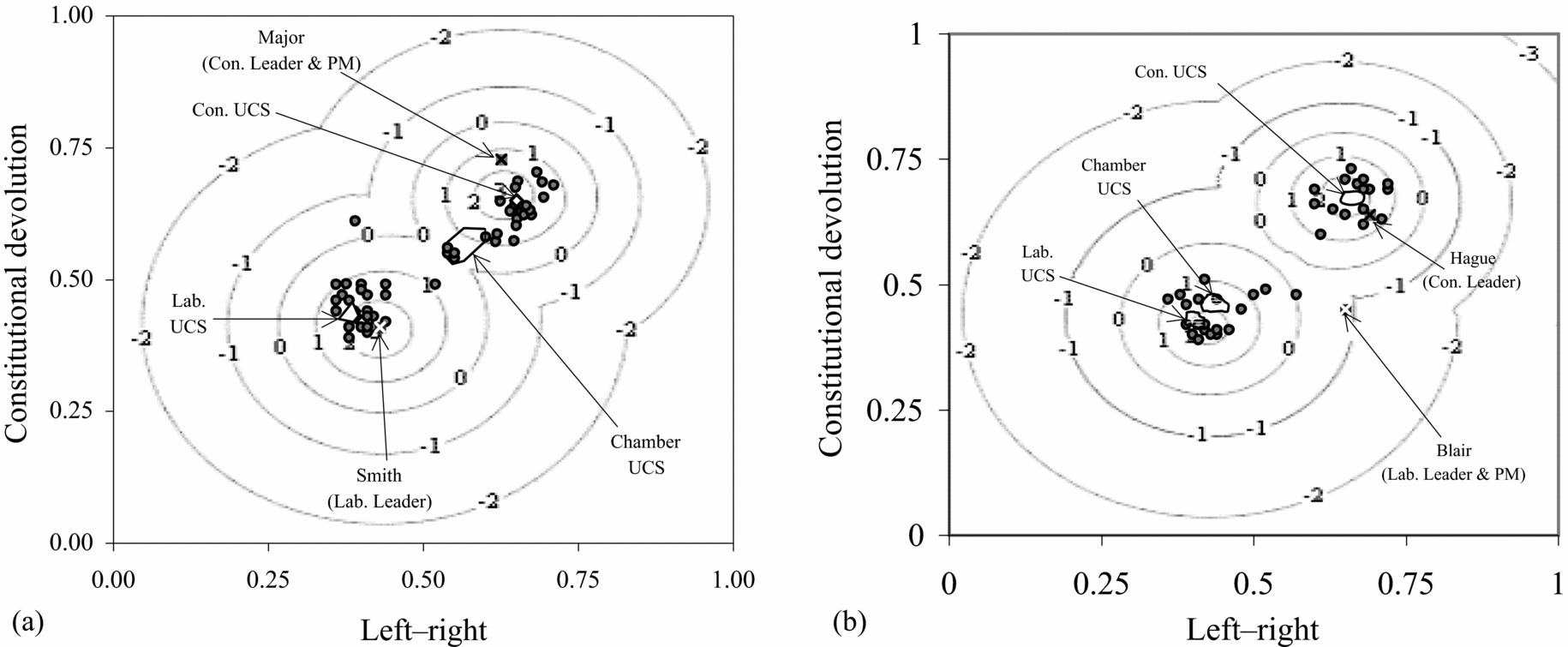
Figures 1a and 1b offer a graphical perspective on our results. We use the parameter estimates of Specification 4 to calculate the relative probability that an MP of a particular ideological stripe is appointed to a ministerial position in his or her party, and then superimpose the results of this calculation on the two-dimensional ideological space, along with the locations of the party leaders and the party and chamber uncovered sets. We perform this calculation for the 1992 Conservative-majority Parliament and the 1997 Parliament Labour-majority Parliament created by the 1997 elections. The contours in each plot show which kinds of MPs have higher probabilities of appointment to each party's cabinet. For comparability across parties and parliamentary terms, we express these probabilities in terms of z-scores (calculated using the distribution of predicted probabilities). Thus, the contours in each plot identify sections of the policy space where an MP's probability of being named a minister is one, two, or three standard deviations greater or less than the mean. The bottom-left contours of Figure 1a (the 1992–97 plot), for example, show what kinds of legislators were more likely than others to be appointed as members of the Labour shadow ministry. The small light polygon is the Labour Party UCS, with the Labour leader at that time, John Smith, located east–southeast of the Labour UCS. The smallest, ellipses delimit the z > 3 regions, the somewhat ellipses larger the z > 2 regions, and so or—so that it is clearly the case that the MP's probability of being appointed a Labour shadow minister increases the closer the MP is to the Labour Party UCS. The same relationship holds for the Conservatives in Figure 1a and for both parties in Figure 1b.
Cabinet and Shadow Cabinet Appointments in the 1992–97 Parliament (a) and the 1997–2001 Parliament (b).

Specification 5 is a robustness checks on our results. It uses the MP's distance from the centroid point of the party's UCS in place of the MP's average distance from all points in the party UCS. This specification addresses the argument that the average distance measure biases the results in favor of the party government hypothesis and against the party leadership hypothesis. The concern is that the distance coefficients reflect a comparison between the distance between the MP and a single point (i.e., the leader's ideal point) and the average of a set of points (i.e., the party UCS), and that the latter will tend to be smaller than the latter by construction. Specification 5 shows that this concern is unwarranted: even when we calculate the MP's distance from the party UCS on the basis of the UCS centroid point, we find that the coefficient on the MP's distance to the party UCS remains stable and statistically significant (b = −4.414, 1-tailed p < .05). A similar comment can be made on the MP's distance to the party leader, which remains statistically insignificant.
Specifications 6 and 7 test how sensitive our results are to how we have measured leaders’ ideal points. Specification 6 conditions the model on leadership rather than parliamentary fixed effects. None of the leadership dummy variables are statistically significant, so there is no indication that MPs are systematically estimated as being closer to one leader than another. In addition, an MP's proximity to the party UCS continues to exert a statistically significant effect on the MP's probability of being appointed to the cabinet or shadow cabinet. Nevertheless, the party leader distance coefficient is much larger (increasing from −0.713 to −2.908) and statistically significant under this specification. Specification 7 tests the sensitivity of our results to how we have estimated leaders’ ideal points by including in the model a dummy variable that indicates if the leader's ideal point was estimated via MPs’ assessments of that leader's ideological position. This dummy variable has no effect on the coefficient on MPs' proximity to the party UCS (it remains stable and statistically significant), whereas the coefficient on the MPs' distance to the party leader declines in size and reverts to statistical insignificance. This suggests that the leadership effect in Specification 6 (and which is absent in all the other specifications) is not a function of how we have measured leaders’ ideal points.
The last specification in Table 1 focuses on Labour ministerial selection, conditional on the party's status as the government or the opposition. The specification includes an interaction between government status and the distance between the MP's and the party leader's ideal points (Government × Dist. to Party Leader). As we noted above, the procedure by which Labour ministers are selected changes depending on whether the party is in opposition or in government: in opposition, Labour shadow cabinet ministers are elected by a formal ballot of the parliamentary party; in government, Labour cabinet ministers are appointed by the prime minister. These institutional rules imply that the Labour leader's influence on ministerial selection should be more visible when the Labour party is in power.Footnote 20 Indeed, that is what the results show. When the Labour Party is in opposition, the coefficient on the MP–Leader distance variable is just -0.108 and is statistically insignificant. When the Labour Party is in government, the total coefficient on the MP–Leader distance variable increases in magnitude to −7.79 (i.e., −0.108 − 7.682 = −7.790, s.e. = 3.903, t = 1.996, d.f. = 114, 1-tailed p = .024). In other words, only under conditions that one would expect to provide the strongest support for the leadership hypothesis do our findings clearly bear out that expectation. Even then, the MP's proximity to the party UCS remains a statistically significant predictor of ministerial selection, indicating that the leader's influence on the cabinet's membership does not come directly at the parliamentary party's expense.
CONCLUSION
This paper began with a fundamental question regarding cabinet formation in parliamentary systems: who controls ministerial appointments in the contemporary British parliament? The question stems from a broader question of legislative decision-making: how might members of a party caucus shape policy outcomes in line with their interests through mechanisms such as a committee system, agenda setting, and the selection of leaders, including which MPs will hold ministerial positions?
Our argument here reflects the literature on ministerial appointments: one natural solution to the combined selection–agency problem facing parliamentary parties is to select as ministers and shadow ministers those whose backgrounds suggest that they are capable of exercising policy-making power, and whose policy preferences suggest they will naturally prefer to act in accordance with the party's policy “will.” Within this literature, theories of ministerial selection disagree about which actors most influence ministerial selection—debating whether it is the party leaders or party backbenchers who are able to employ ex ante solutions to the principal–agent dilemma.
Our analysis supports the party government hypothesis, arguing that it is backbenchers and not party leaders who act as principals to ministerial agents. Across model specifications, the variable that captures MPs’ distance to the party UCS is significant, and the sign is in the expected direction. In other words, the closer an MP is to the party's UCS, the more likely he or she is to be appointed to a ministerial post. In both the Labour and Conservative parties, in power and out, initial appointments are sensitive to appointees’ qualifications and to their policy leanings.
These findings highlight two critical insights into the contemporary British Parliament and into parliamentary democracies more generally. First, although modern parliamentary government is both cabinet government and party government, it would be a mistake to conclude from this description that party leaders are all-powerful within their organizations or, equivalently, that backbenchers are powerless in the face of leader initiatives. Although it is true that ministerial appointments are only one aspect of policy-making in a parliamentary democracy, they are clearly one of the most important—and our analysis reveals that backbenchers have considerable influence over these appointments regardless of the formal rules used to make the appointments. This finding does not suggest that party leaders in parliamentary democracies are powerless; rather, it suggests that regardless of the formal and informal powers held by party leaders, scholars should consider the preferences of party backbenchers when explaining all aspects of policy-making in these systems.
Second, our findings suggest a broader conception of the mechanisms that underlie responsiveness and accountability in parliamentary democracies. If party leaders dominate the policy-making process, through their control of Cabinet appointments and the exercise of party discipline on the floor, then citizens are left with very little control over government policy, as the individual candidates who stand for election have no role save as symbols of their party. However, if backbenchers exert a modicum of influence over ministerial appointments and perhaps other policy-relevant decisions, then participation in elections gives citizens a more direct voice over policy-making in government than would exist if party leaders were the only relevant actors. Our analysis suggests that at least for the contemporary British Parliament, this linkage through backbenchers is significant.
Finally, the analysis underscores the potential usefulness of the uncovered set as a tool for exploring important empirical puzzles across democratic regimes. In this paper, for example, we have shown that the party uncovered set can be used to predict the selection of ministerial personnel. Moreover, the fact that the uncovered set applies empirically to the ministerial selection process suggests that policy (as opposed to office) concerns are a vital aspect of cabinet formation and intraparty politics. Whether the uncovered set always characterizes the outcome of a cabinet formation game is a provocative question that our empirical results cannot answer. What we have shown, however, is that the uncovered set can sometimes be a feasible way to characterize the outcome of majority rule decision-making procedures in multidimensional policy settings, settings in which the median voter theorem rarely applies. This approach addresses a longstanding critique of much of the contemporary literature. It may also help scholars obtain a deeper understanding of legislative decision-making and, on the basis of that deeper understanding, generate more realistic theories of legislative politics.
APPENDIX: ESTIMATING MP AND LEADER IDEAL POINTS
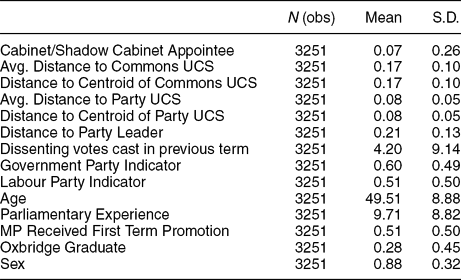
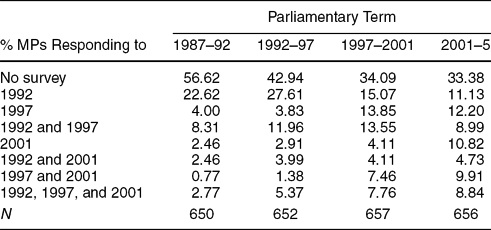
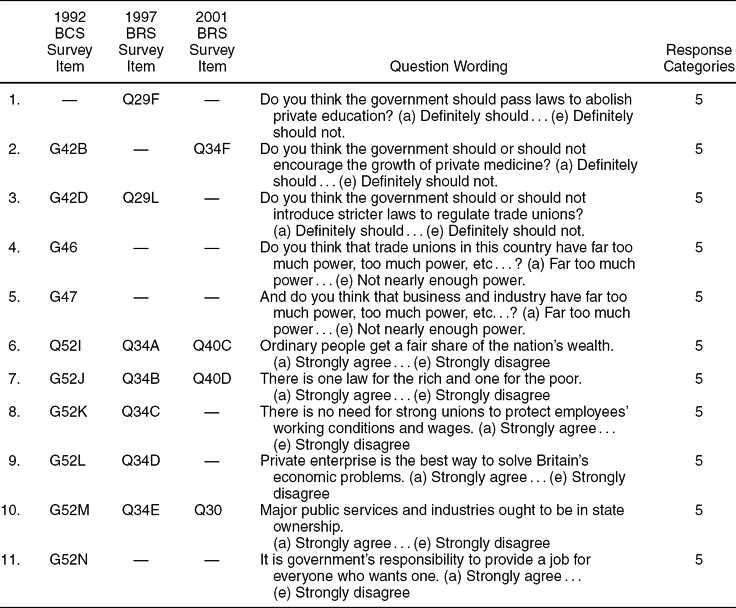
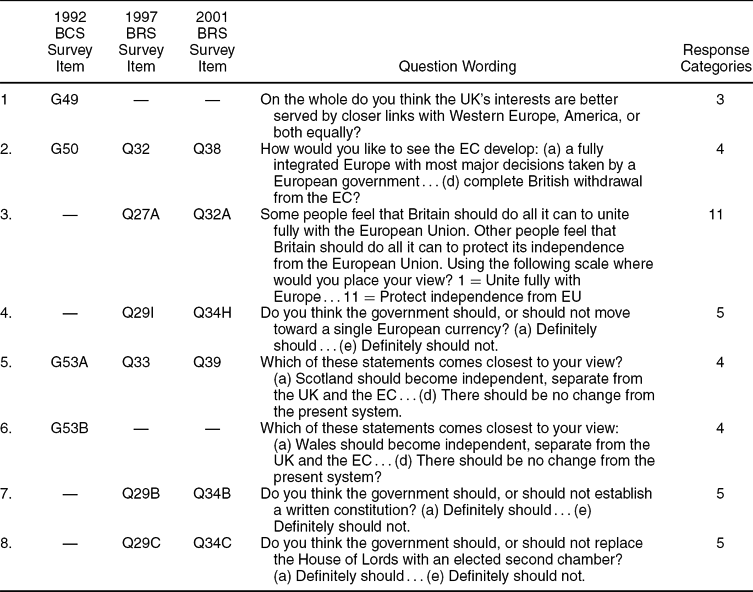
This appendix describes how we constructed the policy scales on which we locate British MPs’ ideal points. It also details how we computed party leaders’ ideal points and provides descriptive statistics for the variables that appear in the ministerial selection models in Table 1 (see Table A1). A series of candidate surveys provided the basic data with which to construct the ideological scales. These surveys were conducted by Norris and Lovenduski in Reference Norris and Lovenduski1992, Reference Norris and Lovenduski1997, and Reference Norris and Lovenduski2001. Table A2 shows the response rates among MPs to these surveys for each parliament; Tables A3 and A4 list the survey items from which the scales used were created and their response categories (e.g., Strongly Agree, Agree, Neutral, Disagree, Strongly Disagree).
Descriptive Statistics

Response Rates among MPs by Survey Wave

Survey Items Used to Construct the Left–Right Ideological Scale

Survey Items Used to Construct the Constitutional-Devolution Scale

Scales were identified (and survey items selected) using an approach very similar to the “vanilla” method in Gabel and Huber (Reference Gabel and Huber2000): analyze all issue items via principal components and take the component that explains the most variance in the data as the left–right dimension. The difference between our method and Gabel and Huber's is that we do not constrain the analysis to return just one component.Footnote 21 Additive scales were created based on these principal components by adding together respondents’ scores on a component's constituent items. Scale items were normalized to range between 0 and 1 from left to right before being added together. Thus an item with five response categories was, for example, coded (0, .25, .5, .75, 1), whereas an item with three response categories was coded (0, .5, 1). These scales do not generate common space scores (in fact, the content of the survey made this impossibleFootnote 22), but with the scales constructed in this fashion it is possible to say in a concrete fashion that MPi answered “agree” or “strongly agree” to more rightist policy items than MPj. Moreover, if one also considers the high degree of ideological constraint exhibited by MPs, comparisons across individuals on these scales would seem to be meaningful. A high degree of ideological constraint, after all, implies that MPs are not answering questions randomly. Thus, there is a sound basis for taking the difference in the number of rightist responses given by any two MPs as indicative of the true ideological distance between these individuals.
The scores of nonresponding MPs were imputed using multiple imputation methods. We used Ameila II to generate five complete data sets.Footnote 23 (Table A2 shows the percentages of missing MP responses for each parliamentary term.) Note that some variables such as the MP's age, educational background, party affiliation, parliamentary rank, and date of first election were available from public sources such as Dod's Parliamentary Companion and Parliamentary Profiles. In these cases, we filled missing cells with the observed datum. In addition, a variety of background variables and data were added to the imputation model to improve the quality of imputed survey responses. These variables and data included survey responses from all other major party candidates, with a dummy variable to identify winners (i.e., MPs) and losers; socioeconomic profiles of every constituency garnered from recent census data; and the party vote shares of every constituency over the past three elections in each country.
With regard to leader positions, if a party leader answered the survey, we used his or her responses to generate his or her ideal points just as we did with other MPs. If not, the surveys contained questions that asked MPs to place their leaders on a 7-point left–right scale and on an 11-point pro–anti-European Union scale. The difficulty in using these scales to locate the ideal points of party leaders who did not answer the surveys is twofold: (1) the mapping from the placement scales to the policy dimensions on which we locate MPs (i.e., the left–right and constitutional-devolution dimensions) is not obvious; (2) we cannot be sure that MPs perceive and employ the placement scales in the same fashion (i.e., MPs may expand or contract the placement scales, shift them to the left or right, and interpret distances between points on the scale idiosyncratically). The problem, then, is to estimate the jth party leader's ideal point on one of the policy question–based dimensions (e.g., the left–right dimension) (Qj) given three observed data: (1) the MPs’ location on that same policy question–based dimension (Yi); (2) the MPs’ self-placement on the associated placement scale (e.g., the seven-point left–right scale) (Zi); and (3) the MPs' placement of their party leader on that same placement scale (Mij). The solution begins with the assumption (per Aldrich and McKelvey Reference Aldrich and McKelvey1977) that MPs' observed positions are linear functions of their “true” ideological positions Xi such that


Footnote 24 and that Cov(βi, ɛi) = Cov(αi, νi) = 0. Equations (1) and (2) state that the MP's positions on the policy question dimension and placement scale are linear functions of his or her true position “stretched or compressed” by βi and αi, respectively, and shifted left or right by νi, and ɛi, respectively.Footnote 25 Assume also that the MP's distortion of the placement scale extends to the MP's placement of the leader on that same scale (albeit with different errors, ϖij ~ N(0, σϖ), Cov(αi, ϖij) = 0) so that the MP perceives the leader's true position, Lj, as Mij = αi Lj + ϖij.
If we assume that both αi and ϖij are i.i.d. across MPs (i.e., the manner in which one MP stretches or shifts the scale is independent of how any other MP stretches or shifts the scale), then we can estimate Lj, ϖij, and σϖ by

In other words, averaging the leader placements of all of a party's MPs washes out the measurement errors associated with MPs’ placements of the leader and leaves us with unbiased measures of (a) the leader's ideological position, (b) the MP's perceptual error in placing her leader, and (c) the variance of all of a party's MPs’ perceptual errors in placing their leader. Moreover, as Lj is fixed (i.e., the leader occupies just a single point on the latent ideological dimension), it must be the case that Cov(Lj, Xi) = 0 and that Cov(Mij, Zi) reflects only the covariance in the MP's perceptual errors; i.e.,

Thus, a regression of (standardized) Mij on (standardized) Zi returns b 1 = Cov(ϖi, ɛi). Given the estimates of ϖi obtained above, we can now estimate ɛi:

Similarly, a regression of Mij on Yi allows us to recover estimates of νi.
We now know how each MP is shifting the question-based and placement scales. The remaining question is how they are stretching or compressing each scale. If we assume that the leader's location on the question-based scale is distorted in the same way as the MP's location on the question-based scale (i.e., Qj = βiLj), dividing βiXi by αiXi tells us how MPi is stretching or compressing the question-based scale relative to their similar distortion of the placement scale.Footnote 26 We can recover Qj via the following operations:

Just as Mj served as our best estimate of the leader's true position on the placement scale, Qj serves as our best estimate of the leader's true position on the question-based scale.





Comments
No Comments have been published for this article.