INTRODUCTION
Mesoamerican codices are written and illustrated documents that describe pre-Columbian history, tributes and cosmogony. After the conquest of Mexico thousands of these documents were destroyed by European Christians as they were considered pagan and samples of idolatry, superstition and stories of the Devil (Timmer Reference Timmer1997). The Mayan Codex of Mexico (MCM, formerly Codex Grolier), proclaimed as the fourth Mayan Codex by Michael Coe (Reference Coe1973), is a folding-screen book painted on bark paper that comprises 10 sheets, with each one composed of three layers and coated with a fine layer of stucco on both sides. In addition, part of the Codex consists of four single layers of un-stuccoed bark paper, one of them adhering to the back of leaf 8. At present, the document has a total length of 1.25 m and an average height of 18.5 cm. The original book must have contained twenty pages with a total length close to 250 cm (Coe Reference Coe1973). Venus, the brightest object in the sky after the Sun and Moon was well known by Mayans, whose astronomer-priests understood the four Venus cycles as a Morning Star (236 days) disappearance at Superior Conjunction (90 days), Evening Star (250 days) and disappearance at Inferior Conjunction (8 days). Michael D. Coe was the first to describe the tables of Venus in the pages of the Codex; he claimed that the Codex illustrates astronomical events related to Venus cycles (Coe Reference Coe1973). The pages of the MCM illustrate the helical risings and settings of the planet Venus, whose synodic cycle consist of a total of 584 days (Carlson Reference Carlson2012–2013) (Figure 1).
Mayan Codex of Mexico. Picture by ©Martirene Alcántara/INAH.

The MCM was exhibited for the first time in 1971 during the Ancient Maya Calligraphy exposition at the Grolier Club, a private club and society of bibliophiles in New York, USA. The name of the owner of the codex, was revealed until 1973, when Karl E Meyer from The New Yorker, mentioned that the document had been sold to the pre-Columbian art collector Dr. Josue Saenz around 1966, as part of a lot of archaeological objects found in a cave near the Chiapas Range, Southeast Mexico (Coe Reference Coe2010; Brito Reference Brito2018). Because Mexico and the United States of America already had signed a Treaty of Cooperation “Providing for the recovery and return of stolen Archaeological, Historical and Cultural properties” in 1970, the retrieval of the codex was possible. Since the codex was obtained by looting, data on its manufacture, origin and chronology were uncertain. In addition, because of differences in iconography, described as hybrid in content compared with the known Mayan codices, its authenticity was questioned. This polemical issue remained for more than 40 years. After the return of the codex to Mexico, the owner donated it to the Mexican government, on the condition that the codex be tested for authenticity. The codex remained under the custody of the National Museum of Anthropology and History and was subject of many studies for several years without it being possible to prove whether it was original or newly produced (Brito Reference Brito2018).
In 2016 the authorities of the National Coordination of Museums and Exhibitions (CNME), the National Museum of Anthropology and History (MNAH) and the National Library of Anthropology and History (BNAH) decided to integrate a team of specialists to carry out a multidisciplinary analysis of the codex with the purpose of dilucidate its authenticity. The project was led by Baltazar Brito and Sofía Martínez del Campo. The analyses included composition, iconography, procedures used in the production of the codex, the causes and degree of damage and the radiocarbon (14C) dating, among others. If the results of the study of the plaster bases, their pigments, iconographic analysis and other evidence result in a manufacturing according to the age of the support, there would be elements that would support the authenticity of the Maya Codex of Mexico (Brito Reference Brito2018).
The known Mayan codices, Dresden, Paris and Madrid, were created using bark paper (known in Mexico as amate). The bark paper in the Mayan zone was produced from the cambium fibers, present between the bark and the heartwood of trees. Long, thin, flexible pages resulted.
According to Xelhuantzi et al (Reference Xelhuantzi, Alvarado and Sánchez-Martínez2018), from the National Institute of Anthropology and History (INAH), the vegetal material of the support of the codex are three thin layers of paper bark made from a fig tree of the genus Ficus sp. These three layers present in pages 1–8 could have been prepared from the cambium of a single tree because it is believed the elaboration of bark paper at that time was not a well-established industry. Thus, the manufacture of this bark paper shows signs of being primitive. The fibers of the tree’s tissue are considered as part of a single layer and without the bond between layers due to mechanical processes such as mashed. It is unknown if an adhesive was used to join these layers. The weak bond between layers can be explained by contact between the cellulose fibers rich in groups—OH that would facilitate the union between the vegetal layers by intermolecular attractions. Because the vascular cambium is the most recent growth tissue in the life of a tree, and at that time there was not a production industry of bark paper, it is reasonable to assume that the age of the MCM should be very close to the age of the bark paper.
Concerning the age of the codex, previous 14C dates exist. The first analysis was performed on the unpainted pages at Teledyne Isotopes laboratory by radiometric techniques (Coe Reference Coe1973). The second dating was performed on page 11 (now page 10b), by AMS-RC dating at the NSF Arizona AMS Laboratory in 2002 (Carlson Reference Carlson2012–2013). Results obtained in both labs placed the support material of the Codex in the 13th century.
In this work we present new AMS-14C dating of the bark paper of the codex. The analyses were performed at the Laboratory of Accelerator Mass Spectrometry (LEMA), of the National Autonomous University of Mexico (Solís et al. Reference Solís, Chávez-Lomelí, Ortiz, Huerta, Andrade and Barrios2014). The dates obtained were compared with previous dates obtained at the Arizona AMS Laboratory and with others obtained later in a commercial laboratory. We hypothesized that if the codex were authentic, the age of different pages should be similar, therefore samples were taken from a page not dated before. Page number 5 was selected also because it showed less damage caused by moisture and insects. In this study, we compared a vegetable fiber cleaning method using Soxhlet + ABA treatment against standard ABA treatment in order to obtain more reliable 14C dates. The density of probabilities obtained from both methods were contrasted.
MATERIALS AND METHODS
For 14C dating by AMS, a sample (15mg) of bark paper fibers was taken at different points from the back of page 5. Loose or under-entrenched multiple fine fibers were chosen to affect the document as little as possible (Figure 1). The purpose of this strategy was to avoid possible errors from present pollutants in a single area, or to take a sample in a repaired or intervened area. Taking samples of different parts of the same sheet results in an average age of the materials used to manufacture the codex and would minimize this problem. The pre-treatment of the sample of the codex began with the mechanical cleaning followed by a washing with type I water and ultrasound. Since at the beginning of this work it was unknown whether the codex was treated at some point before its arrival to the NMAH or the way it was manipulated we decided to use Soxhlet wash (Büchi E-812) to treat a subsample of 5 mg (LEMA-774.1). This process was carried out from low to high polarity: hexane (polarity index = 0.1), 2-propanol (polarity index = 5.5) and ethanol (polarity index = 6.5) to remove traces of glue, varnish, waxes or resins, accidentally or intentionally added. Each solvent taken before and after the Soxhlet cleaning was analyzed by IR spectroscopy, but no difference was observed between the spectra (data not shown). However, this does not negate the possible presence of organic or synthetic compounds. This Soxhlet treatment for sample 774.1 was followed by a series of acid-base-acid (0.5M HCL, 4% (m/v) NaOH, 0.5M HCl) to remove carbonates and humic acids. Subsequently, a second subsample of 5 mg (LEMA-774.2) was subjected to ABA treatment only.
Sample AA-48427, was submitted to a routine sample treatment for cellulosic materials. They were first carried through solvent extractions with hexane, ethanol, methanol and water using Soxhlet apparatus, followed by a sequence of mineral acids and bases, 0.1M HCl, 0.25M NaOH, 0.010M HCl, to remove acid and base contaminants (Khandekar et al. Reference Khandekar, Mancusi-Ungaro, Cooper, Rosenberger, Eremin, Smith, Stenger and Kirby2010). For the 14C analysis by AMS, the carbon of the sample was converted to graphite in an Automated Graphitization Equipment device (AGEIII; Ion Plus). Organic matter was oxidized to CO2 and then by catalytic reduction of CO2 with hydrogen and Fe powder to pure carbon in the form of graphite (Wacker et al. Reference Wacker, Němec and Bourquin2010: 931–934). The obtained graphite was pressed in an aluminum cathode. The AMS analysis of the graphite obtained was performed using a Tandetron equipment (1 MV; High Voltage Engineering Europa). The analysis is performed on both the samples to be dated and in standards of known ages (oxalic acid HOX (II), reference materials, and blanks (14C-free phthalic acid). 14C age (conventional age) is expressed as before present (BP), i.e. prior to 1950, is obtained from the ratios of 14C/12C, and 13C/12C (Stuiver and Polach Reference Stuiver and Polach1977). The 14C age was corrected by fractionation by δ13C from the ratio of 13C/12C in the sample. Calendar ages were obtained by using the most recent calibration curve and the OxCal v4.2.4 calibration program (Ramsey and Lee Reference Ramsey and Lee2013; Reimer et al. Reference Reimer, Bard, Bayliss, Beck, Blackwell, Bronk Ramsey, Buck, Cheng, Edwards, Friedrich, Grootes, Guilderson, Haflidason, Hajdas, Hatté, Heaton, Hoffmann, Hogg, Hughen, Kaiser, Kromer, Manning, Niu, Reimer, Richards, Scott, Southon, Staff, Turney and van der Plicht2013). This calibration allows to move from an uncalibrated 14C age before the present (BP) to a calendar age (cal. BC/AD). The most likely intervals of the sample age were calculated, with confidence levels of 68% (1 σ) and 95% (2 σ).
RESULTS AND DISCUSSION
The results of 14C dating obtained at different laboratories are reported in Table 1. The ages are expressed in 14C ages (in BP). The calibrated ages obtained with the program OxCal are expressed in years cal AD.
14C ages and OxCal calibrated ages obtained with Soxhlet + ABA and ABA protocols.

This table includes the sample 774.1 from page 5, dated at LEMA; sample AA-48427 from page 10b previously dated at Arizona AMS Laboratory; samples Beta-465514 from page 10b and Beta-484640 from page 3, dated at Beta Analytic and sample LEMA-774.2 that was cleaned only with the ABA protocol. The samples dated at Beta Analytic were included at the request of Baltazar Brito, head of the group together with Gerardo Gutiérrez of the University of Colorado in Boulder, to provide independent verification of the 14C dating at LEMA. Unlike the reports of the University of Arizona and LEMA, the Beta Analytic report indicates that the samples were pretreated using the ABA standardized procedure but does not indicate the use of any additional pre-treatment of the material.
Results from Table 1 show that dates from LEMA-774.1 and AA-48427 samples treated through a combination of Soxhlet and ABA, have very similar ages. The samples treated only by ABA, Beta-465514, Beta-484640, show dates close to each other but older than those treated with Soxhlet + ABA.
When performing intercomparison of several 14C dates of the same object with different processing, it is common to find different values (Damon et al. Reference Damon, Donahue, Gore, Hatheway, Jull, Linick, Sercel, Toolin, Bronk, Hall, Hedges, Housley, Law, Perry, Bonani, Trumbore, Woelfli, Ambers, Bowman, Leese and Tite1989). However, it is noteworthy from Table 1 that Soxhlet + ABA samples are within 2-σ range agreement while the Beta Analytic ages are not in such an agreement. Also, samples from the same page 10b (AA-48427 and Beta-465514) cleaned with different methods, show 14C ages 131 years apart.
To explore if this difference is due to the methodology, a second sub-sample of the page 5, was analyzed, but this time, the sample was cleaned only with the ABA protocol (LEMA-774.2). The 14C age obtained was 990 ± 30 BP, i.e. 140 years older than the same sample cleaned with Soxhlet + ABA (LEMA-774.1).
All samples treated with ABA protocol only (Beta-465514, 484640 and LEMA-774.2) resulted in older ages (940 ± 30, 1060 ± 30 and 990 ± 30 respectively), relative to Soxhlet + ABA treatment.
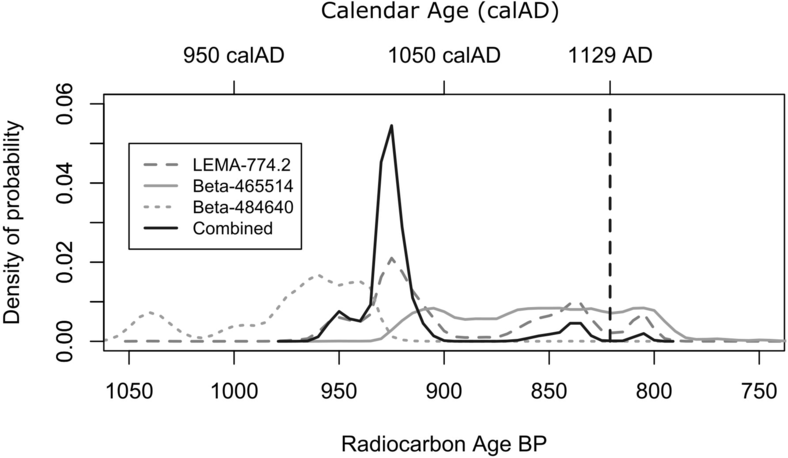
Therefore, results were classified according to the treatment method. In Figure 2, the probability distributions for dates obtained for three samples washed with ABA only are shown. Combined dates give an interval of 991–1147 years cal AD with 95.4% of confidence.
Density of probability for dates from Beta Analytic and LEMA with ABA treatment only, using the IntCal13 calibration curve with R programming language and Clam package (Blaauw Reference Blaauw2010). The combined ages are represented by a thick line.

Intervention of textile and vegetable fibers for conservation, frequently implies the use of oil derived substances. However, a very small fraction of exogenous carbon coming from a contaminant with no 14C within the sample will result in an older age (Wood Reference Wood2015). Therefore, the purpose of applying a rigorous treatment to the LEMA-774.1 sample was to ensure that cleaning procedures would reduce contamination to a minimum and assure the accuracy of 14C values (Wood Reference Wood2015). One of the most successful methods to remove organic pollutants present in old materials is the use of Soxhlet extraction. The intercomparison between the sample preparation procedures performed at LEMA and the Arizona AMS Laboratory confirmed that LEMA-774.1 and AA-48427 samples were submitted to a similar cleaning process with Soxhlet + ABA. The resulting material in both cases was a white-yellowish cellulosic material.
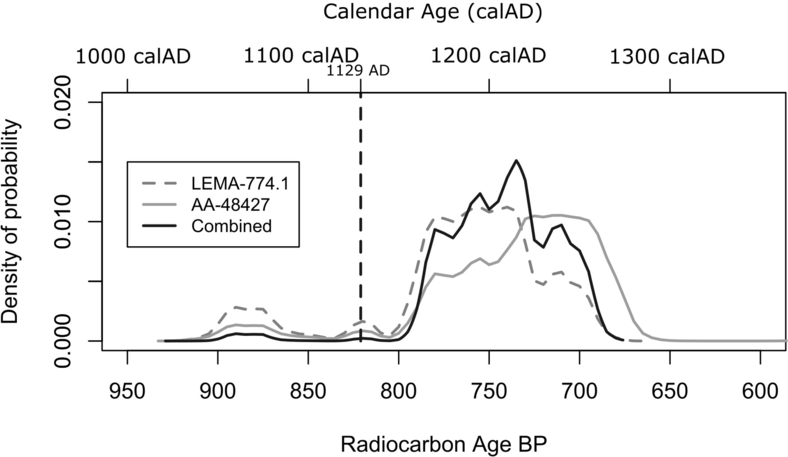
The density of probability for dates obtained at LEMA and the Arizona AMS laboratory with Soxhlet + ABA are shown in Figure 3. Both curves are similar, and the combined dates fall in an interval of 1159–1261 AD with 95.4% of confidence level.
Density of probability for dates obtained at LEMA and at Arizona AMS Laboratory, using the IntCal13 calibration curve in the R programming language with the Clam package (Blaauw Reference Blaauw2010). The combined ages are represented by a thick line.

In the traditional production of the bark paper, the living tissue of trees that are between 3 and 5 years old is used. This implies that even if different trees are used to manufacture the bark paper their age should not to differ much. Based on this premise we hypothesized that if the codex was authentic, the ages of different pages should be similar.
Regardless of the pretreatment applied to samples, dates obtained are a conclusive proof of the MCM bark paper antiquity and therefore, that its manufacture and possibly the Codex itself, is pre-Columbian and belongs more specifically to the Postclassical Mayan period. The differences of these new dates obtained at Beta Analytic and LEMA laboratories, may not need further analyses. However, when working with unique objects that are rarely accessed; the use of the best procedures to treat samples with the consequent reduction of contaminants, is of major importance. For this reason, it is important to provide the greatest amount of information about the objects to be dated, when submitting a sample to the laboratory that will analyze the samples, to assure that the best sample pretreatment will be applied.
In addition to dating, considerable new evidence argues for the authenticity of the MCM (Martínez del Campo Lanz Reference Martínez del Campo Lanz2018). For example, about the use of the codex, Michael D. Coe had already identified the MCM as a record of the synodic cycle of Venus, with its four phases as morning star, evening star, the upper and lower conjunction phases (Coe Reference Coe1973). Under this premise and taking in account the age intervals obtained with 14C, Erik Velazquez cross-dated the absolute ages with astronomical tables of Venus (Velázquez Reference Velázquez2018). He estimated the dates that would correspond to the phases of Venus represented in the MCM. He proposed that the appearance of Venus as a morning star occurred on December 4/7, 1129 AD. This date, after Velázquez (Reference Velázquez2018), indicates the starting point of the Venus table in the MCM is included in Figures 2 and 3. In the case of MCM, considering that the Soxhlet + ABA protocol is the most reliable for sample preparation, the time of manufacture of the Codex corresponds to an interval between 1159 and 1261 cal AD, i.e. post-dating 1129 cal AD. Therefore, we interpret this to mean that the MCM registers astronomical events of the past.
CONCLUSIONS
Two independent sample treatment strategies were used in the revision of the dating of Mexico’s Mayan codex, in order to obtain the best estimate of the age of the document. These treatments included pretreatment of samples with Soxhlet + ABA and ABA only. In this work, we can demonstrate the reproducibility of both methods but consider that pretreatment of samples with Soxhlet + ABA provides the most reliable age.
The results of the AMS 14C dating at LEMA and Arizona AMS Laboratory are a conclusive proof of the antiquity of the bark paper of the MCM and, therefore that the vegetal support and possibly of the Codex itself, and that it was manufactured in the Postclassical Mayan period, between 1159–1261 AD (95% confidence).
ACKNOWLEDGMENTS
We thank Baltazar Brito and Sofía Martínez del Campo for their invitation to be part of this research, Sergio Martínez and Hector Cruz-Manjarrez for technical assistance, and Arcadio Huerta for maintenance and operation of the LEMA-AMS system. We are also grateful to the reviewers for helping to improve this manuscript. Support was received by DGAPA IG100619 and CONACyT 299073 grants. We are grateful to the AMS team at the University of Arizona. The original measurement work at the University of Arizona was supported by NSF grant EAR 01-15488. AJTJ also acknowledges support from the European Union and the State of Hungary, co-financed by the European Regional Development Fund in the project of GINOP-2.3.2-15-2016-00009 “ICER”.