Introduction
It is well established that the prenatal environment contributes to the risk for both metabolic and cardiovascular diseases in offspring.Reference Gluckman, Hanson, Cooper and Thornburg 1 Specifically, maternal over- and undernutrition have been reported to alter genes involved in hepatic lipid and glucose metabolismReference Burns, Desai and Cohen 2 , Reference Burdge, Slater-Jefferies and Torrens 3 and produce endothelial dysfunction,Reference Torrens, Hanson, Gluckman and Vickers 4 – Reference Samuelsson, Matthews and Argenton 6 an early marker of atherosclerotic disease, in offspring. The negative health outcomes associated with maternal over- and undernutrition are typically attributed to offspring birth weight, with birth weights and adverse health outcomes forming a U-shaped relationship.Reference Gluckman, Hanson, Cooper and Thornburg 1 , Reference Hopkins and Cutfield 7
Maternal aerobic exercise during pregnancy, which is currently recommended by the American Congress of Obstetricians and Gynecologists (ACOG), Centers for Disease Control (CDC), and the American College of Sports Medicine (ACSM),Reference Borodulin, Evenson, Wen, Herring and Benson 8 has also been reported to impact offspring birth weight.Reference Hopkins and Cutfield 7 It is currently unclear whether similar negative metabolic and cardiovascular health outcomes, which have been reported in models of maternal undernutrition, are also prevalent in progeny of exercise-trained mothers. However, preliminary epidemiological data suggest that women who participated in strenuous exercise during pregnancy produced offspring that tended (P = 0.084) to have less carotid artery atherosclerosis at 9 years of age when compared with age of matched controls.Reference Gale, Jiang and Robinson 9 These preliminary data provide initial evidence that maternal exercise during pregnancy may reduce rather than increase the risk for metabolic and cardiovascular diseases in offspring.
The purpose of this investigation was to use a swine model of fetal programming to test the hypothesis that aerobic exercise training during pregnancy would enhance endothelial function in the offspring from exercise-trained compared with sedentary mothers. The secondary aim of this investigation was to test the hypothesis that enhanced endothelial function in the offspring of aerobically exercise-trained mothers would be associated with changes in the expression of key genes involved in the regulation of hepatic metabolism, as changes in maternal nutrient supply are known to be associated with changes in transcript levels of metabolic genes.Reference Burns, Desai and Cohen 2 , Reference Burdge, Slater-Jefferies and Torrens 3
Methods
Animals
Due to their similarity to human cardiovascular anatomy and physiology, swine were utilized to ascertain the effects of maternal exercise on offspring susceptibility to atherosclerosis.Reference Turk and Laughlin 10 Ovarian cycles were synchronized by feeding an orally active progestin (Altrenogest) to 6-month-old primiparous crossbred gilts (n = 8) 2 weeks before artificial insemination. Gilts were randomized into two groups: exercise-trained (n = 4) and sedentary (n = 4), which were individually housed in an environmentally controlled large animal housing facility and fed a standard gilt gestational diet of 3.25 kg/day.
Intervention
Exercise training consisted of treadmill exercise for 20–45 min a day, 5 days a week at an intensity of 65–85% of maximal heart rate as assessed by a heart rate monitor (Polar S810, Polar Electro Inc., Lake Success, NY, USA). To demonstrate the efficacy of the exercise protocol, 6 h resting heart rates were obtained from both exercised and sedentary gilts at week 15 of gestation using a heart rate monitor. During exercise training protocols, sedentary gilts were loaded in a cage adjacent to the treadmill to control for environmental stimuli. All gilts were weighed weekly.
Litter characteristics and euthanasia
Measurements of litter characteristics (number, sex, length, and weight) were taken at birth. Offspring were randomly selected and euthanized approximately 48 h following birth. A total of 16 offspring were euthanized, representing four distinct groups (male sedentary, female sedentary, male exercise-trained and female exercise-trained).
Vascular experiments
The thoracic aortas of all euthanized animals were harvested, cleaned of connective tissue and cut into three sections (∼3 mm) for in vitro vascular function experiments as described previously.Reference Newcomer, Taylor, Bowles and Laughlin 11 Briefly, arterial rings were measured for axial length and inner/outer diameters using a stereomicroscope (PZMIII, World Precision Instruments, Sarasota, FL, USA) in combination with Image J software (NIH, Bethesda, MD, USA). Thoracic aortic rings were then individually mounted in an alternating series on wire myographs (Myobath II, World Precision Instruments, Sarasota, FL, USA), placed in a 20 ml bath of Kreb's bicarbonate solution that was heated to 37°C, bubbled with 95% O2 and 5% CO2 gas mixture, and set to 8 g of tension. This tension was determined to be the optimal point in the length–tension relationship based on preliminary length–tension experiments in the thoracic aorta of piglets and historical data from arterial segments of similar size.Reference Newcomer, Taylor, Bowles and Laughlin 11 All rings were preconstricted using prostaglandin F2α (PGF2α; 30 μM) and allowed to reach a tension equilibrium. Endothelium-dependent, dose-dependent vasorelaxation was then assessed using cumulative addition of bradykinin (BK; 10−11–10−6 M). The role of the nitric oxide synthase (NOS) pathway in the relaxation response to BK was assessed through the addition of 300 μM NG-nitro-l-arginine methyl ester (l-NAME) to the Kreb's bicarbonate solution 30 min before preconstriction with PGF2α. Endothelium-independent, dose-dependent vasorelaxation was assessed using addition of sodium nitroprusside (SNP; 10−10–10−4 M).
Isolation of ribonucleic acid (RNA)
Liver tissue was snap frozen in liquid nitrogen and stored at −80°C until RNA isolation. Total RNA was isolated using TRI REAGANT (Molecular Research Center, Inc., Cincinnati, OH, USA) following the manufacturer's protocol. Briefly, 0.25 g of tissue was homogenized in 2.5 ml TRI REAGENT. After allowing the homogenized liver to incubate at room temperature for 5 min, 0.5 ml of chloroform was added. The mixture was vortexed for 15 s and allowed to sit at room temperature for 2 min then centrifuged at 12,000 g for 15 min at 4°C. The aqueous phase was removed and mixed with 1.25 ml of isopropanol and incubated at room temperature for 5 min to precipitate the RNA. RNA was pelleted by centrifugation at 12,000 g for 8 min; the RNA pellet was then washed in 2.5 ml of 75% ethanol. The RNA pellet was resuspended in 0.25 ml of H2O and further purified using RNeasy Mini Kit (Qiagen, Austin, TX) following the manufacturer's instructions. RNA samples were quantified and stored at −80°C.
Quantitative real time-polymerase chain reaction (RT-PCR)
Complimentary DNA (cDNA) was synthesized from 5 ng of DNase-treated total RNA using iScript (Bio-Rad Laboratories, Hercules, CA, USA) according to the manufacturer's protocol. Ten microliters of 0.25 μg/μl cDNA was then diluted with 105 μl of water so that there was the equivalent of 20 ng of input RNA per μl of cDNA. Primer pairs for quantitative PCR (qPCR) analysis of acetyl-CoA carboxylase alpha (ACACA), peroxisome proliferator-activated receptor alpha (PPARα), fructose-1,6-bisphosphatase 1 (FBPASE), carnitine palmitoyltransferase 1A (CPT1), fatty acid synthase (FASN), phosphoenolpyruvate carboxykinase 1 (PEPCK), acyl-CoA synthetase long-chain family member 3 (ACSL3), peroxisome proliferator-activated receptor gamma coactivator 1 alpha (PGC1), and nuclear receptor subfamily 3, group C, member 1 glucocorticoid receptor (GR) were designed using PrimerQuest provided by Integrated DNA Technologies (Skokie, IL, USA). Primer specificity and capture temperature were determined using melt curve analysis. PCR products were cloned into pCRII-TOPO vector and chemically transformed into TOP10 E. coli (Invitrogen, Inc.). Plasmids were sequenced to confirm that only the ‘gene of interest’ was amplified by the designed primers. Plasmids with sequence-verified inserts were quantified using fluorometry (Picogreen dsDNA Quantitation Kit, Invitrogen, Inc., Carlsbad, CA, USA) and digested with EcoRI. Quantitative PCR assays were carried out in 15 μl reaction volume. Each contained 10 μl of iQ SYBR Green Supermix (Bio-Rad Inc., Hercules, CA, USA) with 5 μl diluted first-strand cDNA (totaling 100 ng of input RNA). All cDNA samples were assayed in duplicate. PCR was carried out on an iCycler Real-Time PCR Detection System (Bio-Rad Inc., Hercules, CA, USA). Quantification standards were comprised of four 100-fold dilutions of plasmid DNA (107–101 or 107–101 molecules) and were assayed in triplicate. These standards were used to calculate a linear regression model for threshold cycle relative to transcript abundance in each sample.
Statistical analysis
The Students’ t-test was used to compare resting heart rates and weight between sedentary and exercise-trained gilts. Litter characteristics, vessel characteristics and dose–response curves for BK and SNP were analyzed using a repeated measures analysis of variance (ANOVA). Within the ANOVA model, gilt was nested in treatment and offspring was nested in sow to overcome correlations between offspring from the same gilt. BK and SNP data from the thoracic aortas are expressed as a percent relaxation of PGF2α-induced tension to baseline tension. Log values for transcript abundance from each sample duplicate were subjected to an ANOVA using the MIXED procedure of SAS for treatment effects. Statistical significance was set at P < 0.05. All data are presented as mean ± s.e.
Results
Sow training
Exercise sessions averaged 39.4 ± 0.9 min in duration over the 15 weeks of the protocol at a moderate intensity (mean exercise heart rate: 162 ± 12.3 bpm). Resting heart rates were significantly (P = 0.047) lower in the exercise-trained (95 ± 4 bpm) compared with the sedentary (107 ± 3 bpm) gilts following 15 weeks of exercise. Weight gain over the 16 weeks of gestations was significantly (P = 0.049) lower in exercise-trained (70.5 ± 4.8 kg) compared with sedentary (83.7 ± 3.8 kg) gilts.
Litter and vessel characteristics
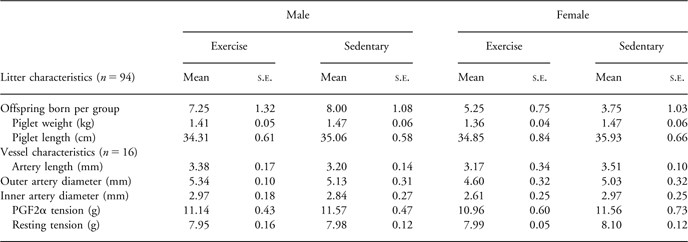
At birth there were no significant differences in litter characteristics (size, piglet weight, and piglet length) between offspring of exercise and sedentary gilts (Table 1). Similarly, there were no significant difference in vessel characteristics (artery lengths, diameters, and tensions) between offspring of exercise and sedentary gilts (Table 1).
Litter and vessel characteristics between offspring of exercise and sedentary gilts

PGF2α, prostaglandin F2α; BK, bradykinin.
Means and standard errors are reported for litter characteristics at birth and vessel properties before the dose–response curves. Litter characteristics are described by the distribution of male v. female offspring from exercise and sedentary sows as well as piglet weight and length grouped by sex and intervention. Vessel characteristics are described by artery length placed between the steel wires of the myograph, outer and inner artery diameter, as well as resting and PGF2α tension. Resting tension is the amount of tension before introducing PGF2α. PGF2α tension is the result of 3 × 10⁻⁵ M PGF2α infusion before adding BK. No significant differences were observed (α < 0.05).
Dose–response
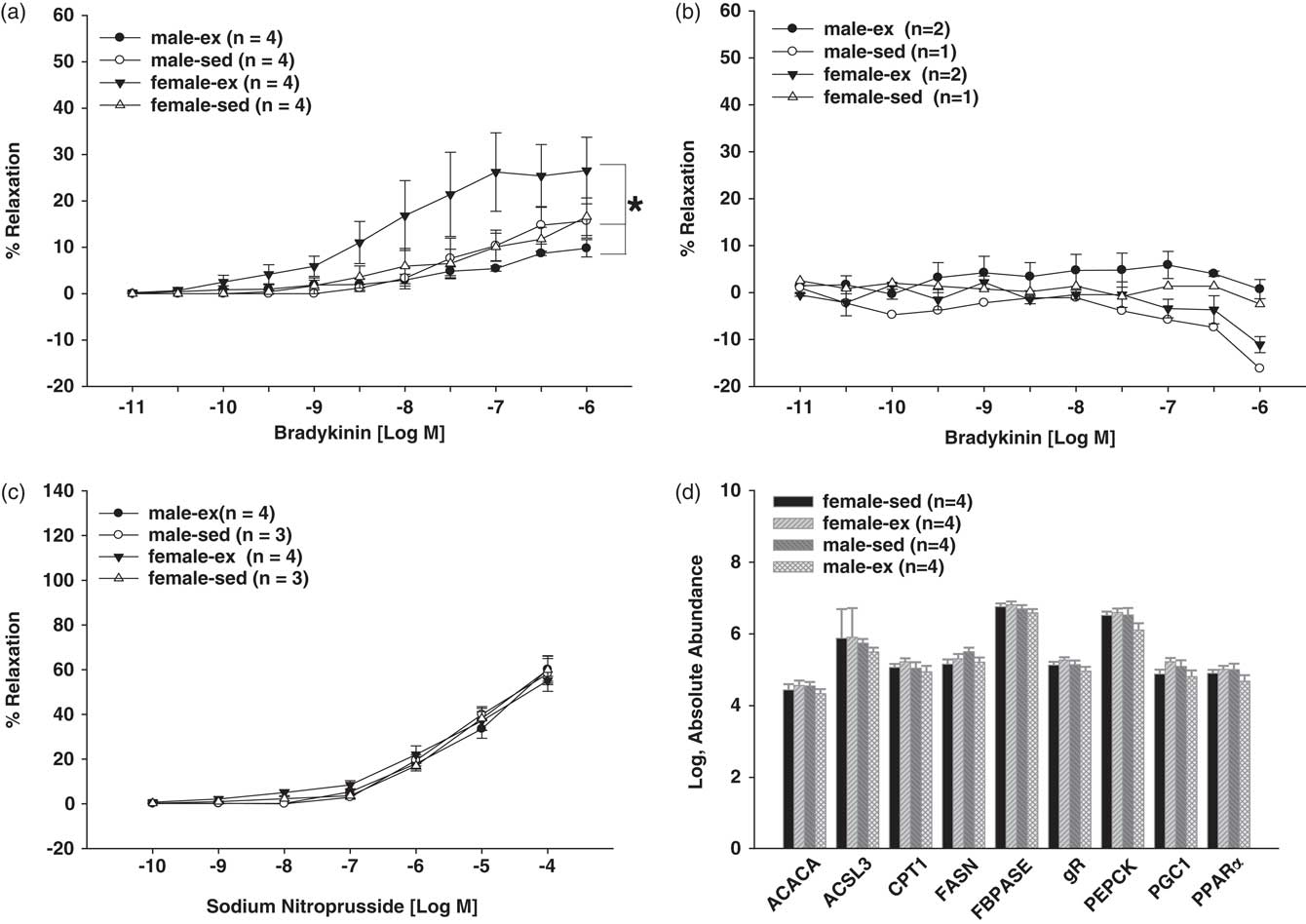
BK elicited a concentration-dependent relaxation on the thoracic aortas of sedentary and exercise-trained offspring (Fig. 1a). Exercise during pregnancy did not result in a significant main effect for BK-induced endothelium-dependent vasorelaxation. However, a significant effect for sex as well as the sex × treatment interaction was observed. Specifically, female offspring from the exercise-trained gilts had a significantly greater relaxation response to BK when compared with the male offspring and female offspring from the sedentary gilts (Fig. 1a). In addition, female offspring from exercise-trained gilts tended (P = 0.08) to have greater relaxation response to BK compared with male offspring from sedentary gilts. Treatment with l-NAME abolished BK-induced vasorelaxation in the male and female offspring from exercise and sedentary gilts (Fig. 1b).
Vasorelaxation response to increasing doses of bradykinin (BK; a), BK + NG-nitro-l-arginine methyl ester (b) and sodium nitroprusside (c) in the thoracic aorta of female offspring from exercise-trained gilts (▾), female offspring from sedentary gilts (Δ), male offspring from exercise-trained gilts (•) and male offspring from sedentary gilts (○) 48 h after birth. (d) Absolute abundance in mRNA of liver acetyl-CoA carboxylase alpha (ACACA), peroxisome proliferator-activated receptor alpha (PPARα), fructose-1,6-bisphosphatase 1 (FBPASE), carnitine palmitoyltransferase 1A (CPT1), fatty acid synthase (FASN), phosphoenolpyruvate carboxykinase 1(PEPCK), acyl-CoA synthetase long-chain family member 3(ACSL3), peroxisome proliferator-activated receptor gamma coactivator 1 alpha (PGC1), and nuclear receptor subfamily 3, group C, member 1 glucocorticoid receptor (GR). *Significant differences, P < 0.05.

SNP elicited a concentration-dependent relaxation on the thoracic aortas of sedentary and exercise-trained offspring (Fig. 1c). SNP-induced endothelium-independent vasorelaxation did not reveal significant differences for treatment, sex, or treatment × sex interaction (Fig. 1c).
Gene expression
The absolute transcript abundance of FBPASE, ACACA, CPT1, GR, FASN, PEPCK, ACSL3, PPARα, and PGC1 was not significantly different between the four experimental groups (Fig. 1d).
Discussion
The purpose of this study was to determine whether maternal exercise during pregnancy decreases offspring susceptibility to cardiovascular and metabolic diseases when compared with offspring from sedentary animals. Exercise reduces the risk of mortality from atherosclerotic cardiovascular disease in adultsReference Blair and Morris 12 through modifications to both endothelial cell phenotype and function.Reference Newcomer, Thijssen and Green 13 This is the first investigation to demonstrate that exercise during pregnancy affects the vascular health of offspring at birth. Specifically, the current results reveal that maternal aerobic exercise training during pregnancy enhances endothelial cell function as assessed by increasing doses of BK in the thoracic aorta of female offspring 48 h following birth.
Only 15% of women in the United States achieve the current ACOG, CDC, and ACSM exercise recommendations during their pregnancies.Reference Borodulin, Evenson, Wen, Herring and Benson 8 This disconnect is likely due to the ambiguity concerning the long-term health effects on the unborn child. In the current investigation, pregnant gilts exercised at intensities and durations that met those recommended for women by the aforementioned organizations. Adherence to these exercise recommendations resulted in a significant maternal cardiovascular training effect as demonstrated by a lower resting heart rate in the exercise-trained gilts. In addition, gilts that were exercise-trained gained significantly less weight than sedentary gilts throughout pregnancy, which is consistent with data obtained in women that exercise-trained during pregnancy.Reference Streuling, Beyerlein and Rosenfeld 14
Although the majority of research has focused on the maternal benefits of exercise during pregnancy, there is mounting evidence that cardiovascular outcomes in the offspring may also be influenced by this stimulus. Specifically, maternal exercise during pregnancy has been reported to influence autonomic control of fetal heart rateReference May, Glaros, Yeh, Clapp and Gustafson 15 and decrease the initial phases of atherosclerosis in children.Reference Gale, Jiang and Robinson 9 The enhanced endothelium-dependent vascular relaxation in the female offspring of exercise-trained gilts provides additional evidence that maternal exercise during pregnancy can produce beneficial cardiovascular outcomes in the progeny. It is well established that endothelium-dependent relaxation is a barometer of vascular health and susceptibility to future atherosclerosis.Reference Ross 16 Therefore, the current results demonstrate that vascular health is improved in female offspring from exercise-trained compared with sedentary gilts at birth. However, it is unclear if this endothelial cell phenotype will persist into adulthood and influence future atherogenesis.
One can only speculate on the underlying mechanisms for these beneficial effects of maternal exercise on atherosclerotic susceptibility of female offspring at birth. Historically, differences in the in utero nutrient environment have been thought to play a pivotal role in the prevalence of metabolic and cardiovascular disease later in life.Reference Barker 17 It is unlikely that reported reductions in glucose delivery to the fetus during maternal exerciseReference Clapp 18 contributed to differences in endothelial function, given that both birth weight and genes involved in hepatic metabolism were not found to be different between offspring from exercise-trained or sedentary gilts.
Another potential explanation for these beneficial effects of maternal exercise on endothelial function in female offspring may be linked to increases in fetal heart rate during maternal exercise.Reference Clapp 18 It is clear that alterations in the hemodynamic stimuli can result in regulatory epigenetic modifications, including DNA methylation and histone modification.Reference Yan, Matouk and Marsden 19 Increases in the frictional force of erythrocytes moving across the endothelium have also been reported to increase nitric oxide bioavailability through the upregulation of anti-atherogenic genes such as eNOS.Reference Newcomer, Thijssen and Green 13 , Reference Laughlin, Newcomer and Bender 20 Therefore, one can speculate that during maternal exercise increases in fetal heart rate and blood flow through the thoracic aorta leads to increased bioavailability of nitric oxide through an upregulation of eNOS. In the current investigation treatment of the thoracic aortas with a nitric oxide inhibitor (l-NAME) abolished the BK relaxation response in all groups. These data suggest that differences in endothelial function between offspring can be attributed to increased bioavailability of nitric oxide in the female offspring from exercise-trained gilts as other vasoactive molecules do not contribute to the BK-induced relaxation. The sole contribution of nitric oxide to the BK-induced vasorelaxation in the thoracic aorta 48 h after birth is also consistent with data reporting that endothelium-dependent dilation increases progressively through nitric oxide-mediated pathways over the first 10 days of life in the pulmonary arteries of swine.Reference Boegehold 21
The mechanisms underlying the sex-specific nature of these findings remain unclear. However, models of maternal dietary restriction have also reported outcomes to the progeny that are sex-specific in nature.Reference Moritz, Cuffe and Wilson 22 One can speculate that estrogen may play a role in these sex-specific findings given the well-known link between estrogen and nitric bioavailability.Reference Arnal, Fontaine and Billon-Gales 23 Additional work addressing the mechanisms underlying the effect of maternal exercise on producing an atherosclerotic-resistant phenotype in female offspring is needed.
It is important to acknowledge that this investigation is limited by the relatively small sample size from which this data was obtained. Future studies with larger sample sizes using a variety of animal models and ages will be needed to confirm these results.
In conclusion, the results of this investigation demonstrate for the first time that maternal exercise during pregnancy produces an enhanced endothelium-dependent vasorelaxation response in the thoracic aortas of female offspring at birth. If maintained into adulthood, this finding suggests that maternal exercise during pregnancy may lead to an endothelial cell phenotype in female offspring that is protective against future atherosclerosis.