Introduction
A central topic of contemporaneous astrobiology is the study of habitability around different types of stars, particularly main-sequence stars. This is motivated by the fact that stars spent most of their lifetimes on the main-sequence (e.g. Maeder & Meynet Reference Maeder and Meynet1988). Furthermore, it is noteworthy that the distribution of stellar spectral types is strongly tilted toward low-mass stars, i.e. K and M-type stars, as implied by detailed determinations of the initial mass function in the solar neighbourhood and beyond (e.g. Kroupa Reference Kroupa2002; Chabrier Reference Chabrier2003). For the present study, we want to consider stars of large abundance in the galactic disk, within a reasonably large mass range, and which all have the potential of being central objects to habitable planetary systems. Thus, it is the aim of the present paper to significantly augment our previous study that dealt with the evolution of circumstellar habitability for stars akin to the Sun (1M ⊙), see von Bloh et al. (Reference Von Bloh, Cuntz, Schröder, Bounama and Franck2009), by considering stars with masses between 0.5 and 2.0 M ⊙. Moreover, we will adopt a wider grid of planetary masses, encompassing 1–10 Earth masses (M ⊕).
Von Bloh et al. (Reference Von Bloh, Cuntz, Schröder, Bounama and Franck2009) in Paper I presented a detailed thermal evolution model for a 10-Earth-mass planet in the environment of a star like the Sun, while also adopting an up-to-date solar evolutionary model (Schröder & Smith Reference Schröder and Smith2008). The planetary model of habitability has been based on the integrated system approach, which describes the photosynthetic biomass production taking into account a variety of climatological, biogeochemical and geodynamical processes. This allowed us to identify a so-called photosynthesis-sustaining habitable zone (pHZ) determined by the limits of biological productivity on the planetary surface. The model also considered the principal possibility of habitability during stellar evolution along the red giant branch (RGB). It was found that the solar pHZ increases in width over time and moves outward, as expected. For example, for ages of 11.0, 11.5, 12.0 and 12.1 Gyr, the pHZ is found to extend from 1.41 to 2.60, 1.58 to 2.60, 4.03 to 6.03 and 6.35 to 9.35 AU, respectively.
The approach of evaluating habitability based on assessing the pHZ is alternative to the study of the climatological habitable zone used by Kasting et al. (Reference Kasting, Whitmire and Reynolds1993) and others. Note that concerning Earth-mass planets, a detailed study of geodynamic habitability based on the pHZ was previously presented by Franck et al. (Reference Franck, von Bloh, Bounama, Steffen, Schönberner and Schellnhuber2000b). They found that Earth will be rendered uninhabitable after 6.5 Gyr as a result of plate tectonics, notably the growth of the continental area (enhanced loss of atmospheric CO2 by the increased weathering surface) and the dwindling spreading rate (diminishing CO2 output from the solid Earth). This work already considered systems of different types of main-sequence stars; however, it was based on an earlier version of stellar evolution models given by Schaller et al. (Reference Schaller, Schaerer, Meynet and Maeder1992). Moreover, it also did not include stellar post–main-sequence evolution.
The study by Franck et al. (Reference Franck, von Bloh, Bounama, Steffen, Schönberner and Schellnhuber2000b) implies that there is no merit in investigating the future habitability of Earth during long-term stellar evolution, as in the framework of pHZ models, the lifetime of habitability is limited by terrestrial geodynamic processes. However, this situation is expected to be significantly different for super-Earth planets due to inherent differences compared with Earth-mass planets (e.g. Valencia et al. Reference Valencia, Sasselov and O'Connell2007). A further motivation for this type of work stems from the ongoing discovery of super-Earths in the solar neighbourhood with the Gliese 876 (Rivera et al. Reference Rivera, Lissauer, Butler, Marcy, Vogt, Fischer, Brown, Laughlin and Henry2005) and Gliese 581 (Udry et al. Reference Udry, Bonfils, Delfosse, Forveille, Mayor, Perrier, Bouchy, Lovis, Pepe and Queloz2007; Vogt et al. Reference Vogt, Butler, Rivera, Haghighipour, Henry and Williamson2010) systems as prime examples. In the following, we describe aspects of stellar evolutionary processes pertaining to our study. Next, we discuss the definition of the pHZ, including the relevant geodynamic assumptions. Thereafter, we present our results and discussion. Finally, we convey our summary and conclusions.
Stellar evolution computations
Methods
As in Paper I, we base the selected evolution models on the well-tested Eggleton code, which allows us to follow the changes of stellar properties through the stages of the main-sequence, the RGB and beyond. Our computations have been made with an advanced version of the Eggleton code, which considers updated opacities and an improved equation of state as described by Pols et al. (Reference Pols, Tout, Eggleton and Han1995, Reference Pols, Schröder, Hurley, Tout and Eggleton1998). For the abundance of heavy elements, which decisively affect the opacities, we use the near-solar value of Z=0.02. This choice is an appropriate representation of present-day samples of stars in the thin galactic disk, noting that these stars show a relatively narrow distribution (Z=0.01–0.03) regarding heavy element abundances about this value. Besides other desirable characteristics, the adopted evolution code uses a self-adapting mesh and has a treatment of ‘overshooting’ that has thoroughly been tested. Its two parameters, i.e. the mixing length and the overshoot length, have been calibrated by utilizing giant and supergiant stars in well-studied, eclipsing binary systems (Schröder et al. Reference Schröder, Pols and Eggleton1997).
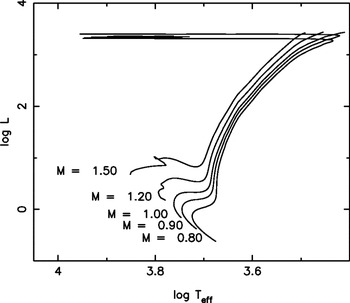
The evolution code, as used by us, also considers a detailed description of the stellar mass loss, including its impact on the evolution during the stages of giant star evolution following Schröder & Cuntz (Reference Schröder and Cuntz2005). The treatment of the stellar mass loss rate as a function of the governing stellar parameters has successfully been tested on globular clusters as well as for a set of well studied stars (Schröder & Cuntz Reference Schröder and Cuntz2007). Thus, the attained models of stellar evolution are expected to provide an accurate description of the time-dependent behaviour of stellar luminosity (see Fig. 1), as well as other stellar quantities, from the main-sequence to the RGB stage, for the entire range of masses considered in our study. Also note that as a consequence of the steadily increasing mass loss, particularly on the upper RGB of various stars including the Sun, the orbital distance R of any putative planet increases as  with M * as stellar mass, owing to the conservation of the orbital angular momentum of the planet.
Hertzsprung–Russell diagram (log L versus log T eff) of stellar evolution tracks with initial masses of 0.8, 0.9, 1.0 (Sun), 1.2 and 1.5 M ⊙, reaching from the ZAMS to the tip of the RGB. In the first two cases, the stars lose so much mass on the RGB that they do not ignite He-burning but directly evolve into white dwarfs. The AGB branches of the more massive stars have been omitted for the sake of clarity.

Mass range of interest
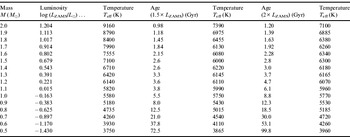
In Table 1, we present some characteristics of stellar evolution models for the mass range of 0.5–2 M ⊙. For comparison, we note that the solar age, according to our models, is given as 4.58 Gyr, see Schröder & Smith (Reference Schröder and Smith2008) (for a metallicity of Z=0.018), and the Sun's present-day effective temperature is identified as T eff=5774 K. Masses below 0.5 M ⊙, i.e. mostly M-type stars, have been omitted from our study. Their stellar evolution can be neglected; their luminosity and stellar temperature remain unchanged.
Stellar parameters

Moreover, stars of relatively large masses, i.e. M>2M ⊙ are also considered poor candidates for supporting life because the stellar lifetimes are almost certainly too short to permit the onset of biology. In Table 1, we list information on the target stars taken into consideration. Particularly, we convey the time for each stellar model at which the initial (i.e. zero-age main sequence) luminosity L ZAMS has increased by 50%, and when L ZAMS has doubled. Stars above 2 M ⊙ reach the stage at which they leave the main-sequence phase after less than a billion years. If we set a relatively low age limit of, say, 300 million years as a requirement for the development of complex life forms during the phase of slowly increasing stellar luminosity, we would limit the mass range of host stars of potentially life-bearing planets to a maximum of about 1.3 M ⊙.
In Table 1, we also list the stellar effective temperatures, which are a steep monotonic function of the stellar mass. Note that due to the appearance of increased photospheric UV fluxes, relatively high effective temperatures by themselves represent an adverse factor for the general possibility of advanced life forms (e.g. Cockell Reference Cockell1999; Cuntz et al. Reference Cuntz, Guinan, Kurucz, Kosovichev, Andrei and Rozelot2010), which is particularly relevant for stars of spectral type mid-F and earlier, although the biological impact of stellar UV environments is typically significantly altered by the attenuation of planetary atmospheres. This consideration is a further motivation to disregard stars with masses beyond 1.5 or 2.0 M ⊙ (i.e. early F stars) in the context of exobiology. Towards the low mass limit at about 0.5 M ⊙, there are virtually no stellar evolutionary changes for these stars while being on the main-sequence owing to the current age of the Universe. However, regarding M-type stars, adverse influences on the origin and development of sophisticated life forms also exist, particularly associated with strong UV, EUV and X-ray flaring (e.g. Hawley et al. Reference Hawley, Allred, Johns-Krull, Fisher, Abbett, Alekseev, Avgoloupis, Deustua, Gunn and Seiradakis2003; Scalo et al. Reference Scalo, Kaltenegger, Segura, Fridlund, Ribas, Kulikov, Grenfell, Rauer, Odert and Leitzinger2007; Cuntz et al. Reference Cuntz, Guinan, Kurucz, Kosovichev, Andrei and Rozelot2010; Segura et al. Reference Segura, Walkowicz, Meadows, Kasting and Hawley2010).
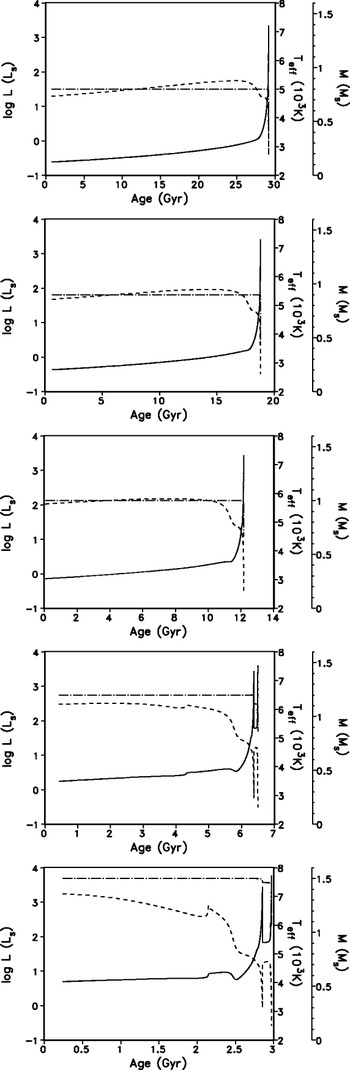
Close to about one solar mass, we find an interesting result: stars of, e.g. 0.9 M ⊙, still spend many billion years in increasing their luminosity from 1.5 times to 2 times of their zero-age main-sequence luminosity. During that phase, which is sufficiently stable and long-lived to provide the development of life forms, the initially significantly cooler effective temperature of such a star is closing in on that of the early Sun. This change of quality and quantity of the host star radiation could ‘unfreeze’ a planet, which was initially outside the habitable zone, and still leave it with enough time to develop complex life forms. When reaching about 1.5 times their zero-age main-sequence luminosity, stars of 0.9 M ⊙ have reached an age of about 8 billion years (see Fig. 2), much like the older stars of the thin galactic disk. Hence, several such cases should be found in present-day stellar samples of the solar neighbourhood. We also note that these stars continue to evolve quite slowly. It will take them several further billions of years to leave the main-sequence and to advance towards the RGB.
Stellar evolution models of stars of 0.8, 0.9, 1.0, 1.2 and 1.5 M ⊙ following Schröder & Smith (Reference Schröder and Smith2008), depicting the luminosity (solid line), the effective temperature (dashed line) and the mass (dash-dotted line). Note the vast differences in the x-axes within the figure panel.

A closer look at the mass range of 0.8–1.5 M⊙
As previously pointed out, the most promising types of stars for hosting life-bearing planets regarding our grid of models are those of 0.8, 0.9, 1.0 (Sun), 1.2 and 1.5 M ⊙. All these stars have a lot in common: they all evolve into red giants (RGB phase) after central hydrogen burning has ceased. The expansion of the outer layers of an RGB star is driven by two related processes: the contraction of the inner helium core, which has lost its stabilizing energy production, and the growing energy production by the hydrogen burning shell around it. This layer right above the contracting core experiences a steady density increase, which drives up the resulting stellar luminosity. The now much higher energy output of the hydrogen burning shell as well as the much higher density of the core region lead to a very expanded outer stellar structure, associated with a significant increase in stellar luminosity and radius (see Fig. 2). Additionally, the stellar structure is shaped by the onset of a cool wind, associated with significant mass loss (e.g. Dupree & Reimers Reference Dupree, Reimers and Kondo1987).
For our models of 1.0, 1.2 and 1.5 M ⊙, the appearance of a helium flash marks the end of the RGB phase, as the stars settle into a new equilibrium with a much less compact core (due to its new source of energy) and a consequently much less expanded outer structure. However, the post-RGB stellar evolution does not offer any promising aspects for the origin of life, since the relatively stable phase of central helium burning lasts only a few hundred million years. Furthermore, any ancient life forms on previously habitable worlds will most likely be destroyed, since in the extreme RGB phases those stars amount to 200–300 times of their initial sizes and several thousand times of their initial luminosities. This entails a complete nullification of previous zones of circumstellar habitability established during stellar main-sequence evolution.
However, despite such remarkable homogeneity concerning their main physical processes, stars in the range of 0.8–1.5 M ⊙ differ largely in their lifetimes; see Fig. 2 and Table 1 for details. On the upper RGB, the much longer times spent in that phase by low-mass stars have an interesting consequence: their mass loss experienced in this phase amounts to more than 0.4 M ⊙. This has dramatic implications for any existing planets at these stages noting that their orbital distances R increases as  . This may imply that a previously habitable planet may permanently leave the stellar habitable zone or, conversely, an inhabitable planet may enter the stellar habitable zone, and becomes ‘unfrozen’; see, e.g. Lopez et al. (Reference Lopez, Schneider and Danchi2005) and von Bloh et al. (Reference Von Bloh, Cuntz, Schröder, Bounama and Franck2009) for previous results for stars akin to the Sun.
In summary, it is the stellar main-sequence phase that is most relevant for the evolution of life on planets at a suitable distance. The slower the star increases its luminosity, the longer a planet stays within the slowly expanding habitable zone. Thus, all stars between 0.9 and 1.2 M ⊙ are potential host stars for life from the beginning of stellar evolution. Stars between 0.8 and 0.9 M ⊙ show an even slower change in stellar effective temperature and luminosity; in fact, they reach solar luminosity after 8 billion years. Detailed studies for the evolution of habitability, based on the definition of the climatological habitable zones (see below), during stellar lifetimes were given by Underwood et al. (Reference Underwood, Jones and Sleep2003) and others. Jones et al. (Reference Jones, Underwood and Sleep2005, Reference Jones, Sleep and Underwood2006) applied this framework to known exoplanetary systems to evaluate the possibility of habitable ‘Earths’. Stellar evolutionary aspects are also relevant to the future of life on Earth, as discussed by, e.g. Sackmann et al. (Reference Sackmann, Boothroyd and Kraemer1993) and Schröder & Smith (Reference Schröder and Smith2008), although the impact of geodynamic processes appears to be dominant for setting the time limit of terrestrial habitability (Franck et al. Reference Franck, von Bloh, Bounama, Steffen, Schönberner and Schellnhuber2000b).
Habitability of super-Earth planets
pHZ
Customary simulations about the role of stellar evolution on circumstellar habitability typically invoke the framework of the climatic habitable zone (Kasting et al. Reference Kasting, Whitmire and Reynolds1993; Selsis et al. Reference Selsis, Kasting, Levrard, Paillet, Ribas and Delfosse2007). In this type of models, the zone of habitability at a given evolutionary time for a star with luminosity L and effective temperature T eff can be calculated following Underwood et al. (Reference Underwood, Jones and Sleep2003) as

with S in(T eff) and S out(T eff) described as second-order polynomials.
It is the purpose of this paper to expand the focus of Paper I, which is solely focused on the Sun. Paper I is based on the concept that the habitability of super-Earth planets is evaluated via a modified Earth system model that describes the evolution of the temperature and atmospheric CO2 concentration. On Earth, the carbonate–silicate cycle is the crucial element for a long-term homeostasis under increasing solar luminosity. On geological timescales, the deeper parts of the Earth are considerable sinks and sources of carbon.
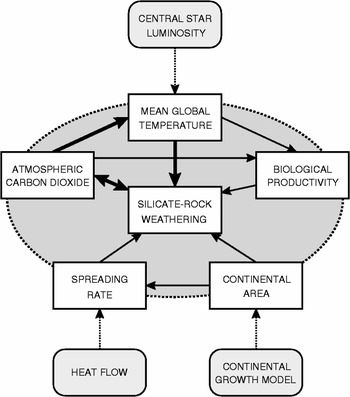
Our numerical model was previously applied to the super-Earths Gl 581c and Gl 581d (von Bloh et al. Reference Von Bloh, Bounama, Cuntz and Franck2007), the putative super-Earth Gl 581g (von Bloh et al. Reference Von Bloh, Cuntz, Franck and Bounama2011) as well as fictitious Earth-mass planets around 47 UMa and 55 Cnc (Cuntz et al. Reference Cuntz, von Bloh, Bounama and Franck2003; Franck et al. Reference Franck, Cuntz, von Bloh and Bounama2003; von Bloh et al. Reference Von Bloh, Cuntz, Franck and Bounama2003), among numerous other studies. This model couples the stellar luminosity L, the silicate–rock weathering rate F wr and the global energy balance to obtain estimates of the partial pressure of atmospheric carbon dioxide  , the mean global surface temperature T surf, and the biological productivity Π as a function of time t (Fig. 3). The main point is the persistent balance between the CO2 sink within the atmosphere–ocean system and its metamorphic (plate tectonic) sources. This is expressed through the dimensionless quantities

where f wr(t)≡F wr(t)/F wr,0 is the weathering rate, f A(t)≡A c(t)/A c,0 is the continental area and f sr(t)≡S(t)/S 0 is the areal spreading rate, which are all normalized by their present values of Earth. Equation (2) can be rearranged by introducing the geophysical forcing ratio GFR (Volk Reference Volk1987) as

Here we assume that the weathering rate only depends on the global surface temperature and the atmospheric CO2 concentration. For the investigation of a super-Earth under external forcing, we adopt a model planet with a prescribed continental area. The fraction of continental area with respect to the total planetary surface f A is varied between 0.1 and 0.9.
Box model of the integrated system approach adopted in our model. The arrows indicate the different types of forcing, which are the main feedback loop for stabilizing the climate (thick solid arrows), the feedback loop within the system (thin solid arrows) and the external and internal forcings (dashed arrows).

The connection between the stellar parameters and the planetary climate can be obtained by using a radiation balance equation (Williams Reference Williams1998):

where a denotes the planetary albedo, I R the outgoing infrared flux, and R the planetary distance from the central star. Equations (3) and (4) constitute a set of two coupled equations with two unknowns, T surf and , if the parameterization of the weathering rate, the luminosity, the planetary distance to the central star and the geophysical forcing ratio are specified. Therefore, a numerical solution can be attained in a straightforward manner.
In the framework of the described model the domain of distances R for a super-Earth planet from its respective main-sequence star for which a photosynthesis-active biosphere is productive (Π>0) can be calculated. It is defined as the pHz given as

In our model, biological productivity is considered to be solely a function of the surface temperature and the CO2 partial pressure of the atmosphere. Our parameterization yields zero productivity for T surf⩽0°C or T surf⩾100°C or  bar (Franck et al. Reference Franck, Block, von Bloh, Bounama, Schellnhuber and Svirezhev2000a). The inner and outer boundaries of the pHZ do not depend on the detailed parameterization of the biological productivity within the temperature and pressure tolerance window.
The maximum lifespan of a photosynthetic-active biosphere t max is the point in time when a planet at an optimum distance from its central star R opt finally leaves the pHZ

Note that the evaluation of pHZ(t) and t max will be essential to our models of circumstellar habitability.
Comments on the thermal evolution model
Parameterized convection models are the simplest models for the investigation of the thermal evolution of terrestrial planets and satellites. They have successfully been applied to the evolution of Mercury, Venus, Earth, Mars and the Moon (Stevenson et al. Reference Stevenson, Spohn and Schubert1983; Sleep Reference Sleep2000). Franck & Bounama (Reference Franck and Bounama1995) studied the thermal and volatile history of Earth and Venus in the framework of comparative planetology. The internal structure of massive terrestrial planets with 1–10 Earth masses has been investigated by Valencia et al. (Reference Valencia, O'Connell and Sasselov2006) to obtain scaling laws for the total radius, mantle thickness, core size and average density as a function of mass. Similar scaling laws were found for different compositions. We will use these scaling laws for mass-dependent properties of our super-Earth models. Moreover, we will also use the mass-independent material properties previously given by Franck & Bounama (Reference Franck and Bounama1995).
The thermal history and future of a super-Earth planet has to be determined to calculate the spreading rate for solving key equation (2). A parameterized model of whole mantle convection including the volatile exchange between the mantle and surface reservoirs (Franck & Bounama Reference Franck and Bounama1995; Franck Reference Franck1998) is applied. The key equations used in our present study are in accord with our previous work focused on Gl 581c, Gl 581d and Gl 581g; see von Bloh et al. (Reference Von Bloh, Bounama, Cuntz and Franck2007, Reference Von Bloh, Cuntz, Franck and Bounama2011) for details. A key element is the computation of the areal spreading rate S; note that S is a function of the average mantle temperature T m, the surface temperature T surf, the heat flow from the mantle q m, and the area of ocean basins A 0 (Turcotte & Schubert Reference Turcotte and Schubert2002). It is given as

where κ is the thermal diffusivity and k the thermal conductivity. To calculate the spreading rate, the thermal evolution of the mantle has been computed:

where ρ is the density, c is the specific heat at constant pressure, E(t) is the energy production rate by decay of radiogenic heat sources in the mantle per unit volume, and R m and R c are the outer and inner radii of the mantle, respectively. To calculate the thermal evolution for a planet of several Earth masses the planetary parameters have to be adjusted. Therefore, we assume

and where R p and M p are the planetary radius and mass, respectively, see Valencia et al. (Reference Valencia, O'Connell and Sasselov2006).
The total radius, mantle thickness, core size and average density are all functions of mass, with the subscript ⊕ denoting Earth values. The exponent of 0.27 has been obtained for super-Earths. The values of R p, R m, R c, as well as the other planetary properties are scaled accordingly. Table 2 gives a summary of these size parameters for the planetary models between 1 and 10 M ⊕; see the studies by von Bloh et al. (Reference Von Bloh, Bounama, Cuntz and Franck2007, Reference Von Bloh, Cuntz, Franck and Bounama2011) for additional information including parameters for the mass-independent quantities. According to Valencia & O'Connell (Reference Valencia and O'Connell2009), we assume that a more massive planet is likely to convect in a plate tectonic regime similar to Earth. Thus, the more massive the planet, the higher the Rayleigh number that controls convection, the thinner the top boundary layer (lithosphere), and the higher the convective velocities.
Planetary parameters

We recognize that there is an ongoing debate about the onset and significance of plate tectonics on super-Earth planets. On the one hand, Stein et al. (Reference Stein, Schmalzl and Hansen2004) and O'Neill & Lenardic (Reference O'Neill and Lenardic2007) pointed out that there might be in an episodic or stagnant lid regime, considering that increasing the planetary radius acts to decrease the ratio of driving to resisting stresses, an effect that appears to be robust when increases in planetary gravity are included. Other thermodynamic processes that peak at different planet masses (e.g. Noack & Breuer Reference Noack and Breuer2011) operate as well. On the other hand, Valencia et al. (Reference Valencia, Sasselov and O'Connell2007) and Valencia & O'Connell (Reference Valencia and O'Connell2009) argued that plate tectonics of super-Earths should be considered inevitable. Their models show that as the planetary mass increases, the shear stress to overcome resistance to plate thickness increases, while the plate thickness decreases, and thereby enhancing plate weakness. These effects contribute favourably to the subduction of the lithosphere (like on Earth), a crucial component of plate tectonics. Noting that in the framework of our model, a plate-tectonic–driven carbon cycle is considered necessary and essential for carbon-based life, we will assume the existence of plate tectonics on super-Earths for our models in the following.
Results and discussion
Habitability based on the integrated system approach
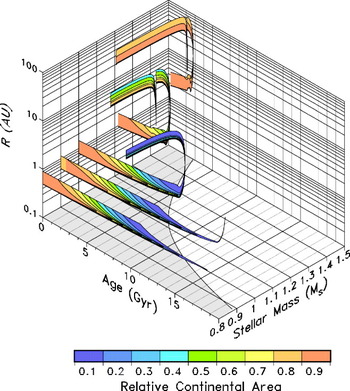
We calculated the pHz zones for a 10 M ⊕ super-Earth with relative continental areas between r=0.1 and 0.9 orbiting central stars in the mass range between 0.8 and 1.5 M ⊙. The results are shown in Fig. 4. The width of the pHZ during the main-sequence evolution is found to be approximately constant for all stellar models taken into account. For stellar mass M<0.9 M ⊙ the pHZ ceases to exist before the main-sequence evolution ends, while for higher stellar masses the width of the pHZ increases significantly and moves outward in time. The timescale of this process critically depends on the stellar mass, as expected.
The pHZ for a 10-Earth-mass planet orbiting an M=0.8, 0.9, 1.0, 1.2 and 1.5 M ⊙ star also considering post–main-sequence evolution. The grey-shaded area at the bottom denotes the time period of the stellar main-sequence evolution. Note the ‘bending-over’ of the colour-coded areas for stars with masses of 1.0 M ⊙ and above due to the drastic increases in the stellar luminosities and the associated increases of the stellar mass loss rates.

‘Water worlds’, i.e. planets mostly covered by oceans, are favoured in the facilitation of habitability during this stage as previously obtained in the context of long-term evolution studies for hypothetical Earth-mass and super-Earth planets in various star–planet systems (Franck et al. Reference Franck, Cuntz, von Bloh and Bounama2003; von Bloh et al. Reference Von Bloh, Cuntz, Franck and Bounama2003, Reference Von Bloh, Bounama, Cuntz and Franck2007, Reference Von Bloh, Cuntz, Schröder, Bounama and Franck2009). In principle, the favoured existence of water worlds instead of land worlds around stars during their phase of RGB evolution constitutes a possible extension of the outer edge of circumstellar habitability. The reason for the favourism of water worlds under those circumstances is that planets with a considerable continental area have relatively high weathering rates that provide the main sink of atmospheric CO2. Therefore, this type of planets are unable to build up CO2-rich atmospheres that prevent the planet from freezing over, which in turn is thwarting the possibility of photosynthesis-based life.
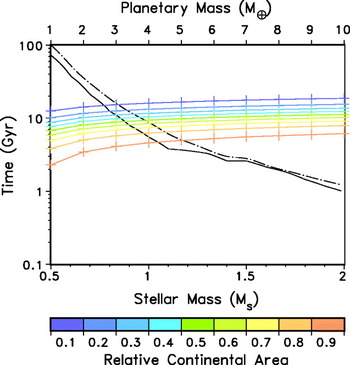
The maximum lifespans t max (equation 6) of super-Earth planets have been calculated for a grid of planetary masses between 1 and 10 M ⊕ in increments of 1 M ⊕ and relative continental areas r between 0.1 and 0.9. Figure 5 depicts t max as a function of the planetary mass. It is found that t max increases with planetary mass and, furthermore, decreases for increasing r values. In addition, we depict the timespans of habitability as a function of the stellar mass when the central star reaches a luminosity of L=1.5 L ZAMS and L=2 L ZAMS with L ZAMS as the initial (i.e. zero-age main sequence) luminosity at time t=0.
The maximum lifespan of the biosphere t max in dependence on the planetary mass M (coloured solid lines). The graphs are colour coded by the assumed portion of the planetary surface covered by continents r. The solid black line denotes the time when the star reaches a luminosity of L=1.5 L ZAMS, while the dash-dotted line denotes the time for L=2.0 L ZAMS.

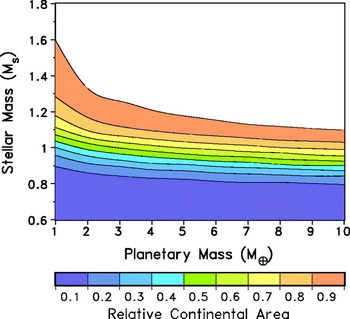
Moreover, in Fig. 6 the critical central stellar mass is depicted dependent on the planetary mass up to which the lifespan of the biosphere is solely determined by t max (color-shaded areas) instead by the increase in stellar luminosity (white area). It is found that the biospheric lifespan of super-Earth planets for central stars with masses above about 1.5 M ⊙ is always limited by the increase in stellar luminosity. For central star masses below 0.9 M ⊙, it is solely determined by t max, i.e. the maximal geodynamic lifespan of the biosphere can always be realized irrespectively of the stellar nuclear evolution. For central star masses between 0.9 and 1.5 M ⊙ the situation depends on the relative continental area r.
The critical mass of the central star as a function of the planetary mass up to which the lifespan of the biosphere is solely determined by the maximum geodynamic lifespan (colour-coded area) instead of the time of the stellar nuclear evolution, i.e. when the star reaches a luminosity of L=2.0 L ZAMS (white area). Different colours correlate to different relative continental areas of the model planet.

Main-sequence stars with masses between 0.5 and 0.9 M ⊙ belong to late-type G, K, and early M stars. The luminosity of such stars remains almost constant during their entire nuclear evolution on the main-sequence. Therefore, planets within the habitable zone would remain habitable for a very long period of time if the geodynamic evolution of the planet is not taken into account. In these cases, the planetary evolution is driven by the long-term cooling of the planetary interior. Therefore, diminished internal forcing will affect the planetary habitability of the biospheres. In the framework of the adopted models it is found that the maximum lifespan of super-Earth planets around low-mass stars depends almost entirely on the properties of the planet. It is known, however, that other factors are also expected to potentially impact or limit the habitability in the environments of late K and M stars, encompassing effects associated with, e.g. tidal locking of the planet and stellar flares (e.g. Lammer Reference Lammer2007; Tarter et al. Reference Tarter, Backus, Mancinelli, Aurnou, Backman, Basri, Boss, Clarke, Deming and Doyle2007; Selsis et al. Reference Selsis, Kasting, Levrard, Paillet, Ribas and Delfosse2007; Lammer et al. Reference Lammer, Bredehöft, Coustenis, Khodachenko, Kaltenegger, Grasset, Prieur, Raulin, Ehrenfreund and Yamauchi2009; Segura et al. Reference Segura, Walkowicz, Meadows, Kasting and Hawley2010; Heller et al. Reference Heller, Leconte and Barnes2011).
Summary and conclusions
We investigated the habitability of super-Earth planets in the environments of main-sequence stars of masses between 0.5 and 2.0 M ⊙. This work complements a previous study that has been focused on stars akin to the Sun (M=1 M ⊙), see von Bloh et al. (Reference Von Bloh, Cuntz, Schröder, Bounama and Franck2009). Both studies employ the concept of planetary habitability based on the integrated system approach that describes the photosynthetic biomass production by taking into account a variety of climatological, biogeochemical and geodynamical processes. Among the various assumptions entertained as part of our study, we consider that super-Earth planets are expected to develop plate tectonics, an assumption critical to our models, although it is currently under serious scrutiny. Pertaining to the different types of stars, we identify so-called pHZs determined by the limits of biological productivity on the planetary surface. We obtain various sets of solutions consistent with the principal possibility of life. Our models are based on an advanced version of the Eggleton stellar evolution code that considers updated opacities and an updated equation of state as described by Pols et al. (Reference Pols, Tout, Eggleton and Han1995, Reference Pols, Schröder, Hurley, Tout and Eggleton1998). Additionally, an improved description of mass loss is implemented following the work by Schröder & Cuntz (Reference Schröder and Cuntz2005).
Considering that high-mass stars depart from the main-sequence much faster than low-mass stars, it was found that the biospheric lifespan of super-Earth planets of stars with masses above approximately 1.5 M ⊙ is always limited by the increase in stellar luminosity dictated by stellar nuclear evolution. However, for stars with masses below 0.9 M ⊙, the lifespan of super-Earths is solely determined by the geodynamic timescale. Clearly, the luminosity of stars with spectral type mid-K or later has not deviated much from their ZAMS luminosities owing to the limited age of the Universe. For central star masses between 0.9 and 1.5 M ⊙, the possibility of life in the framework of our models depends on the relative continental areas of the super-Earth planets.
A crucial finding of our study is that planets of large geological age are expected to be water worlds, i.e. planets with a relatively small continental area. The reason why land worlds are considered to be unfavourable is that planets with a considerable continental area have relatively high weathering rates that provide the main sink of atmospheric CO2. Therefore, these types of planets are unable to build up CO2-rich atmospheres that prevent the planet from freezing over, thus allowing for the possibility of photosynthesis-based life. Our study is both expanding and superseding previous work, including the study by Franck et al. (Reference Franck, von Bloh, Bounama, Steffen, Schönberner and Schellnhuber2000b). This work solely considered Earth-mass planets instead of also including super-Earth planets. Additionally, it considered a linear growth model for the continental growth and refrained from taking into account post–main-sequence evolution. Although the evolutionary timescales for stars on the RGB are short compared with the time spent on the main-sequence, habitable planets around red giants should be considered a realistic possibility, as previously pointed out by Lopez et al. (Reference Lopez, Schneider and Danchi2005), von Bloh et al. (Reference Von Bloh, Cuntz, Schröder, Bounama and Franck2009) and others. However, for central stars with higher masses than the Sun, a more rapid evolution will occur that will also place significant temporal and spatial constraints on planetary habitability when the central stars have reached the RGB.
Acknowledgements
This article is dedicated to Siegfried Franck who passed away unexpectedly on 16 May 2011.