1. Introduction
Cities are the natural homes for linguistic and cultural diversity. Valletta, Malta's capital city and the smallest city in the European Union, is no different. When its foundation stone was laid in 1566 by Grandmaster Jean Parisot de Vallette, it was given the formal title of Humillima Civitas Valettae, but ‘there is little that is humble about the appearance of Valletta, that city “built by gentlemen for gentlemen”’ (Luke, Reference Luke1968: 65).
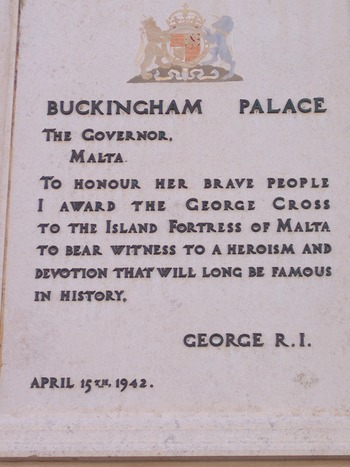
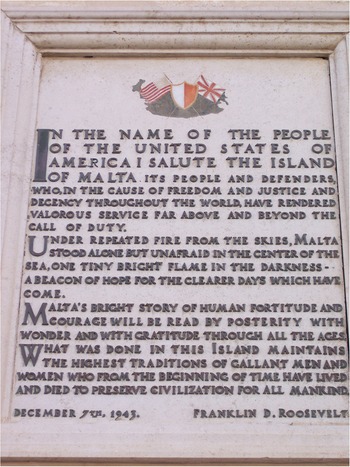
Prior to its development, Valletta was a desolate peninsula and the Knights of St John invested a lot of money and resources to embellish it with imposing auberges, majestic palaces and grand churches, most of which still stand today. Unfortunately, some of the buildings did not withstand the heavy bombing during World War II, a most tumultuous time for Malta, then a colony of Britain. Its strategic position at the centre of the Mediterranean Sea was much coveted. The harbours around Valletta were heavily blitzed by the German and Italian foes. Nevertheless, Malta did not surrender and the heroism of its people did not go unnoticed and unrecompensed. In April 1942, King George VI awarded the island the prestigious George Cross, and in December 1943, the American president Franklin Roosevelt lauded Malta's central role during the war by saying it was ‘a tiny bright flake in the darkness – a beacon of hope’. The two commemorative marble plaques on the façade of the Grandmaster's palace in St George's Square in Valletta (Figures 1 and 2) reproduce the contents of these two letters.
George Cross Award

Franklin Roosevelt's letter

In 1964, Malta was granted independence from Britain and a decade later became a Republic. In 1980, Valletta was chosen by UNESCO as a World Heritage Site. Throughout 2018 it held the title of the European Capital of Culture.
Another major event in Malta's multifarious history took place in 2004, when it was accorded full membership within the European Union. Two years earlier, in 2002, the islanders’ indigenous and Semitic-based language, Maltese, was included in the EU's long list of official languages. Even though both English and Maltese had been the official languages of Malta since 1934, three decades later, when Malta became an independent state within the Commonwealth, the new Constitution highlighted the importance of Maltese by giving it both a national and an official status. Chapter 2, Article 5 of the Constitution of Malta stipulates the official languages and the status of Maltese as the national language.
Furthermore, in 2005, L-Att dwar l-Ilsien Malti (The Maltese Language Act) was promulgated so as to promote and safeguard Maltese. Through this Act, the Kunsill Nazzjonali tal-Ilsien Malti (National Council for the Maltese Language) was set up. This Council promotes the study of Maltese and ensures its proper use in educational and government institutions as well in the public domain; in our case, in public signage.
1. 1 Why choose Valletta?
Valletta was chosen for this study for a number of reasons. Firstly, it is the capital city of Malta, the tiny island of the Maltese people. Linguistic Landscape (LL) research has been carried out in a number of capital cities such as Brussels (Tulp, Reference Tulp1978), Jerusalem (Spolsky & Cooper, Reference Spolsky and Cooper1991), Prague (Pipalová, Reference Pípalová and Sciriha2020) and Tokyo (Backhaus, Reference Backhaus2007). Secondly, Valletta has been a UNESCO World Heritage Site since 1980, and it held the title of the European City of Culture in 2018. Thirdly, it is a both a commercial locality with many businesses and shops, and a residential locality for the Maltese. Fourthly, Valletta is also home to several of the country's government, cultural and religious institutions, such as parliament, the law courts, some government administrative offices, museums, the Grandmaster's palace, the archbishop's palace, and several baroque churches, foremost among which is St John's Co- Cathedral. Finally, Valletta is the most frequently visited city by both Maltese and foreigners in Malta.
2. Aims
In this study, the signs collected in Valletta were quantitatively and qualitatively analysed. The analysis checked for differences in the number of languages featuring in these signs, and whether some languages are given more prominence. Also considered was the combination of languages in bilingual and multilingual signs, as outlined by Scollon and Wong Scollon (Reference Scollon and Wong Scollon2003).
These research questions will be answered in the next section on Findings in the following order:
1. How many monolingual, bilingual and multilingual signs comprise the Valletta corpus?
2. Which of the two official languages is given prominence in bilingual signs?
3. How many autonomous languages appear in the corpus ?
3. Methodology
A quantitative research method was adopted for the LL fieldwork in Valletta. The main street of this city, Republic Street was chosen and a variety of data (in the form of street names, house names, names of shops, parking, traffic signs etc.) was digitally captured.
In this study, a sign is a publicly displayed notice which is intended to inform, direct, appeal, request or warn. The special interest in the Valletta corpus is the fact that the setting is an officially-bilingual one and therefore the choice of languages and their positions can be used as an important vantage point to explore deeper meanings on the city's identity. Signs which could not be clearly deciphered because of their degraded physical condition were not included in the corpus. Each sign was captured, classified, coded and eventually processed with IBM SPSS27. In the process, each photo was accordingly assigned a unique number and coded by linguistic category (i.e. monolingual, bilingual and multilingual) and by language (Italian, English, French etc.). In respect of bilingual and multilingual signs, a coding frame was created to take into consideration the combination of languages as they appear on each sign. This is in line with the guidance of Scollon and Wong Scollon (Reference Scollon and Wong Scollon2003: 120):
In most cases studied so far, the preferred code is located above the secondary or peripheral codes if they are aligned vertically; if they are aligned horizontally the preferred is located in the left position and the peripheral code is located in the right position. A third possibility is that the preferred code is located in the center and the peripheral code is placed around the periphery.
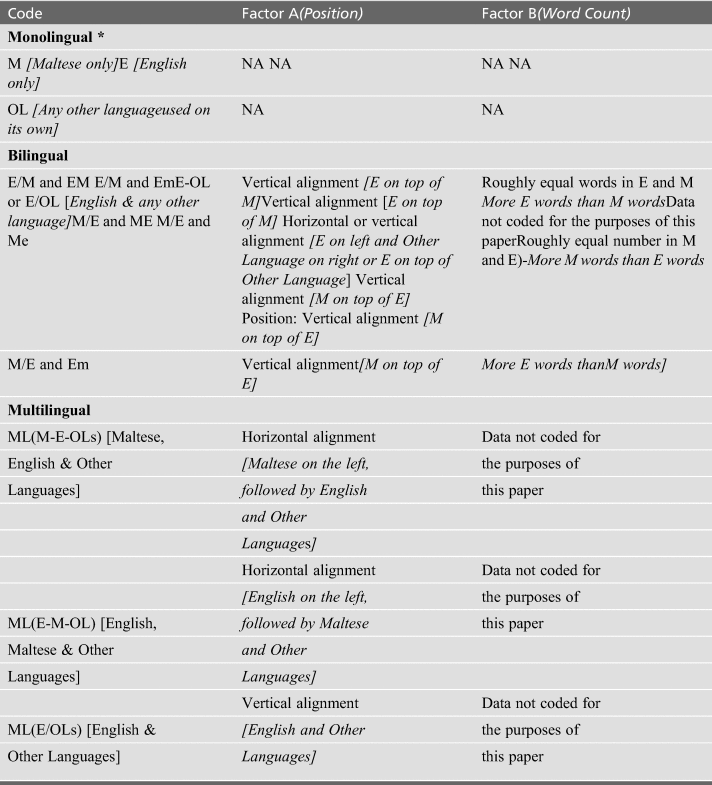
The above principles have been broadly adopted as the coding frame for this paper. However, in view of the diversity of signs in Valletta, a special bi-factorial coding frame was developed to analyse bilingual signs in Malta's capital. Each code accordingly fuses the two factors in this way:
Factor A: the physical position of the two languages on the sign; and Factor B: the number of words used in each language.
The merging of these two factors on the one hand simplifies the analysis, and, on the other, allows for a more holistic analysis. Table 1 presents the coding frame which was used for easy reference, divided into three sections. The bi-factorial codes used to analyse the bilingual signs is clearly identifiable in Table 1, with full explanations presented in the respective box for each code.
Coding frame

*Note: In the case of signs in one language only (Monolingual), Factor A (Position) and Factor B (Relative Word Count) are irrelevant. So the respective boxes are marked Not Applicable (NA)
4. Findings
4.1 Overview of languages used in signs in the Valletta corpus
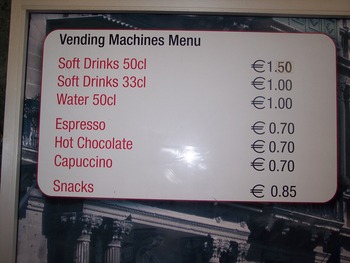
The corpus comprised 472 signs of which 79 (17%) were official or government signs, while the vast majority (83%) were unofficial or non-government signs. Figures 3 and 4 are examples of signs from these two domains.
Official sign in English

Unofficial sign in English

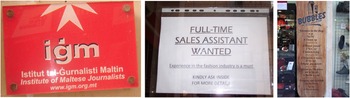
As noted earlier, all signs were categorised by linguistic category into monolingual, bilingual and multilingual signs. Most signs were monolingual (N = 410, 87%), a much smaller number were bilingual signs (N = 56, 12%) and a mere six signs (1%) were multilingual. Figure 5 displays signs in each of these three linguistic categories.
Monolingual, bilingual and multilingual signs

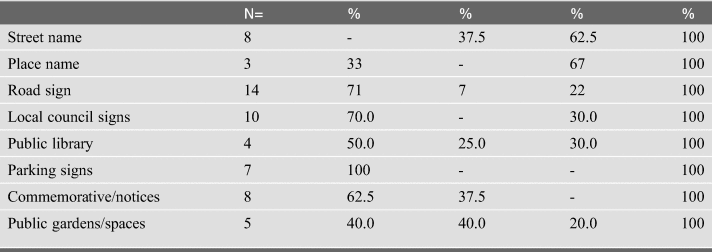
The signs were categorised not only by official and unofficial domains, but the contexts of the signs were also noted. As shown in Table 2, the presence of English only signs in the official domain is quite high, except in street names where it is only present in bilingual signs with Maltese. Since Republic Street is a very long one, there were eight instances of this street name. Of particular note is the fact that in this set there are five bilingual signs in Maltese and English, while the other three signs are in Maltese only. Again, signs showing the place name were repeated but at times the name was in English only and other times they were bilingually in Maltese and English. On the other hand, all parking signs are in English only (100%) and in other contexts there are also high percentages of signs in English: 71% of road signs, 70% of local council signs and 62.5% of commemorative signs. In some contexts there is a high presence of bilingual signs, especially in place names (67%) and street names (62.5%), while in others, there are much lower percentages (e.g. public gardens/spaces, 20%). In contexts such as those related to parking, or commemorative plaques, no bilingual signs were present in the corpus. Figure 6 portrays the presence of English only signs in four contexts: (i) commemorative plaque, (ii) local council directional sign, (iii) parking sign and (iv) road sign.
Official signs in contexts from left to right: (i) commemorative plaque; (ii) local council directional sign; (iii) parking sign; (iv) road sign

Presence of English by official domain and selected contexts

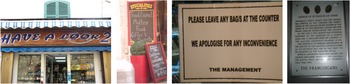
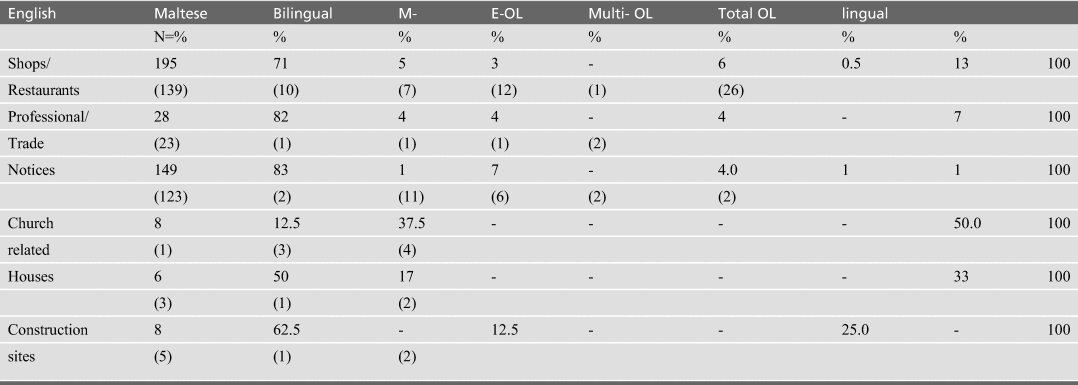
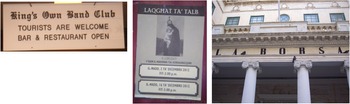
English has a huge presence in the unofficial domain in all contexts (Table 3). A qualitative analysis of the official and unofficial domains) shows that the data in the unofficial domain (Table 3) is much more diverse. Indeed, in the unofficial domain (Table 3) bilingual signs accompanied by OL are present only with English as one of the other languages (E-OL or E/OL). Maltese is not included in such a bilingual combination. English is visible not only with Maltese with whom it is co-official, but also with other languages such as Italian and other languages. No bilingual signs were captured with Maltese and other languages. The highest numbers registered in respect of English only signs in this unofficial domain are found in shops (71.3%) and notices (82.6%). Other contexts include professional/trade signs (82.1%), notices on construction sites (62.5%) and house names (50%). Figure 7 gives a sample of English only signs in four contexts: (i) shop, (ii) restaurant, (iii) notice and (iv) church-related.
Unofficial signs in four contexts from left to right: (i) shop name; (ii) restaurant menu; (iii) notice; (iv) church-related information

Presence of English signs by unofficial domain and selected contexts

4.2 Relative importance of languages in in bilingual signs
Bilingual signage in Valletta is not that frequent, even though one would expect it to be so in the capital city of an officially bilingual country. As previously discussed, only 56 (12%) of these signs are present and are mostly found in the official domain, e.g. street names and place names (Table 2). The categorisation of these bilingual signs was based on Scollon and Wong Scollon (Reference Scollon and Wong Scollon2003).
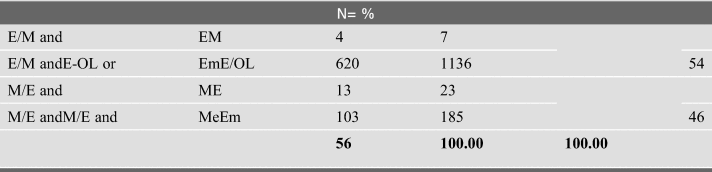
Table 4 gives a breakdown of bilingual signs by language dominance. A total of 30 signs (54%) are English dominant and a slightly lower percentage of 47% (N = 26) are Maltese dominant. It is apposite to remark that a total of 20 bilingual signs in the corpus include only English as one of the official languages. In such signs the invisibility of Maltese is stark.
Dominance of English and Maltese in bilingual signs

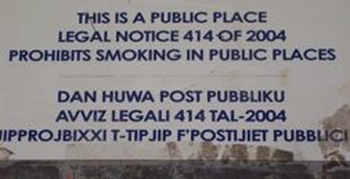
Of the bilingual signs in the corpus, two examples have been selected for a qualitative analysis (Figures 8 and 9). Though the interpretation of the official sign Legal Notice Prohibiting Smoking (Figure 8) is straightforward, it is not the case with the unofficial one (Figure 9). As shown in Figure 8, both language versions are printed in capital letters; the dominance of English is evident because it is in the preferred position at the top of the vertically aligned sign. Moreover, both versions are in the same font type and size and roughly the same number of words are used in both languages (E/M and EM).
English-dominant official sign

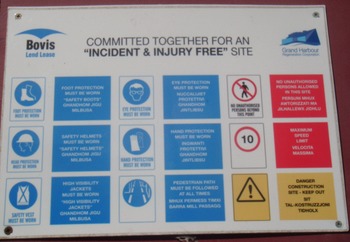
English-dominant unofficial sign

The second example is an unofficial bilingual sign on the use of Personal Protective Equipment (Figure 9). This sign is more complex compared to the previously analysed official sign. It includes more information and can roughly be divided into two parts, i.e. the title is the first part and in the second part there is the main body of the text. A closer look at this sign raises a number of interesting points, i.e. (i) English dominance is clearly shown by the title's capital letters and the much larger font size compared to the rest of the text. It is also at the centre of the sign. Noteworthy is the fact that unlike the previous official sign, the title is not translated into Maltese. (ii) In addition to the title which stands out due to the larger font size and use of capital letters, the main body of the sign, which takes up the most space, is partitioned into four columns. The first and the third columns (left-to-right reading direction) each include four icons or ‘picture of the thing in the world’ (Scollon & Wong Scollon, Reference Scollon and Wong Scollon2003: vii). All icons, except one, are accompanied underneath by a description in English. (iii) The second and fourth columns are a repetition of the contents of the first and third columns, respectively. However, this time there are both English and Maltese versions of the text. In these columns, the dominance of English is manifested by its preferred position at the top, while the Maltese translation lies directly beneath it.
Striking is the fact that several English words such as ‘safety boots’, ‘safety helmets’ and ‘high visibility jackets’ are not translated into Maltese and instead are placed within single inverted commas to show that these words have been retained in toto from English. This is quite puzzling since all these words do have equivalents in Maltese. Does this point to the inability of the sign-writer to find exact Maltese equivalents for all of them, or does it reveal that the sign-writer deliberately took the decision not to translate them because although there are lexicalised Maltese equivalents, these are not commonly used? Moreover, rather perplexing is the last icon in the third column, which is missing an English interpretation. It is the only icon without the accompanying English words. Was there not enough space for ‘Pedestrian path must be followed at all times?’ Visually, this icon stands out because of the omission of its interpretation in words. Was this done on purpose? Did the sign-writer wish to highlight this icon more than the others? Is it just carelessness on the part of the sign-writer?
4.3 Overview of autonomous languages in the corpus
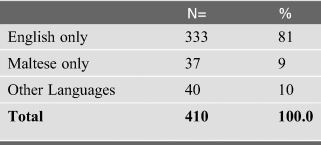
As noted earlier, English is not only the dominant language in the majority of bilingual signs, but as is clearly evident in Table 5, it has a colossal presence as an autonomous language. Of the total number of autonomous signs (N = 410), an impressive 333 signs (81%) are in English only. Clearly, it towers over its co-official language Maltese, which is only visible as an autonomous language in just 37 signs (9%) which is an even lower number than the sum of the signs in Other Languages (non-official languages in Malta) present in Valletta (10%). As such, the presence of the island's national language is surprisingly indeed very low, despite concerted efforts by successive governments to improve its visibility in the LL. To what extent has the Maltese Language Act (2005) influenced sign-writers’ willingness to write in Maltese? Though this Act encourages the use of Maltese, in no way does it enforce sign-writers to adopt Maltese. The Charter of the French Language, known as Bill 101, enacted in the city of Quebec in Canada in 1977 had initially stipulated that all commercial and outdoor signage should be in French only, but an amendment came into force in 1993 so that other languages could be included together with French in public signage (Parisella, Reference Parisella2013). From the findings of Valletta's LL, there seems to be little desire to promote Maltese in public signage despite the fact that Maltese is overwhelmingly spoken in all contexts in the daily lives of the Maltese. This chasm between the spoken and written forms of the island's national language has often been commented upon (Sciriha & Vassallo, Reference Sciriha and Vassallo2006; Vassallo & Sciriha, Reference Vassallo, Sciriha and Sciriha2020). One might ask whether it is such a difficult language to write or are the sign-writers purposely using English, a global language, to market their products?
Autonomous languages in Valletta's LL

What explains the presence of Other Languages such as Italian, French, Latin and German in
Valletta? Table 5 gives a breakdown of the languages found in Valletta's LL. The presence of Italian as the third language in the capital's LL is noteworthy, and presumably used to cater for the increasing number of visitors from neighbouring Italy. This fact has also been highlighted in other LL studies in Malta (Sciriha & Vassallo, Reference Sciriha and Vassallo2015). Figure 10 provides examples of autonomous languages by context and unofficial domain.
Unofficial signs in the three most visible languages from left to right: (i) English; (ii) Maltese; (iii) Italian

5. Conclusion
The extensive presence of English reflects its unrivalled current status as a world language. It also shows that the Maltese sign-writers are proficient in written English. After all it is one of the two languages that they have been formally taught at school. Thus, they satisfy the first rule of Spolsky and Cooper (Reference Spolsky and Cooper1991), which states that the sign-writer needs to know the language in which he or she is writing the sign. For most Maltese sign-writers, English is a second language, and they are at ease composing signs in this language.
The dominance of Maltese in Maltese and English official bilingual signs is also to be expected, in view of the efforts taken by successive governments to increase the visibility and salience of the national language. But what is unexpected is the inclusion of bilingual signs in English and another language (E-OL or E/OL) in the unofficial domain, in contrast to the fact that no bilingual sign was captured with Maltese and another language in the same unofficial domain.
Furthermore, noteworthy is the presence of 14 autonomous languages in Valletta's LL. What do these combinations of languages in bilingual signs and the breadth of languages in autonomous signs in Valletta mean? And what, in particular, explains the extensive use of English, an official, but not the national language?
The only plausible explanation that fits the model used by the sign-writers is that there is virtually little or no interest in promoting the national language as the core element of linguistic policy through the LL of Valletta's main street. The incidence of English by far supersedes that of Maltese. The dominance of Maltese in bilingual Maltese and English signs is present only in some signs in the official domain. As such, Maltese is not being used for its own sake, as a reflection of the identity value it has for the Maltese and as a surrogate of their societal identity. Clearly, Maltese unofficial sign-writers have no overriding interest in being identified as Maltese. In this domain, the creators of the Valletta signs do not entertain a predominant value orientation in their choice of language. Instead, they clearly opt for an instrumental value: their main interest is the extent to which their message can be understood by the largest number of persons, and therefore English is used. This is partly understandable because signs are intended to lead, to point, and to provide information to as many persons as possible. The use of English in Valletta as the medium with the highest reach, clearly reflects instrumental rationality, an option that is completely devoid of considerations about the intrinsic values of Maltese, Malta's national language.
The choice of English, extensively on its own, or given more visibility when used with other languages, is all too obviously founded only on purposeful/instrumental rationality. This is another instance where Max Weber's distinction between Wertrationalität and Zweckrationalität is a useful construct, the significance of which extends far beyond the analysis of social change as it has traditionally been used (Mueller, Reference Mueller1979; Weiß, Reference Weiß, Seebaß and Tuomela1985). It is a distinction which can be very useful to analyse and understand the frame of mind which, unwittingly, sign creators adopt, even as they, independently of each other, create the linguistic landscape of a city or a country.
The answers to the three research questions throw an important light on the vicissitudes of Valletta, on its history and on the multifarious roles it played in the past. The range of languages used in public signage reflects the confluence of Valletta's current role as a capital city of a minute state and its international role at the crossroads of different Mediterranean cultures.
 LYDIA SCIRIHA has been lecturing in the Department of English at the University of Malta since 1987. In 2001 she was promoted to Professor – the second female academic to be accorded this rank in an institution that was founded in 1769. Over the years she has taught in several universities in Europe and in Australia. Her publications include 16 books (authored/co-authored and edited) and many scientific papers. Email: lydia.sciriha@um.edu.mt
 MARIO VASSALLO graduated in Economics, Philosophy and Italian at the University of Malta and at the University of Oxford in Sociology. He has since been lecturing at the University of Malta in Sociology and Social Policy, and in a number of other universities both for short visits and for longer periods during sabbaticals. He has been active at EU level through services provided to various expert networks. He has published in various areas of the social sciences. Email: mario.vassallo@um.edu.mt