1. Introduction
Trace fossil Zoophycos is a highly complex burrow system with compositional, structural, developmental, operational/algorithmic, hierarchical/modular and ecological/physiological complexities (Miller, Reference Miller2003). It is one of the most distinctive and widespread trace fossils, and ranges from the Early Cambrian (Crimes, Reference Crimes1987) to the Holocene (Wetzel & Werner, Reference Wetzel and Werner1981; Löwemark & Schäfer, Reference Löwemark and Schäfer2003). It occurs in a wide variety of deposi-tional settings, involving carbonate, terrestrial and volcaniclastic rocks and in sedimentary environments from sublittoral to deep sea (Ekdale & Lewis, Reference Ekdale and Lewis1991). The sophisticated and enigmatic Zoophycos or Zoophycos group (Uchman, Reference Uchman1999) has attracted much interest for more than a century and continues to challenge the geological community. Current controversies are mainly concerned with the morphology, taxonomy, palaeoenvironmental distribution, constructional mode and evolution of the burrow system (Seilacher, Reference Seilacher1967a, Reference Seilacher, Nitecki and Kitchell1986; Bottjer, Droser & Jablonski, Reference Bottjer, Droser and Jablonski1988; Savrda & Bottjer, Reference Savrda and Bottjer1994; Olivero, Reference Olivero1996, Reference Olivero2003; Miller, Reference Miller1991; Bromley & Hanken, Reference Bromley and Hanken2003), and the characteristics and ethology of the Zoophycos maker (Seilacher, Reference Seilacher1967b; Simpson, Reference Simpson, Crimes and Harper1970; Kotake, Reference Kotake1989, Reference Kotake1991; Löwemark & Schäfer, Reference Löwemark and Schäfer2003), as well as the relationships between macro-Zoophycos maker(s) and microbes (Bromley, Reference Bromley1991; Fu & Werner, Reference Fu and Werner1995; Bromley & Hanken, Reference Bromley and Hanken2003).
Here we report the pyrite framboids that are interpreted as the pyritized remains of microbial colonies (probably sulphate-reducing bacteria) preserved within the Zoophycos spreiten hosted in glaciomarine greywackes from the Middle Permian Broughton Formation of the southern Sydney Basin, southeastern Australia. These data provide new evidence pertaining to the Zoophycos maker's behaviour and construction of this elaborate trace fossil, and to the understanding of the relationships between macro-trace-makers and microbes.
2. Materials and methods
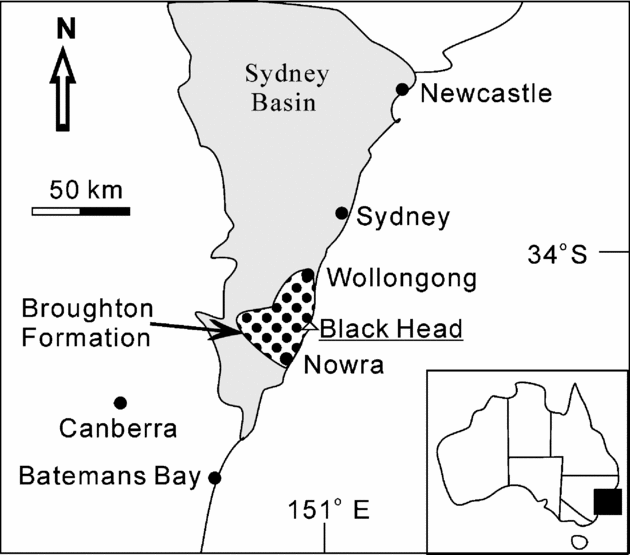
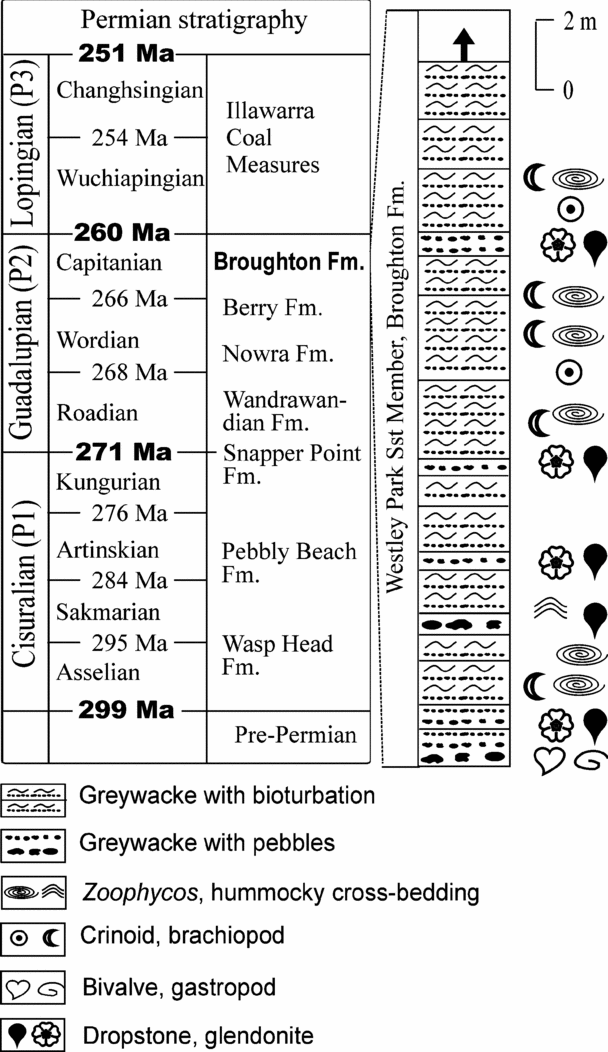
The Zoophycos material (230 outcrop photos showing Zoophycos and the samples of 50kg containing Zoophycos and other trace fossils) was obtained from the Westley Park Sandstone Member at the base of the Middle Permian (Wordian) Broughton Formation, at Black Head, Gerroa, in the southern Sydney Basin, southeastern Australia (Figs 1, 2). The Westley Park Sandstone Member is mainly composed of green-grey massive siltstone and fine-grained tuffaceous greywacke. It is 190m thick, generally flat lying, with a regional dip of about two degrees and localized dip of up to 12° towards the north to northwest. The strata contain abundant body fossils, including brachiopods, bivalves, gastropods, crinoids, sponges, bryozoans, conulariids, fragmental plant materials, and trace fossils, including Zoophycos, Rosselia, Chondrites and Palaeophycus. The fossils are associated with abundant dropstones (ice-rafted debris), glendonites and hummocky cross-bedding (Figs 2, 3e–f). These features indicate that the strata containing the Zoophycos were deposited in a glaciomarine environment influenced by storm activity and volcanism (Bann & Jones, Reference Bann and Jones2001).
Locality of the studied Zoophycos hosted in the Westley Park Sandstone Member, the base of the Middle Permian Broughton Formation from Black Head, southern Sydney Basin, southeastern Australia.

Stratigraphic column showing the characteristics of Zoophycos-bearing strata from the southern Sydney Basin, southeastern Australia.

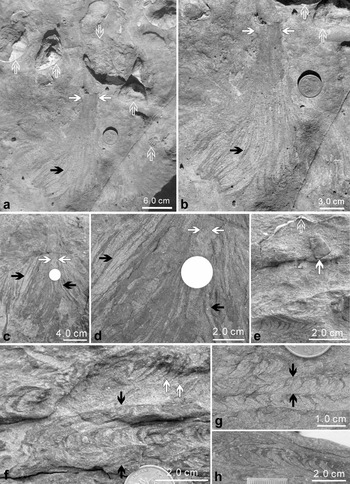
Photographs showing the characteristics of Zoophycos studied herein in plan (a, b) and vertical (c–h) views. (a–d) Major lamellae (black arrows) radiate from the central shaft (white solid arrows) and curve distally to the left and right, (b) and (d) are the close-ups of (a) and (c), respectively; white hollow arrows indicate brachiopods in (a) and (b). (e–h) Zoophycos in outcrops (e–g) and polished surface (h) is associated with brachiopod (white hollow arrow in e) and dropstones (white solid arrows in e and f); a spreite (black arrows in f and g) of Zoophycos consists of light- and dark-grey minor lamellae in rhythmic alternation.

After the initial ichnological and petrographical work, the freshly broken and polished greywacke/siltstone surfaces containing Zoophycos spreiten and fragments of the host strata were selected, cleaned and coated with carbon and gold, respectively. They were then analysed both micrographically and chemically in a Quanta 200 Environmental Scanning Electron Microscope (ESEM) equipped with Energy Dispersive X-ray Spectrometric Microanalysis (EDXSM).
3. Results
The observed Zoophycos shows a conical form consisting of a series of spreiten, which radiate from a central shaft (9–35mm in diameter, 100–120mm in height) that is perpendicular to the bedding surface and curves distally in either a sinistral or dextral manner. In vertical cross-section, Zoophycos is usually composed of a series of imbricate or superposed spreiten (Fig. 3c–h) that are distally arranged in rows sub-parallel to the bedding surface. No or little compaction has been observed in the central shaft and spreiten.
Both thick (10–25 mm; Fig. 3e–f) and thin (< 10 mm; Fig. 3g–h) minor lamellae have been distinguished in the same sample or outcrop; the former mainly consists of coarse clastics (feldspar and quartz) poor in organic matter and with dropstones, and appears light-grey in colour (Fig. 3f), whereas the latter is enriched in finer-grained sediments, clay minerals and organic matter and with no dropstones, and tends to be dark-grey in colour (Fig. 3f).
The spreiten consist of both major lamellae and the oblique minor lamellae between the major lamellae (Fig. 3e–h). The minor lamellae appear as crescents or rounded chevrons. The direction of the crescents within any one spreite is always the same. It is commonly seen that the top of a spreite is truncated by succeeding spreiten. Occasionally, due to their sometimes sub-parallel nature, a spreite will disappear completely, having been cut off by an overlying slightly oblique spreite (Fig. 3g). The Zoophycos herein is tentatively referred to as Zoophycos cf. caudagalli Vanuxem, 1842. No marginal tube has been observed. Within the spreite structures, we have not observed any homogeneous filling, fecal pellets or any sign of re-exploitation of the minor lamellae.
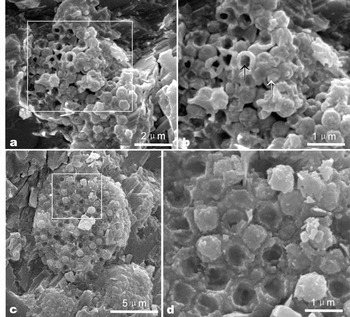
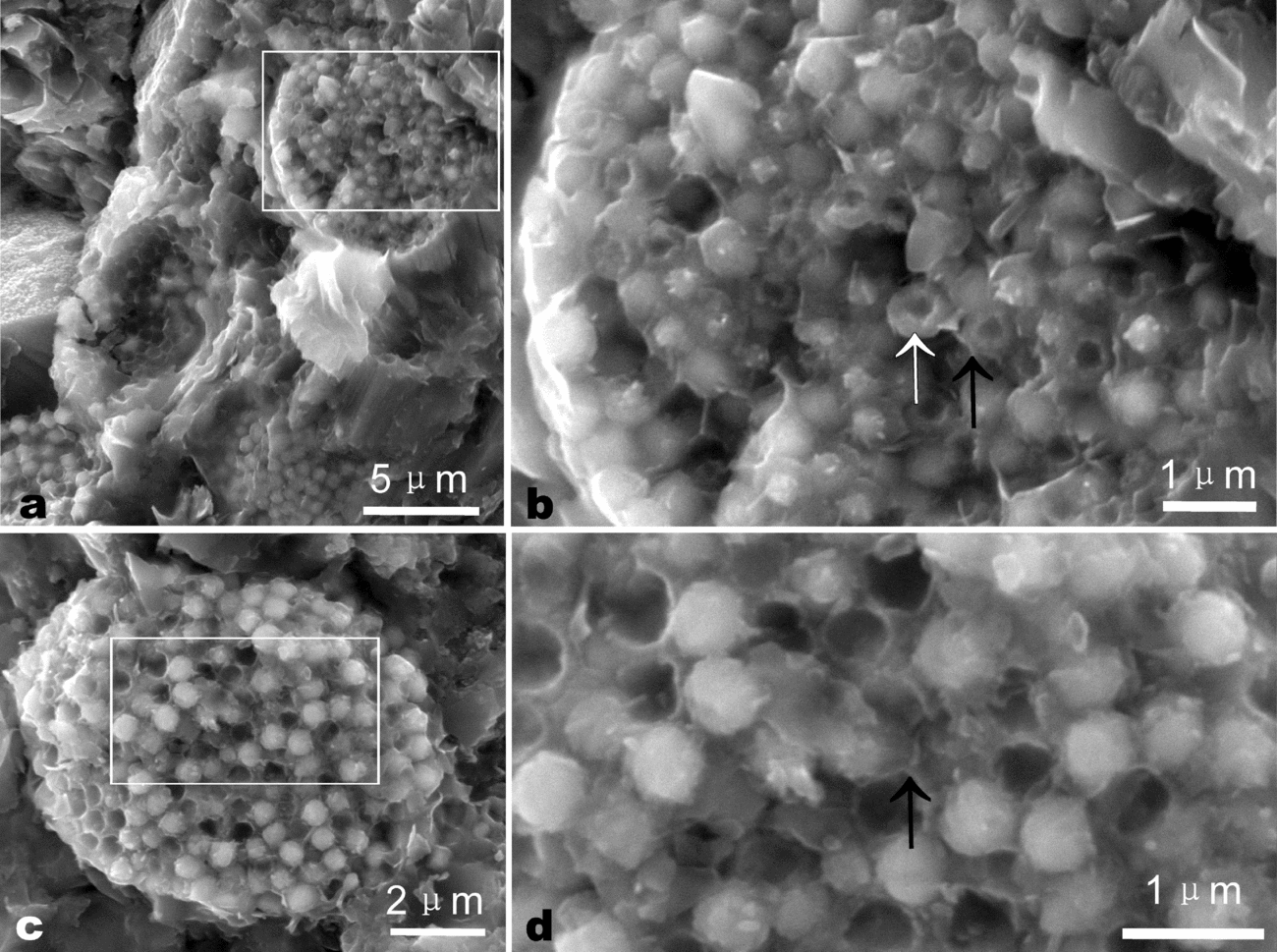
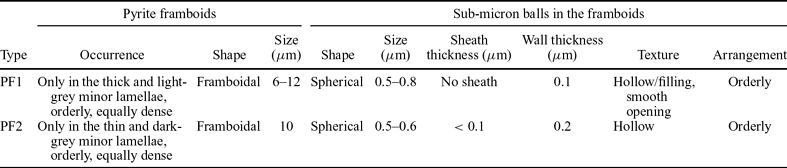
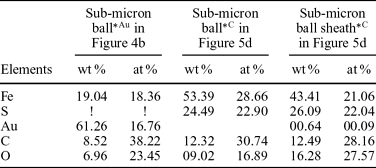
Two types of pyrite framboids (PF1 and PF2) have been found within the minor lamellae of the Zoophycos spreiten (Figs 4, 5; Table 1). PF1 are composed of non-sheathed, hollow or infilled sub-micron balls with or without a smooth opening (Fig. 4a–d). PF2 consist of sheathed, hollow sub-micron balls with a thick wall (Fig. 5a–d). PF1 occur only within the thick, light-grey minor lamellae and shallowly penetrate into or adhere to broken surfaces or crystal surfaces of the detrital feldspar and quartz (Fig. 4a–d). PF2, on the other hand, are restricted to the thin, dark-grey minor lamellae. In generally, all the framboids are framboidal or spheroidal, 6–12 μm in diameter and consist of orderly arranged, equidimensional and equimorphic sub-micron balls 0.5–0.8 μm in diameter (Figs 4, 5; Table 1); they are highly abundant and occur in an orderly arrangement of equal density and in a good state of preservation within the minor lamellae (Figs 4, 5). No similar framboids have been found outside the minor lamellae. A systematic geochemical analysis of the framboids measured by EDXSM indicates that the main elements of the sub-micron balls are iron, sulphur, carbon and oxygen. All the balls and ball sheaths coated with gold or carbon within the framboids contain the element carbon (Table 2).
Scanning electron microscope images showing the pyrite framboids (PF1) interpreted as microbial colonies within the light-grey minor lamellae of Zoophycos spreiten. (a–d) PF1 consist of non-sheathed, hollow (black arrow in b) and infilled (white arrow in b) sub-micron balls with smooth opening, (b) is the close-up of (a), and (d) is the close-up of (c). PF1 shallowly penetrate into surfaces of the detrital feldspars in (a) and (c).

Scanning electron microscope images showing the pyrite framboids (PF2) interpreted as microbial colonies within the dark-grey minor lamellae of Zoophycos spreiten. (a–d) The PF2 consist of sheathed (black arrows in b and d) and hollow (white arrow in b) sub-micron balls with thick wall; (b) is the close-up of (a), and (d) is the close-up of (c). PF2 are hosted in the environment rich in clay minerals and organic material in (a) and (c).

A comparison of the main characteristics of pyrite framboids (PF) within the Permian Guadalupian Zoophycos spreiten from Australia

Main element contents in the pyrite framboids studied

Analysis instrument – Quanta 200 Environmental Scanning Electron Microscope (ESEM) equipped with Energy Dispersive X-ray Spectrometric Microanalysis (EDXSM).
*Au, *C – measured samples were coated with gold and carbon, respectively.
wt% – percentage of atom weight; at % – percentage of atom quantity.
! – sulphur was not measured because of gold shielding.
4. Discussion
4.a. Biogenic features of the framboids
Pyrite framboids (Rust, Reference Rust1935) are essentially clusters of equidimensional and equimorphic microspheroids arranged in ordered, partly ordered, or disordered ways (cf. Butler & Rickard, Reference Butler and Rickard2000; Ohfuji & Rickard, Reference Ohfuji and Rickard2005). They have been reported from a wide variety of fossil and modern records, including sediments, soil, limestone, sandstone, volcanic sequences, peat bogs, fossil woods and even old books (Garcia-Guinea et al. Reference Garcia-Guinea, Martinez-Frias, Gonzales-Martin and Zamora1997) and from a wide variety of environments, including marine and freshwater sediments (Sweeney & Kaplan, Reference Sweeney and Kaplan1973), as well as anoxic water columns (Wilkin, Barnes & Brantley, Reference Wilkin, Barnes and Brantley1996). This great variability in both the spatial (environmental) and temporal occurrences of the framboids has attracted considerable interest from geologists worldwide, leading to the publication of a sizeable amount of literature dealing with descriptions of the morphology of framboids, their laboratory synthesis, and speculations upon their preferred environments and the mechanisms of their formation (Rickard, Reference Rickard1970; Wilkin, Barnes & Brantley, 1996; Wilkin, Arthur & Dean, Reference Wilkin, Arthur and Dean1997; Wilkin & Barnes, Reference Wilkin and Barnes1997; Butler & Rickard, Reference Butler and Rickard2000; Taylor & Macquaker, Reference Taylor and Macquaker2000; Roychoudhury, Kostka & Cappellen, Reference Roychoudhury, Kostka and Cappellen2003; Popa, Kinkle & Badescu, Reference Popa, Kinkle and Badescu2004; Wignall, Newton & Brookfield, Reference Wignall, Newton and Brookfield2005). There has also ensued much discussion on biotic and abiotic origins of the framboids in nature and in the laboratory since the early 20th century (Schneiderhöhn, Reference Schneiderhöhn1923; Schouten, Reference Schouten1946; Love, Reference Love1957, Reference Love1962; Rickard, Reference Rickard1970; Butler & Rickard, Reference Butler and Rickard2000; Schieber, Reference Schieber2002; Popa, Kinkle & Badescu, 2004; Folk, Reference Folk2005; Ohfuji & Rickard, Reference Ohfuji and Rickard2005).
Biogenically formed minerals are characterized by unusual external morphologies and are often made of agglomerations of mineral crystals separated by organic material (Dove, De Yoreo & Weiner, Reference Dove, De Yoreo, Weiner and Rosso2003). Two avenues of evidence indicate that the framboids described herein are formed by biotic processes.
Firstly, the sub-micron balls within the framboids show unusual external morphologies and texture, such as a sheath-like appearance, a mouth-like opening, hollow/infilling textures, and smooth spherical surfaces (Table 1), which are quite different from the crystals within the framboids synthesized by abiotic processes (Sweeney & Kaplan, Reference Sweeney and Kaplan1973; Butler & Rickard, Reference Butler and Rickard2000; Ohfuji & Rickard, Reference Ohfuji and Rickard2005). The size (0.5–0.8 μm) of a single sub-micron ball within the framboids is larger than the minimum size of a living cell that metabolizes (0.1–0.2 μm in size: Maniloff, Reference Maniloff1997) and smaller than the maximum size (1–2 μm) of most Bacteria and Archaea (see Javaux, Knoll & Walter, Reference Javaux, Knoll and Walter2004). The minerals within the framboids synthesized by abiological processes either in a laboratory or in a natural setting usually show euhedral crystals of solid octahedral and cubic morphology (Ohfuji & Rickard, Reference Ohfuji and Rickard2005). Chemically, as shown in Table 2, the sub-micron balls within the framboids have high contents of carbon in the measured samples coated with gold. Therefore, we speculate that the framboids are very likely the pyritized remains of the framboidal microbial colonies (probably sulphate-reducing bacteria) preserved in Zoophycos spreiten.
Secondly, the framboids under study have only been found within Zoophycos spreiten, where thick and light-grey minor lamellae alternate rhythmically with thin and dark-grey minor lamellae. The framboids show a high abundance, an orderly arrangement of even density and are in a good state of preservation. PF1 occur only within the light-grey minor lamellae and shallowly penetrate into or adhere to broken surfaces or crystal surfaces of the detrital feldspar and quartz (Fig. 4a–d). PF2 are restricted to the dark-grey minor lamellae. In addition, no similar framboids have been found outside the Zoophycos spreiten. These features do not support the suspicion that the framboids were formed by an inorganic process or by man-made contamination, and would suggest that the Zoophycos maker may have intentionally created optimal conditions for planting and culturing both the framboidal microbial colonies with no sheath (PF1) and with sheath (PF2). The similar pyrite framboids formed by microbial processes were reported from the modern sulphidic aquifer in carbonate rock in Romania (Popa, Kinkle & Badescu, 2004).
4.b. Comparisons of morphology and ethology
Two basic types of Zoophycos, J-type and U-type, were first distinguished in modern deep-sea sediments (Wetzel & Werner, Reference Wetzel and Werner1981). The J-type has a J-shaped shaft spreite with only one opening connected to the seafloor, which has been taken to suggest a well-oxygenated environmental condition. The U-type Zoophycos, on the other hand, has a U-shaped shaft spreite with two openings connected to the seafloor, and therefore would indicate poorly oxygenated conditions (Wetzel & Werner, Reference Wetzel and Werner1981; Wetzel, Reference Wetzel1991). A major difference between the reconstruction model of Wetzel & Werner (Reference Wetzel and Werner1981) and that of the Zoophycos documented here lies in the presence in the latter of a single shaft (Fig. 3c, d) instead of a shaft spreite. This feature of Zoophycos from the southern Sydney Basin is similar to the reconstruction of the modern Portuguese Zoophycos presented by Löwemark & Schäfer (Reference Löwemark and Schäfer2003).
The Zoophycos from the southern Sydney Basin has neither the U-shaped shaft spreiten nor the discontinuous Rhizocorallium-like spreiten reported from the Upper Cretaceous to lower Oligocene of New Zealand (Ekdale & Lewis, Reference Ekdale and Lewis1991) and the Miocene of Turkey (Uchman & Demircan, Reference Uchman and Demircan1999). The fact that the overlying spreiten cut the underlying ones (Fig. 3c–h) indicates that the Zoophycos from the study area is of an upward construction, which differs from the downward-constructed Zoophycos reported from the Upper Cretaceous in Scandinavia (Ekdale & Bromley, Reference Ekdale and Bromley1983; Bromley, Ekdale & Asgaard, Reference Bromley, Ekdale and Asgaard1999) and the Pliocene in Japan (Kotake, Reference Kotake1989), but is comparable to the upward-constructional Zoophycos reported from the modern deep sea in the Portuguese continental margin (Löwemark & Schäfer, Reference Löwemark and Schäfer2003), the Mesozoic slope to deep basin in southeastern France (Olivero, Reference Olivero2003) and the Lower Devonian neritic sea in New York, USA (Marintsch & Finks, Reference Marintsch and Finks1982).
As described above, the Zoophycos from the southern Sydney Basin is closely associated with dropstones and brachiopods, neither of which has been found from the Zoophycos reported from the modern deep sea in the Portuguese continental margin (Löwemark & Schäfer, Reference Löwemark and Schäfer2003), or those from the Mesozoic slope to deep basin environment in southeastern France (Olivero, Reference Olivero2003). In the Zoophycos spreiten, both the thick and light-grey minor lamellae poor in organic matter and with dropstones and the thin and dark-grey minor lamellae rich in clay minerals, organic matter and with no dropstone can be distinguished. Their alternation in rhythm may be suggestive of a gardening manner of the Zoophycos maker responding to the warm and cold changes, food supply in pulses and variations of sedimentation rate for planting and culturing microbial colonies under the conditions of a glaciomarine environment at high latitudes.
A large number of ethological modes involving Zoophycos have been put forth on the basis of different Zoophycos characteristics, including the deposit feeder mode (Seilacher, 1967a; Simpson, Reference Simpson, Crimes and Harper1970; Wetzel & Werner, Reference Wetzel and Werner1981; Ekdale & Lewis, Reference Ekdale and Lewis1991), the inverse conveyor or cesspit mode (Kotake, Reference Kotake1989, Reference Kotake1991), refuse dump mode (Bromley, Reference Bromley1991), cache mode (Jumars et al. Reference Jumars, Mayer, Deming, Baross and Wheatcroft1990; Bromley, Reference Bromley1991; Miller & D'Alberto, Reference Miller and D'Alberto2001; Löwemark et al. Reference Löwemark, Lin, Wang, Huh, Wei and Chen2004; Löwemark, Lin & Sarnthein, Reference Löwemark, Lin and Sarnthein2006), gardening mode (Bromley, Reference Bromley1991), and composite mode (e.g. deposit feeder mode + gardening mode: Bromley & Hanken, Reference Bromley and Hanken2003; detritus feeding mode + cache mode: Löwemark & Schäfer, Reference Löwemark and Schäfer2003). Since a diverse morphological range of Zoophycos has been described from the early Cambrian to the present, and from sublittoral to abyssal environments, it is highly unlikely that the various Zoophycos were made by the same taxon, nor is it likely that the behavioural modes employed by the varied Zoophycos makers were consistent in different sedimentary environments throughout Phanerozoic times.
5. Conclusions
Based on our study of Zoophycos, the following conclusions can be made:
(1) The pyrite framboids documented in this study are the pyritized remains of framboidal microbial colonies enriched within Zoophycos spreiten from the Middle Permian glaciomarine greywacke of the Westley Park Sandstone Member within the Broughton Formation in the southern Sydney Basin of southeastern Australia. The framboids are composed of both non-sheathed (PF1) and sheathed (PF2) sub-micron balls. Both PF1 and PF2 occur in rhythmic alternation within the thick, light-grey and thin, dark-grey minor lamellae of Zoophycos spreiten. No similar framboids have been found in the surrounding host strata.
(2) The fact that the overlying spreiten cut the underlying ones indicates that the Zoophycos from the study area is of an upward construction. The rhythmic alternation of both the thick, light-grey and thin, dark-grey minor lamellae within Zoophycos spreiten may be suggestive of a gardening manner of the Zoophycos maker responding to the warm and cold changes, food supply in pulses and variations of sedimentation rate for planting and culturing microbial colonies under the condition of a glaciomarine environment at high latitudes.
(3) The highly complex and orderly Zoophycos in external morphology and internal texture documented herein from the southern Sydney Basin hinted that the Zoophycos would have been the multifunctional garden that was carefully constructed by the Zoophycos maker, where the trace-maker may have intentionally created optimal conditions (substrate types and the quality and quantity of food) for planting and culturing microbes and selectively and periodically introduced sediments rich in clastics, organic matter and clay minerals or other useful components through the central shaft from the seafloor above into the spreiten for the microbial colonies to cultivate and feed on.
(4) It is proposed that the Zoophycos-producer had a symbiotic relationship with microbial colonies on the mutual basis of the food supply and redox conditions.
Acknowledgements
This research was jointly supported by grants from the Natural Science Foundation of China (40472020, 40328003, 40621002), the Research Fund for the Doctoral Program of Higher Education of China (2004000127), the Special Project of Basic Research of China (2005CCA05000; G0800-06-ZS-319), an Australian Research Council Discovery grant (DP0772161) and a Chinese Academy of Science research grant (2006-1-16).