




No CrossRef data available.
When the course of aggressive behavior in childhood does not predict antisocial outcomes in adolescence and young adulthood: An examination of potential explanatory variables
Published online by Cambridge University Press: 01 December 2004
Abstract
Theoretical models and empirical studies suggest that there are a number of distinct pathways of aggressive behavior development in childhood that place youth at risk for antisocial outcomes in adolescence and young adulthood. The prediction of later antisocial behavior based on these early pathways, although substantial, is not perfect. The goal of the present study was to identify factors that explain why some boys on a high-risk developmental trajectory in middle childhood do not experience an untoward outcome, and, conversely, why some boys progressing on a low-risk trajectory do become involved in later antisocial behavior. To that end, we explored a set of theoretically derived predictors measured at entrance to elementary and middle school and examined their utility in explaining discordant cases. First-grade reading achievement, race, and poverty status proved to be significant early predictors of discordance, whereas the significant middle-school predictors were parent monitoring, deviant peer affiliation, and neighborhood level of deviant behavior.This research was supported by grants from the National Institutes of Mental Health (RO1 MH42968 to Sheppard G. Kellam, PI, and T-32 MH18834 to Nick Ialongo, PI) and the Centers for Disease Control and Prevention (R49/CCR318627-03). We thank the Baltimore City Public Schools for their continuing collaborative efforts and the parents, children, teachers, principals, and school psychologists and social workers who participated.
Information
- Type
- Research Article
- Information
- Copyright
- © 2004 Cambridge University Press
Childhood aggressive behavior is widely recognized as a precursor for antisocial behavior in adolescence and adulthood. Numerous prospective studies have demonstrated that conduct problems identified as early as preschool predict later delinquent behavior and drug use (Ensminger, Kellam, & Rubin, 1983; Hawkins, Herrenkohl, Farrington, Brewer, Catalano, Harachi, & Cothern, 2000; Loeber & Hay, 1997; Lynam, 1996; McCord & Ensminger, 1997; Moffitt, 1993; Yoshikawa, 1994). Yet the available evidence also suggests that a substantial proportion of those children who display high levels of aggressive behavior in childhood do not manifest antisocial behavior in adolescence or adulthood (Maughan & Rutter, 1998). Indeed, there appear to be “desisters” as well as “persisters” (McCord, 1983). Moreover, a considerable number of children appear to be “late starters” (Moffitt, 1993), engaging in average levels of aggressive behavior in the early childhood years but proceeding to engage in serious antisocial behavior in adolescence and adulthood. It is important to discriminate various pathways early in the developmental course so that the limited resources available for preventive and intervention efforts may be more precisely targeted.
Models of Antisocial Behavior Development
Several influential theories of antisocial behavior development have described qualitatively different trajectories to different types of delinquency and criminal involvement. Patterson, DeBaryshe, and Ramsey's (1992) model argues for two distinct pathways toward adult criminality: early-starters (i.e., coercive parenting, school failure, and antisocial behavior problems starting in childhood) and late-starters (i.e., poor parental monitoring, oppositionality, and deviant peer involvement starting in early adolescence). Moffitt's (1993) model also proposes two mutually exclusive subgroups of antisocial youth: life-course persistent offenders who show high levels of aggression throughout development and continue to be violent as adults; and adolescence-limited offenders who engage in nonviolent forms of antisocial behavior only during the teen years.
Loeber and Stouthamer–Loeber (1998), in an extension of their earlier work (Loeber, Wung, Keenan, Giroux, Stouthamer–Loeber, Van Kammen, & Maughan, 1993), proposed five distinct subtypes to account for the observed heterogeneity among boys within these dual-pathway models. They propose two types of life-course persistent youth, one with a preschool onset of aggression and comorbid attention-deficit/hyperactivity disorder (ADHD) and one with a middle childhood onset of aggression without ADHD. They also propose two limited-duration groups: one whose initially high level of aggression desists in elementary school and another whose aggression desists in late adolescence or early adulthood. The final group, late-onset offenders, is thought to comprise those youth who show no antecedent problems in aggression but who develop antisocial behavior problems in late adolescence or early adulthood. These models have helped to shift the study of youth antisocial behavior away from a variable-centered focus on describing broad predictors of behavior toward a more person-centered focus emphasizing individual differences in development (Magnusson, 1998).
Modeling Studies of Individual Differences in Antisocial Behavior Development
Various methodological techniques have been used to determine individual differences in longitudinal patterns in antisocial behavior. One technique is to make post hoc classifications of individuals based on their progression on variables of interest over time, using empirically or theoretically defined cutoff scores (e.g., see Loeber, Wei, Stouthamer–Loeber, Huizinga, & Thornberry, 1999; Moffitt & Caspi, 2001; Moffitt, Caspi, Harrington, & Milne, 2002; Patterson, 1996; Patterson, Forgatch, Yoerger, & Stoolmiller, 1998; Tolan & Gorman–Smith, 1998). Although post hoc classification of youth to various developmental trajectories has heuristic value, this method is fraught with problems as well. Post hoc classification does not allow for empirical testing, and it may over- or underclassify youth to various trajectories while failing to identify other trajectories entirely. An alternative method for identifying developmental patterns in longitudinal data is to use growth modeling techniques to empirically define distinct subgroups within a sample (Muthén, 2000, 2001; Nagin, 1999). These techniques, which treat group membership as an unobserved variable, have been used to describe individual differences in development for a range of behaviors, including reading achievement (e.g., Crijnen, Feehan, & Kellam, 1998), coping strategies (e.g., Sandler, Tein, Mehta, Wolchik, & Ayers, 2000), substance use (e.g., Curran, Muthén, & Harford, 1998; Oxford, Gilchrist, Morrison, Gillmore, Lohr, & Lewis, 2003; White, Xie, Thompson, Loeber, & Stouthamer–Loeber, 2001), and aggression (e.g., Muthén, 2001; Schaeffer, Petras, Ialongo, Poduska, & Kellam, 2003).
Several groups of researchers have used latent growth modeling to classify antisocial boys on the basis of their longitudinal behavioral patterns (Broidy et al., 2003; Maughan, Pickles, Rowe, Costello, & Angold, 2000; Nagin & Tremblay, 1999; Shaw, Gilliom, Ingoldsby, & Nagin, 2003). Taken together, the results from these longitudinal studies suggest that there are empirically identifiable subgroups of youth with distinct developmental trajectories of antisocial behavior. Those studies that modeled aggression over time identified different numbers of trajectories, but the trajectories were otherwise similar. Each study identified one to two normative subgroups (about 60% of boys) that never showed serious problems with aggression and were not at increased risk for later criminal behavior. These samples also identified two groups of boys with sustained problems in antisocial behavior over time: a chronic group (4–12% of boys) whose aggressive behavior was consistently high throughout development, and a high but desisting group (20–28% of boys) whose aggression started at a high level but decreased over time. Across samples, aggressive trajectories were associated with later antisocial and criminal behavior in adolescence (Maughan et al., 2000; Nagin & Tremblay, 1999).
Most recently, Schaeffer et al. (2003) used general growth mixture modeling (GGMM) to find empirical evidence for pathways described in theoretical models within an epidemiological sample of urban, primarily African American boys. Teacher-rated aggression measured longitudinally through elementary school was used to define growth trajectories. Consistent with prior studies, evidence was found for a chronic high aggression and a low-risk aggression trajectory. The Schaeffer et al. study also empirically identified a trajectory of increasing aggression, which corresponds closely to Loeber and Stouthamer–Loeber's (1998) hypothesized life-course persistent, childhood-onset group. Relative to the low-risk trajectory, boys with chronic high and increasing trajectories were at increased risk for juvenile arrest in adolescence and antisocial personality disorder (ASPD) and adult arrest in young adulthood. Concentration problems were highest among boys with a chronic high aggression trajectory and also differentiated boys with increasing aggression from boys with stable low aggression. Peer rejection also was higher among boys with chronic high aggression relative to the low aggression group.
Present Study Rationale and Goals
Among the questions left unanswered by Schaeffer et al. (2003) is how to explain the fact that although boys in the chronic high and increasing aggression trajectories were at increased risk for a number of untoward outcomes in adolescence and early adulthood, at least 26% of these boys did not manifest any of the antisocial outcomes assessed. Conversely, although boys in the stable low-aggression trajectory had the lowest risk of an untoward outcome, a small percentage (9–16%) of these boys did manifest an antisocial outcome in adolescence and/or young adulthood. The primary purpose of this article was to determine whether we could predict which boys will have outcomes that are inconsistent with their early aggressive behavior growth trajectory. To that end, we examined a set of predictors measured at entrance to elementary and middle school within the growth-mixture modeling framework. We drew upon two major theoretical models in selecting our predictors. First, consistent with Bronfenbrenner's (1979) social ecological model of child development, we selected first- and sixth-grade predictors that represent a range of systemic influences (i.e., individual, family, peer, school, and neighborhood factors). Second, Patterson, Reid, and Dishion's (1992) early starter and late starter model of the development of antisocial behavior provided the rationale for specific hypotheses.
Predictors of discordant cases in the chronic high class
We hypothesized that concentration problems and peer rejection in the presence of high levels of aggressive/disruptive behavior at the entrance to first grade would promote the persistence of aggressive/disruptive behavior over time and heighten the risk of later antisocial behavior in adolescence and adulthood. Thus, we expected that those boys with a chronic high-aggression trajectory who went on to antisocial outcomes in adolescence and young adulthood would have significantly higher levels of concentration problems and peer rejection in first grade than boys with chronic high aggression who did not manifest later serious antisocial behavior. There is considerable empirical (Jensen, Martin, & Cantwell, 1997; Lahey, McBurnett, & Loeber, 2000; Satterfield & Schell, 1997) and theoretical (e.g., Loeber et al., 1993; Moffitt, 1993; Patterson et al., 1989) evidence linking ADHD and concentration problems to chronic antisocial behavior patterns. In terms of potential mechanisms, consistent with Patterson et al.'s (1992) early starter model, concentration problems may make demand/compliance bouts more likely, which in turn lead to more frequent coercive child behavior management on the part of parents and teachers and more sustained levels of aggressive/disruptive behavior over development.
Peer rejection is another common correlate of chronic aggressive behavior problems (Haselager, Van Lieshout, Riksen–Walraven, Cillessen, & Hartup, 2002; Hektner, August, & Realmuto, 2000; Schwartz, 2000) and, in accord with Patterson et al. (1992), may serve to hasten the aggressive/disruptive child's drift into a deviant peer group in late childhood and early adolescence. In these deviant peer groups, aggressive/disruptive behavior is reinforced, thereby canalizing the pathway to later antisocial behavior (Deater–Deckard, 2001; French, Conrad, & Turner, 1995; Hektner et al., 2000). Thus, we expected that boys who displayed a chronic high aggression trajectory in childhood and who went on to serious antisocial behavior in adolescence and young adulthood would have higher levels of peer rejection in the early elementary school years than their chronic high aggressive behavior trajectory counterparts who did not manifest serious antisocial behavior in young adulthood.
Poor academic achievement is another correlate of chronic aggressive behavior, and consistently predicts later delinquency (Denno, 1990; Maguin & Loeber, 1996). Furthermore, academic failure during the elementary grades also has been related to increased risk for later violent behavior (Farrington, 1989; Maguin & Loeber, 1996). Accordingly, we hypothesized that those boys with a chronic high aggressive growth trajectory in childhood but who do not go onto antisocial behavior in young adulthood would have higher levels of academic achievement than their chronic high-aggressive behavior counterparts who do engage in serious antisocial behavior in young adulthood.
Predictors of discordant cases in the stable low class
Patterson et al.'s (1992) late starter model of the development of antisocial behavior provided the conceptual framework for predicting which boys who demonstrated a low aggression trajectory in childhood would go on to serious antisocial behavior in adolescence and young adulthood. Patterson et al. argue that late starters typically exhibit marginal levels of social adaptation in the elementary school years (e.g., poor academic and social skills), making them more vulnerable to perturbations in parental monitoring and supervision. More specifically, Patterson et al. hypothesize that the escalation in antisocial behavior during early adolescence among late starters is due to disruptions in parental monitoring and supervision, which are brought on by serious family adversities that first surface in the middle-school years and tend to be chronic in nature. The disruptors may include a divorce, serious financial distress associated with the loss of a job, and/or the onset of parental psychiatric distress or substance abuse. As a result of their coercive and antisocial behavior, late-onset children are also rejected by their mainstream natural raters. Their limited social survival skills and the rejection by their mainstream natural raters precipitate drift into a deviant peer group, where antisocial behavior, substance use, and rejection of mainstream social values, mores, and institutions are reinforced. Based on the late starter model, we hypothesized that lower parental monitoring, higher deviant peer affiliation, and lower academic skills would discriminate those boys in the low-aggression trajectory who went on to antisocial outcomes in young adulthood from those who evaded an untoward outcome.
Predictors of discordant cases in the increasing class
We also predicted that boys with increasing aggression (childhood onset subtype) who went on to have an antisocial outcome would show higher levels of concentration problems and peer rejection relative to boys with increasing aggression who did not have an untoward outcome. In formulating this hypothesis, once again we drew upon Patterson et al.'s (1992) conceptualization of the development of antisocial behavior among late starters. Specifically, attention/concentration problems at home and in the classroom may increase the likelihood of demand/compliance bouts with parents and teachers. Such bouts may then lead to more coercive and inconsistent forms of discipline on the part of parents and teachers, which in turn, leads to the development of antisocial behavior. Attention/concentration problems also may result in rejection from mainstream peers and a subsequent drift into antisocial peer groups, which further promotes antisocial behavior. Thus, we hypothesized that among those children who display low levels of aggressive/disruptive behavior early on in their elementary-school careers, the higher the level of attention/concentration problems and peer rejection, the more likely that they will manifest antisocial behavior later in their development.
Poverty, race, and neighborhood characteristics as predictors of discordant cases across all aggressive behavior trajectories
Family poverty is associated with a wide array of negative health, cognitive and socioemotional outcomes in children (Bradley & Corwyn, 2002; Loeber et al., 1993). Similarly, children growing up in economically deprived neighborhoods are more likely to get involved in crime and violence (Farrington, 1989; Yoshikawa, 1994). One potential mechanism for the effects of poverty on aggressive behavior is the role that poverty plays in disrupting parent monitoring and discipline, which in turn, increases the likelihood of youth exposure to deviant peers (Patterson et al., 1992). Ingoldsby and Shaw (2002) hypothesize that neighborhood poverty and neighborhood criminality operate as risk indicators early in youth development and exert a more direct influence as youth gain increased exposure to deviant neighborhood influences in adolescence. In urban environments, African American youth are more likely than Caucasian youth to experience poverty on the family and neighborhood level and to experience neighborhood criminality, potentially placing them at greater risk for later antisocial behavior. Moreover, given the same level of antisocial behavior, African American youth are more likely to be arrested and detained than are Caucasian youth (Beck & Karberg 2001; Sickmund, 2000).
These realities led us to a set of trajectory-specific hypotheses. Within the chronic high and the increasing trajectories of aggression, we hypothesized that boys who did not manifest antisocial behavior in young adulthood were more likely to be Caucasian, come from higher income families, and live in neighborhoods with less deviance. On the other hand, within the low aggression trajectory, we hypothesized that African American youth from families with lower income levels and higher levels of neighborhood deviance would be at a higher risk for later antisocial behavior.
Strengths of the Present Study
Consistent with Schaeffer et al. (2003), the present study improves upon previous longitudinal work in several important ways. First, in contrast to previous studies comprised primarily of Caucasian, urban (e.g., Nagin & Tremblay, 1999; Shaw et al., 2003) or Caucasian, rural (e.g., Maughan et al., 2000) youth, the longitudinal sample used in the present study is comprised of primarily African American urban youth, consistent with the US Surgeon General call for more mental health research among ethnic minority populations (US Public Health Service, 2001). Second, the present study utilizes an epidemiologically defined population, representative of all youth entering first grade in 19 public schools within five urban areas defined by census tract data and vital statistics. Accordingly, the present study allows for generalization to similar populations of students entering school from urban neighborhoods with multiple problems (i.e., high rates of poverty, unemployment, and crime). Third, the present study includes both a psychiatric and a criminological young adult outcome (diagnosis of ASPD and arrest) measured at a much later point in development (young adulthood), thereby providing strong external validity for the identified trajectories and spanning several important periods for youth antisocial behavior development. Finally, the present study employs the newest generation of latent growth modeling techniques, GGMM (Muthén & Muthén, 2000), to address methodological limitations (i.e., assumption of invariance between classes and time points, uncorrected estimates of covariates and young adult outcomes) of previous longitudinal modeling studies.
Method
Participants
The participants included 675 boys who were first assessed at age 6 as part of an evaluation of two school-based, universal preventive interventions targeting early learning and aggression in first and second grade (Dolan, Kellam, Brown, Werthamer–Larsson, Rebok, Mayer, Laudolff, Turkkan, Ford, & Wheeler, 1993; Kellam, Werthamer–Larsson, Dolan, Brown, Mayer, Rebok, Anthony, Laudolff, Edelsohn, & Wheeler, 1991) in 19 Baltimore City public schools. These 675 boys were members of the control group within the evaluation design. The 19 schools were drawn from five geographic areas within the eastern half of the city, which were defined by census tract data and vital statistics obtained from the Baltimore City Planning Office. The five areas varied by ethnicity, type of housing, family structure, income, unemployment, violent crime, suicide, and school drop out rates. However, each area was defined so that the population within its borders was relatively homogenous with respect to each of the above characteristics.
Special education and gifted classrooms were excluded from the pool of potential classrooms in light of the fact the preventive interventions targeted regular or mainstream classrooms. In schools with three or fewer regular first-grade classrooms, all classrooms participated, whereas in larger schools, three first-grade classrooms were randomly selected for inclusion in the study. Children had been randomly assigned to classrooms prior to assignment of classrooms to intervention conditions. Schools were randomly assigned to either an intervention or control condition within a geographic area. In all analyses, standard errors are corrected to reflect the fact that individual participants are clustered within classes and within schools (Jo, Muthén, Ialongo, & Brown, 2004).
A total of 675 male control participants were originally available within the 19 participating Baltimore City public schools in first grade. Seventy-eight of these 675 control boys did not have a fall of first-grade teacher rating, and, consequently, they were not included in the analyses for this article. The resulting sample of 597 boys was 60.8% African American, 38.0% Caucasian American heritage, and 1.2% other ethnicity (American Indian or Hispanic). At entrance into first grade, the boys had a mean age of 6.3 years (SD ± 0.47). Fifty-two percent of the children received free or reduced school lunch, a proxy for family income. There were no differences in terms of ethnicity, age, or standardized achievement test scores between the 78 boys with missing data and the 597 boys with baseline teacher and covariate data.
Of the 597 control males with a fall of first-grade teacher rating, 40 refused to participate in the age 19–20 follow-up, 16 had died prior to the follow-up as confirmed by a search of the National Death Index and/or an immediate family member or friend, and the remaining 126 young adults either failed to respond to repeated requests for an interview or were unable to be located during the fielding period. Thus, 415 boys (66.0% African American, 33.0% European Americans, 1.0% American Indian or Hispanic) contributed data for variables from the age 19–20 follow-up. As to differences between those 415 males with a fall of first-grade teacher data and who completed ages 19–20 versus those missing ages 19–20 follow-up data, no differences were found in terms of a fall of first-grade free lunch status, math achievement, child's rating of anxiety and depression, and teacher ratings of aggressive behavior and concentration problems. Those who were missing the age 19–20 follow-up had slightly lower standard reading scores than those who were interviewed (.20 SD), but the magnitude of this difference was quite small. In addition, African Americans were more likely to complete the age 19–20 follow-up (75.5% African American vs. 60.3% European Americans).
Assessment design
Data for this report were gathered in the fall and spring of first grade, the spring of second to fifth grades, the spring of sixth grade, and at the age 19 or 20 follow-up assessment. The data gathered in the first-grade assessments included teacher reports of child aggressive/disruptive behavior, attention/concentration problems, and peer rejection. Data on free lunch eligibility and race also were collected in first grade. Teacher reports of child aggressive/disruptive behavior were collected annually or semiannually in Grades 1–5. Teacher ratings of academic performance and youth ratings of parental monitoring, neighborhood deviance, and deviant peer affiliation were collected in the spring of sixth grade. At the age of 19–20 years, a follow-up structured clinical interview was used to ascertain whether the participant met criteria for ASPD, and juvenile and adult adjudication records were obtained.
Measures for elementary school (Grades 1–5)
Teacher Observation of Classroom Adaptation—Revised (TOCA-R). Teacher ratings of aggressive/disruptive behavior, attention/concentration problems, and peer rejection were obtained in the fall and spring of first grades using the TOCA-R (Werthamer–Larsson, Kellam, & Wheeler, 1991). Thereafter, teacher ratings of aggressive/disruptive using the TOCA-R were collected annually in the spring of Grades 2–5. Thus, although the same teacher rated the youth in first grade, each subsequent year a different teacher provided ratings of aggression for the child.
The TOCA-R is a structured interview with the teacher, which is administered by a trained assessor. Teachers respond to 36 items pertaining to the child's adaptation to classroom task demands over the last 3 weeks. Adaptation is rated by teachers on a 6-point frequency scale (1 = almost never to 6 = almost always). The aggressive/disruptive behavior subscale includes the following items: (a) breaks rules, (b) harms others and property, (c) breaks things, (d) takes others property, (e) fights, (f) lies, (g) trouble accepting authority, (h) yells at others, (i) stubborn, and (j) teases classmates. The coefficient alphas for the aggressive/disruptive behaviors subscale ranged from .92 to .94 over Grades 1–7 or ages 8–13. The 1-year test–retest intraclass reliability coefficients ranged from .65 to .79 over Grades 2–3, 3–4, and 4–5. Scores on the aggressive/disruptive behavior subscale were significantly related to the incidence of school suspensions within each year from Grades 1–5 (i.e., the higher the score on aggressive behavior, the greater the likelihood of being suspended from school that year).
The TOCA-R's attention/concentration subscale consists of the following items: (a) completes assignments, (b) concentrates, (c) poor effort, (d) works well alone, (e) pays attention, (f) learns up to ability, (g) eager to learn, (h) works hard, and (i) stays on task. Werthamer–Larsson et al. (1991) report alpha values of .91 and .83 in first grade. In terms of concurrent validity; each single unit of increase in teacher rated attention/concentration problems was associated with a twofold increase in risk of teacher perception for the need for medication for such problems.
Teacher ratings of peer rejection were based on a single item “rejected by classmates,” with 1 indicating total acceptance and 6 representing total rejection. The 4-month intraclass correlation coefficient for this item was .74, and it correlated significantly with peer nominations (not reported in this study) for the questions “which kids don't you like?” (r = .43) and “which kids are your best friends?” (r = −.58).
California Achievement Test (CAT, Forms E and F)
The CAT was administered in the fall of the grade and represents one of the most frequently used standardized achievement batteries (Wardrop, 1989). Subtests in CAT-E and F cover both verbal (reading, spelling, and language) and quantitative topics (computation, concepts, and applications). The CAT was standardized on a nationally representative sample of 300,000 children. Internal consistency coefficients for virtually all of the subscales exceed .90. Alternate form reliability coefficients are in the .80 range (Wardrop, 1989).
Eligibility for free lunch
Eligibility for a free school lunch upon entry into first grade was chosen as a proxy for family income in the present study. Conceptually, eligibility for free lunch is likely to be a proxy variable for a range of economic and other stressors operating at the family and neighborhood levels. Previous research has demonstrated that free lunch eligibility correlates highly with family income and other traditional measures of socioeconomic status (Ensminger, Forrest, Riley, Kang, Green, Starfield, & Ryan, 2000). Eligibility was treated as a binary variable (i.e., eligible or not eligible). In the present study, free lunch status had a strong negative correlation with parent education status measured in fourth grade.
Race/ethnicity
Race is an important factor to consider in studies of antisocial behavior, given that African American youth are disproportionately represented in the juvenile justice system (Snyder & Sickmund, 1999), and may be rated higher by teachers on externalizing behavior problems (Zimmerman, Khoury, Vega, & Gil, 1995). Race was treated as a binary variable (African American vs. Caucasian American).
Measures for middle school
Academic performance
As part of the TOCA-R, sixth-grade teachers were asked to rate participating students' academic progress on a scale of 1 = failing to 6 = excellent. In this study, academic progress was treated as a binary variable, using the mean as the cut point (1 ≥ mean, 0 < mean).
Deviant peer affiliation
As elaborated above, Patterson et al. (1992) and colleagues have theorized that drift into a deviant peer group increases the risk for antisocial behavior. They argue that antisocial behavior is not only modeled but also reinforced by deviant peers. In Grade 6, we used a subset of items from Capaldi and Patterson's (1989) self-report scale to measure deviant peer affiliation. Youths are asked in forced choice format to indicate how many of their friends (1 = none to 5 = all of them) have engaged in antisocial behavior, such as hitting or threatening someone, stealing, and damaging others' property. Coefficient alpha in sixth grade was .78. This variable was also treated as a binary variable, using the mean as cut point (1 ≥ mean, 0 < mean).
Neighborhood level of deviant behavior
To assess the level of the youth exposure to deviant behavior in the neighborhood, four items from the Neighborhood Environment Scale (NES; Elliot, Huizinga, & Ageton, 1985) were used: (a) kids get beat up in neighborhood, (b) adults get beat up in neighborhood, (c) neighbors often steal, and (d) drug dealers have most money. The four items are coded so that low scores indicate high levels of exposure and high scores indicate low levels of exposure. The reliability coefficient in sixth grade was .70. This variable was dichotomized using the mean as the cut point.
Structured Interview of Parent Management Skills and Practices—Youth Report (SIPMSP)
The Monitoring subscale of the SIPMSP (Capaldi & Patterson, 1989) was used to assess parent monitoring in the sixth grade. Youth are asked to respond to questions regarding their parent monitoring practices in a forced choice response format (1 = never to 5 = always). The questions making up the Monitoring subscale include, “When you get home from school, how often is there an adult there within one hour?” and “If you are at home when your parents are not, how often do you know how to get in touch with them?” This variable also was treated as a binary variable, using the mean as cut point (1 ≥ mean, 0 < mean).
Measures for young adults
ASPD diagnosis
As part of a larger telephone interview at age 19–20, a scale was developed and administered to determine whether the participant met Diagnostic and Statistical Manual Fourth Edition (DSM-IV; American Psychiatric Association, 1994) criteria for ASPD. The questions comprising the scale were keyed to DSM-IV criteria and the diagnoses derived in accord with those criteria. To reduce the likelihood of socially desirable responses, participants were asked to maintain their own count of yes responses as opposed to responding yes or no to the interviewer's questions. To ensure against the respondents losing track of the count, they were asked to have a pencil and sheet of paper available to mark down the number of yes responses. In addition, the questions were divided into three sections and at the end of each section of the interview the interviewer obtained a count of yes responses. In terms of concurrent validity, relative to those who did not meet criteria for ASPD, participants with an ASPD diagnosis were four times more likely than those who did not to have a juvenile or adult adjudication record (odds ratio [OR] = 4.91, 95% confidence interval [CI]: 2.77–8.71).
Juvenile and adult adjudication records
Juvenile police and court records also were obtained throughout the follow-up period to determine the frequency and nature of police contacts and criminal convictions during adolescence. Juvenile records were updated after all participants had aged out of the juvenile court system (i.e., after everyone in the sample had reached their 18th birthday) and thus represent complete juvenile court data for this sample. Adult court records were obtained at the time of the young adult follow-up interview when participants were on average 20 years of age. For the present study, both juvenile and adult court records were treated as binary variables (i.e., presence or absence of a record).
Analytic plan
The statistical methods applied in this study were consistent with a person-centered approach to data analysis, which emphasizes individual differences in development (Magnusson, 1998). GGMM (Muthén, 2001; Muthén & Muthén, 2000; Muthén & Shedden, 1999), implemented with the Mplus Version 2.14 statistical software package (Muthén & Muthén, 1998), was used to identify distinct patterns of growth in aggression over time. The observed time variant indicators consisted of teacher-rated classroom aggression measured at six time points: fall and spring of first grade, and spring of second through fifth grades.
Like traditional growth modeling techniques, GGMM estimates latent variables based on multiple indicators. The multiple indicators of latent growth parameters correspond to repeated univariate outcomes at different time points. However, rather than assuming that the population is constructed of a single continuous distribution, GGMM tests whether the population is constructed of two or more discrete classes (pathways) of individuals, with the goal of determining optimal class membership for each individual. As suggested in Muthén (2003), we incorporated first-grade covariates as antecedents for class membership and growth factors to correctly specify the model, to find the proper number of classes, and to correctly specify class proportions and class membership.
Evidence for these different pathways in aggressive behavior development exists when models involving two or more latent classes of growth provide a better fit than a traditional (single-class) growth model. Nested models are compared based on their specific log likelihood; nonnested models were compared using several test statistics available in the Mplus software package. The Bayesian Information Criterion (BIC), the sample size adjusted BIC (SSA BIC), and the Akaike Information Criterion (AIC) were used for comparing nonnested models; lower scores represent better fitting models (Akaike, 1987; Schwartz, 1978; Sclove, 1987). In addition, the Lo-Mendell–Rubin (LMR) likelihood ratio test of model fit and an adjusted version were used to compare the estimated and alternative models (Lo, Mendell, & Rubin, 2001). The obtained p value represents the probability that the null hypothesis (i.e., there is no difference in how the two models fit the data) is true. A low p value indicates that the estimated model is preferable to a model with one fewer class. Finally, a summary measure of the overall classification quality was given by the entropy measure (Ramaswamy, DeSarbo, Reibstein, & Robinson, 1993). Entropy values range from zero to 1, with values closer to 1 indicating better classifications of individuals to specific classes. The estimation for a model with an increasing number of classes was stopped when none of the fit indices showed further improvement.
The analytical model used in this study is shown in Figure 1. Three pathways (P0, P1, P2) are of particular interest in this model. Pathway P0 stands for the base model, where the prevalence of the outcome for each of the aggression trajectory classes is presented. In pathway P1, it is explored to what extent early covariates are related to the occurrence of the young adult outcome, once the model controls for class membership. Finally, in pathway P2, the association of middle-school covariates with the two outcomes is tested after controlling for class membership and the impact of early covariates.

The analytical model, using a growth mixture framework.
Missing data
The estimates of parameters in the models were adjusted for attrition. All longitudinal studies experience attrition when following participants over time (Hanson, Tobler, & Graham, 1990). The Mplus software program used full information maximum likelihood estimation under the assumption that the data were missing at random (MAR). MAR assumes that the reason for the missing data is either random (i.e., not related to the outcome of interest) or random after incorporating other variables measured in the study (Arbuckle, 1996; Little, 1995). Full information maximum likelihood, used in the present study, is widely accepted as an appropriate way of handling missing data (Muthén & Shedden, 1999; Schafer & Graham, 2002).
Overall, the percentage of boys in the sample missing data at a given time point was as follows: missing 0–1 time points, 59.1%; 2–3 time points, 34.3%; 4–6, 6.6%. The Mplus software bases its estimates on all available time points for a given case. Only cases with missing on all of the repeated aggression measures or with missing on the first-grade covariates are excluded from the analysis. To assess the extent of missing data in the dataset, the Mplus software provides a covariance “coverage” matrix that gives the proportion of available observations for each indicator variable and pairs of variables, respectively. The minimum coverage necessary for models to converge is .10 (Muthén & Muthén, 1998). In the present study, coverage ranged from .47–.89, more than adequate for acceptable estimation.
Results
The relationship between patterns of growth in aggressive/disruptive behavior (hereafter referred to as “aggression”), covariate information in the fall of first grade and spring of sixth grade, and the young adult outcomes was estimated using GGMM. The results are presented in three parts. First, we describe the basic growth mixture model that includes only the set of a fall of first-grade covariates and the young adult outcome. Second, for each of the two outcomes (ASPD diagnosis and arrest record) we investigate if any of the first-grade covariates contribute to the prediction of the young adult outcomes over and above what is explained by the membership in one of the aggression trajectories. Third, we describe the association between the sixth-grade covariates (level of neighborhood deviance and parental monitoring) and the two young adult outcomes in the final section.
Growth model, trajectory classes, and young adult outcomes
In this section, the model building procedure is discussed, and the resulting model is described in terms of growth trajectories, characteristics of class membership/growth, and prevalence of the two young adult outcomes (juvenile or adult arrest record, ASPD diagnosis).
Model building procedure of growth mixture model
Prior model testing was used to determine the growth shape of aggression, the number of different developmental trajectories needed, and the impact of the early covariates on growth and class membership (Muthén, 2003). Further improvements were added to this base model. First, to account for the fact that the same teacher provided ratings in the fall and spring of first grade, the residual correlation between aggression ratings at these time points was added to the model. Second, due to low and nonsignificant estimates, the variance of the quadratic slope as well as covariation between the three growth parameters (intercept, linear slope, quadratic slope) were set to zero. In all models tested, the fall of first-grade covariates were allowed to influence the overall growth parameters (intercept, slope, quadratic slope), as well as class membership (Muthén, 2003).
Assuming equal residual and growth variance, we compared models with increasing numbers of classes (see Table 1). Although the BIC value indicated almost equal fit for a model with two or three classes, the sample size adjusted BIC and the AIC indicated a four-class solution as the best model. The LMR test indicated a two-class model was better fitting than a single-class model, whereas no better fit was found for the unmodified three- and four-class models.
Comparison of model fit among models with different numbers of classes

To further explore the impact on model fit once the equal variance assumption was relaxed, class-specific differences in variation were integrated into the model. Specifically, to account for the fact that low-aggressive boys appeared to be a more homogenous group, intercept and residual variances were allowed to be different in the low-aggression class, and slope means (linear and quadratic) and the variance of the linear slope were set to zero in that class. With these modifications, two-, three-, and four-class models were compared. The three-class model showed the lowest BIC value and the p value of the LMR test was significant. On the other hand, the sample size adjusted BIC and the AIC were lowest for a four-class solution. Given the small differences in fit between a three- and four-class solution and the nontrivial difference of nine additional parameters in the four-class model, we decided on the modified three-class model as the most parsimonious solution. Parameter estimates for the model are presented in Table 2.
Parameter estimates for the three-class GGMM model, including two distal outcomes

In a second step, the two young adult outcomes (crime record, ASPD diagnosis) were added to the model (BIC = 7188.48, SSA BIC = 7026.58, entropy = 0.789). A graphical depiction of the resulting solution with young adult outcomes is presented in Figure 2 . Three distinct trajectories were identified: a chronic high aggression (CHA) trajectory, consisting of those boys (16.1%) whose aggression started high in first grade and remained high throughout elementary school; an increasing aggression (IA) trajectory, consisting of boys (52.5%) whose first-grade aggression was low but who became increasingly more aggressive through fifth grade; and a stable low aggression (SLA) trajectory, consisting of boys (31.4%) with consistently low levels of aggression over time. Consistent with Schaeffer et al. (2003), we were unable to identify a group of boys whose aggression decreased over time (i.e., desisters).

The prevalence of antisocial personality disorder and arrest as a function of growth in aggression.
First-grade covariates and class membership
As noted, the first-grade predictors selected for this study were included in model building as a means of improving model fit and increasing the accuracy of assignments of individuals to trajectory classes (Muthén, 2003). For this purpose, class membership and growth parameters (intercept, slope) were simultaneously regressed on the fall of first-grade covariates.
The effects of first-grade covariates on class membership are presented in Table 3. The risk for class membership is given in reference to the SLA class. Because this part of the analytical work builds the foundation for the later analyses, we chose to express these findings only in reference to the group (SLA) least at risk for later young adult outcomes. Relative to the SLA class, boys with higher levels of reading achievement, concentration problems, and peer rejection were more likely to be in the CHA class. Similarly, high levels of concentration problems and receiving a free school lunch were associated with membership in the IA class. Across all classes, African American boys (est. = 0.172, SE = 0.063) with high levels of concentration problems (est. = 0.106, SE = 0.037) and peer rejection (est. = 0.175, SE = 0.082) had higher intercepts of aggression. Furthermore, the course (slope) of aggression was accelerated by boys' reading level (est. = 0.002, SE = 0.001).
Association between class membership and first grade predictors

Class membership and young adult outcomes
Of the boys with a CHA trajectory, 27.2% had an ASPD diagnosis and 44.8% were arrested as a juvenile or adult (percentages are based on threshold estimates from the regression of distal outcomes on class membership). Of the boys with IA, 25.6% had an ASPD diagnosis and 52.6% had a juvenile or adult court record. In comparison, of the boys who were in the SLA class, 11.1% were diagnosed with ASPD and 12.9% had an arrest record. Significance testing revealed that boys in the CHA trajectory were three times more likely to be diagnosed with ASPD (OR = 2.99, 95% CI = 0.74–11.94) and more than five times more likely (OR = 5.48, 95% CI = 2.59–11.559) to have an arrest record when compared to boys in the SLA class. Boys with an IA trajectory were almost three times more likely to be diagnosed with ASPD (OR = 2.77, 95% CI = 1.26–6.11) and more than seven times more likely to have an arrest record (OR = 7.46, 95% CI = 2.96–11.47) when compared to boys in the SLA class.
Contribution of first-grade covariates to the prediction of young adult outcomes
In this section, we present the class specific impact of the fall of first-grade covariates on the likelihood to have an arrest record or an ASPD diagnosis (see Table 4). We hypothesized that concentration problems, peer rejection, and low levels of reading would be associated with an increase in risk for boys in the CHA and the IA trajectories. Poverty and being of African American heritage were hypothesized to increase risk across all classes, but would be particularly instrumental in explaining discordant cases in the SLA class.
Association between first-grade predictors and young adult outcomes by class membership

For boys in the CHA trajectory, none of the covariates contributed significantly to the likelihood of an arrest over and above the risk associated with class membership. Among boys in the IA class, race (African American), lunch status (eligible for free lunch), and reading achievement (lower) in the fall of first grade were significantly related to risk of an arrest record. Among boys in the SLA class, being eligible for a free school lunch and being African American significantly increased the risk for later arrest. With respect to an ASPD diagnosis, none of the covariates in any of the three classes contributed to the prediction over and above class membership.
Middle-school covariates and young adult outcomes
It was hypothesized that low levels of parental monitoring and poor academic progress and high levels of deviant peer affiliation and neighborhood exposure to deviant behavior would be associated with an increase in risk for the two outcomes, especially in the IA and the SLA class (see Table 5).
Association between middle school predictors and young adult outcomes by class membership

Academic performance in sixth grade
Regarding a diagnosis of ASPD, higher academic achievement was associated with a nonsignificant decrease in risk in the CHA and SLA trajectory classes, and with a nonsignificant increase in risk for boys in the IA class. Regarding later criminal record, higher academic achievement was associated with a nonsignificant increase in risk for boys in the IA and SLA classes and a decrease in risk for boys in the CHA class (see Table 5).
Deviant peer affiliation
Boys in the IA class who were above the mean on deviant peer affiliation were more than three times more likely to be diagnosed with ASPD, whereas no significant associations were found in the CHA or the CLA classes. Regarding the likelihood of a criminal record, no significant associations with deviant peer affiliation were found. However, estimates indicated an increase in risk in the increasing and in the low aggressive classes.
Exposure to neighborhood level deviant behavior
Boys' perception of neighborhood level deviant behavior was not significantly related to the probability of an ASPD diagnosis. However, estimates of ORs indicated an increase in risk for ASPD ranging from 11% in the CHA to 232% in the SLA class. For arrest, a significant increase in risk was found for two of the classes. Boys in the CHA class whose perception of neighborhood deviance was above the mean were more than eight times more likely to have an arrest record by age 21, and boys in the IA class were more than two times more likely. Neighborhood deviant behavior increased risk in the SLA class but not significantly.
Parental monitoring
With respect to an ASPD diagnosis, parental monitoring reduced the risk in all three classes but did not reach significance. With respect to an arrest record, sixth-grade level of parental monitoring significantly reduced the risk by 55% for boys in the IA class. For boys in the CHA class and in the SLA class, parental monitoring also was associated with a reduction in risk but did not reach significance.
Discussion
Prior research (e.g., Broidy et al., 2003; Nagin & Tremblay, 1999; Schaeffer et al., 2003) and theory (e.g., Loeber & Stouthamer–Loeber, 1998; Moffitt, 1993; Patterson et al., 1989) point to a number of distinct pathways from aggressive behavior in childhood to later antisocial outcomes in young adulthood. Yet the prediction of later antisocial behavior based on these early pathways, though substantial, is not perfect (Schaeffer et al., 2003). Indeed, Schaeffer et al. found a significant level of discordance between the early course of aggression and later antisocial outcomes. The goal of the present study was to identify factors that explain why some boys on high-risk developmental trajectories in middle childhood do not experience an untoward outcome, and, conversely, why some boys progressing on a low-risk trajectory do become involved in later antisocial behavior. To that end, we explored a set of predictors measured at entrance to elementary and middle school and examined their utility in explaining discordant cases. Bronfenbrenner's (1979) social ecological model and Patterson et al.'s (1992) early and late starter model of the development of antisocial behavior served as the theoretical basis for our choice of these predictors.
Trajectory class membership, first-grade covariates, and young adult outcomes
Before discussing findings regarding predictors of discordance, it is important to point out that, consistent with Schaeffer et al. (2003), aggressive behavior trajectory membership in elementary school was a significant predictor of criminal arrest and ASPD in young adulthood. Moreover, consistent with Schaeffer et al. and in line with Patterson et al.'s (1992) model, teacher-rated concentration problems and peer rejection in first grade significantly predicted aggressive behavior trajectory membership. The higher the level of teacher-rated concentration problems and peer rejection in first grade, the greater the likelihood of being in the CHA and IA trajectory classes in elementary school.
It is also important to point out that our examination of the early predictors of discordance centers on their role in explaining variation within trajectory class in terms of the young adult outcomes. This is also the case for the middle-school predictors. However, in regard to middle-school predictors, analyses also control for the effects of trajectory class membership and the early covariates on the middle-school predictors. Thus, the results for the middle-school predictors in terms of discordance answer the question of what factors within trajectory classes explain discordance between early course and the young adult outcomes beyond first-grade covariates and class membership itself.
Early predictors of discordant cases
To understand early childhood factors that might predict later discordance, predictors from the individual (i.e., attention/concentration problems, race), family (i.e., poverty status), peer (i.e., peer rejection), and school (i.e., first-grade reading achievement) were examined. Of these, reading achievement proved predictive of discordant cases for boys with an IA trajectory, such that those with higher reading achievement were less likely to have a criminal arrest record. Poverty and race also were predictive of discordant cases amongst boys with a SLA trajectory in elementary school. More specifically, boys with SLA who were eligible for free school lunch in first grade were four times more likely to have a criminal arrest record than their SLA counterparts who were not eligible for free lunch. In addition, African American boys with SLA were six times more likely to have an arrest record than were their Caucasian counterparts. Of note, for boys with a CHA trajectory, none of the early predictors explained the discordant cases for either antisocial outcome (i.e., arrest or ASPD diagnosis).
There are at least two possible explanations why reading achievement predicted discordance in terms of later arrest among boys with IA. First, and consistent with Patterson et al. (1992), early reading achievement may buffer at-risk youth from engagement in later antisocial activities through mechanisms such as mainstream peer acceptance, greater attachment to school, enhanced job prospects in young adulthood, or better cognitive resources (e.g., foresight and planning) for anticipating the negative consequences of engaging in crime. Alternatively, it may be that IA boys with higher reading achievement are simply better at avoiding arrest when compared to youth with lower cognitive abilities.
Regarding the role of race and poverty status among boys in the SLA trajectory, our findings may be further evidence for the tendency of police to arrest African American youth for minor misbehaviors that are overlooked or handled informally when committed by Caucasian youth (Sickmund, 2000). For the boys in the present study, race and poverty were closely related, such that African American boys were much more likely than Caucasian boys to also be poor. Thus, it seems likely that broader social policies related to poverty and community violence or crime, such as increased police presence in low-income innercity neighborhoods, may be responsible for these discrepancies in arrest rates rather than (or in addition to) racial profiling per se.
Middle-school predictors of discordant cases
Middle-school predictors from the family (i.e., parental monitoring), peer (i.e., deviant peer affiliation), school (i.e., academic performance), and neighborhood (i.e., level of deviant behavior) domains were examined to understand later factors affecting discordance. We found that the lower the level of neighborhood-level deviant behavior, the lower the risk of criminal arrest among boys with CHA and IA trajectories. In addition, a high level of parental monitoring was associated with a significant decrease in the risk of criminal arrest among boys with an IA trajectory. Teacher-rated academic performance in sixth grade was not predictive of discordant cases in any of the three trajectory classes. Moreover, none of the middle-school predictors explained discordant cases for an ASPD diagnosis in any of the aggressive behavior trajectories. However, with few exceptions, and regardless of significance level, the effects of the predictors on ASPD diagnosis and criminal arrest were in the hypothesized direction within each of the aggressive behavior trajectories.
As noted, parental monitoring in sixth grade was associated with a reduction in risk for both outcomes for all three trajectories; however, its protective effect was found to be significant only for boys with an IA trajectory. It is possible that monitoring has somewhat of a reduced effect on boys with a pattern of CHA (i.e., early starters) because of problems in the parent–child affective relationship. Recent evidence suggests that monitoring is most effective in the context of a strong parent–child emotional bond (Stattin & Kerr, 2000) that by middle school may have eroded significantly for boys with CHA who by then have a long history of compliance bouts and coercive cycles with caregivers. In addition, CHA boys may have earned antisocial reputations among teachers, peers, and police that are not affected by parental monitoring, and that keep these boys at risk for arrest. Alternatively, there may be a dose–response relationship between monitoring and later antisocial outcomes, such that CHA boys require a higher level of monitoring and supervision to protect them from those outcomes. Regarding the failure to find a significant relationship between parent monitoring and the young adult outcomes in the SLA trajectory, one possible explanation was the relatively small number of boys who fell into the low level of parent monitoring. There may have been too little variation in parent monitoring among these SLA boys for it to serve as a predictor of discordance.
Contrary to predictions, a protective effect for sixth-grade academic performance was not found for either of the high-risk classes in terms of arrest or ASPD diagnosis. Once again, a possible explanation for this finding is the high number of boys in the CHA and IA trajectory classes with below the mean levels of academic performance (>80%). It is not clear why sixth-grade academic performance did not operate in the same way as reading achievement in first grade for boys in the IA class. One explanation for this discrepancy might be method variance, given that a standardized achievement test was used to measure reading in first grade, while academic performance in sixth grade was assessed by teacher ratings.
Neighborhood level of deviant behavior operated in the hypothesized direction for an arrest record and showed a sizable, but nonsignificant increase in risk for an ASPD diagnosis in the IA and SLA trajectory classes. These findings suggest that exposure to neighborhood level deviant behavior may be related to opportunistic outcomes, such as arrest, but not to enduring patterns of antisocial conduct, such as ASPD diagnosis. This differential effect of neighborhood on antisocial outcomes may be evidence that ASPD has more microsystemic underpinnings (e.g., family and peer influences) whereas being arrested has a greater macrosystemic component (e.g., differential police practices). Alternatively, this finding may reflect a confound in the present study design between the ASPD and conduct disorder (CD) diagnoses; because a diagnosis of CD is a prerequisite for ASPD, it is possible that boys with ASPD already met criteria for CD at the time that neighborhood effects were assessed.
To summarize, consistent with Patterson et al. (1992), we found evidence that middle-school factors may serve as a developmental bridge between early aggressive behavior and antisocial outcomes in adolescence and young adulthood, particularly with respect to criminal arrest. Recall that our middle-school predictor findings emerged despite the fact that we controlled for the effects of aggression growth trajectory and first-grade predictors on both the young adult outcomes and the middle-school predictors themselves. Thus, these findings suggest that antisocial behavior in adolescence and young adulthood is not solely a function of early-risk behaviors and risk factors. The results of the present study are consistent with the organizational theory of development (Cicchetti & Schneider–Rosen, 1984), which suggests that although competence at one developmental period is likely to exert a positive influence toward achieving competence at the next period, factors operating at the level of the child, family, peer group, school, neighborhood, and greater society may mediate between early and later adaptation and permit alternative outcomes.
Implications for prevention
Our findings suggest preventive interventions should be targeted at the entrance to both elementary and middle school. Universal interventions targeting parenting and classroom management were implemented successfully in the Reid, Eddy, and Fetrow (1999) trial in first and fifth grades. In line with Ialongo, Werthamer, Kellam, Brown, Wang, and Lin (1999), we recommend a nested approach to the prevention of antisocial behavior, wherein youth who do not respond to universal interventions are routed to either a selected or indicated intervention. As we argue in Ialongo et al. (1999), a universal preventive intervention can serve as a diagnostic function in terms of the need for more intensive intervention. That is, the need for a selected or indicated intervention could be determined on the basis of the response to the universal intervention as opposed to some crudely measured risk factors assessed at one point in time. Thus, the universal intervention potentially provides us with a more accurate and therefore more cost-effective strategy for identifying individuals in need of more intensive intervention.
As noted, among boys with IA across elementary school, the higher the early reading achievement in first grade, the lower the risk of a criminal arrest in adolescence or adulthood. This finding is consistent with Kellam, Mayer, Rebok, and Hawkins (1998), who found that a first-grade intervention targeting reading improvement had a small but beneficial effect on concurrent aggressive/disruptive behavior. Accordingly, we conclude that elementary and middle-school interventions aimed at preventing later antisocial behavior should include a focus on academic achievement, which is in line with the crucial role “social survival skills” are afforded in Patterson et al.'s (1992) model of the development of antisocial behavior.
Of concern is the fact that race and poverty status were the only significant predictors of discordant cases among boys with SLA with respect to criminal arrest in adolescence and young adulthood. As noted in Greenberg, Domitrovich, and Bumbarger's (2001) review of programs for the prevention of mental disorders in children and adolescents, interventions found to be effective in preventing antisocial behavior focus almost exclusively on improving child social cognitions, peer relations, or parent and teacher behavior management. Thus, when it comes to antisocial behavior, the field's most effective preventive interventions are likely to prove of little benefit if you are well behaved in elementary school, but are African American and poor and live in an urban environment. Clearly, our results with respect to the role of race in explaining discordant cases among boys with SLA need to be replicated. In addition, there needs to be further study of the potential mechanisms by which race and poverty influence course and outcome among boys who exhibit little in the way of aggressive/disruptive behavior in elementary school.
Strengths of the study
Consistent with Schaeffer et al. (2003), the present study improves upon previous longitudinal research in several important ways. First, the longitudinal sample used in the present study is comprised of primarily African American urban youth, consistent with the US Surgeon General's call for more mental health research among ethnic minority populations (US Public Health Service, 2001). Second, the study's epidemiologically defined population allows for generalization to similar populations of students entering school from urban neighborhoods with multiple problems (i.e., high rates of poverty, unemployment, and crime). Third, the study spans several important periods for youth antisocial behavior development (elementary school through young adulthood) and uses young adult outcomes that provide strong external validity for identified aggression trajectories. Fourth, the study examines predictors of discordance across important domains in the child's social ecology (i.e., individual, family, peer, school, and neighborhood factors). Fifth, the present study employs the newest generation of latent growth modeling techniques, GGMM (Muthén & Muthén, 2000), to address methodological limitations of previous longitudinal modeling studies.
Limitations and Future Directions
A significant limitation of the present study is the limited number of predictors examined with respect to discordance. In addition, whereas we have repeated assessments of aggressive/disruptive behavior throughout the elementary-school years, the assessments of the predictors of discordance were limited to two time points: the entrance to first grade, and middle school. Repeated assessments of a wider array of potential predictors result in better prediction of discordant cases and provide further evidence that developmental pathways to antisocial behavior remain malleable even for those boys with a prolonged course of aggressive behavior.
Consistent with Schaeffer et al. (2003), there was no evidence in the present study for a high-but-desisting group as has been found in previous studies modeling aggression with high-risk samples (e.g., Broidy et al., 2003; Maughan et al., 2000; Nagin & Tremblay, 1999). Although boys in the CHA group who did not go on to have an antisocial outcome might be considered to be a distinctive desister group, the latent class approach used in the present study failed to empirically identify such a group. First, the relatively small sample size in this study as well as the low prevalence of boys with a CHA pattern (16%) in this community sample may have resulted in a subsample size too small for further empirical subdivision (i.e., not enough meaningful variation within this class to justify the extraction of an additional group). Second, it is possible that the probability of desisting from aggression will be much smaller in urban areas characterized by high rates of antisocial behavior and violence. Another possibility is that the final time point used to identify growth trajectories in this study (i.e., spring of fifth grade) may have been too early in youth development for desistence from aggression yet to have occurred.
The fact that youth and teacher reports were the primary source of data is an additional limitation. Multiple reporters and assessment methods would be preferable from the standpoint of reliability and validity. Furthermore, as is the case in most longitudinal studies, the end of the study is not the end of development for study participants. Indeed, it is possible that a number of the participants engaged in antisocial behavior for the first time following the study's age 19–20 end point. It is also possible that participants who had engaged in antisocial behavior prior to the study end point may have “desisted” from such behavior as adults. A final limitation of the present study is the exclusive focus on boys. Future research should include gender comparisons regarding the strength of the association between the course of aggression and later antisocial behaviors as well as the impact of first-grade and middle-school covariates.
References
REFERENCES
American Psychiatric Association.
(1994).
Diagnostic and statistical manual of mental disorders
(4th ed.).
Washington, DC:
Author.
Arbuckle, J. L.
(1996).
Full information estimation in the presence of incomplete data. In
G. A. Marcoulides &
R. E. Schumacker (Eds.),
Advanced structural equation modeling: Issues and techniques.
Mahwah, NJ:
Erlbaum.
Beck, A. J., &
Karberg, J.
(2001).
Prison and Jail Inmates at Midyear 2000.
Washington, DC:
Bureau of Justice Statistics.
Bradley, R. H., &
Corwyn, R. F.
(2002).
Socioeconomic status and child development.
Annual Review of Psychology
53,
371–399.Google Scholar
Broidy, L. M.,
Nagin, D. S.,
Tremblay, R. E.,
Bates, J. E.,
Brame, B.,
Dodge, K. A.,
Fergusson, D.,
Horwood, J. L.,
Loeber, R.,
Laird, R.,
Lyman, D. R.,
Moffitt, T. E.,
Pettit, G. S., &
Vitaro, F.
(2003).
Developmental trajectories of childhood disruptive behaviors and
adolescent delinquency: A six-site, cross-national study.
Developmental Psychology
39,
222–245.Google Scholar
Bronfenbrenner, U.
(1979).
The ecology of human development: Experiments by nature and design.
Cambridge, MA:
Harvard University Press.
Capaldi, D. M., &
Patterson, G. R.
(1989).
Psychometric properties of fourteen latent constructs from the
Oregon Youth Study.
New York:
Springer–Verlag.
Cicchetti, D., &
Schneider–Rosen, K.
(1984).
Toward a transactional model of childhood depression. In
D. Cicchetti &
K. Schneider–Rosen (Eds.),
Childhood depression a developmental perspective (pp.
5–28).
San Francisco, CA:
Jossey–Bass.
Crijnen, A. A. M.,
Feehan, M., &
Kellam, S. G.
(1998).
The course and malleability of reading achievement in elementary
school: The application of growth curve modeling in the evaluation of a
mastery learning intervention.
Learning and Individual Differences
10,
137–157.Google Scholar
Curran, P. J.,
Muthén, B. O., &
Harford, T. C.
(1998).
The influence of changes in marital status on developmental
trajectories of alcohol use in young adults.
Journal of Studies on Alcohol
59,
647–658.Google Scholar
Deater–Deckard, K.
(2001).
Annotation: Recent research examining the role of peer
relationships in the development of psychopathology.
Journal of Child Psychology and Psychiatry and Allied Disciplines
42,
565–579.Google Scholar
Denno, D. W.
(1990).
Biology and violence: From birth to adulthood.
Cambridge:
Cambridge University Press.
Dolan, L. J.,
Kellam, S. G.,
Brown, C. H.,
Werthamer–Larsson, L.,
Rebok, G. W.,
Mayer, L. S.,
Laudolff, J.,
Turkkan, J.,
Ford, C., &
Wheeler, L.
(1993).
The short-term impact of two classroom-based preventive
interventions on aggressive and shy behaviors and poor
achievement.
Journal of Applied Developmental Psychology
14,
317–345.Google Scholar
Elliot, D. S.,
Huizinga, D., &
Ageton, S. S.
(1985).
Explaining delinquency and drug use.
Beverly Hills, CA:
Sage.
Ensminger, M. E.,
Forrest, C. B.,
Riley, A. W.,
Kang, M.,
Green, B. F.,
Starfield, B., &
Ryan, S. A.
(2000).
The validity of measures of socioeconomic status of adolescents.
Journal of Adolescent Research
15,
392–419.Google Scholar
Ensminger, M. E.,
Kellam, S. G., &
Rubin, B. R.
(1983).
School and family origins of delinquency: Comparisons by sex. In
K. T. Van Dusen &
S. A. Mednick (Eds.),
Prospective studies of crime and delinquency (pp.
73–97).
Boston:
Kluwer–Niejhoff.
Farrington, D.P.
(1989).
Early predictors of adolescent aggression and violence.
Violence and Victims
4,
79–100.Google Scholar
French, D. C.,
Conrad, J., &
Turner, T. M.
(1995).
Adjustment of antisocial and nonantisocial rejected adolescents.
Development and Psychopathology
7,
857–874.Google Scholar
Greenberg, M.,
Domitrovich, C., &
Bumbarger, B.
(2001).
The prevention of mental disorders in school-aged children: current
state of the field.
Prevention & Treatment
4.Google Scholar
Hanson, W. B.,
Tobler, N. S., &
Graham, J. W.
(1990).
Attrition in substance abuse prevention research: A meta-analysis
of 85 longitudinally followed cohorts.
Evaluation Review
14,
677–685.Google Scholar
Haselager, G. J. T.,
Van Lieshout, C. F. M.,
Riksen–Walraven, J. M. A.,
Cillessen, A. H. N., &
Hartup, W. W.
(2002).
Heterogeneity among peer-rejected boys across middle childhood:
Developmental pathways of social behavior.
Developmental Psychology
38,
446–456.Google Scholar
Hawkins, J. D.,
Herrenkohl, T. I.,
Farrington, D. P.,
Brewer, D.,
Catalano, R. F.,
Harachi, T. W., &
Cothern, L.
(2000).
Predictors of youth violence.
Office of Juvenile Justice and Delinquency Prevention Bulletin
4,
1–11.Google Scholar
Hektner, J. M.,
August, G. J., &
Realmuto, G. M.
(2000).
Patterns and temporal changes in peer affiliation among aggressive
and nonaggressive children participating in a summer school
program.
Journal of Clinical Child Psychology
29,
603–614.Google Scholar
Ialongo, N. S.,
Werthamer, L.,
Kellam, S. G.,
Brown, C. H.,
Wang, S., &
Lin, Y.
(1999).
Proximal impact of two first-grade preventive interventions on the
early risk behaviors for later substance abuse, depression, and
antisocial behavior.
American Journal of Community Psychology
27,
599–641.Google Scholar
Ingoldsby, E. M., &
Shaw, D. S.
(2002).
Neighborhood contextual factors and early-starting antisocial
pathways.
Clinical Child and Family Psychology Review
5,
21–55.Google Scholar
Jensen, P. S.,
Martin, D., &
Cantwell, D. P.
(1997).
Comorbidity in ADHD: Implications for research, practice, and
DSM-IV.
Journal of the American Academy of Child and Adolescent Psychiatry
36,
1065–1079.Google Scholar
Jo, B.,
Muthén, B.,
Ialongo, N. S., &
Brown, C. H.
(2004).
Cluster randomized trials with nonadherence.
Manuscript submitted for publication.
Kellam, S. G.,
Werthamer–Larsson, L.,
Dolan, L. J.,
Brown, C. H.,
Mayer, L. S.,
Rebok, G. W.,
Anthony, J. C.,
Laudolff, J.,
Edelsohn, G., &
Wheeler, L.
(1991).
Developmental epidemiologically-based preventive trials: Baseline
modeling of early target behaviors and depressive symptoms.
American Journal of Community Psychology
19,
563–584.Google Scholar
Kellam, S. G.,
Mayer, L. S.,
Rebok, G. W., &
Hawkins, W. E.
(1998).
The effects of improving achievement on aggressive behavior and of
improving aggressive behavior on achievement through two prevention
interventions: An investigation of causal paths. In
B. Dohrenwend (Ed.),
Adversity, stress and psychopathology
(Vol. 27, pp.
486–505).
New York:
Oxford University Press.
Lahey, B. B.,
McBurnett, K., &
Loeber, R.
(2000).
Are attention-deficit/hyperactivity disorder and oppositional
defiant disorder developmental precursors to conduct disorder? In
A. J. Sameroff &
M. Lewis (Eds.),
Handbook of developmental psychopathology
(2nd ed., pp.
431–446).
New York:
Plenum Press.
Little, R. J.
(1995).
Modeling the dropout mechanism in repeated-measures studies.
Journal of the American Statistical Association
90,
1112–1121.Google Scholar
Lo, Y.,
Mendell, N. R., &
Rubin, D. B.
(2001).
Testing the number of components in a normal mixture.
Biometrika
88,
767–778.Google Scholar
Loeber, R., &
Hay, D.
(1997).
Key issues in the development of aggression and violence from
childhood to early adulthood.
Annual Review of Psychology
48,
371–410.Google Scholar
Loeber, R., &
Stouthamer–Loeber, M.
(1998).
Development of juvenile aggression and violence: Some common
misconceptions and controversies.
American Psychologist
53,
242–259.Google Scholar
Loeber, R.,
Wei, E.,
Stouthamer–Loeber, M.,
Huizinga, D., &
Thornberry, T. P.
(1999).
Behavioral antecedents to serious and violent offending: Joint
analyses from the Denver Youth Survey, Pittsburgh Youth Study, and the
Rochester Youth Development Study.
Studies on Crime and Crime Prevention
8,
245–263.Google Scholar
Loeber, R.,
Wung, P.,
Keenan, K.,
Giroux, B.,
Stouthamer–Loeber, M.,
Van Kammen, W. B., &
Maughan, B.
(1993).
Developmental pathways in disruptive child behavior.
Development and Psychopathology
5,
103–133.Google Scholar
Lynam, D. R.
(1996).
The early identification of chronic offenders: Who is the fledging
psychopath?
Psychological Bulletin
120,
209–234.Google Scholar
Magnusson, D.
(1998).
The logic and implications of a person-oriented approach. In
R. B. Cairns,
L. R. Bergman, &
J. Kagan (Eds.),
Methods and models for studying the individual (pp.
33–64).
Thousand Oaks, CA:
Sage.
Maguin, E., &
Loeber, R.
(1996).
Academic performance and delinquency. In
M. Tomry (Ed.),
Crime and Justice: A review of research
(Vol. 20, pp.
145–264).
Chicago:
University of Chicago Press.
Maughan, B.,
Pickles, A.,
Rowe, R.,
Costello, E. J., &
Angold, A.
(2000).
Developmental trajectories of aggressive and nonaggressive conduct
problems.
Journal of Quantitative Criminology
16,
199–221.Google Scholar
Maughan, B., &
Rutter, M.
(1998).
Continuities and discontinuities in antisocial behavior from
childhood to adult life. In
T. H. Ollendick &
R. J. Prinz (Eds.),
Advances in clinical child psychology
(Vol. 20, pp.
1–47).
New York:
Plenum Press.
McCord, J.
(1983).
A longitudinal study of aggression and antisocial behavior. In
K. T. Van Dusen &
S. A. Mednick (Eds.),
Studies of crime and delinquency (pp.
269–275).
Boston:
Kluwer–Nijhoff.
McCord, J., &
Ensminger, M. E.
(1997).
Multiple risks and co-morbidity in an African-American population.
Criminal Behavior and Mental Health
7,
339–352.Google Scholar
Moffitt, T. E.
(1993).
Adolescent-limited and life-course persistent antisocial behavior:
A developmental taxonomy.
Psychological Review
100,
674–701.Google Scholar
Moffitt, T. E., &
Caspi, A.
(2001).
Childhood predictors differentiate life-course persistent and
adolescence-limited antisocial pathways among males and females.
Development and Psychopathology
13,
355–375.Google Scholar
Moffitt, T. E.,
Caspi, A.,
Harrington, H., &
Milne, B. J.
(2002).
Males on the life-course-persistent and adolescence-limited
antisocial pathways: Follow-up at age 26 years.
Development and Psychopathology
14,
179–207.Google Scholar
Muthén, B.
(2000).
Methodological issues in random coefficient growth modeling using
a latent variable framework: Applications to the development of heavy
drinking in ages 18–37. In
J. S. Rose,
L. Chassin,
C. Presson, &
J. Sherman (Eds.),
Multivariate applications in substance use research: New methods
for new questions (pp.
113–140).
Mahwah, NJ:
Erlbaum.
Muthén, B.
(2001).
Latent variable mixture modeling. In
G. A. Marcoulides &
R. E. Schumacker (Eds.),
New developments and techniques in structural equation modeling (pp.
1–33).
Washington, DC:
APA.
Muthén, B.
(2003).
Statistical and substantive checking in growth mixture modeling:
Comment on Bauer and Curran (2003).
Psychological Methods
3,
369–377.Google Scholar
Muthén, B., &
Muthén, L. K.
(2000).
Integrating person-centered and variable-centered analyses: Growth
mixture modeling with latent trajectory classes.
Alcoholism: Clinical and Experimental Research
24,
1–10.Google Scholar
Muthén, B., &
Shedden, K.
(1999).
Finite mixture modeling with mixture outcomes using the EM
algorithm.
Biometrics
6,
463–469.Google Scholar
Muthén, L. K., &
Muthén, B. O.
(1998).
Mplus users guide.
Los Angeles, CA:
Muthén and Muthén.
Nagin, D. S.
(1999).
Analyzing developmental trajectories: A semiparametric, group-based
approach.
Psychological Methods
4,
139–157.Google Scholar
Nagin, D., &
Tremblay, R. E.
(1999).
Trajectories of boys' physical aggression, opposition, and
hyperactivity on the path to physically violent and nonviolent juvenile
delinquency.
Child Development
70,
1181–1196.Google Scholar
Oxford, M. L.,
Gilchrist, L. D.,
Morrison, D. M.,
Gillmore, M. R.,
Lohr, M. J., &
Lewis, S. M.
(2003).
Alcohol use among adolescent mothers: Heterogeneity in growth
curves.
Prevention Science
4,
15–26.Google Scholar
Patterson, G. R.
(1996).
Some characteristics of a developmental theory for early-onset
delinquency. In
M. F. Lenzenweger &
J. J. Haugaard (Eds.),
Frontiers of developmental psychopathology (pp.
81–124).
New York:
Oxford University Press.
Patterson, G. R.,
DeBaryshe, B. D., &
Ramsey, E.
(1989).
A developmental perspective on antisocial behavior.
American Psychologist
44,
329–335.Google Scholar
Patterson, G. R.,
Forgatch, M. S.,
Yoerger, K. L., &
Stoolmiller, M.
(1998).
Variables that initiate and maintain an early-onset trajectory for
juvenile offending.
Development and Psychopathology
10,
531–547.Google Scholar
Patterson, G. R.,
Reid, J. B., &
Dishion, T. J.
(1992).
A social learning approach: Vol. 4. Antisocial boys.
Eugene, OR:
Castilia.
Ramaswamy, V.,
DeSarbo, W.,
Reibstein, D., &
Robinson, W.
(1993).
An empirical pooling approach for estimating marketing mix
elasticities with PIMS data.
Marketing Science
12,
103–124.Google Scholar
Reid, J.,
Eddy, M., &
Fetrow, R.
(1999).
Description and immediate impacts of a preventive intervention for
conduct problems.
American Journal of Community Psychology
27,
483–517.Google Scholar
Sandler, I. N.,
Tein, J. Y.,
Mehta, P.,
Wolchik, S., &
Ayers, T.
(2000).
Coping efficacy and psychological problems of children of divorce.
Child Development
71,
1099–1118.Google Scholar
Satterfield, J. H., &
Schell, A.
(1997).
A prospective study of hyperactive boys with conduct problems and
normal boys: Adolescent and adult criminality.
Journal of the American Academy of Child and Adolescent Psychiatry
36,
1726–1735.Google Scholar
Schaeffer, C.,
Petras, H.,
Ialongo, N.,
Poduska, J., &
Kellam, S.
(2003).
Modeling growth in boys' aggressive behavior across elementary
school: Links to later criminal involvement, conduct disorder, and
antisocial personality disorder.
Developmental Psychology
39,
1020–1035.Google Scholar
Schwartz, G.
(1978).
Estimating the dimensions of a model.
The Annals of Statistics
6,
461–464.Google Scholar
Schafer, J. L., &
Graham, J. W.
(2002).
Missing data: Our view of the state of the art.
Psychological Methods
7,
147–177.Google Scholar
Schwartz, G.
(1978).
Estimating the dimension of a model.
The Annals of Statistics
6,
461–464.Google Scholar
Schwartz, D.
(2000).
Subtypes of victims and aggressors in children's peer groups.
Journal of Abnormal Child Psychology
28,
181–192.Google Scholar
Sclove, L. S.
(1987).
Application of model-selection criteria to some problems in
multivariate analysis
(Tech. Rept.).
Los Angeles:
University of California.
Shaw, D. S.,
Gilliom, M.,
Ingoldsby, E. M., &
Nagin, D. S.
(2003).
Trajectories leading to school-age conduct problems.
Developmental Psychology
39,
189–200.Google Scholar
Snyder, H. N., &
Sickmund, M.
(1999).
Juvenile offenders and victims: 1999 national report.
Washington, DC:
National Center for Juvenile Justice.
Snyder, H. N., &
Sickmund, M.
(2000).
Challenging the myths.
Juvenile Justice Bulletin,
May 25th.Google Scholar
Tolan, P. H., &
Gorman–Smith, D.
(1998).
Development of serious, violent, and chronic offenders. In
R. Loeber &
D. Farrington (Eds.),
Never too early, never too late: Serious, violent, and chronic
juvenile offenders (pp.
68–85).
Beverly Hills, CA:
Sage.
US Public Health Service.
(2001).
Mental health: Culture, race, and ethnicity. A supplement to mental
health: A report of the Surgeon General.
Rockville, MD:
US Department of Health and Human Services, Substance Abuse and
Mental Health Services Administration, Center for Mental Health
Services, National Institutes of Health, National Institute of Mental
Health.
Wardrop, J. L.
(1989).
Review of the California Achievement Tests, Forms E and F. In
J. Close Conoley &
J. Kramer (Eds.)
The tenth mental measurements yearbook (pp.
128–133),
Lincoln, NE:
University of Nebraska Press.
Werthamer–Larsson, L.,
Kellam, S. G., &
Wheeler, L.
(1991).
Effect of first-grade classroom environment on child shy behavior,
aggressive behavior, and concentration problems.
American Journal of Community Psychology
19,
585–602.Google Scholar
White, H. R.,
Xie, M.,
Thompson, W.,
Loeber, R., &
Stouthamer–Loeber, M.
(2001).
Psychopathology as a predictor of adolescent drug use trajectories.
Psychology of Addictive Behaviors
15,
210–218.Google Scholar
Yoshikawa, H.
(1994).
Prevention as cumulative protection: Effects of early family
support and education on chronic delinquency and its risks.
Psychological Bulletin
115,
28–54.Google Scholar
Zimmerman, R. S.,
Khoury, E. L.,
Vega, W. A., &
Gil, A. G.
(1995).
Teacher and parent perceptions of behavior problems among a sample
of African-American, Hispanic, and non-Hispanic White students.
American Journal of Community Psychology
23,
181–197Google Scholar
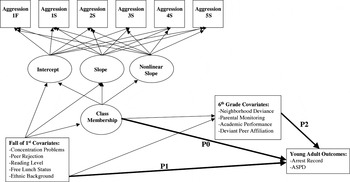
The analytical model, using a growth mixture framework.
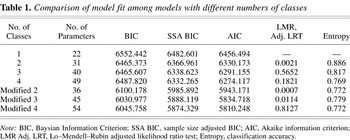
Comparison of model fit among models with different numbers of classes
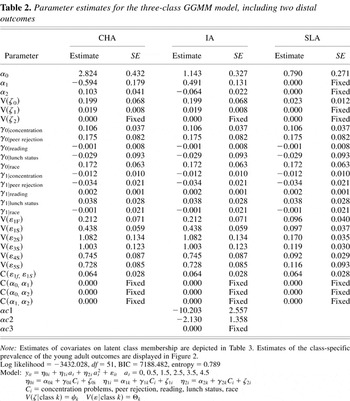
Parameter estimates for the three-class GGMM model, including two distal outcomes
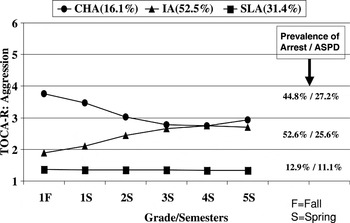
The prevalence of antisocial personality disorder and arrest as a function of growth in aggression.
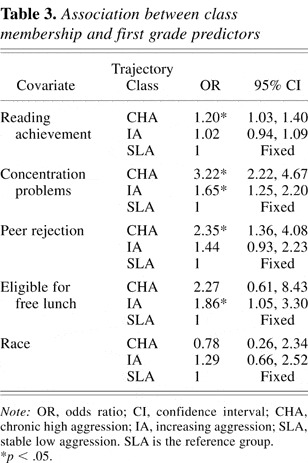
Association between class membership and first grade predictors
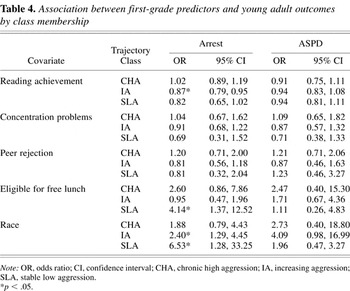
Association between first-grade predictors and young adult outcomes by class membership
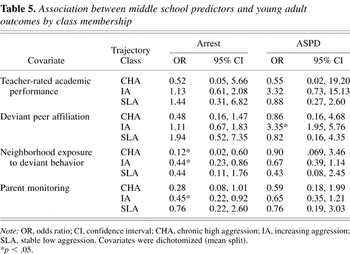
Association between middle school predictors and young adult outcomes by class membership
 You have
Access
- 34
- Cited by