



1 Introduction
The Shafarevich conjecture for abelian varieties, proved by Faltings and Zarhin [Reference Faltings, Wüstholz, Grunewald, Schappacher and Stuhler8, 5, VI, Section 1, Theorem 2] asserts the finiteness of isomorphism classes of abelian varieties of a fixed dimension over a fixed number field that admit good reduction away from a fixed finite set of finite places. In [Reference Javanpeykar and Loughran16], Javanpeykar and Loughran conjectured that the Shafarevich conjecture holds for more general families of varieties. They also show that the Lang–Vojta conjecture for integral points of hyperbolic varieties implies the Shafarevich conjecture for hypersurfaces and complete intersections of general type [Reference Javanpeykar and Loughran16, Theorem 1.5]. The Shafarevich conjecture is proved in many cases. For example, this has been proved for del Pezzo surfaces [Reference Scholl32], flag varieties [Reference Javanpeykar and Loughran15], certain Fano threefolds [Reference Javanpeykar and Loughran17] [Reference Ito, Kanemitsu, Takamatsu and Tanaka13], proper hyperbolic polycurves [Reference Javanpeykar14, Reference Nagamachi and Takamatsu28], K3 surfaces [Reference André1, Reference She33, Reference Takamatsu34], Enriques surfaces [Reference Takamatsu35], hyper-kähler varieties [Reference André1, Reference Fu, Li, Takamatsu and Zou10]). Furthermore, it is verified for hypersurfaces in abelian varieties [Reference Lawrence and Sawin23] and very irregular varieties [Reference Krämer and Maculan21]. However, it is still open in general.
In the first part of this article (Section 2), we shall consider the same problem for bielliptic surfaces. Our main theorem is the following.
Theorem 1.1 (Theorem 2.10)
Let F be a finitely generated field over
 $\mathbb {Q}$
, and R be a finite type algebra over
 $\mathbb {Z}$
which is a normal domain with fraction field F. Then, the set
 $$\begin{align*}\left\{X \left| \begin{array}{l} X\colon \text{bielliptic surface over }F \text{ which admits a rational point},\\ X \text{ has good reduction at any height }1 \text{ prime ideal }\mathfrak{p} \in \mathop{\mathrm{Spec}} R \end{array} \right.\right\}/F \text{-isom} \end{align*}$$
is finite.
Remark 1.2 In Theorem 1.1, we only consider bielliptic surfaces with rational points. This restriction is essential. Indeed, in Proposition 2.12, we show that the Shafarevich conjecture for general bielliptic surfaces fails. Our counterexample is based on the example in [Reference Mazur27, footnote 27], which is a counterexample to the Shafarevich conjecture for genus 1 curves.
As stated above, the Shafarevich conjecture is also justified in the cases of K3 surfaces and Enriques surfaces (see [Reference She33, Reference Takamatsu34, Reference Takamatsu35]). Therefore, Theorem 1.1 completes the study of the Shafarevich conjecture for minimal surfaces of Kodaira dimension
 $0$
. We remark that we assume the existence of a rational point on X in Theorem 1.1, as in the case of abelian varieties.
In Section 2, first, we shall study the structure of bielliptic surfaces with a rational point and its reduction nature. After that, we give a proof of Theorem 1.1 by using that structure result and the Shafarevich conjecture for (products of) elliptic curves. Here, we also use the finitely generatedness of the Mordell–Weil groups of elliptic curves to reduce the problem to the case of products of elliptic curves.
In the second part (Section 3), we shall study a Néron model of a bielliptic surface. Let K be a discrete valuation field, and X a smooth separated finite type scheme over K. A Néron model
 $\mathcal {X}$
of X is a smooth separated finite type model over
 $\mathcal {O}_{K}$
satisfying some extension property, which is known as the Néron mapping property. Néron proves the existence of such models for abelian varieties [Reference Néron30]. Moreover, Liu and Tong prove the existence of Néron models for smooth proper curves of positive genus (see [Reference Liu and Tong26] for a more precise statement). In general, a Néron model need not exist. Our main theorem is the following.
Theorem 1.3 (see Theorem 3.6 for more precise statements.)
Let K be a strictly Henselian discrete valuation field with residue characteristic different from
 $2$
and
 $3$
, and X be a bielliptic surface over K. Then X potentially admits a Néron model, i.e., there exists a finite separable extension
 $L/K$
, such that
 $X_{L'}$
admits a Néron model for any finite extension
 $L'/L$
.
The key idea of Theorem 1.3 is to take a quotient of a Néron model of abelian surfaces. If X satisfies some condition, we can show that this quotient is the Néron model again (see Theorem3.5 for a sufficient condition). However, in general, that quotient is not necessarily a Néron model. To treat the general case, we use some gluing arguments.
Notations and Terminologies
-
• Let
 $A \rightarrow B$
be a morphism of algebras. For a scheme X over A, we denote its base change
$X\times _{A}B$
by
$X_{B}$
.
-
• For any scheme S and a point
$s\in S$
, we denote its residue field by
$\kappa (s)$
. -
• For any discrete valuation field K, we denote its valuation ring by
$\mathcal {O}_{K}$
. We denote the completion of K by
$\widehat {K}$
. -
• Let K be a discrete valuation field and X a smooth separated finite type scheme over K. A scheme (resp. algebraic space)
$\mathcal {O}_{K}$
-model
$(\mathcal {X}, i)$
of X is a scheme (resp. algebraic space)
$\mathcal {X}$
which is separated and of finite type over
$\mathcal {O}_{K}$
with an isomorphism
$i\colon \mathcal {X}_{K} \simeq X$
. We often omit i and say that
$\mathcal {X}$
is a scheme (resp. algebraic space)
$\mathcal {O}_{K}$
-model of X. We assume that “a
$\mathcal {O}_K$
-model” simply refers to a
$\mathcal {O}_K$
-scheme model. An algebraic space
$\mathcal {O}_{K}$
-model
$\mathcal {X}$
of X is called smooth (resp. proper) (resp. projective) if
$\mathcal {X}$
is smooth (resp. proper) (resp. projective) over
$\mathcal {O}_{K}$
. -
• Let X be a smooth projective variety over k. We denote the Albanese torsor of X by
$\mathrm {Alb} (X)$
, and the Albanese morphism by
$ \mathrm {alb} \colon X \rightarrow \mathrm {Alb} (X)$
.



2 Bielliptic surfaces and good reduction
In this section, we first recall the definition of bielliptic surfaces and study their basic properties.
Definition 2.1 Let k be a field. Let X be a smooth projective surface over k, and Y a smooth projective curve over k. Let
 $f \colon X \rightarrow Y$
be a proper surjective morphism over k. We say f is an elliptic fibration if
 $f_{*} \mathcal {O}_{X} =\mathcal {O}_{Y}$
and the generic fiber of f is a smooth genus 1 curve over the generic point of Y.
Definition 2.2 Let k be a field, and X a smooth projective surface over k. We say X is a bielliptic surface over k if the Kodaira dimension
 $\kappa (X)$
is equal to
 $0$
, the second Betti number
 $b_{2} (X)$
is equal to
 $2$
, and the Albanese morphism
 $\mathrm {alb} \colon X \rightarrow \mathrm {Alb} (X)$
is an elliptic fibration.
Note that, we mainly treat the case where
 $\operatorname {\mathrm {char}} k \neq 2,3$
where the condition of the Albanese morphism is unnecessary (see [Reference Bombieri, Mumford, Baily and Shioda3, p. 26]).
First, we review the basic property of bielliptic surfaces over an algebraically closed field.
Proposition 2.1 Let k be a field of characteristic different from
 $2$
and
 $3$
, and X a bielliptic surface over k. Then the Albanese torsor
 $\mathrm {Alb} (X)$
is 1-dimensional and the Albanese morphism
 $\mathrm {alb} \colon X \rightarrow \mathrm {Alb} (X)$
is an elliptic fibration such that any geometric fiber is a smooth elliptic curve. Moreover,
 $X_{\overline {k}}$
admits another elliptic fibration
 $g \colon X_{\overline {k}} \rightarrow \mathbb {P}^1_{\overline {k}}$
, and all the fibers of g are irreducible.
Proof This follows from [Reference Bădescu2, Theorems 8.6 and 8.10 and Lemma 8.7].
It is well-known that a bielliptic surface over an algebraically closed field is written as a quotient of certain abelian surfaces (cf. [Reference Bădescu2, Section 10.24]). We shall generalize this fact to fields that are not necessarily algebraically closed.
Lemma 2.2 Let k be a field of characteristic different from
 $2$
and
 $3$
, and X a bielliptic surface over k with a rational point
 $x \in X(k)$
. Let
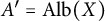 $A^{\prime} = \mathrm {Alb} (X)$
be the Albanese torsor of X, and B the fiber
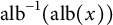 $\mathrm {alb}^{-1}(\mathrm {alb}(x))$
. By Proposition 2.1, we regard
 $A^{\prime}$
and B as elliptic curves with rational points coming from x. Then there exists an elliptic curve A over k which is isogenous to
 $A^{\prime}$
and a finite étale subgroup scheme
 $G \hookrightarrow A$
with a group scheme monomorphism
 $G \rightarrow \text {Aut}_{B/k}$
, such that there exists an isomorphism
 $$\begin{align*}X \simeq_{k} (A \times B) /G \end{align*}$$
which sends x to
 $\overline {(0,0)}.$
Here,
 $\text {Aut}_{B/k}$
is the automorphism scheme of the variety (rather than the group scheme) B. Furthermore, the projection
 $X\rightarrow A/G$
via the above isomorphism is isomorphic to the Albanese morphism
 $\mathrm {alb}$
, and
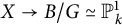 $X \rightarrow B/G \simeq \mathbb {P}^{1}_{k}$
is an elliptic fibration.
Proof We will prove this in three steps: first, when k is an algebraically closed field; second, when k is a separably closed field; and finally, in the case of a general field.
In the case when
 $k = \overline {k}$
, then it follows from [Reference Bădescu2, Section 10.24]. For future convenience, we will outline the proof. Let
 $g\colon X \rightarrow \mathbb {P}^1$
be an elliptic fibration given in Proposition 2.1. Let
 $S \subset \mathbb {P}^1$
be the image of the non-smooth locus of g, which is a closed subscheme of dimension
 $0$
. Then we can define the action
 $$\begin{align*}A^{\prime} \times g^{-1}(\mathbb{P}^{1} \setminus S) \rightarrow g^{-1}(\mathbb{P}^{1} \setminus S) \end{align*}$$
as follows. For any k-algebra R, take
 $P \in g^{-1}(\mathbb {P}^{1}\setminus S) (R).$
Then we have the abelian scheme
 $$\begin{align*}T:= g^{-1} (g(P)) = g^{-1} (\mathbb{P}^{1} \setminus S) \times_{\mathbb{P}^{1} \setminus S} g(P) \end{align*}$$
over
 $\mathop {\mathrm {Spec}} R$
with a section P, and we have a morphism
 $T \rightarrow A^{\prime}_{R}$
coming from the composition
 $$\begin{align*}T \rightarrow g^{-1}(\mathbb{P}^{1}\setminus S) \hookrightarrow X \rightarrow A^{\prime}. \end{align*}$$
Then we have
 $$\begin{align*}{A^{\prime}}_{R} \simeq {A^{\prime}}_{R}^{\vee} \rightarrow T^{\vee}, \end{align*}$$
and the right-hand side acts on T canonically. Therefore we get the desired action.
By the minimality of X (see [Reference Bădescu2, Theorem 10.21]), one can extend the above action to
 $\sigma \colon A^{\prime} \times X \rightarrow X$
(since
 $A^{\prime}$
is an elliptic curve, it is enough to extend the action of the generic point of
 $A^{\prime}$
). Let n be the intersection number of a fiber of
 $\mathrm {alb}$
and a fiber of g.
Then we have a diagram

where
 $\phi (a, a'):= na + a'$
. This diagram is commutative since it is commutative over
 $\overline {k}$
as in [Reference Bădescu2, Section 10.24]. By the above diagram,
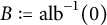 $B := \mathrm {alb}^{-1}(0)$
is stable under the action of
 $G^{\prime} := A^{\prime}[n]$
given by
 $\sigma $
. Therefore we have the morphism
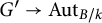 $G^{\prime} \rightarrow \text {Aut}_{B/k}$
corresponding to
 $\sigma \colon G^{\prime} \times B \rightarrow B$
. Moreover, we get the desired isomorphism
 $(A^{\prime} \times B) /G^{\prime} \simeq X$
via the action
 $\sigma $
since it induces an isomorphism over
 $\overline {k}$
. We put
 $$ \begin{align*} A &:= A^{\prime}/ \ker(G^{\prime} \rightarrow \text{Aut}_{B/k}), \\ G &:= G^{\prime}/ \ker(G^{\prime} \rightarrow \text{Aut}_{B/k}) \end{align*} $$
so that
 $G \rightarrow \text {Aut}_{B/k}$
is injective. These
 $A, B,$
and G satisfy the desired conditions, and it finishes the proof for the case where
 $k= \overline {k}$
.
Next, we treat the case where k is separably closed. Then by the argument in the case where
 $k=\overline {k}$
, we have a finite étale morphism
 $\pi \colon A^{\prime}_{\overline {k}} \times B_{\overline {k}}\rightarrow X_{\overline {k}}$
which is the quotient map by an action of
 $G^{\prime}_{\overline {k}}$
, where
 $G^{\prime}:= A^{\prime}[n]$
for some
 $n\in \{2,3,4,6,8,9\}$
. We shall prove that this morphism is defined over k. The morphism
 $\pi $
can be decomposed as

Here,
 $\pi _{\ast } \mathcal {O}_{A^{\prime}_{\overline {k}}\times B_{\overline {k}}}$
is decomposed as
 $\oplus _{\chi \in \widehat {G^{\prime}(\overline {k})}} \mathcal {F}_{\chi }$
, where
 $\mathcal {F}_{\chi }$
is a line bundle on
 $X_{\overline {k}}$
associated with a character
 $\chi \in \widehat {G^{\prime}(\overline {k})}$
. Since the n-multiplication map on the Picard scheme
 $\mathrm {Pic}_{X/k}$
is an étale morphism, each
 $\mathcal {F}_{\chi }$
descends to a line bundle on X, hence the morphism
 $\pi _{2}$
comes from the morphism
 $$\begin{align*}\pi_{2,0} \colon Y:= \underline{\mathop{\mathrm{Spec}}}_{X}\oplus_{\chi \in \widehat{G^{\prime}(\overline{k})}}\mathcal{F}_{\chi} \rightarrow X \end{align*}$$
over k. Since
 $\pi _{2,0}$
is a finite étale morphism, the fiber over x consists of k-rational points. In particular,
 $\pi _{1}(0,0)$
descends to a k-rational point of Y. We can equip Y with the structure of abelian variety over k with the zero section
 $\pi _{1}(0,0)$
by the Albanese morphism. Therefore the morphism
 $\pi _{1}$
is a homomorphism over
 $\overline {k}$
between abelian varieties defined over k. Since the homomorphism scheme of abelian varieties is étale [Reference Edixhoven, Van der Geer and Moonen7, Proposition 7.14], the morphism
 $\pi _{1}$
is also defined over k. Hence our
 $\pi $
is defined over k, i.e., there exists a morphism
 $A^{\prime} \times B \rightarrow X$
. Through this morphism, we have an isomorphism
 $(A^{\prime}\times B)/G^{\prime}\rightarrow X$
. This isomorphism induces the desired isomorphism
 $ (A \times B)/G \rightarrow X, $
where
 $$ \begin{align*} A &:= A^{\prime}/\ker (G^{\prime} \rightarrow \text{Aut}_{B/k}), \\ G &:= G^{\prime}/\ker (G^{\prime} \rightarrow \text{Aut}_{B/k}). \end{align*} $$
Finally, we show the general case. Note that, we have an elliptic fibration
 $$\begin{align*}g' \colon X_{k^{\mathrm{sep}}} \rightarrow B_{k^{\mathrm{sep}}}/G_{k^{\mathrm{sep}}} \simeq \mathbb{P}^{1}_{k^{\mathrm{sep}}}. \end{align*}$$
Then by the argument in [Reference Creutz and Viray6, Proposition 5.6], we obtain an elliptic fibration
 $$\begin{align*}g \colon X \rightarrow \mathbb{P}^{1} \end{align*}$$
over k such that
 $g_{k^{\mathrm {sep}}}$
is isomorphic to
 $g'$
. Using this g, we can prove the theorem in exactly the same way as in the case where
 $k = \overline {k}$
. It finishes the proof.
Remark 2.3 In the proof of the above proposition, we take a quotient A (resp. G) of
 $A^{\prime}$
(resp.
 $G^{\prime}$
). However, if we do not require
 $G \rightarrow \text {Aut}_{B/k}$
to be injective, we do not have to take quotients in the final part of the proof. More precisely,
 $A:=A^{\prime}$
and
 $G:=G^{\prime}$
gives the description
 $$\begin{align*}X \simeq_{k} (A \times B)/G, \end{align*}$$
where A is the Albanese variety of X,
 $B := \mathrm {alb}^{-1}(\mathrm {alb}(x))$
,
 $G:= A[n]$
for some
 $n \in \{2,3,4,6,8,9\}$
with a group scheme morphism
 $G \rightarrow \text {Aut}_{B/k}$
. In this description, the projection
 $X \rightarrow A/G \simeq A$
gives the Albanese morphism, where
 $A/G \simeq A$
is given by the n-multiplication map. Note that the integer n is independent of the choice of a rational point
 $x\in X(K)$
.
Definition 2.3 Let K be a discrete valuation field, and X a bielliptic surface over K. We say X admits good reduction if there exists a smooth proper algebraic space
 $\mathcal {X}$
over
 $\mathcal {O}_{K}$
such that
 $\mathcal {X}_{K}\simeq X$
.
Here, we also recall the definition of a Néron model.
Definition 2.4 Let K be a discrete valuation field, X a smooth separated finite type scheme over K, and
 $\mathcal {X}$
a smooth
 $\mathcal {O}_{K}$
-model of X. The
 $\mathcal {O}_K$
-model
 $\mathcal {X}$
is a Néron model of X if for any smooth
 $\mathcal {O}_{K}$
-scheme Z and K-morphism
 $u_{K} \colon Z_{K} \rightarrow X$
, there exists a unique extension
 $u \colon Z \rightarrow \mathcal {X}$
of
 $u_{K}$
.
Remark 2.4 In Definition 2.4, if an extension u exists, then it is automatically unique since
 $\mathcal {X}$
is separated over
 $\mathcal {O}_{K}$
.
Lemma 2.5 Let K be a discrete valuation field with residue field k whose characteristic is different from
 $2$
and
 $3$
. For any bielliptic surface X over K, the following are equivalent.
-
(1) X admits good reduction.
-
(2) There exists a smooth proper scheme
$\mathcal {O}_{K}$
-model
$\mathcal {X}$
of X. -
(3) There exists a smooth projective scheme
$\mathcal {O}_{K}$
-model
$\mathcal {X}$
of X.


Proof
 $(3) \Rightarrow (2) \Rightarrow (1)$
is clear. We shall show
 $(1)\Rightarrow (3)$
. Let
 $\mathcal {X}$
be a smooth proper algebraic space
 $\mathcal {O}_{K}$
-model of X. Let
 $\widehat {\mathcal {X}}$
be a formal completion of
 $\mathcal {X}_{\widehat {\mathcal {O}_{K}}}$
along its special fiber
 $\mathcal {X}_{k}$
, where
 $\widehat {\mathcal {O}_{K}}$
is a completion of
 $\mathcal {O}_{K}$
. We note that
 $\mathcal {X}_{k}$
is a bielliptic surface over k. Indeed, since
 $\mathcal {X}_{k}$
is a principal Cartier divisor on
 $\mathcal {X}$
, we have
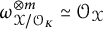 $\omega ^{\otimes m}_{\mathcal {X}/\mathcal {O}_{K}} \simeq \mathcal {O}_{\mathcal {X}}$
, where m is the order of
 $\omega _{X/K}$
. Therefore
 $\omega _{\mathcal {X}_{k}/k}^{\otimes m}$
is trivial, and
 $\mathcal {X}_{k}$
is a minimal surface of Kodaira dimension
 $0$
with the same Betti numbers as X. Hence
 $\mathcal {X}_{k}$
is a bielliptic surface, and we have
 $H^{2}(\mathcal {X}_{k}, \mathcal {O}_{\mathcal {X}_{k}})=0$
. By [Reference Fantechi, Göttsche, Illusie, Kleiman, Nitsure and Vistoli9, Corollary 8.5.5], one can lift an ample line bundle
 $L_{k}$
on
 $\mathcal {X}_{k}$
to
 $\widehat {L}$
on
 $\widehat {\mathcal {X}}$
. By Grothendieck’s existence theorem [Reference Knutson18, Theorem 6.3], the line bundle
 $\widehat {L}$
also lifts to L on
 $\mathcal {X}_{\widehat {\mathcal {O}_{K}}}$
as an invertible sheaf. The categorical equivalence of Grothendieck’s existence theorem implies that for any coherent sheaf F on
 $\mathcal {X}_{\widehat {\mathcal {O}_{K}}}$
,
 $F\otimes L^{\otimes n}$
is globally generated for sufficiently large n. This also holds over a finite scheme cover of
 $\mathcal {X}_{\widehat {\mathcal {O}_{K}}}$
, hence L is an ample line bundle. Therefore, we have a smooth projective scheme model
 $\mathcal {X}_{\widehat {\mathcal {O}_{K}}}$
over
 $\widehat {\mathcal {O}_{K}}$
. Let
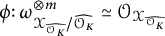 $\phi \colon \omega _{\mathcal {X}_{\widehat {\mathcal {O}_{K}}}/\widehat {\mathcal {O}_{K}}}^{\otimes m}\simeq \mathcal {O}_{\mathcal {X}_{\widehat {\mathcal {O}_{K}}}}$
be the base change of the isomorphism
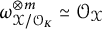 $\omega ^{\otimes m}_{\mathcal {X}/\mathcal {O}_{K}} \simeq \mathcal {O}_{\mathcal {X}}$
. We take a cyclic covering
 $\mathcal {Y}$
associated with
 $\phi $
, i.e.,
 $$\begin{align*}Y := \underline{\mathop{\mathrm{Spec}}}_{\mathcal{X}_{\widehat{\mathcal{O}_{K}}}} \bigoplus_{r=0}^{m-1} \omega_{\mathcal{X}_{\widehat{\mathcal{O}_{K}}/\mathcal{O}_{K}}}^{\otimes r}, \end{align*}$$
where the module on the right-hand side is equipped with the algebra structure given by
 $\phi $
. Since m is
 $2, 3, 4,$
or
 $6$
(see [Reference Bombieri, Mumford, Baily and Shioda3, p. 37]),
 $\mathcal {Y}$
is finite étale over
 $\mathcal {X}_{\widehat {\mathcal {O}_{K}}}$
. The base change
 $Y_{\overline {\widehat {K}}}$
of the generic fiber
 $Y := \mathcal {Y}_{\widehat {K}}$
is an abelian surface since its canonical sheaf is trivial and its first Betti number is not equal to zero. Moreover, by Hensel’s lemma, there exists a finite unramified extension
 $L/ \widehat {K}$
such that
 $Y_{L}$
admits an L-rational point, i.e.,
 $Y_{L}$
has a structure of an abelian variety. Therefore, by [Reference Bosch, Lütkebohmert and Raynaud4, Proposition 1.4.2], the
 $\mathcal {O}_L$
-model
 $\mathcal {Y}_{\mathcal {O}_{L}}$
satisfies the Néron mapping property, and
 $\mathcal {Y}$
also satisfies the Néron mapping property by a descent argument. Using [Reference Bosch, Lütkebohmert and Raynaud4, Theorem 7.2.1], the smooth proper Néron model
 $\mathcal {Y}$
descends to the smooth proper Néron model
 $\mathcal {Y}_{0}$
over
 $\mathcal {O}_{K}$
whose generic fiber is
 $Y_{0}$
which is the cyclic covering of X associated with
 $\phi _{0}$
. By the Néron mapping property, the cyclic action on
 $Y_{0}$
can be extended to that on
 $\mathcal {Y}_{0}$
, and this action is free since its base change to
 $\widehat {\mathcal {O}_{K}}$
is the cyclic action on
 $\mathcal {Y}$
. Therefore, we can take a finite étale quotient
 $\mathcal {Y}_{0}/\mu _{m}$
which is separated of finite type. Hence it gives a smooth proper scheme model over
 $\mathcal {O}_{K}$
of X. Note that
 $\mathcal {Y}_0$
is projective over
 $\mathcal {O}_{K}$
by [Reference Bosch, Lütkebohmert and Raynaud4, Theorem 6.4.1], hence
 $\mathcal {Y}_{0}/\mu _{m}$
is also a smooth projective.
Remark 2.6 In general, if a smooth proper variety X over a discrete valuation field admits a smooth proper scheme
 $\mathcal {O}_{K}$
-model and a Néron model, then the smooth proper scheme model of X is isomorphic to the Néron model, by van der Waerden’s purity theorem (see [Reference Grothendieck12, Corollaire (21.12.16)]). Hence a smooth proper
 $\mathcal {O}_{K}$
-model of X is unique for such X. Note that, for general X, a smooth proper scheme
 $\mathcal {O}_K$
-model of X need not be unique (see [Reference Liedtke and Matsumoto24, Remark 6.3]).
Lemma 2.7 Let K be a discrete valuation field with residue field k whose characteristic is p. Let A be an abelian variety over K. Let
 $G \subset A$
be a finite subgroup scheme over K. Suppose that the order of
 $G(\overline {K})$
is coprime to p. Let
 $\mathcal {A}$
be the Néron model of A. Then there exists the Néron model
 $\mathcal {G}$
of G and a natural closed immersion
 $\mathcal {G} \rightarrow \mathcal {A}$
.
Proof Let
 $\mathcal {A}'$
be the Néron model of
 $A/G$
. Then the natural morphism
 $\pi : \mathcal {A} \rightarrow \mathcal {A}'$
is an étale isogeny. Indeed, by [Reference Bosch, Lütkebohmert and Raynaud4, Proposition 7.3.6], we have a morphism
 $\pi ' \colon \mathcal {A}' \rightarrow \mathcal {A}$
with
 $\pi ' \circ \pi = n$
, where n is the order of
 $G(\overline {K})$
. Since n is coprime to p,
 $\pi ' \circ \pi $
is étale [Reference Bosch, Lütkebohmert and Raynaud4, Lemma 7.3.2]. Hence,
 $\pi $
is quasi-finite and flat [Reference Bosch, Lütkebohmert and Raynaud4, Proposition 2.4.2, Lemma 7.3.1]. Moreover, the kernel of
 $\pi $
is étale, since
 $\pi ' \circ \pi $
is étale. So
 $\pi $
is étale. Let
 $\mathcal {K}$
be the kernel of
 $\pi $
, which is étale separated of finite type over
 $\mathcal {O}_{K}$
. Then
 $\mathcal {G}$
is canonically isomorphic to
 $\mathcal {K}$
, since for any smooth
 $\mathcal {O}_{K}$
-scheme Z,
 $$ \begin{align*} \mathcal{K}(Z) &= \ker (\mathcal{A}(Z)\rightarrow \mathcal{A}'(Z))\\ &= \ker (A(Z_{K})\rightarrow (A/G)(Z_{K})) \\ &= G(Z_{K}). \end{align*} $$
Proposition 2.8 Let K be a discrete valuation field with residue field k whose characteristic is different from
 $2$
and
 $3$
. Let X be a bielliptic surface over K which admits a rational point
 $x\in X(K)$
. Let
 $X \simeq (A \times B) /G$
be the isomorphism given in Lemma 2.2. Then the following are equivalent.
-
(1) The bielliptic surface X admits good reduction.
-
(2) The elliptic curves A and B admit good reduction.
Proof First we shall show
 $(1)\Rightarrow (2)$
. By Lemma 2.5, we have
 $\mathcal {X} \rightarrow S:= \mathop {\mathrm {Spec}} \mathcal {O}_{K}$
which is a smooth projective scheme
 $\mathcal {O}_{K}$
-model of X. Note that
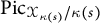 $\mathrm {Pic}_{\mathcal {X}_{\kappa (s)}/\kappa (s)}$
is smooth of dimension
 $1$
for any geometric point s on S since
 $\mathcal {X}_{\kappa (s)}/\kappa (s)$
is a bielliptic surface over a field of characteristic different from
 $2$
and
 $3$
. Let
 $\mathrm {Pic}_{\mathcal {X}/S}$
be the Picard functor, and
 $\mathcal {Y} := \mathrm {Pic}^{0}_{\mathcal {X}/S} \hookrightarrow \mathrm {Pic}_{\mathcal {X}/S}$
is the open closed subgroup scheme whose fiber over any geometric point s of S is equal to the identity component of
 $\mathrm {Pic}_{\mathcal {X}_{s}/\kappa (s)}$
(see [Reference Fantechi, Göttsche, Illusie, Kleiman, Nitsure and Vistoli9, Theorem 9.4.8, Proposition 9.5.20]). Therefore,
 $\mathcal {Y}$
is an abelian scheme over S. For the fixed rational point
 $x\in \mathcal {X}(\mathcal {O}_{K})$
, we have the corresponding morphism
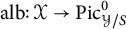 $\mathrm {alb} \colon \mathcal {X} \rightarrow \mathrm {Pic}^{0}_{\mathcal {Y}/S}$
which sends x to
 $0$
. Note that this morphism is flat since one can check it fiberwise (see [Reference Bosch, Lütkebohmert and Raynaud4, Proposition 2.4.2]). Since
 $\mathrm {Pic}^{0}_{\mathcal {Y}/S}$
is a smooth proper scheme
 $\mathcal {O}_{K}$
-model of the Albanese variety of X, the elliptic curve A admits good reduction. Moreover, one can show that
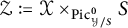 $\mathcal {Z}:= \mathcal {X}\times _{\mathrm {Pic}^{0}_{\mathcal {Y}/S}}S$
is a smooth proper scheme
 $\mathcal {O}_{K}$
-model of B, where
 $S \rightarrow \mathrm {Pic}^{0}_{\mathcal {Y}/S}$
is the
 $0$
-section. Indeed, by the definition
 $\mathcal {Z}$
is proper and flat over S, and whose geometric fibers are smooth. Therefore B admits good reduction too.
Next, we shall show
 $(2)\Rightarrow (1)$
. Let
 $\mathcal {A}, \mathcal {B}$
be the Néron models of A, B (which is the unique smooth proper scheme
 $\mathcal {O}_{K}$
-model of the elliptic curves
 $A, B$
). Moreover, let
 $\mathcal {G}$
be the Néron model of G. Since A admits good reduction, the scheme G consists of spectra of fields that are unramified over K (recall that G is a quotient of the n-torsion points of
 $A^{\prime}$
, where
 $A^{\prime}$
is an elliptic curve which is isogenous to A and
 $n \in \{ 2,3,4,6,8,9 \}$
). Therefore a Néron model of G is a finite étale group scheme over
 $\mathcal {O}_{K}$
. By the Néron mapping property, one can extend the action of G on
 $A \times B$
to the action of
 $\mathcal {G}$
on
 $\mathcal {A} \times \mathcal {B}$
. Be Lemma 2.7,
 $\mathcal {G} \hookrightarrow \mathcal {A}$
is a closed immersion of group schemes. Therefore the above action
 $\mathcal {G} \times \mathcal {A} \times \mathcal {B} \rightarrow \mathcal {A} \times \mathcal {B}$
is a free action by the locally free group scheme. Hence one can take a finite étale quotient
 $\mathcal {A} \times \mathcal {B} \rightarrow \mathcal {X}$
, where
 $\mathcal {X}$
is separated of finite type over
 $\mathcal {O}_{K}$
. Therefore one can show that
 $\mathcal {X}$
is a smooth proper scheme
 $\mathcal {O}_{K}$
-model of X, and it finishes the proof.
Remark 2.9 This proposition is one formulation of a good reduction criterion for bielliptic surfaces. By using a
 $\mu _{m}$
-torsor of a bielliptic surface X defined as a cyclic covering defined by
 $\omega _X$
, one can formulate a similar statement for bielliptic surfaces without rational points (see [Reference Chiarellotto and Lazda5, Section 9]).
Theorem 2.10 Let F be a finitely generated field over
 $\mathbb {Q}$
, and R a finite type algebra over
 $\mathbb {Z}$
which is a normal domain with fraction field F. Then, the set
 $$\begin{align*}\mathrm{Shaf} := \left\{X \left| \begin{array}{l} X\colon \text{bielliptic surface over }F \text{ which admits a rational point},\\ X \text{ has good reduction at any height }1 \text{ prime ideal }\mathfrak{p} \in \mathop{\mathrm{Spec}} R \end{array} \right.\right\}/F \text{-isom} \end{align*}$$
is finite.
Proof Shrinking
 $\mathop {\mathrm {Spec}} R$
, we may assume that R is smooth over
 $\mathbb {Z}$
. For
 $X \in \mathrm {Shaf}$
, one can associate a rational point
 $x\in X (F)$
and we have a description
 $X \simeq (A \times B)/G$
as in Lemma 2.2. By Proposition 2.8, the elliptic curves A and B admit good reduction at any height
 $1$
prime
 $\mathfrak {p} \in \mathop {\mathrm {Spec}} R$
. Therefore there exists a map
 $\mathrm {Shaf} \rightarrow \mathrm {Shaf}_{\text {ab}}$
, where
 $\mathrm {Shaf}_{\text {ab}}$
is the set of pairs of F-isomorphism classes of elliptic curves both of which admit good reduction at any height
 $1$
prime of
 $\mathop {\mathrm {Spec}} R$
. By [Reference Faltings, Wüstholz, Grunewald, Schappacher and Stuhler8, VI, Section 1, Theorem 2],
 $\mathrm {Shaf}_{\text {ab}}$
is a finite set. Therefore, by Lemma 2.11 below, we obtain the desired finiteness.
Lemma 2.11 Let F be a finitely generated field over
 $\mathbb {Q}$
, and R a smooth domain over
 $\mathbb {Z}$
with fraction field F. We put
 $\mathrm {Shaf}$
as in Theorem 2.10. Also, we put
 $\mathrm {Shaf}_{\mathrm {ab}}$
as in the proof of Theorem 2.10, i.e.,
 $$\begin{align*}\mathrm{Shaf}_{\mathrm{ab}} := \left\{ (A,B)\left| \begin{array}{l} A, B \colon \text{elliptic curves over } F \text{ that have good reduction}\\ \text{ at any height } 1 \text{ prime ideal } \mathfrak{p} \in \mathop{\mathrm{Spec}} R \end{array} \right\} \right. /F\text{-isom}. \end{align*}$$
Let
 $$\begin{align*}\mathrm{Shaf} \rightarrow \mathrm{Shaf}_{\mathrm{ab}}, \quad X \mapsto (A,B) \end{align*}$$
be the morphism defined by choosing a rational point
 $x \in X(F)$
and using Lemma 2.2 and Proposition 2.8 (see the proof of Theorem 2.10). Then this morphism is finite-to-one.
Proof For fixed
 $A \times B \in \mathrm {Shaf}_{\text {ab}}$
, let
 $X\in \mathrm {Shaf}$
be a bielliptic surface lying in its fiber. Then, X is isomorphic to
 $(A \times B) /G_{X}$
for some finite étale subgroup scheme
 $G_{X} \hookrightarrow A$
and some embedding
 $\alpha _{X} \colon G_{X} \hookrightarrow \text {Aut}_{B/F}$
. Since the order of
 $G_{X}$
is bounded, the candidates of
 $G_{X}\hookrightarrow A$
are finitely many. Hence we may fix an embedding
 $\iota \colon G := G_{X} \hookrightarrow A$
. Let
 $S_{A, B, \iota }$
be the set of embeddings
 $\alpha \colon G \hookrightarrow \text {Aut}_{B/F}$
such that
 $(A\times B) / G$
is a bielliptic surface, where the quotient is taken with respect to the action
 $\iota \times \alpha $
. Let
 $\sim $
be the equivalence relation on
 $S_{A,B, \iota }$
given by
 $B(F)$
-conjugate. More precisely, for
 $\alpha , \alpha ' \in \text {Aut}_{B/F}(G)$
,
 $\alpha \sim \alpha '$
if and only if there exists
 $b \in B(F)$
such that
 $t_{b} \alpha t_{-b} = \alpha '$
, where
 $t_{b} \colon B \rightarrow B$
is the translation which sends
 $0$
to b. In this case, we have the F-isomorphism
 $$\begin{align*}((A \times B)/G)^{(\iota \times \alpha)} \simeq ((A \times B)/G)^{(\iota \times \alpha')} \end{align*}$$
induced by
 $\mathrm {id} \times t_{b}$
, where the left-hand (resp. right-hand) side is the quotient with respect to the action
 $\iota \times \alpha $
(resp.
 $\iota \times \alpha '$
). Therefore, it suffices to show the finiteness of
 $S_{A,B,\iota }/\sim $
. Since
 $(B/G)_{\overline {F}}^{(\alpha _{\overline {F}})}$
(the quotient with respect to the action
 $\alpha _{\overline {F}}$
) is
 $\mathbb {P}^{1}_{\overline {F}}$
, the image H of
 $\alpha _{\overline {F}} (G(\overline {F}))$
in
 $\text {Aut}(B_{\overline {F}})/B(\overline {F}) \simeq \text {Aut}(B_{\overline {F}},0)$
is non-trivial. Indeed, if this is trivial, then the quotient is given by an isogenous elliptic curve, and we have a contradiction. Take an element
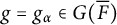 $g = g_{\alpha } \in G(\overline {F})$
such that the image of
 $\alpha _{\overline {F}} (g)$
generates H. Let
 $b_{\alpha } \in B(\overline {F})$
be a fixed point of
 $\alpha _{\overline {F}} (g)$
. Since
 $\alpha _{\overline {F}}(G(\overline {F}))$
is commutative, we have a decomposition
 $G(\overline {F}) \simeq H_{1}^{\alpha } \times H_{2}^{\alpha }$
, with
 $\alpha (H_{1}^{\alpha }) \subset \text {Aut} (B_{\overline {F}},b_{\alpha })$
and
 $\alpha (H_{2}^{\alpha }) \subset B(\overline {F}) \subset \text {Aut} (B_{\overline {F}})$
(see the arguments in [Reference Bădescu2, Section 10.26, List 10.27]). We denote the projection
 $G(\overline {F}) \rightarrow H_{i}^{\alpha }$
by
 $p_{i}^{\alpha }$
. Since
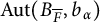 $\text {Aut} (B_{\overline {F}}, b_{\alpha })$
is
 $\mathbb {Z}/2\mathbb {Z}$
,
 $\mathbb {Z}/4\mathbb {Z}$
, or
 $\mathbb {Z}/6\mathbb {Z}$
, there are classification of
 $H_{1}^{\alpha } \hookrightarrow \text {Aut} (B_{\overline {F}}, b_{\alpha })$
and
 $H_{2}^{\alpha } \hookrightarrow B(\overline {F})$
(see [Reference Bădescu2, List 10.27]). In particular, we remark that if
 $H_{2}^{\alpha }$
is non-trivial then
 $H_{2}^\alpha $
is
 $\mathbb {Z}/2\mathbb {Z}$
(the case of
 $(a_{2})$
or
 $(c_{2})$
in [Reference Bădescu2, List 10.27]) or
 $\mathbb {Z}/3\mathbb {Z}$
(the case of
 $(c_{1})$
in [Reference Bădescu2, List 10.27]). In both cases, we note that
 $\# H_{2}^{\alpha }$
divides
 $\# H_{1}^{\alpha }$
.
We can define the morphism of sets
 $$\begin{align*}\phi \colon S_{A,B,\iota} \rightarrow B(F); \alpha \mapsto \sum_{g \in G(\overline{F})}\alpha_{\overline{F}}(g) (0). \end{align*}$$
Since
 $\# H_{2}^{\alpha } | \# H_{1}^{\alpha }$
, we have
 $$\begin{align*}\sum_{g\in G(\overline{F})} \alpha_{\overline{F}}(p_{2}^{\alpha}(g))(0) = \sum_{h \in H_{2}^{\alpha}} \# H_{1}^{\alpha} \cdot \alpha_{\overline{F}}(h)(0) =0. \end{align*}$$
Let n be the order of
 $G(\overline {F})$
, and
 $h^{\alpha ,g} \in \text {Aut}(B_{\overline {F}},0)$
the automorphism such that
 $$\begin{align*}\alpha_{\overline{F}}(p_{1}^{\alpha}(g)) = t_{b_{\alpha}} h^{\alpha,g} t_{b_{\alpha}}^{-1}. \end{align*}$$
Since
 $$\begin{align*}h^{\alpha,g_{0}}\left(\sum_{g\in G(\overline{F})} h^{\alpha,g}\right) =\sum_{g\in G(\overline{F})} h^{\alpha,g} \end{align*}$$
for non-trivial
 $h^{\alpha ,g_{0}}$
(one can take
 $g_{0} = g_{\alpha }$
), the image
 $(\sum _{g\in G(\overline {F})} h^{\alpha ,g}) (B_{\overline {F}})$
is contained in the fixed locus of
 $h^{\alpha , g_{0}}$
. Since
 $(\sum _{g\in G(\overline {F})} h^{\alpha ,g}) (B_{\overline {F}})$
is connected and containing
 $0$
, we have
 $\sum _{g\in G(\overline {F})} h^{\alpha ,g} = 0 \in \text {End} (B_{\overline {F}})$
. Combining with
 $$\begin{align*}\alpha_{\overline{F}}(g)(0) = \alpha_{\overline{F}}(p_{1}^{\alpha}(g))(0) + \alpha_{\overline{F}}(p_{2}^{\alpha}(g))(0), \end{align*}$$
we have
 $$ \begin{align*} \phi (\alpha) &= \sum_{g\in G(\overline{F})} \alpha_{\overline{F}}(p_{1}^{\alpha}(g))(0) \\ &= \sum_{g\in G(\overline{F})} ( h^{\alpha,g} (-b_{\alpha}) + b_{\alpha})\\ &= \sum_{g\in G(\overline{F})} (1 - h^{\alpha,g}) (b_{\alpha})\\ &= n b_{\alpha}. \end{align*} $$
Since we fix the isomorphism class of G, possible isomorphism classes
 $H_{1}^{\alpha }, H_{2}^{\alpha }$
are at most finitely many (in fact unique). Therefore, possible
 $\alpha |_{H_{2}^{\alpha }}$
are at most finitely many. Moreover, if
 $n b_{\alpha }$
is fixed, then possible
 $b_{\alpha }$
are finitely many, and
 $\alpha |_{H_{1}^{\alpha }}$
are at most finitely many since possible embeddings
 $H_{1}^{\alpha } \rightarrow \text {Aut}(B_{\overline {F}}, b_{\alpha })$
are finitely many. Hence each fiber of
 $\phi $
is finite. We note that
 $\phi (t_{b} \alpha t_{b}^{-1}) = n(b_{\alpha }+b)$
. Therefore
 $\phi $
induces the morphism with finite fibers
 $$\begin{align*}S_{A,B,\iota}/ \sim \rightarrow B(F)/ n B(F). \end{align*}$$
By [Reference Néron29] (see also [Reference Lang and Néron22, Section 1]), the abelian group
 $B(F)$
is finitely generated, so the right-hand side is finite. It finishes the proof.
In Theorem 2.10, we only consider bielliptic surfaces admitting rational points. We construct an example below to show that this assumption is an essential one. This example is based on a counterexample to the Shafarevich conjecture for genus 1 curves in [Reference Mazur27, footnote 27].
Proposition 2.12 There exists a finite set of finite prime numbers S such that the set
 $$\begin{align*}\mathrm{Shaf}' := \left\{X \left| \begin{array}{l} X\colon \text{bielliptic surface over }\mathbb{Q},\\ X \text{ has good reduction at any} \text{ prime number }p \notin S \end{array} \right.\right\}/F \text{-isom} \end{align*}$$
is an infinite set.
Proof We take a finite set of finite prime numbers S and an elliptic curve E over
 $\mathbb {Q}$
satisfying the following:
-
(1)
$2 \notin S,$
-
(2) E has good reduction outside S,
-
(3) The Mordell-Weil rank of E is 0, and the analytic rank of E is 0,
-
(4) Any point of
$E[2]$
is a
$\mathbb {Q}$
-rational point.


Note that the assumption
 $(2)$
ensures that S is non-empty by [Reference Ogg31]. Moreover, by Kolyvagin’s result [Reference Kolyvagin19] (see also [Reference Kolyvagin and Satake20, Theorem 1]) and the assumption (3), the Tate-Shafarevich group
 of E is known to be finite. We can take, for example, S as
 $\{3,5 \}$
and E as the elliptic curve over
 $\mathbb {Q}$
with Cremona label
 $15a2$
. We shall show that
 $\mathrm {Shaf}'$
is an infinite set for this S.
By Tate’s argument [Reference Mazur27, footnote 27] and the assumptions (2) and (3), we can take infinitely many isomorphism classes of E-torsors
 $C_{i}$
over
 $\mathbb {Q}$
(
 $i=1,2, \ldots $
) such that
 $C_{i, \mathbb {Q}_{p}}$
is a trivial torsor for any
 $p \notin S$
. Since
 is finite, we may assume that there exists a prime number
 $p \in S$
such that the isomorphism classes of
 $E_{\mathbb {Q}_{p}}$
-torsor
 $C_{i, \mathbb {Q}_{p}}$
are all distinct. By restricting the action of the torsor structure, we have a free action
 $\sigma _{1}$
of
 $E[2]$
on
 $C_{i}$
. We fix a
 $\mathbb {Z}/2\mathbb {Z}$
-basis
 $P, Q$
of
 $E[2] \simeq (\mathbb {Z}/2\mathbb {Z})^{\oplus 2}$
, that are
 $\mathbb {Q}$
-rational points by the assumption (4). We consider the morphism
 $$\begin{align*}\sigma_{2} \colon E[2] \times E \rightarrow E; (aP+bQ, R) \mapsto (-1)^a R + bQ, \end{align*}$$
which is well-defined and gives the action of
 $E[2]$
on E. We put
 $$\begin{align*}X_{i} := (C_{i} \times E)/ E[2], \end{align*}$$
where the quotient is taken with respect to the action
 $\sigma := \sigma _{1} \times \sigma _{2}$
. Clearly,
 $X_{i}$
is a bielliptic surface over
 $\mathbb {Q}$
. Moreover,
 $X_{i}$
has good reduction outside S by the same argument as in the proof of Proposition 2.8. We shall show that
 $X_{i} (i=1,2, \ldots )$
represent infinitely many
 $\mathbb {Q}$
-isomorphism classes. Let
 $A_{i}$
be the Albanese torsor
 $\mathrm {Alb} (X_{i})$
of
 $X_{i}$
. It suffices to show that
 $A_{i} (i=1,2, \ldots )$
represent infinitely many
 $\mathbb {Q}$
-isomorphism classes. Let
 $f_{i} \colon X_{i} \rightarrow C_{i}/ E[2]$
be the natural morphism. Fix a
 $\overline {\mathbb {Q}}$
-rational point of
 $C_{i, \overline {\mathbb {Q}}}$
so that
 $C_{i, \overline {\mathbb {Q}}}$
is equipped with the structure of an elliptic curve, which is isomorphic to
 $E_{\overline {\mathbb {Q}}}$
. Since
 $$\begin{align*}(E_{\overline{\mathbb{Q}}} \times E_{\overline{\mathbb{Q}}})/E[2] \simeq X_{i, \overline{\mathbb{Q}}} = (C_{i, \overline{\mathbb{Q}}} \times E_{\overline{\mathbb{Q}}}) /E[2] \rightarrow C_{i, \overline{\mathbb{Q}}} / E[2] \simeq E_{\overline{\mathbb{Q}}} / E[2] \rightarrow E_{\overline{\mathbb{Q}}} \end{align*}$$
is an Albanese morphism by the proof of Lemma 2.2, we have
 $A_{i} \simeq C_{i}/E[2]$
. Therefore,
 $A_{i}$
admits
 $E/E[2] \simeq E$
-torsor structure, whose class in Weil–Châtelet group
 $H^1(\mathrm {Gal}(\overline {\mathbb {Q}}/\mathbb {Q}), E)$
is
 $2[C_{i}]$
. Here,
 $C_{i}$
is a class represented by the E-torsor
 $C_{i}$
. We recall that
 $[C_{i, \mathbb {Q}_{p}}] \in H^1 (\mathrm {Gal} (\overline {\mathbb {Q}_{p}},\mathbb {Q}_{p}), E_{\mathbb {Q}_{p}})$
is a non-trivial class. Moreover, since
 $p \neq 2$
by the assumption (1), the group
 $H^1 (\mathrm {Gal} (\overline {\mathbb {Q}_{p}},\mathbb {Q}_{p}), E_{\mathbb {Q}_{p}}) [2] \simeq E(\mathbb {Q}_{p})/ 2 E(\mathbb {Q}_{p})$
is a finite group. Since the classes
 $[C_{i,\mathbb {Q}_{p}}] \in H^1 (\mathrm {Gal} (\overline {\mathbb {Q}_{p}},\mathbb {Q}_{p}), E_{\mathbb {Q}_{p}})$
are all distinct,
 $\{2[C_{i,\mathbb {Q}_{p}}] \} \subset H^1 (\mathrm {Gal} (\overline {\mathbb {Q}_{p}},\mathbb {Q}_{p}), E_{\mathbb {Q}_{p}})$
is an infinite set, and it finishes the proof.
3 On the Néron model of a bielliptic surface
In this section, we prove the existence of a Néron model of a bielliptic surface under certain conditions. First, we recall the notion of a weak Néron model.
Definition 3.1 Let K be a discrete valuation field,
 $X_{K}$
be a smooth separated finite type scheme over K, and
 $\mathcal {X}$
and
 $\mathcal {X}_{i} (i=0, \ldots , s)$
smooth
 $\mathcal {O}_{K}$
-models of X. The family of
 $\mathcal {O}_K$
-models
 $\{\mathcal {X}_{i}\}_i$
is a weak Néron model of X if each
 $K^{\mathrm {sh}}$
-valued point of X extends to an
 $\mathcal {O}_{K^{\mathrm {sh}}}$
-valued point of at least one of
 $\mathcal {X}_{i}$
. We say the
 $\mathcal {O}_K$
-model
 $\mathcal {X}$
is a weak Néron model of X if
 $\{\mathcal {X}\}$
is a weak Néron model of X in the sense defined above.
A weak Néron model satisfies the following useful extension property.
Proposition 3.1 Let K be a discrete valuation field, and X be a smooth separated K-scheme of finite type.
-
(1) Let
$\mathcal {X}$
be a weak Néron model of X. Then for any smooth
$\mathcal {O}_{K}$
-scheme Z and for any K-rational map
$u_{K} \colon Z_{K} \dashrightarrow X$
, there exists an extension of
$u_{K}$
to an
$\mathcal {O}_{K}$
-rational map
$Z \dashrightarrow \mathcal {X}$
, i.e., there exists an open subscheme
$U \subset Z$
and an
$\mathcal {O}_{K}$
-morphism
$u \colon U \rightarrow \mathcal {X}$
which is an extension of
$u_{K}$
such that
$U_{\kappa (s)}$
is open dense in
$Z_{\kappa (s)}$
for any
$s \in \mathop {\mathrm {Spec}} \mathcal {O}_{K}$
. -
(2) Let
$\{\mathcal {X}_{i}\}_{0\leq i \leq s}$
be a weak Néron model of X. Then for any smooth
$\mathcal {O}_{K}$
-scheme Z with irreducible special fiber and for any K-rational map
$Z_{K} \dashrightarrow X$
, there exists an integer i with
$0 \leq i \leq s$
such that
$u_{K}$
extends to an
$\mathcal {O}_{K}$
-rational map
$Z \dashrightarrow \mathcal {X}_{i}$
.


Proof See [Reference Bosch, Lütkebohmert and Raynaud4, Proposition 3.5.3].
Lemma 3.2 Let K be a discrete valuation field, X a smooth separated K-scheme of finite type, and
 $\mathcal {X}$
the Néron model of X. Let
 $\mathcal {Y}$
be a smooth separated finite type scheme over
 $\mathcal {O}_{K}$
. Let
 $f \colon \mathcal {X} \rightarrow \mathcal {Y}$
be a finite étale morphism over
 $\mathcal {O}_{K}$
. Assume that
 $\mathcal {Y}$
is a weak Néron model of its generic fiber
 $\mathcal {Y}_{K}$
. Then
 $\mathcal {Y}$
is the Néron model of
 $\mathcal {Y}_{K}$
.
Proof Let Z be a smooth
 $\mathcal {O}_{K}$
-scheme, and
 $u_{K} \colon Z_{K} \rightarrow \mathcal {Y}_{K}$
a K-morphism. We shall extend the domain of
 $u_{K}$
to Z. By Proposition 3.1, there exists an open subscheme
 $U \subset Z$
and
 $u \colon U \rightarrow \mathcal {Y}$
, such that U contains the generic fiber
 $Z_{K}$
and all the generic points of the special fiber, and u is the extension of
 $u_{K}$
. Using u, one has a finite étale covering
 $\widetilde {U}:= U \times _{\mathcal {Y}}\mathcal {X} \rightarrow U$
. Since Z is a regular scheme, by taking the normalization of Z in
 $\widetilde {U}$
and using the Zariski–Nagata purity theorem, one can extend this finite étale covering to
 $\widetilde {Z} \rightarrow Z$
. By the Néron mapping property of
 $\mathcal {X}$
, we have
 $\mathcal {X}(\widetilde {U})=\mathcal {X}(\widetilde {U}_{K})= \mathcal {X}(\widetilde {Z})$
. Therefore, the base change morphism
 $\widetilde {u} \colon \widetilde {U} \rightarrow \mathcal {X}$
can be extended to
 $\widetilde {u}\colon \widetilde {Z} \rightarrow \mathcal {X}$
. Then we have a morphism
 $u_{\widetilde {Z}} \colon \widetilde {Z} \rightarrow \mathcal {Y}$
. Consider the equalizer diagram

where the vertical arrows are injective since Z,
 $\widetilde {Z}$
, and
 $\widetilde {Z} \times _{Z}\widetilde {Z}$
are reduced schemes which are flat over
 $\mathcal {O}_{K}$
and
 $\mathcal {Y}$
is separated over
 $\mathcal {O}_{K}$
. It suffices to show that
 $u_{\widetilde {Z}} \in \mathcal {Y}(\widetilde {Z})$
is contained in the equalizer of the upper right arrows. Since the middle vertical map sends
 $u_{\widetilde {Z}}$
to
 $u_{K}$
, which is contained in the equalizer of the lower right arrows, it finishes the proof.
Remark 3.3 Without the assumption that
 $\mathcal {Y}$
is a weak Néron model, Lemma 3.2 does not hold. For example, consider an elliptic curve E over a discrete valuation field K whose
 $\ell $
-torsion points are K-rational. Here, we fix a prime number
 $\ell $
that is different from the residual characteristic of K. Assume that the residue field of K is algebraically closed, and the special fiber of minimal regular model of E is of reduction type
 $I_n$
(i.e., non-singular rational curves arranged in the sphe of an n-gon) with
 $\ell | n$
. Let
 $\mathcal {E}$
and
 $\mathcal {G}$
be Néron models of E and
 $G:= E[\ell ]$
with a closed immersion
 $\mathcal {G} \hookrightarrow \mathcal {E}$
given by Lemma 2.7. Then
 $\mathcal {E} \rightarrow \mathcal {E}/\mathcal {G}$
is a finite étale morphism over
 $\mathcal {O}_K$
, but
 $\mathcal {E}/\mathcal {G}$
is not a Néron model of
 $E/G$
. Suppose by contradiction that
 $\mathcal {E}/\mathcal {G}$
is a Néron model of
 $E/G$
. Then the isomorphism
 $E/G \simeq E$
induced by
 $\times \ell $
extends to an isomorphism
 $\mathcal {E}/\mathcal {G} \simeq \mathcal {E}$
. Since the composition
 $E \rightarrow E/G \simeq E$
is the
 $\ell $
-multiplication, so is the composition
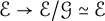 $\mathcal {E} \rightarrow \mathcal {E}/\mathcal {G} \simeq \mathcal {E}$
. Since the later composition is not surjective by
 $\ell |n$
, we obtain the contradiction.
We obtain the existence of a Néron model for biellptic surfaces admitting good reduction. Note that this can also be proved using [Reference Gabber, Liu and Lorenzini11, Proposition 6.2].
Proposition 3.4 Let K be a discrete valuation field with residual characteristic different from
 $2$
and
 $3$
, and X a bielliptic surface over K. Assume that X admits good reduction. Then X admits a Néron model.
Proof Let
 $\mathcal {X}$
be a proper smooth scheme in Lemma 2.5. Then the cyclic covering over
 $\mathcal {O}_{K}$
associated with a fixed isomorphism
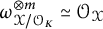 $\omega _{\mathcal {X}/\mathcal {O}_{K}}^{\otimes m} \simeq \mathcal {O}_{\mathcal {X}}$
is the Néron model of its generic fiber as in the proof in Lemma 2.5. By the valuative criterion of properness, the model
 $\mathcal {X}$
is a weak Néron model of X, so by Lemma 3.2, it finishes the proof.
Next, we state the existence of Néron models in a little more general setting. Let K be a discrete valuation field with residue characteristic different from
 $2$
and
 $3$
, and X a bielliptic surface over K which admits a rational point
 $x\in X(K)$
. Let
 $X \simeq (A\times B) /G$
be the isomorphism given in Lemma 2.2. Let
 $\mathcal {A}$
,
 $\mathcal {B}$
and
 $\mathcal {G}$
be Néron models of A, B and G. Let
 $\overline {\mathcal {A}}$
,
 $\overline {\mathcal {B}}$
be minimal regular models of A, B. Note that the Néron model of an elliptic curve is the smooth locus of the minimal regular model (see [Reference Bosch, Lütkebohmert and Raynaud4, Proposition 1.5.1]). By the Néron mapping property, we have a group action
 $\sigma \colon \mathcal {G} \times \mathcal {A} \times \mathcal {B} \rightarrow \mathcal {A} \times \mathcal {B}$
, which is a free action since
 $\mathcal {G} \hookrightarrow \mathcal {A}$
is a closed immersion by Lemma 2.7. In the following, we assume that
 $\mathcal {G}$
is finite étale over
 $\mathcal {O}_{K}$
(i.e., G admits good reduction). Then one can extend the action
 $\mathcal {G} \times \mathcal {A} \rightarrow \mathcal {A}$
to
 $\mathcal {G} \times \overline {\mathcal {A}} \rightarrow \overline {\mathcal {A}}$
uniquely. Indeed, the connected component of
 $\mathcal {G}$
is the spectrum of discrete valuation ring
 $\mathcal {O}_{L}$
which is unramified over
 $\mathcal {O}_{K}$
. Since
 $\mathcal {A}_{\mathcal {O}_{L}}$
is also a minimal regular model of
 $A_{L}$
[Reference Liu25, Proposition 9.3.28], one can use the minimality to extend this action [Reference Liu25, Proposition 9.3.13]. Similarly, one can extend the action
 $\mathcal {G} \times \mathcal {B} \rightarrow \mathcal {B}$
uniquely, therefore we have the action
 $\Sigma \colon \mathcal {G}\times \overline {\mathcal {A}} \times \overline {\mathcal {B}} \rightarrow \overline {\mathcal {A}}\times \overline {\mathcal {B}}$
.
Theorem 3.5 Let
 $A, B, G, \mathcal {A}, \mathcal {B}, \mathcal {G} ,\sigma $
and
 $\Sigma $
as above (so we suppose that G admits good reduction). Then, if
 $\Sigma $
is a free action (for example, the case where A admits good reduction), the quotient
 $(\mathcal {A}\times \mathcal {B}) /\mathcal {G}$
is the Néron model of X.
Proof By the assumption, the scheme
 $(\overline {\mathcal {A}}\times \overline {\mathcal {B}})/\mathcal {G}$
is a finite étale quotient of
 $\overline {\mathcal {A}} \times \overline {\mathcal {B}}$
. Therefore
 $(\overline {\mathcal {A}} \times \overline {\mathcal {B}})/\mathcal {G}$
is a regular scheme which is proper over
 $\mathcal {O}_{K}$
. Since its smooth locus is
 $(\mathcal {A} \times \mathcal {B})/\mathcal {G}$
, by the valuative criterion of the properness and [Reference Liu and Tong26, Lemma 3.1], one can show that
 $(\mathcal {A}\times \mathcal {B})/\mathcal {G}$
is a weak Néron model of X. By Lemma 3.2, it finishes the proof.
This proof is based on the philosophy “the smooth locus of a minimal model is the Néron model”. On the other hand, one can prove the existence of Néron models in a more general setting, as follows.
Theorem 3.6 Let K be a strictly Henselian discrete valuation field with residue field k whose characteristic is different from
 $2$
and
 $3$
, and X a bielliptic surface over K which admits a rational point
 $x \in X(K)$
. Let
 $X \simeq (A \times B) /G$
be the isomorphism given in Remark 2.3. If G admits good reduction (i.e., the inertia group
 $I_{K}$
acts trivially on
 $G(\overline {K})$
), then X admits a Néron model. In particular, for any bielliptic surface X over K, there exists a finite separable extension
 $L/K$
such that
 $X_{L'}$
admits a Néron model for any finite extension
 $L'/L$
.
Remark 3.7 Since we work over a strictly Henselian discrete valuation field, if
 $X(K) = \emptyset $
, then
 $X \rightarrow \mathop {\mathrm {Spec}} K \rightarrow \mathop {\mathrm {Spec}} \mathcal {O}_{K}$
itself is the Néron model of X by Hensel’s lemma. Thus, to prove the existence of a Néron model, we may assume that
 $X(K) \neq \emptyset $
.
Proof It suffices to show the first statement. Let
 $X \simeq (A \times B)/G$
be a bielliptic surface with a rational point
 $x \in X(K)$
, as in the assumption. Let n be the integer as in Remark 2.3. Since we are working with a strictly Henselian discrete valuation field, the following hold.
-
• The group scheme G consists of K-rational points.
-
• Every connected component of the special fiber of a Néron model
$\mathcal {A}$
has a k-rational point. Especially, every component is geometrically connected. -
• Let
be the composition of the Albanese morphism with the reduction maps. Here, the second arrow is an isomorphism given by the n-multiplication map as in Remark 2.3. Then, there exist K-valued points
$$\begin{align*}\Phi\colon X(K) \rightarrow A/G(K) \rightarrow A(K) \simeq \mathcal{A}(\mathcal{O}_{K}) \rightarrow \pi_{0}(\mathcal{A}_{k})/n\pi_{0}(\mathcal{A}_{k}) \end{align*}$$
$x_{0}=x, x_{1}, \ldots , x_{s} \in X(K)$
which give a complete set of representatives of
$\mathrm {Im} \Phi $
.




For each rational points
 $x_{i}$
, we have a description
 $$\begin{align*}X \simeq (A_{i} \times B_{i}) /G_{i} \end{align*}$$
given in Remark 2.3. Here, by the definition every
 $A_{i}$
is the Albanese variety of X, so every
 $A_{i}$
is naturally isomorphic to each other. The only difference is that the zero section of
 $A_{i}$
is given by
 $\mathrm {alb}(x_{i})$
. As in Remark 2.3, each
 $G_{i}$
consists of K-rational points.
Let
 $\mathcal {A}_{i}, \mathcal {B}_{i}, \mathcal {G}_{i}$
be the Néron models of
 $A_{i}, B_{i}, G_{i}$
. By the Néron mapping property, one can extend the group action to Néron models. By Lemma 2.7, a Néron model
 $\mathcal {G}_{i}$
is a finite étale subgroup scheme of
 $\mathcal {A}_{i}$
. Let
 $\mathcal {X}_{i}$
be the finite étale quotient
 $(\mathcal {A}_{i} \times \mathcal {B}_{i})/\mathcal {G}_{i}$
. As before, the quotient
 $\mathcal {X}_{i}$
is smooth separated of finite type over
 $\mathcal {O}_{K}$
. Let
 $\mathcal {X}$
be the scheme obtained by gluing
 $\mathcal {X}_{i}$
together on the generic fibers. By definition,
 $\mathcal {X}$
is a smooth finite type scheme over
 $\mathcal {O}_{K}$
satisfying
 $\mathcal {X}_{K}\simeq X$
. We shall prove that this
 $\mathcal {X}$
is the desired Néron model. First, we shall prove that
 $\mathcal {X}$
is separated over
 $\mathcal {O}_K$
. Let R be a discrete valuation ring over
 $\mathcal {O}_{K}$
, and F the fraction field of R. By the valuative criterion of separatedness, it is enough to show that
 $\mathcal {X}(R) \rightarrow \mathcal {X}(F)$
is injective. Assume that there exist
 $t_{1}, t_{2} \colon \mathop {\mathrm {Spec}} R \rightarrow \mathcal {X}$
which are different R-valued points going to the same F-valued point. Clearly, each
 $t_{l}$
factors through some
 $\mathcal {X}_{i_{l}} \hookrightarrow \mathcal {X}$
. If
 $t_{l}$
factors through the same component
 $\mathcal {X}_{i}$
, by the separatedness of
 $\mathcal {X}_{i}$
, we have
 $t_{1}=t_{2}$
. Therefore each
 $t_{l}$
factors through
 $\mathcal {X}_{i_{l}}$
with
 $i_{1}\neq i_{2}$
and each
 $t_{l}$
does not factors through the generic fiber X. Let
 $s_{l} := \mathrm {alb}(t_{l}) \in \mathcal {A}_{i_{l}} (R),$
where
 $\mathrm {alb}$
is the extension of the Albanese morphism to
 $\mathcal {X} \rightarrow \mathcal {A}$
. The morphism
 $\mathrm {alb}|_{\mathcal {X}_{i_{l}}}$
is written as the following composition,
 $$\begin{align*}\mathcal{X}_{i_{l}} := (\mathcal{A}_{i_{l}} \times \mathcal{B}_{i_{l}}) /\mathcal{G}_{i_{l}} \rightarrow \mathcal{A}_{i_{l}}/\mathcal{G}_{i_{l}} \rightarrow \mathcal{A}_{i_{l}}, \end{align*}$$
where the last map is given by n-multiplication morphism. As remarked above, for any
 $0\leq i,j \leq s$
, the varieties
 $\mathcal {A}_{i}$
and
 $\mathcal {A}_{j}$
are naturally isomorphic (we denote it by
 $\mathcal {A}$
), and there exists the following commutative diagram.

Here
 $t_{i,j}$
is a translation on
 $\mathcal {A}$
which sends
 $\mathrm {alb}(x_{i})$
to
 $\mathrm {alb}(x_{j})$
, and
 $n_{\mathcal {A}_{i}}$
is n-multiplication map as the group scheme
 $\mathcal {A}_{i}$
. Note that we identify
 $\mathrm {alb}(x_{i})$
with its extension to the
 $\mathcal {O}_{K}$
-valued point of
 $\mathcal {A}$
. Let
 $\mathfrak {m}$
be the maximal ideal of
 $\mathop {\mathrm {Spec}} R$
. Since
 $t_{l} (\mathfrak {m})$
is contained in the special fiber of
 $\mathcal {X}_{i_{l}}$
, the point
 $s_{l} (\mathfrak {m})$
is contained in the special fiber of
 $\mathcal {A}$
. By the above description of
 $\mathrm {alb}|_{\mathcal {X}_{i_{l}}}$
, the point
 $s_{l}(\mathfrak {m})$
lies in the component which is contained in
 $\Pi _{i_{l}}$
, where
 $$\begin{align*}\Pi_{i} := \mathrm{Im} (n_{\mathcal{A}_{i}} \colon \pi_{0}(\mathcal{A}_{k}) \rightarrow \pi_{0}(\mathcal{A}_{k})). \end{align*}$$
By the above commutative diagram, as subsets of the component group
 $\pi _{0}(\mathcal {A}_{k})$
, we have
 $$\begin{align*}\Pi_{i_{l}} = t_{0,i_{l}}\Pi_{0}= (\mathrm{alb}(x_{i_{l}})-\mathrm{alb}{(x_{0}}))\Pi_{0}. \end{align*}$$
Since we have
 $i_{1}\neq i_{2}$
, by the definition of
 $x_{i}$
, we have that
 $\Pi _{i_{1}}$
and
 $\Pi _{i_{2}}$
are disjoint in
 $\pi _{0}(\mathcal {A}_{k}).$
So we have
 $s_{1} \neq s_{2}$
. However, since
 $s_{1}$
and
 $s_{2}$
give the same F-valued point of
 $\mathcal {A}$
, we have
 $s_{1}=s_{2}$
by the separatedness of
 $\mathcal {A}$
. This is a contradiction, thus
 $\mathcal {X}$
is separated over
 $\mathcal {O}_{K}$
.
Next, we shall prove that the family
 $\{\mathcal {X}_{i}\}_{i=0, \ldots , s}$
is a weak Néron model of X. Let
 $y \in X(K)$
be any K-valued point of X. By definition, there exists a unique
 $x_{i} \in X(K)$
which represents
 $\Phi (y)$
. Let
 $\mathrm {alb}(y)' \in \mathcal {A}(\mathcal {O}_{K})$
be the unique extension of
 $\mathrm {alb}(y)$
. Then the special fiber of
 $\mathrm {alb} (y)'$
lies in the union of components corresponding to
 $t_{0,i} \Pi _{0}=\Pi _{i}$
. We note that this union of components is the image of the n-multiplication map on the special fiber induced by
 $n_{\mathcal {A}_{i}}$
(see [Reference Bosch, Lütkebohmert and Raynaud4, Lemma 7.3.1 and 7.3.2]). Since
 $\mathcal {O}_{K}$
is strictly Henselian, the fiber of
 $\mathrm {alb}(y)'$
along
 $n_{\mathcal {A}_{i}}$
has a component
 $\mathop {\mathrm {Spec}} \mathcal {O}_{K}$
, i.e., there exists a lift
 $y^{\prime}_{1} \in \mathcal {A}(\mathcal {O}_{K})$
of
 $\mathrm {alb}(y)'$
along
 $n_{\mathcal {A}_{i}}$
. Let
 $y_{1}\in A(K)$
be the K-rational point of A induced by
 $y^{\prime}_{1}$
(so
 $y_{1}$
is a lift of
 $\mathrm {alb}(y)$
along the n-multiplication map on
 $A_{i}$
). Let
 $y_{2} := (-y_{1}) \cdot y \in X(K)$
, where
 $\cdot $
denotes the action
 $A_{i}\times X \rightarrow X$
given in the proof of Lemma 2.2. Then by the definition (see the commutative diagram (2.1) in the proof of Lemma 2.2), we have
 $\mathrm {alb}(y_{2}) =\mathrm {alb} (x_{i})$
, and therefore
 $y_{2}$
lies in
 $B_{i}(K)$
and we have
 $y=\overline {(y_{1}, y_{2})}$
. We can extend
 $(y_{1}, y_{2}) \in A_{i} \times B_{i}$
to
 $(y^{\prime}_{1}, y^{\prime}_{2}) \in \mathcal {A}_{i}\times \mathcal {B}_{i}(\mathcal {O}_{K})$
. Therefore
 $y^{\prime} := \overline {(y^{\prime}_{1}, y^{\prime}_{2})} \in \mathcal {X}_{i}(\mathcal {O}_{K})$
gives a desired extension of y.
Finally, we shall prove that
 $\mathcal {X}$
satisfies the Néron mapping property. This part is essentially the same as in the proof of Lemma 3.2, but we include it for the sake of completeness. Let Z be any smooth
 $\mathcal {O}_{K}$
-scheme, and
 $u_{K} \colon Z_{K}\rightarrow X$
be a K-morphism. By Remark 2.4, it suffices to show the existence of an extension of u. Moreover, we may assume that Z has an irreducible special fiber (in the general case, one can glue them). By Proposition 3.1 (2), there exists an extension of
 $u_{K}$
to an
 $\mathcal {O}_{K}$
-rational map
 $u\colon Z \dashrightarrow \mathcal {X}_{i}$
for some
 $0 \leq i \leq s$
. Therefore, there exists an open subscheme
 $U \hookrightarrow Z$
where u is defined, such that U contains
 $Z_{K}$
and the generic point of
 $Z_{k}$
. Then the finite étale covering
 $$\begin{align*}\widetilde{U}:= U\times_{\mathcal{X}_{i}} (\mathcal{A}_{i} \times \mathcal{B}_{i}) \rightarrow U \end{align*}$$
can be extended to the finite étale covering
 $\widetilde {Z} \rightarrow Z$
by taking the normalization of Z in
 $\widetilde {U}$
and using the Zariski–Nagata purity theorem. By the Néron mapping property, we have
 $$\begin{align*}\mathcal{A}_{i} \times \mathcal{B}_{i}(\widetilde{U}) = \mathcal{A}_{i} \times \mathcal{B}_{i} (\widetilde{U}_{K}) = \mathcal{A}_{i} \times \mathcal{B}_{i}(\widetilde{Z}), \end{align*}$$
so the base change morphism
 $\widetilde {u} \colon \widetilde {U} \rightarrow \mathcal {A}_{i} \times \mathcal {B}_{i}$
can be extended to
 $\widetilde {u} \colon \widetilde {Z}\rightarrow \mathcal {A}_{i} \times \mathcal {B}_{i}$
. Hence we have a morphism
 $u_{\widetilde {Z}} \colon \widetilde {Z} \rightarrow \mathcal {X}_{i}$
, and by the uniqueness of extension, one can descends
 $u_{\widetilde {Z}}$
to
 $u_{Z}$
which is a desired extension of
 $u_{K}$
. It finishes the proof.
Acknowledgements
The author is deeply grateful to his advisor Naoki Imai for his deep encouragement and helpful advice. The author also would like to thank Yohsuke Matsuzawa and Tetsushi Ito for helpful suggestions. The author also thanks the referee for constructive suggestions.



