Introduction: Rāgī Faqīrs and Shah Jo Rāg
Rāgī faqīrs are a loose-knit community of devotees who perform Shah Jo Rāg, a corpus of poetry mostly composed by eighteenth-century Sufi poet-mystic Shāh ‘Abdul Latīf Bhiṭṭāī (1689–1752), sung in specific formulas at his shrine in Sindh, Pakistan. Literally meaning the music (rāg) of the Shah, Shah Jo Rāg (SJR) was established around 1728 by Shah Latif in the village of Bhit Shah (Baloch Reference Baloch and Umrani2010).Footnote 1 It emerged from Islamic conventions of samā‘ (“audition”) nourished in Sindh, and is connected to a “common pool of ideas” (Esmail Reference Esmail2002:32) for performing devotional poetry shared across communal boundaries in the north Indian Subcontinent.Footnote 2
Shah Latif’s commune animated one of the many manifestations of the Islamic conceptual paradigm madhhab-i ‘ishq—the way of love. Love, as an ethical practice and mode of knowing, is a “way of going about being Muslim…a mode of being with God” (Ahmed Reference Ahmed2016:38–42). The predominant theme in the verses of SJR is recognition of humans’ separation from their Source, the Beloved. This ontological state is called “poverty”—the utter dependence of humans on God (Chittick Reference Chittick2013:382–383). Traditionally, Sufi practitioners on this path of love called themselves faqīrs—from faqr (“poverty”)—to acknowledge this state of nothingness.
In Sindhi conventional usage, faqīr can refer to a beggar, a religious mendicant, or a devotee who performs services for a saint.Footnote 3 The majority of faqīrs at Latif’s shrine today identify as the latter. They are committed devotees who practice common Sufi concepts of servanthood, worship, and remembrance (Nasr Reference Nasr2007:12–13) through services of love for Latif. These services are collectively called ḥāz̤rī (“presence”). They include sweeping shrine compounds, distributing food and water, or participating in regular acts of remembrance.Footnote 4 Faqīrs who sing Rāg in front of their spiritual master’s tomb according to a fixed schedule distinguish themselves as rāgī faqīrs; today they form various groups to perform at the shrine three times a day, seven days a week. All current rāgī faqīrs are male. They are around 150 in number and identify as Muslims.Footnote 5
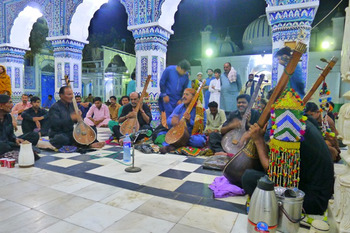
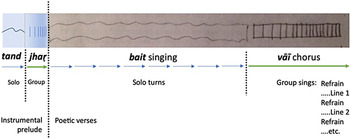
During ḥāz̤rī, groups of rāgī faqīrs perform a sequence of Surs from SJR. Surs are chapters of verses based on a topical theme or folk romance, sung according to specific rules that incorporated melodic contours from existing melody types (surs) and accompanied by the danbūro, a five-stringed lute (Figure 1).Footnote 6 Each Sur-chapter functions as a performance unit, starting with instrumental preludes called tand and jhaṛ on the danbūro, followed by solo bait singing, and concluding with a group chorus of vāī (Figure 2).Footnote 7
A rāgī faqīr group led by Faqīr Gul Muhammad Khaskheli. Photo taken by author on 9 June 2018 in Bhit Shah.

A unit of Sur performance. Transcribed by author.

Bait and vāī are the main poetic forms composed by Latif.Footnote 8 Bait combines lines of two or more in the poetic metres of dohā and soraṭhā (Jotwani Reference Jotwani1975; Allana Reference Allana1991).Footnote 9 Vāī consists of a thalu (“refrain”) and several misrah (usually “one-line verses”); its form is similar to those of kāfī and Sindhi maulūd, respectively the prevalent genre of devotional singing in Sindh and the Punjab, and a genre for praising the Prophet Muhammad.Footnote 10 Melodically, vāī, kāfī and maulūd all follow the sthāyī-antarā structure ubiquitous in South Asian music. Bait singing is governed by line-by-line melodic rules unique to SJR.
It is likely that Latif was aided by professional musicians, drawing inspiration from both Sindhi surs and Hindustani rāgas to set his verses to music (Baloch Reference Baloch1973:21, 25; Ishqui Reference Ishqui and Yusuf1988). Compiling devotional poetry according to melody types has a long history in South Asia (cf. Hess Reference Hess, Schomer and McLeod1987). The names of the thirty-one Surs performed by rāgī faqīrs today overlap with rāga sets employed by North Indian devotional communities in their singing practices.Footnote 11
Rāgī faqīrs emphasise their difference from wayfaring mendicants: they are embedded in society and belong to their families. In other parts of Sindh and the Punjab, faqīrs who engage in music and dance at shrines more often identify as mendicants who shun worldly life. They practice remembrance of God by singing sūfiāna kalām, the poetry of Sufi saints (predominantly kāfī), accompanied by a drone stick-lute (yaktāro, iktāra) and percussive instruments (Nayyar Reference Nayyar and Arnold1999:796; Sakata Reference Sakata and Arnold1999). In a similar vein, itinerant malangs enact remembrance with dhamāl dancing and drumming (Wolf Reference Wolf2006; Frembgen Reference Frembgen2012). Musicians from professional castes also participate in shrine culture by performing kāfī (more in Sindh) and qawwālī (more in the Punjab).Footnote 12
In contrast to the exuberant, rhythmic character of kāfī, dhamāl, and qawwālī, SJR is slow and tranquil. Rāgī faqīrs spend the majority of ḥāz̤rī time drawing out the baits in sedate, flexible rhythm. They punctuate the baits with vāī, the emotional culmination of each Sur, which is usually set to metres based on iambic strumming patterns rather than evenly-measured tālas. Unlike in kāfī and qawwālī, rāgī faqīrs do not engage with audiences musically during ḥāz̤rī—ideally, they render their services in a fixed sequence only for Shah Latif.Footnote 13
Between Faqīr and Fankār?
During my 2017 to 2018 fieldwork in Bhit Shah, I sensed an uneasiness regarding selfhood among the rāgī faqīrs with whom I interacted. They expressed this unease in the process of distinguishing themselves from fankārs—paid professional artists—saying that faqīrs, as spiritual practitioners, do not, or should not, sing for money, especially since the very name faqīr means “poor person.” At the same time many faqīrs, including my teacher Manthār Faqīr Junejo, do supplement their income in the precarious economic conditions of rural Sindh with a variety of performances outside ḥāz̤rī. As a live-in student residing with my teacher and his family, I was struck by how often Manthār Faqīr laid out for me the economics and politics of his various programmes, while also conveying to me the spiritual benefits of Rāg, artistic pride in his devotional practice, and nostalgia for faqīrs he felt were closer to Allah. As Manthār Faqīr once solemnly told me:
What’s called faqīrī (being a faqīr), is slowly disappearing. No faqīr [today] asks Bhittai: “bequest me your divine appearance (dīdār karvāo).” All the [past] faqīrs, their biggest requests were: “Master, bequest me your divine appearance…if not in the day then at least in my dreams.” Such were their thoughts, their souls…in front of the spiritual guide, placed on the seat of sacrifice…The faqīrs of now, including us, we bring the same intentions (irāda) we have in the market to the court of Bhittai…so then…what we’ll get is also the equivalent! We’ll get as much reward as the intentions (niyat) we set.
(interview, 24 June Reference Junejo2018)During another conversation, he lamented “but who are we to tell others what to do when we perform? We are just fankārs, we will present whatever the audience asks for” (11 September 2017). In contrast, his peer Qambar Faqīr Lanjwani, who often performs at programmes, reasons that, “We don’t ask fees from anyone, like other fankārs. If people give, then it’s our portion from Bhittai, if not…bismillah [in the name of Allah]” (interview, 3 February Reference Lanjwani2018).
In this article, I elucidate and historicise the various subject positions that contemporary rāgī faqīrs and their audiences reference when they use such terms as faqīr, kārīgar (skilled artisan), fankār, and artist. I use the term subject position to mean a mode of experience and action shaped by processes that draw individuals into becoming subjects of hegemonic powers (Nyong’o Reference Nyong’o, Burgett and Hendler2014). Multiple powers in a social field give rise to conflicting subject positions. Scholars have employed the concept of a fragmented composite subject to consider how individuals connected with popular Sufi practices in contemporary Pakistan are affected by hegemonic forces such as modernity, Islam, and state ideology; actors in turn are motivated by a “bundle of agencies” (Ewing Reference Ewing1997:5; Wolf Reference Wolf2006:248) in order to operate in a sphere of potentially contradictory ideologies. Similarly, Skinner (Reference Skinner2015) draws on Mbembe’s account of how postcolonial subjects constantly “bargain and improvise” within a “plurality of legitimizing rubrics, institutional forms, rules, arenas, and principles of combination” (Mbembe Reference Mbembe1992:5). I find inspiration in Skinner’s discussion of what Simone de Beauvoir called “projects” of agency (Reference Beauvoir1948), which he glosses as “inherently intersubjective and…thus, contingent on the intentional interests and actions of others” (Skinner Reference Skinner2015:9).
Following the lead of these scholars, I examine rāgī faqīrs’ discourses of self and other; oral and written local history; and various contexts of SJR performance, mainly through the prism of Manthār Faqīr’s life experiences, in order to analyse subject positions that emerged historically. I identify my teacher’s intersubjective agency in his Rāg performances: how he negotiates existing ideologies, audience expectations, and strategies that emerged from the subject positions of past experiences to achieve an outcome favourable to his own needs and intentions. These multiple subjectivities manifest sonically, at times one after another, at times coexisting during performance.Footnote 14
My study shares the concerns of scholars investigating the re-contextualisation of performances emerging from Sufi practices, as they undergo negotiations of style, content, and meaning under the powers of (global) market forces and state cultural ideology (Shannon Reference Shannon2003; Kapchan Reference Kapchan2008; Qureshi Reference Qureshi and Bohlman2013; Saarazin Reference Saarazin and Salhi2014; Senay Reference Senay2015; Jankowsky Reference Jankowsky2017). However, I depart from the way these scholars frame their research by focusing specifically on how the performers understand their selfhood in relation to new performance contexts. As Regula Qureshi points out in her history of qawwālī’s globalisation, qawwāls are the “agents of coexistence” within feudal and capitalist socioeconomic structures (Reference Qureshi and Bohlman2013:594). I argue that for rāgī faqīrs, the multiple subject positions produced by various structures coexist in differing configurations in every performance of SJR today. What is at stake for a devotional tradition such as SJR in contemporary Sindh is the rāgī faqīrs’ capacity to balance spiritual merit, artistic inclinations, and economic survival under multiple circumstances, in order to live a life of meaning and dignity.
Faqīr (1): Part-time Devotees in Ḥāz̤rī
For rāgī faqīrs today, ḥāz̤rī for Shah Latif is worship through which they gain peace and solace. Commitment to this devotional practice entails sacrifice, embodied in the very act of sitting. The faqīrs’ seat during ḥāz̤rī is called ad̤ī, meaning “the butcher’s cutting board.” Symbolically, they prepare to give up their lives “like meat on a cutting board.” Their bodies suffer from arduous and emotionally intense singing for long periods of time. Faqīrs tell stories of their predecessors singing the whole night without standing up, an activity so physically arduous that blood seeped out from under their nails and skin.
In the earlier genealogy of rāgī faqīrs, most were ascetics who practiced celibacy.Footnote 15 Oral histories suggest that the ascetic community of rāgī faqīrs transitioned into a predominantly clan-based practice after the 1850s.Footnote 16 Subsequently, spaces in which to learn SJR expanded beyond the shrine, where agrarian villagers often related by kin gathered to sing and listen to Rāg as a devotional pastime. Rāgī faqīrs slowly turned from full-time renunciants into part-time devotees with the worldly need to sustain their families. In this position, the ideal of an allāhwālā faqīr (a faqīr close to Allah) sets a prescriptive goal for sustaining devotional practice at the shrine. Manthār Faqīr tells me that allāhwālā faqīrs are those who “hide their names so no one knows about them and [have] no use for worldly things.” Calling himself a “sinful” faqīr, he contrasts the faqīrs of now with those from the past, whose intentions and deeds, he says, were purer. He claims that devotion in Rāg gave past elders miraculous powers because, unlike the rāgī faqīrs today, they did not sing for material gain.
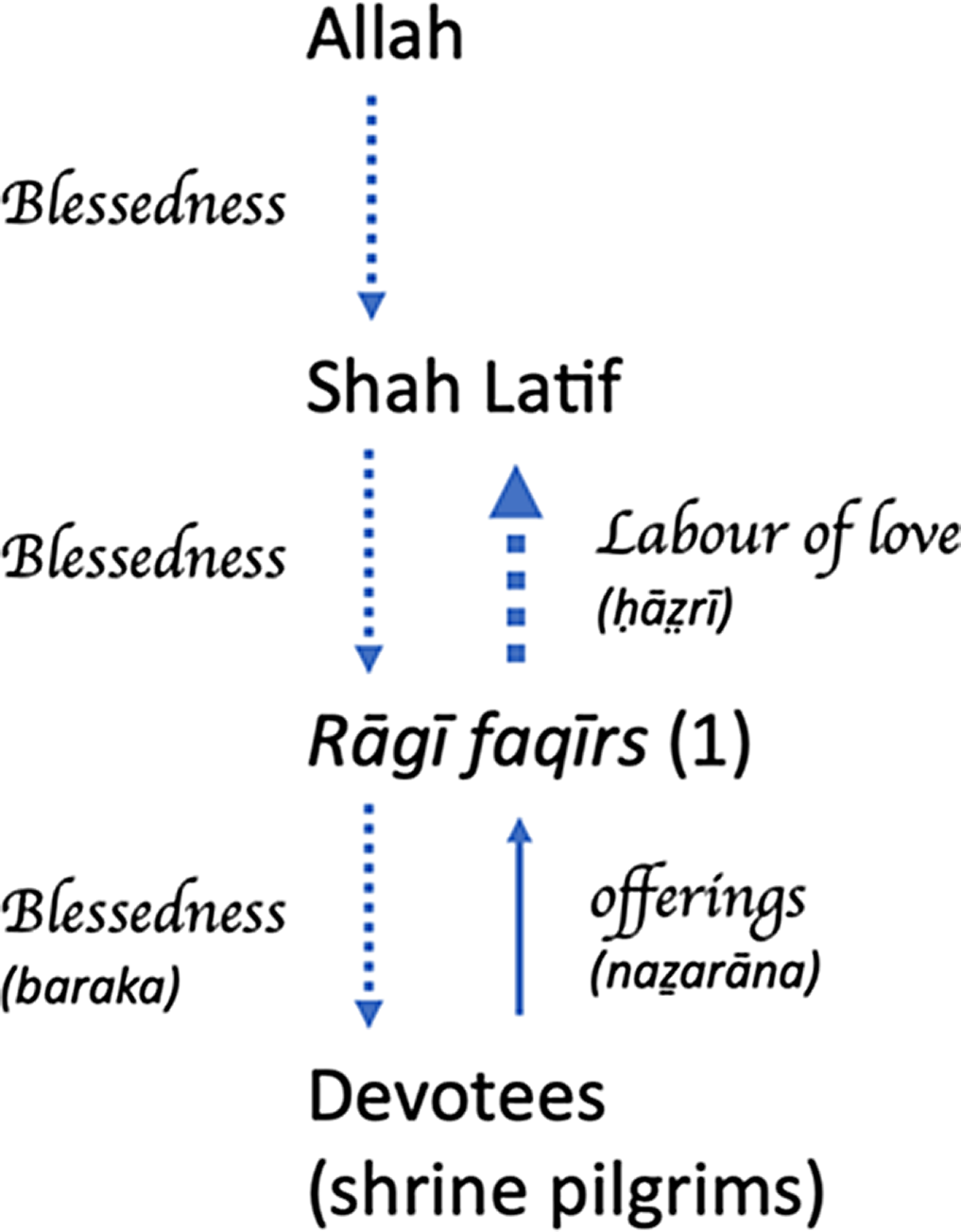
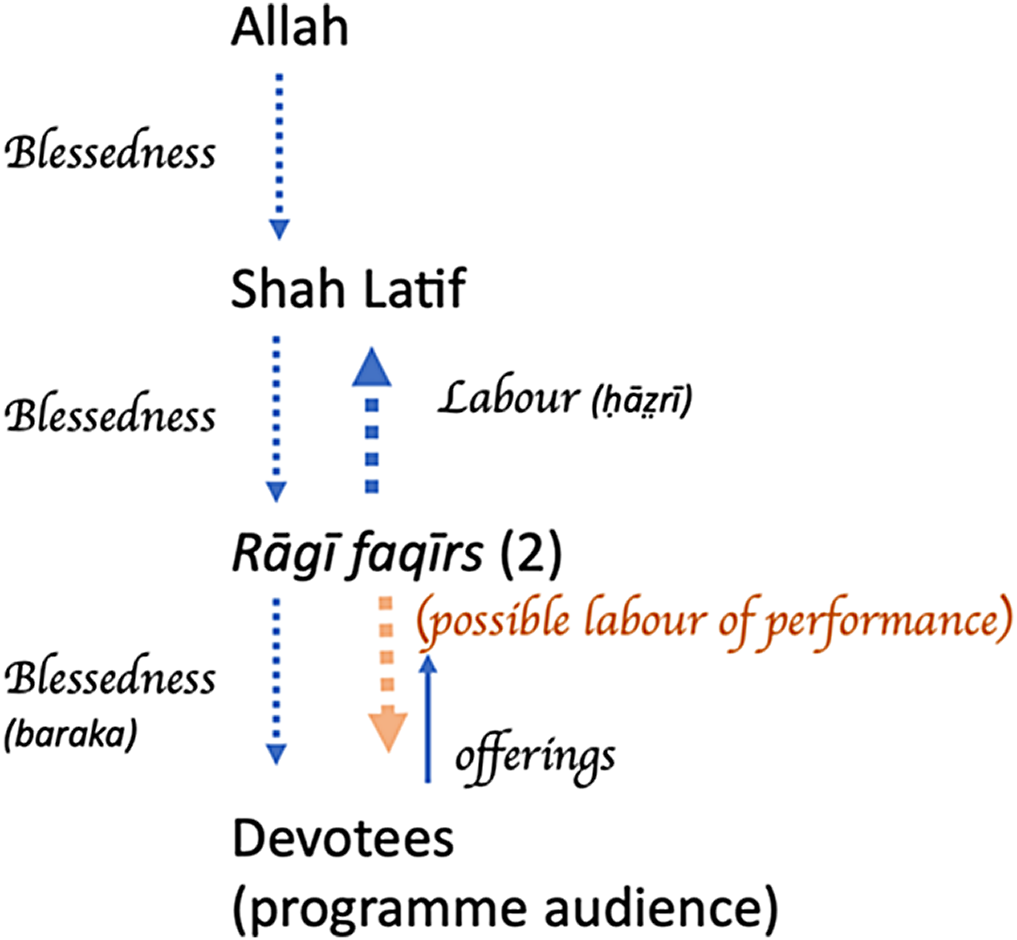
Prior to the influx of pilgrims in recent decades, Rāg ḥāz̤rī took place without many listeners and even fewer material rewards. The faqīrs believe that their devotion to Shah Latif will be rewarded through the saint’s blessedness (baraka), a mediation of Allah’s powers (Rehman Reference Rehman, Bennett and Ramsey2012). As is common practice in shrine culture across South Asia, pilgrims seek mediation from the saint, whom they regard as closer to Allah and thus better positioned to help with supplications (cf. Bellamy Reference Bellamy2011). This spiritual hierarchy informs the direction of the pilgrim’s sacrificial giving, with gifts to Allah manifesting as “upward” offerings (naẕarāna) towards saints and spiritual practitioners (Werbner Reference Werbner, Werbner and Basu1998). Following this logic, many pilgrims consider the rāgī faqīrs as mediators of Shah Latif’s blessedness. The material offerings they give to faqīrs ideally flow in the same upward direction as the faqīrs’ offerings of Rāg service (Figure 3). Yet the increasing number of pilgrims and monetary offerings in the last twenty to thirty years has raised concern in the faqīr community that many are not directing their ḥāz̤rī upwards out of true devotion, but rather are becoming corrupted by material greed.
Exchange in Faqīr (1) position. Drawn by author.

Kārīgar: Artistry in Ḥāz̤rī
Rāgī faqīrs acknowledge that art (fan) was built into SJR. Legend has it that two kārīgars, court musician disciples of Latif, helped set his poetry to music. Not all faqīrs agree that advanced artistry is necessary for ḥāz̤rī. Some prefer to keep their singing simple. Manthār Faqīr holds a different view. After his first teacher taught him the basics of Rāg, the two started visiting senior faqīrs Syed Ghulam Shah and Syed Ghulam Haider to further study the intricacies of vāī. Rāgī faqīrs respect these elders as great kārīgars in the art of SJR. In contrast to bait singing, which follows a flexible melodic formula, vāī is through-composed and more difficult to learn. Moreover, the words in the vāī are pulled apart and set to an iambic strumming pattern, rendering them hard to understand and memorise by ear (see Figures 10 and 11). Due to these complexities, some faqīrs are content to know just a few vāīs for each Sur.
Manthār Faqīr derives great self-worth from locating the art of Rāg in vāī, having memorised many obscure compositions. He further follows Syed Ghulam Haider in setting unsung vāīs in the poetic corpus to existing vāī melodies.Footnote 17 Some faqīrs reject this innovation, adhering only to the repertoire they believe was created by Latif. Manthār Faqīr counters this view by citing the popular account that Yaqūb Shahīd—an early nineteenth-century faqīr credited with setting a tree on fire with his powerful voice—invented the techniques for playing tand preludes on the danbūro. “Each generation of faqīrs contributed something to Rāg,” he reasons.Footnote 18 Syed Ghulam Shah was a master of tand, and Manthār Faqīr delights in emphasising that he is among the few today who possess the skills to play tand during ḥāz̤rī. After thirty years of sitting behind other group leaders, in the early 2000s Manthār Faqīr gained permission from the sajjādanashīn (hereditary custodian) of Latif’s shrine to lead his own group. During his Monday afternoon duty, he would switch to a difficult vāī if he saw other rāgī faqīrs listening nearby. He calls this “artistic combat” (fanī muqāblo), taking pride in his mastery over the intricate melodic turns that many find difficult to learn by heart.
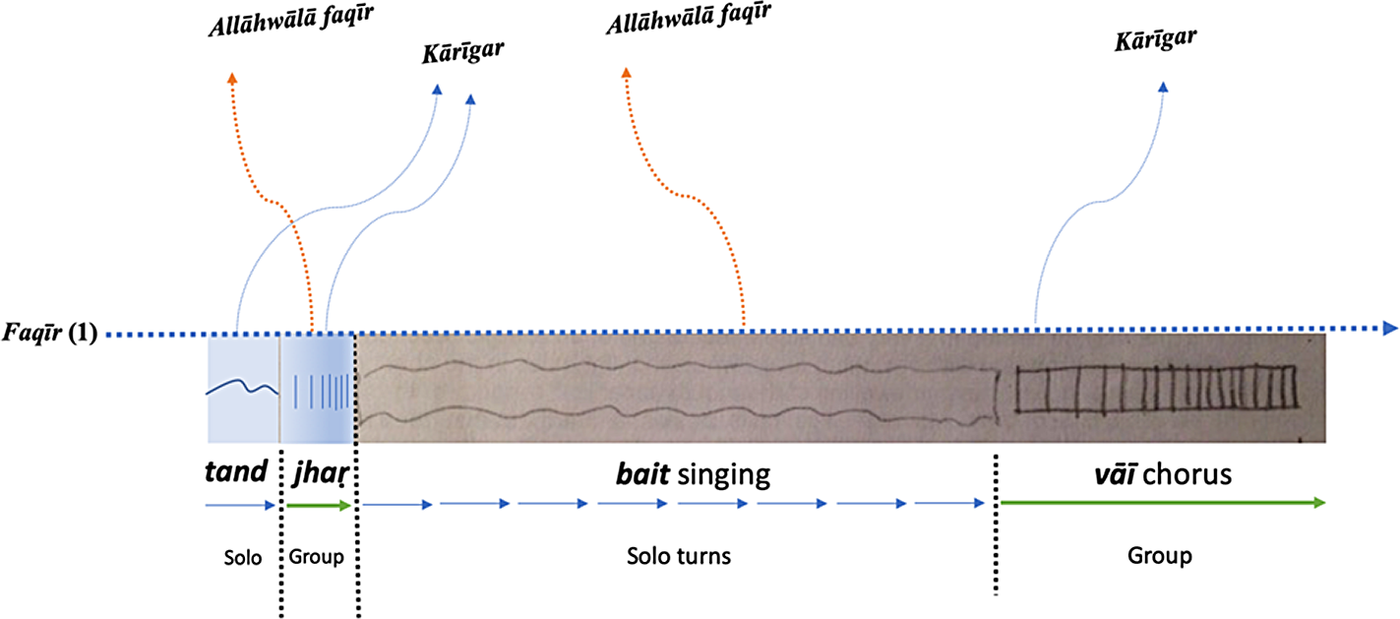
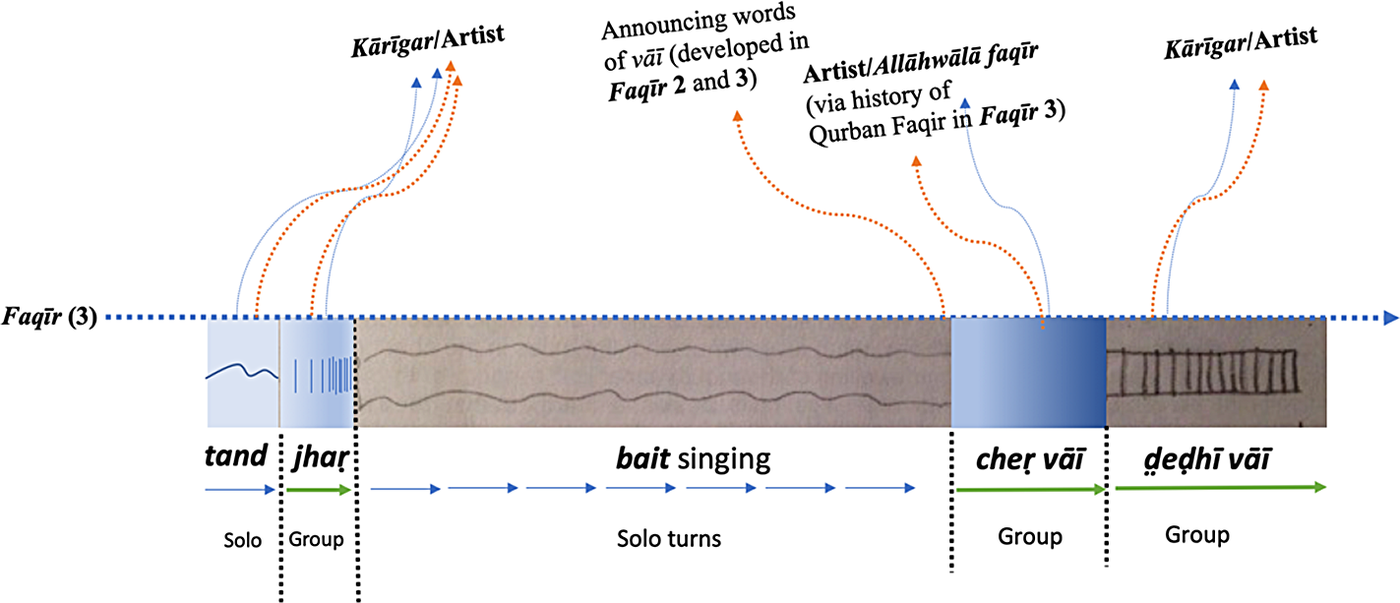
Artistry and devotion are not mutually exclusive. Remembrance of Allah (ẕikr) is built into elements of jhaṛ and bait singing. Patterns of string strokes in jhaṛ operate as ẕikr—iterating such phrases as “Allah Hu” or “tūn tūn Allah;” one can also demonstrate artistry through advanced left-hand finger techniques. Also functioning as ẕikr is the formulaic opening phrase for bait recitation called sad̤ (“call”). Manthār Faqīr has complained about faqīrs curtailing melismatic parts of this high ardent call during ḥāz̤rī to save energy, implying their lack of devotional effort. In a hypothetical Sur performance (Figure 4) led by Manthār Faqīr in ḥāz̤rī, I locate him in the subject position of Faqīr (1). If he turns his intention towards Shah Latif, he can channel an Allāhwālā faqīr subjectivity through the ẕikrs in jhaṛ and bait. In that state, he may further gain divine inspiration and utter creative melodic turns in moments of bait singing. Simultaneously, over the course of a Sur, he has options to demonstrate his Kārīgar subjectivity to other rāgī faqīrs during the sections of tand, jhaṛ, and vāī.
Subjectivities in a hypothetical performance during ḥāz̤rī. Transcribed by author.

Faqīr (2): Programmes for Other Devotees
Many Sindhis who believe in the spiritual powers of Latif hail him as their murshid (“spiritual guide”); this is an open community not regulated by an institutionalised order. I refer to all who enact devotion to Latif in various ways as devotees. Faqīrs are devotees who perform dedicated ḥāz̤rī at the shrine. Other devotees may commit to memorising, reciting, or listening to Latif’s poetry, some through the rāgī faqīrs’ musical rendition. Some pledge allegiance to a member of the sajjādanashīn’s family. Many conduct pilgrimages, following a code of conduct common to shrine visitation (cf. Suvorova Reference Suvorova2004; Rehman Reference Rehman, Dandekar and Tschacher2016).
There is no distinct line between performing SJR as ḥāz̤rī and as a programme for other devotees. It is thus hard to pinpoint a time when this new position emerged. During the period when the rāgī faqīr community consolidated into well-defined clans, students of SJR started performing ḥāz̤rī at shrines outside Bhit Shah and in their own villages.Footnote 19 This promoted love of listening to SJR among more devotees, who started inviting rāgī faqīrs to perform within a shared sphere of devotion yet outside the context of ḥāz̤rī at Latif’s shrine. Historians document how the religious authority of Sufi leaders and their descendants (pīrs) in the Indus Valley came to fuse with the political authority of landed elites (Eaton Reference Eaton and Metcalf1984; Gilmartin Reference Gilmartin and Metcalf1984; Ansari Reference Ansari1992). Such individuals wielded much social power, commanding deference from other faqīrs: some sent rāgī faqīrs to perform SJR for other spiritual elites who were devotees of Latif in the 1970s.Footnote 20 Starting in the 1980s, the growing number of rāgī faqīrs somewhat fragmented the monopolising power of local elites. Many built their own connections with devotees from all over Sindh, who were visiting Bhit Shah more frequently and inviting rāgī faqīrs to their villages or local shrines for devotional programmes.
When I attended programmes with Manthār Faqīr’s group, the hosts covered the cost of car rental, and the faqīrs kept the cash offerings they received from the audience.Footnote 21 The Rāg performances at these programmes did not differ from those at ḥāz̤rī except they included fewer Surs within a shorter duration. Sometimes the group leader might address the audience to announce the Sur names and words of the vāī they were about to sing: such action never occurs during ḥāz̤rī. In this position, although the faqīr performers and devotee-audiences are still operating in a devotional sphere in which the intentionality is directed at Allah, Latif, and local saints, other power relationships are often at play (Figure 5). The potential power of devotee-audiences over the rāgī faqīrs might direct the faqīrs’ intentionality towards certain patrons (e.g. sayyid or landlord).Footnote 22 Ordinarily, devotees, in deference to faqīrs, would not make demands, but socially powerful devotees might compel the faqīrs to accept requests for particular Surs.
Exchange in Faqīr (2) position. Drawn by author.

Not Fankār
It may be this ambiguity of intentionality during Rāg that exacerbated the rāgī faqīrs’ uneasiness about their identity. If they seem to be performing for an audience, their labour of love for Latif might be seen as labour in exchange for material offerings: they would be mistaken as fankārs, who sing for money. Faqīrs of Bhit Shah use the generic term fankār to refer to all those who perform on musical instruments such as yaktāro, bājo, and tablo. Footnote 23 This term encompasses groups who sing kāfī poetry as well as classical repertoires. Rāgī faqīrs mark their difference from fankārs by restricting all instruments except for their danbūro within the inner compound of Latif’s mausoleum. Notably, this is a distinction only rāgī faqīrs draw, as many other performers in Sindh sing kāfī at shrines to the accompaniment of the yaktāro or bājo and do not hesitate to call themselves faqīrs.
Before the twentieth century, much of South Asian musical activity outside the domestic sphere was designated to hereditary occupational castes who performed “musical service” for their patrons within a “feudal relation of production” (Qureshi Reference Qureshi and Qureshi2002). This system was controlled by an ideology of stratification that degraded the musicians and devalued their labour. Such ideology continues somewhat in contemporary Sindh. Despite the fact that many rāgī faqīrs learnt Rāg from their relatives, they identify with the various castes that they were born into and are not bound to the social label of an occupational musician caste. The stigma associated with hereditary performance could be a reason why rāgī faqīrs distinguish themselves from fankārs.
The Joint Reformulation of “Sindhi Sufism” and “Sindhi Culture”
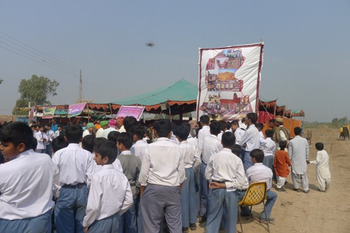
In February 2018, representatives of the Mehran Historical and Cultural Welfare Society, Tando Adam, invited Manthār Faqīr to inaugurate their annual Sindhi Siqāfat Melo (Culture Fair).Footnote 24 It was funded by landlords and organised by teachers and shopkeepers to “celebrate Sindhi culture.” The event started with a group salute to a huge poster representation of Sindh—its geographical contours filled with photos depicting “Sindhi heritage and culture” (Figure 6), accompanied by a stirring recorded song, Sindh Salamat, played loudly through large speakers.Footnote 25 After the inauguration speeches, Manthār Faqīr’s group ascended the staged platform in a large tent set up with rows of chairs, and performed a short Sur lasting around twenty minutes. Many cameramen recorded the performance for the local media. No audience members came up to make offerings. The organisers had settled on a fixed sum beforehand. When I asked one of them why they organised SJR for this inauguration, he told me that “it’s for du‘ā [prayers], because Latif’s poetry are like Quranic verses. It’s message for Muslims. It’s for peace and love. It’s Sufism.” The event and this statement revealed personal devotion as well as reformist ideas about Sindhi culture.
Poster representation of Sindh at the Sindhi Siqāfat Melo. Photo taken by author on 24 February 2018 in Tando Adam, Sindh.

A particular historical process informs this popular enactment of “culture” in Sindh, which intertwines reified elements of material heritage with the Sindhi language, Shah Latif, and Sufism. The British and a new class of English-educated Sindhi literati contributed to the colonial construction of Sufism in Sindh, beginning around the 1850s. Administrators standardised Sindhi to implement colonial rule, printing popular texts, including Latif’s poetry, to serve in the new education syllabus (Shackle Reference ʻAbd al-Laṭīf and Shackle2018:xii). Sindhis educated in this context built their newly consolidated linguistic-ethnic identity on an essentialised idea of “Sindhi Sufism,” centred around Shah Latif (Boivin Reference Boivin2015; Levesque Reference Levesque, Dandekar and Tschacher2016). While still regarding Latif as an object of devotion, they increasingly framed him as a social reformer who could guide the masses toward cultural renaissance.
This idea became an important component in Sindhi nationalism, which grew from political mobilisation in colonial times into resistance against Pakistani state dominance (Ansari Reference Ansari and Low1991). One of the movement’s pioneers, Syed Ghulam Murtaza Shah (popularly known as G. M. Syed), propagated the influential idea of Sindh as a distinctive land of Sufi mysticism with Shah Latif at the helm. In the 1960s and 1970s, separatist leaders, including G. M. Syed, reformulated the notion of Sindhi Sufism into a “powerful ideological force behind left-wing and ethnic movements that protested the modernizing and centralizing policies and ideologies of the state” (Verkaaik Reference Verkaaik2004:69).
Bhit Shah was a central site for projects informed by this reformist ideology. In a conference convened by G. M. Syed in 1928, Muslim intellectuals discussed the idea of holding literary conferences during the ‘urs (death anniversary) of saints to educate the masses (Qazi Reference Qazi2014:30). This plan was put into action in 1932 during the ‘urs at Bhit Shah by Syed Miran Muhammad Shah, a close friend of G. M. Syed and fellow member of the spiritual elite. Historically, the abodes of saints served as neutral zones for inter-tribal contact and festivities (Ansari Reference Ansari1992). Their ‘urs was a time for a spontaneous melo (“fair”), where multitudes gathered for agricultural exchange, sports competitions, and musical concerts. M. M. Shah built on this format, adding literary conferences and healthcare-educational film screenings.
Organising the Bhittai literary conference on Latif’s ‘urs became a foundational activity in the governmental institutionalisation of Sindhi literature.Footnote 26 From 1950 onwards, new roads facilitated the move of the annual Bhittai Melo conference to Bhit Shah by the urban literati and government officials. With support from fellow political elites, Shah and Syed formulated plans to establish a cultural centre there, to create the “spirit of patriotism” and “sense of national (qaumī) reawakening”; and to allow “for development of Sindh’s culture…to make Sindh on par with other nations of the world” (Kanasro Reference Kanasro and Pirzado2007:146). The foundation stone of the Bhit Shah Culture Centre was laid by the Chief Minister of Sindh during the 1954 Melo conference.
In the 1960s, Bhit Shah became a site of ideological struggle between the Pakistani state and Sindhi intellectuals. Under the One-Unit scheme, the state attempted to co-opt the Bhittai Melo and Culture Centre, with plans to make it an institution for constructing national culture.Footnote 27 At the same time, Sindhi students and literati resisting the centrist authoritarian state were inspired by the Sindhi nationalist notions of (leftist) reformed Sufism. They took to visiting Sufi shrines, reinterpreting the message of Sufi saints as encouraging liberation: peasants from landlords, Sindhis from the Pakistani state (Verkaaik Reference Verkaaik2004:82; Levesque Reference Levesque, Dandekar and Tschacher2016:217). The shrine and poetry of Shah Latif became a potent space for cultural resistance.
These students and literati formed the new urban middle class, who consolidated a popular imaginary of Sindhi culture based on “rural mystical Sindh” (Levesque Reference Levesque, Dandekar and Tschacher2016). Many framed their mysticism as “secular,” in reaction to state-sponsored religious nationalism. Their stance against superstition and shrine feudalism nonetheless aligned with state-propagated modernist ideology to undercut the power of hereditary pīrs, through nationalising shrine endowments and emphasising Sufi saints as literary figures and social reformers rather than miracle workers (Ewing Reference Ewing1997:71).Footnote 28
Faqīr (3): Performing Programmes as “Sindhi Culture”
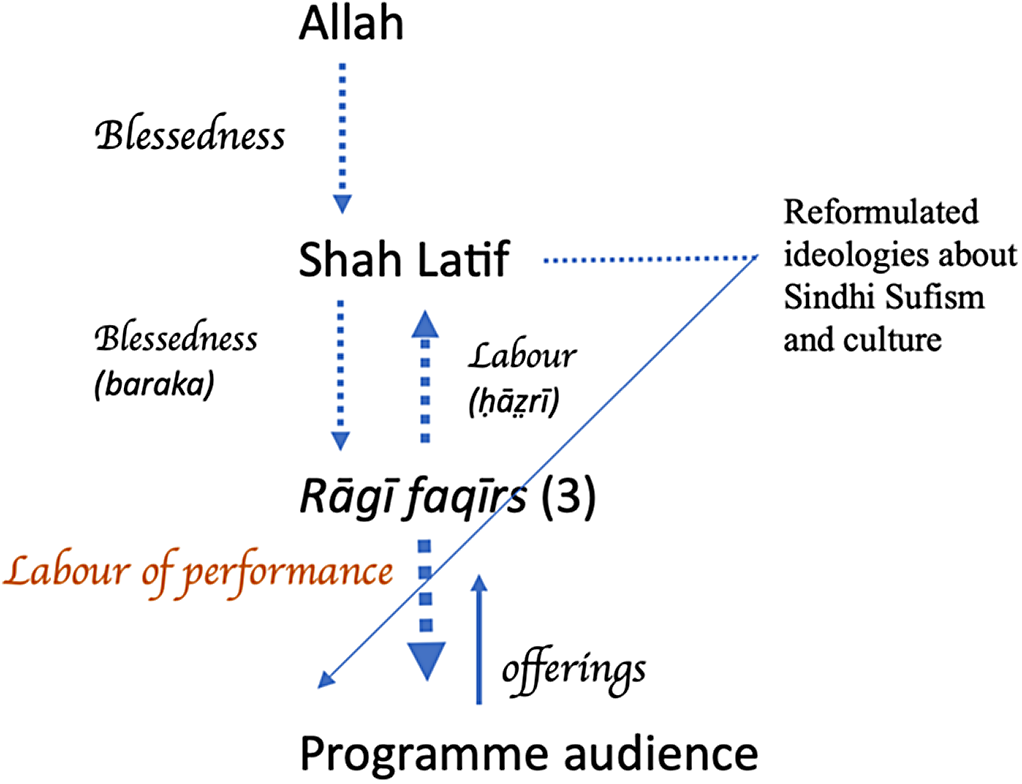
Many refractions of the above-mentioned ideology regarding “Sindhi Sufism and culture” manifest when urban Sindhi patrons invite rāgī faqīrs to participate in programmes. Compared with the contexts of ḥāz̤rī and performance for other devotees, this third, “cultural” context takes place less frequently. In this subject position, audiences see rāgī faqīrs as bearers of Sindhi culture and Latif’s musical legacy (Figure 7).Footnote 29 I locate the emergence of this new faqīr-audience relationship around the 1960s.
Exchange in Faqīr (3) position. Drawn by author.

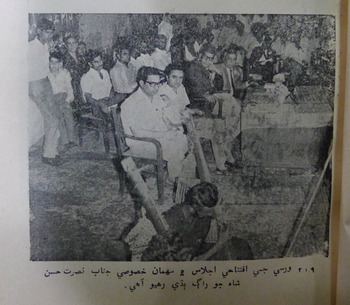
The annual Bhittai Melo inspired an increasing number of Sindhi urbanites to visit Bhit Shah in the 1950s (Shaikh, interview, 11 January Reference Shaikh2019). However, rāgī faqīrs did not take part in the literary Melo until the 1960s. Before then, the leader of faqīrs prohibited Rāg outside the context of devotion; although the practise of singing for other devotees was acceptable, they considered it a dishonour to perform on stage. In the published documentation of Bhittai Melo concerts before 1961, all performers came from outside Bhit Shah, performing Sindhi vocal or instrumental genres.Footnote 30 The first published mention of SJR performance appeared during the 1961 Melo conference, in regard to a performance by Bangal Faqīr from Matli (Mirza Reference Mirza and Abro2005).Footnote 31 The earliest photograph I have found of rāgī faqīrs performing at the Melo is dated 1971 (Figure 8).Footnote 32
Rāgī faqīrs performing at the 1971 Bhittai Melo opening. Baloch, N. A., ed. Reference Baloch1971. Latif Anniversary Miscellany No.12. Hyderabad, Sindh: The Bhitshah Culture Committee.

Jureel Faqīr Lanjwani remembers his rāgī faqīr predecessors invited to perform for the first time at the Hyderabad station of Radio Pakistan in the late 1960s (interview, 5 February Reference Lanjwani2018).Footnote 33 Following the faqīrs’ self-distinction from fankārs, the station producers considered them separate from concert stage musicians (Imdad, interview, 16 January Reference Imdad2019). They were not recorded in the music category of radio programmes, and instead demonstrated their singing on a live-broadcast, rural-themed talk show (Hingorjo, pers. comm., 16 January Reference Hingorjo2019). Not all urban audiences distinguished between the faqīr/fankār labels, though. Sindhi writers documenting the Bhittai Melo customarily referred to all the musicians performing at the Melo concerts as “faqīrs of Shah Latif.”Footnote 34 SJR came to the scholarly attention of Dr. Nabi Bakhsh Khan Baloch when he started organising the Bhittai Melo in 1951. Locating it as a vital institution for Sindhi musical renaissance, he produced many publications on the subject during the 1960s and 1970s.Footnote 35 From 1974 to 1976, the Institute of Sindhology collaborated with Radio Pakistan to archive the performances of Syed Ghulam Shah.
Around the same time, individuals working in the Sindh government created new staged spaces for rāgī faqīrs. Mumtaz Mirza, a protégé of Dr. Baloch, spent copious time with rāgī faqīrs and visiting fankārs when he assisted at the Bhit Shah Cultural Centre (Mirza Reference Mirza1988). Often joining him was Hamid Akhund (interview, 28 December Reference Akhund2019), who later became director of the newly established Culture Cell in the Education Department in 1976, and secretary of the Culture Department in 1988. They overrode existing hierarchies at the shrine to select rāgī faqīrs from various groups for concert programmes based on the criterion that they demonstrate outstanding artistry and possess stirring voices, and particularly favouring the performance of Qurban Faqīr Lanjwani.Footnote 36 Mumtaz Mirza invited Qurban Faqīr’s group to perform for the first time on television after he joined the state-run PTV in Karachi in the 1970s. Hamid Akhund took many rāgī faqīrs and other artists to world music festivals in Europe in the 1990s. Together, they introduced rāgī faqīrs to the wider Sindhi public, and from 1988 onwards, to audiences abroad, as an emblem of “Sindhi Sufi culture.”Footnote 37
Claiming Fankār: Artists as Government Employees
During his tenure as Secretary of Culture in the Government of Sindh, Akhund saw the difficult living conditions of many faqīrs. He helped initiate a government stipend programme, which grew to encompass registered rāgī faqīrs above fifty years of age. Expanding on projects that relocated artisans to Bhit Shah to create handicrafts for the Culture Centre, Akhund added a faqīr colony to the building plans, allotting basic housing plots to rāgī faqīrs (interview, 28 December 2019).
Manthār Faqīr was among the generation of faqīrs whose livelihood strategies began to shift in response to these developments. Born in a landless farming family in the 1970s, he worked the fields as a child with Gul Muhammad Pahor, a young farmer keenly interested in Rāg. Initiated by his first ustād, Pahor, Manthār started walking with him to learn in Bhit Shah.Footnote 38 One day when he was in the tenth grade, Pahor took him along to perform at a feudal minister’s private event. Their performance moved the host so much that the minister granted young Manthār a basic salaried job, the coveted secure government posting (sarkārī naukrī). Because he had no family resources, his only other option in the rural economy would have been uncontracted labour.
“Whatever we have now, it is by the grace of Latif,” says Manthār Faqīr. In the 1990s, he was the first among his relatives to move out of his village after receiving a quarter in the Bhit Shah Faqīr Colony. He also seized an opportunity to perform in Austria and the UK in one of the Sindh government-organised cultural tours. The growing fame of Bhit Shah helped him increase contact with visitors and perform in new venues, supplementing his basic income, which helped him run his large household.
These circumstances contribute to Manthār Faqīr’s ambivalence as an artist. His urban audiences in Pakistan and abroad appreciate Rāg in nondevotional ways. Yet, despite the demands for artistic labour in new venues, much of the attraction of SJR hinges on the performers being practising faqīrs. Those who too visibly “sell out” are censured by other faqīrs, as well as some audiences, for “becoming professional.” At the same time, Manthār Faqīr is proud of his artistry in adjusting the repertoire to move different audiences: if they come to love Rāg through his performances, he feels, he is helping to spread the message of Latif.
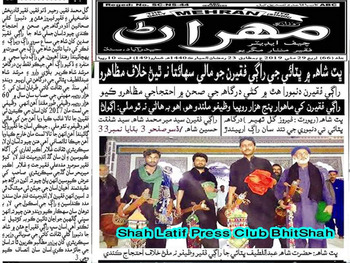
Rāgī faqīrs today strategically adopt the title of “artist” to increase their eligibility for support by the provincial government.Footnote 39 Manthār Faqīr has helped faqīrs from the shrine of Shah Karim petition the Culture Department to include them in the artist stipends list. In June 2018, he joined other faqīrs to participate in a meeting held by the Sindh Fankār Welfare Trust, to make demands on the government alongside other artists. Their demands included government support for medical expenses, better allotment of stipends, and job quotas for faqīrs’ sons. In May 2019, a group of rāgī faqīrs held a rally at the shrine to protest the discontinuation of their stipends following budget cuts (Figure 9). These actions suggest that the cultural regrouping of rāgī faqīrs as “artists” by Sindhi literati and government officials has inspired a number of rāgī faqīrs to make claims as subjects of the state under the label of fankār, in the absence of other ways to gain government support.
News report of the rāgī faqīrs’ protest. The Daily Mehran, 29 May 2019, circulated on WhatsApp group “Shah Latif Jā Faqīr [Faqīrs of Shah Latif].”

Sounding Intersubjective Agency
On an evening in February 2018, elite guests from Karachi, Hyderabad, and Bhit Shah crowded into a small but artfully furnished lobby on the ground floor of the newly built Madan Faqīr Resort to attend its inauguration ceremony. The Shah Latif Foundation (SLF), an NGO founded by the current sajjādanashīn, had received funding from the United Nations Development Programme to build this “tourist eco-resort” behind the shrine. My interactions with the SLF led them to invite me and Manthār Faqīr’s daughters to perform at the event.
Although a few women have learnt and performed SJR in the past, there is no active tradition of female rāgī faqīrs at the shrine. This is due to patriarchal notions of honour (‘izzat) that regulate the visibility of women outside the space of a clan. Under this premise, conditions for women performers in Sindh and Pakistan vary depending on the intersection of caste, class, and religion; those who sing professionally do so within patrilineal constraints (Hemani Reference Hemani2017).Footnote 40 Many women do perform sūfiāna kalām at shrines, in groups or alone, for both spiritual reward and material income; some have been promoted through mass media and gained international fame (Abbas Reference Abbas2002). I was included in the emergence of a first “ladies’ group” to perform SJR on stage due to my apprenticeship and relation with Manthār Faqīr’s family and my position as a foreign woman in contact with Sindhi cultural elites.Footnote 41 The phenomenon of female SJR performers is still nascent: we were primarily invited to perform for urban or literary audiences invested in cultural reform, in the Faqīr (3) position.
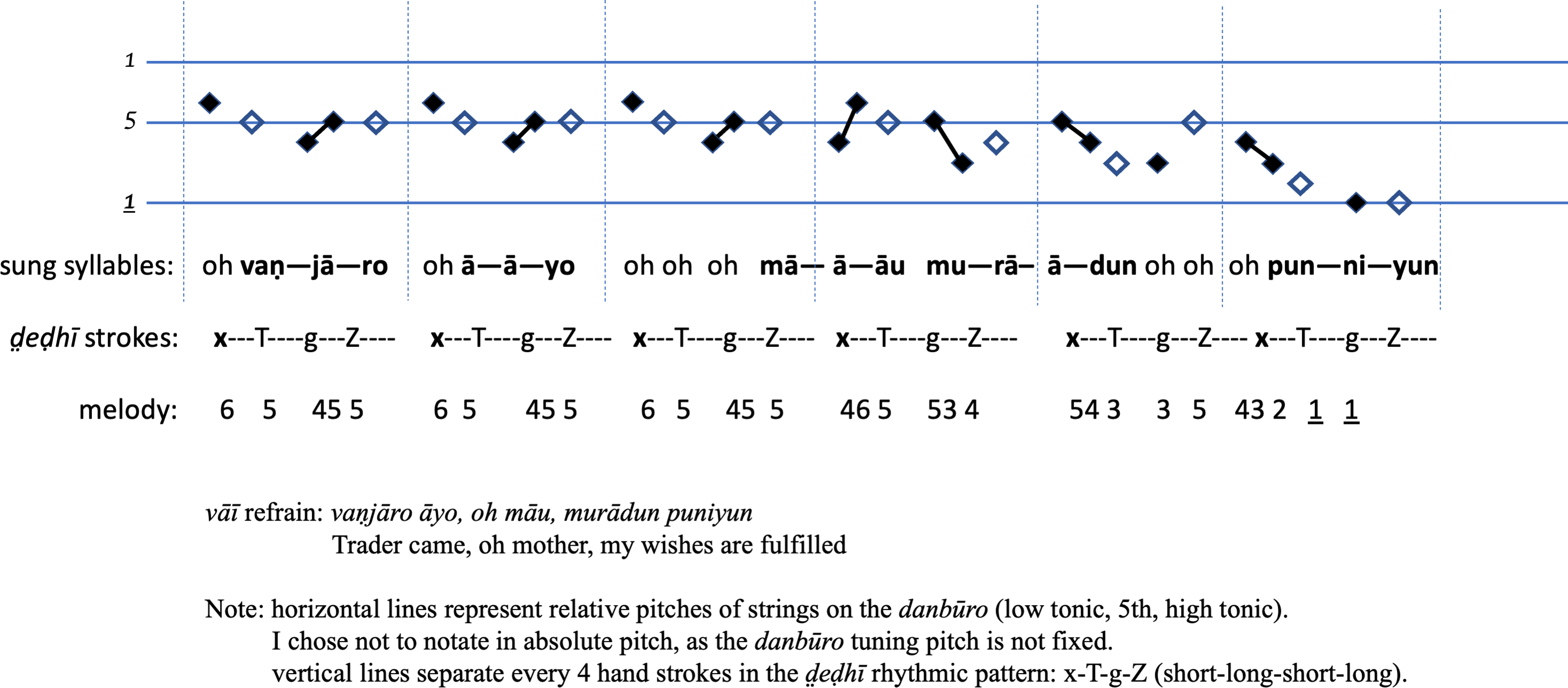
We negotiated a programme in which Manthār Faqīr’s male group performed the first Sur, the ladies’ group sang another Sur, and Manthār Faqīr joined us for the last Sur. Due to the organisers’ request for brevity, each of the three items was around ten minutes long, in stark contrast to Surs during ḥāz̤rī, which are usually thirty minutes to an hour long. We spent copious time discussing what to sing and rehearsing for this important function, realising that impressing the high-level guests could mean invitations to perform beyond Bhit Shah.Footnote 42 The first Sur performance by Manthār Faqīr’s group was no different from how they sing at the shrine, except for the shorter duration and the fact that Manthār Faqīr cut off Inayat Faqīr’s ending phrase in the last bait to announce the words of the vāī to the audience (53” in Supplementary Video 1: Sur Kalyan excerpt). This is a presentation technique he and others developed over countless invited programmes to help audiences understand the otherwise indecipherable words. Despite the time limit, Manthār Faqīr made sure both he and I played the tand and jhaṛ preludes when leading our respective sections. Our ladies’ group performed Sur Samundi, the first Sur we learnt as beginners.Footnote 43 The vāī, entitled Vaṇjāro Āyo, was an easy composition that many faqīrs sing. Set to the d̤eḍhī rhythm, with strokes on the danbūro that sound like patterns of “short-long, short-long,” the refrain sounded like this (Figure 10; Supplementary Video 2: Vaṇjāro Āyo refrain).Footnote 44
Vaṇjāro Āyo refrain. Transcribed by author.

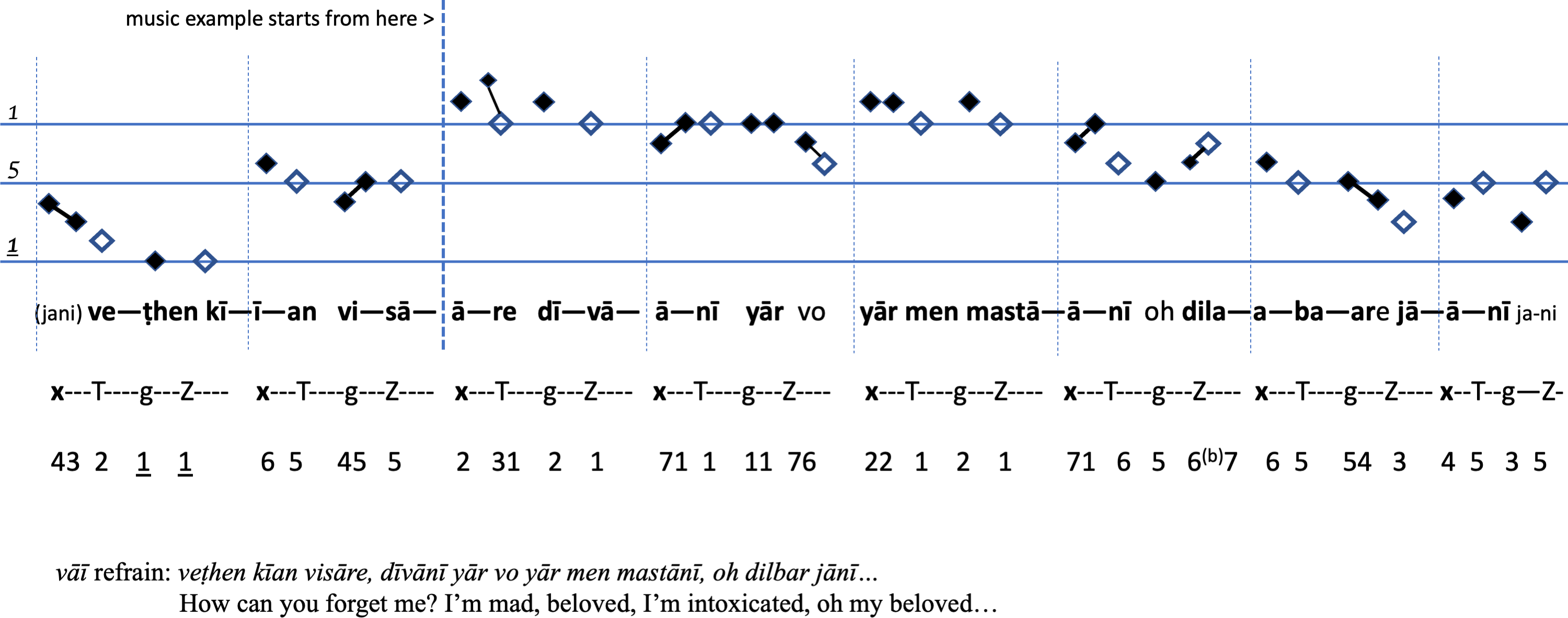
Manthār Faqīr planned the final item, Sur Suhni, to make a lasting impression. He especially taught us two new vāīs for the event. The d̤eḍhī vāī, entitled Veṭhen Kīan Visāre, boasts a particularly soaring melody in the high range, which is physically demanding to sing. Manthār Faqīr chose this work because, as we were performing near the shrine, he wanted other rāgī faqīrs to hear. It was a statement of artistic combat, since not many faqīrs have mastery over this vāī. Compared to the melodic contour of the previous vāī, which hovers around the fifth before descending to the lower tonic, this refrain covers a wider pitch range, from the higher to lower tonics, with a third of the melody lingering around the higher tonic (Figure 11; Supplementary Video 3: Veṭhen Kīan Visāre refrain).
Veṭhen Kīan Visāre refrain. Transcribed by author.

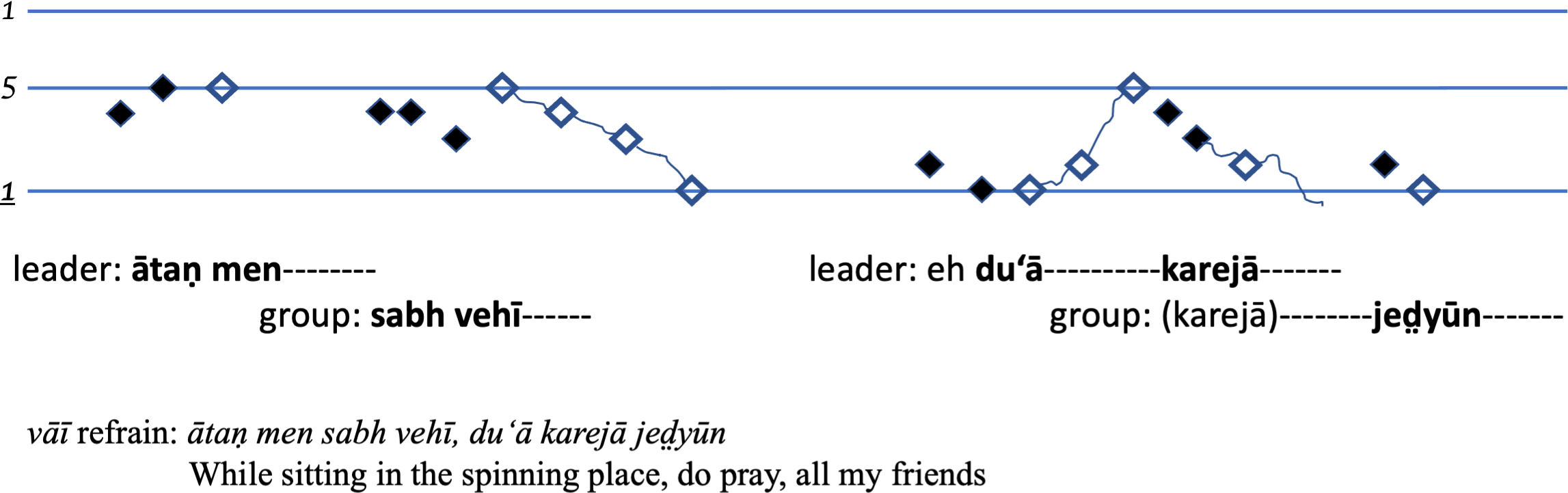
In contrast, the cheṛ vāī he taught us (Ātaṇ Men Sabh) was primarily geared towards moving the audience. Cheṛ (“to stroke”) refers to strumming danbūro strings in elastic tempo when accompanying this kind of vāī. The leader sings the majority of each line as a soloist, while the other singers join in towards the end of the line, sustaining the last note of each melodic phrase as a group (Figure 12; Supplementary Video 4: Ātaṇ Men Sabh refrain).
Ātaṇ Men Sabh refrain. Transcribed by author.

Traditionally, faqīrs did not sing cheṛ vāī often during ḥāz̤rī. Compositions of this kind were designated for only three nights of the month, when the moon is at its fullest. According to Manthār Faqīr, cheṛ vāī started gaining fame due to Qurban Faqīr Lanjwani,Footnote 45 the first rāgī faqīr selected by government officials to perform on TV and abroad. In addition to learning SJR among relatives, Qurban Faqīr was a school teacher, poet, and connoisseur of classical vocal arts. His voice and eloquence captured the admiration of Mirza and Akhund, who brought him to the wider public stage. Manthār Faqīr recounts singing with Qurban Faqīr when they performed abroad: he had such a heartrending and spiritually powerful way of singing cheṛ vāī that European audiences were reportedly in tears after hearing him: something akin to a miracle. Qurban Faqīr is widely appreciated among faqīrs and audiences for incorporating a shaking vocal ornamentation inspired by classical singing into his cheṛ performance. This was the technique Manthār Faqīr taught us for the programme, as he felt it was a more artistic way of singing. He wanted the audience that night to cry, to be overpowered spiritually, and to hear our artistry.
To sum up: our performance for this programme was mainly from the subject position of Faqīr (3), geared toward urban and foreign audiences, presenting SJR as “Sindhi Sufi culture” (Figure 13). Pausing the singing to announce words of the vāī is a technique developed in past Faqīr (2) and (3) positions. Proximity to discerning rāgī faqīrs encouraged Manthār Faqīr to sound the tand, jhaṛ, and a difficult vāī to emphasise his Kārīgar status, with additional hopes that the audience would recognise his skills as an Artist. Furthermore, the idea of preparing a spiritually and artistically powerful cheṛ vāī draws on the history of Qurban Faqīr as an acclaimed Artist and Faqīr (3) recognised by the state. At the same time, invoking the miraculous powers of Qurban Faqīr’s vocal technique called on an Allāhwālā faqīr devotional subjectivity.
Subjectivities in the Sur Suhni performance. Transcribed by author.

Conclusion
Intentionality, as Manthār Faqīr hinted, is requisite in the practice of love. My intention in this article is to understand an aspect of rāgī faqīrs’ lives on a path of Islam through analysing how they involve musical practice in projects of selfhood both spiritual and vocational. Rāgī faqīrs play out such projects within various positions shaped by ideological forces, power relations, and conditions of exchange. Of course, complex subjectivities exceed reductive labels such as the ones I assign above. Yet it is through this kind of multiplicity that Manthār Faqīr navigates all of his performances. On the surface, the Surs sound the same in different performing contexts, altering only in duration. In reality, he constantly negotiates positions and techniques in relation to his audiences and his conception of higher powers. These shifting and coexisting subject positions help Manthār Faqīr balance active devotion and artistry, to sustain livelihood and legitimacy as a rāgī faqīr in postcolonial Sindh.
Acknowledgements
My deepest gratitude to all the rāgī faqīrs who shared their wisdom and life experiences with me, and my generous Sindhi friends, teachers, and interlocutors without whom my studies would not be possible. Above all, this article is for my dear ustād Manthār Faqīr and his loving family. I thank colleagues who gave me feedback at presentations of this article in earlier form at the Harvard South Asia Across Disciplines workshop and 45th ICTM World Conference. Special thanks to Divya Chandramouli, Laurie Lee, Tamar Sella, the Q-hort, Kay Shelemay, Richard Wolf, and the journal reviewers and editors for their time and insight in the revision process.
Glossary
- Sindhi terms
-
English translation
- allāhwālā
-
close to Allah
- bait
-
a type of Sindhi verse
- cheṛ
-
“to stroke,” a type of vāī
- danbūro
-
five-stringed plucked lute used in SJR
- d̤eḍhī
-
“one and a half,” a type of vāī
- fan
-
art
- fankār
-
performing artist
- faqīr
-
a type of devotional practitioner
- ḥāz̤rī
-
“presence,” performing service for a saint
- jhaṛ
-
group instrumental prelude in SJR
- kāfī
-
a genre of sung devotional poetry
- kārīgar
-
skilled artisan
- pīr
-
a Sufi leader or their descendants
- rāg
-
music
- rāgī faqīr
-
a devotee who performs SJR
- samā‘
-
audition
- sajjādanashīn
-
hereditary custodian of a shrine
- sayyid
-
those who claim direct descent from the Prophet Muhammad
- Shah Jo Rāg (SJR, Rāg)
-
musical tradition founded by Shah Latif
- sūfiāna kalām
-
poetry of Sufi saints
- sur
-
melody, melody type, melodic rules for singing each Sur-chapter in SJR
- tand
-
solo instrumental prelude in SJR
- ustād
-
teacher
- vāī
-
group chorus in SJR
- ẕikr
-
ritual remembrance of Allah
Supplementary Materials
To view the supplementary material for this article, please visit http://dx.doi.org/10.1017/ytm.2020.19.