The risks conferred on offspring of caregivers with major depressive disorder (MDD) have been well established and include the increased likelihood of a range of negative youth outcomes. For example, youth of depressed parents are at a substantially increased risk of experiencing internalizing and externalizing symptoms and are more likely to develop MDD themselves (National Research Council and Institute of Medicine, 2009). Given that MDD is one of the most prevalent psychiatric disorders in the United States (affecting approximately 16% of adults in a lifetime; Kessler & Wang, Reference Kessler, Wang, Gotlib and Hammen2009) and is highly recurrent (Boland & Keller, Reference Boland, Keller, Gotlib and Hammen2009), it is concerning, but not surprising, that 15 million children are currently growing up with a depressed parent (National Research Council and Institute of Medicine, 2009). Fortunately, there is a growing recognition of the costs exacted by depression: on society through high healthcare payments and lost wages (Greenberg et al., Reference Greenberg, Kessler, Birnbaum, Leong, Lowe and Berglund2003), on families through negative parent–child interactions and marital conflict (Fear et al., Reference Fear, Champion, Reeslund, Forehand, Colletti and Roberts2009; Tompson et al., Reference Tompson, Pierre, Boger, McKowen, Chan and Freed2010), and on individuals, their children, and grandchildren (Weissman et al., Reference Weissman, Wickramaratne, Nomura, Warner, Verdeli and Pilowsky2005). As a result, efforts to design and disseminate effective preventive interventions targeting at-risk youth are receiving deserved critical attention (Beardslee, Gladstone, & O'Connell, Reference Beardslee, Gladstone and O'Connor2011; Munoz, Beardslee, & Leykin, Reference Munoz, Beardslee and Leykin2012).
To facilitate the development and testing of preventions targeting youth at risk for depression, research attention and dollars have turned toward delineating specific pathways that undergird and explain the link between parent and offspring psychopathology. Utilizing Goodman and Gotlib's (Reference Goodman and Gotlib1999) integrative model of the transmission of depression from mother to offspring to frame their review, Beardslee et al. (Reference Beardslee, Gladstone and O'Connor2011) reported updated findings from the literature that explore the links among parental depression, specific mechanisms of risk, youth vulnerabilities, and youth depression, including advances in understanding (a) transmission as a bidirectional process, (b) genetic heritability and Gene × Environment interactions, (c) brain structure and function, and (d) family system and individual factors.
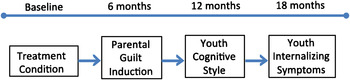
Goodman and Gotlib's (Reference Goodman and Gotlib1999) model suggests that the risk of depression is transmitted from caregiver to offspring via four primary mechanisms (i.e., heritability; dysfunctional neuroregulatory systems; exposure to negative parental cognitions, emotions, and behaviors; and exposure to contextual stress), which in turn contribute to or exacerbate youth vulnerabilities (e.g., skills deficits/maladaptive styles/behavioral tendencies) that finally lead to the outcome of youth psychopathology. The current study explores one possible pathway by which participation in a family-based cognitive–behavioral group (FGCB) prevention program (Compas et al., Reference Compas, Forehand, Keller, Champion, Rakow and Reeslund2009) may impact youth internalizing symptoms by disrupting the transmission of risk. Specifically, two aspects of Goodman and Gotlib's model are identified (one purported mechanism of risk, parenting behaviors, and one youth vulnerability factor, negative cognitive style) and tested as possible conduits here (see Figure 1 for delineation of the model).
(Color online) The general schematic of the model that was tested.

Parenting Deficits: Focus on Guilt Induction
One factor included in Goodman and Gotlib's (Reference Goodman and Gotlib1999) model to partially explain the association between parental depression and offspring outcomes is “exposure to mother's negative and/or maladaptive cognitions, behaviors, and affect” (p. 461). Depressed parents consistently demonstrate deficits in caregiving or compromised parenting competencies (for a review, see Dix & Meunier, Reference Dix and Meunier2009), including low levels of warmth and positive affect (e.g., Feng, Shaw, Skuban, & Lane, Reference Feng, Shaw, Skuban and Lane2007), high levels of emotional overinvolvement, intrusiveness, disengagement, and criticism (e.g., Field, Healy, Goldstein, & Guthertz, Reference Field, Healy, Goldstein and Guthertz1990; Tompson et al., Reference Tompson, Pierre, Boger, McKowen, Chan and Freed2010), and high levels of inconsistent discipline (e.g., Lovejoy, Graczyk, O'Hare, & Neuman, Reference Lovejoy, Graczyk, O'Hare and Neuman2000). While these deficits and excesses in parenting have been predictive of negative youth outcomes broadly (i.e., externalizing symptoms and decreased social competence), the links between low caregiver competence and offspring internalizing symptoms specifically have been more tenuous, with some researchers finding support for the association and others failing to (see McKee, Colletti, Rakow, Jones, & Forehand, Reference McKee, Colletti, Rakow, Jones and Forehand2008; McLeod, Weisz, & Wood, Reference McLeod, Weisz and Wood2007, for reviews).
Although the association between parenting behaviors and youth internalizing symptoms is still debated in the literature, one parenting construct in particular, psychological control, has been linked more robustly and consistently with youth internalizing symptoms (El-Sheikh, Hinnant, Kelly, & Erath, Reference El-Sheikh, Hinnant, Kelly and Erath2010; Soenens et al., Reference Soenens, Luyckx, Goossens, Vansteenkiste, Luyten and Duriez2008; for a review, see Barber, Stolz, & Olsen, Reference Barber, Stolz and Olsen2005). A parent's ability to strike the delicate balance between exerting control and granting autonomy, and to adapt that balance to a child's developmental stage, has clear implications for youth behavioral and emotional well-being (Steinberg, Reference Steinberg, Feldman and Elliot1990). Striking such a delicate balance may be even more trying for parents suffering from depression, who are more likely to believe their children are in control during difficult interactions and to perceive themselves as nonefficacious caregivers (see Dix & Meunier, Reference Dix and Meunier2009, for a review).
Over the past two decades, research has begun to highlight the importance of psychological control on critical youth outcomes (e.g., Barber et al., Reference Barber, Stolz and Olsen2005; Barber, Xia, Olsen, McNeely, & Bose, Reference Barber, Xia, Olsen, McNeely and Bose2012; Kincaid, Jones, Cuellar, & Gonzalez, Reference Kincaid, Jones, Cuellar and Gonzalez2011). Largely missing from this literature, however, is clarity regarding the ways in which the specific components of psychological control (e.g., attempts to manipulate child behavior via threats of love withdrawal, disapproval, and guilt induction) may operate as depressed parents engage in caregiving activities (see Barber & Harmon, Reference Barber, Harmon and Barber2002; Schaefer, Reference Schaefer1965; Soenens & Beyers, Reference Soenens and Beyers2012, for discussions of the construct and constituent parts of psychological control). Several studies over the past decade have highlighted guilt induction as a subcomponent of psychological control worthy of attention and have begun to provide some evidence for it as a candidate behavior that partially explains the link between parent and child depression (e.g., Donatelli, Bybee, & Buka, Reference Donatelli, Bybee and Buka2007; Rakow et al., Reference Rakow, Forehand, McKee, Coffelt, Champion and Fear2009, Reference Rakow, Forehand, Haker, McKee, Champion and Potts2011).
Guilt induction has been defined as a parent's attempt to manipulate youth behavior by (a) directing criticism and inappropriate, unwarranted blame and responsibility toward him/her; (b) expressing disappointment over his/her minor mistakes or wrongdoings; and (c) reminding the youth that the parent's needs are more important than the youth's (Donatelli et al., Reference Donatelli, Bybee and Buka2007). When titrated carefully and in response to specific events, guilt induction could theoretically serve an adaptive function for the developing child (e.g., as a promoter of prosocial behavior and/or inhibitor of offensive behavior), as has been demonstrated in research on self-regulation (e.g., Amodio, Devine, & Harmon-Jones, Reference Amodio, Devine and Harmon-Jones2007; see also Tilghman-Osborne, Cole, & Felton, Reference Tilghman-Osborne, Cole and Felton2010, for a review of the adaptive versus maladaptive qualities of the guilt construct based on assessment tools). However, several studies indicate that guilt induction may lead to maladaptive outcomes, including offspring internalizing symptoms (Donatelli et al., Reference Donatelli, Bybee and Buka2007; Rakow et al., Reference Rakow, Forehand, McKee, Coffelt, Champion and Fear2009).
In an earlier analysis focused on a similar but not identical sample of depressed caregivers and offspring used in the current study, Rakow et al. (Reference Rakow, Forehand, Haker, McKee, Champion and Potts2011) found that parental guilt induction partially explained the concurrent baseline association between parental depressive symptoms and youth internalizing symptoms. The present study extends these findings by utilizing a longitudinal model and an experimental design with an at-risk sample of youth and their depressed caregivers, approximately half of whom were randomized to a family-based cognitive–behavioral prevention program, and by exploring an additional vulnerability variable, youth cognitive style, which has also been linked in prior research to parental depression and youth internalizing symptoms.
Youth Cognitive Style
Cognitive theories of depression suggest that individuals who make certain kinds of interpretations or attributions about negative events, themselves, and the future are more vulnerable to the onset of depression when they face stressful events or experience high levels of chronic stress (e.g., Abramson, Metalsky, & Alloy, Reference Abramson, Metalsky and Alloy1989; Beck, Reference Beck1987; for a review of cognitive vulnerability in youth, see Abela & Hankin, Reference Abela, Hankin, Abela and Hankin2008). Hopelessness theory in particular posits that individuals with the tendency to make certain interpretations about the causes of negative events (i.e., they are stable and global) and about the consequences of a negative event for the self (i.e., the event is indicative of pathology or unworthiness on the part of the individual) and for the future (i.e., the current negative event will lead to other negative outcomes) are more likely to experience depressive symptoms when faced with such events than are individuals who make a different set of inferences (Abramson et al.,Reference Abramson, Metalsky and Alloy1989). A growing body of empirical work has borne out this theoretical model of depression by showing that a depressogenic cognitive style is associated with an elevated risk of depression in youth, particularly for adolescents in the context of stressful life events or circumstances (e.g., Carter & Garber, Reference Carter and Garber2011; Cole et al., Reference Cole, Ciesla, Dallaire, Jacquez, Pineda and LaGrange2008; see Abela & Hankin, Reference Abela, Hankin, Abela and Hankin2008, and Lakdawalla, Hankin, & Mermelstein, Reference Lakdawalla, Hankin and Mermelstein2007, for reviews).
Although there are less data identifying the predictors or precursors of a depressongenic cognitive style, some evidence suggests that parental depression is associated with negative cognitive style in youth. For example, compared with children of medically ill or healthy control parents, youth with depressed mothers demonstrated a more negative attributional style (Jaenicke et al., Reference Jaenicke, Hammen, Zupan, Hiroto, Gordon and Adrian1987, as cited in Garber & Flynn, Reference Garber and Flynn2001) and lower self-worth (Goodman, Adamson, Riniti, & Cole, Reference Goodman, Adamson, Riniti and Cole1994, as cited in Garber & Flynn, Reference Garber and Flynn2001). In addition, developmentalists and social learning theorists suggest that a youth's sense of self and views of the world are molded via exposure to particular parenting behaviors. In other words, a “child learns to construct reality through his or her early experiences with the environment, especially with significant others. Sometimes, these early experiences lead children to accept attitudes and beliefs that will later prove maladaptive” (Beck & Young, Reference Beck, Young and Barlow1985, p. 207, as cited in Bruce et al., Reference Bruce, Cole, Dallaire, Jacquez, Pineda and LaGrange2006). Eisenberg, Cumberland, and Spinrad's (Reference Eisenberg, Cumberland and Spinrad1998) heuristic model of the socialization of emotion further supports this notion of a direct link between emotion-related parenting practices and youth outcomes, which include the development of cognitive structures about the self, relationships, and the world. Tangney and Dearing's (Reference Tangney and Dearing2002) model also places parental beliefs and practices as the variable most proximal to youth emotional style in their model of socialization of shame and guilt. Compelling empirical data support this relation between parenting practices and youth cognitive style. Youth whose depressed mothers made negative comments (Radke-Yarrow, Belmont, Nottelman, & Bottomly, Reference Radke-Yarrow, Belmont, Nottelman, Bottomly, Cicchetti and Beeghly1990, as cited in Garber & Flynn, Reference Garber and Flynn2001) and negative emotional statements (Goodman et al., Reference Goodman, Adamson, Riniti and Cole1994), for instance, demonstrated precursors or signs of a negative cognitive style. Others have likewise documented the association of negative parenting practices and negative youth cognitive style (e.g., Bruce et al., Reference Bruce, Cole, Dallaire, Jacquez, Pineda and LaGrange2006). Although prospective investigations of parenting behavior and youth cognitive style are scant, Garber and Flynn (Reference Garber and Flynn2001) reported a significant association between maternal psychological control and youth attributional style 1 year later. More recently, Mezulis, Funasaki, and Hyde (Reference Mezulis, Funasaki and Hyde2011) demonstrated that negative maternal attributions and emotional displays (i.e., frustration and tension) in response to youth failure prospectively predicted a more negative youth cognitive style.
In addition, Tilghman-Osborne, Cole, and Felton (Reference Tilghman-Osborne, Cole and Felton2012) argue that “inappropriate guilt,” which is one symptom of depression listed in the DSM-IV-TR (American Psychiatric Association, 2000), may be defined as misplaced responsibility. In other words, assuming responsibility for something that is out of one's control is akin to a cognitive error often related to depression (Beck Reference Beck1967, as cited in Tilghman-Osborne et al., Reference Tilghman-Osborne, Cole and Felton2012). In this framework, insomuch as parental guilt-inducing behaviors create excessive or inappropriate guilt, youth cognitive style is likely to be impacted.
Drawing from Goodman and Gotlib's (Reference Goodman and Gotlib1999) model, and the theoretical and empirical literatures around parental depression, parenting, and youth cognitive style, the current study tested one model hypothesized to explain the links among compromised caregiving, youth negative cognitive style, and finally, youth internalizing symptoms. Theory and extant empirical work suggest a preventive intervention that teaches parents skills to effectively manage their children's behavior despite the parent's lingering or current depressive symptoms may reduce reliance on specific maladaptive parenting strategies (i.e., guilt induction; e.g., Buhler, Kotter, Jaursch, & Losel, Reference Buhler, Kotter, Jaursch and Losel2011). Recent work by Forehand et al. (Reference Forehand, Thigpen, Parent, Hardcastle, Bettis and Compas2012) using the same sample as the present study, for example, reports that parents enrolled in a preventive intervention that teaches skills to manage youth behavior demonstrated fewer negative parenting behaviors (i.e., parental negative affect, hostility, intrusiveness, or neglect/distancing) than did parents in the comparison condition. Furthermore, such parenting changes have been associated with improvement in youth emotional and behavioral problems (Compas et al., Reference Compas, Champion, Forehand, Cole, Reeslund and Fear2010). Although the intervention did not explicitly target parental guilt, it is possible that similar to the findings for the negative parenting behaviors just noted, parents who are receiving instruction in positive, effective parenting are less reliant on specific maladaptive parenting strategies. Building on this work and the studies linking parenting behaviors to youth cognitive style, we hypothesized that participating in the FGCB intervention would be related to decreased parental use of guilt induction 6 months postbaseline (PB), that guilt induction at 6 months PB would in turn predict a change in youth cognitive style 12 months PB, and that youth cognitive style at 12 months PB would be related to a reduction in youth internalizing symptoms at 18 months PB.
The current study extends prior studies in several ways. First, the model is tested with parents and youth participating in a randomized controlled trial of a family-based cognitive–behavioral preventive intervention targeting families with a history of caregiver depression. Testing the model in the context of a prevention program affords the opportunity not only to examine linkages in a high-risk sample but also to capture change in the parenting behavior of interest (i.e., guilt induction) and the youth vulnerability of interest (i.e., cognitive style) for families assigned to the active and comparison conditions. Second, although many of the separate links in the proposed pathway are supported by prior research, this is the first occasion to our knowledge on which all components are considered simultaneously in one model. Third, the current work extends prior studies, many of which are cross-sectional, by examining the associations of these behaviors, cognitive tendencies, and symptoms over time. Fourth, building on prior research (e.g., Mian, Wainwright, Briggs-Gowan, & Carter, Reference Mian, Wainwright, Briggs-Gowan and Carter2011), we present separate models utilizing parent report and youth report of internalizing symptoms, given that concordance rates for the two informants regarding youth internalizing symptoms are generally relatively low (Kendall & Drabick, Reference Kendall and Drabick2010; see De Los Reyes & Kazdin, Reference De Los Reyes and Kazdin2005, for a review). As De Los Reyes and Kazdin point out, there is no “gold standard” when it comes to informants; however, because youth are generally considered to be valid and more accurate reporters of their own internalizing symptoms than are parents (Welner, Reich, Herjanic, Jung, & Amado, Reference Welner, Reich, Herjanic, Jung and Amado1987; Yule, Reference Yule, Ollendick and Hersen1993; as cited in Myers & Winters, Reference Myers and Winters2002), we consider the youth model to be our primary focus.
Method
Participants
One hundred and eighty families, all of which had at least one caregiver with a history of MDD and one child in the target age range of 9 to 15 (49.4% females; M age = 11.46; SD = 2.00), were recruited from the larger Burlington, Vermont, and Nashville, Tennessee, communities and included in current analyses. The majority of the target parents (i.e., those identified as having a history of MDD) were female (88.9%), married (61.7%), and highly educated (31.7% with 4-year college degree; 23.3% with graduate education) at baseline. Although participant ethnic composition was primarily Caucasian, with 25.6% of youth identifying as racial/ethnic minorities (12.8% Black or African American, 3.3% Asian, 1.7% Latino or Hispanic, 0.6% American Indian or Alaska Native, and 7.2% mixed race), the ethnic makeup of participants was, according to 2000 US Census data, representative of the regions from which they were drawn.
Procedure
Families were recruited through a variety of means, including flyers, newspaper and radio advertisements, and referrals from physicians. Interested families, who either contacted the study coordinators directly or provided contact information and agreed to be called/e-mailed, were screened first over the phone, followed by an in-person visit to determine eligibility. Inclusion criteria for parents consisted of a history of MDD during the lifetime of the target child(ren). Parental exclusion criteria based on the Structured Clinical Interview for DSM (First, Spitzer, Gibbon, & Williams, Reference First, Spitzer, Gibbon and Williams2001) consisted of a history of bipolar I disorder, schizophrenia, or schizoaffective disorder. If parents were suicidal with a global assessment of functioning of ≤50, or suffering from current substance problems with a global assessment of functioning of ≤50, families were deferred, offered assistance with obtaining community mental health services, and rescreened at regular intervals for eligibility (see Compas et al., Reference Compas, Forehand, Keller, Champion, Rakow and Reeslund2009, for training and reliability for the current project). Youth in the age range of 9–15 years old were eligible based on the Schedule for Affective Disorders and Schizophrenia for School-Age Children—Present and Lifetime Version (Kaufman et al., Reference Kaufman, Birmaher, Brent, Rao, Flynn and Moreci1997) if they were free of lifetime diagnoses of autism spectrum disorders, mental retardation, bipolar I disorder, and schizophrenia, and if they did not currently meet criteria for conduct disorder or alcohol/substance use disorders (see Compas et al., Reference Compas, Forehand, Keller, Champion, Rakow and Reeslund2009, for interviewer training and reliability in the current project). When youth were depressed at screening, the family was deferred, provided appropriate referrals, and rescreened at 2-month intervals. The current sample included 16.7% of youth with a history of depression.
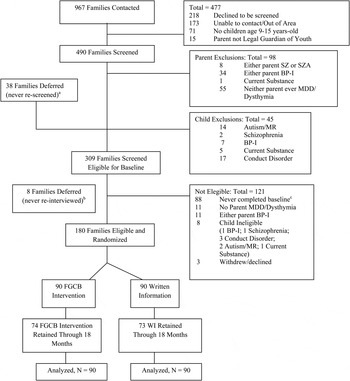
As demonstrated in Figure 2, 180 eligible families were randomized to the FGCB intervention (50% of current sample) or to a written information (WI; 50% of current sample) comparison condition. Families randomized to the FGCB participated in 8 weekly group meetings and 4 monthly follow-up sessions with several other families that included psychoeducation about depression and its effect on the family, positive parenting skills training for the depressed caregivers and participating partner, and secondary control coping skills training for the youth (details of the prevention program are described more fully in Compas et al., Reference Compas, Forehand, Keller, Champion, Rakow and Reeslund2009, Reference Compas, Forehand, Thigpen, Keller, Hardcastle and Cole2011). Prevention sessions were cofacilitated by one of three clinical social workers and one of nine doctoral-level clinical graduate students and supervised by two PhD-level clinical psychologists. Treatment participation was adequate for those families randomized to the FGCB condition as demonstrated by the following data. First, the number of group sessions attended or made up after an absence by at least one family member averaged 7.9 sessions. Second, for those who attended at least 1 session, the mean number of sessions attended or made up after an absence was 10.5 sessions. Third, almost 70% of families attended more than one half of the 12 sessions.
Participant screening and randomization: a 15 families deferred due to youth major depressive episode (MDE), b 5 families deferred due to youth MDE, c 8 youth not interested; 56 parent not interested, 3 families moved, 1 parent not legal guardian, 19 not reachable, 1 contacted study after enrollment closed.

Modeled on prior successful self-study or informational conditions (i.e., Beardslee, Wright, Gladstone, & Forbes, Reference Beardslee, Wright, Gladstone and Forbes2007; Wolchik et al., Reference Wolchik, West, Sandler, Tein, Coatsworth and Lengua2000), families in the WI condition were mailed three separate youth and parent packets of psychoeducational readings regarding depression, signs of depression in youth, and effects of parental depression on families over an 8-week period (for more detailed information about the readings, see Compas et al., Reference Compas, Forehand, Keller, Champion, Rakow and Reeslund2009).
Families in both the FGCB and the WI conditions completed questionnaires at baseline, as well as 2, 6, 12, and 18 months PB (see Figure 2 regarding family retention). Ninety-three percent of families remained enrolled at 18 months (i.e., 7% of families withdrew from the study), and 82% of the families completed data collection through the 18-month follow-up (82% of families assigned to the intervention and 81% of the comparison group), as defined by the provision of data at either or all of the 6-, 12-, or 18-month follow-up data collections. For families with more than one eligible child who participated in the study, the present analyses utilized one randomly selected child per family.
Measures
Demographic information
Target parents responded to demographic questions designed to capture information about themselves (e.g., parental age and education) and their families (e.g., household income). Youth also reported demographic information (e.g., sex and age).
Parent guilt induction
The Maladaptive Guilt Inventory (Donatelli et al., Reference Donatelli, Bybee and Buka2007) is a 22-item measure with two subscales designed to assess youth's perceptions of parental guilt induction. Based on a prior exploratory factor analysis using a portion of the current sample, the Maladaptive Guilt Inventory is conceptualized here as a single factor composed of 12 items (see Rakow et al., Reference Rakow, Forehand, McKee, Coffelt, Champion and Fear2009, Reference Rakow, Forehand, Haker, McKee, Champion and Potts2011). Youth respond to statements such as “My mom makes me feel guilty about leaving home to do things with other people” and “I feel I am a disappointment to my mom,” on a scale ranging from 1 (not at all true) to 7 (very true). Prorated total summed scores were utilized in the current analyses. Higher scores are indicative of higher levels of parental use of guilt induction. The resulting alpha for this scale was 0.89 at baseline and 0.93 at 6 months PB.
Youth cognitive style
The Adolescent Cognitive Style Questionnaire (ACSQ; Hankin & Abramson, Reference Hankin and Abramson2002) is a youth-completed measure that consists of hypothetical situations to which the youth responds with his or her attributions regarding the causes and consequences of the event. Four hypothetical situations were used in the current study. In one item, for example, youth were instructed to first, “Imagine you get into a fight with your parents,” and then to complete a series of questions, each of which loads onto one of three subscales including: attributional style, or the attributions the youth makes about the negative event being internal (“something about you or because of something else”), stable (“the reason you got in the fight will also cause you to get in fights with your parents in the future”), and global (“the reason you got in the fight will cause problems in other parts of your life”); negative inferences for consequences, assessing the youth's sense of the likelihood of additional bad things happening (“Do you think other bad things will happen to you because you got in the fight with your parents?”); and negative inference for the self-concept, or how the fight reflects on the youth's sense of self (“Do you think there is something wrong with you because you got in the fight with your parents?”). A total score and three subscale scores (attributional style subscale, negative inference for consequence subscale, and negative inference for self-concept subscale) may be calculated. In the current analyses, the mean prorated scores for each of the three subscales were utilized as indicators of a latent youth cognitive style construct at both baseline and 12 months. Higher scores are indicative of a more negative cognitive style. The alpha coefficient of the ACSQ total scale was 0.91 and 0.90 at baseline and 12 months, respectively. The alpha coefficients for the attributional style, negative inference for consequence, and negative inference for self-concept subscales at baseline were 0.85, 0.74, and 0.77, respectively. The alpha coefficients for the attributional style, negative inference for consequence, and negative inference for self-concept subscales at 12 months were 0.85, 0.76, and 0.76, respectively.
Youth internalizing symptoms
The Youth Self-Report for Ages 11–18 (YSR/11–18; Achenbach & Rescorla, Reference Achenbach and Rescorla2001) and the Child Behavior Checklist for Ages 6–18 (CBCL; Achenbach & Rescorla, Reference Achenbach and Rescorla2001) are widely used, nationally normed assessments of youth behavioral and emotional problems. The YSR consists of 118 items; using the scale 0 (not true), 1 (somewhat or sometimes true), or 2 (very or often true), youth describe how well the statements describe their own symptoms/behaviors over the past 6 months. The CBCL consists of a series of statements describing potential youth behaviors and symptoms; parents use the same 0, 1, or 2 scale to indicate the degree to which the items describe their child. Both the YSR and the CBCL yield a total problem score, two broadband factor scores, eight empirically based syndrome scores, and six DSM-oriented scales. In the current study, three syndrome scale raw scores (anxious/depressed, withdrawn/depressed, and somatic complaints) were used as indicators for the latent variable, youth internalizing symptoms, at baseline and 18 months in both the parent and the youth models. Higher scores are indicative of higher levels of pathology. Although the YSR was originally designed for children 11 years and older to complete, recent research indicates children as young as 7 years can complete the measure (Ebesutani, Bernstein, Martinez, & Chorpita, Reference Ebesutani, Bernstein, Martinez and Chorpita2011). Furthermore, prior analyses suggest adequate internal consistency for the YSR scales among 9- and 10-year-olds (i.e., all α ≥ 0.80; see Compas et al., Reference Compas, Forehand, Keller, Champion, Rakow and Reeslund2009). The alpha coefficient of the YSR internalizing broadband scale was 0.90 at baseline and 0.91 at 18 months. The α coefficients for the YSR anxious/depressed, withdrawn/depressed, and somatic complaints subscales at baseline were 0.83, 0.74, and 0.80, respectively. The α coefficients for the YSR anxious/depressed, withdrawn/depressed, and somatic complaints subscales at 18 months were 0.82, 0.80, and 0.78, respectively. The α coefficient of the CBCL internalizing broadband scale was 0.87 at baseline and 0.87 at 18 months. The α coefficients for the CBCL anxious/depressed, withdrawn/depressed, and somatic complaints subscales at baseline were 0.80, 0.80, and 0.70, respectively. The α coefficients for the CBCL anxious/depressed, withdrawn/depressed, and somatic complaints subscales at 18 months were 0.83, 0.80, and 0.75, respectively. Concordance rates between parent and youth report of internalizing symptoms at baseline and 18 months ranged from modest to moderate (see correlations in Table 1). Although raw scores were utilized in analyses to maximize variance (means and standard deviations are included in Table 1), broadband internalizing T scores are reported here for clinical interpretability. Mean T scores averaged across participants in the FGCB and the WI groups on the YSR and the CBCL were 54.6 and 59.4, respectively, at baseline and 47.3 and 53.6 at 18 months (for additional information, see Compas et al., Reference Compas, Forehand, Thigpen, Keller, Hardcastle and Cole2011).
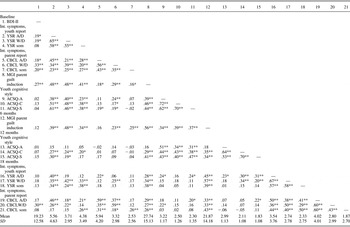
Descriptive data and zero order relations among parental depressive symptoms, parental guilt induction, youth cognitive style, and youth internalizing symptoms

Note: BDI-II, Beck Depression Inventory—II; YSR, Youth Self-Report; A/D, anxious/depressed; W/D, withdrawn/depressed; som, somatic; CBCL, Child Behavior Checklist; ACSQ, Adolescent Cognitive Style Questionnaire; ACSQ-A, attributional style; ACSQ-C, negative inference for consequence subscale; ACSQ-S, negative inference for self concept subscale; MGI, maladaptive guilt inventory.
*p < .05. **p < .01.
Parental depressive symptoms
Target parents were recruited into the study if they had experienced a major depressive episode (MDE) during the lifetime of the parents’ offspring. Because parents were not excluded for being in a current MDE, it was necessary to measure and control depressive symptoms at baseline. The Beck Depression Inventory—II (Beck, Steer, & Brown, Reference Beck, Steer and Brown1996) is a commonly utilized self-report inventory designed to assess the presence and severity of current depressive symptoms. Parents responded to 21 items to indicate the degree of symptom severity that best characterized their current experience. The items at baseline were summed to calculate a prorated total score. The alpha coefficient for the current sample was 0.93. As indicated in Table 1, parents’ prorated scores on the Beck Depression Inventory—II at baseline averaged 19.23 (SD = 12.58); clinical interpretation guidelines suggest that scores ranging from 14 to19 are indicative of mild depression, and 20 to 28 indicate moderate depression (for additional information, see Compas et al., Reference Compas, Forehand, Thigpen, Keller, Hardcastle and Cole2011).
Results
Preliminary analyses
At the bivariate level many, but not all, of the cross-sectional and prospective correlations were significant and in the expected direction (please refer to Table 1 for correlations, means, and standard deviations; as dichotomous variables, neither youth gender nor treatment condition was included in the correlation matrix). Parental guilt induction at 6 months was positively related to two subscales of the youth cognitive style construct at 12 months, such that higher levels of reported parental guilt induction were related to a more negative cognitive style. Further, parental guilt induction at 6 months was positively related to all three indicators of youth-reported and parent-reported internalizing problems at 18 months. All three indicators of 12-month youth cognitive style were positively correlated with the 18-month youth-reported anxious/depressed symptom subscale, and two indicators of 12-month youth cognitive style were also positively associated with the 18-month youth-reported withdrawn/depressed symptom subscale. Of note, only 1 of 9 correlations among indicators of 12-month youth cognitive style and 18-month parent report of youth internalizing symptoms was significant, that is, 12-month ACSQ-S (negative inference for self-concept subscale) was significantly correlated with 18-month CBCL A/D (anxious/depressed subscale); r = .22, p < .05.
Primary analyses
Prior to testing the model, t tests were conducted to compare the FGCB and the WI groups to determine whether the groups differed regarding mean levels of the study variables. None of the model's primary variables were significantly different at baseline for individuals randomized to the FGCB condition versus those randomized to the WI condition.
Following examination of descriptive and correlational data, separate measurement models were tested for parent and child report. Given the strengths and weaknesses of each fit index, a number of fit indices were examined to determine model fit, including the comparative fit index (CFI; Bentler, Reference Bentler1990), the Tucker–Lewis index (TLI; Tucker & Lewis, Reference Tucker and Lewis1973), and the root mean squared error of approximation (RMSEA; Browne & Cudeck, Reference Browne, Cudeck, Bollen and Long1993). As a yardstick, CFI and TLI values greater than 0.95 and RMSEA values smaller than 0.06 are considered to be indicative of good model fit (Hu & Bentler, Reference Hu and Bentler1999). The model utilizing youth report of internalizing problems at baseline and 18 months fit the data well, χ2 (42, N = 179) = 47.94, p = .24, CFI = 0.99, TLI = 0.99, RMSEA = 0.03. An identical model, with the exception that parent report of youth internalizing symptoms was utilized at baseline and 18 months, also fit the data well, χ2 (42, N = 180) = 45.85, p = .32, CFI = 0.99, TLI = 0.99, RMSEA = 0.02.
Based on adequate measurement model fit, two structural equation models were fitted to the data with Mplus 6.0 software package (Muthén & Muthén, Reference Muthén and Muthén1998–2011) using the maximum likelihood estimation with robust standard errors to adequately account for skewed data. Percentage of missing data on core variables ranged across measures and time points, from a low of 1.2% at baseline to a high of 31.7% missing for measures at 18 months, with a mean percentage missing across indicators of 13.8%. All missing data were treated as ignorable (missing at random) and full-information maximum-likelihood estimation techniques were used for inclusion of all available data for each participating family at each time point. In both models, error terms associated with the indicators of the two latent variables, youth internalizing symptoms and youth cognitive style, were allowed to covary as suggested by Kessler and Greenberg (Reference Kessler and Greenberg1981) for repeated measures (as cited in Farrell, Reference Farrell1994). In other words, for both latent variables, pairs of error terms associated with the same subscale indicators across time points were allowed to covary (e.g., for youth internalizing symptoms, YSR anxious/depressed subscale at baseline and 18 months; for youth cognitive style, negative inference for consequence subscale at baseline and 12 months). Because the youth model is considered our primary focus, it is presented first.
Youth model
We originally controlled for baseline parental depressive symptoms and child gender. Because neither variable was significantly associated with youth internalizing symptoms at 18 months and inclusion/exclusion of these variables did not change the significance of pathways in the model, they were removed from the model. In the final youth report model, 9 cases with missing data on independent variables or covariates were excluded from analyses by Mplus, resulting in 171 observations utilized to estimate the model. Model fit was good, χ2 (73, N = 171) = 88.22, p = .11, CFI = 0.98, TLI = 0.97, RMSEA = 0.04.
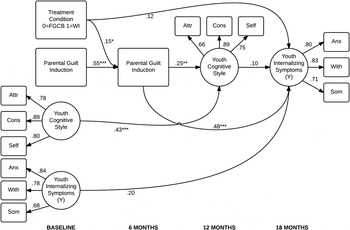
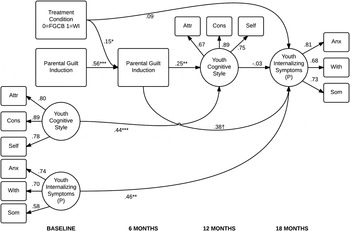
Baseline guilt induction, youth cognitive style, and youth internalizing symptoms were included as covariates in the model. Baseline parental guilt induction was positively predictive of 6-month parental guilt induction (β = 0.55, p < .001) and the baseline youth cognitive style latent construct was positively and significantly predictive of the 12-month youth cognitive style latent construct (β = 0.43, p < .001); however, the baseline internalizing latent construct was not a significant predictor of the 18-month internalizing construct.
Of primary interest were paths from treatment condition to 6-month guilt induction, to 12-month youth cognitive style, and finally to 18-month youth internalizing symptoms (see Figure 3). Youth who participated in the active arm of the study (FGCB) relative to youth assigned to the comparison condition (WI) reported greater reductions from baseline to 6 months in parental guilt induction (β = 0.15, p < .05). In turn, lower levels of parental guilt induction at 6 months were associated with a less negative cognitive style of youth at 12 months (β = 0.25, p < .01) and with fewer internalizing symptoms at 18 months (β = 0.48, p < .001). There was not a significant path from youth cognitive style to youth internalizing symptoms. The direct effect between treatment condition and youth internalizing symptoms at 18 months was not significant.
The youth-report model. The loadings for the latent constructs are all significant at p < .001. Correlated errors between pairs of indicators across time points (e.g., Youth Self-Report [YSR] anxious/depressed at baseline and 18 months) were estimated for the two latent constructs but are not depicted. Treatment condition: FGCB, family group cognitive–behavioral; WI, written information group; Attr, attributional style subscale; Cons, negative inference for consequence subscale; Self, negative inference for self-concept subscale; Anx, YSR anxious/depressed subscale; With, YSR withdrawn/depressed subscale; Som, YSR somatic symptoms subscale. *p < .05, **p < .01, ***p < .001.

To test the significance of the indirect effect from condition to youth internalizing through parental guilt induction, the Model Indirect command in Mplus was utilized to calculate a standardized indirect effect parameter and biased-corrected bootstrap confidence intervals (CIs). Although the direct effect of condition on youth internalizing was nonsignificant, the indirect effect through parental guilt induction was significant (β = 0.07, 95% CI 0.00–0.15, p = .05). Furthermore, the total effect (considering direct and indirect effects) of condition on youth internalizing was also significant (β = 0.19, 95% CI 0.00–0.38, p < .05) with 38% of the total effect being accounted for by parental guilt induction.
Parent model
Consistent with the youth model, both child gender and baseline parental depressive symptoms were originally included as covariates. Again, because neither variable was significantly associated with youth internalizing symptoms at 18 months and because inclusion/exclusion of these variables did not change the significance of pathways in the model, they were removed from the model. In the final parent model, 9 cases with missing data on independent variables or covariates were excluded from analyses by Mplus, resulting in 171 observations utilized to estimate the model. Model fit was good, χ2 (73, N = 171) = 90.12, p = .08, CFI = 0.98, TLI = 0.97, RMSEA = 0.04.
Baseline guilt induction, youth cognitive style, and youth internalizing symptoms were included as covariates in the model. Baseline parental guilt induction was positively and significantly predictive of 6-month guilt induction (β = 0.56, p < .001); the baseline youth cognitive style latent construct was positively and significantly predictive of the 12-month youth cognitive style latent construct (β = 0.44, p < .001); and the baseline internalizing latent construct was positively and significantly predictive of the 18-month internalizing construct (β = 0.46, p < .01).
Of primary interest were paths from treatment condition, to 6-month guilt induction, to 12-month youth cognitive style, to 18-month youth internalizing symptoms (see Figure 4). Youth in the active arm of the study (FGCB), relative to youth assigned to the comparison condition (WI), reported greater reductions in parental guilt induction at 6 months (β = 0.15, p < .05), In turn, lower levels of parental guilt induction at 6 months were associated with a less negative cognitive style of youth at 12 months (β = 0.25, p < .01) and trended toward fewer internalizing symptoms at 18 months (β = 0.38, p = .06). There was not a significant path from cognitive style to youth internalizing symptoms. Furthermore, the direct effect from treatment condition to 18-month internalizing problems was not significant. Although indirect (β = 0.05, 95% CI 0.01–0.12, p = .11) and direct effects of condition on youth internalizing symptoms for the parent-report model were nonsignificant, the total effect of condition on youth internalizing was marginally significant (β = 0.15, 95% CI 0.02–0.32, p < .10) with 37% of the total effect being accounted for by parental guilt induction.
The parent-report model. The loadings for the latent constructs are all significant at p < .001. Correlated errors between pairs of indicators across time points (e.g., Child Behavior Checklist [CBCL] anxious/depressed at baseline and 18 months) were estimated for the two latent constructs but are not depicted. Treatment condition: FGCB, family group cognitive–behavioral; WI, written information group; Attr, attributional style subscale; Cons, negative inference for consequence subscale; Self, negative inference for self-concept subscale; Anx, CBCL anxious/depressed subscale; With, CBCL withdrawn/depressed subscale; Som, CBCL somatic symptoms subscale. †p = .06, *p < .05, **p < .01, ***p < .001.

Discussion
In the current study, relative to a comparison condition, families who participated in a cognitive–behavioral intervention designed to prevent offspring depression showed a significant decline in the use of one psychological control parenting behavior (i.e., guilt induction) at the conclusion of the intervention (6 months PB). Furthermore, reductions in parental guilt induction at 6 months were associated with significantly lower levels of negative cognitive style of youth at 12 months and with lower youth internalizing symptoms 1 year following the conclusion of the intervention (18 months PB). In neither model, however, was 12-month cognitive style predictive of 18-month youth internalizing symptoms. The indirect effect from condition to youth internalizing through parental guilt induction was significant only for the youth model; however, the ratios of the specific indirect effects to the total effects for youth and parent models were comparable, with 38% and 37% of the total effect being accounted for by parental guilt induction, respectively.
These findings build and extend several bodies of work. First, the current findings add to the growing body of data suggesting that programs targeting parenting style and techniques can positively impact youth internalizing problems (e.g., Connell & Dishion, Reference Connell and Dishion2008; Wolchik et al., Reference Wolchik, West, Sandler, Tein, Coatsworth and Lengua2000). Although the effects of the FGCB preventive intervention on parenting and youth outcomes have been explored in prior work (e.g., Compas et al., Reference Compas, Forehand, Keller, Champion, Rakow and Reeslund2009, Reference Compas, Champion, Forehand, Cole, Reeslund and Fear2010, Reference Compas, Forehand, Thigpen, Keller, Hardcastle and Cole2011), the current analyses build on the earlier findings by suggesting that an intervention designed primarily to teach parents skillful ways of communicating with and monitoring their youth also had the positive side effect of reducing one psychological control behavior, the use of guilt. Although the intervention did not target parental guilt specifically, it is possible that the exposure to alternative parenting approaches may have reduced the caregivers’ reliance on psychological control in addition to other negative behaviors (Forehand et al., Reference Forehand, Thigpen, Parent, Hardcastle, Bettis and Compas2012).
Second, the current findings extend the work of Rakow et al. (Reference Rakow, Forehand, McKee, Coffelt, Champion and Fear2009, Reference Rakow, Forehand, Haker, McKee, Champion and Potts2011) by manipulating parental guilt induction and examining its association with youth internalizing symptoms longitudinally. Consistent with a growing body of evidence that highlights the negative impact of psychologically controlling parenting behaviors on youth internalizing symptoms (e.g., Barber et al., Reference Barber, Stolz and Olsen2005), our findings suggest that experimentally induced decreases in parent use of guilt through a preventive intervention are prospectively associated with improvements in youth psychological symptoms.
Third, findings from both parent and youth models also extend a very small body of work suggesting that parental psychological control predicts negative cognitive style in youth (i.e., Garber & Flynn, Reference Garber and Flynn2001). As expected, findings from both models identified lower levels of parental guilt induction as a significant predictor of a less negative cognitive style. Caution in interpretation of this finding is warranted, however, given that youth report was utilized for parental guilt induction and youth cognitive style in both models; for example, the associations may be inflated because both measures (cognitive style and parental guilt induction) may be impacted by biases toward negative interpretation.
Contrary to expectation, however, youth cognitive style was not predictive of youth internalizing symptoms in either parent- or child-report models. Although a sizable literature links negative cognitive style to internalizing symptoms in youth (Jacobs, Reinecke, Gollan, & Kane, Reference Jacobs, Reinecke, Gollan and Kane2008), consensus has not emerged regarding the role of cognitive style as mediator or moderator of stressful or negative life events. Cole et al. (Reference Cole, Jacquez, LaGrange, Pineda, Truss and Weitlauf2011), for example, have argued that an additive model, wherein both cognitive style and stressful life events are important contributors, best predicts depressive symptoms. They have also argued that a mediation model, wherein negative cognitions explain the association between stressors and depression, is superior to a moderation model, particularly for younger youth (e.g., Cole & Turner, Reference Cole and Turner1993). Alternatively, researchers working within the diathesis–stress model have argued that the youth's cognitive vulnerability is activated in the context of specific stressful events and subsequently associated with increased depressive symptoms or MDD diagnoses (e.g., Carter & Garber, Reference Carter and Garber2011); in other words, cognitive vulnerability moderates the impact of negative life events. The current research set out to test a model in which negative cognitions may account for an association between parental guilt induction (which could certainly be considered a chronic stressor) and youth internalizing symptoms. It is possible that our failure to detect a significant path between cognitions and internalizing symptoms is because a moderational model may explain the relations among the data better than a direct pathway, at least for the older adolescents. Research that continues to disentangle associations between different types of acute and chronic stressors (e.g., interpersonal and achievement) and negative cognitions in developmentally sensitive models is necessary.
The current study is limited by several factors. First, although the sample was representative with regard to race/ethnicity of the catchment areas from which participants were recruited, it is a highly educated sample. As such, findings may not generalize to parents with lower mean levels of educational attainment. In addition, similar to other prevention studies, referral of families came from multiple sources, including media, brochures placed in health and mental health clinics, physician referral, and so on, which may have influenced the findings (e.g., different levels of participant motivation based on referral source). However, it was not possible to reliably parse out and systematically compare outcome by referral source because parents often reported learning about the project via multiple exposures (e.g., flyers in doctor's office, TV ads, and presentation to parents in youth's school). Second, we were not able to systematically assess depression status of additional parents or caregivers; therefore, it was not possible to examine potential differences in youth outcomes that may have resulted from exposure to different numbers of caregivers with a history of depression. Third, the WI group served as a control condition in which families received information about depression but did not receive information specifically about parenting or coping skills; although families were contacted to ensure receipt of readings, a check was not conducted to determine whether the materials had been read. Furthermore, the WI families only received written information during the initial 8-week period of intervention; therefore, it is possible that group differences after this point were partially a function of only FGCB families receiving boosters during Weeks 9–25.
Fourth, several of the variables in the models (i.e., parental guilt induction and, parent depressive symptoms) were manifest (e.g., had only 1 indicator) and did not benefit, as the latent constructs did, from the correction of random error (Tomarken & Waller, Reference Tomarken and Waller2005). Fifth, in the youth-report model, youth internalizing symptoms, parental guilt induction, and youth cognitive style were all assessed via youth report; attempts to include additional reporters (e.g., teachers and coparent) in future research would reduce shared method variance, and utilizing observational data would decrease the potential impact of any distortions owing to parent or youth depression. Sixth, although we examined the association between parental guilt induction and youth cognitive style, and between youth cognitive style and youth internalizing problems, we are not able to explore the mechanisms underlying those associations. We are unable using the extant model, for example, to demonstrate whether the association between negative cognitive style and youth internalizing symptoms is explained by rumination, working memory deficits, or some combination of those and other processes (see Gotlib & Joormann, Reference Gotlib and Joormann2010, for a review of the associations between cognition and depression). Future work would benefit from exploration of the various information-processing constructs such as attention and memory that have been tied to depression (Everaert, Koster, & Derakshan, Reference Everaert, Koster and Derakshan2012). Seventh, interpretation of findings should be considered in light of the fact that a small proportion of youth had experienced a major depressive episode prior to enrollment in the study. Given the chronic nature of depression in adolescents (e.g., Lewinsohn, Rohde, Klein, & Seeley, Reference Lewinsohn, Rohde, Klein and Seeley1999), it is possible that this subsample had an even higher likelihood of elevated internalizing symptoms at the 18-month follow-up. It is also possible that the pattern of relations among parental guilt induction, negative cognitive style, and internalizing symptoms would be impacted by a prior episode. Although the size of the subsample precluded analysis of these potential differences, future research comparing these variables and associations over time among groups of youth with and without a history of depression would add to the literature attempting to distinguish risk factors for depression onset and recurrence (e.g., Hammen, Brennan, Keenan-Miller, & Herr, Reference Hammen, Brennan, Keenan-Miller and Herr2008) and to the body of work examining stability and change of cognitive style (e.g., Cole et al., Reference Cole, Ciesla, Dallaire, Jacquez, Pineda and LaGrange2008; Mezulis et al., Reference Mezulis, Funasaki and Hyde2011).
The construct of parental guilt induction also deserves attention in future research. A comparison of this construct with other indicators of negative parenting (e.g., negative affect, intrusiveness, and hostility) is important in order to contextualize how this particular strategy fits into the larger constellational of parenting behaviors and impacts youth outcomes. Furthermore, the terms guilt and shame have often been used interchangeably, especially in the clinical literature, despite theoretical and empirical data suggesting important distinctions (see Tangney & Dearing, Reference Tangney and Dearing2002, for a review). As a result, future work would benefit from the inclusion of measures, such as the Test of Self-Conscious Affect for Children (Tangney, Wagner, Burggraf, Gramzow, & Fletcher, Reference Tangney, Wagner, Burggraf, Gramzow and Fletcher1990), which carefully distinguish guilt and shame. Furthermore, the field may benefit from the creation of parenting measures intended to disentangle the two emotions that specific parental behaviors may induce.
Several strengths of the study also merit mention. The study draws upon Goodman and Gotlib's (Reference Goodman and Gotlib1999) theoretical model and examines relations among a purported mechanism of risk (parental guilt induction), a youth vulnerability factor (negative cognitive style), and youth outcome (internalizing problems) in a high-risk sample (caregiver with a history of depression) in the context of a preventive intervention. The opportunity to examine the impact of such an intervention on parental use of guilt, and subsequently youth cognitive style and youth internalizing symptoms in one cohesive prospective model, affords the opportunity to draw conclusions and consider implications with more certainty. Finally, both parent and youth report of internalizing symptoms were utilized; the separate models approach allowed us to determine which, if any, of the findings would be replicated and perhaps suggests additional confidence in those that were substantiated in both models.
Conclusion
In conclusion, the current study suggests that parental guilt induction is a parenting strategy that can be modified, in this case by teaching parents more positive skills to use when spending time with, monitoring, and disciplining youth. Furthermore, when parents rely less on guilt induction, their youth demonstrate decreases in anxiety, withdrawal, and somatic symptoms, and decreases in parental use of guilt also impact youth cognitive style. This is the first study, to our knowledge, to demonstrate that teaching parents positive caregiving skills also impacts parents’ use of guilt and that youth are positively impacted. It is possible that explicitly targeting psychological control strategies and teaching the positive strategies as alternatives would increase the parents’ awareness of their negative caregiving patterns and further bolster the effects demonstrated in the current study. Finally, future research examining these associations among more diverse samples and additional at-risk groups (e.g., parents with a history of substance problems) may be fruitful in identifying beneficiaries of a prevention targeting positive parenting, youth coping skills, and potentially parental use of guilt induction.