Introduction
Close inter-personal relationships are important at all stages of the life span. People at any age may turn to a trusted figure when faced with educational, occupational or personal challenges, a phenomenon that is explained by attachment theory as an evolutionarily selected and in-born tendency (Ainsworth Reference Ainsworth, Parkes, Stevenson-Hinde and Marris1991; Cassidy Reference Cassidy, Cassidy and Shaver1999). Young children use their parents as a secure base from which to explore the environment and rely on them for support and comfort (Cassidy Reference Cassidy, Cassidy and Shaver1999). Attachment theory was developed as a unifying theory that could explain dynamic processes in intimate relationships across the life span (Bowlby Reference Bowlby1982).
From the perspective of attachment theory, inter-generational relations manifest universal components of human relationships and their interactions with the environment, and also depict the unique experiences of individuals, families and societies (for a theoretical discussion, seeMerz, Schuengel and Schulze Reference Merz, Schuengel and Schulze2007). These generalisations emphasise the importance of, on the one hand, the environment and context and, on the other hand, of the personal, biologically-rooted and experientially-modified affective basis for inter-personal relationships (see Hinde and Stevenson-Hinde Reference Hinde and Stevenson-Hinde1990). Deep emotions, affections and conflict are strongly connected in the family context; they play an important role in inter-generational solidarity as certain cultural expectations of love, close bonding and solidarity are intimately associated with family affiliation (Schulze, Tyrell and Künzler Reference Schulze, Tyrell, Künzler, Nave-Herz and Markefka1989). Given current societal trends, such as increasing longevity, the high vulnerability to chronic diseases of the oldest age groups, and decreasing state-funded social welfare, it seems likely that adult children will become a more important source of support, help and advice for their parents (Attias-Donfut Reference Attias-Donfut2001; Grundy and Henretta Reference Grundy and Henretta2006). They may even become ‘attachment figures’ for their elderly parents. This paper contributes to our understanding of parent-child relationships in later life. It addresses questions such as, who provides support and security for whom during different phases of life? How important and central adult-child parent relationships remain in late adulthood? Is the quality of the adult-child parent relationship independent of age?
John Bowlby formulated the general frame of attachment theory by drawing together concepts from ethology, biology and psychoanalysis in an evolutionary framework. Subsequently, Robert Hinde (Reference Hinde1979) made important contributions to the theory on the conception of relationships and their effects. He argued that attachment links psychological states to social phenomena across contexts and time. In addition, he saw social and cultural values as distal influences on the child-parent relationship. Attachment theory, however, does not claim to cover all aspects of all relationships, but rather refers to unique and exclusive relationships in which one or both partners provide, or are expected to provide, security for the other (Hinde Reference Hinde1997). The characteristics of attachment relationships can be described along three a priori dimensions: direction, penetration and quality (Hinde Reference Hinde1979). Direction refers to the inherent asymmetry of the relationship. One person is generally perceived as stronger and wiser, and so offers support and protection to the other (Hill et al. Reference Hill, Fonagy, Safier and Sargent2003; Schuengel and Van IJzendoorn Reference Schuengel and Van IJzendoorn2001). The direction of an attachment relationship from children to their parents in childhood is a universal given. During unintended separations and other stressful events, children use their parent attachment figures as a secure base (Cassidy Reference Cassidy, Cassidy and Shaver1999). Later in life, attachment relationships to peers, friends and romantic partners may become alternative sources of support and comfort. Attachment to the primary care-givers remains important in adolescence, however, and it has been shown that young adults continue to rely on their parents for advice and support (Cicirelli Reference Cicirelli1993; Colin Reference Colin1996).
Little is known, however, about attachment relationships between parents and adult children. It is not self-evident that these relationships continue to be ones of attachment, as both parent and child may turn to other sources of ‘secure base’ support, or may cease to offer themselves as a source of support. The direction of exchange may also reverse, from the children deriving security from the relationship with their parents, to parents deriving security from their relationship with their children (Ainsworth Reference Ainsworth1989). Parent-child relationships may gradually become symmetrical or may even reverse, as when the parent's mental and physical state deteriorates in old age or through poor health, while the child gains in knowledge, experience and other personal resources (Colin Reference Colin1996; Doherty and Feeney Reference Doherty and Feeney2004). From a study of adult daughters and their mothers who suffered from dementia, Steele, Phibbs and Woods (Reference Steele, Phibbs and Woods2004) found that the daughters were care-givers and the mothers were dependent on them for protection and care. This can also be a consequence of the decreased capacities of older mothers, as a result of ageing processes and changed personal circumstances.
The social networks of older people tend to be concentrated on the nuclear family and close kin (Van Tilburg Reference Van Tilburg1998), and it is common for their children to play a central role in elderly parents' lives and even to function as attachment figures. The penetration of a relationship refers to the importance and breadth of the relationship and the role that it plays in the life of a person (Hinde Reference Hinde1979). The term was suggested as an alternative to ‘strength’ or ‘intensity’ to emphasise the centrality of the attachment relationship in a person's life (Cassidy Reference Cassidy, Cassidy and Shaver1999). The more an attachment relationship is integrated into different areas of a person's life, the greater its importance and penetration. Whether or not parents and children are attachment figures for each other, they may play a central instrumental role in the other's life, as reflected by frequent contacts and exchanges of help. The penetration concept is especially useful when considering the changing nature of an attachment relationship through the life span. An attachment relationship does not necessarily generate weaker affect over time, but it may penetrate fewer aspects of the other person's life or do so to a lesser extent (Cassidy Reference Cassidy, Cassidy and Shaver1999). The decreased capacities that accompany advanced old age may result in the parent-child relationship having low penetration at this stage.
Research on attachment relationships has focused on their quality, very often in terms of the organisation of behaviours and interactions by which both members of the dyad seek to establish harmonious interactions (Sroufe and Waters Reference Sroufe and Waters1977). There are striking individual differences in the quality of attachment, and they are related to the history of care-giving as well as developmental sequelae (Van IJzendoorn, Schuengel and Bakermans-Kranenburg Reference Van IJzendoorn, Schuengel and Bakermans-Kranenburg1999). If the attachment relationship is well organised, the partners experience more harmony and less conflict. As the organisation of the interactions seems to be crucial for their quality, age might be less important for this dimension. Differences in the direction and the level of penetration of attachment relationships may partially depend on age. It is not clear whether the age effects are autonomous or moderated by other factors, such as a person's private circumstances (e.g. having a partner, or being a parent or single). Two aspects seem to be central for forming and consolidating strong emotional relationships. A person's own resilience at times of vulnerability and stressful events determines whether the attachment system activates contacts with a trusted figure (Bowlby Reference Bowlby1982). Who this trusted figure is depends on an individual's social network. The size of the social network is unlikely to be the same at all phases of life. In young adulthood, the network usually expands to allow peers, friends and romantic partners to play important roles, whereas at a later age, as non-kin relationships dwindle, family members generally again become more central (Cavallero, Morino-Abbele and Bertocci Reference Cavallero, Morino-Abbele and Bertocci2007; Kuypers and Bengtson Reference Kuypers and Bengtson1973; Routasalo et al. Reference Routasalo, Savikko, Tilvis, Strandberg and Pitkälä2006; Van Tilburg Reference Van Tilburg1998).
The potential determinants of attachment relationships in adulthood, and the resilience, size and nature of the relational network may depend not only on age but also on the form of the individual's private and intimate life. Romantic partners are a main source of trust and comfort at particular phases of the life span, and the child-parent relationship may be an attachment relationship only if a romantic partner is unavailable. The presence of a romantic partner also has a beneficial influence on the quality of the adult-child parent relationship. A positive romantic relationship might influence the mental construction of attachment (Hesse Reference Hesse, Cassidy and Shaver1999). Furthermore, it has been found that those who have children are generally more competent in life than those without, and it has been claimed that motherhood brings benefits in cognitive functioning, attention, sensitivity, resilience and the ability to cope with challenges (Kinsley and Lambert Reference Kinsley and Lambert2006). Parenthood seems to intensify the attachment relationship with one's parents, whereas prior to the birth of children the romantic partner plays the most important role. Different people can be primary attachment figures at different life phases (Antonucci, Akiyama and Takahashi Reference Antonucci, Akiyama and Takahashi2004).
Research questions and hypotheses
This study has investigated the characteristics of the adult-child parent relationship at different adult ages, with particular reference to the influence of different forms of people's private lives. The focus is on the effects of greater age on attachment relationships between adult children and their parents, especially on the direction of the regard and exchange. We were particularly interested in the forms of the adult children's private lives (being a parent or not, living with a partner or as a single person) and how the household context affected inter-generational attachment. It was hypothesised that the direction of the relationship would differ by age, with, in general, older children functioning as attachment figures for their elderly parents, and the converse being true for young-adult children. The balance of interest, advice and initiative was taken as an indication of the direction of the attachment relationship. Concerning the penetration of the relationship, it was hypothesised that the centrality of the relationship between adult children and their parents decreases with age. As a result of decreasing flexibility and mobility on the parent's side, and of family responsibilities on the adult child's side, it was expected that inter-generational personal contacts would become less frequent with increasing age.
Attachment theory holds that experiences in childhood and adolescence are incorporated in the individual's internal representations of attachment relationships. Adults' evaluations of their childhood experiences and their influences on current functioning are manifested as a relatively stable understanding of attachment (Van IJzendoorn Reference Van IJzendoorn1995). We therefore hypothesised that the quality of the relationship is stable across the life span. However, the existence of a partner or children can influence and even change the quality of the attachment relationship. Having a partner or children might improve the quality of the relationship with parents, through their similar experiences of having partnership or parenting responsibilities.
Method
Design and sample
The data on parent-child relationships were drawn from The Netherlands Kinship Panel Study (NKPS) (Dykstra et al. Reference Dykstra, Kalmijn, Knijn, Komter, Liefbroer and Mulder2004). The NKPS is a representative survey of 8,161 people living in The Netherlands; 58.1 per cent of the respondents were women. Wave 1 data collection was during 2002–04, and the overall response rate was 45 per cent, about average for such surveys in The Netherlands (Dykstra et al. Reference Dykstra, Kalmijn, Knijn, Komter, Liefbroer and Mulder2004). Of the 8,161 respondents, 4,589 gave details of the relationship with their mothers and 3,247 of the relationship with their fathers.Footnote 1
Measures
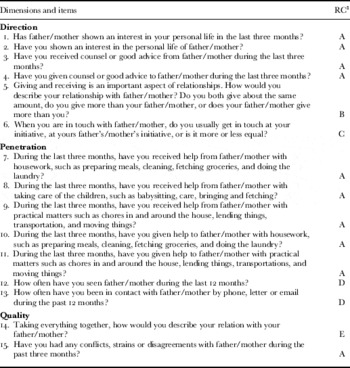
The respondents (i.e. the adult children) were divided into four age groups (18–29, 30–39, 40–49 and 50–79 years), each spanning about 10 years; the last age group was wider to generate more evenly-populated groups. The sample was further divided by whether respondents had children and a marital or cohabiting partner. The analyses were conducted separately for respondent-father and respondent-mother dyads. To operationalise the dimensions of attachment relationships using our definitions of direction, quality and penetration, 15 variables were selected from the NKPS dataset (see Table 1). Items 1 and 2 were combined to obtain a single score for the predominant direction of the interest in the personal life by the parent or child towards the other. A score ‘1’ was assigned if interest shown by the child exceeded the interest shown by the parent, ‘2’ was assigned if both showed equal interest in each other, and ‘3’ was assigned if the parent's interest exceeded the child's. Similarly, items 3 and 4 were combined into a single score for the direction of counsel or advice received. The absolute level of interest and advice was therefore not reflected, to avoid overlap with the measures of penetration, for which items 7, 8 and 9 were combined into an aggregate measure of help received from the parent. A combination of items 10 and 11 provided the measure of help given to parent. The help exchange items were combined because, from the attachment perspective, it is less important which types of help are provided than who provides them.
Item measures of the three dimensions of attachment relationships

Notes: 1. RC: response categories, differentiated by A to E, as follows. A: 1 ‘not at all’, 2 ‘once or twice’, 3 ‘several times’. B: 1 ‘respondent (adult child) gives more’, 2 ‘both give about the same’, 3 ‘father/mother gives more’. C: 1 ‘usually at my initiative’, 2 ‘more or less equal’, 3 ‘usually at the initiative of my father/mother’. D: 1 ‘not at all’, 2 ‘once’, 3 ‘a few times’, 4 ‘at least once a month’, 5 ‘at least once a week’, 6 ‘a few times a week’, 7 ‘daily’. E: 1 ‘not great’, 2 ‘reasonable’, 3 ‘good’, 4 ‘very good’.
Results
Factor analyses
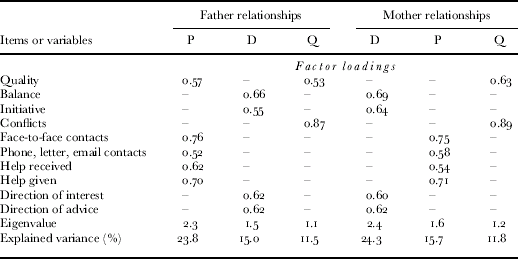
Two factor analyses, beginning with principal components analysis (PCA) followed by varimax rotation, were performed on the 10 measures distilled from the 15 NKPS items. One analysed the respondent-father dyads, the other the respondent-mother dyads. The sample sizes were 3,247 for relationships with fathers, and 4,589 for relationships with mothers. The scree plots pointed to a three factors solution. All three components had eigenvalues above 1.0, and together they accounted for 50.3 per cent of the variance in the dyads with fathers, and 51.8 per cent of the variance in the dyads with mothers. After varimax rotation, the factor contents or structures were examined for items that had loadings exceeding 0.5. The analyses for respondent-fathers and for respondent-mothers grouped the items similarly (cf. Table 2).
The structure of the three factors of child-parent relations
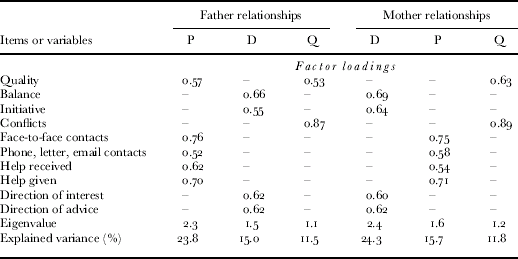
Notes: Factor labels: P=Penetration, D=Direction, Q=Quality. Loadings <0.50 are not shown.
One factor comprised items that describe contact and mutual help in different areas of life and was labelled penetration – these items indicated the quantitative importance and the centrality of the relationship in the attached person's life, and the different areas of life in which the other person was involved. A second factor comprised items on the balance of the relationship, as between giving and receiving interest and advice, and was labelled direction. A third factor contained items that assessed relationship quality and conflict, and was labelled quality. The results of the factor analyses were consistent with the three dimensions that were proposed a priori as distinct dimensions along which parent-child relationships might vary by age group.
Diversity of inter-generational relationships across age groups
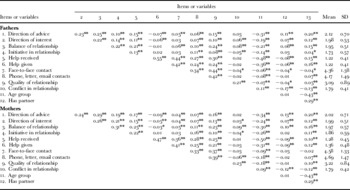
The next step in the analysis was to test the hypotheses regarding the direction, penetration and quality of the adult-child parent relationship using multivariate analyses of covariance, treating the items loading on a factor as dependent variables. Table 3 shows the bivariate associations among the study variables. There were very similar results for the respondent-father and respondent-mother dyads. The items loading on each attachment relationship dimension correlated moderately with each other, whereas the items for the different dimensions had lower correlations. All attachment relationship items correlated strongly with age group, whereas correlations with ‘having children or not’ and ‘having a partner or not’ were inconsistent and particular to items or factors. Further analyses of covariance to identify differences by age group were conducted for the three dimensions of the attachment relationships. In all the following analyses, the age difference between respondents and their fathers or mothers was added as a covariate.Footnote 2
Bivariate associations between attachment dimensions and age group and private forms of living in adult-child with father and adult-child with mother relationships

Notes: Item 13 is ‘respondents have own children’. SD: standard deviation. The tabulated statistics are Pearson correlation coefficients.
Significance levels: * p<0.05, ** p<0.01.
Direction of respondent-father and respondent-mother relationships
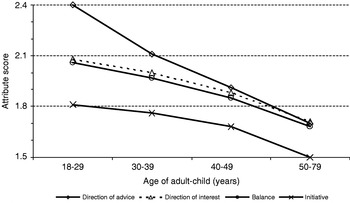
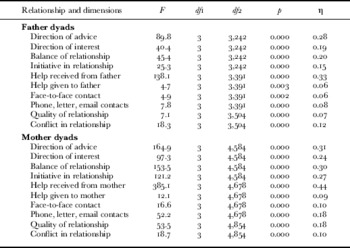
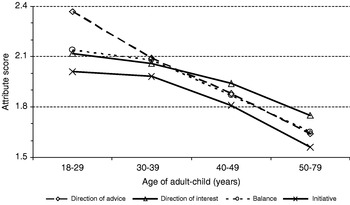
Multivariate analyses of covariance (MANCOVA) were run to determine the effects of age group and the form of the adult-child's private life (the independent variables) on the direction of the relationship between the respondents and their fathers, the dependent variable (viz. the direction of advice, interest, balance and initiatives). Significant differences on the dependent variables were found by age group.Footnote 3 These multivariate effects were examined further by ANCOVAs of the associations between each age group and each dependent variable. Table 4 shows that the age groups differed on all dependent variables. The younger the respondents, the more interest and advice they received from their fathers; and the older the respondents, the more they provided their fathers with interest and advice. Balance and initiative were almost balanced in the youngest age group and depended on age, in the sense that adult children were the primary initiators in the relationship in the older child-parent dyads. Figure 1 displays the differences between the age groups, and shows that the direction was reversed among adult children aged 30–39 years and older compared to younger age groups.
Direction of relationship between respondents and fathers.

Main effects of age group on attachment dimensions in respondent-father and respondent-mother dyads

Notes: Age group refers to the age of adult-children and had four categories: 18–29, 30–39, 40–49 and 50–79 years. df1: hypothesis degrees of freedom. df2: error degrees of freedom. η: general measure for effect size, comparable to Pearson's correlation coefficient (Cohen Reference Cohen1988).
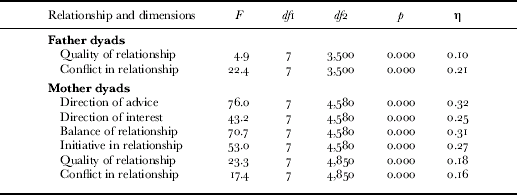
For the direction of the relationship between respondents and their mothers, age group had a significant effect on the four dependent measures. Furthermore the interaction between age group and partner was also significant.Footnote 4 Separate ANCOVAs to investigate the main effect of age group on each of the dependent variables showed that the younger the respondent, the more interest and advice they received from their mother, and the older the respondent, the more they provided their mother with interest and advice (see Table 4). Concerning the balance and initiative of the relationship, the results were similar to those for the respondent-father relationship. In the older age groups, children were the initiating partner in the relationship (see Figure 2). The interaction between age group and partner was probed by separate ANCOVAs for the four age groups that compared the respondents with and without partners (see Table 5). Respondents without a partner relied more on their mothers for advice and interest than those with a partner, and the relationship was imbalanced in the sense that children with a partner invested more in the relationship with their mothers than did single children.
Direction of relationship between respondents and mothers.

Interaction effects between age-group and partner on attachment dimensions in respondent-father and respondent-mother dyads

Notes: Age group refers to the age of adult-children and had four categories: 18–29, 30–39, 40–49 and 50–79 years. df1: hypothesis degrees of freedom. df2: error degrees of freedom. η: general measure for effect size comparable to Pearson's r (Cohen Reference Cohen1988).
Penetration of respondent-father and respondent-mother relationships
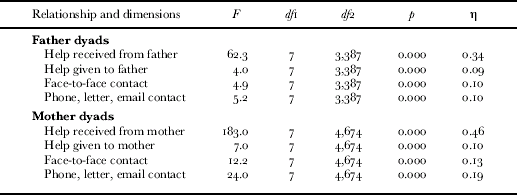
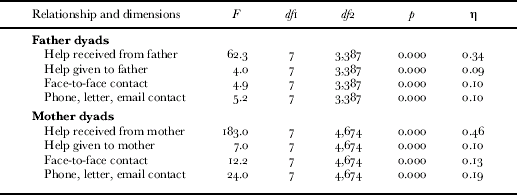
Penetration was measured by the items ‘help received’, ‘help given’, ‘face-to-face contact’ and ‘phone, letter and email contact’. Multivariate tests of penetration in the respondent-father dyad revealed significant effects of age group and of the interaction between age group and children.Footnote 5 Multivariate tests of the effects of age group and of forms of private life on penetration in the respondent-mother dyad revealed significant effects of age group and of the interaction between age group and having children.Footnote 6 Probes of these results with separate ANCOVAs revealed that help-exchange and contact between adult children and both fathers and mothers were generally higher in the younger age groups. Help given by adult children to their parents was also high in the oldest group (see Table 4). A test of the effect of the interaction between age group and having children on the penetration of the relationship showed that respondents with children received more help from their parents than respondents without children (see Table 6). In the oldest age group, however, this difference was not found. In the two younger age groups, respondents with children also had more contact with their parents than respondents without children.
Interaction effect of age-group and children on attachment dimensions in respondent-father and respondent-mother dyads
Notes: Age group refers to the age of adult-children and had four categories: 18–29, 30–39, 40–49 and 50–79 years. df1: hypothesis degrees of freedom. df2: error degrees of freedom. η: general measure for effect size comparable to Pearson's r (Cohen Reference Cohen1988).
Quality of the respondent-father and respondent-mother relationship
A MANCOVA on the quality of respondent-father relationship using the two single items ‘quality’ and ‘conflict’ revealed significant effects for age group and for the interaction between age group and having a partner.Footnote 7 Similar effects were found for the respondent-mother relationship.Footnote 8 Separate ANCOVAs on the quality items revealed an overall trend, of higher relationship quality for younger compared to older parent-child dyads, and a departure from the trend, higher quality in relationships with fathers for the oldest age group of respondents (see Table 4). The rate of conflict, however, was lower in the older than the younger age groups for both respondent-mother and respondent-father dyads. A test of the interaction between age group and partner on the quality items showed, first, that among those aged 30–39 years, those with a partner had a better relationship with their fathers; secondly, that in respondent-mother relationships no differences between single and partnered respondents were found; and thirdly, that respondents with partners also had less conflict with their parents than single respondents except in the oldest age group.
Generally, the strongest effects of age were found on the direction items and on help received, while those on other items of penetration and quality were rather low (see Table 4). The interaction between age and having a partner had a slightly stronger effect on the quality items than did age as a main effect (see Table 5). For the respondent-mother relationship, this interaction and that between age group and having children had considerable effects on direction. Furthermore, the interaction between age and having children had a strong effect on help received for both the respondent-father and respondent-mother relationships, but small effects on the other penetration items (see Table 6).
Discussion
As hypothesised from attachment theory, and as consistent with previous research on intergenerational relationships, the direction of provision and receipt exchanges in relationships between adult-children and parents depended on age. More specifically, young adults perceived their parents more as providers than recipients of interest and advice, which may be an extension of the role in childhood of the parent as an attachment figure. The analysis has suggested that the direction of the relationship reverses after a child reaches 40 years of age. The older the children and their parents, the more it was that the children showed interest in their parents' activities and whereabouts, and provided them with advice; while for older parents, children were a source of support and the initiators in the relationship.
The analyses have also shown that after a low value in middle age, the penetration of the parental relationship was again high in the oldest parent-child dyads. In other words, parent-child relationships in old age were characterised by more intensive help exchange and personal contact than for middle-aged children and their parents. Unexpectedly, the quality of the relationship also associated with age, but to a lesser degree than the other two dimensions. Some of the age differences depended on the living situation of the adult children, particularly whether they had a partner or children of their own.
An attachment theory perspective on intergenerational support
This section discusses the implications of the findings for our understanding of the role of attachment in inter-generational relationships. Attachment theory suggests that the direction of relationships between adult-children and parents is likely to change as children become stronger and wiser and as parents become weaker and more vulnerable. The differences that we have observed are consistent with this hypothesis. Nevertheless, older parents who look to their children for support and comfort might also wish still to provide their children with support. Given that reciprocity and mutual caring are central to inter-generational attachment relationships, the direction of the relationship will seldom be completely reversed (Berger and Fend Reference Berger and Fend2005; Logan and Spitze Reference Logan and Spitze1996). Furthermore, when children become adults, patterns of support and care change. Some children will be more likely to attend to their parents' needs than others, but most adult children attain a degree of ‘filial maturity’, in other words are prepared to take on a caring role (Brody Reference Brody1985). Not only is the balance of strength and wisdom likely to determine the direction of an attachment relationship, but it also influences parental attitudes and the child's adult development.
As noted, the age-group differences in the help received from the parents and the amount of contact indicated that a young adult's relationship with their parents is more important, penetrating and central than when they are older. The amount of help given by children to their parents was high, however, in the youngest and oldest age groups, which might indicate that adult children become important attachment figures for very old parents. Unexpectedly, the quality of the relationship was also associated with age but to a lesser extent than the other two dimensions. In the younger age groups, both relationship quality and conflict were high. This may be related to the high level of penetration in the younger groups. When there is more contact, there is more potential for conflict, and young adult children may be more spirited and disputatious than later in their lives.
The age differences on the dimensions of the attachment relationships depended in certain age groups on the child's living situation. Living with a partner appeared to be especially important for the quality of the parent-child relationship. Single respondents reported significantly more conflict with their parents than cohabiting or married respondents. Single respondents aged in the thirties also reported a lower quality of relationship with their fathers. These effects may indicate the effect of parent-child relationships on the ability to form and maintain romantic relationships. Doyle and colleagues (Reference Doyle, Brendgen, Markiewicz and Kamkar2003) reported that secure attachments with parents compromise adjustment in early romantic relationships, but the effect may also work the other way around. Because romantic partners increasingly function as attachment figures and sources of comfort and security in adulthood (Markiewicz et al. Reference Markiewicz, Lawford, Doyle and Haggart2006), it is conceivable that a qualitatively good and secure romantic relationship stimulates and even ameliorates the adult-child parent relationship.
Having children of one's own was particularly influential on the direction and penetration of the parental relationship. Contact and help exchange was also determined by available opportunities and the personal and familial situations of the adult children. Having children was associated with more intense contact in the younger age group and with giving less help to parents. A study by Ikkink, Tilburg and Knipscheer (Reference Ikkink, Van Tilburg and Knipscheer1999) found that elderly parents offer support to their adult children because they wish the relationship to be balanced and do not want to be a burden. This too might be an explanation for the lower penetration levels when there are grandchildren.
Conclusions
This analysis of a large and representative sample of adult children and their parents, aged from 18 to 99 years, has enabled a genuinely intergenerational approach. Other distinctive features include the application of attachment theory to a sociological analysis, and a sufficiently large sample to investigate adult-child parent relationships over a wide age range. Most of the observed effects not only confirmed our expectations but were also notable in effect-size, particularly when compared to those found by other attachment studies. For example, De Wolff and Van IJzendoorn's (Reference De Wolff and Van IJzendoorn1997) meta-analysis of studies of one of the central hypotheses of attachment theory, namely the positive association between maternal sensitive responsiveness and the security of attachment between infants and mothers, found a moderate effect size (Pearson's r=0.24). Some of the presented findings showed socio-demographic effects on the attachment dimensions in excess of 0.24.
The limitations of the study should be noted. First, the use of secondary data sacrificed the gold-standard approach to measuring attachment (i.e. observations or semi-structured interviews). A limited set of variables was available to measure the three dimensions of attachment. Compared to mainstream attachment research, the several measures were rather superficial, particularly for the quality of relationships. Nonetheless, the factor analyses confirmed the basic dimensions as described by Hinde (Reference Hinde1979). It would be useful if future surveys collected an expanded range of items that tap these dimensions of attachment. Improved data would allow the construction of sound psychometric scales and lead to more parsimonious descriptions.
In conclusion, it has been shown that attachment is a useful concept that links personal experience to social circumstances – this is because attachment relationships are the first social ties through which human beings learn to organise meaning within the broader societal context (Marris Reference Marris, Parkes, Stevenson-Hinde and Marris1991). This process might be the key to the explanation of inter-generational relations during different phases of the lifecourse. This study has investigated certain socio-demographic influences of relationships between adult children and their parents. Although the study was cross-sectional, the results evince the expected shift with increasing age in the balance and direction of these relationships. The findings showed that from a life span perspective, attachment is not a phenomenon driven only by complex psychological processes and dyadic interactions, but also by differences in age and variations in children's private lives.
Acknowledgements
The project ‘Inter-generational Solidarity: An Attachment Perspective’ was funded by Grant 457-03-014 from The Netherlands Organisation for Scientific Research (NWO) to Prof. Dr C. Schuengel and Prof. Dr H.-J. Schulze as part of the programme ‘The Ties that Bind’. The Netherlands Kinship Panel Study is funded by Grant 480-10-009 from the Major Investment Fund of The Netherlands Organization for Scientific Research (NWO), and by The Netherlands Interdisciplinary Demographic Institute (NIDI), Utrecht University, the University of Amsterdam, and Tilburg University.