1. Introduction
In this paper, we exhibit several families of infinite identities involving the Rogers dilogarithm
 $\mathcal{L}(x)$
, following Bridgeman. These identities arise from Bridgeman’s orthospectrum identity (see [Reference Bridgeman1]) as applied to various hyperbolic cylinders. They generalise the connection found by Bridgeman in [Reference Bridgeman2] between the solutions of Pell’s equations, the continued fraction convergents of these solutions and the Rogers dilogarithm. In particular, families of identities involving the dilogarithms of Fibonacci numbers, Lucas numbers, other recurrence sequences and convergents of continued fraction expansions with period two or even period are derived.
1·1. Main results
Recall that the Rogers dilogarithm
 $\mathcal{L}(z)$
, for
 $0 \le z \le 1$
is given by
 \begin{align*}\mathcal{L}(z)=Li_2(z)+\frac{1}{2}\log|z|\log (1-z), \quad {\hbox{where}} \quad Li_2(z)=\sum_{n=1}^\infty \frac{z^n}{n^2}, \qquad |z|\le 1,\end{align*}
is the dilogarithm function. Note that
 $\mathcal{L}(0)=0$
and
 $\mathcal{L}(1)=\pi^2/6$
and although
 $\mathcal{L}(z)$
can be extended by analytic continuation to complex values, we will be mainly concerned with its values for
 $z \in [0,1]$
. The dilogarithm and the Rogers dilogarithm appear in various forms in Algebraic K-theory, mathematical physics, number theory and hyperbolic geometry, see for example [Reference Zagier11]. The Fibonacci numbers are defined by
 $f_0 =0, f_1=1,$
 $f_n=f_{n-1}+f_{n-2}$
,
 $n \in \mathbb{Z}$
and the Lucas numbers are defined by
 $l_0 = 2, l_1=1, l_n= l_{n-1}+l_{n-2}$
,
 $n \in \mathbb{Z}$
and
 $\phi \,:\!=\, (1+\sqrt5)/2$
is the golden ratio.
Remark. In the statement of the results in the rest of the introduction, the equation number (X.Y) attached to the identities indicate the section where it is stated and proved, for example (8·7) indicates that the identity is proven in Section 8 as equation (8·7).
Theorem 1·1. Let
 $\mathcal{L}(x)$
be the Rogers dilogarithm,
 $ f_k$
,
 $l_k$
the Fibonacci and Lucas numbers and
 $\phi$
the golden ratio. Let
 $\epsilon_1=1/2$
and
 $\epsilon_k=1$
otherwise. We have:
 \begin{equation}\sum_{k=2}^{\infty }\mathcal{L} \left (\left (\frac{f_{2n}}{f_{2nk}}\right )^2\right )=\mathcal{L} \left( \left (\frac{1}{\phi}\right )^{4n}\right ), \qquad n \in \mathbb{N}.\end{equation}
When
 $n=1$
,
 \begin{equation}\sum_{k=2}^{\infty}\mathcal{L} \left (\left ( \frac{ 1}{f_{2k}}\right )^2\right )=\mathcal{L} (1/\phi^4 ) ,\qquad\sum_{k=1}^{\infty }\mathcal{L} \left (\frac{1}{f_{2k-3}f_{2k+1}}\right ) =\mathcal{L} (1-1/\phi^4),\end{equation}
 \begin{equation}\sum_{k=1}^{\infty }\left ( \mathcal{L} \left (\frac{1}{f_{2k+2}^2}\right )+ \mathcal{L} \left (\frac{1}{f_{2k-3}f_{2k+1}}\right )\right ) = \frac{\pi^2}{6}.\end{equation}
When
 $n=2$
,
 \begin{equation}\sum_{k=2}^{\infty }\mathcal{L} \left (\frac{3^2}{f_{4k}^2}\right )=\mathcal{L} (1/\phi^8),\qquad\sum_{k=0}^{\infty }\mathcal{L} \left (\frac{45}{l_{4k-2} l_{4k+6}}\right)=\mathcal{L} (1-1/\phi^8),\end{equation}
 \begin{equation} \sum_{k=2}^{\infty } \mathcal{L} \left (\frac{3^2}{f_{4k}^2}\right) + \sum_{k=0}^{\infty } \mathcal{L} \left (\frac{45}{l_{4k-2}l_{4k+6}}\right) = \frac{\pi^2}{6}.\end{equation}
For powers of
 $\phi$
congruent to
 $2 \mod 4$
, we have:
 \begin{equation} \sum_{k=2}^{\infty} \mathcal{L} \left ( \frac{l_{2n+1}^2}{l_{k(4n+2)-(2n+1)}^2}\right ) + \sum_{k=1}^{\infty} \mathcal{L} \left ( \frac{l_{2n+1}^2}{5f_{k(4n+2)}^2}\right )=\mathcal{L} (1/\phi^{4n+2}), \qquad n \in \mathbb{N}\cup\{0\}.\end{equation}
We also get identities for
 $\pi^2/6$
and
 $\pi^2/10=\mathcal{L}(1/\phi)$
where the arguments of the terms in the infinite sums are expressed in terms of the Fibonacci numbers and the Lucas numbers:
 \begin{equation}\sum_{k=1}^{\infty } \left (\mathcal{L} \left (\frac{1}{5f_{2k}^2}\right)+\mathcal{L} \left (\frac{1}{l_{2k+1}^2}\right)+\mathcal{L} \left (\frac{1}{l_{2k-2} l_{2k}}\right)+\epsilon_k \mathcal{L} \left (\frac{1}{5f_{2k-3}f_{2k-1}}\right)\right )= \pi^2/6,\end{equation}
 \begin{equation}\sum_{k=1}^{\infty }\left (\mathcal{L} \left (\frac{1}{l_{2k-2} l_{2k}}\right)+\epsilon_k \mathcal{L} \left (\frac{1}{5f_{2k-3}f_{2k-1}}\right)\right )=\mathcal{L} (1/\phi)= \frac{\pi^2}{10}.\end{equation}
An identity for
 $\pi^2/12=\mathcal{L}(1/2)$
is given below in Corollary 1·4. Identities for
 $\mathcal{L} (1/\phi^{2n+1})$
are more involved and can be found in Section 11. Note that (10·1) for
 $n=0$
was first derived by Bridgeman in [Reference Bridgeman2].
The next result is a generalisation of the Richmond Szekeres identity [Reference Richmond and Szekeres10], see also [Reference Lewin6]. Define the cross ratio of 4 points in
 $\hat{\mathbb{C}}$
, at least three of which are distinct, by
 \begin{align*} [z_1,z_2,z_3,z_4]=\frac{(z_1-z_2)(z_4-z_3)}{(z_1-z_3)(z_4-z_2)}.\end{align*}
Theorem 1·2. Consider the ideal hyperbolic polygon P with vertices
 $v_1,\ldots, v_{n}$
,
 $n \ge 3$
with
 $ v_1=0/1 < v_2 <\ldots< v_{n-1}=1/1$
,
 $v_n=\infty$
. Then
 \begin{align*}\mathop{\sum\sum}_{1 \le j<i\le n-2}\mathcal{L} \left(\left[v_i,v_{i+1},v_{j},v_{j+1}\right]\right)+ \sum_{i=1}^{n-2}\sum_{j=1}^{n-2} \sum_{k=1}^{\infty}\mathcal{L} \left(\left[v_i,v_{i+1},k+v_{j},k+v_{j+1}\right]\right)=\frac{(n-2)\pi^2}{3}.\\[3pt] \end{align*}
Remark. The case
 $n=3$
reduces to the Richmond Szekeres identity
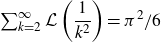 $\sum_{k=2}^{\infty} \mathcal{L} \left (\dfrac{1}{k^2}\right ) = \pi^2/6$
. This case also follows as limits of (5·3) or (7·1) below. More interesting examples with
 $n=4$
can be found in Section 13. Furthermore, note that if adjacent vertices of P are Farey neighbors, then the arguments of
 $\mathcal{L}(x)$
in the identity are all rational numbers with numerator 1.
We also have the following identities involving sequences defined by recurrences in the next two results:
Theorem 1·3. (Theorem 5·1) Suppose that
 $t>2$
and
 $u>1/u$
are the roots of
 $x^2-tx+1=0$
. Then
 $t=u+1/u$
and
 \begin{equation} \sum_{n=1}^{\infty } \mathcal{L} \left( \frac {1}{q_{n}\,^2}\right) =\mathcal{L} \left(1/u^2\right),\qquad \sum_{n=1}^{\infty } \mathcal{L} \left (\frac{t-2}{\left(q_{n}-q_{n-1}\right)\left(q_{n-2}-q_{n-3}\right)} \right)=\mathcal{L} \left( 1-1/u^2\right),\end{equation}
where
 $\{q_n\}$
is the recurrence defined by
 $ q_0=1 , q_1=t, q_n= tq_{n-1}-q_{n-2}.$
Note that
 $\mathcal{L}\left(1/u^2\right) +\mathcal{L}\left(1-1/u^2\right)= \pi^2/6$
so the two identities above can be combined to give an expression for
 $\pi^2/6$
. In the case
 $t = \sqrt n+1/\sqrt n$
, Theorem 1·3 gives the following identity.
Corollary 1·4. Let
 $n>2$
be an integer. Then
 \begin{equation}\mathcal{L}\left (\frac{1}{n}\right )= \sum_{k=1}^{\infty} \mathcal{L} \left (\left (\frac {n^{k/2}}{ n^k +n^{k-1}+\cdots +n^2+n+1}\right ) ^2\right ).\end{equation}
In particular, when
 $n=2$
, we get
 \begin{align*}\frac{\pi^2}{12}=\mathcal{L}\left (\frac{1}{2}\right )= \sum_{k=1}^{\infty} \mathcal{L} \left (\frac {2^k}{ \left(2^{k+1}-1\right)^2} \right ).\end{align*}
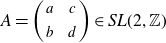
Theorem 1·5. Let
 $A={\left(\begin{array}{c@{\quad}c} a& c\\[3pt] b & d \end{array} \right) }\in SL(2, \Bbb Z)$
with positive entries, trace
 $t=a+d>2$
and eigenvalues
 $u>1/u$
. Set
 $A^{n}= {\left(\begin{array}{c@{\quad}c} p_{2n-1}& p_{2n-2}\\[3pt] q_{2n-1} & q_{2n-2} \end{array} \right)} $
, where
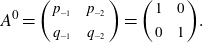 $A^{0}= {\left(\begin{array}{c@{\quad}c} p_{-1}& p_{-2}\\[3pt] q_{-1} & q_{-2} \end{array} \right) = \left(\begin{array}{c@{\quad}c} 1& 0\\[3pt] 0 & 1 \end{array} \right)} .$
Then
 $A^n= tA^{n-1}-A^{n-2}$
and
 \begin{equation}\sum _{n=2}^{\infty}\mathcal{L} \left (\left (\frac {b}{q_{2n-1}}\right)^2 \right )=\mathcal{L} (1/u^2),\end{equation}
 \begin{equation}2\sum _{n=2}^{\infty}\mathcal{L} \left (\left (\frac {b}{q_{2n-1}}\right)^2 \right )+\sum_{n=1}^{\infty }\mathcal{L} \left (\frac{bc}{q_{2n}q_{2n-4}}\right ) +\sum_{n=1}^{\infty }\mathcal{L} \left (\frac{bc}{p_{2n+1}p_{2n-3}}\right )+\mathcal{L} \left (\frac{bc}{ad}\right ) = \pi^2/3.\end{equation}
Theorem 1·5 can be applied to periodic continued fractions of period two to obtain the following corollary.
Corollary 1·6. Let
 $\alpha=[\overline {a,b}]$
be a continued fraction of period 2 and let
 $r_n = p_n/q_n$
be the n-th convergent of
 $\alpha$
. Set
 $A= { \left(\begin{array}{c@{\quad}c} ab+1& a\\[3pt] b &1 \end{array} \right)} = { \left(\begin{array}{c@{\quad}c} p_1& p_0\\[3pt] q_1&q_0 \end{array} \right) },$
with eigenvalues
 $u>1/u$
. Then
 \begin{equation} \mathcal{L} \left(1/(b\alpha+1)^2\right) = \mathcal{L} \left(1/u^2\right) = \sum _{n=2}^{\infty} \mathcal{L} \left (\left (\frac {b}{q_{2n-1}}\right)^2 \right ).\end{equation}
The case
 $b=1$
above was first derived by Bridgeman in [Reference Bridgeman2]. For the more general case of periodic continued fractions of even period greater than two, the identity is more involved and is studied in Section 15. The precise statement for the identities is stated as Theorem 15·3. The crowns in these cases are more interesting as the number of tines will be greater than one.
1·2. Geometric background
The geometry behind our identities is simple, the geometric objects we consider are just hyperbolic cylinders S with finite area, which have infinite cyclic fundamental group
 $\langle g\rangle$
, with holonomy
 $\rho(g)\,:\!=\,T \in PSL (2, \mathbb{R})$
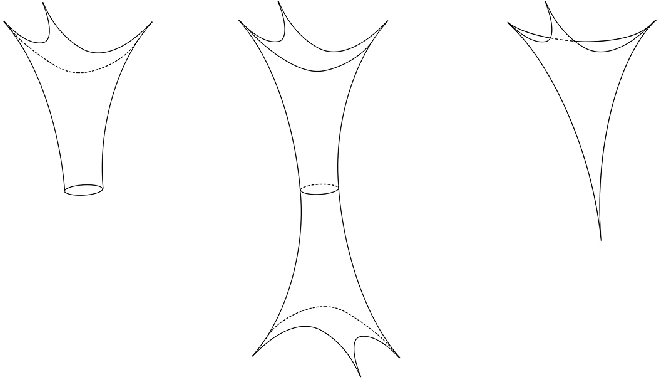
. These cylinders have a finite number of boundary components which are either closed geodesics or complete infinite geodesics adjacent to boundary cusps (as opposed to regular cusps), and are called crowns or double crowns, see Figure 1. The boundary cusps are the tines of the (double) crowns. Typically, T is hyperbolic, the degenerate situation where T is parabolic (in which case there is one regular cusp) gives rise to Theorem 1·2. The geometry will be encoded in what we call feasible pairs (T, P) where P is a hyperbolic polygon with vertices in
 $\mathbb{H} \cup \partial \mathbb{H}$
and
 $T=\rho(g)\in PSL (2, \Bbb R)$
identifies two sides of P and maps P to the exterior of P, so that P is a fundamental domain for the cylinder S. Judicious choices of the pair (T, P) relating the geometry to the algebra and arithmetic of various sequences and application of Bridgeman’s orthospectrum identity gives us the identities stated above.
A crown; double crown; and degenerate crown with parabolic holonomy

1·3. The feasible pairs
We call a pair (T, P) feasible if
 $T\in PSL (2, \Bbb R)$
identifies two sides of a hyperbolic polygon P (the hyperbolic convex hull of a finite number of vertices in
 $\mathbb{H} \cup \partial \mathbb{H}$
) and sends the interior of P to the exterior of P. In the case where P has a finite side, than this side must be part of the invariant axis for T. For convenience, we will often choose a lift of T to
 $SL (2, \Bbb R)$
with non-negative trace which we will also denote by T and work with this lift. All our identities are constructed by studying such feasible pairs (models). Let t be the trace of T. The (degenerate) model (T, P) where
 $t=2$
is studied in Section 13. In the case
 $t>2$
, we study the following three feasible pairs giving rise to double-crowns. A modification (see Section 5) gives related pairs (T, P
′) giving rise to crowns. The polygon P for continued fractions of even period
 $>2$
is more complicated, with more tines, see Section 15.
-
(i)
 $T ={\left(\begin{array}{c@{\quad}c} t& -1\\[3pt] 1 &0 \end{array} \right)}$
and P is the hyperbolic convex hull of
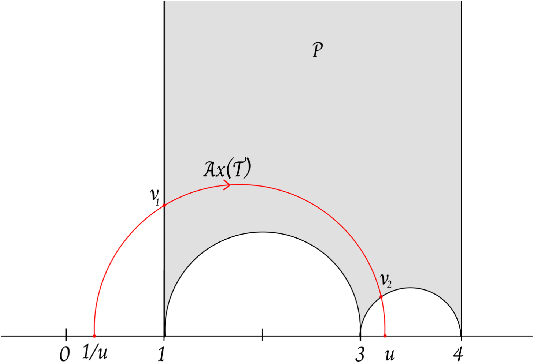
$\{ 1, t-1, t ,\infty\}$
where
$t >2$
, see Figure 2 for the case
$t=4$
.Fig. 2.
A feasible pair showing P and the axis of T, fixed points
$1/u$
and u of T, and intersection points
$v_1,v_2$
. -
(ii)
$T ={\left(\begin{array}{c@{\quad}c} a& c\\[3pt] b &d \end{array} \right)}$
,
$a, b , c, d >0$
and P is the hyperbolic convex hull of
$\{ c/d, a/b, t ,\infty\}$
where
$a+d>2$
. This feasible pair works better then (i) for continued fractions. -
(iii)
$T ={\left(\begin{array}{c@{\quad}c} t& -1\\[3pt] 1 &0 \end{array} \right)}$
and P is the hyperbolic convex hull of
$\{ 2/t, t/2, t, \infty \}$
, where
$t>2$
.









In the following subsection an example of how dilogarithm identities can be derived using the first feasible pair is given. Modifications and elaborations of this in subsequent sections gives the identities stated above.
1·4. The identities
Let (T, P) be a feasible pair given as in (i) of subsection 1·3, S the hyperbolic cylinder obtained from the identification of the two sides of P by T. Let E be the collection of (unordered) pairs of nonadjacent sides of the universal cover
 $\tilde{S}$
of S. Then
 \begin{equation}E= \left\{ ( u, v)\,:\, u, v \in \left\{ T^n(e_1), \, T^m \left(e_{\infty}\right)\,:\, n, m \in \Bbb Z\right\},\, d(u, v)>0\right\}, \end{equation}
where d(u, v) is the hyperbolic distance between u and v, and
 $e_1= [1, t-1]$
,
 $e_{\infty} = [t, \infty]$
, where
 $[x_1,x_2]$
denotes the geodesic with endpoints
 $x_1,x_2$
. Note that (u, v) and (v, u) are considered as the same pair of geodesics. The action of T on E splits E into orbits. The following is a set of representatives.
 \begin{equation}\mathcal E= \left\{\left( T^n\left(e_{\infty} \right), e_{\infty}\right)\,:\, n\ge 2\right\} \cup\left\{ \left(e_1, T^n \left(e_1\right)\right)\,:\, n \ge 2\right\}\cup \left\{\left(T^n\left(e_1\right), e_{\infty}\right)\,:\, n\in \Bbb Z\right\}.\end{equation}
Note that the third set can be decomposed into
 $ \{(T^n(e_1), e_{\infty})\,:\, n\ge 1\}\cup \{(e_1, T^n(e_{\infty}))\,:$
 $n\ge 1\}\cup\{ (e_1, e_{\infty})\}$
. This decomposition may make the calculation easier on some occasions. Applying Bridgeman’s orthospectrum identity (see (3·2)), one has
 \begin{equation}\sum_{(u,v)\in \mathcal E} \mathcal{L} ([ u, v]) = \pi^2/3,\end{equation}
where [u, v] is the cross ratio of u and v (note that here, u, v are infinite geodesics and not points), defined from the cross ratio of their endpoints (see Section 2). The set
 $\{ [u, v]\,:\, (u, v)\in \mathcal E\}$
is called the set of cross ratios of (T, P), which can then be expressed in terms of known recurrence sequences.
1·5. Outline of the paper
Section 2 defines the cross ratio which will be used later and relates it to the distance between two non-intersecting complete geodesics. Section 3 gives Bridgeman’s remarkable orthospectrum identity. Section 4 onwards describes and proves the various infinite dilogarithm identities.
2. Cross ratios and distances between complete geodesics
Following the convention used in [Reference Bridgeman2], we define the cross ratio of 4 points in
 $\hat{\mathbb{C}}$
(with at least three of them distinct) by
 \begin{equation} \left[z_1,z_2,z_3,z_4\right]=\frac{\left(z_1-z_2\right)\left(z_4-z_3\right)}{\left(z_1-z_3\right)\left(z_4-z_2\right)}.\end{equation}
As is well known, the cross ratio is invariant under the action of elements of
 $PSL(2, \mathbb C)$
. If
 $x,y \in {\mathbb R}\cup \{\infty\}=\partial \mathbb H^2$
, we will denote the geodesic from x to y by [x, y]. With this convention, if
 $x_1,x_2,x_3,x_4$
are four points in cyclic order in
 $\partial \mathbb H^2$
and l is the perpendicular distance between the geodesics
 $[x_1,x_2]$
and
 $[x_3,x_4]$
, then
 \begin{equation}\left[x_1,x_2,x_3,x_4\right]=\frac{1}{\cosh ^2(l/2)}.\end{equation}
If u, v are infinite geodesics with distance
 $l>0$
and end points
 $\{x_1,x_2\}$
and
 $\{x_3,x_4\}$
respectively such that
 $x_1,x_2,x_3,x_4$
are in cyclic order, then we define the cross ratio
 $[u,v]=[v,u]\,:\!=\,[x_1,x_2,x_3,x_4]$
. If u and v have exactly one common endpoint (so distance
 $l=0$
), then
 $[u,v]=1$
.
3. Bridgeman’s Identity
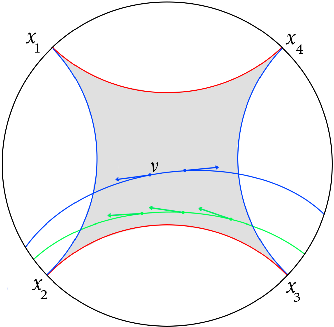
In [Reference Bridgeman1], Bridgeman showed that the measure of the set Q of unit tangent vectors whose base point lies in the ideal quadrilaterial with vertices
 $x_1,x_2,x_3,x_4 \in \partial \mathbb H^2$
(in cyclic order) and which exponentiate in both directions to a complete geodesic with one end point in the interval
 $(x_1,x_2) \subset \partial \mathbb H^2$
and the other endpoint in the interval
 $(x_3,x_4) \subset \partial \mathbb H^2$
is given by
 \begin{equation}\mu(Q)=8 \mathcal{L}([x_1,x_2,x_3,x_4]),\end{equation}
where
 $\mu(Q)$
is the measure of Q and
 $\mathcal{L} (x)$
is the Rogers dilogarithm defined at the beginning of the introduction, see Figure 3.
Unit vectors v with base point in an ideal quadrilateral exponentiating to geodesics hitting opposite sides, using the disk model for
 $\mathbb H^2$
.

More generally, he proved the following remarkable orthospectrum identity by decomposing the unit tangent bundle:
Theorem 3·1. (Bridgeman [Reference Bridgeman1]) For a finite area hyperbolic surface S with totally geodesic boundary
 $\partial S \neq \emptyset$
and N(S) boundary cusps, let O(S) be the set of orthogeodesics in S, that is, the set of geodesic arcs with end points on
 $\partial S$
, and perpendicular to
 $\partial S$
at both ends. Then
 \begin{equation}\sum_{\alpha \in O(S)} \mathcal{L} \left (\frac{1}{\cosh^2(l(\alpha)/2)}\right )=-\frac{\pi^2}{12}(6 \chi(S)+N(S)),\end{equation}
where
 $\chi(S)$
, the Euler characteristic of S, satisfies
 $\chi(S)=-{\mathrm{Area}}(S)/2\pi$
.
Generalisations of this in various settings be found in [Reference Bridgeman and Kahn3], [Reference Bridgeman and Tan4] and [Reference Luo and Tan8].
4. The first feasible pair : (i) of subsection 1·3
4·1. The first feasible pair
We start with a basic case. Let
 $ \,{T =\left(\begin{array}{c@{\quad}c}t& -1\\[2pt]1 & 0\end{array}\right)}\in SL(2, \Bbb R)$
,
 $(t>2$
) be an element of infinite order. The two sides
 $[\infty,1]$
and
 $[t-1,t]$
of the hyperbolic convex hull P of
 $\{\infty, 1, t-1, t\}$
are identified by T. Note that T sends the interior of P to the exterior of P. The identification of the two sides of P by T gives a hyperbolic cylinder S, a double crown with one boundary cusp on each boundary component. The universal cover
 $\tilde S$
of S is the hyperbolic convex hull of
 $\{ T^n(1), T^n(\infty)\,:\, n \in \Bbb Z\}$
. The action of T on the sides of
 $\tilde S$
gives two orbits
 $\{T^n([t, \infty])\,:$
 $n\in \Bbb Z\}$
and
 $\{T^n([1, t-1])\,:\,n\in \Bbb Z\}$
. Applying our discussion in subsection 1·4, the set of cross ratios of pairs of non-adjacent sides of
 $\tilde{S}$
(see (1·2) and (1·3)) consists of the following:
-
(i)
$[(T^n(t), T^n(\infty), t, \infty]=[\infty, t, T^n(\infty), T^n(t)]=[\infty, T(\infty), T^n(\infty), T^{n+1}(\infty)]$
, where
$n \ge 2$
; -
(ii)
$[(1,t-1, T^{n}(1), T^n( t-1)]=[1, T(1), T^n(1), T^{n+1}(1)]$
, where
$n \ge 2$
; -
(iii)
$[(1, t-1 , T^n(t), T^n(\infty) ]=[(1,T(1) , T^{n+1}(\infty), T^n(\infty) ]$
, where
$n \ge 1$
; -
(iv)
$[(T^n(1), T^n(t-1) , t, \infty]=[T^n(1), T^{n+1}(1),T(\infty), \infty]$
, where
$n \ge 1$
; -
(v)
$[1, t-1, t, \infty ]=[1,T(1),T(\infty), \infty]$
.





We shall now give a detailed study of
 $T^n$
so that one can determine the cross ratios above. One can easily prove by induction that
 \begin{equation} T^n=\left( \begin{array}{c@{\quad}c}q_n& -q_{n-1}\\[3pt]q_{n-1} & -q_{n-2}\end{array}\right ) , \quad T^n(\infty) = {q_n\over q_{n-1}}, \quad T^n(1)= {\frac{\left(q_n-q_{n-1}\right)}{\left(q_{n-1}-q_{n-2}\right)}},\end{equation}
where
 $ q_0=1$
,
 $q_{1}=t$
,
 $q_n= tq_{n-1}-q_{n-2}, \quad n \in \mathbb Z.$
To simplify the calculations, we set
 $p_n= q_n-q_{n-1}. $
It follows that
 $\{p_n\}$
is defined by
 $p_0=1, p_1=t-1, p_n=tp_{n-1}-p_{n-2}.$
It is then an easy matter to show that
 \begin{equation}p_kp_{k-2}=p_{k-1}^2+(t-2),\qquad \,p_n-p_{n-1}= (t-2)q_{n-1}.\end{equation}
We are now ready to calculate the cross ratios. The cross ratios of (i)-(v) can be calculated easily by the above mentioned recurrences. In particular, by direct calculation, we have
 \begin{equation}[1, t-1, t,\infty]= [T(1), T(t-1), t , \infty].\end{equation}
Also, by (4·1) and (4·2), (i) and (ii) gives the same cross ratios. Indeed, we can always find a transformation
 $S\in PSL(2,\mathbb C)$
with the same fixed points as T such that
 $S(\infty)=1$
and
 $TS=ST$
so the cross ratios in (i) and (ii) are the same by the invariance of cross ratios. Equivalently,
 $\{ c \in \mbox{(i)}\} = \{ c\in\mbox{(ii)}\}$
. Furthermore,
 \begin{equation} \sum _{c\in \mbox{(ii)}}\mathcal{L}( c)=\sum_{c\in \mbox{(i)}} \mathcal{L}(c)= \sum_{n=2}^{\infty }\mathcal{L} \left ([ T^{n+1}(\infty), T^{n}(\infty), t, \infty]\right) =\sum_{n=2}^{\infty }\mathcal{L} \left (\left ( \frac {1}{q_{n-1}}\right ) ^2\right),\end{equation}
where the first summation represents the sum of all the cross ratios coming from (ii). Applying (4·1), (4·2) and (4·3) one has
 $\{ c \in \mbox{(iv)}\}=\{ c \in \mbox{(iii)} \cup \mbox{(v) }\}$
and
 \begin{equation}\sum_{c\in \mbox{(iv)}}\mathcal{L}(c) =\sum_{n=1}^{\infty }\mathcal{L} \left ([ T^n(1), T^{n}(t-1), t, \infty]\right)=\sum_{n=0}^{\infty }\mathcal{L} \left ( \left (\frac{t-2}{(q_{n+1}-q_n)(q_{n-1}-q_{n-2})}\right)\right ).\end{equation}
Since all the set of cross ratios have been completely determined, we have:
Proposition 4·1. Suppose that
 $t>2$
. Then
 \begin{equation}\sum_{n=2}^{\infty }\mathcal{L} \left (\left ( \frac {1}{q_{n-1}}\right ) ^2\right) +\sum_{n=0}^{\infty }\mathcal{L} \left ( \left (\frac{t-2}{(q_{n+1}-q_n)(q_{n-1}-q_{n-2})}\right)\right )= \pi^2/6,\end{equation}
where
 $\{q_n\}$
is the recurrence defined by
 $ q_0=1 , q_1=t,q_n= tq_{n-1}-q_{n-2}.$
Proof. The pair (T, P) has two boundary cusps and area
 $2\pi$
. By (4·4), (4·5) and (1·3), one has
 \begin{align*}2 \sum_{n=2}^{\infty }\mathcal{L} \left (\left ( \frac {1}{q_{n-1}}\right ) ^2\right) +2\sum_{n=0}^{\infty }\mathcal{L} \left ( \left (\frac{t-2}{(q_{n+1}-q_n)(q_{n-1}-q_{n-2})}\right)\right )= \pi^2/3.\end{align*}
4·2. Fibonacci numbers
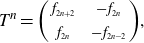
Let
 $ T= {\left(\begin{array}{c@{\quad}c}3& -1\\[3pt]1 & 0\end{array}\right)}$
. Then
 $T^n ={\left(\begin{array}{c@{\quad}c}f_{2n+2}& - f_{2n}\\[3pt]f_{2n} & -f_{2n-2}\end{array}\right)},$
where
 $f_n$
is the n-th Fibonacci number. Consequently,
 $T^n(\infty) = f_{2n+2}/f_{2n}$
and
 $T^n(1) = f_{2n+1}/f_{2n-1}$
. By (4·6), one has
 \begin{equation}\sum_{k=1}^{\infty }\left ( \mathcal{L} \left (\frac{1}{f_{2k+2}^2}\right )+ \mathcal{L} \left (\frac{1}{f_{2k-3}f_{2k+1}}\right )\right ) = \frac{\pi^2}{6},\end{equation}
4·3. Lucas numbers
The Lucas numbers are defined by
 $l_0 = 2, l_1=1, l_n= l_{n-1}+l_{n-2}$
. Let
 $ {T = \left(\begin{array}{c@{\quad}c} 7& -1\\[3pt] 1 & 0 \end{array} \right)}$
and P the hyperbolic convex hull of
 $\{\infty, 1, 6, 7\}$
. Note that
 $t=7$
,
 $f_4=3$
and
 $f_4^2(t-2)=45$
. By (4·6), and expressing the terms
 $q_n$
in terms of the Fibonacci and Lucas numbers, we have:
 \begin{equation}\sum_{k=2}^{\infty }\mathcal{L} \left (\frac{3^2}{f_{4k}^2}\right)+\sum_{k=0}^{\infty }\mathcal{L} \left (\frac{45}{l_{4k-2}l_{4k+6}}\right)= \frac{\pi^2}{6}.\end{equation}
5. Decomposition of Proposition 4·1
The main purpose of this section is to break (4·6) of Proposition 4·1 into two dilogarithm identities, and to show that one of the resulting identities is equivalent to that obtained by Bridgeman in [Reference Bridgeman2]. Geometrically what we do is to decompose the double crown into two crowns using the unique closed geodesic (“waist”) embedded in the double crown.
Let (T, P) be the feasible pair given as in subsection 4·1, where
 $T={\left(\begin{array}{c@{\quad}c}t& -1\\[3pt]1 & 0\end{array}\right)}$
and P is the hyperbolic convex hull of
 $\{\infty, 1, t-1, t\}$
. We shall decompose P as follows. Let
 $ u > 1/u $
be the fixed points of T. Then
 $[1/u , u]$
intersects
 $[1, \infty] $
and
 $[t-1, t]$
at two points
 $v_1$
and
 $v_2$
, where
 $[1/u, u]\cap [1,\infty]=\{v_1\}$
. See Figure 2. Let
 $P_1$
be the hyperbolic convex hull of
 $\{\infty, v_1, v_2, t\}$
. Then T pairs
 $[v_1,\infty]$
and
 $[v_2, t]$
and
 $(T, P_1)$
is also a feasible pair. The side pairing of
 $P_1$
gives a crown
 $S_1$
with one tine. We may also consider the other polygon
 $P_2$
which is the convex hull of
 $\{1, t-1, v_2, v_1\}$
and the corresponding pairs
 $(T, P_2)$
and surface
 $S_2$
. As the surfaces
 $S_1$
and
 $S_2$
are isometric, the identities arising from both are essentially the same.
Let
 $\tilde {S_1}$
be the universal cover of
 $S_1$
. It follows that the sides of
 $\tilde {S_1}$
has two orbits:
 $\{[1/u , u]\}$
and
 $\{ T^n( [t, \infty])\,:\, n\in \mathbb Z\}$
. Note that
 $T(\infty) = t=u+1/u>2$
. By (3·2), one has
 \begin{equation} \mathcal{L} ([1/u , u, t, \infty]) +\sum_{n=2}^{\infty }\mathcal{L} \left (\left[ T^{n+1}(\infty), T^{n}(\infty), t, \infty\right]\right)=\pi^2/6.\end{equation}
Applying (4·4) and the fact that
 $\mathcal{L} (x) +\mathcal{L}(1-x) =\pi^2/6$
, we have
 \begin{equation}\sum_{n=2}^{\infty }\mathcal{L} \left (\left ( \frac {1}{q_{n-1}}\right ) ^2\right) =\mathcal{L} (1/u^2),\end{equation}
where
 $q_n$
is the recurrence defined by
 $q_0=1 , q_1=t, q_n= tq_{n-1}-q_{n-2}.$
Theorem 5·1. Suppose that
 $t>2$
(not necessarily an integer). Let
 $u > 1/u$
be the roots of
 $x^2-tx+1=0$
. Then
 $t= u+ 1/u$
and
 \begin{equation}\sum_{n=1}^{\infty }\mathcal{L} \left ( \frac {1}{q_{n}\,^2}\right )=\mathcal{L} \left(1/u^2\right), \qquad\sum_{n=1}^{\infty }\mathcal{L} \left (\frac{t-2}{\left(q_{n}-q_{n-1}\right)\left(q_{n-2}-q_{n-3}\right)}\right)=\mathcal{L} \left( 1-1/u^2\right),\end{equation}
where
 $q_n$
is the recurrence defined by
 $q_0=1 , q_1=t, q_n= tq_{n-1}-q_{n-2}.$
5·1. An equivalent form of Bridgeman’s identity
Bridgeman studied the universal cover of a hyperbolic surface S which is topologically an annulus with one boundary component being a closed geodesic of length
 $L >0$
and the other an infinite geodesic with a single boundary cusp (a crown with one tine) and proved that
 \begin{equation}\mathcal{L} ( e^{-L})= \sum_{k=2}^{\infty}\mathcal{L} \left (\frac{\sinh ^2(L/2)}{\sinh ^2 (kL/2)}\right ). \end{equation}
In our notation, he used
 $ T= { \left(\begin{array}{c@{\quad}c} \sqrt \lambda& 0\\[3pt] 0&1/\sqrt \lambda \end{array} \right)}$
, P the hyperbolic convex hull of
 $\{i,1,\lambda, \lambda i\}$
where
 $\lambda=e^L$
, and T identifies [i, 1] with
 $[\lambda i, \lambda]$
to get S. The universal cover
 $\tilde S$
under his study is the hyperbolic convex hull of
 $\{0, \infty\} \cup \{ T^{k-1}(\lambda)=\lambda^k\,:\, k \in \mathbb{Z} \}$
, since
 $T (x) = \lambda x.$
We show in this section that (5·4) and (5·2) are equivalent, which is not surprising as the crowns obtained from the two constructions are isomorphic for appropriate choices of L and t.
Adapting to Bridgeman’s pair (T, P) (his
 $\sqrt \lambda$
is our u), we set
 $ t \,:\!=\, \sqrt \lambda + 1/\sqrt \lambda >2$
,
 $ A\,:\!=\, {\left(\begin{array}{c@{\quad}c}t& -1\\[3pt]1 & 0\end{array}\right)}.$
By (4·1), one has
 \begin{equation} A^{n}= {\left( \begin{array}{c@{\quad}c}q_n& -q_{n-1} \\[3pt]q_{n-1} & -q_{n-2}\end{array}\right )},\end{equation}
where
 $q_{-1}=0, q_{0}=1, q_n= tq_{n-1}- q_{n-2}, \, n \in \mathbb{Z}.$
Note that A is similar to T. We have:
Proof. To simplify the calculations, we define a recurrence
 $v_n$
by
 \begin{align*}v_{-1} = 2, v_0=t, v_n= tv_{n-1}-v_{n-2}, \quad n>1.\end{align*}
Let T, P and
 $\tilde S$
be given as above and let
 $ V= {\left(\begin{array}{c@{\quad}c}\sqrt \lambda & 1/\sqrt \lambda\\[3pt]1 & 1\end{array}\right)}.$
Then
 \begin{align*}V^{-1} AV={\left( \begin{array}{c@{\quad}c}\sqrt \lambda & 0\\[3pt]0 & 1/\sqrt \lambda\end{array}\right )}=T\end{align*}
and
 $V\tilde S$
is the universal cover of VS that is invariant under the action of A. The sides of
 $V\tilde S$
under the action of A has two orbits
 $\{ [1/\sqrt \lambda, \sqrt \lambda]\}$
and
 $\{A^k V[1, \lambda]\,:\, k\in \mathbb{Z} \}$
. Applying (1·3) and (3·4) to
 $V\tilde S$
, (5·4) is equivalent to
 \begin{equation}\mathcal{L} (1/\lambda )= \sum_{k=2}^{\infty}\mathcal{L} \left ([A^0V(1), AV(1), A^kV(1), A^{k+1}V(1)]\right ),\,\, {where}\,\, V(1) = t/2. \end{equation}
It is an easy matter to show that
 $A^kV(1)= v_{k}/v_{k-1}$
. As a consequence, the above identity can be simplified as follows.
 \begin{equation} \mathcal{L} (1/\lambda )= \sum_{n=2}^{\infty}\mathcal{L} \left (\left ( \frac{ t^2-4}{v_n-v_{n-2}}\right )^2\right ).\end{equation}
One can show by induction that
 $1/q_{n-1} = (t^2-4)/(v_n-v_{n-1})$
. This completes the proof of the proposition.
Remark. The difference between (5·4) and (5·2) is that (5·4) arises from the study of the Jordan canonical form which express the functions in terms of the eigenvalues of T (see [Reference Bridgeman2, proof of theorem 2.1]) while (5·2) arises from the study of T in cyclic basis. The surfaces are of course isometric so that the identities have to be identical, the difference is that one is expressed in terms of the hyperbolic sine of the length L of the waist, the other is expressed in terms of recurrences defined from the trace t, where
 $t=2\cosh( L/2)$
.
5·2. Examples
We give some examples of how Theorem 5·1 works.
Example 5·3. Let
 $\phi = (1+\sqrt 5)/2 $
and let
 $f_1=1,f_2=1, f_3=2, f_4 = 3$
be the Fibonacci numbers. Then
 \begin{equation}\sum_{k=2}^{\infty}\mathcal{L} \left (\left ( \frac{ 1}{f_{2k}}\right )^2\right )=\mathcal{L} (1/\phi^4 ), \qquad\sum_{k=1}^{\infty }\mathcal{L} \left (\frac{1}{f_{2k-3}f_{2k+1}}\right ) =\mathcal{L} (1-1/\phi^4).\end{equation}
The above is a special case of our results in Section 8 (see (8·7)) and comes from our study of
 $u = \phi^2,$
 $t=3$
in Theorem 5·1. In the case
 $u = \phi^4$
, one has
 $t=7$
. Theorem 5·1 gives
 \begin{equation}\sum_{k=2}^{\infty }\mathcal{L} \left (\frac{3^2}{f_{4k}^2}\right )=\mathcal{L} (1/\phi^8) ,\qquad\sum_{k=0}^{\infty }\mathcal{L} \left (\frac{45}{l_{4k-2} l_{4k+6}}\right)=\mathcal{L} (1-1/\phi^8),\end{equation}
where
 $l_n$
is the nth Lucas number (
 $l_0=2, l_1=1, l_n= l_{n-1}+l_{n-2}$
).
Formulas for
 $\mathcal{L} (1/\phi^k)$
for general k can be found in (8·7) and Sections 10-11. The following gives
 $\mathcal{L} (1/\phi^2)$
.
Example 5·4. Let
 $t =\phi+1/\phi = \sqrt 5$
. By (5·2), one has
 \begin{equation}\sum_{n=1}^{\infty}\mathcal{L} \left (\left ( \frac{ 1}{5f_{2n}}\right )^2\right )+\sum_{n=2}^{\infty}\mathcal{L} \left (\left ( \frac{ 1}{l_{2n-1}}\right )^2\right )=\mathcal{L} (1/\phi^2 ).\end{equation}
Identity (5·10) was first proved by Bridgeman [Reference Bridgeman2]. However, the current feasible pair does not work well for
 $\mathcal{L} (1-1/\phi^2)$
as
 $(t-2)/(q_n-q_{n-1})(q_{n-2}-q_{n-3})$
is not rational. See Section 12 for an identity for
 $\mathcal{L}(1-1/\phi^2)$
expressed in terms of dilogarithms of rationals.
6. Identities for two term recurrences
Let
 $p_n$
be the recurrence defined by
 $p_{-2}=0$
,
 $p_{-1}=1$
,
 $p_n= ap_{n-1}+bp_{n-2}$
where a and b are positive integers. It follows that
 \begin{equation}\left( \begin{array}{c}p_{n+2} \\[3pt]p_{n+1} \end{array}\right )=\left( \begin{array}{c@{\quad}c}a^2+b & ab\\[3pt]a & b\end{array}\right )\left( \begin{array}{c}p_n \\[3pt]p_{n-1} \end{array}\right ).\end{equation}
Let
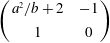
 $T={ \left(\begin{array}{c@{\quad}c}(a^2+b )/b& a\\[3pt]a/b & 1\end{array}\right) \in PSL(2,\mathbb R) }$
. Then T is similar to
 ${R\,=\!:\, \left(\begin{array}{c@{\quad}c}a^2/b +2& -1\\[3pt]1 & 0\end{array}\right) }$
. Let P be the hyperbolic convex hull of
 $\{\infty, 1, {a^2/b}+1, {a^2/b}+2\}$
. Then
 $(R,P)$
is a feasible pair and we call the dilogarithm identity associated with (R, P) the dilogarithm identity of the recurrence
 $p_n$
.
Proposition 6·1. Let a and b be positive integers and let
 $\{p_n\}$
be given as in (6·1). Then the dilogarithm identity associated with
 $\{p_n\}$
is
 \begin{equation}\mathcal{L} (1/u^2 )= \sum_{n=1}^{\infty}\mathcal{L} \left ( \frac{1}{q_n^2}\right ),\end{equation}
where
 $ u +1/u=t = a^2/b +2 $
is the trace of T,
 $u >1$
, and
 $q_n$
is the recurrence defined by
 $q_0=1, q_1=t, q_n=tq_{n-1}-q_{n-1}$
. Furthermore,
 \begin{equation}\frac{1}{q_n}=\frac{b^n}{p_{2n-1} +b p_{2n-3} + \cdots + b^k p_{2n-2k-1} + \cdots+ b^n p_{-1}}. \end{equation}
Proof. T is similar to
 ${ \left(\begin{array}{c@{\quad}c}a^2/b +2& -1\\[3pt]1 & 0\end{array}\right) }$
. The proposition can be proved by applying (5·2). The expression in terms of
 $p_n$
is a straightforward computation.
Example 6·2. Let
 $a=2$
and
 $b=3$
. Then the
 $p_n$
’s (starting at
 $p_{-2}$
) are given as follows.
 \begin{align*}\begin{array}{ccccccccc}p_n\,:\,& 0\quad &\quad 1&\quad 2&\quad 7&\quad 20&\quad 61&\quad 182 &\quad \cdots\end{array}\end{align*}
It follows that
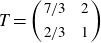 $T={ \left(\begin{array}{c@{\quad}c}7/3& 2\\[3pt]2/3 & 1\end{array}\right) }$
and T is similar to
 ${ \left(\begin{array}{c@{\quad}c}10/3& -1\\[3pt]1 & 0\end{array}\right) }$
. By Proposition 6·1, one has
 \begin{equation}\mathcal{L}\left (\frac{1}{9}\right )= \sum_{k=1}^{\infty} \mathcal{L} \left (\left (\frac {3^{k}}{ 9^k +9^{k-1}+\cdots +9^2+9+1}\right ) ^2\right ).\end{equation}
Remark. This identity can be interpreted as arising from the convergents of a non-standard continued fraction expansion arising from a non-arithmetic lattice
 $\Gamma(1,1/3,3)$
, see [Reference Lou, Tan and Vo7, section 7] for the definition of
 $\Gamma(1,1/3,3)$
and more details. A more general version is given below.
7. Identities for
$\mathcal{L} (1/n)$
and Chebyshev polynomials

7·1. Identities for
$\mathcal{L} (1/n)$

Let
 $u =\sqrt n$
,
 $t = \sqrt n +1/\sqrt n$
, where
 $n >2$
. (Of particular interest is when n is an integer). Identity (5·2) gives
 \begin{equation}\mathcal{L}\left (\frac{1}{n}\right )= \sum_{k=1}^{\infty} \mathcal{L} \left (\left (\frac {n^{k/2}}{ n^k +n^{k-1}+\cdots +n^2+n+1}\right ) ^2\right ).\end{equation}
7·2. Chebyshev polynomials
Let
 $q_n$
be the recurrence defined in Theorem 5·1 and let
 $t=2x$
. It follows that
 \begin{equation}q_n = U_n(x),\end{equation}
where
 $U_n(x)$
is the nth Chebyshev polynomial of the second kind. Applying (5·3) gives, for
 $x>1$
:
 \begin{equation}\begin{aligned}\sum_{n=1}^{\infty }\mathcal{L} \left ( \frac {1}{U_n(x)\,^2}\right )&=\mathcal{L} \left(\frac{1}{(x+\sqrt{x^2+1})^2}\right), \qquad \quad\\[3pt]\sum_{n=1}^{\infty }\mathcal{L} \left (\frac{2x-2}{(U_{n}(x)-U_{n-1}(x))(U_{n-2}(x)-U_{n-3}(x))}\right)&=\mathcal{L} \left( 1-\frac{1}{(x+\sqrt{x^2+1})^2}\right). \qquad\end{aligned}\end{equation}
The first identity of (7·3) was derived by Bridgeman in [Reference Bridgeman2].
8. The second feasible pair : (ii) of subsection 1·3
The feasible pair (T, P) given as in Proposition 4·1 does not work well for continued fractions as one cannot tell if the
 $q_n$
’s in Theorem 5·1 are related to the nth convergents of u. We will develop another feasible pair that works well for Fibonacci numbers (subsection 8·2) as well as continued fractions (Section 9).
8·1. The second feasible pair
Let
 $A={\left(\begin{array}{c@{\quad}c}a& c\\[3pt]b & d\end{array}\right) }\in SL(2, \Bbb Z)$
be a matrix with positive entries and trace
 $a+d >2$
. A identifies the sides
 $[0, \infty]$
and
 $[c/d, a/b]$
of the hyperbolic convex hull P of
 $\{0, c/d, a/b, \infty\}$
and sends the interior of P to the exterior of P so (T, P) is a feasible pair. Let
 $t= a+d$
be the trace of A. Then
 $A^n= tA^{n-1}-A^{n-2}$
for all n. Hence, if we set
 $A^{n}={\left(\begin{array}{c@{\quad}c}p_{2n-1}& p_{2n-2}\\[3pt]q_{2n-1} & q_{2n-2}\end{array}\right)} $
, where
 $A^{0}={\left(\begin{array}{c@{\quad}c}p_{-1}& p_{-2}\\[3pt]q_{-1} & q_{-2}\end{array}\right) =\left(\begin{array}{c@{\quad}c}1& 0\\[3pt]0 & 1\end{array}\right)} ,$
then
 \begin{equation}A^n = \left( \begin{array}{c@{\quad}c}p_{2n-1}& p_{2n-2}\\[3pt]q_{2n-1} & q_{2n-2}\end{array}\right)= t\left(\begin{array}{c@{\quad}c}p_{2n-3}& p_{2n-4}\\[3pt]q_{2n-3} & q_{2n-4}\end{array}\right)-\left(\begin{array}{c@{\quad}c}p_{2n-5}& p_{2n-6}\\[3pt]q_{2n-5} & q_{2n-6}\end{array}\right).\end{equation}
This gives recurrence formulas for the
 $p_n$
’s and
 $q_n$
’s. One can show by induction that the
 $q_k$
’s and
 $p_k$
’s satisfy the following identities for all n.
 \begin{equation}\det\, {\left( \begin{array}{c@{\quad}c}p_{2n+1}& p_{2n+1+k}\\[3pt]q_{2n+1} & q_{2n+1+k}\end{array}\right ) } = q_{k-1},\,\,\det\, {\left( \begin{array}{c@{\quad}c}p_{2n}& p_{2n+k}\\[3pt]q_{2n} & q_{2n+k}\end{array}\right ) } = -p_{k-2}.\end{equation}
Note that
 $p_0/q_0=c/d$
,
 $p_1/q_1= a/b$
. Note also that
 \begin{equation}A^{-n} ={\left( \begin{array}{c@{\quad}c}p_{-2n-1} & p_{-2n-2}\\[3pt]q_{-2n-1} & q_{-2n-2}\end{array}\right ) } = (A^n)^{-1} ={\left( \begin{array}{c@{\quad}c}q_{2n-2} &- p_{2n-2}\\[3pt]-q_{2n-1} & p_{2n-1}\end{array}\right ) }.\end{equation}
The sides of the universal cover
 $\tilde S$
of the cylinder S form two orbits
 $\{ A^n([a/b, \infty])\,:\, n \in \Bbb Z\}$
and
 $\{ A^n([0, c/d])\,:\, n \in \Bbb Z\}$
. The following identity holds:
 \begin{align}\sum _{n=2}^{\infty}\mathcal{L} \left (\left (\frac {b}{q_{2n-1}}\right)^2 \right ) & +\sum _{n=2}^{\infty}\mathcal{L}\! \left (\left (\frac {c}{p_{2n-2}}\right)^2 \right )+\sum_{n=1}^{\infty }\mathcal{L}\! \left (\frac{bc}{q_{2n}q_{2n-4}}\right ) +\sum_{n=1}^{\infty }\mathcal{L}\! \left (\frac{bc}{p_{2n+1}p_{2n-3}}\right )\nonumber\\[5pt]& + \mathcal{L} ([0, c/d, a/b ,\infty]) = \pi^2/3.\end{align}
Proof. Similar to Proposition 4·1, the cross ratios associated with (T, P) consists of the following sets of cross ratios (see (1·3)):
-
(i) the cross ratios
$[(A^n(a/b), A^n(\infty), a/b, \infty]$
and
$[(0,c/d, A^{n}(0), A^n( c/d)]$
, where
$n \ge 2$
; -
(ii) the cross ratios
$[(0, c/d , A^n(a/b), A^n(\infty) ]$
and
$[(A^n(0), A^n(c/d) , a/b, \infty]$
, where
$n \ge 1$
; -
(iii) the cross ratio
$[0, c/d, a/b, \infty ]= bc/ad$
.




Apply the above and identity (1·3), where the terms in the infinite sums correspond to (i) and (ii) above and are expressed in terms of the
 $p_n$
’s and
 $q_n$
’s.
Recall the way we decompose identity (4·6) into two identities given as in Theorem 5·1. A similar decomposition can be done to (8·4). Let A be given as above and let
 $w >\overline w$
be the fixed points of A. Let
 $v_1$
and
 $v_2$
be the intersection
 $[0, \infty]\cap [\overline w, w]$
and
 $ [c/d, a/b]\cap[\overline w, w]$
respectively. A identifies
 $[v_1, \infty]$
and
 $[v_2, a/b]$
and
 $(A, P_1)$
is a feasible pair where
 $P_1$
is the hyperbolic convex hull of
 $\{\infty, v_1, v_2, a/b\}$
. The surface
 $S_1$
obtained from
 $P_1$
is a crown with one tine. Lift to the universal cover of
 $S_1$
. The sides of
 $\tilde S_1$
split into two orbits
 $\{(\overline w, w)\}$
and
 $\{ A^n((a/b ,\infty))\,:\, n\in \Bbb Z\}$
. Similar to the way we get (5·2), we apply (1·3) and (3·2) to get the following identity.
Proposition 8·1. Let
 $b>0$
be an integer and let A and
 $q_n$
be given as in (8·1). Then
 \begin{equation}\mathcal{L} \left(1/u^2\right) = \sum _{n=2}^{\infty}\mathcal{L} \left (\left (\frac {b}{q_{2n-1}}\right)^2 \right )\end{equation}
where
 $u> 1/u$
are the eigenvalues of A.
We find (8·5) works better for
 $\mathcal{L} (1/\phi^{4k})$
(see Remark 8·3) and continued fractions (see Section 9).
Remark 8·2. Note that the cross ratios below satisfy the following interesting properties.
-
(i)
$ [A(0), A^{2}(0), a/b, \infty]=[0, c/d, a/b, \infty] = bc/ad$
if
$d=1$
, -
(ii)
$[0, c/d, a/b, \infty]=[0, c/d, A^2(\infty) , A(\infty)] =bc/ad$
, if
$a=1$
.


Also, since we assume
 $a+d>2$
, one cannot have
 $a=d=1$
. Note also that
 $ A^n = {\left(\begin{array}{c@{\quad}c} ar_n-r_{n-1} & cr_n\\[3pt] br_n & dr_n-r_{n-1}\end{array}\right)}$
, where
 $r_0 =1, r_1=t = a+d, r_n =tr_{n-1}-r_{n-2}$
. Hence
 $bp_{2n-2} = cq_{2n-1}$
. It follows that (8·4) can be expressed in the following form.
 \begin{equation}2\sum _{n=2}^{\infty}\mathcal{L} \left (\left (\frac {b}{q_{2n-1}}\right)^2 \right )+\sum_{n=1}^{\infty }\mathcal{L} \left (\frac{bc}{q_{2n}q_{2n-4}}\right ) +\sum_{n=1}^{\infty }\mathcal{L} \left (\frac{bc}{p_{2n+1}p_{2n-3}}\right )+\mathcal{L} \left (\frac{bc}{ad}\right ) = \pi^2/3.\end{equation}
8·2. Dilogarithm identity for
$\mathcal{L} (1/\phi^{4k})$

Identity (5·8) studies the matrix
 $ {\left(\begin{array}{c@{\quad}c}3& -1\\[3pt]1 & 0\end{array}\right)}$
which is a conjugate of
 ${\left(\begin{array}{c@{\quad}c}f_3& f_2\\[3pt]f_2 & f_1\end{array}\right)}$
whose trace is 3 and gives an identity for
 $(1/\phi^4)$
. It is therefore natural to extend our study to
 $ {\left(\begin{array}{c@{\quad}c}a& c\\[3pt]b & d\end{array}\right)=\left(\begin{array}{c@{\quad}c}f_{2k+1}& f_{2k}\\[3pt]f_{2k} & f_{2k-1}\end{array}\right)}$
. By Proposition 8·1, one has,
 \begin{equation} \mathcal{L} \left( \left (\frac{1}{\phi}\right )^{4k}\right )=\sum_{n=2}^{\infty }\mathcal{L} \left (\left (\frac{f_{2k}}{f_{2nk}}\right )^2\right ).\end{equation}
Note that
 $b = f_{2k} $
and that the arguments of
 $\mathcal{L} $
in (8·7) are all rational numbers with reduced forms
 $1/x$
for some
 $x \in \Bbb N$
. However, Identity (8·5) does not work for
 $\mathcal{L} (1/\phi^ {2(2k+1)})$
and
 $\mathcal{L} (1/\phi^ {2k+1})$
. See Sections 10 and 11 for identities for
 $\mathcal{L} \left(1/\phi^ {2(2k+1)}\right)$
and
 $\mathcal{L} \left(1/\phi^ {2k+1}\right)$
.
Remark 8·3. One can also obtain Identity (8·7) by applying Theorem 5·1. However, one only gets
 $\{q_i\} = \{ 1, t, t^2-1 ,\cdots \}$
(see Theorem 5·1 for the recurrence for
 $q_i$
) rather than
 $ \{f_{2k}/f_{2nk}\}=\{ f_{2k}/f_{4k}, f_{2k}/f_{6k}, f_{2k}/f_{8k},\cdots\}$
which we feel gives more insight and a direct connection with the Fibonacci numbers.
9. Dilogarithm identities for Continued fractions of period two
9·1. Periodic continued fractions
Let
 $a_i$
 $(i\ge 0$
) be positive integers and let
 \begin{equation}\alpha = [{ a_0, a_1, a_2, \ldots, a_{l-1}}, \ldots ] = a_0+ \frac{1} {a_1 +\frac{1}{a_2 + \cdots}}\end{equation}
be a continued fraction. Let
 $r_n= p_n/ q_n =[{ a_0, a_1, a_2, \cdots, a_{r}} ] $
(
 $n\ge 0$
) be the nth convergent of
 $\alpha$
. Set
 $(p_{-2}, p_{-1})=(0,1) $
and
 $(q_{-2}, q_{-1})= (1,0)$
. Then
 $p_n$
and
 $q_n$
can be calculated recursively by
 $p_n= a_n p_{n-1}+ p_{n-2}$
and
 $q_n= a_n q_{n-1}+ q_{n-2}$
. If the
 $a_i$
’s satisfies
 $a_{n+l} = a_n$
for all
 $n \ge0$
, we say that
 $\alpha$
is periodic of period l and write
 $\alpha = [ \overline{ a_0, a_1, a_2, \ldots, a_{l-1}} ]$
.
9·2. Continued fractions of period 2
Let
 $\alpha=[\overline {a,b}]$
be a continued fraction of period 2 and let
 $r_n = p_n/q_n$
be the nth convergent of
 $\alpha$
. Set
 $A= {\left(\begin{array}{c@{\quad}c}ab+1& a\\[3pt]b &1\end{array}\right)}={\left(\begin{array}{c@{\quad}c}p_1& p_0\\[3pt]q_1&q_0\end{array}\right)}.$
One can prove by induction that
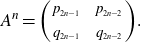 $A^{n}= { {\left(\begin{array}{c@{\quad}c}p_{2n-1}& p_{2n-2}\\[3pt]q_{2n-1} &q_{2n-2}\end{array}\right)}}.$
Let
 $u >1/u$
be the eigenvalues of A. Similar to Proposition 8·1, we have:
 \begin{equation} \mathcal{L} \left(1/\left(b\alpha+1\right)^2\right) =\mathcal{L} \left(1/u^2\right) = \sum _{n=2}^{\infty}\mathcal{L} \left (\left (\frac {b}{q_{2n-1}}\right)^2 \right ).\end{equation}
Note that the arguments of
 $\mathcal{L}$
in the infinite sum involve the
 $(2n-1)$
th convergents of the continued fraction of
 $\alpha$
which gives a close connection between the dilogarithm identity associated with u and the continued fraction of
 $\alpha$
. When
 $b=1$
,
 $u=\alpha+1$
is the solution of a positive Pell’s equation and the identity was derived by Bridgeman in [Reference Bridgeman2]. Applying (8·6), gives a dilogarithm identity for
 $\mathcal{L} \left(1-1/u^2\right)$
, details are left to the reader.
9·3. Generalised continued fractions
Let
 $t >2$
. Define
 \begin{equation} \left \lt \overline t\right \gt =t+ \frac{-1}{t +\frac{-1}{t + \cdots}}\end{equation}
 $\left \lt \overline t\right \gt $
is called the generalised continued fraction associated with t. Define similarly the generalised nth convergent of
 $\left \lt \overline t\right \gt $
. Let u and t be given as in Theorem 5·1. Then
 $u =\left \lt \overline t\right \gt $
and the generalised nth convergent of
 $\left \lt \overline t\right \gt $
is
 $q_n/q_{n-1}$
. As a consequence, Theorem 5·1 gives two dilogarithm identities (one for
 $\mathcal{L} (1/u^2)$
, one for
 $\mathcal{L} (1-1/u^2)$
) where the arguments of
 $\mathcal{L} $
of the infinite part are in terms of the generalised nth convergents of u.
10. Identities for
$\mathcal{L} (1/\phi^{4k+2})$

Let
 $\phi= (1+\sqrt 5)/2.$
Since the matrix
 $A= {\left(\begin{array}{c@{\quad}c}f_{2n}& f_{2n-1}\\[3pt]f_{2n-1} &f_{2n-2}\end{array}\right)}$
has determinant
 $-1$
(the A in subsection 8·2 has determinant 1), one cannot directly apply (8·5) to get identities for
 $\mathcal{L} (1/\phi^{4k+2})$
and
 $L(1/\phi^{2k+1})$
. However, identities for
 $\mathcal{L} (1/\phi^{4k+2})$
can be obtained easily by applying Theorem 5·1 as follows. Let
 $u = \phi^{2k+1} $
. Then
 $t =u+1/u= f_{2k+1} \sqrt 5$
. One can easily show by induction that the
 $q_n$
’s in Theorem 5·1 with
 $t = f_{2k+1} \sqrt 5$
satisfies
 $q_{2(n-1)} = l_{n(4k+2)-(2k+1)}/l_{2k+1}$
and
 $q_{2n-1} = \sqrt 5f_{n(4k+2)}/l_{2k+1}$
. By (5·2), we get:
 \begin{equation}\mathcal{L} (1/\phi^{4k+2})= \sum_{n=2}^{\infty} \mathcal{L} \left ( \frac{l_{2k+1}^2}{l_{n(4k+2)-(2k+1)}^2}\right )+\sum_{n=1}^{\infty} \mathcal{L} \left ( \frac{l_{2k+1}^2}{5f_{n(4k+2)}^2}\right ).\end{equation}
Note that the arguments of
 $\mathcal{L} $
in the right-hand side of (10·1) are rational numbers with reduced forms
 $1/x$
for some
 $x\in \Bbb N$
.
11. Identities for
$\mathcal{L} (1/\phi^{2k+1})$

Let
 $u = \phi^{(2k+1)/2}$
and
 $t = u+1/u$
. Then
 $t^2 -2= f_{2k+1}\sqrt 5$
. Similar to (10·1), the
 $q_n$
’s in Theorem 5·1 can be split into two recurrences
 $H_n$
and
 $K_n$
. To be more precise, one has
 \begin{equation}\mathcal{L} (1/\phi^{2k+1})= \sum_{n=1}^{\infty} \mathcal{L} \left ( \frac{1}{t^2H_n^2}\right )+\sum_{n=1}^{\infty} \mathcal{L} \left ( \frac{1}{K_n^2}\right ),\end{equation}
where
 $t_0= t^2-2=f_{2k+1}\sqrt 5$
, and
 $H_n$
and
 $K_n$
are recurrences defined by the following:
 \begin{equation}H_1=1,\,\, H_2= t_0, \,\,H_n= t_0H_{n-1} - H_{n-2},\end{equation}
 \begin{equation}K_0=1,\,\, K_1= t_0 +1 ,\,\,K_n= t_0K_{n-1}-K_{n-2}.\end{equation}
Similar to the way we split
 $\{q_n\}$
into
 $\{H_n\}$
and
 $\{K_n\}$
,
 $\{H_n\}$
can be split further. To be more precise, the first summation of (11·1) splits into
 \begin{equation}\sum_{n=1}^{\infty} \mathcal{L} \left ( \frac{1}{t^2H_n^2}\right ) =\sum _{n=1}^{\infty} \mathcal{L} \left ( \left (\frac{l_{k_0}}{ t\cdot l_{(2n-1)k_0} } \right ) ^2 \right )+\sum _{n=1}^{\infty} \mathcal{L} \left ( \left (\frac{l_{k_0}}{\sqrt 5 t\cdot f_{2nk_0} } \right ) ^2 \right ),\end{equation}
where
 $t^2 = f_{2k+1} \sqrt 5+2$
,
 $k_0 = 2k+1$
. This implies that the arguments of
 $\mathcal{L} $
are not rational. This is very different from (10·1) and (8·7) where the arguments of
 $\mathcal L$
in those identities are rational numbers. Returning to (11·1), similar to the first summation, one can show that the second summation of (11·1) splits into
 \begin{equation}\sum_{n=1}^{\infty} \mathcal{L} \left ( 1/K_n^2\right )=\sum _{n=1}^{\infty} \mathcal{L} \left ( \left (\frac{l_{k_0}}{ l_{(2n-1)k_0} +\sqrt 5f_{2nk_0} } \right ) ^2 \right )+\sum _{n=2}^{\infty} \mathcal{L} \left ( \left (\frac{l_{k_0}}{l_{(2n-1)k_0} +\sqrt 5 f_{2(n-1)k_0} } \right ) ^2 \right )\end{equation}
where as before,
 $k_0 = 2k+1$
. This completes our study of the dilogarithm identities for
 $\mathcal{L} (1/\phi^{2k+1})$
.
12. The third feasible pair : (iii) of subsection 1·3
Consider the feasible pair (T, P), where
 $ {T =\left(\begin{array}{c@{\quad}c}t& -1\\[3pt]1 & 0\end{array}\right)}$
and P is the hyperbolic convex hull of
 $\{\infty,2/t, t/2, t\}$
. Similar to Proposition 4·1, one has
 \begin{equation}\sum_{n=1}^{\infty}\left (2\mathcal{L} \left( \left (\frac{1}{q_n}\right )^2 \right )+\mathcal{L} \left (\frac{t^2-4}{p_np_{n-2}}\right) +\mathcal{L} \left (\frac{t^2-4}{p_{n+1}p_{n-1}}\right )\right )=\pi^2/3,\end{equation}
where
 $p_0=2, p_1 = t, p_n= t p_{n-1}-p_{n-2}\mbox{ and }q_0=1, q_1 =t, q_n= t q_{n-1}-q_{n-2}.$
Note that
 $q_{n}-q_{n-2}= p_n$
and that
 $ p_{n+2}-p_n= (t^2-4)q_n$
. Note also that
 $T^n(\infty) = q_n/q_{n-1},$
 $ T^n(2/t) =p_n/p_{n-1}$
.
Example 12·1. In the case
 $t=\sqrt 5$
, identity (12·1) reduces to the following identity.
 \begin{equation}\sum_{k=1}^{\infty } \left (\mathcal{L} \left (\frac{1}{5f_{2k}^2}\right)+\mathcal{L} \left (\frac{1}{l_{2k+1}^2}\right)+\mathcal{L} \left (\frac{1}{l_{2k-2} l_{2k}}\right)+\epsilon_k \mathcal{L} \left (\frac{1}{5f_{2k-3}f_{2k-1}}\right)\right )= \pi^2/6,\end{equation}
where
 $\epsilon _1= 1/2$
and
 $\epsilon _k= 1$
otherwise. Comparing to (5·10) and (12·2) gives us an identity for
 $\mathcal{L}(1-1/\phi^2)=\mathcal{L}(1/\phi)$
in terms of dilogarithms of rational numbers which is not accessible by the previous methods. We have:
 \begin{equation}\sum_{k=1}^{\infty }\left (\mathcal{L} \left (\frac{1}{l_{2k-2} l_{2k}}\right)+\epsilon_k \mathcal{L} \left (\frac{1}{5f_{2k-3}f_{2k-1}}\right)\right ) =\mathcal{L} (1-1/\phi^2)=\mathcal{L} (1/\phi)=\frac{\pi^2}{10}.\end{equation}
13. Identities associated with
$T \,:\, x\to x+1$

For this section it is convenient to introduce orthogeodesics of length 0 between adjacent infinite geodesics meeting at a boundary cusp, that is, one orthogeodesic of length 0 for each boundary cusp. This will allow for more compact expressions for the identities obtained. We define the enlarged set
 $\hat{O}(S)$
of orthogeodesics to be the set of orthogeodesics with these orthogeodesics of zero length included. Then, since
 $\mathcal{L}(1)=\pi^2/6$
, we can re-write Bridgeman’s identity (3·2) as
 \begin{equation}\sum_{\alpha \in \hat{O}(S)} \mathcal L \left(\frac{1}{\cosh^2(l(\alpha)/2)}\right)=-\frac{\pi^2}{12}(6 \chi(S)-N(S)).\end{equation}
Consider the ideal hyperbolic polygon P with vertices
 $v_1,\ldots, v_{n}$
,
 $n \ge 3$
with
 $ v_1=0/1 < v_2 <\cdots< v_{n-1}=1/1$
,
 $v_n=\infty$
. Identifying the two vertical sides of P by the translation
 $T(z)=z+1$
gives a hyperbolic cylinder S with fundamental domain P so (T, P) is a feasible pair. Note that S is a degenerate crown, it has one regular cusp and
 $n-2$
boundary cusps. Lifting S to the universal cover, we see that the enlarged set of orthogeodesics
 $\hat O(S)$
in (13·1) corresponds to pairs of geodesics of the following form:
-
(i)
$[v_i, v_{i+1} ]$
and
$[ v_j , v_{j+1} ]$
,
$1\le j < i \le n-2$
; -
(ii)
$[v_i, v_{i+1}]$
and
$[k+ v_j , k+v_{j+1}] =T^k[v_i, v_{i+1}] $
,
$1\le i, j \le n-2,$
$k \ge 1$
.


Since S has
 $n-2$
boundary cusps and
 $\chi(S) = (2-n)/2$
, identity (13·1) gives
 \begin{align}\mathop{\sum\sum}_{1 \le j<i\le n-2}\mathcal{L} \left([v_i,v_{i+1},v_{j},v_{j+1}]\right)+ \sum_{i=1}^{n-2}\sum_{j=1}^{n-2} \sum_{k=1}^{\infty}\mathcal{L} \left([v_i,v_{i+1},k+v_{j},k+v_{j+1}]\right)=\frac{(n-2)\pi^2}{3}.\end{align}
Example 13·1. Let
 $n=3$
. Then
 $v_1=0,$
 $v_2=1$
,
 $v_3=\infty$
, there are no terms in the double sum and the triple sum reduces to a single sum, so (13·2) gives the Richmond Szekeres identity (see also [Reference McShane9] where the identity was derived in the same way as here).
 \begin{equation}\sum_{k=2}^{\infty} \mathcal{L} \left (\frac{1}{k^2}\right ) = \pi^2/6.\end{equation}
Let
 $n=4$
. The more interesting cases are
 $v_1=0,$
 $v_2 = f_{k-1}/f_k$
,
 $v_3=1$
,
 $v_4=\infty$
and
 $v_1=0,$
 $v_2 = 1/\phi$
,
 $v_3=1$
,
 $v_4=\infty$
, where
 $f_n$
is the nth Fibonacci number and
 $\phi = (1+\sqrt5)/2$
is the golden ratio. Letting
 $k \rightarrow \infty$
in the first case gives the second case, which gives the following identity.
 \begin{equation}\sum_{k=1}^{\infty}\left ( \mathcal{L} \left ( \frac{ 1}{ \phi^2 k^2}\right ) +\mathcal{L} \left ( \frac{1}{ \phi^4 k^2}\right )+2\mathcal{L} \left ( \frac{ 1}{ (\phi k -1)(\phi^2k-1)}\right )\right ) = 2\pi^2/3.\end{equation}
Restricting to rational vertices and
 $n=4$
, one has
 $v_1=0$
,
 $v_2= p/q$
,
 $v_3= 1$
,
 $v_4= \infty$
. Set
 $r= q-p$
. Then (13·2) reduces to the identity
 \begin{equation}\sum_{k=1}^{\infty}\left ( \mathcal{L} \left ( \frac{ p^2}{ q^2 k^2}\right ) +\mathcal{L} \left ( \frac{ r^2}{ q^2 k^2}\right )+2\mathcal{L} \left ( \frac{ pr}{ (qk-p)(qk-r)}\right )\right ) = 2\pi^2/3.\end{equation}
More generally, if
 $n\ge 4$
and successive vertices are rational and Farey neighbours, the dilogarithm terms in (13·2) are all in terms of rationals with numerator 1.
14. Continued fractions and cross ratios
The main purpose of this section is to give a technical lemma that will enable us to express the dilogarithm identities associated with continued fractions
 $\alpha$
of even period greater than two in terms of the convergents of the kth cyclic permutations
 $\alpha^{(k)}$
of
 $\alpha$
(see Section 15).
14·1. A technical lemma
Let
 $\alpha =[a_0,a_1,\cdots]$
be an infinite continued fraction and
 $r_n= p_n/q_n$
its nth convergent as in subsection 9·1. Denote by
 $[r_i \,:\,r_j]$
the determinant of the matrix
 ${\left (\begin{array}{c@{\quad}c}p_i & p_{j} \\[3pt]q_i & q_{j}\end{array}\right ) }$
. Note that
 \begin{equation}[r_i \,:\,r_j]=-[r_j \,:\,r_i].\end{equation}
Let k be a fixed integer. Since the determinant function is a multi-linear function in terms of its columns,
 $d_k(n) \,:\!=\,[r_k \,:\, r_n]$
is a recurrence that shares the same recurrence with the
 $p_n$
’s and
 $q_n$
’s (see subsection 9·1). To be more precise, one has
 \begin{equation}d_k(k) =0,\,\, d_k(k+1)= ({-}1)^{k-1},\,\,d_k(n) =a_{n}d_k(n-1)+d_k(n-2).\end{equation}
Example 14·1. Let
 $\alpha = [\, \overline {1,2,3}\,]$
be a continued fraction of period 3. The first few convergents
 $r_k$
’s are given as follows
 \begin{align*} r_0= \frac{1}{1},\,\, \frac{3}{2},\,\, \frac{10}{7},\,\, \frac{13}{9},\,\, \frac{36}{25}\,\, \frac{121}{84},\,\, \frac{157}{109},\,\, \frac{435}{302},\,\, \cdots\end{align*}
Note that
 $a_0=1, a_1=2, a_2=3$
. In the case
 $k=0$
, by (14·2), the first few
 $d_0(n)$
’s are
 \begin{align*}d_0(0)=0,\,\,d_0(1)=-1,\,\,-3,\,\,-4,\,\,-11,\,\,-37,\,\,-48,\cdots.\end{align*}
In the case
 $k=2$
, one has
 $d_2(2+k)=-q_{k-1}$
. The first few
 $d_2(2+k)$
’s are
 \begin{align*}d_2(2)=0,\,\,d_2(3)=-1,\,\,-2,\,\,-7,\,\,-9,\,\,-25,\,\,-84,\,\,-109,\cdots.\end{align*}
Lemma 14·2. Let
 $\alpha$
,
 $a_i$
and
 $d_n(m)$
be given as in (9·1), (14·2) and let
 $r_n, r_{n+2}, r_{m}, r_{m+2}$
be convergents of
 $\alpha$
, where
 $m \neq n$
. Then
 \begin{equation} [ r_{n+2}, r_n, r_{m+2}, r_m]= \frac{ ({-}1)^{m+n} a_{n+2}a_{m+2}} {d_m(n)d_{m+2}(n+2)} .\end{equation}
Note that
 $d_n(m)d_{n+2}(m+2)= d_m(n) d_{m+2}(n+2)$
by (14·1).
Proof. Apply a direct calculation and use (14·2) and the definition of
 $d_m(n)$
.
More generally, one can determine
 $[r_a, r_b, r_c, r_e]$
as well but as we will see in equation (15·5), the restricted form in (14·3) suffices for our purpose.
15. Dilogarithm identities for continued fractions of even period
$> 2$

Let
 $\alpha=[\overline{a_0,a_1,\ldots,a_{l-1}}]$
be a continued fraction of period l. Doubling the period if necessary, for example,
 $\alpha=[\overline {1,2,3}]=[\overline {1,2,3,1,2,3}]$
, we may assume that l is even. Let
 $r_n= p_n/q_n$
be the nth convergent of
 $\alpha$
, and following standard convention, set
 $r_{-2}=0=0/1$
,
 $r_{-1}=\infty=1/0$
. One sees easily that
 \begin{equation} r_0 <r_2<r_4 < \cdots < \alpha < \cdots < r_{l-1} < r_{l-3}<\cdots < r_3 <r_1.\end{equation}
Since
 $\alpha$
has period l, letting
 $A =\left(\begin{array}{c@{\quad}c}p_{l-1}& p_{l-2}\\[3pt]q_{l-1} &q_{l-2}\end{array}\right)$
, a direct calculation shows that
 \begin{equation} A^n(r_k) =\left( \begin{array}{c@{\quad}c} p_{l-1}& p_{l-2}\\[3pt] q_{l-1} &q_{l-2}\end{array}\right )^n r_k = r_{nl+k}\,,\,\mbox{ where } 0\le k\le l-1,\quad n\ge 0.\end{equation}
15·1. A feasible pair (A, P) for
$\alpha$

Let
 $\overline \alpha $
the Galois conjugate of
 $\alpha$
. Let
 $v_0=[\overline \alpha, \alpha]\cap[0, \infty]$
and
 $v_1=[\overline \alpha, \alpha]\cap[r_{l-2}, r_{l-1}]$
. Let P be the hyperbolic convex hull of
 \begin{equation} \{\infty, v_0,v_1, r_{l-1}, r_{l-3},\ldots, r_3, r_1\}.\end{equation}
The sides
 $[v_0, \infty]$
and
 $[v_1, r_{l-1}]$
of P are paired by
 $ A= {\left(\begin{array}{c@{\quad}c} p_{l-1}& p_{l-2}\\[3pt] q_{l-1} &q_{l-2}\end{array}\right)}$
, giving a crown S with
 $l/2$
boundary cusps. Note that A has determinant one (l is even) and that (A, P) is a feasible pair.
15·2. The sides of the universal cover
$\tilde S$
of S

Applying A to the sides of
 $\tilde S$
, the universal cover of S, and using (15·2), we see that the sides of
 $\tilde S$
split into
 $l/2 +1$
orbits under the action of A. The side
 $[\overline \alpha, \alpha]$
is the only representative in its orbit. The other orbits are infinite sets. The representatives of these orbits are
 \begin{equation} \{[\overline \alpha, \alpha]\}\cup \{[r_1, r_{-1}]\} \cup \{(r_3, r_1)\} \cup \{[r_5, r_3]\} \cup \cdots \cup \{[r_{l-1}, r_{l-3}]\} . \end{equation}
15·3. The dilogarithm identity for
$\alpha$

Recall that
 $\bar \alpha$
and
 $\alpha$
are the fixed points of A. Similar to (13·2), and using the enlarged set of orthogeodesics
 $\hat O(S)$
of S and applying Bridgeman’s identity (13·1), one has
Proposition 15·1. Let
 $\alpha=[\overline{a_0, a_1,a_1,\ldots,a_{l-1}}]$
be a continued fraction of even period l and let
 $e_{2i+1}=[r_{2i+1}, r_{2i-1}]$
, where
 $r_i=p_i/q_i$
is the ith convergent of
 $\alpha$
. Then
 \begin{align*}\mathop{\sum\sum}_{0 \le j<i\le l/2-1} \mathcal{L} \left(\left[e_{2i+1}, e_{2j+1}\right]\right) & + \sum _{j=0}^{l/2-1} \sum _{i=0}^{l/2-1} \sum _{k=1}^{\infty} \mathcal L \left(\left[A^k(e_{2i+1}), e_{2j+1}\right]\right)\\[3pt] & + \sum_{m=0}^{l/2-1} \mathcal L\left(\left[\overline \alpha, \alpha, r_{2m+1}, r_{2m-1}\right]\right) = \frac {\pi^2 l}{6}. \end{align*}
We call the identity in Proposition 15·1 the dilogarithm identity associated to the continued fraction
 $\alpha$
. The cross ratios occurring in the double and triple summations can be expressed in terms of the convergents of the kth cyclic permutations of
 $\alpha$
(see section 15·4) by applying Lemma 14·2. To start with, a direct application of Lemma 14·2 gives:
 \begin{equation}\left[A^k\left(e_{2i+1}\right), e_{2m+1}\right]=\left[r_{2n+1}, r_{2n-1}, r_{2m+1}, r_{2m-1}\right] = \frac{ a_{2n+1}a_{2m+1}} {d_{2m-1}(2n-1) d_{2m+1}(2n+1)},\end{equation}
where
 $n=kl/2+i$
, since
 $A^k(e_{2i+1})= [r_{kl+2i+1}, r_{kl+2i-1}]$
by (15·2). Note that the numerator of (15·5) is bounded, since
 $a_{l+k}=a_k$
. In fact, if
 $a_{2k+1}=1$
for all k, then the numerator is always equal to 1. The denominator of (15·5) is a product of two recurrences that can be calculated easily from (14·2), see also Example 14·1. It can can also be expressed in terms of the convergents of the cyclic permutations of
 $\alpha$
as shown in the next subsection.
15·4. The denominator of the cross ratio terms of Proposition 15·1
Recall that
 $\alpha =[\overline {a_0. a_1, a_2, \cdots, a_{l-1}}]$
and l is even. Define the kth (cyclic) permutation of
 $\alpha$
by
 \begin{equation} \alpha ^{(k)}\,:\!=\, [\overline {a_k, a_{k+1},\ldots, a_{l-1}, a_0, a_1, \ldots, a_{k-1}}].\end{equation}
It is clear that
 $\alpha=\alpha^{(0)}$
. Denote the s-th convergent of
 $\alpha^{(k)}$
by
 \begin{align*}p^{(k)}(s)/ q^{(k)}(s).\end{align*}
Note that we are writing s as an argument instead of an index unlike the case of the convergents for
 $\alpha$
, to fit with later applications, so
 $p^{(0)}(s)/q^{(0)}(s)=p_s/q_s$
.
Suppose that k is odd. By (14·2), one has
 \begin{equation} d_k(k)=0,\,\, d_k(k+1)=1,\,\, d_{k}(k+ t+2) = p^{(k+2)}(t).\end{equation}
The numerator of (15·5) is coming from the terms that define the continued fraction of
 $\alpha$
. By (15·5) and (15·7), the denominator of the terms in the double and triple summation of Proposition 15·1 can be described as follows.
Proposition 15·2. With terms as defined in Lemma 14·2, Proposition 15·1, and equation (15·5), we have:
 \begin{equation}\mathcal L \left (\frac{ a_{2n+1}a_{2m+1}} {d_{2m-1}(2n-1) d_{2m+1}(2n+1)}\right ) =\mathcal L \left (\frac{a_{2n+1}a_{2m+1}} {p^{(2m+1)} (s) p^{(2m+3)}(s)}\right ),\end{equation}
where
 $s = 2n-2m-2$
and
 $p^{(k)}(s) $
is the numerator of the s-th convergent of the continued fraction of
 $\alpha^{(k)}$
, the kth permutation of
 $\alpha$
.
Combining Proposition 15·1, (15·5) and (15·8) gives the following dilogarithm identity associated with
 $\alpha$
:
Theorem 15·3. Let
 $\alpha=[\overline{a_0,a_1, \ldots, a_{l-1}}]$
be a periodic continued fraction of even period l,
 $\bar{\alpha}$
its Galois conjugate,
 $\alpha^{(k)}=[\overline{a_k,a_{k+1},\ldots,a_{k-1}}]$
the kth cyclic permutation of
 $\alpha$
, and
 $r^{k}(s)=p^{(k)}(s)/q^{(k)}(s)$
the sth convergent of
 $\alpha^{(k)}$
. Then
 \begin{align} & \mathop{\sum\sum}_{0 \le j<i\le l/2-1} \mathcal{L} \left(\frac{a_{2i+1}a_{2j+1}}{p^{(2j+1)}(2i-2j-2)p^{(2j+3)}(2i-2j-2)}\right)\nonumber\\[5pt]& \qquad +\sum _{j=0}^{l/2-1}\sum _{i=0}^{l/2-1} \sum _{k=1}^{\infty}\mathcal L \left(\frac{a_{2i+1}a_{2j+1}}{p^{(2j+1)}\left(kl+2i-2j-2\right)p^{(2j+3)}\left(kl+2i-2j-2\right)}\right)\nonumber\\[5pt]& \qquad +\sum_{m=0}^{l/2-1}\mathcal L\left(\left[\overline \alpha, \alpha, r_{2m+1}, r_{2m-1}\right]\right)= \frac {\pi^2 l}{6}.\end{align}
16. Final remarks
-
(1) Theorem 15·3 indicates that if
$\alpha $
has even period greater than 2, then the connection between the arguments of
$\mathcal L$
in the identity associated with
$\alpha$
is not as tight as in (9·2). They can nonetheless be expressed in terms of the convergents of the kth permutations
$\alpha^{(k)}$
of
$\alpha$
. Note that when
$l=2$
, the first double sum disappears, the triple sum reduces to a single sum involving only convergents of
$\alpha$
and there is only one term in the finite sum. The identity is then equivalent to (9·2). -
(2) There are a couple of analogous identities associated to
$\alpha$
which we can derive. Firstly, we can also consider the double crown associated to
$\alpha$
(which has
$l/2$
boundary cusps on both boundaries, so a total of l boundary cusps) and obtain an identity from it analogous to (4·6), and which does not involve
$\alpha$
explicitly. We leave details to the interested reader. Secondly, we may consider the other crown associated to
$\alpha$
whose tines are the convergents of
$\alpha$
with even indices. Details are again left to the reader. -
(3) Finally, we remark that we have not considered here the case of finite identities derived from Bridgeman’s theorem. As can be seen in [Reference Bridgeman1] and [Reference Bridgeman2], many well-known identities for the Rogers dilogarithm follow easily from Bridgeman’s identity (3·2) applied to various finite sided ideal hyperbolic polyhedra. We can for example consider the finite polygons in Section 13 with rational vertices, without a group action. Indeed, the literature on finite identities for the Rogers dilogarithm is quite extensive, see for example [Reference Kirillov5]. The most interesting question is if it is possible to find exact values for
$\mathcal{L}(x)$
for exact arguments x, which are different from the small number of known cases:
$\mathcal{L}(0)$
,
$\mathcal{L}(1/2)$
,
$\mathcal{L}(1)$
,
$\mathcal{L}(\phi^{-1})$
and
$\mathcal{L}(\phi^{-2}$
), using some of these relations. There appear to be some evidence that there are theoretical algebraic obstructions (see [Reference Zagier11] for example) to finding new examples, so any new examples would be surprising.


Acknowledgements
We are grateful to Martin Bridgeman, Tengren Zhang and Sam Kim for their interest in this work and for helpful conversations and comments.