Implications
The use of protocols that control follicular development and ovulation, commonly known as fixed-time artificial insemination protocols, has the advantage of being able to apply assisted reproductive technologies without the need for detecting oestrus. These treatments have been shown to be practical and easy to perform by the farm staff, and more importantly, they do not depend on the accuracy in oestrus detection. These treatments have been proven to be efficient, with repeatable results and are the best way of introducing the best genetics in a herd through artificial insemination.
Introduction
Artificial insemination has been used widely to reproduce the most valuable genetics. However, factors such as nutrition, management and oestrus detection efficiency affect the widespread use of this technology in most cattle operations. The most useful alternative to increase the number of cows inseminated is to apply protocols that allow for artificial insemination (AI) without the need for oestrus detection, usually referred to as fixed-time artificial insemination (FTAI). There are basically two types of FTAI protocols currently used in beef cattle, gonadotropin-releasing hormone (GnRH)-based and oestradiol-based protocols, in both cases combined with progestin devices. The preference for one of those protocols by practitioners is related to the availability of hormones in a given country; for example, oestradiol-based programmes are widely used in South America, whereas GnRH-based programmes are used in North America and Europe. The objective of this manuscript is to review the available protocols that synchronize ovulation in beef cattle and some of the factors that may affect pregnancy rates.
Ovulation synchronization treatments for FTAI in beef cattle
Oestradiol and progestin treatments have been widely used over the past several years in oestrus synchronization programmes in beef cattle (Baruselli et al., Reference Baruselli, Reis, Marques, Nasser and Bó2004) and are the preferred treatment for FTAI of beef cattle in South America. Treatments consist of insertion of a progestin-releasing device and the administration of 2 mg of oestradiol benzoate (EB) on Day 0 (to induce follicle atresia and synchronize follicular wave emergence), prostaglandin F2α (PGF) at the time of progestin device removal on Days 7, 8 or 9 (to ensure luteolysis) and the subsequent application of 1 mg EB 24 h later or GnRH/LH 54 h later to synchronizeovulation (Bó et al. Reference Bó, Cutaia and Tribulo2002a; Martinez et al., Reference Martinez, Kastelic, Adams, Cook, Olson and Mapletoft2002a). More recently, the treatment has been further simplified by replacing the second application of EB 24 h after device removal with 0.5 or 1 mg of oestradiol cypionate given at the time of progestin device removal, without affecting pregnancy rates (Colazo et al., Reference Colazo, Kastelic and Mapletoft2003; Bó et al., Reference Bó, Baruselli and Mapletoft2013). A recent analysis from 266 978 FTAI performed in 1387 herds in Argentina reported a mean pregnancy per AI (P/AI) of 49.48%, ranging from 10.0% to 82.0% (L. Cutaia, unpublished observations). The most prevalent P/AI was between 51% and 60% (43% of the herds) followed by 41% to 50% in 29% of the herds. The mean number of animals FTAI on a given day was 192 and the most prevalent number of animals FTAI on a given day was 200 cows. As in the previous studies (Bó et al., Reference Bó, Baruselli, Moreno, Cutaia, Caccia, Tríbulo, Tríbulo and Mapletoft2002a and Reference Bó, Cutaia, Peres, Pincinato, Maraña and Baruselli2007), factors that most affected pregnancy rates were body condition sore (BCS) and the number of cows in postpartum anoestrus at the time of treatment.
GnRH-based protocols have been used extensively for FTAI in dairy (Pursley et al., Reference Pursley, Mee and Wiltbank1995) and beef cattle (Geary et al., Reference Geary, Whittier, Hallford and MacNeil2001). The treatment consists of the administration of GnRH to induce LH release and ovulation of the dominant follicle, with emergence of a new follicular wave ~1.5 to 2 days later. Prostaglandin F2α is given at 6 days (Twagiramungu et al., Reference Twagiramungu, Guilbault and Dufour1995) or 7 days (Pursley et al., Reference Pursley, Mee and Wiltbank1995) to induce luteal regression, and a second GnRH is given to synchronize ovulation (Pursley et al., Reference Pursley, Mee and Wiltbank1995). The treatment protocol currently used in dairy cattle has been called Ovsynch (Pursley et al., Reference Pursley, Mee and Wiltbank1995) in which GnRH is given 56 h after PGF and cows are inseminated 16 h later (Brusveen et al., Reference Brusveen, Cunha, Silva, Cunha, Sterry, Silva, Guenther and Wiltbank2008). CO-Synch protocols are more commonly used in beef cattle because cows are FTAI at the time of the second GnRH (Geary et al., Reference Geary, Whittier, Hallford and MacNeil2001). Recent studies have shown that the first GnRH resulted in ovulation in 44% to 54% of dairy cows (Bello et al., Reference Bello, Steibel and Pursley2006; Colazo et al., Reference Colazo, Gordon, Rajamahendran, Mapletoft and Ambrose2009), 56% of beef heifers (Martinez et al., Reference Martinez, Adams, Bergfelt, Kastelic and Mapletoft1999) and 60% of beef cows (Small et al., Reference Small, Colazo, Kastelic and Mapletoft2009), and the emergence of a new follicular wave was synchronized only when treatment caused ovulation (Martinez et al., Reference Martinez, Adams, Bergfelt, Kastelic and Mapletoft1999). If the first GnRH does not synchronize follicular wave emergence, ovulation following the second GnRH may be poorly synchronized (Martinez et al., Reference Martinez, Kastelic, Adams, Cook, Olson and Mapletoft2002a), resulting in disappointing pregnancy rates to AI (P/AI; Martinez et al., Reference Martinez, Kastelic, Adams and Mapletoft2002b). In addition, ~20% of heifers show oestrus before the injection of PGF, markedly reducing fertility to FTAI (Colazo et al., Reference Colazo, Small, Ward, Erickson, Kastelic and Mapletoft2004). Prevention of the early ovulations by addition of a progestin-releasing device to a 7-day GnRH-based protocol has improved P/AI in heifers (Martinez et al., Reference Martinez, Kastelic, Adams, Cook, Olson and Mapletoft2002a and Reference Martinez, Kastelic, Adams and Mapletoft2002b) and beef cows (Lamb et al., Reference Lamb, Stevenson, Kesler, Garverick, Brown and Salfen2001). Therefore, most beef cows and heifers that are synchronized with a GnRH-based protocol also receive a progestin-releasing device between the administration of the first GnRH and PGF.
Another alternative to increase the number of cows that ovulate after the first GnRH is through a pre-synchronization with either one dose or two doses of PGF 14 days apart, and administration of the first GnRH 12 or 14 days after the second dose of PGF (Moreira et al., Reference Moreira, Orlandi, Risco, Schouten, Lopes and Thatcher2001; Bartolome et al., Reference Bartolome, Sheerin, Luznar, Melendez, Kelbert, Risco, Thatcher and Archbald2002). The objective is to get cows between Days 5 and 12 at the time of GnRH treatment. An interval of 11 days between the second PGF and the first GnRH resulted in higher P/AI than the previously used 14-day interval (Galvão et al., Reference Galvão, Sá Filho and Santos2007). Therefore, an interval of 10 to 12 days is preferable than the 14-day interval in dairy cows.
The effects of pre-synchronization with PGF before a CO-Synch protocol on oestrus synchrony, corpus luteum (CL), preovulatory follicle diameters, and P/AI has also been studied on beef heifers (Colazo et al., Reference Colazo, Small, Ward, Erickson, Kastelic and Mapletoft2004). Pre-synchronization reduced the proportion of heifers in oestrus before FTAI, suggesting that this may be useful in the successful application of GnRH-based protocols in beef heifers. However, P/AI was not affected by pre-synchronization in this study. Another study also examined the effects of pre-synchronization with a progestin device on follicle size and ovulation rate to an initial injection of GnRH in lactating beef cows subjected to a CO-Synch protocol (Small et al., Reference Small, Colazo, Kastelic and Mapletoft2009). Pre-synchronization with a progestin device increased the proportion of cows responding to the first GnRH treatment, but P/AI was not affected. It would seem that there are several different pre-synchronization protocols that will increase the numbers of animals ovulating to the first injection of GnRH, and these may result in improved P/AI in GnRH-based FTAI protocols. However, additional studies are needed on beef cattle. The biggest concern in the application of pre-synchronization treatments in beef cattle is the necessity to manage cows two extra times and the period of time involved with these sequential treatments, making this approach impractical in many commercial beef operations.
The Ovsynch protocol itself has not been successfully used to synchronize beef cows in postpartum anoestrus, with pregnancy rates in anoestrous cows significantly lower (14.9%) than in cycling cows (46.3%; Fernandes et al., Reference Fernandes, Teixeria, Crocci and Barros2001). Anoestrous is a common condition in extensively managed suckled beef herds (Bó et al., 2007; Baruselli et al., Reference Baruselli, Reis, Marques, Nasser and Bó2004) and the use of Ovsynch in beef herds has resulted in pregnancy rates as low as 15%, compared with 53% in cows treated with a progestin device and oestradiol (Baruselli et al., 2004). Other trials have confirmed that Ovsynch protocol yields low conception rate in beef herds showing high percentage of anoestrous animals (Barros et al., Reference Barros, Moreira, Figueiredo, Teixeira and Trinca2000; Diskin et al., Reference Diskin, Austin and Roche2002). In dairy cows, this protocol appears to induce ovulation in a high percentage of anoestrous cows, but some of these cows have a subsequent short luteal phase (Gumen et al., Reference Gumen, Guenther and Wiltbank2003; McDougall, Reference McDougall2010) resulting in lower conception rates than in cycling cows (Moreira et al., Reference Moreira, Orlandi, Risco, Schouten, Lopes and Thatcher2001). Thus, although GnRH may induce ovulation in non-cycling cows, there is still likely to be a reduction in conception rates in beef herds that will depend on the percentage of the cows that are already cycling at the beginning of the breeding season. Thus, one of the best alternatives for treating beef cows in postpartum anoestrous is to combine a progestin device with the CO-Synch protocol, with FTAI and the second GnRH given 60 to 66 h after the removal of the progestin device (Busch et al., Reference Busch, Schafer, Wilson, Mallory, Leitman, Haden, Ellersieck, Smith and Patterson2008).
Another approach to increase progesterone concentrations during Ovsynch includes the administration of GnRH 6 or 7 days before Ovsynch. These treatments are called Double Ovsynch (Souza et al., Reference Souza, Ayres, Ferreira and Wiltbank2008) or G6G (Bello et al., Reference Bello, Steibel and Pursley2006) and have been reported to increase P/AI in high-producing dairy cows. Nevertheless, these treatments may be too complicated and too long to implement in pasture-managed beef cattle.
One final alternative is to palpate cattle before initiating the GnRH-based programme; those with a functional CL are given PGF (and GnRH is administered 12 to 14 days later) and those with a large ovarian follicle or corpus hemorragicum are given GnRH (and the GnRH-based programme is started 8 days later; Bartolome et al., Reference Bartolome, Sheerin, Luznar, Melendez, Kelbert, Risco, Thatcher and Archbald2002). However, to the best of our knowledge, these treatments have not been critically investigated in beef cows.
Treatments using equine chorionic gonadotropin (eCG) in beef cattle
The application of eCG at the time of removal of a progestin device has been extensively used in oestradiol-based FTAI programmes in Bos indicus cattle (Baruselli et al., Reference Baruselli, Reis, Marques, Nasser and Bó2004) and in Bos taurus cattle with high incidence of postpartum anoestrus (Bó et al., Reference Bó, Baruselli, Moreno, Cutaia, Caccia, Tríbulo, Tríbulo and Mapletoft2002a). Probably the most important effect of eCG is the stimulation of the growth of the dominant follicle that consequently increases ovulation rate (Sá Filho et al., Reference Sá Filho, Ayres, Ferreira, Marques, Reis, Silva, Rodrigues, Madureira, Bó and Baruselli2010a), especially in cows in postpartum anestrous and/or in low BCS (Bó et al., Reference Bó, Baruselli, Moreno, Cutaia, Caccia, Tríbulo, Tríbulo and Mapletoft2002a and Reference Bó, Cutaia, Peres, Pincinato, Maraña and Baruselli2007; Sales et al., Reference Sales, Crepaldi, Girotto, Souza and Baruselli2011). Furthermore, treatment with eCG increased circulating progesterone concentrations in the subsequent oestrous cycle (Baruselli et al., Reference Baruselli, Reis, Marques, Nasser and Bó2004; Sá Filho et al., Reference Sá Filho, Torres-Junior, Penteado, Gimenes, Ferreira, Ayres, Castro e Paula, Sales and Baruselli2010b), which was associated with an increased diameter of the CL (Bó et al., 2002b) and to the stimulation of progesterone production by the CL itself. It has been shown that treatment with eCG increases the expression of steroidogenic enzymes (P450scc, 3b-HSD and StAR) in the CL (reviewed in Baruselli et al., Reference Baruselli, Sá Filho, Ferreira, Sales, Gimenes, Vieira, Mendanha and Bó2012).
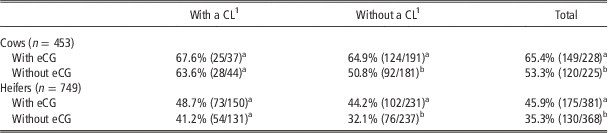
Optimization of follicle size may be an important consideration when treating beef cows in postpartum anoestrus. Cows with larger ovulatory follicles had a greater ovulation rate and resulted in a greater number of pregnancies per AI (P/AI) in beef cattle (Bó et al., Reference Bó, Cutaia, Peres, Pincinato, Maraña and Baruselli2007; Perry et al., Reference Perry, Smith, Roberts, Macneil and Geary2007; Sá Filho et al., Reference Sá Filho, Crespilho, Santos, Perry and Baruselli2010c). Furthermore, considering only those cows that ovulated following FTAI, the P/AI increased as the ovarian follicle size increased (Sá Filho et al., Reference Sá Filho, Crespilho, Santos, Perry and Baruselli2010c). Therefore, in addition to the increased ovulation rate, ovulation of larger follicles could be responsible for other events, such as the improvement of endogenous E2 production, oocyte competence, CL diameter and concentration of progesterone in the subsequent oestrous cycle, which may benefit the fertility of beef cows following FTAI. Analysis from on-farm FTAI has shown that animals treated with progestin devices must have a BCS higher than 2.5 (scale 1 to 5) and ideally >3 to achieve pregnancy rates of 50% or higher (Bó et al., Reference Bó, Cutaia, Peres, Pincinato, Maraña and Baruselli2007). Conversely, the addition of eCG allowed for pregnancy rates close to 50% in cows with a BCS of ⩽2.5 (Bó et al., Reference Bó, Cutaia, Peres, Pincinato, Maraña and Baruselli2007). It is very important to note that these results have been achieved only when cows were gaining body condition during the breeding season. If drought conditions or lack of feed prevent cattle from improving body condition during the breeding season, pregnancy rates will most probably be 35% or less, even after the administration of eCG (Bó et al., Reference Bó, Cutaia, Peres, Pincinato, Maraña and Baruselli2007, Butler et al., Reference Butler, Atkinson, Boe-Hansen, Burns, Dawson, Bo and McGowan2011). In a recent review conducted after the FTAI of 453 suckled Hereford cows in Uruguay (Menchaca et al., Reference Menchaca, Núñez, Wijma, García Pintos, Fabini and de Castro2013, Table 1), the P/AI increased in cows and heifers that did not have a CL detected by ultrasonography at the time of insertion of a progestin device that were treated with eCG. Conversely P/AI was not different between those that had a CL and were treated or not with eCG at progestin device removal.
Pregnancy rates in Bos taurus beef cows and heifers synchronized with progestin devices and estradiol with or without eCG (adapted from Menchaca et al., Reference Menchaca, Núñez, Wijma, García Pintos, Fabini and de Castro2013)

eCG=equine chorionic gonadotropin.
abProportions within a column with different superscripts differ significantly (P<0.05).
1 Detected by ultrasonography at progestin device insertion.
Restricted suckling or calf removal (CR) associated with progestin devices have also been used for the induction of cyclicity in beef cows (Williams et al., Reference Williams, Stanko, Amstalden and Williams2002). However, the response to CR seems to be related to body condition of the cows. Two experiments were conducted to compare the effects of eCG treatment and temporary CR on ovulation and pregnancy rates in postpartum cows in moderate to low body condition and only 22% of them with a CL (Bó et al., Reference Bó, Cutaia, Peres, Pincinato, Maraña and Baruselli2007). We found that both CR and eCG increased ovulation rates. Although the growth rate of the ovulatory follicle was greater in cows treated with eCG than in those not treated with eCG, the ovulatory follicle was smaller in CR cows, compared with those that were not CR. P/AI were increased in cows treated with eCG, whereas no differences were found between cows that were CR and those that were not. There was an interaction between CR and pregnancy rates that it was manifested as an improvement in P/AI when cows had >2.5 BCS and no improvement when cows were ⩽2.5 BCS. It was concluded that the use of eCG but not CR improved P/AI following FTAI in postpartum crossbred cows in moderate to low body condition. Results also suggest that the eCG-related increase in P/AI may be because of the final growth rate of the ovulatory follicle. On the contrary, the absence or little effect of CR on pregnancy rates contrasts with data from other studies conducted on Nelore (B. indicus) cows (Penteado et al., Reference Penteado, Ayres, Madureira and Baruselli2004; Sá Filho et al., Reference Sá Filho, Meneghetti, Peres, Lamb and Vasconcelos2009. Yet in another study conducted in Colombia on suckled Brahman cows (B. indicus) that were mostly in postpartum anoestrus (i.e. only 16% had a CL) and treated with progestin devices, EB and eCG, CR for 56 h and with the calves located >1 km away from the cows (to avoid contact between them) resulted in an increased P/AI (Castro Duarte and Osorno Chica, Reference Castro Duarte and Osorno Chica2010). Therefore, the beneficial effects of CR may differ depending on the management, cyclicity and BCS of the herd. Moreover, to set up a CR programme creates logistical problems in several farms, especially in medium to small farms. Although data on the addition of eCG to GnRH-based treatments are limited because GnRH-based treatments are not commonly used in beef cattle in countries where oestradiol is available, the addition on eCG has shown an improvement in pregnancy rates in B. indicus cows in postpartum anoestrus treated with a CO-Synch programme with progestin devices (Pincinato, Reference Pincinato2012) and in primiparous B. taurus cows (Small et al., Reference Small, Colazo, Kastelic and Mapletoft2009); however, no improvement in pregnancy rates has been reported in B. taurus cows in good BCS (Marquezzini et al., Reference Marquezini, Mercadante, Olson, Jaeger, Perry, Stevenson and Lamb2013).
The 5-day CO-Synch protocol in beef cattle
The 5-day CO-Synch is a GnRH-based treatment that has recently gained a lot of attention among practitioners and producers. Bridges et al. (Reference Bridges, Helser, Grum, Mussard, Gasser and Day2008) compared a 7-day CO-Synch protocol plus progestin device with FTAI at 60 h and a 5-day CO-Synch protocol plus a progestin device with FTAI at 72 h in postpartum beef cows. In that study, P/AI was 11% higher with the 5-day protocol. Similar results were recently reported by Whittier et al. (Reference Whittier, Currin, Schramm, Holland and Kasimanickam2013) that found a significantly higher P/AI in cows treated with the 5-day CO-Synch than in those treated with the 7-day CO-Synch.
It has been proposed that the higher pregnancy rates in the 5-day protocol is related to higher preovulatory oestradiol and luteal phase progesterone concentrations, especially in those cows not ovulating after the first GnRH (Bridges et al., Reference Bridges, Mussard, Hesler and Day2014). Cows treated with the 7-day CO-Synch that did not ovulate after the first GnRH have a marginal reduction in the diameter of the dominant ovulatory follicle and a substantial reduction in preovulatory oestradiol and progesterone concentrations in the ensuing luteal phase than those ovulating after the first GnRH. Conversely, in cows treated with the 5-day CO-Synch protocol, endocrine and follicular characteristics were similar between cows that did or did not ovulate to the first GnRH (Bridges et al., Reference Bridges, Mussard, Hesler and Day2014).
Additional studies have suggested that owing to a shorter interval between the first GnRH and induction of luteolysis in the 5-day protocol, two injections of PGF 6 to 24 h apart seemed to be necessary to induce complete regression of the GnRH-induced CL in cows (Kasimanickam et al., Reference Kasimanickam, Day, Rudolph, Hall and Whitier2009). More recently, Kasimanickam et al. (Reference Kasimanickam, Asay, Firth, Whittier and Hall2012) reported that beef heifers inseminated at 56 h in a 5-day CO-Synch protocol (plus a progestin device) had, on average, a 10.3% higher P/AI than heifers inseminated at 72 h.
On the basis of the most recent data reported in the literature, there are still two questions to be resolved in this protocol when it is applied in heifers: (1) the necessity of the first GnRH injection at the time of insertion of the progestin device, considering that only a few heifers ovulate and (2) the necessity of one or two injections of PGF at the time of removal of the progestin device. Colazo and Ambrose (Reference Colazo and Ambrose2011) and Lima et al. (Reference Lima, Ayres, Favoreto, Bisinotto, Greco, Ribeiro, Baruselli, Risco, Thatcher and Santos2011) showed that P/AI did not differ between dairy heifers receiving or not GnRH at the time of insertion of a progestin device. Rabaglino et al. (Reference Rabaglino, Risco, Thatcher, Kim, Santos and Thatcher2010) found no differences in P/AI when one or two doses of PGF were used in dairy heifers. However, Peterson et al., (Reference Peterson, Alkar, Smith, Kerr, Hall, Moore and Kasimanickam2011) reported a tendency for higher P/AI when two injections of PGF were given 6 h apart at progestin device removal in crossbred beef heifers. In addition, a more recent study reported a greater P/AI in dairy heifers receiving GnRH at progestin device insertion, but only when two PGFs were administered at progestin device removal and 24 h later (Lima et al., Reference Lima, Ribeiro, Bisinotto, Greco, Martinez, Amstalden, Thatcher and Santos2013).
Kasimanickam et al. (Reference Kasimanickam, Firth, Schuenemann, Whitlock, Gay, Moore, Hall and Whittier2014) have recently conducted a study involving a large number of beef (n=1018) and dairy (n=1137) heifers to determine the effects of GnRH injection at the time of insertion of a controlled internal drug release device (CIDR, Zoetis Animal Health) and the number of PGF doses at CIDR removal on P/AI in heifers synchronized with the 5-day CO-Synch protocol. The administration of GnRH at the time of insertion of the CIDR device significantly improved pregnancy rates in beef heifers, but not in dairy heifers. In addition, the administration of one or two PGF at CIDR removal did not have a significant effect on P/AI in both beef and dairy heifers. Thus, results can be interpreted to suggest that in beef heifers GnRH administration at the time of progestin insertion is required to maximize pregnancy rates, whereas increasing the number PGF treatments may not be necessary to achieve high pregnancy rates. A double dosage of PGF seems to be required to maximize pregnancy rates in mature beef cows (Bridges et al., Reference Bridges, Ahola, Brauner, Cruppe, Currin, Day, Gunn, Jaeger, Lake, Lamb, Marquezini, Peel, Radunz, Stevenson and Whittier2012). In the latter studies, no differences in P/AI were found between the administration of two doses of PGF 8 h apart and the administration of the double dosage of PGF simultaneously with CIDR removal.
A recent study reported a comparison between the 5-day CO-Synch plus progestin protocol with the oestradiol-based protocol in suckled cows in postpartum anoestrus. Pregnancy per AI was comparable when 400 IU of eCG was given at the time progestin device removal in both the 5-day CO-Synch and the oestradiol-based protocol (5-day CO-Synch: 120/259, 46.3% v. oestradiol: 151/277, 54.5%). However, P/AI was lower in cows treated with the 5-day CO-Synch but not receiving eCG at progestin device removal (71/265, 26.8%; P<0.05; Huguenine et al., Reference Huguenine, Peracchia, Benitez, Martini, Cledou, Bó and Callejas2013).
We have recently carried out an experiment to evaluate a new treatment based on oestradiol but with a prolonged proestrus that we named J-Synch (de la Mata and Bó, Reference de la Mata and Bó2012). In the first study, 28 Angus crossbred beef heifers that were 16 and 17 months of age and were randomly divided into two groups. Heifers in Group 1 (J-Synch, n=14) received 2 mg EB and an intravaginal device with 0.6 g of progesterone (Emefur 0.6 g, Merial Argentina SA) for 6 days, whereas those in Group 2 (n=14) were treated with the 5-day CO-Synch and the same progesterone device. All heifers received 150 µg of d-cloprostenol (Emefur, Merial) at device removal and were FTAI and received GnRH 72 h later. All heifers were examined by ultrasonography to monitor follicular development and ovulation. The initiation of a new follicular wave occurred earlier (P<0.05) in heifers treated with GnRH (2.1±1.0 days) than in those treated with EB (3.7± 0.9 days). However, ovulation rate (91.6% v. 92.8%), the diameter of the ovulatory follicle (11.7±0.2 v. 12.0±0.5 mm), the interval from PGF to ovulation (97.1±17.4 v. 95.1±12.5 h) and P/AI (50.0% v. 57.1%) did not differ between heifers in the J-Synch group and those in the 5-day CO-Synch group. This treatment is still under investigation but in field trials conducted on 854 commercial beef heifers, overall P/AI with the J-Synch treatment average 53.7% (range: 35 to 71.8%). In another follow-up study on Holstein heifers that is currently underway, preliminary P/AI were 62.7% (37/59) for the J-Synch, 54.5% (30/55) for the 5-day CO-Synch and 53.4% (31/58; P=0.3) for those in the control group, which were treated with the standard EB plus progestin protocol for 7 days (Ré et al., Reference Ré, de la Mata and Bó2014). In conclusion, these treatments proved to be efficient for synchronizing ovulation in heifers and it is necessary to conduct more studies on a large number of animals to determine whether this treatment increases P/AI compared with the traditional oestradiol plus progestin treatment currently used by most practitioners in South America.
The use of FTAI in commercial beef herds
One of the main advantages of implementing FTAI programmes in a beef herd is that more cows can be impregnated earlier in the breeding season to genetically improved bulls, resulting in heavier weaning weights (reviewed in Bó et al., Reference Bó, Cutaia, Peres, Pincinato, Maraña and Baruselli2007). Fifty per cent of the cows could potentially become pregnant on the first day of the breeding season and result in a higher number of cows calving at the beginning of the calving season. Therefore, their calves will be older and heavier at weaning. Besides, the use of genetically superior bulls will also result in heavier calves at weaning.
The impact of FTAI has proven to be equally efficient for different beef operations in Argentina and Brazil (Baruselli et al., 2004; Bó et al., 2007) and examples will be shown in the following paragraphs.
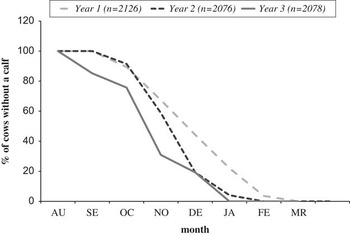
The ‘Estancia El Mangrullo’ (Lavalle, Santiago del Estero, Argentina) is located in the semiarid region of Argentina, with seasonal rainfalls of 600 mm per year from November to December to May to June (summer and fall). Animals are all zebu-derived and a cross-breeding programme with Bonsmara (B. taurus adapted breed) has been implemented with the use of semen and embryos. A FTAI programme was implemented in heifers and suckled cows that resulted in pregnancy rates between 35% and 50%, with an overall pregnancy rate of 45.5% (2193/4816). Probably, the main aspect of applying this system was its effect on calving distribution as shown in Figure 1. The progression of calvings throughout the calving season was compared between years using Kaplan–Meier’s method for comparison of survival curves. Survival curves across years were significantly different (P<0.01). In year 1 (no FTAI), calvings were distributed over 6 months with a high number of cows calving from December to March (late calvers). This was changed with the limited use of FTAI in year 2. However, with a more aggressive FTAI programme, calvings began earlier, with a high proportion of heifers calving in September (i.e. 30 days before the cows) and a higher percentage of mature cows calving earlier in the breeding season (October onwards) in year 3.
Survival curves for calving distribution at ‘Estancia El Mangrullo’ Santiago del Estero, Argentina in 3 consecutive years. Curves differ significantly among the 3 years (P<0.01) (adapted from Bó et al., Reference Bó, Cutaia, Peres, Pincinato, Maraña and Baruselli2007).

This improvement in the calving pattern distribution has been also shown after the application of FTAI programmes in large-scale beef operations with B. indicus cattle in Brazil. Specific details of these studies have been reported elsewhere (Bó et al., 2007), but just as an example in 1 study involving 5579 suckled Nelore cows that were FTAI early in the postpartum period (i.e. 35 to 45 days postpartum) P/AI was 50.5% (2817/5579) and the overall pregnancy rate after two cycles of rebreeding with bulls was 80.7% (4390/5579). As in the previous example, the use of a progestin-based FTAI programme at the beginning of the breeding season increased the number of calvings early in the calving season and tighten the calving pattern. Apart from the effect of FTAI on the calving distribution, these studies have also shown an impact of FTAI on weaning weights, with improvements ranging between 29 and 35 kg compared with those calves obtained by natural breeding (Bó et al., 2007).
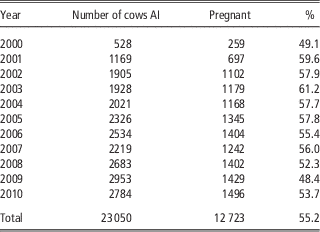
Another programme worth mentioning is that applied at ‘Estancia Santa Dominga’, Los Lazos S.A. an FTAI programme was implemented in the Angus herd in 2000 and results obtained since the first programme are shown in Table 2. The results shown involve 11 years of FTAI programmes with heifers and suckled cows that are 45 to 70 days postpartum. In this herd, animals have always been in adequate BCS (2.5 to 3.5 in 1 to 5 scale) at the beginning of the breeding season. As is shown in Table 2, pregnancy rates with FTAI were similar over the 11 years, thus showing stability of the programme when good management practices are applied.
Number of cows FTAI and pregnancy rates over a 10-year period in Angus cows and heifers in ‘Estancia Santa Dominga’, Olavarria, Argentina

FTAI=fixed-time artificial insemination; AI=artificial insemination.
Summary and conclusions
The use of protocols that control follicular development and ovulation has the advantage of being able to apply assisted reproductive technologies without the need for detecting oestrus. These treatments have been shown to be practical and easy to perform by the farm staff, and more importantly, they do not depend on the accuracy in oestrus detection. Treatments with GnRH or oestradiol and progestin-releasing devices have provided for FTAI in beef cattle, and the addition of eCG has been especially useful in increasing pregnancy rates in cows experiencing postpartum anoestrus. Shorter ovulation synchronization treatments that provide for a longer proestrus are an interesting new alternative for FTAI; however, more studies are needed to determine whether these treatments increase P/AI compared with the traditional EB plus progestin treatments currently used by most practitioners in South America. Finally, these treatments have been proven to be efficient, with repeatable results and are the best way of introducing the best genetics in a herd through artificial insemination.
Acknowledgements
Research was supported by FAPESP, Brazil; the Instituto de Reproducción Animal Córdoba (IRAC) and U. of Villa María, Argentina. Special thanks to our colleagues and graduate students of IRAC, U. of Villa María and U. of São Paulo for technical assistance.