Introduction
Congenital hydrocephalus is commonly associated with two disorders, spina bifida myelomingocele (SBM) and aqueductal stenosis (AS; Fletcher & Dennis, Reference Fletcher and Dennis2010). The brain dysmorphologies and neuropsychological deficits of these disorders are partially overlapping and partially distinct, but more is known about neurobehavioral outcomes in SBM than in AS. Hydrocephalus, per se, is the final common path of a set of disruptions of cerebrospinal fluid (CSF) production, absorption, and flow that typically produce ventriculomegaly (enlargement of the cerebral ventricles) and increased intracranial cranial pressure (Barkovich, Reference Barkovich2005; Charney, Reference Charney1992). Hydrocephalus, which also occurs with acquired (e.g., brain tumors) conditions, disturbs the regulation of blood flow and management of waste product (e.g., harmful metabolites, drugs), destroying periventricular white matter (Del Bigio, Wilson, & Enno, Reference Del Bigio, Wilson and Enno2003). Treatment of hydrocephalus often involves a diversionary shunt to reduce intracranial pressure and ventricular size (Barkovich, Reference Barkovich2005; Charney, Reference Charney1992; Raimondi, Reference Raimondi1994).
Hydrocephalus is associated with cognitive morbidity in both AS and SBM. What is not established is whether the level and type of cognitive morbidity varies by etiology, largely because there are few samples of children with AS large enough to evaluate this question. Such a comparison would not only identify morbidity associated with hydrocephalus rather than with etiology-specific brain dysmorphologies, but also provide the basis for outcome risk stratification among the group of congenital brain malformations that share hydrocephalus as a final common path of their brain disorder.
Spina Bifida Myelomeningocele
Spina bifida (i.e., split spine) is a neural tube defect in the first 30 days in gestation associated with failure of the caudal end of the neural tube to close. Orthopedic and urinary complications below the level of the affected spine are common and brain malformations may occur, especially in relation to myelomeningocele. The rate of SBM has declined to 2.02 per 1000 live births because of folate supplementation, but it remains the most common central nervous system birth defect compatible with survival (Boulet, Gambrell, Shin, Honein, & Mathews, 2009). Hydrocephalus in SBM results from the Chiari II malformation of the cerebellum and hindbrain, which obstructs the flow of cerebrospinal fluid (CSF) at the level of the third and fourth ventricles.
Aqueductal Stenosis
The incidence of AS is 7.18 per 100,000 live births (Moffitt, Abiri, Scheuerle, & Langlois, Reference Moffitt, Abiri, Scheuerle and Langlois2011). CSF blockage from congenital narrowing of the aqueduct of Sylvius causes hydrocephalus in AS (Barkovich, Reference Barkovich2005; Del Bigio, Reference Del Bigio2010; Hommet et al., Reference Hommet, Billard, Gillet, Barthez, Lourmiere, Santini and Autret1999; Juranek & Salman, Reference Juranek and Salman2010; Tew & Laurence, Reference Tew and Laurence1975), although some early literature suggested that hydrocephalus caused AS (McMillan & Williams, Reference McMillan and Williams1977). Outcome studies often combine individuals with hydrocephalus and AS with individuals with hydrocephalus and SBM and other etiologies of early hydrocephalus (e.g., Dandy Walker syndrome, intraventricular hemorrhage). However, the relation of AS to neuropsychological outcome, particularly when the primary clinical problem is hydrocephalus, is of interest in its own right and has been infrequently studied. AS is of particular interest because the primary anomaly is often hydrocephalus and many with AS have no other brain dysmorphology.
Comparison of SBM and AS
The neuropsychological profile of individuals with SBM varies with factors such as hydrocephalus status (Hampton et al., Reference Hampton, Fletcher, Cirino, Blaser, Kramer, Drake and Dennis2011) and spinal lesion level (Fletcher et al., Reference Fletcher, Copeland, Frederick, Blaser, Kramer, Northrup and Dennis2005). There appears to be common strengths and weaknesses both across and within content domains (Dennis, Landry, Barnes, & Fletcher, Reference Dennis, Landry, Barnes and Fletcher2006). Across broad content domains, children with hydrocephalus and SBM are more impaired in spatial, math, memory, and concept formation domains, compared to their relative strengths in vocabulary and word reading domains (Barnes & Dennis, Reference Barnes and Dennis1998; Dennis et al., Reference Dennis, Landry, Barnes and Fletcher2006). Within content domains, cognitive strengths involve the learned association and categorization of stimulus information, such as word recognition, vocabulary, and priming abilities. Areas of weakness involve abstract assembly and construction of information, such as coordinate visual perception, mathematical computation, reading and language comprehension, and concept formation tasks (Barnes & Dennis, Reference Barnes and Dennis1998; Dennis et al., Reference Dennis, Landry, Barnes and Fletcher2006; Fletcher & Dennis, Reference Fletcher and Dennis2010).
Previous research comparing etiologies (with small samples of children with AS) found that hydrocephalus in children with either AS and SBM contributed to decreased language abilities (e.g., pragmatic and word retrieval skills), lower performance on nonverbal tasks, and lower adaptive behavior ratings (Brookshire et al., 1995; Fletcher et al., 1992; Fletcher et al., 1994). Relative To children with SBM (who have more severe neural presentations), children with AS may have better overall neuropsychological outcomes (Fletcher, Brookshire, Bohan, Brandt, & Davidson, Reference Fletcher, Brookshire, Bohan, Brandt and Davidson1995; Hommet et al., Reference Hommet, Billard, Gillet, Barthez, Lourmiere, Santini and Autret1999), but samples are typically small and etiologies are rarely directly compared. Relative to other postnatal etiologies that present with less severe hydrocephalus (e.g., hemorrhage, postnatal infections), children with AS may have poorer neuropsychological outcomes (Dennis et al., Reference Dennis, Fitz, Netley, Sugar, Harwood-Nash, Hendrick and Humphreys1981).
More severe hydrocephalus status contributes to greater weakness in visuospatial and concept formation domains (Fletcher & Dennis, Reference Fletcher and Dennis2010; Fletcher et al., Reference Fletcher, Brookshire, Bohan, Brandt and Davidson1995; Hommet et al., Reference Hommet, Billard, Gillet, Barthez, Lourmiere, Santini and Autret1999; Matson, Mahone, & Zabel, Reference Matson, Mahone and Zabel2005). In addition, Scott et al. (Reference Scott, Fletcher, Brookshire, Davidson, Landry, Bohan and Francis1998) reported that children who received shunt treatments (both AS and SBM) performed lower on verbal and nonverbal encoding and retrieval memory tasks. Children in a combined group with shunted hydrocephalus (both SBM and AS) also had greater difficulty focusing and shifting attention, tasks associated with the posterior attention system that may be damaged as a result of hydrocephalus (Brewer, Fletcher, Hiscock, & Davidson, 2001).
Underlying functional outcomes, the brain dysmorphologies of SBM and AS are different. While those of SBM are widespread and involve the cerebellum, midbrain, corpus callosum, and posterior cortex (Juranek & Salman, Reference Juranek and Salman2010), those of AS appear more restricted. However, SBM has been studied more extensively than AS, and neither brain dysmorphology nor behavioral outcome has been directly compared in the two conditions.
The objective of the present study was to compare neuropsychological functioning in children with SBM and AS, and a group of typically developing (TD) children. Our approach differed from previous research because we were able to analyze a large sample and make direct comparisons across several cognitive domains. In addition, we were able to compare the etiologies and their differences in hydrocephalus severity and neural presentation.
There were three specific predictions for comparisons of neuropsychological outcomes in the clinical groups. First, we predicted a stepwise order of overall performance across domains, such that the children with AS and SBM would perform lower than the TD group, but the group with AS would perform better than those with SBM. This performance order would reflect the difference in effects of hydrocephalus in children with AS versus the effects of other brain dysmorphologies in SBM. Second, we predicted an etiology by task interaction, such that children with hydrocephalus (AS and SBM) would perform comparably to TD children on vocabulary and word reading, but more poorly on spatial, motor, memory, and concept formation tasks. Third, we predicted that children with AS would perform significantly better than those with SBM on fine motor tasks, reflecting, in part, the greater integrity of the cerebellum in individuals with this disorder.
Methods
Participants
The sample was derived from a larger sample of 444 children and adolescents with disorders related to congenital hydrocephalus and 117 typically developing (TD) participants recruited from 1999 to 2004 for a research project on spina bifida (Fletcher et al., Reference Fletcher, Copeland, Frederick, Blaser, Kramer, Northrup and Dennis2005). Participants were screened before admission in the study and did not have unrelated congenital and neurological disorders, psychiatric disorders, uncontrolled seizure disorders, or inability to control upper limbs.
Because the current study compared children with AS and SBM and shunted hydrocephalus, children with Dandy Walker syndrome or variant (n = 29), milder spinal dysraphisms (e.g., meningocele, lipoma; n = 26), or with SBM and arrested (n = 23) or no hydrocephalus (n = 6) were excluded from the analyses. Participants that were younger than 7 years old and older than 18 years old (n = 126, 8 children with AS children, 62 children with SBM and 56 TD children) and who were not primarily English speaking (n = 16, 1 TD child and 15 children with SBM) were also excluded. To clarify patterns of cognitive and academic performance, participants who performed below the standard score of 70 on the verbal (Vocabulary) and the nonverbal (Pattern Analysis) subtests of the Stanford Binet – 4th edition (Thorndike, Hagen, & Sattler, Reference Thorndike, Hagen and Sattler1986) were excluded (1 child with AS and 32 children with SBM). For the present study, children with SBM who had thoracic level spinal cord lesions (n = 58) were not included because upper spinal lesions are more severe and may be qualitatively distinct (Fletcher et al., Reference Fletcher, Copeland, Frederick, Blaser, Kramer, Northrup and Dennis2005). In addition, four children with SBM who presented with a normal cerebellum were not included.
The final sample consisted of 180 children and adolescents, 7–18 years of age (mean age = 11.69 years), with either SBM or AS, and 60 TD children. Medical records and MRI scans were used to classify eligible participants according to etiology (SBM, AS). Participants who presented with AS had been previously diagnosed and treated with a shunt for hydrocephalus (n = 29). Participants who presented with a lower level myelomeningocele and evidence of shunted hydrocephalus were included in the group with SBM (n = 151).
Participants with SBM and AS were continuously recruited from three major hospitals: The Spina Bifida Clinic at Texas Children's Hospital, the Shriner's Hospital for Children-Houston, and the Hospital for Sick Children in Toronto. In addition, participants were recruited from parent groups for children with SBM in Houston and Toronto. TD children were recruited through local advertising. Written agreement to participate was obtained from parents and older adolescents and verbal assent was obtained from younger children.
Human participant review boards at The University of Houston and the two Houston hospitals and The Hospital for Sick Children approved the study. In addition, research was completed in accordance with the Helsinki Declaration.
Demographic Comparisons
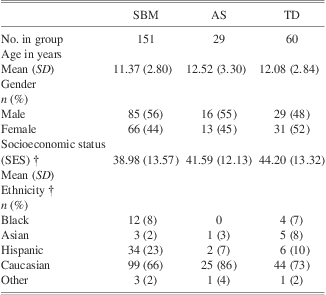
Table 1 shows participant age, gender, socioeconomic status (SES), and ethnicity. The sample was geographically, ethnically, and economically diverse. Participants with SBM were slightly younger than both the AS and TD groups, but the difference was not statistically significant, F(2,229) = 2.71, p = .069. There were no significant group differences in gender, with males and females comparably represented in each group, χ2 (2) = 1.11, p = 0.574. χ2
Summary characteristics of children classified by etiology status
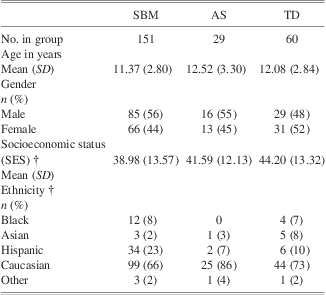
Note. SBM = spina bifida myelomeningocele with shunted hydrocephalus; AS = aqueductal stenosis with shunted hydrocephalus; TD = typically developing.
† p < .05.
SES was compared using the Hollingshead 4-factor index of socioeconomic status (Hollingshead, Reference Hollingshead1975). As seen in Table 1, analysis of variance (ANOVA) revealed significant differences in SES among etiology groups, F(2,239) = 3.94, p = .021. The clinical groups did not significantly differ from one other in SES and the group with AS did not differ from the TD group (p < .05). The group with SBM had a significantly lower SES than the TD group (p < .05). Therefore, SES was used as a covariate in the subsequent analyses. Ethnicity was grouped into Hispanic and non-Hispanic groups due to the smaller samples of Black, Asian, and other ethnicities (see Table 1). A chi square test revealed significant group differences in ethnicity, χ2 (2) = 7.23, p = .027. As seen in Table 1, the ethnicity difference reflected higher prevalence of SBM in the Hispanic population relative to the AS or TD groups. Only SES was used as a covariate because ethnicity was captured in the SES descriptive, F(1,239) = 33.01, p < .0001, with a higher SES representing the non-Hispanic (M = 42.86; SD = 12.70) population and a lower SES representing in the Hispanic group (M = 30.53; SD = 12.28). This result was consistent with previous findings by Swartwout et al. (2010), who showed that SES drove the associations of SB with cognitive performance more than ethnicity in a comparison of cognitive performances of children with SBM and TD children who varied in SES within ethnicities.
Neuropsychological Assessment
Each child was individually assessed with the following tests in a quiet environment by research assistants who were supervised by experienced neuropsychologists.
Vocabulary
The Vocabulary subtest of the Stanford-Binet – 4th edition (Thorndike et al., Reference Thorndike, Hagen and Sattler1986) requires children to point to pictures given or define printed words. This subtest has an average reliability of 0.90.
Judgment of line orientation
Spatial processing was measured using the Judgment of Line Orientation Test (age adjusted Z-score; (Lindgren & Benton, Reference Lindgren and Benton1980), which requires the child to match the orientation of two lines with two of 13 lines laid out in a fan-like array. This test, which consists of 30 pairs of angled lines, has a long-term test–retest reliability of .64 for children (Lindgren & Benton, Reference Lindgren and Benton1980).
Reading and math skills
Reading and math skills were measured using subtests from the Woodcock-Johnson Psycho-Educational Battery-Revised (Woodcock & Johnson, Reference Woodcock and Mather1989, 1990). Basic reading skills were measured by decoding real (Letter-Word Identification) and nonwords (Word Attack) of varying difficulty. Math achievement was measured using the Calculations subtest, which consists of written arithmetic computations. Reliability of these subtests ranges from .80 to .90 (Woodcock & Johnson, Reference Woodcock and Mather1989, 1990).
Concept formation
The Concept Formation subtest of the Woodcock Johnson-Revised Cognitive Achievement Battery was used to measure the ability to identify, categorize, and determine appropriate rules to sort shapes based on specific characteristics (color, number; Woodcock & Mather, Reference Woodcock and Mather1989, 1990).
Purdue pegboard
The Purdue Pegboard was designed to test fine motor dexterity. Participants placed round pegs in holes down the board using their dominant hand, then non-dominant hand, and finally both hands (Tiffin, Reference Tiffin1968). Composite reliability is high (.88) and overall reliability ranges from .82 to .91 for the three trial scores (Composite of all three conditions, age adjusted Z-score; Tiffin, Reference Tiffin1968).
California verbal learning test
In the California Verbal Learning Test – Children's Version (Delis, Kramer, Kaplan, & Ober, Reference Delis, Kramer, Kaplan and Ober1994), participants recall as many words from a 16 grocery-related word list (e.g., “Apple, sweater, puzzle, grapes”). The total score across trials (1–5) will be the primary variable for analysis as an assessment of explicit memory. Internal consistencies across trials (.84–.91) and across words (.81) are moderately strong (Delis, Kramer, Kaplan, & Ober, Reference Delis, Kramer, Kaplan and Ober1994).
MRI Procedures
MRI scans were obtained on comparable 1.5 Tesla magnets (General Electric, Milwaukee, WI) at each site. The scans were usually completed on the same day as neuropsychological testing. Three imaging sequences were obtained. The initial series was a sagittal plane spin-echo T1-weighted localizer, field of view (FOV) 24 cm, repetition time (TR) 500 ms, echo time (TE) 14 ms, 256 × 192 matrix, 3 mm with a 0.3 skip, 2 repetitions. The localizer was followed by two whole brain coronal acquisitions. One series involved three-dimensional (3D) fast spin-echo T2-weighted images, FOV 24 cm, TR 4000 ms, TE 102 ms, ETL 16, 256 × 256 matrix, 1 repetition with contiguous 1.7 mm coronal images. The other series was a 3D-spoiled gradient-echo with contiguous 1.7 mm coronal images, FOV 24 cm, TR 18 ms, TE 3 ms, flip angle 25 degrees, 124 locations, 256 × 256 matrix, 1 repetition. Conventions for qualitative coding of scans that included 10% of the scans from one institution being read by radiologists from the other institution were developed and discussed by radiologists in Houston and Toronto who were blinded to group assignment.
Results
Clinical Markers
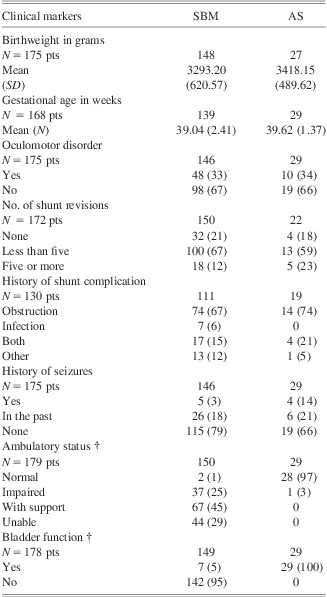
Table 2 presents clinical markers commonly used to characterize children with shunted hydrocephalus based on clinical coding of MRI scans and medical records to describe differences between clinical groups. The TD group does not, by definition, have impairment on clinical markers, so was not included in these analyses. We used these data to ensure that differences in birth history, shunt factors, and other medical factors did not contribute to the hypothesized differences in outcomes.
Number (percentage) of participants with clinical markers classified by etiology

Note. SBM = spina bifida myelomeningocele with shunted hydrocephalus; AS = aqueductal stenosis with shunted hydrocephalus; TD = typically developing.
† p < .05.
There were no significant differences between children with SBM and AS in birth weight, F(1,174) = 0.98, p = .32, gestational age, F(1,167) = 1.55, p = .21, or history of oculomotor disorder, χ2 (1) = 0.03, p = .867. The groups with SBM and AS also did not differ in number of shunt revisions, χ2 (2) = 1.91, p = .385, or shunt complications, χ2 (3) = 2.27, p = .518. Children with AS were more likely to have a history of seizures than the children with SBM, χ2 (2) = 5.72, p = .057, which may reflect how AS is often discovered. As expected, significant group differences were found on ambulatory status, χ2 (3) = 158.08, p < .0001, and bladder function, χ2 (1) = 136.65, p < .0001, reflecting the differing clinical characteristics of these disorders. As seen in Table 2, most participants with AS had either normal or mildly impaired ambulatory status. The group with SBM had partially or significantly impaired ambulatory status.
Imaging anomalies
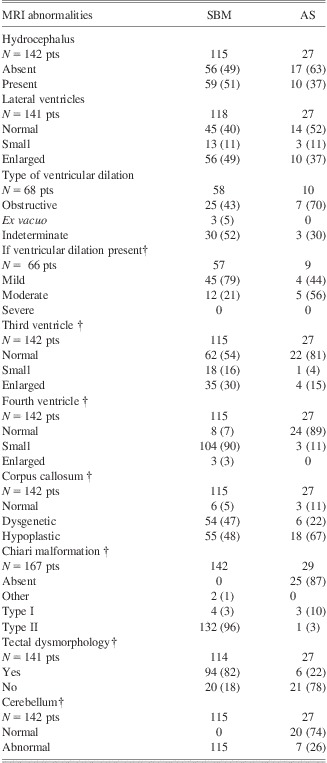
To evaluate whether patterns of neural anomalies were consistent with etiology, Table 3 presents qualitative magnetic resonance imaging features between etiologies showing patterns consistent with the underlying disorders. Some levels of these characteristics were combined when the sample sizes were small.
Qualitative abnormalities on MR imaging by etiology status

Note. SBM = spina bifida myelomeningocele with shunted hydrocephalus; AS = aqueductal stenosis with shunted hydrocephalus.
† p < .05.
At the time of MRI, there were no significant group differences in the presence of ventricular dilation, χ2 (1) = 1.78, p = .182, type of ventricular dilation, χ2 (2) = 2.66, p = .265, or the status of the lateral ventricles, χ2 (2) = 1.48, p = .477. Most SBM participants with MRI-identified post shunt ventricular dilation had mild hydrocephalus, whereas those with AS had mild and moderate hydrocephalus, χ2 (1) = 4.84, p = .028. Locus of ventricular abnormality also varied by group.
Consistent with the etiology-associated effects of hydrocephalus, there were significant differences in the status of the third ventricle, χ2 (2) = 7.08, p = .029, and fourth ventricle, χ2 (2) = 84.10, p < .0001, between groups. The corpus callosum was either hypoplastic or dysgenetic in the group with SBM, while corpus callosum hypoplasia (usually secondary to hydrocephalus) was more common in the group with AS, χ2 (2) = 5.87, p = .053.
The signature dysmorphology of SBM is the Chiari II malformation of the cerebellum and midbrain. As expected, the groups differed on this variable, χ2 (3) = 148.14, p < .0001, and on variables causally related to the dysmorphology, such as tectal dysmorphology, χ2 (1) = 38.40, p < .0001. By definition, the entire group with SBM had some form of cerebellar abnormality. Unexpectedly, seven children with AS shared a cerebellar anomaly, χ2 (1) = 99.15, p < .0001, including one child with a Type II Chiari malformation, three children with Type I Chiari malformations, and three children with mild displacement of the tonsils and dysplasia. Because the abnormal cerebellum status in AS was not expected and the effects on neuropsychological outcome are not known, we conducted analyses including and excluding these children.
Neuropsychological Outcomes
All scores were transformed so that M = 100 and SD = 15, based on the available normative data. A few participants with SBM (n = 10) and AS (n = 3) had missing data for individual tests and/or SES, including 2 children with AS that were missing scores for the memory task, 3 children with SBM that were missing scores for the executive function task, and 1 child with SBM that was missing a score for the fine motor task. In addition, there were 9 children (5 children with SBM, 1 child with AS and 3 TD children) missing SES information. Because none of these instances was due to an inability to perform the task, and because a missing score would drop these cases in multivariate analyses, we imputed the mean of the performance for each subgroup. We checked the effect of dropping these cases and the patterns were the same with and without them.
To examine the effect of etiology on performance across domains, a multivariate approach to repeated measures ANOVA was run using SAS PROC GLM. Etiology was used as the between-subjects factor (SBM, AS, TD), and the within-subjects factor was the mean score for each task. SES was used as a covariate to identify any SES by task interactions. A significant main effect would support Hypothesis 1 and a significant interaction (etiology × task) would support Hypothesis 2. Although main effects are not typically reported if the interaction is significant, there is a specific hypothesis about the order of performance, justifying the evaluation of the main effect. Linear contrasts were computed to determine the order of performance on each task. The follow up contrast would permit evaluation of Hypothesis 3.
Because all pairwise comparisons were examined in the etiology status grouping, Tukey's pairwise comparisons were used to control for Type I. For each content domain, we controlled for the number of groups by using an adjusted critical level of alpha (p = .05/3 = 0.0167). We did not control for the number of domain comparisons, but reported effect sizes (d) using the raw means and pooled standard deviation across the three groups (Cohen, Reference Cohen1960).
Preliminary analyses evaluated the interaction of SES with group and task. Both the etiology × task interaction, F(12,458) = 1.34, p = .193, and the etiology × SES × task interaction, F(12,458) = 1.43, p = .151 were not significant. SES was retained as a covariate, but interactions with SES were trimmed from the model.
The first prediction was stepwise linear performance related to severity, such that the group with AS would perform lower than the TD group across all tasks, but higher than the group with SBM. The significant main effect of etiology supported this hypothesis, F(2,236) = 62.06, p < .0001. The TD group had the highest average score (total unadjusted mean performance = 106.05, SD = 9.28); the group with AS (total unadjusted mean performance = 95.47, SD = 17.28) outperformed the group with SBM (total unadjusted mean performance = 82.25, SD = 14.54).
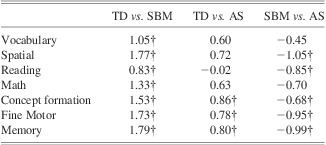
The etiology × task, F(12,462) = 3.71, p < .0001, and the SES × task, F(6,231) = 3.98, p = .0008, interactions were significant, supporting Hypothesis 2. The latter interaction simply showed that clearly verbal tasks were more associated with SES (e.g., vocabulary, verbal learning) than less verbal tasks (e.g., spatial cognition). Follow up linear contrasts on each task revealed that order of performance was significant across all tasks, p < .05, except for the order of performance between the group with AS and the TD group on the reading task. Table 4 shows the effect size differences in SES-adjusted means converted to Z-scores. The largest difference between both clinical groups and the TD group occurred in the spatial, concept formation, motor, and memory content domains, with smaller effects found for the reading, math, and vocabulary content domains.
Effect size difference in overall adjusted mean performance by etiology status across domain
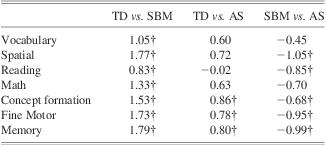
Note. SBM = spina bifida myelomeningocele with shunted hydrocephalus; AS = aqueductal stenosis with shunted hydrocephalus; TD = typically developing.
† p < .0167.
The third hypothesis was also supported. There was a significant group difference in performance on a motor task, p = .002. However, the groups with AS and SBM also differed significantly in performance in the spatial, reading, concept formation, and memory domains, p < .05.
Analyses Excluding AS and Abnormal Cerebellum Status
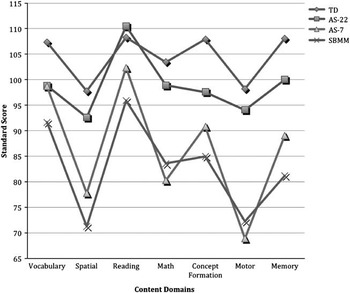
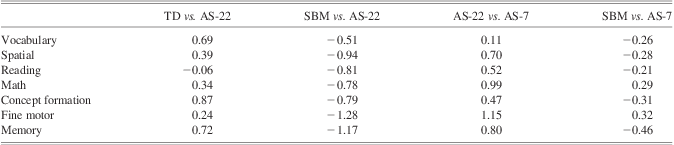
Figure 1 shows the SES-adjusted profiles for each group, separating the group with AS according to normal (n = 22) and abnormal cerebellums (n = 7) A comparison of the two AS groups is underpowered, so Table 5 includes effect sizes for the two groups with AS relative to other groups. The overall results were similar with the seven children with AS and abnormal cerebellums excluded. Both the etiology × task, F(12,448) = 4.28, p < .0001, and the SES × task, F(6,224) = 4.64, p = .0002, were significant. As in the previous analyses, Tukey's pairwise comparisons and linear contrasts were conducted.
Adjusted mean performance across neuropsychological domains for children with shunted hydrocephalus grouped by etiology, and typically developing children. SBM = spina bifida myelomeningocele with shunted hydrocephalus; AS-22 = aqueductal stenosis with shunted hydrocephalus and no cerebellar dysmorphology; AS-7 = aqueductal stenosis with shunted hydrocephalus and cerebellar dysmorphology; TD = typically developing.

Effect size difference in overall adjusted mean performance by etiology status across domain
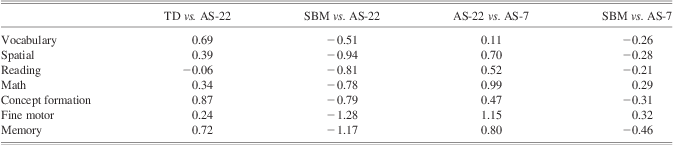
Note. SBM = spina bifida myelomeningocele with shunted hydrocephalus; AS-22 = aqueductal stenosis with shunted hydrocephalus and normal cerebellums; AS-7 = aqueductal stenosis with shunted hydrocephalus with abnormal cerebellums; TD = typically developing.
† p < .0167.
Although the etiology × task interaction remained significant, the specific pattern of performance differences changed with the exclusion of the individuals with AS and abnormal cerebellum (Figure 1). Table 5 shows the largest effect size differences between the group with AS and no cerebellar dysmorphology (AS-22) and the TD group occurred in the concept formation. There were moderate effect size differences in both memory and vocabulary content domains, with smaller effects found for the reading, spatial, and math content domains. The performance of the group with AS and abnormal cerebellums is generally lower than children with AS and normal cerebellums, but higher than the group with SBM, with the exception of math and motor tasks (Figure 1). Table 5 shows the larger effect size differences between the children with SBM and the AS-22 group across all content domains, which contrasts with the smaller effect size differences between the children with SBM and the children with AS and cerebellar dysmorphology (AS-7) across content domains. The effect size differences between the two AS groups were larger in the spatial, math, motor, and memory content domains than in the vocabulary, reading, and concept formation content domains.
Discussion
Our results suggest that etiology matters for clinical status, brain pathology, and neuropsychological outcome. Although both SBM and AS groups had hydrocephalus that required shunt treatment, we found important differences in outcomes related to the more extensive brain dysmorphology in SBM relative to AS. Furthermore, evaluating AS helped delineate the effects of hydrocephalus in a condition with less severe brain abnormalities.
Clinical Characteristics
The differences in outcomes do not appear to reflect differences in shared clinical characteristics. The two groups did not differ on markers of hydrocephalus treatment, including history of shunt complications and number of shunt revisions. The groups did not differ in most indicators of post shunt hydrocephalus status at the time of MRI, although the degree of hydrocephalus differed by group (participants with SBM had milder ventricular dilation than those with AS). However, because the group with AS performed at a higher level than group with SBM, this difference and the significant group difference between third and fourth ventricle status (related to the etiology-specific effects of congenital hydrocephalus; Fletcher et al., Reference Fletcher, Copeland, Frederick, Blaser, Kramer, Northrup and Dennis2005) do not appear to be contributing factors to the results because the outcomes were poorer in SBM.
As expected, the group with SBM had signs of more widespread brain dysmorphology (abnormal cerebellum and corpus callosum status, tectal beaking) than the group with AS. In addition, the group with SBM was made up of primarily of Type II Chiari malformations. With the exception of the single child with a Chiari II malformation, the cerebellum changes in the children with AS may be secondary to pressure effects from hydrocephalus and shunting. Similarly, hypoplasia in both groups usually represents thinning from hydrocephalus.
Neuropsychological Performance
As predicted, neuropsychological performance was lower in both clinical groups relative to TD comparison children even when children with AS and abnormal cerebellums were excluded. The group with AS performed higher overall than the group with SBM regardless of cerebellum status (Figure 1), and both performed below the TD group. The group with AS and normal cerebellar development approximated that of the TD group (Figure 1). This shows that treated hydrocephalus is associated with more modest neuropsychological deficits when hydrocephalus is the primary problem than when it is accompanied by significant brain dysmorphologies.
It is of considerable interest that cerebellar insult in AS added not only to motor deficits (which might have been expected) but also was associated with more significant cognitive difficulties. This suggests that early cerebellar abnormalities in congenital disorders have more general effects on cognitive and motor functions. This finding is consistent with other evidence that the cerebellum, possibly by virtue of its connections with anterior cortical regions, helps shape normal cognitive development (Diamond, Reference Diamond2000), cognitive development in neurodevelopmental disorders (Dennis & Barnes, 2010), and cognitive function in individuals with brain lesions acquired after birth, either earlier (Limperopoulos & du Plessis, Reference Limperopoulos and du Plessis2006) or later (Schmahmann, Reference Schmahmann2004) in development.
Differences in motor function between the two clinical groups may also be related to differences in cerebellum status. Cerebellar dysmorphologies impair motor regulation (Dennis & Barnes, 2010), and the group with SBM had a high incidence of Chiari II malformation, additional cerebellar anomalies and tectal dysmorphology (Table 2). Although some in the group with AS had cerebellar impairments on MRI (Table 3), the group with AS and normal cerebellums had better motor function, but still below the TD group. Hydrocephalus also thins white matter (Del Bigio, Reference Del Bigio2010; Juranek & Salman, Reference Juranek and Salman2010), which may also contribute to decreased motor performance in children with SBM or AS.
Limitations of the Study
The results are complicated by variations in the level of performance on the vocabulary and spatial measures for all groups. The group with AS group performed higher on vocabulary than for spatial tasks, as did the group with SBM (Figure 1). This discrepancy was consistent in the TD group as well, whose vocabulary was in the high average range. This result is consistent with previous research (Burmeister et al., Reference Burmeister, Hannay, Copeland, Fletcher, Boudousquie and Dennis2005; Matson et al., Reference Matson, Mahone and Zabel2005; Tew & Laurence, Reference Tew and Laurence1975). In additional, the significantly lower performance on the spatial task seen in individuals with SBM may reflect a less than adequate normative sample for the Judgment of Line Orientation task.
It is also possible that the corpus callosum anomalies contribute to outcome, but the corpus callosum, as a major white matter association tract, is commonly damaged in a wide range of developmental disorders, including SBM and AS. Specific tasks would be needed, such as measures of interhemispheric transfer (Hannay et al., Reference Hannay, Walker, Dennis, Kramer, Blaser and Fletcher2008) to determine the relation of corpus callosum anomalies and neuropsychological outcome.
While the sample size is large in the context of previous congenital hydrocephalus research, performance in some domains is variable. The variability could be the impact of other environmental factors, severity factors, and the heterogeneity with the groups on clinical markers. In addition, the TD group performed in the above average range across many tasks, affecting the difference in significance levels in comparison with the clinical groups. In many instances, the group with AS performed in the average to above average range, and the group with SBM performed in the average range on a reading task. However, the differences were still large relative to the above average performance of the TD group.
Conclusions
Despite these considerations, this study highlights the complex relation of etiology and hydrocephalus. It has been claimed that the neuropsychological deficits of disorders such as SBM and AS in children are driven by hydrocephalus, but the evidence for these claims has been limited to comparisons of different samples. The current study found etiology-dependent differences between SBM and AS in cognitive outcomes, despite similar hydrocephalus history. Second, even within a single etiology, variations in cerebellar abnormalities drove variations in the degree of motor and cognitive deficit. The fact that etiology does matter in assessing the impact of hydrocephalus on cognitive function is consistent with other, adult data. Although hydrocephalus is common to several groups with brain insult, and may exacerbate memory deficits, memory profiles vary with etiology of the hydrocephalus. Hommet et al. (Reference Hommet, Billard, Gillet, Barthez, Lourmiere, Santini and Autret1999) found that young adults with SBM had poorer memory than those with AS. In both children and adults with SBM and AS, it appears that not only hydrocephalus, but also the etiology of the disorder shapes cognitive function.
Acknowledgments
This research was supported by Eunice Kennedy Shriver National Institute of Child Health and Human Development Grant P01 HD35946 “Spina Bifida: Cognitive and Neurobiological Variability.” The opinions expressed in this study are not necessarily the opinions of the NICHD. There are no financial or other relationships that could be interpreted as conflicts of interest.