Pregnancy is a sensitive period during which women experience significant physiological changes, including weight gain; hormonal, cardiac and haematological variations and fluctuations in oxygen demands(Reference Jouanne, Oddoux and Noël1). These changes require a significant increase in caloric and micronutrient intake to ensure optimal fetal growth and to prepare the body for delivery and breastfeeding(Reference Jouanne, Oddoux and Noël1). The elevated demands for micronutrients during pregnancy increase the risk of clinical or subclinical deficiency, especially in low- and middle-income countries (LMICs), where a high proportion of women enter pregnancy undernourished(Reference Gomes, Agustina and Black2). Globally, the prevalence of deficiency in at least one of three core micronutrients – Fe, Zn and folate – among women of reproductive age is estimated to be 56 %, with the prevalence being highest in sub-Saharan Africa at 80 % and lowest in high-income countries at 48 %(Reference Stevens, Beal and Mbuya3).
Micronutrient deficiencies during pregnancy have been linked to compromised conception, length of gestation and fetal development and growth, which can lead to several adverse birth outcomes including loss of pregnancy, preterm birth, small birth size, birth defects and long-term metabolic complications(Reference Gernand, Schulze and Stewart4). One of the most common micronutrient deficiencies among pregnant women is Fe deficiency, which can lead to Fe deficiency anaemia. Anaemia, defined as a reduced Hb concentration (Reference Karyadi, Reddy and Dearden5), affects about 45 % of pregnant women in LMICs(Reference Alem, Efendi and McKenna6) and can have serious impacts on maternal and fetal health, including contributing to preterm birth, low birth weight, low neonatal Fe status, preeclampsia and post-partum haemorrhage(Reference Haider, Olofin and Wang7–Reference Zhao, Sun and Wu10). Even though anaemia has many causes, in LMICs, Fe deficiency is one of the most recognised ones(11). In settings with limited resources, anaemia-related health complications put mothers and their babies at risk for poor long-term health outcomes.
Increasing micronutrient intake through improved diets, fortification of staple foods and condiments, biofortification and supplementation, has been shown to reduce the burden of maternal and child morbidity, impaired neurocognitive development and mortality(Reference Stevens, Beal and Mbuya3). Among these strategies, supplementation with Fe and folic acid (IFA) during pregnancy has been identified as one of the most effective ways to reduce Fe deficiency anaemia and improve maternal, neonatal and child survival(Reference Siekmans, Roche and Kung’u12). The WHO recommends Fe supplementation to all pregnant women via daily oral IFA, with 30–60 mg of Fe and 0·4 mg of folic acid, throughout the pregnancy beginning as early as possible after conception(13).
However, numerous research questions remain regarding the implementation of antenatal Fe supplementation programs, especially in LMICs. First, the uptake of Fe-containing supplements during pregnancy, as well as adherence to the prescribed regimen, remains unclear in many countries. Second, to our knowledge, studies have rarely explored barriers and facilitators to Fe supplementation programs among beneficiaries in a comprehensive way. While numerous studies explored the levels of antenatal Fe uptake and associated barriers and facilitators, including secondary analyses of Demographic and Health Surveys (DHS)(Reference Karyadi, Reddy and Dearden5,Reference Siekmans, Roche and Kung’u12,Reference Ba, Ssentongo and Kjerulff14,Reference Wang, Benedict and Mallick15) , literature reviews(Reference Fite, Roba and Oljira16,Reference Sendeku, Azeze and Fenta17) and cross-sectional studies(Reference Kamau, Mirie and Kimani18–Reference Begum, Ouédraogo and Wessells25), data tend to be fragmented, with studies mostly reporting data for a limited number of countries and not presenting most recent estimates. Understanding updated estimates, as well as barriers and facilitators, in a variety of LMICs will help identify implementation priorities and opportunities for improvement of service delivery.
To address these research gaps, we conducted a study to quantify the most recent estimates of consumption of Fe-containing supplements among pregnant women, based on the most updated DHS data from sixty-nine LMICs. We also explored associations with socio-demographic and antenatal care (ANC) determinants. Additionally, to address the gap in the literature regarding a comprehensive synthesis of barriers and facilitators related to the uptake of and adherence to Fe supplementation among pregnant women in LMICs, we conducted a literature review using scoping review methods to identify and map-relevant studies.
Materials and methods
Demographic and Health Survey data and country coverage
The study is based on data collected from pregnant women aged 15–49 years by the DHS program. Datasets from eighty-five countries were identified and downloaded from the DHS website(26). Criteria for the data search included countries that were LMICs as defined by the World Bank in 2024(27) and where data were collected between the years 2000 and 2024. For each country, only the most recent available DHS was included. The data search was conducted in October 2024. Procedures and questionnaires for DHS surveys were reviewed and approved by ICF Institutional Review Board. Additionally, country-specific DHS survey protocols were reviewed by the ICF Institutional Review Board and by an Institutional Review Board in the host country(28).
Out of eighty-five countries, datasets for fourteen countries were excluded due to lack of information on consumption of Fe-containing supplements during pregnancy, and one was excluded due to data being collected prior to the year 2000. Additionally, one dataset was removed due to lack of sampling weights. Therefore, sixty-nine datasets were eligible and included in this study. In total, data in the study are available for six countries in Southeast Asia and Oceania, seven countries in Eastern Europe and Central Asia, nine countries in Latin America and the Caribbean, four countries in Middle East and North Africa, six countries in South Asia and thirty-seven countries in Sub-Saharan Africa. Online Supplementary Table 1 presents a summary of countries covered in the study.
The DHS employs standardised questionnaires, sampling procedures and data collection protocols across participating countries, facilitating cross-country comparability. Sampling weights were applied to account for the complex survey design and ensure nationally representative estimates. The sampling procedure is a stratified two-stage cluster sampling design based on national census sampling frames. In the first stage, primary sampling units are selected using probability proportional to size. In the second stage, a fixed number of households is selected by equal probability systematic sampling in the selected cluster. This design ensures representation at the national level and, in most surveys, for urban–rural residence and major subnational regions(29). Information on Fe supplementation is collected through the women’s questionnaire administered to women aged 15–49 years, who are asked about the use of Fe tablets or syrup during their most recent pregnancy within the 5 years preceding the survey(Reference Mare, Aychiluhm and Mulaw30).
DHS surveys generally achieve high response rates, with household response rates typically exceeding 90 % and women’s interview response rates often above 95 %, which helps minimise non-response bias and supports the representativeness of the estimates. Sampling details and details regarding sample size and the response rate for women can be found in publicly available DHS reports of each country(31).
Variables of interest
Outcomes
Outcome variables in the analysis included uptake of Fe-containing supplements (henceforth referred to as ‘Fe supplements’ or ‘Fe-containing supplements’) and adherence to their regimen during pregnancy. Uptake of Fe supplements was measured using a binary indicator, indicating whether the respondent had purchased or been given Fe tablets or Fe syrup during her most recent pregnancy in the 5 years preceding the survey. The type of supplement is not specified in the survey and may include either IFA or other Fe-containing supplements, including multiple micronutrient supplements (MMS) containing Fe. Adherence was assessed based on the self-reported number of days the respondent consumed Fe supplements during her most recent pregnancy in the 5 years preceding the survey. It was measured using binary indicators to determine whether the respondent consumed ninety or more (compared with a reference group of 1–89), 120 or more (compared with a group of 1–119) and 180 or more (compared with a group of 1–179) Fe-containing supplements(Reference Lencha, Mengistu and Mekonnen19,Reference Boti, Bekele and Godana20,Reference Sununtnasuk, D’Agostino and Fiedler32) .
Exposures
Exposures of interest included socio-demographic variables, including age, education, marital status, wealth index, place of residence (urban v. rural) and gender of household head, as well as media exposure such as ownership of mobile phones and internet exposure. Wealth index was calculated by DHS as a composite measure of household cumulative living standard, based on assets and material goods owned by households. The individual households were placed on a continuous scale of wealth and categorised into quintiles, from poorest to richest(33). For the purposes of this study, wealth index was recategorised into tertiles. Other exposures included variables pertaining to ANC, including number of pregnancies (gravidity), total number of children ever born (parity), utilisation of ANC services (yes/no), number of ANC visits and timing of the first ANC visit, by trimester.
A directed acyclic graph (DAG) (online Supplementary Figure 1) was developed to illustrate the hypothesised relationships between socio-demographic characteristics, media exposure, reproductive history, ANC utilisation and consumption of Fe supplements during pregnancy. In the DAG, socio-demographic characteristics, gravidity and parity, media exposure and ANC factors were all hypothesised to influence Fe supplement consumption among pregnant women. At the same time, these variables are interrelated. For example, socio-demographic factors may shape access to media and utilisation of ANC services, while gravidity and parity may influence ANC attendance and health-seeking behaviours. Given these interdependencies, all variables were included as covariates in the analysis to account for potential confounding and to better isolate the independent effects of each factor on Fe supplement consumption(Reference Karyadi, Reddy and Dearden5,Reference Alemu, Roba and Getaneh34) . This framework aligns with the socio-ecological model (sem)(Reference Salihu, Wilson and King35), which posits that health behaviours are shaped by multiple layers of influence. In this context, socio-demographic characteristics operate at the individual and structural levels, gravidity and parity reflect individual reproductive history, media exposure represents the informational or community environment and ANC factors capture health system influences. This suggests that a woman’s adherence to Fe supplements is not merely a personal choice, but a result of the interplay between her immediate domestic environment, her access to media and information and the broader socio-economic status of her community.
Statistical analysis
First, exposure and outcome variables were tabulated, overall, by country, and by world region according to the 2024 World Bank classification(27). Counts and frequencies were calculated for categorical variables, and mean and sd, or median and interquartile range, were calculated as appropriate for continuous variables based on normality of distribution. Pooled proportions were calculated utilising a two-step meta-analysis, tabulating proportions by individual countries first and pooling the proportion together through meta-analyses with fixed effects. World maps showing the prevalence of consumption of ninety or more and 120 or more Fe tablets were created utilising Microsoft Excel. To account for sample weights and the two-stage sampling strategy utilised by DHS, survey weights were applied throughout the analysis.
Subsequently, univariable and multivariable logistic regressions were carried out. A two-step pooled meta-analysis with random effects was carried out to account for differences between country surveys. Models were first run for individual countries, and estimates for each outcome were pooled together for a meta-analysis. Models for each country included all available variables. OR and 95 % CI were reported. Meta-analyses were also done by world regions, based on the World Bank classification. Survey weights were used throughout the regression analyses. All analyses were performed using Stata 16 (StataCorp, Texas)(36).
Literature review
We conducted a comprehensive review of the literature. The review followed the Population, Concept, and Context model for scoping reviews(Reference Munn, Peters and Stern37), with the population of interest being pregnant women, the concept being facilitators and barriers to IFA and MMS utilisation, and the context being LMICs as defined by the World Bank in 2024(27). Based on these criteria, a systematic search was developed and ran on PubMed as the primary database. The search aimed to identify qualitative studies, published between 2000 and 2024, in English language, that adhered to our Population, Concept, and Context framework. Search results were then exported into Covidence(38), where one reviewer screened titles and abstracts, and, subsequently, full texts. After the full text screening, data were extracted into a prespecified data extraction form and analysed through a modified, brief thematic analysis(Reference Mak and Thomas39–Reference Keats, Haider and Tam41). The comprehensive PubMed search strategy can be found in online Supplementary Table 2.
Results
In total, 595 787 women from sixty-nine countries were included in the analysis for Fe uptake, and 438 992 women from sixty-seven countries were included in the analysis on Fe adherence. Most women, 248 573, were from countries in Sub-Saharan Africa, while the least number of women, 15 482, were from countries in Europe and Central Asia. Online Supplementary Table 3 provides a breakdown of participants by countries and world regions and describes participants’ characteristics. In total, 78·0 % of women were between ages 20–34, while only 17·7 % were between ages 35–49 and 4·3 % were between 15–19. Additionally, 56·5 % of women had secondary education or higher, and the large majority, 96·0 %, reported attending ANC visits at least once during pregnancy. Finally, 54·9 % reported attending ANC visits for the first time during the first trimester of pregnancy, 26·5 % in the second trimester and 18·6 % in the third trimester (online Supplementary Table 3).
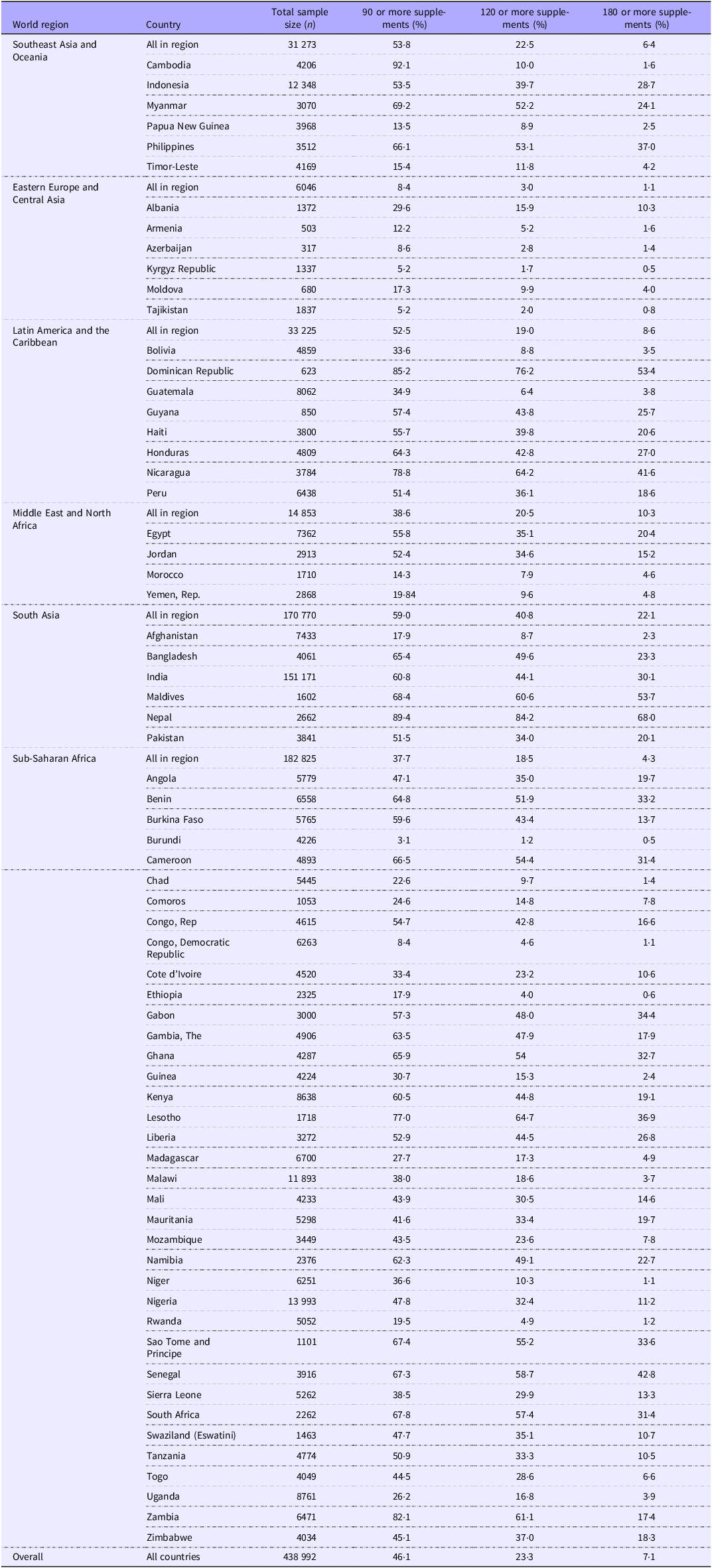
In total, 86·0 % of respondents reported that they bought or were given Fe tablets or syrup at least once during the last pregnancy in the 5 years preceding the survey. Among women for whom information on Fe adherence was available, 53·9 % consumed less than ninety Fe tablets, 13·0 % consumed between ninety and 119, 10·3 % consumed between 120 and 179 and only 7·1 % consumed 180 or more tablets (Table 1). Among all countries, Cambodia had the highest proportion of women who consumed ninety or more tablets (92·1 %), while Burundi had the lowest (3·1 %). Nepal had the highest proportion of women who consumed 120 (84·2 %) as well as 180 or more tablets (68·0 %), while Burundi had the lowest (1·2 % and 0·5 %, respectively) (Table 2).
Iron uptake and adherence during pregnancy among women responding to the DHS

Table 1 Long description
A table showing iron uptake and adherence during pregnancy among women responding to the DHS. The table has 8 rows and 5 columns. The columns are labeled 'Fe consumption', 'Number of women (weighted)', 'Pooled proportions', 'Median', and '25th, 75th percentiles'. The rows are labeled with different categories of iron consumption and adherence. Row 1: Fe uptake, 595787, 100.0, , . Row 2: Was given/bought Fe supplements, 473715, 86.0, , . Row 3: Distribution of Fe adherence, 438992, 100.0, , . Row 4: Less than 90 supplements, 215087, 53.9, , . Row 5: 90-119 supplements, 68215, 13.0, , . Row 6: 120-179 supplements, 66214, 10.3, , . Row 7: Greater than or equal to 180 supplements, 89476, 7.1, , . Row 8: Number of Fe supplements consumed, , , 90, 30, 150.
Figures are weighted for sampling probability based on DHS weights. Figures are counts and pooled proportions for categorical variables and median (25th percentile, 75th percentile) for continuous variables. Proportions were pooled together from individual countries using meta-analysis for proportions, to account for differences between countries, and, as such, they do not always reflect the counts.
* Data refer to the last pregnancy in the 5 years preceding the survey.
† Total number of LMICs = 69.
‡ Total number of LMICs = 67.
§ Denominator is women who responded ‘yes’ or ‘don’t know’ to whether they took or were given Fe supplements during the last pregnancy (Fe uptake).
Adherence to prenatal iron supplementation by country and world region

Table 2 Long description
The table presents data on adherence to prenatal iron supplementation by country and world region. It includes columns for world region, country, total sample size, and the percentage of women who consumed 90 or more, 120 or more, and 180 or more iron tablets. The table is divided into several world regions, each containing multiple countries. For example, in Southeast Asia and Oceania, Cambodia has the highest adherence with 92.1 percent of women consuming 90 or more tablets, while Indonesia has 39.7 percent. In Eastern Europe and Central Asia, Albania shows 29.6 percent adherence for 90 or more tablets. Latin America and the Caribbean show varying adherence, with Bolivia at 33.6 percent and Dominican Republic at 85.2 percent for 90 or more tablets. The Middle East and North Africa region includes Egypt with 55.8 percent and Jordan with 52.4 percent adherence for 90 or more tablets. South Asia shows significant variation, with Bangladesh at 6.8 percent and India at 44.1 percent for 90 or more tablets. Sub-Saharan Africa has a wide range, with Angola at 47.1 percent and Chad at 22.6 percent for 90 or more tablets. The table provides a comprehensive overview of prenatal iron supplementation adherence across different regions and countries.
Proportion of women who consumed 90 or more, 120 or more and 180 of more Fe supplements during the last pregnancy of the 5 years preceding the survey, by world region and country. Years: DHS ranging from 2000 to 2023. World regions based on 2025 World Bank classification. Number of LMICs in table: sixty-seven. Total sample in study includes sixty-nine countries, but data on number of Fe supplements consumed was not available for Colombia and Turkey. Figures are weighted for sampling probability based on DHS weights. Proportions by region and total were pooled together from individual countries using meta-analysis for proportions, to account for differences between countries, and, as such, they are not a simple average of proportions.
When looking at world regions, South Asia had the highest proportion of women consuming ninety or more, 120 or more and 180 or more Fe supplements (59·0 %, 40·8 % and 22·1 % respectively), while Eastern Europe and Central Asia had the lowest proportion in all three categories (8·4 %, 3·0 % and 1·1 %) (Table 2). Figures 1 and 2 present world maps showing the proportion of Fe supplement consumption across the countries included in the analysis. The maps indicate that the number of countries where 51 % to 100 % of women consume ninety or more supplements is notably higher than the number of countries reaching the same proportions for consumption of 120 or more supplements.
Proportion of pregnant women who consumed ninety or more iron supplements, by country.
Note. n 67 LMICs. Prevalence is weighted. Total number of women: 438 992. Data based on one survey per country.

Proportion of pregnant women who consumed 120 or more iron supplements, by country.
Note. n 67 LMICs. Prevalence is weighted. Total number of women: 438 992. Data are based on one survey per country.

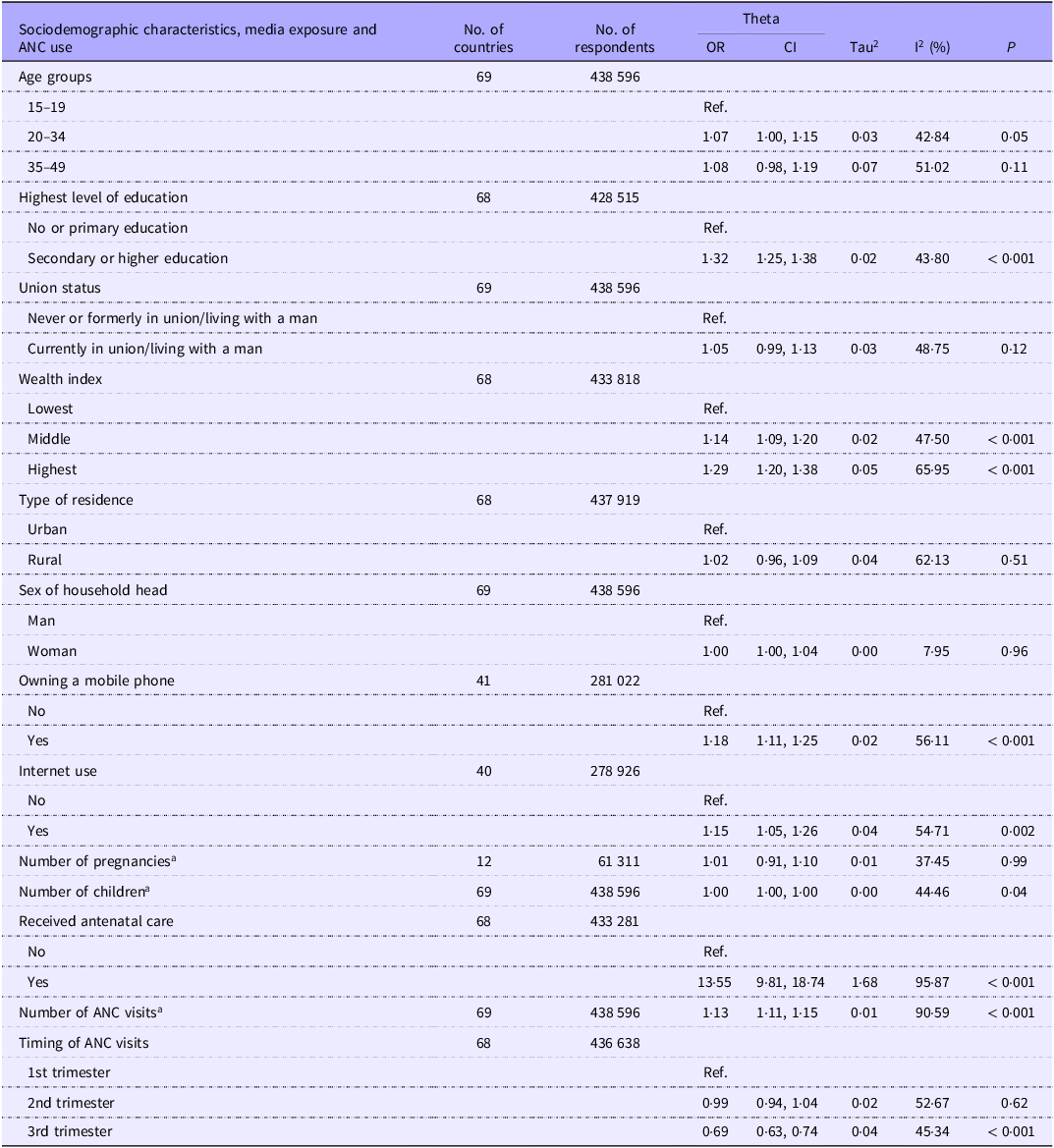
After adjusting for all exposures, two-step meta-analyses of logistic regressions showed that having secondary or higher education, compared with having no or primary education, was associated with 32 % higher odds of consuming Fe-containing supplements at least once during pregnancy (OR: 1·32; 95 % CI: 1·25, 1·38; P value < 0·001) (Table 3). Similarly, being in the middle and highest wealth indexes, compared with being in the lowest index, was associated with 14 % and 29 % higher odds of consuming Fe supplements, respectively (OR: 1·14; 95 % CI: 1·09, 1·20; P value < 0·001 and OR: 1·29; 95 % CI: 1·20, 1·38; P value < 0·001) (Table 3). A similar trend also emerged for having access to phones and internet, which were associated with higher odds of uptake compared with not having access. Finally, attending ANC visits was also associated with higher odds of consuming the supplements, compared with not attending, and attending ANC visits for the first time later in pregnancy, such as in the third trimester compared with the first trimester, was associated with lower odds of uptake (Table 3).
Associations between socio-demographic characteristics, media exposure and use of ANC services with uptake of iron supplements

Table 3 Long description
A table with 15 rows and 8 columns. The columns are labeled: Sociodemographic characteristics, media exposure and ANC use, No. of countries, No. of respondents, Theta, OR, CI, Tau^2, I^2 (%), and P. The rows are labeled with various sociodemographic characteristics such as age groups, highest level of education, union status, wealth index, type of residence, sex of household head, owning a mobile phone, internet use, number of pregnancies, number of children, received antenatal care, number of ANC visits, and timing of ANC visits. Each row provides data on the number of countries and respondents, and statistical values including OR, CI, Tau^2, I^2 (%), and P.
Two-step meta-analyses based on logistic regressions. Fe uptake defined as a binary indicator for whether the woman bought or was given Fe supplements during the most recent pregnancy of the 5 years preceding the survey. Significance taken at P < 0·05. Theta: pooled effect size resulting from meta-analysis. Tau2: between study variances. I2: heterogeneity of studies. a: continuous explanatory variable.
Similar trends emerged for consumption of ninety or more Fe supplements. Among women who reported consuming supplements at least once during pregnancy, higher levels of education, wealth index and access to media were positively associated with consuming ninety or more tablets (Table 4). Additionally, age groups 20–34 and 35–49 had higher odds of consuming ninety or more tablets compared with adolescents aged 15–19 years, and living in a rural area was slightly associated with lower odds of consumption of ninety or more tablets compared with living in an urban area (OR: 0·94; 95 % CI: 0·88, 1·00; P value = 0·05) (Table 4). Attending a higher number of ANC visits was associated with higher odds of adherence (OR: 1·18; 95 % CI: 1·15, 1·21; P < 0·001), and initiating ANC visits later in the pregnancy was associated with lower odds (OR: 0·93; 95 % CI: 0·88, 0·99; P < 0·02 for second trimester and OR: 0·29; 95 % CI: 0·26, 0·33; P < 0·001 for third trimester) (Table 4).
Associations between socio-demographic characteristics, media exposure and use of ANC services with consumption of ninety or more iron supplements in pregnancy

Table 4 Long description
A table with 15 rows and 8 columns. The columns are labeled: Socio-demographic characteristics, media exposure and ANC use, No. of countries, No. of respondents, Theta, OR, CI, Tau^2, I^2 (%), and P. The rows include Age groups, Highest level of education, Union status, Wealth index, Type of residence, Sex of household head, Owning a mobile phone, Internet use, Number of pregnancies, Number of children, Received antenatal care, Number of ANC visits, and Timing of ANC visits. Each row provides specific data points for the columns, detailing the associations and statistical values related to the consumption of ninety or more iron supplements during pregnancy.
Two-step meta-analyses based on logistic regressions. Adherence is defined by a binary indicator based on whether the respondent consumed ninety or more Fe supplements during the most recent pregnancy of the 5 years preceding the survey. Significance taken at P < 0·05. Theta: pooled effect size resulting from meta-analysis. Tau2: between study variances. I2: heterogeneity of studies. a: continuous explanatory variable.
When looking at consumption of 120 or more supplements, similar trends emerged related to age, education, wealth index, living in rural areas and access to media. Similarly, attending a higher number of ANC visits was associated with higher odds of consuming 120 or more tablets (OR: 1·23; 95 % CI: 1·20, 1·27; P < 0·001), while initiating ANC later in pregnancy was associated with lower odds (OR: 0·84; 95 % CI: 0·79, 0·89; P < 0·001 for second trimester; OR: 0·21; 95 % CI: 0·12, 0·25; P < 0·001 for third trimester, compared with first trimester) (online Supplementary Table 4).
When looking at results across world regions, trends for the associations between higher wealth index and uptake of Fe supplements observed in overall analyses were most clearly evident in Eastern Europe and Central Asia, the Middle East and North Africa, South Asia and Sub-Saharan Africa (online Supplementary Figure 2). Similarly, associations for higher wealth index and odds of consuming ninety or more supplements were most clear in Southeast Asia and Oceania, Middle East and North Africa and Sub-Saharan Africa (online Supplementary Figure 3). A higher number of ANC visits was associated with higher odds of Fe uptake and adherence across all regions, and initiating ANC visits in the third trimester was also associated with higher odds of Fe uptake and adherence across all regions (online Supplementary Figure 2 and 3). Finally, older age was associated with higher adherence only in the Middle East and North Africa, South Asia and Sub-Saharan Africa regions (online Supplementary Figure 3).
Discussion
The current study utilised DHS data to describe trends in consumption of Fe supplements among pregnant women in sixty-nine LMICs and explore socio-demographic and ANC-related determinants associated with Fe consumption. Four main findings emerged from the study. First, 86 % of all respondents reported receiving Fe supplements during pregnancy, and, among those receiving the supplements, 46 % reported consuming ninety or more supplements, while 23 % reported 120 or more and 7 % 180 or more. Second, higher education, wealth and access to media such as mobile phones or the internet were strongly associated with higher odds of initiating Fe supplementation and adhering to the regimen in the selected countries. This was also consistent for analyses across world regions. Third, living in a rural area was associated with lower odds of adherence compared with living in an urban area. Finally, ANC services played a key role in the consumption of Fe supplements among respondents, including across world regions.
While many women reported consuming Fe supplements at least once during pregnancy, less than 50 % of women reported adhering to the prescribed regimen, highlighting the existence of sustainability challenges. Figure 3 summarises the main determinants of prenatal Fe consumption based on the findings of our analysis and literature review, following the sem, which suggests that an individual’s behaviour is integrated into a complex system comprised of intrapersonal characteristics, interpersonal relationships, institutional factors, community influences and public policies(Reference Salihu, Wilson and King35).
Barriers and facilitators to prenatal iron supplementation among pregnant women in LMICs, based on socio-ecological model.

The finding of higher socio-economic indices being associated with increased likelihood of initiating and adhering to Fe supplementation is consistent with previous research. Karyadi and colleagues found that, in some African countries, being literate is associated with higher odds of adhering to an Fe regimen, compared with being non-literate(Reference Karyadi, Reddy and Dearden5). Additionally, studies have consistently found that education and knowledge of anaemia and Fe supplementation are associated with higher levels of Fe consumption, including systematic reviews(Reference Fite, Roba and Oljira16,Reference Sendeku, Azeze and Fenta17,Reference Lencha, Mengistu and Mekonnen19,Reference Billah, Raynes-Greenow and Ali23,Reference Mabuza, Waits and Nkoka24,Reference Saragih, Dimog and Saragih42) . Similarly, research shows an association between higher wealth and higher Fe consumption and adherence(Reference Karyadi, Reddy and Dearden5,Reference Alem, Efendi and McKenna6) .
Studies included in our review also reported that limited knowledge of anaemia and the benefits of supplementation, as well as misconceptions around IFA and MMS supplementation, prevented women from consuming the supplements(Reference Alam, Rasheed and Khan43–Reference Mbhenyane and Cherane49). At the intrapersonal level, these barriers include misconceptions around potential harms of the supplements, including the association of both IFA and MMS with larger size babies, miscarriages and excessive bleeding(Reference Ejidokun45,Reference Khaled, Kalbarczyk and Zavala46,Reference Clermont, Kodish and Seck50–Reference Hess, Ouédraogo and Bamba54) , while at the community level, they include cultural beliefs such as associating pill-taking with HIV(Reference Martin, Omotayo and Chapleau55,Reference Tinago, Annang Ingram and Blake56) (Figure 3). On the other hand, a good understanding of the purpose and benefits of the supplements constitutes an important facilitator(Reference Alam, Rasheed and Khan43,Reference Getachew, Abay and Zelalem57) .
Even though having access to mobile phones and to the internet was associated with higher odds of Fe uptake and adherence overall, these two media tools can be considered proxies of higher wealth, especially in LMICs(Reference West58). Nevertheless, studies in our review found that other media tools such as radio, television, newspapers and bus advertisements are perceived by the women as useful ways to promote consumption of the supplements, supporting the idea that various forms of media can be beneficial in increasing acceptability of Fe supplements and promoting consumption(Reference Alam, Rasheed and Khan43,Reference Ejidokun45,Reference Nisar, Alam and Aurangzeb59) . However, wealth, literacy and location are important characteristics to consider when utilising media to distribute Fe supplements information, as they significantly affect the type of media access women have(Reference Ejidokun45,Reference Nisar, Alam and Aurangzeb59) .
The third major finding of the study pertains to differences in Fe consumption between rural and urban locations, as living in rural locations was associated with lower odds of adherence, compared with living in urban locations. As our review highlights, there are significant barriers to accessing supplements in rural areas in LMICs. At the intrapersonal level, these barriers include financial constraints and food insecurity (Figure 3)(Reference Siekmans, Roche and Kung’u12,Reference Clermont, Kodish and Seck50,Reference Simuyemba, Bwembya and Chola52,Reference Nisar, Alam and Aurangzeb59) . Importantly, food insecurity was mentioned by many women as a key barrier to Fe consumption, as women often prefer or are advised to consume supplements with food, and the lack of food can negatively affect consumption. Additionally, many women reported hunger as a side effect of the supplements and were afraid that they would not be able to satisfy the hunger after supplementation while facing food insecurity(Reference Clermont, Kodish and Seck50,Reference Simuyemba, Bwembya and Chola52) . Furthermore, women in rural areas often struggle with access to ANC services and to Fe supplements, as clinics and pharmacies tend to be far away from their homes(Reference Nisar, Alam and Aurangzeb59).
Our study also underscores the importance of initiating ANC early in pregnancy, to facilitate access to Fe supplements early on. This is consistent with previous literature exploring the role of ANC timing in prenatal supplementation, which found an association between later ANC initiation and lower supplement consumption, attributable, among other factors, to education and counseling provided during the visits(Reference Siekmans, Roche and Kung’u12,Reference Billah, Raynes-Greenow and Ali23,Reference Begum, Ouédraogo and Wessells25,Reference Islam and Zobair60–Reference Wendt, Stephenson and Young63) . Our review of the literature identified numerous barriers to antenatal ANC attendance. At the intrapersonal level, major barriers include the inability to afford healthcare and ANC visits, low perceived value of ANC and fears related to hospitals, pregnancy confirmation and HIV testing(Reference Siekmans, Roche and Kung’u12,Reference Simuyemba, Bwembya and Chola52) . At the institutional level, key challenges are the distance to ANC facilities and concerns about the quality of care and hospitality during visits (Figure 3)(Reference Begum, Ouédraogo and Wessells25,Reference Simuyemba, Bwembya and Chola52) . These aspects encompassed the availability of healthcare providers, particularly female providers, patient–provider relationships, wait times, the provision of a sufficient number of supplements and the quality, consistency and depth of information shared by providers.
Notably, several studies reported that women were often not adequately counseled on the benefits and side effects of supplements and that confusion existed among both patients and providers regarding the appropriate timing for ANC initiation and the supplementation regimen(Reference Siekmans, Roche and Kung’u12,Reference Ba, Fox and Keita44,Reference Mbhenyane and Cherane49,Reference Simuyemba, Bwembya and Chola52,Reference Tinago, Annang Ingram and Blake56,Reference Lyoba, Mwakatoga and Festo64–Reference Searle, Hurley and Doumbia67) . It is critical to improve training of healthcare and community health workers and to establish clear, consistent and nationally endorsed guidelines for both supplementation and timing of ANC attendance. Additionally, cultural norms requiring women to be accompanied by a family member to attend ANC visits, as well as reduced mobility and autonomy of women due to prevailing gender norms and beliefs, can be significant barriers at the community level(Reference Siekmans, Roche and Kung’u12,Reference Muthuraj, Kandasamy and Subbiah51) . Finally, at the public policy level, as previously noted, the affordability and accessibility of ANC services and supplements, as well as access to affordable public transportation, are critical determinants of ANC attendance (Figure 3)(Reference Siekmans, Roche and Kung’u12,Reference Lacerte, Pradipasen and Temcharoen68,Reference Mishra, Marwah and Divedi69) .
The literature review identified additional barriers and facilitators for consumption of IFA and MMS. At the intrapersonal level, personal preferences regarding the smell, taste and size of supplements significantly influenced adherence (Figure 3)(Reference Muthuraj, Kandasamy and Subbiah51,Reference Pasaribu, Aritonang and Sudaryati66,Reference Morrison, Giri and Arjyal70–Reference Aikawa, Jimba and Nguen72) . These preferences should be considered when selecting the form of supplementation, whether tablets, capsules, syrups or powders, and when deciding between IFA and MMS(Reference Alam, Rasheed and Khan43,Reference Ba, Fox and Keita44) . Additional barriers include side effects, particularly with IFA, such as nausea, dizziness, vomiting, constipation, diarrhoea, black stools and changes in appetite(Reference Siekmans, Roche and Kung’u12,Reference Labonté, Hoang and Panicker48–Reference Simuyemba, Bwembya and Chola52,Reference Tinago, Annang Ingram and Blake56,Reference Getachew, Abay and Zelalem57,Reference Nisar, Alam and Aurangzeb59,Reference Lyoba, Mwakatoga and Festo64,Reference Riang’a, Nangulu and Broerse65,Reference Searle, Hurley and Doumbia67,Reference Morrison, Giri and Arjyal70,Reference Young, Blanco and Hernandez-Cordero71,Reference Nechitilo, Nguyen and Webb-Girard73–Reference Yassin, Kumma and Haile80) , as well as forgetfulness(Reference Siekmans, Roche and Kung’u12,Reference Muthuraj, Kandasamy and Subbiah51–Reference Ghanekar, Kanani and Patel53,Reference Getachew, Abay and Zelalem57,Reference Nisar, Dibley and Mir62,Reference Lyoba, Mwakatoga and Festo64,Reference Arega Sadore, Abebe Gebretsadik and Aman Hussen74) . Facilitators of adherence include perceived improvements in anaemia-related symptoms and the adoption of strategies to help remember to take the supplements regularly (Figure 3)(Reference Aikawa, Jimba and Nguen72).
At the interpersonal level, other barriers include negative influence from family members. In many cultural contexts, women often rely on the advice of husbands, mothers and mothers-in-law, and several studies reported that women were discouraged by family members from taking supplements due to fears that they might harm the pregnancy(Reference Alam, Rasheed and Khan43,Reference Khaled, Kalbarczyk and Zavala46,Reference Muthuraj, Kandasamy and Subbiah51,Reference Ghanekar, Kanani and Patel53,Reference Nisar, Dibley and Mir62) . Conversely, facilitators include family support and encouragement, the presence of adherence partners and trust in healthcare professionals(Reference Martin, Omotayo and Chapleau55,Reference Morrison, Giri and Arjyal70) . At the community level, the limited acceptability of supplements, particularly MMS, emerged as a significant barrier. In contrast, hearing positive experiences from other women in the community and seeing healthy babies born to women who had taken IFA or MMS served as strong motivators for supplement uptake (Figure 3)(Reference Clermont, Kodish and Seck50).
Our study has a few limitations. First, the analysis is cross-sectional in nature, which limits the ability to draw causal inferences, and country coverage is uneven, with underrepresentation in certain regions such as Latin America. Second, data on Fe supplement consumption from DHS surveys are self-reported and retrospective, which may introduce recall bias. In particular, there may be recall error and digit preference (heaping), whereby respondents round values to salient numbers. Because the study categorised intake using thresholds of 90, 120 and 180 supplements, some misclassification may have occurred. However, these cut-offs correspond to commonly used programmatic indicators, which supports comparability with prior studies. Because intake was analysed using policy-relevant thresholds rather than exact counts, the potential influence of digit preference is expected to have a limited impact on overall interpretation. In addition to recall bias, there may be social desirability bias(Reference Kanyangarara, Katz and Munos81), which could result in an overestimation of supplement intake. However, as with recall-related misclassification, the use of broad, policy-relevant intake categories is likely to mitigate the impact of such bias on the findings.
Additionally, DHS surveys do not distinguish between types of Fe supplements, which may vary significantly based on country and procurement location (e.g. pharmacies v. government clinics); thus, reported intake may refer to various formulations, including IFA or MMS, although it is not clear whether MMS are understood as Fe-containing supplements by beneficiaries(Reference Walton, Wood and Munos82) and different delivery forms (e.g., tablets, capsules and syrups). While efforts have been made to embed MMS-specific indicators into national household surveys(Reference Mei, Jefferds and Namaste83,84) , systematic data collection for MMS is not well established yet. Fourth, the data span a broad period (2000–2024), during which supplementation policies and practices may have changed significantly.
Our study also has several important strengths. First, the analysis includes data from sixty-nine LMICs, offering valuable insights across six of the seven World Bank regions. Second, the use of a two-step meta-analysis approach enabled us to account for the substantial heterogeneity in data across countries. Third, the quantitative findings were complemented by an extensive literature review, which provided deeper understanding of the barriers and facilitators influencing Fe supplementation practices.
These findings underscore the importance of individual characteristics and context-specific determinants, including national, community and cultural aspects, as well as the complex relationship and interconnection between them. Country governments should consider: (a) carefully revising or producing national ANC guidelines in alignment with the WHO guidelines(13,Reference Tuncalp, Rogers and Lawrie85) and with local customs, to ensure that clear guidance is provided to healthcare professionals, community health workers and pregnant women regarding timing and frequency of ANC attendance, as well as regimen for IFA and MMS supplementation and (b) producing policies and procedures to ensure availability and affordability of ANC services, Fe supplements and transportation means, with particular attention to rural areas.
Both objectives can be advanced through collaboration with countries that have well-established systems for the provision of IFA and MMS. To support this, future research should focus on documenting successes and lessons learned from national and sub-national prenatal supplementation programs, with particular attention to coverage, sustainability and implementation strategies. Establishing a centralised database for knowledge sharing would further facilitate cross-country learning. Moreover, while many national surveys already track IFA consumption during pregnancy, there is a pressing need to develop and integrate specific indicators for MMS consumption to enable accurate monitoring and improve data quality at national and global levels(Reference Mei, Jefferds and Namaste83).
Conclusion
Several socio-demographic factors and ANC attendance play a crucial role in the success of prenatal Fe supplementation programs. In addition, factors such as personal preferences, side effects and acceptability of the supplements; family and cultural influences and the accessibility and affordability of ANC services, supplements and transportation are key determinants of both uptake and adherence. Country governments should consider establishing clear guidelines for initiation and continuation of both ANC and Fe supplementation during pregnancy, based on the WHO guidelines. Furthermore, there is a need to develop a comprehensive platform that systematically collects data on the successes and challenges of national and sub-national supplementation programs and facilitates cross-country knowledge sharing to improve policy and practice.
Supplementary material
For supplementary material/s referred to in this article, please visit https://doi.org/10.1017/S000711452610720X
Acknowledgements
This work received no financial support.
W. F. conceptualised of the study; E. F. and U. P. curated the data; E. F. conducted the formal analysis and interpreted the data with support from U. P.; E. F. wrote the original draft; E. F., U. P. and W. F. reviewed and edited the original draft; E. F., U. P. and W. F. reviewed and approved the final draft to be published; U. P. and W. F. provided mentorship and supervision.
The authors declare no conflicts of interest.
The datasets generated and/or analysed during this study are available through the DHS Program at: https://dhsprogram.com/data/available-datasets.cfm.