Introduction
Velopharyngeal incompetence is a common abnormality in cleft palate patients.Reference Shprintzen and Golding1 It causes hypernasal speech, a major communicative disorder.Reference Shprintzen and Marrinan2, Reference Ysunza, Landeros, Pamplona, Prado, Arrieta and Fajardo3 Patients exhibit a combination of structural, anatomicalReference Ysunza, Landeros, Pamplona, Prado, Arrieta and Fajardo3 and behavioural deficiencies, which must be simultaneously and thoroughly assessed.Reference Loney and Bloem4 Velopharyngeal insufficiency can affect both speech and swallowing, which is of major concern in a growing child. Speech disruptions in children, regardless of the cause, are associated with poorer scholastic performance and an increased risk of retention in grade school. They adversely affect the child's social, emotional, educational development, effective communication, self-esteem, and participation in activities. Peers and caregivers often perceive these children negatively, and the resulting emotional impact may affect their participation in activities and scholastic performance.Reference Barr, Thibeault, Muntz and de Serres5 Many health centres offer multidisciplinary team management at a cleft palate clinic, where the child's primary care physician plays an important role in helping the child and his or her family choose the best treatment option.Reference Shah and Wong6
ENT problems appear in almost two-thirds of children with cleft palate or unilateral cleft lip and palate. Otolaryngologists are increasingly required to assist in the differential diagnosis of velopharyngeal valving disorders for speech, treatment planning and assessing treatment outcomes.Reference Tweedie, Skilbeck, Wyatt and Cochrane7 The methods most commonly used for direct visualisation of velopharyngeal function are flexible fibre-optic nasopharyngoscopy and video fluoroscopy. Literature supporting the use of either flexible fibre-optic nasopharyngoscopy followed by video fluoroscopy or the reverse can be found.Reference Marsh8 Magnetic resonance imaging can also make an important contribution to evaluating velopharyngeal anatomy and function.Reference Ozgur, Tuncbilek and Cila9 A recent study documented the use of video endoscopy after a given surgical procedure in predicting surgical success or complications and evaluating treatment outcomes.Reference Ysunza, Pamplona, Femat, Mayer and Garcia10 Contradictory reports regarding the best method for evaluating velopharyngeal function suggest that no single method is best. The choice of the most appropriate evaluation protocol should be guided by which specific information the clinician is seeking and the relative benefits and risks of each method.Reference Rowe and D'Antonio11
Flexible fibre-optic nasopharyngoscopy and speech assessment early in the evaluation process provides not only good information for surgical correction but also a reference point for further management.Reference Shprintzen and Marrinan2 A good digital recording of endoscopy and good record of speech assessment would be useful bio-feedback tools as the child grows.Reference Ysunza, Pamplona, Femat, Mayer and Garcia10 However, to our knowledge this has not yet been investigated. As there is insufficient data comparing velopharyngeal incompetence type and speech defects both from India and internationally, a pilot study was performed to estimate the sample size. Our primary objectives were to assess the role of video endoscopy in evaluating velopharyngeal incompetence and to establish a possible association between the velopharyngeal incompetence type and the specific speech defect.
Materials and methods
A prospective observational study was performed in the ENT and plastic surgery departments of Christian Medical College at Vellore, India. In all, 28 consecutive patients diagnosed with a cleft palate (pre- or post-operative) who exhibited unclear or nasalised speech at age nine months and above were enrolled. Children with multiple syndromic deformities were excluded. The study was approved by the institutional review board, and all patients fulfilling the criteria were subjected to a detailed ENT evaluation. Their ears were examined for tympanic membrane status and their hearing was evaluated by pure tone (those aged above five years) and impedance audiometry. Radiography of the soft tissues of the neck (lateral view) was performed to ascertain the adenoid status. Speech defects were assessed according to the cleft audit protocol for speech by a speech pathologist experienced in assessing and training children with nasalised speech. Findings were noted and subsequently analysed.
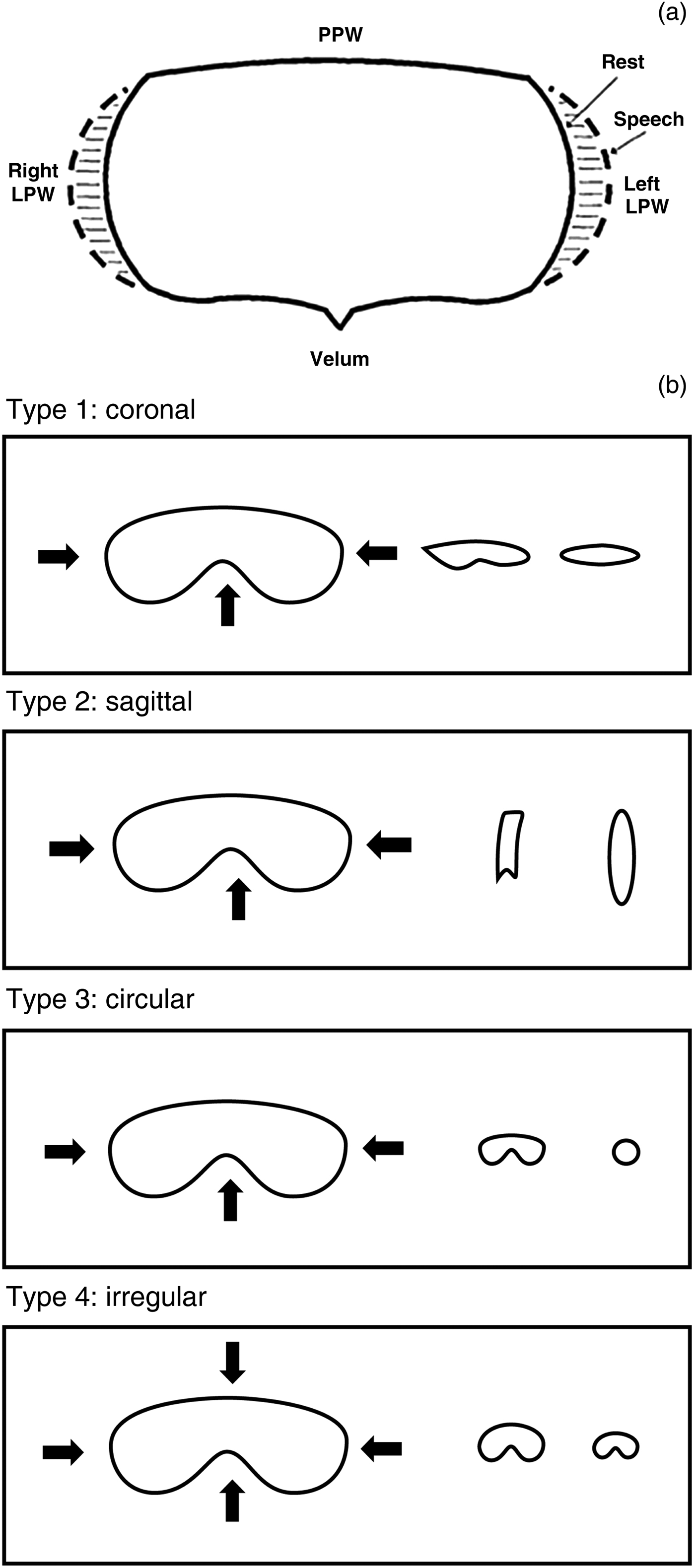
Flexible video endoscopy was performed to ascertain the velopharyngeal incompetence type (Figure 1). A nasal spray consisting of a 1:1 ratio of 0.025% oxymetazoline hydrochloride solution and 2 per cent Xylocaine® was used to help open the nasal passages and numb each side of the nasal cavity for easy and comfortable endoscope insertion. A 3 mm flexible end-viewing Pentax (FNL-10S; Englewood, Colorado, USA) or Olympus (ENF-P; Melville, New York, USA) nasopharyngoscope was used to observe the velopharyngeal port. The endoscope was passed over the middle meatus of the nose to provide a high angle of view above the palate and minimise disturbance by soft palate movement.Reference Karen and Golding12 Once the palate and pharyngeal walls were visualised, the scope was kept stationary. The velopharyngeal apparatus was then examined and mobility of the respective walls was observed during crying (infants and young children) or talking (older children). Older children and young adults were asked to state their name and age, count from 1 to 20, produce sustained vowel sounds, consonant vowel repetitions, sustained ‘s’ sounds, and connected speech (sentence repetition), and repeat a standard sentence containing the consonant ‘k’. The endoscope was moved laterally within the pharynx so that both the lateral pharyngeal walls could be observed (Figure 2), and then passed deep into the pharynx until the larynx was seen. This procedure allowed all possible vertical levels of movement to be observed.Reference Karen and Golding12 Videotaped sequences were then evaluated and the defect pattern was assessed.
(a) Normal velopharyngeal movement. PPW = posterior pharyngeal wall; LPW = lateral pharyngeal wall. (b) Various patterns of velopharyngeal closure seen in velopharyngeal incompetence. Adapted from Muntz et al. 14

Endoscopic view of type 1 (a), type 2 (b), type 3 (c), and type 4 (d) velopharyngeal incompetence
Statistical analyses were performed using the Statistical Package for Social Science program version 6.0 (SPSS Inc, Chicago, IL, USA).
Results
A total of 28 patients took part in the study; of these, 16 (57.1 per cent) were males and 12 (42.9 per cent) were females. Their ages ranged from 1 to 23 years (mean 7.71 years, standard deviation 5.28 years). Seven patients (25 per cent) were pre-operative and 21 (75 per cent) were post-operative.
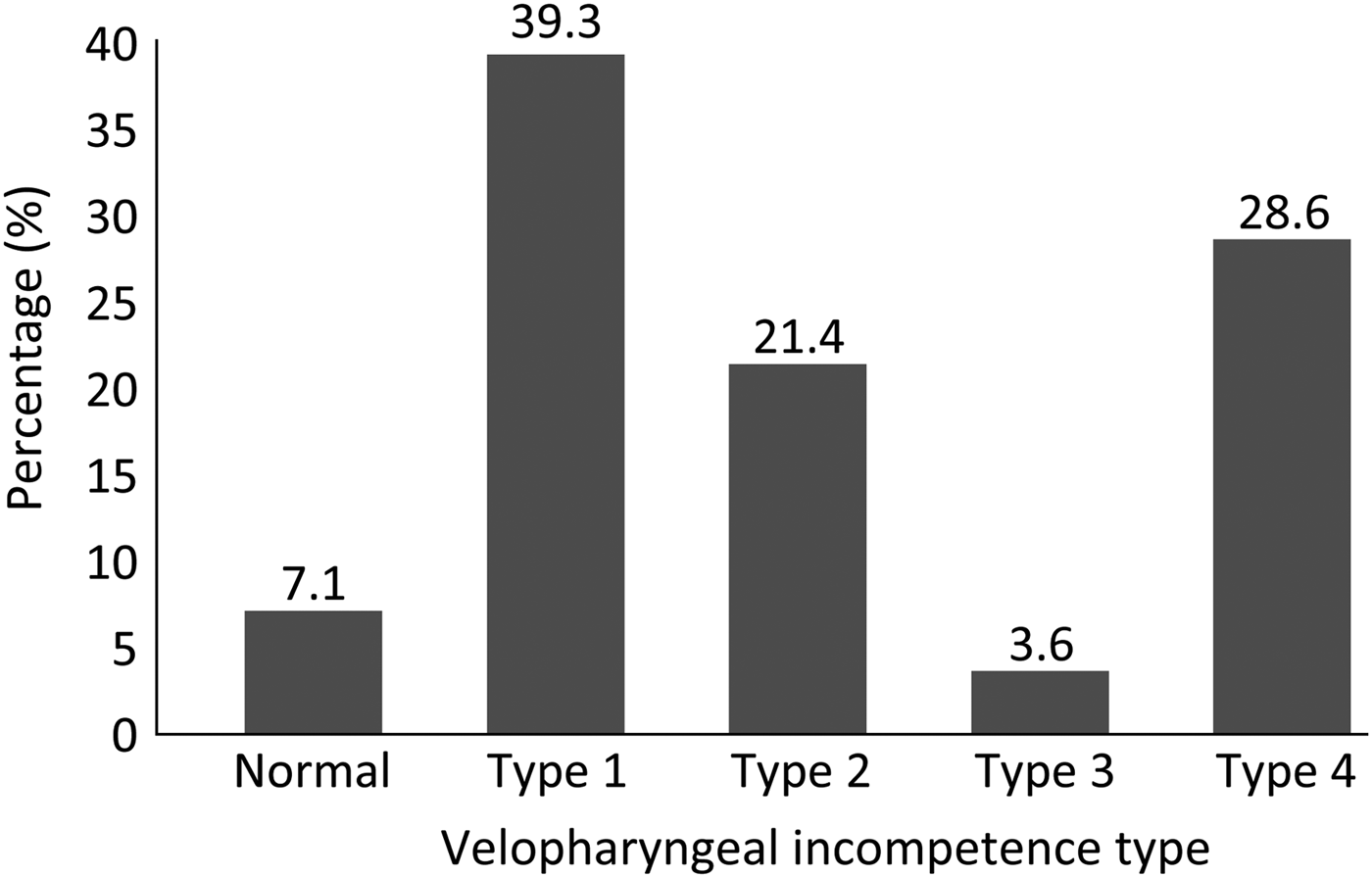
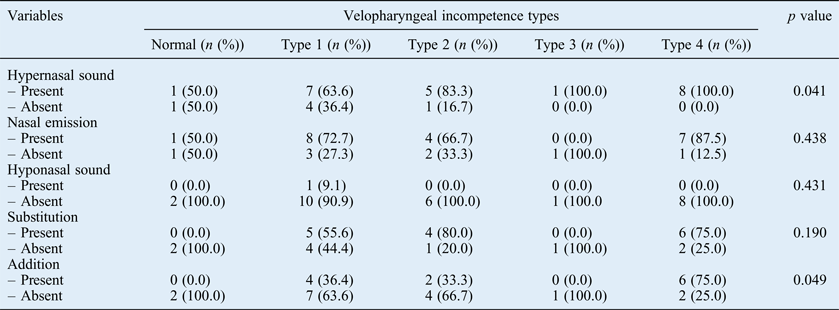
Type 1 velopharyngeal incompetence was commonest (39.3 per cent), followed by type 4 (28.6 per cent) and type 2 (21.4 per cent; Figure 3). Type 3 was least common (3.6 per cent), and 7 per cent of participants had normal velopharyngeal function. Type 1 velopharyngeal incompetence was most common in pre-operative patients (63.6 per cent), and type 4 velopharyngeal incompetence was most common (87.5 per cent) in post-operative patients. Of the entire cohort, 22 (79 per cent) had hypernasal speech. Hypernasal speech was most common in type 1 velopharyngeal incompetence patients with nasal emission (p = 0.041). Although nasal emission is common in type1 velopharyngeal incompetence (72 per cent; Table I), this association was not statistically significant. In 92.8 per cent of patients, hearing was normal, with no evidence of middle-ear effusion, while two post-operative patients had unilateral atticoantral disease.
Graph showing the prevalence of different velopharyngeal incompetence types in cleft palate patients.
Comparison of speech defects (resonance) in various types of velopharyngeal incompetence
Discussion
Otolaryngologists assist in the differential diagnosis of velopharyngeal valving disorders affecting speech, in planning treatment and in assessing treatment outcomes.Reference Tweedie, Skilbeck, Wyatt and Cochrane7 The methods most commonly used for direct visualisation of velopharyngeal function are flexible fibre-optic nasopharyngoscopy and video fluoroscopy. Nasendoscopy and speech assessment of children early in the evaluation process provides both good information for surgical correction and a reference for further management.Reference Shprintzen and Marrinan2 Recordings of the endoscopy procedure and records of speech pathology can be used as bio-feedback tools as the child grows.Reference Ysunza, Pamplona, Femat, Mayer and Garcia10
In the present prospective study, 28 participants aged between 1 and 23 years with unclear speech secondary to cleft palate were all successfully endoscoped. In contrast, in the study by Antonio et al., three children could not be endoscoped after two separate attempts.Reference D'Antonio, Muntz, Marsh, Marty-Grames and Backensto-Marsh13 The present study identified a significant clinically relevant relationship between perceived hypernasality and velopharyngeal insufficiency type. In our study, most cleft palate patients with unclear speech were post-operative (75 per cent). Type 1 velopharyngeal incompetence (or coronal) defect was most common, followed by type 4 (irregular), type 2 (sagittal) and type 3 (circular), in descending order. This pattern was previously reported by Harlan et al. Reference Muntz, Taylor, Smith, Cummings, Flint, Harker, Haughey, Richardson, Robbins, Schuller and Thomas14 Further analysis revealed type 1 velopharyngeal dysfunction to be significantly associated with hypernasality (p = 0.041). This finding has not been reported previously. Perceptual ratings of hypernasality and speech distortion were significant predictors of velopharyngeal incompetence type. Perceptual characteristics accurately predicted type 1 and type 2 velopharyngeal incompetence with accuracies of 63.6 per cent and 75 per cent, respectively. Compensatory or addition articulation of plosive, and fricative words was pathognomic of type 2 velopharyngeal incompetence (p = 0.049). Nasal emission was also more common in type1 velopharyngeal incompetence (72.7 per cent), and nasal substitution (‘b’ with ‘m’ and ‘d’ with ‘n’) was more common in types 1 and 2 velopharyngeal incompetence (Table I). Word distortion was absent in patients with type 2 velopharyngeal incompetence (83 per cent) and present in those with types 1 and 4. Although none of these associations reached statistical significance, they have not been previously reported.
Regarding associations between the surgical status of patients and velopharyngeal incompetence type, type 1 velopharyngeal incompetence is more common in pre-operative patients (63.6 per cent) and type 4 velopharyngeal incompetence is more common in post-operative patients (87.5 per cent). The latter may be caused by inadequate surgical speech correction. In our study, most patients had normal hearing, with no evidence of middle-ear effusion (92.8 per cent), and an absence of adenoid enlargement (71.4 per cent). This has not been previously reported.
• Perceptual speech assessment and flexible video endoscopy indicate links between speech defect and velopharyngeal incompetence type in cleft palate patients
• Velopharyngeal endoscopy with speech assessment defines the anatomical and functional bases for velopharyngeal correction
• A multidisciplinary approach involving otolaryngologists, plastic surgeons and speech pathologists is the best way to manage velopharyngeal incompetence
Treatment of velopharyngeal dysfunction by speech therapy alone is usually reserved for patients with characteristics such as phoneme-specific nasal emission (which can occur with the use of a posterior nasal fricative), inconsistent hypernasality or nasal emission, stimulable closure, or a small velopharyngeal gap (3 mm), as observed through objective measures.Reference Shprintzen and Marrinan2 However, when speech distortion seems severe, as is usually the case with hypernasality, clinicians may not consider speech therapy an option until after physical or surgical management.
Conclusion
This study found that some predictions of velopharyngeal incompetence type can be made based on speech assessment alone. When hypernasal speech is noted, the likely cause is type 1 velopharyngeal incompetence, and speech substitution is a predictor of type 2 velopharyngeal incompetence. However, a more confident prediction of a type 1 opening can be made if the patient's speech has a hypernasal sound. Flexible video endoscopy can be used to confirm the structural changes causing the defect.
Although perceptual speech assessment can predict the type of velopharyngeal gap, it is important to note that the size and type of the velopharyngeal gap, and not the severity of the speech distortion, may be the primary determinant of appropriate treatment. Therefore, pre-operative flexible video endoscopy is a relevant investigation in the management of cleft palate patients because it provides critical information for surgical correction of the defect.
When managing cleft palate patients, it is important that surgical correction of the defect is performed at the same time as velopharyngeal competency for speech is achieved without creating nasal airway obstruction. Velopharyngeal endoscopy with speech assessment defines the anatomical and functional bases of velopharyngeal correction and can be used to plan or tailor pharyngeal flaps. This procedure also provides essential ‘surgical feedback’. Hence, a multidisciplinary approach involving otolaryngologists, plastic surgeons and speech pathologists is necessary for pre-operative evaluation of the defect by perceptual speech analysis and velopharyngeal endoscopy.
Acknowledgements
Dr Rajan wishes to extend his sincere thanks to his teachers Prof. Anand Job and Prof. John Matthew for their support and guidance. We also thank the Christian Medical College for providing the fluid research grant to fund this study.