INTRODUCTION
It has been well established that young deaf children who receive cochlear implants (CIs) during the first three to four years of life are capable of acquiring spoken language but vary enormously in their degree of mastery (Szagun, Reference Szagun2001; Svirksy, Teoh & Neuburger, Reference Svirsky, Teoh and Neuburger2004; Duchesne, Sutton & Bergeron, Reference Duchesne, Sutton and Bergeron2009; Niparko, Tobey, Thal, Eisenberg, Wang, Quittner & Fink, Reference Niparko, Tobey, Thal, Eisenberg, Wang, Quittner and Fink2010; Peterson, Pisoni & Miyamoto, Reference Peterson, Pisoni and Miyamoto2010). The extent of variability far exceeds that observed in normally hearing children (Szagun, Reference Szagun2001; Svirsky et al., Reference Svirsky, Teoh and Neuburger2004; Duchesne et al., Reference Duchesne, Sutton and Bergeron2009). A number of factors contributing to this wide variation are known, notably duration of implant use, age at implantation, quality of pre-implant hearing, communication mode, parents’ educational status, parental language, and interactive style (Connor, Hieber, Arts & Zwolan, Reference Connor, Hieber, Arts and Zwolan2000; Szagun, Reference Szagun2001; Svirsky et al, Reference Svirsky, Teoh and Neuburger2004; Tomblin, Barker, Spencer, Zhang & Gantz, Reference Tomblin, Barker, Spencer, Zhang and Gantz2005; Geers, Nicholas & Moog, Reference Geers, Nicholas and Moog2007; Geers, Moog, Biedenstein, Brenner & Hayes, Reference Geers, Moog, Biedenstein, Brenner and Hayes2009; Niparko et al., Reference Niparko, Tobey, Thal, Eisenberg, Wang, Quittner and Fink2010; Peterson et al., Reference Peterson, Pisoni and Miyamoto2010; Szagun & Stumper, Reference Szagun and Stumper2012; Cruz, Quittner, Marker & DesJardin, Reference Cruz, Quittner, Marker and DesJardin2013). However, the amount of variability each factor explains is often small, and a large proportion of variance remains unexplained (Tomblin et al., Reference Tomblin, Barker, Spencer, Zhang and Gantz2005; Geers et al., Reference Geers, Nicholas and Moog2007; Geers et al., Reference Geers, Moog, Biedenstein, Brenner and Hayes2009, Niparko et al., Reference Niparko, Tobey, Thal, Eisenberg, Wang, Quittner and Fink2010; Giezen, Reference Giezen2011). Furthermore, we do not know how the various factors interact during the course of development, and possibly change their impact on linguistic progress. Thus, it is difficult, if not impossible, to make reliable predictions about children's spoken language outcomes.
The present study examines the relative impact of age at implantation, parental expansions, and children's initial language level on later language outcomes. A second analysis explores to what extent different properties of children's early language are sources of variability in later grammatical skills.
The role of age at implantation
In the paediatric cochlear implant literature, age at implantation has been viewed as a major predictor of spoken language outcomes in children with CIs. Studies indicate that children who receive a CI by around 2;5 have better language outcomes than children implanted thereafter (Svirsky et al., Reference Svirsky, Teoh and Neuburger2004; Tomblin et al., Reference Tomblin, Barker, Spencer, Zhang and Gantz2005; Geers et al., Reference Geers, Moog, Biedenstein, Brenner and Hayes2009; Geers & Nicholas, Reference Geers and Nicholas2013; Tobey, Thal, Niparko, Eisenberg, Quittner & Wang, Reference Tobey, Thal, Niparko, Eisenberg, Quittner and Wang2013). Importantly, such better outcomes are enduring over time (Geers & Nicholas, Reference Geers and Nicholas2013; Tobey et al., Reference Tobey, Thal, Niparko, Eisenberg, Quittner and Wang2013). Whether implantation during the first year of life is of additional advantage for spoken language would appear unclear at present, some studies showing a significant effect (Leigh, Dettman, Dowell & Briggs, Reference Leigh, Dettman, Dowell and Briggs2013) and others not (Holt & Svirsky, Reference Holt and Svirsky2008; Yoshinago-Itano, Baca & Sedey, Reference Yoshinago-Itano, Baca and Sedey2010; Szagun & Stumper, Reference Szagun and Stumper2012).
The age-at-implantation effect has been explained by linking the ability to build up language directly to early sensitivity for building up auditory pathways (Peterson et al., Reference Peterson, Pisoni and Miyamoto2010) and to earlier access to auditory linguistic experience (Tobey et al., Reference Tobey, Thal, Niparko, Eisenberg, Quittner and Wang2013). Such earlier language experiences would lead to better language development (Tobey et al., Reference Tobey, Thal, Niparko, Eisenberg, Quittner and Wang2013). Importantly, the age-at-implantation effect has been discussed within the framework of a ‘sensitive period’ for language learning (Svirsky et al., Reference Svirsky, Teoh and Neuburger2004; Holt & Svirsky, Reference Holt and Svirsky2008; Leigh et al., Reference Leigh, Dettman, Dowell and Briggs2013). During a sensitive period, the effect of experience on the brain is particularly strong and a capacity is readily shaped (Knudsen, Reference Knudsen2004). In order for the behaviour to develop normally, the experience must occur within a time-limited period in development. The heightened sensitivity for language learning is assumed to be strongest during the first four years of life. This is inferred from studies of second language learning and American Sign Language (ASL) acquisition, which show that proficiency is best if learning occurs by around four years (Johnson & Newport, Reference Johnson and Newport1989; Neville & Bavelier, Reference Neville, Bavelier, Johnson, Munakata and Gilmore2002; Mayberry, Reference Mayberry, Marshark and Spencer2009). Better language outcomes in children with CIs who are implanted younger within the sensitive period may point to increased sensitivity early on during this period.
These considerations would still not explain fully why some later-implanted children develop language skills within the normal range, whereas some younger-implanted children do not. A crucial variable contributing to such outcomes might be the availability of early linguistic experience independent of modality. Core language regions are not dependent on modality (Neville & Bavelier, Reference Neville, Bavelier, Johnson, Munakata and Gilmore2002; Mayberry, Chen, Witcher & Klein, Reference Mayberry, Chen, Witcher and Klein2011; Cardin, Orfanidou, Rönnberg, Capek, Rudner & Woll, Reference Cardin, Orfanidou, Rönnberg, Capek, Rudner and Woll2013; Lyness, Woll, Campbell & Cardin, Reference Lyness, Woll, Campbell and Cardin2013). Later implanted children have already constructed communicative systems, possibly including visual language (Connor et al., Reference Connor, Hieber, Arts and Zwolan2000; Tomblin, Barker & Hubbs, Reference Tomblin, Barker and Hubbs2007). There is evidence that exposure to sign language before cochlear implantation relates positively to spoken language skills after implantation (Hassanzadeh, Reference Hassanzadeh2012; Davidson, Lillo-Martin & Pichler, Reference Davidson, Lillo-Martin and Pichler2014). Native signing children with sign language input from birth demonstrate post-implantation spoken language skills within the normal range (Davidson et al., Reference Davidson, Lillo-Martin and Pichler2014) and outperform CI children with no such support (Hassanzadeh, Reference Hassanzadeh2012). Such evidence suggests that access to sign language provides language input to multimodal language circuits which may facilitate the subsequent construction of language from the auditory signal (Lyness et al., Reference Lyness, Woll, Campbell and Cardin2013). Thus, good language outcomes in later-implanted children may, at least partly, relate to accessibility of visual language input.
The role of social environmental variables and expansions
In typical language development, higher levels of socioeconomic status, parental education, and rich maternal language input are associated with faster growth of vocabulary and grammar (Hoff-Ginsberg, Reference Hoff-Ginsberg1985; Hoff, Reference Hoff2003; Fenson, Marchman, Thal, Dale, Reznick & Bates, Reference Fenson, Marchman, Thal, Dale, Reznick and Bates2007). Similar results have been obtained in samples of children with CIs. Higher levels of parental education, IQ, socioeconomic status, and parental sensitivity and engagement in early communication have been shown to be associated with better language outcomes (Geers et al., Reference Geers, Moog, Biedenstein, Brenner and Hayes2009; Niparko et al., Reference Niparko, Tobey, Thal, Eisenberg, Wang, Quittner and Fink2010; Szagun & Stumper, Reference Szagun and Stumper2012; Quittner, Cruz, Barker, Tobey, Eisenberg & Niparko, Reference Quittner, Cruz, Barker, Tobey, Eisenberg and Niparko2013). Indeed, parental IQ and parental education uniquely explain a larger proportion of the variance in receptive and productive language outcome measures than age at implantation (Geers et al., Reference Geers, Moog, Biedenstein, Brenner and Hayes2009).
Only recently has the linguistic home environment of children with CIs moved into the focus of research. In particular, researchers have examined discourse properties in parental language input which have the potential to be effective in promoting the children's language learning (Rüter, Reference Rüter2011; Szagun & Stumper, Reference Szagun and Stumper2012; Cruz et al., Reference Cruz, Quittner, Marker and DesJardin2013). One such property is expansions of incomplete or incorrect child utterances, providing the child with a correct grammatical language model. Such expansions are known to be associated with better grammatical progress in typically developing children (Farrar, Reference Farrar1990; Saxton, Backley & Gallaway, Reference Saxton, Backley and Gallaway2005). They are likely to play a crucial role for language learning in children with CIs, as hearing-impaired children depend to a greater extent on an enriched language environment (Gallaway & Woll, Reference Gallaway, Woll, Gallaway and Richards1994). First results show expansions and other facilitative language strategies, examples being talk accompanying the child's actions and open-ended questions, to be positively associated with grammatical and vocabulary development in children with CIs (Rüter, Reference Rüter2011; Szagun & Stumper, Reference Szagun and Stumper2012; Cruz et al., Reference Cruz, Quittner, Marker and DesJardin2013).
The effect of expansions can be very specific. Thus, for German-speaking CI children, more parental expansions of specific grammatical morphemes, such as plurals, verb endings, and case and gender marking on articles were associated with children's correct use of these grammatical morphemes subsequently (Rüter, Reference Rüter2009). Furthermore, in a large American and smaller German sample, expansions and other facilitative discourse strategies were unrelated to parental education and socioeconomic status, although in the same samples, parental education / socioeconomic status were related to children's linguistic progress (Szagun & Stumper, Reference Szagun and Stumper2012; Cruz et al., Reference Cruz, Quittner, Marker and DesJardin2013). Such widely spread use of expansions may come about because parents of children with CIs are aware of their child's risk for language development and as a result of their being involved in the child's speech therapy sessions.
Early language predicting later language
A possible source of variability that has hardly been explored so far could be the way children with CIs go about constructing a grammar. Language assessment in children with cochlear implants has largely focused on language outcomes and comparability to norms for typically developing children, rather than paths of language construction (Svirsky et al., Reference Svirsky, Teoh and Neuburger2004; Nicholas & Geers, Reference Nicholas and Geers2007; Geers et al., Reference Geers, Moog, Biedenstein, Brenner and Hayes2009; Niparko et al., Reference Niparko, Tobey, Thal, Eisenberg, Wang, Quittner and Fink2010; Peterson et al., Reference Peterson, Pisoni and Miyamoto2010). A focus on processes of grammar construction may reveal early individual differences which relate to subsequent variability in grammatical skills. Examining such early differences and their possible relation to subsequent language skills addresses the issue of the child's own contribution to his/her language development. Here, we will examine the stability of individual differences in language growth and the role of early lexical and grammatical words in building a grammar.
According to Fenson, Dale, Reznick, Bates, Thal & Pethick (Reference Fenson, Dale, Reznick, Bates, Thal and Pethick1994), individual differences in early language and communication skills are stable over time. Furthermore, mathematical growth curve modelling shows that the initial state and small initial changes predict later states of the system (van Geert, Reference van Geert1994; Plunkett & Elman, Reference Plunkett and Elman1998), indicating a stable influence of early learning conditions. While stability of individual differences may be characteristic of typical development, this is less clear regarding early language delay. Thus, many children with language delay at two years have been found to increase their growth rate and match typically developing children at ages three and four, and vice versa; children within the normal range initially may show delays one or two years later (Dale, Price, Bishop & Plomin, Reference Dale, Price, Bishop and Plomin2003; Feldman et al., Reference Feldman, Dale, Campbell, Colborn, Kurs-Lasky, Rockette and Paradise2005). This suggests that the initial growth rate may not predict the rate of later language development satisfactorily. Children with CIs are comparable to children with language delay. Yet, few early language data are available from these children. Available individual growth curves of expressive language based on test results or MLU which include early datapoints are inconclusive with respect to stability of individual differences (Szagun, Reference Szagun2001; Tomblin et al., Reference Tomblin, Barker, Spencer, Zhang and Gantz2005; Holt & Svirsky, Reference Holt and Svirsky2008). This would require further exploration.
Regarding the role of the early lexicon and grammatical progress, a close link has been observed between vocabulary size and grammatical development in typically and atypically developing children (Bates, Dale & Thal, Reference Bates, Dale, Thal, Fletcher and MacWhinney1995; Bates & Goodman, Reference Bates, Goodman and MacWhinney1999). More specifically, theories of lexically driven grammar claim that children's early multiword utterances are based on lexically specific patterns, such that, for instance, there is no overlap between verbs used in transitive and intransitive relations, or no overlap between nouns used with indefinite and definite articles (Pine & Lieven, Reference Pine and Lieven1997; Tomasello, Reference Tomasello2000). An alternative model claims that children's early multiword utterances encode formal grammatical relations in the sense that children make use of distributional regularities in the input (Ninio, Reference Ninio2006; Le Normand, Moreno-Torres, Parisse & Dellatolas, Reference Le Normand, Moreno-Torres, Parisse and Dellatolas2013). Le Normand et al. (Reference Le Normand, Moreno-Torres, Parisse and Dellatolas2013) argue that the most basic grammatical words, e.g. determiners, are easy to learn because they are distributionally restricted, highly predictable, and frequent. Indeed, diversity of grammatical words in early multiword utterances was found to be a more powerful predictor of subsequent increases in grammatical complexity than diversity of lexical words in typically developing French-speaking children (Le Normand et al., Reference Le Normand, Moreno-Torres, Parisse and Dellatolas2013). This would support the view that early grammar building is more strongly driven by grammatical than lexical words.
In German, determiners are important building blocks of grammar. Determiners express case and gender relations. They are important for marking syntactic roles in the sentence, and congruence relations within the noun phrase. In typical development, articles in particular occur early and frequently from the first two-word utterances onwards (Mills, Reference Mills and Slobin1985; Szagun, Stumper, Sondag & Franik, Reference Szagun, Stumper, Sondag and Franik2007), but are delayed in children with CIs (Szagun, Reference Szagun2004). If the early use of grammatical words is crucial for grammar construction, individual differences in early determiner use when children have not yet passed the two-word stage can be expected to relate to individual differences in subsequent grammatical complexity.
The present study
Three research questions are addressed in the present study:
1. What is the relative contribution of age at implantation, expansions in parental child-directed speech, and child initial language level on grammatical complexity two years later? It is hypothesized that parental expansions will have a stronger influence on children's progress in grammar than age at implantation, and that, when initial child language level is added to these two variables, this will have the strongest influence.
2. Are individual differences in grammatical growth stable from the beginning? On the basis of our previous research, we expect that the predictive value of increases in grammatical complexity will become stronger only after an initial period of language learning when growth curves stabilize.
3. To what extent is the early use of determiners and of lexical word types predictive of subsequent grammatical complexity? If determiners are a major driving force in grammar construction, early determiner type and token use is expected to be more strongly associated with subsequent grammatical complexity than early lexical vocabulary.
METHODOLOGY
Participants
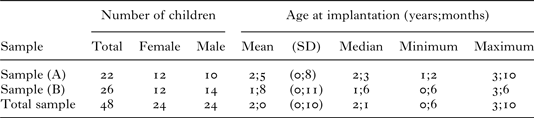
The data used for the present analyses are from two existing large corpora of German-speaking children with CIs: Sample (A) which is available on the CHILDES database (MacWhinney, Reference MacWhinney2000), and Sample (B). Characteristics of each sample as relevant for the present analyses will be presented here. Sample (A) consists of twenty-two, Sample (B) of twenty-six deaf children with cochlear implants. The children in Sample (A) received their implants between 1996 and 1997, the children in Sample (B) between 2002 and 2005. For some of the present analyses the two samples are combined. Table l presents information regarding number and gender of participants and descriptive statistics for age at implantation per separate and combined samples. All the children were considered prelingually deafened. Their pre-operative aided hearing ranged between 50 and 100 dB SPL at 1000 Hz. Appendices 1 and 2 present data regarding gender, age at implantation, pre-operative aided hearing status, and initial language status per individual child and sample. Children in Sample (A) had a very similar initial language status six months after implantation, as indicated by an MLU of 1·00 for most children and a mean MLU of 1·04 (see Appendices 1 and 3). Recordings for Sample (B) started 12 months post implantation. Thus, initial language status was higher. However, MLUs are comparable to those for Sample (A) 11 months post implantation (see Appendices 1, 2, and 3).
Sample characteristics per separate and combined sample: number of children, age at implantation

Children in both samples are growing up in monolingual environments with spoken German. At the start of data collection, parents were asked to indicate on a questionnaire the extent to which they used single signs or gestures, sign-supported German (LBG = Lautsprachbegleitende Gebärden) or German Sign Language (DGS = Deutsche Gebärdensprache). No parent used German Sign Language in a grammatical format, three parents (11%) of Sample (B) reported using individual signs from DGS occasionally in the sense of supporting a single spoken word. Six parents (27%) of Sample (A) and eight parents (31%) of Sample (B) reported using gestures occasionally, whereby it was not clear to what extent these were conventionalized signs or gestures. The children have no other diagnosed impairment besides deafness. Information on the children's IQ and cognitive development indicated that all children were within the normal range, as measured by the Snijders-Oomen Non-verbal Intelligence Test IQ for (Sample A) (Snijders, Tellegen, Winkel, Laros & Wijnberg-Williams, Reference Snijders, Tellegen, Winkel, Laros and Wijnberg-Williams1996) and paediatric developmental checks for Sample (B). Maternal educational level in Sample (B) is representative of the population of women between 20 and 40 in the Federal Republic of Germany. For Sample (A), measurement of parental education is not available.
All the children attended the Cochlear Implant Centrum (CIC) Hannover, North Germany, for their rehabilitation, including the audiological and technical management of the device and speech therapy. During the first two years following implantation, there is a three- to five-day residential rehabilitation period at CIC Hannover every 10–12 weeks, during which the children take part in auditory–verbal programmes using interactive methods of hearing, speech, and language education (Bertram & Pad, Reference Bertram and Pad1995). They receive individualized instruction from speech therapists. Parental support is emphasized, and parents take part in the speech therapy sessions. Additional therapy sessions take place in the children's home towns. Therapy sessions are 45 minutes long. At CIC Hannover, and in the home towns, the extent of speech therapy services is similar for each child. During the residential stay at CIC Hannover, there is a daily speech therapy session; in the home towns it is weekly. They take place in the child's home or kindergarten. In Germany, children attend kindergarten between ages three to six years. Formal schooling starts at six years. None of the children in the two samples had started formal schooling. All the children used their implants during all their waking hours except during activities which preclude such use (e.g. swimming).
Design, data collection, and data transcription
Both samples are longitudinal. Spontaneous speech samples were collected in regular intervals. For Sample (A), recordings took place between 1997 and 2000; for Sample (B) between 2005 and 2008. Time intervals between datapoints were determined by the scheduling of residential stays at CIC Hannover. Appendix 3 presents the data collection times per separate and combined samples. As some data collection times coincided in the two samples, it was possible to combine Samples (A) and (B) for part of the present analyses (see Appendix 3). Length of data collection sessions was determined by the timetable slots at CIC Hannover. In Sample (A), recordings lasted 90 minutes per session, in Sample (B) 45 minutes.
For both samples data collection took place in a playroom at CIC Hannover. The situation was free play with a parent. For some of the time a female or male investigator was present and joined in with the play. The set of toys during the recording sessions was always the same: cars and garage, zoo animals, farm animals, forest animals, doll's house, ambulance, hospital room with medical equipment, fire station, police set with car, motorcycle, helicopter and officers, puzzles, and children's picture books. It was up to the child which toys to choose. Digital audio-recording was carried out using portable Sony DAT-recorders and a high-sensitive Sony microphone.
Everything spoken by the child was transcribed using the CHILDES system for transcribing and analyzing child speech (MacWhinney, Reference MacWhinney2000). Between 500 and 800 child-directed parental utterances per datapoint were transcribed for the four initial datapoints in Sample (A) and for all datapoints in Sample (B). In most of the play sessions the parent was the mother. For 7% in Sample (A) and 13% in Sample (B) it was the father. Transcription rules followed the general CHAT conventions (MacWhinney, Reference MacWhinney2000). A Manual for Transcribing and Analyzing Child Speech in German, with specific rules for omissions and contractions in spoken German, was developed by our team (unpublished) and used when transcribing child and adult speech. These concern omissions of final consonants, e.g. replacing nicht ‘not’ with nich, jetzt ‘now’ with jetz, und ‘and’ with un; omission of final or initial consonant leading to contractions of words, e.g. replacing hast du ‘have you’ with hast ’e, kommt der ‘comes he’ with komm’ der; contractions, especially after nasals, liquids, and long vowels which affect inflectional endings, e.g. replacing einen ArtIndefAccMasc with ein'n ‘a’, sehen Inf ‘see’ with seh'n, bären Pl ‘bears’ with bär'n; and contraction of articles after prepositions, e.g. in den ArtAccMasc ‘into the’ with in'n, mit der ArtDatFem ‘with the’ with mit'er, or auf dem ArtDatMasc ‘on the’ with auf'm. In Sample (A), data transcription was performed by eight trained transcribers, and reliability checks calculated for 7·3% of speech samples. For Sample (B) the corresponding figures were five trained transcribers and 15% for checked speech samples. For both samples, percentage agreements between 96% and 100% for different pairs of transcribers were obtained.
Language measures and coding of transcripts for data analysis
In the present analyses, measures of child language were MLU in morphemes, gain scores of MLU between successive datapoints, type and token frequencies of determiners, and type frequencies of lexical words. Calculating MLU presupposes morphosyntactic analysis. This was performed as part of earlier studies (Szagun, Reference Szagun2001, Reference Szagun2004). Rules for coding utterances and for coding inflectional morphology on nouns, verbs, adjectives, and determiners, such as prefixes, suffixes, and fusions, follow CLAN conventions (MacWhinney, Reference MacWhinney2000) and Brown's (Reference Brown1973) rules, and are laid down in our unpublished Manual for Transcribing and Analyzing Child Speech in German. Gender and case on articles was coded as follows. Gender-marked nominatives are encoded as one morpheme each: der Mas, die Fem, das Neu ‘the’. Within the case paradigm, changes from the nominative which are formally marked are counted as two morphemes: e.g. de-n AccMas and de-r DatFem. Plural di-e NomAccPl is also encoded as two morphemes. The rationale is that children have made grammatical progress when they have learned that der can change to den, die to der, and that across the gender paradigm der, die, das, are die in the plural. This is consistent with the aim of MLU, which is intended as a measure of grammatical progress. In accordance with Brown's (Reference Brown1973) rules, forms of the copula are coded as one morpheme. MLU and type frequencies of grammatical and lexical words were calculated by CLAN programs. All child utterances were used for the analyses.
Regarding parental input, the first 500 child-directed parental utterances per datapoint were used for the analyses. Parental expansions comprised all utterances which expand incomplete or incorrect child utterances, i.e. (a) repetition of the child's utterance with complete/correct grammar (example: Child: Zug kommt ‘train is coming’, Parent: Ein ArtIndefNomMasZug kommt ‘a train is coming’); (b) repetition of the child's utterance with complete/correct grammar and with new information (example: Child: Auf Tisch ‘on table’, Parent: Am CLDatMasTisch steht das Kind ‘the child is standing at the table’); (c) repetition with correct grammar as a question (example: Child: Hier brennt der Haus ‘the house is burning here’, Parent: Oh, das ArtDefNomNeuHaus brennt? ‘Oh, the house is burning?’). These different types of expansions are also referred to as expansion, expatiation, and recast, respectively (Cruz et al., Reference Cruz, Quittner, Marker and DesJardin2013). All transcripts were coded for expansions by the first author. A speech therapist coded 20·5% of randomly drawn transcripts of Sample (A) independently after training on the coding manual. For Sample (B) a trained research assistant coded 35% of randomly drawn transcripts independently. Disagreements between raters were solved by discussion. Inter-rater reliability was calculated with Cohen's kappa. Kappas were .97 for Sample (A) and .92 for Sample (B). This indicates good to very good agreement between coders.
Statistical analysis
In order to examine the relative effects of age at implantation, parental expansions, and early child language on subsequent language outcomes, multiple regression analyses were performed. The combined Samples (A) and (B) were used for these analyses. In the first model, child MLU at 24 and 30 months after implantation were the criterion variables in two separate analyses. Age at implantation and parental expansions were the predictor variables. In the second model, child MLU at 12 months after implantation was added to the predictor variables. Correlational analyses were used to test relations between properties of early language and later grammatical complexity. As ‘early’ we define a period of transition from one- to two-word utterances when children have not yet passed to multiword combinations. Stability of early individual differences in grammatical growth was tested by correlational analyses for each sample separately. Correlations between early MLU gains and subsequent MLU 30 and 36 months post implantation were calculated. Associations between early use of determiners and lexical words were also tested by correlations per separate sample. Type and token frequencies of determiners and frequencies of lexical word types at early datapoints were correlated with MLU 30 and 36 months post implantation.
RESULTS
Regression analyses
Regression analyses are used to investigate the relative contribution of age at implantation, parental expansions, and child initial language level (research question 1). For the regression analyses, the two samples were combined at three selected datapoints at which time in months since implantation converges. These are: 11 (Sample A) / 12 (Sample B) months, 24·5 (Sample A) / 24 (Sample B), 30 (both samples). In the following analyses, these time-points will be referred to as 11–12, 24, and 30 months since implantation. Time since implantation is used as equivalent to time for language learning with the cochlear implant (Szagun & Stumper, Reference Szagun and Stumper2012; Cruz et al., Reference Cruz, Quittner, Marker and DesJardin2013). Sample size was reduced from a total of 48 for both samples to 46, as one parent did not produce a sufficient number of utterances due to his prolonged absence during recording sessions, and one parent did not consent to her speech being analyzed.
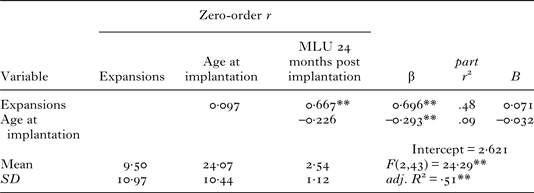
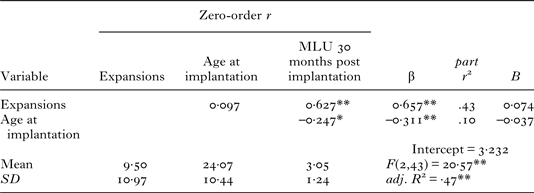
In the first regression model, age at implantation and parental expansions at datapoint 11–12 months post implantation were entered as predictor variables, and child MLU at 24 and 30 months post implantation as dependent variables in two separate analyses, one for each dependent variable. When assessing the influence of adult language, its delayed effect on child language has to be taken into account (Farrar, Reference Farrar1990; Saxton et al., Reference Saxton, Backley and Gallaway2005; Rüter, Reference Rüter2011). In order to deal with the temporal delay, time-lagged correlations are usually calculated (Farrar, Reference Farrar1990; Richards, Reference Richards, Gallaway and Richards1994; Hoff, Reference Hoff2003). A previous analysis showed that for children with CIs, parental expansions become effective from a time lag of nine months to one year (Rüter, Reference Rüter2011). In the present analysis, with parental expansions at datapoint 11–12 months post implantation, the time lag is 12/13 and 18 months. Tables 2 and 3 show the relevant statistics of the first two regression analyses. Both predictor variables relate significantly to child MLU at 24 and 30 months post implantation. The proportion of variance in MLU 24 and 30 months post implantation which is explained uniquely by each predictor is indicated by the squared semi-partial correlation coefficient (part r 2). As the part r 2 coefficients indicate, parental expansions explain the larger proportion of variance, 48% and 43%, respectively, with age at implantation adding another 9% and 10%, respectively. Altogether the predictor variables explain 51% of the variance in child MLU 24 months after implantation and 47% of the variance at 30 months after implantation (adj. R 2).
Prediction of child MLU at 24 months post implantation by age at implantation and parental expansions at 11–12 months post implantation (N = 46)
notes: * p < ·05; ** p < ·01.
Prediction of child MLU at 30 months post implantation by age at implantation and parental expansions at 11–12 months post implantation (N = 46)
notes: * p < ·05; ** p < ·01.
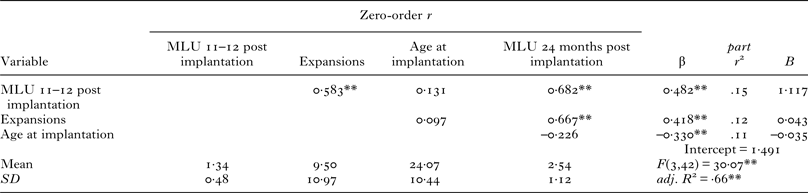
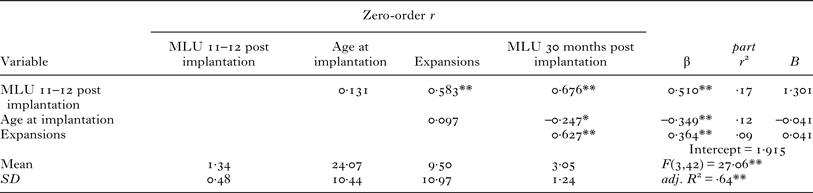
In the second regression model, child MLU at 11–12 months post implantation is added as a predictor variable. Child MLU 11–12 months post implantation and parental expansions at the same datapoint can be assumed to be mutually influential. However, the regression model allows controlling for the variance shared by the predictors. In the regression model, semi-partial correlation coefficients express the correlation between a predictor, after the variance it has in common with other predictors has been removed. As in our previous model, the square of the semi-partial correlation (part r 2) can be used to determine the unique contribution of each predictor to the criterion variance. In this way, the mutual effects of child MLU and expansions 11–12 months post implantation on each other can be controlled for. Results are presented in Tables 4 and 5. All three predictor variables are significantly related to child MLU at 24 and 30 months post implantation, respectively. As indicated by the semi-partial correlation coefficient (part r 2), early child MLU at 11–12 months post implantation uniquely explains the largest amount of the variance in subsequent child MLU, 15% and 17%, respectively. Notably, in this second model the uniquely explained variance by expansions (as indicated by part r 2) is considerably smaller, since parental expansions and child MLU 11–12 correlate highly (see zero-order correlation in Tables 4 and 5), thus explaining a substantial part of the variance in the criterion variable conjointly. In addition, the predictor variables age at implantation and parental expansions are weighted slightly differently in their effect on subsequent child MLU. Parental expansions uniquely explain another 12% of the variance in child MLU 24 post implantation; age at implantation uniquely explains another 11%. This situation reverses at 30 months post implantation, when age at implantation becomes slightly more important, explaining another 12%, and expansions another 9%, of the variance in subsequent child MLU. Thus, parental expansions become a less important predictor as time since implantation progresses, while the effect of age at implantation remains relatively constant. Age at implantation does not correlate significantly with MLU 11–12 months post implantation (see zero-order correlations, Tables 4 and 5). Altogether the predictor variables explain 66% of the variance in child MLU 24 months and 64% of the variance in child MLU at 30 months post implantation (adj. R 2). In both regression models, age at implantation does not correlate significantly with any other predictor variable, thus it explains very little criterion variance conjointly with other predictors. Its contribution to the criterion variance increases somewhat over the time-points in both regression models (see zero-order correlations and part r 2 coefficients in Tables 2–5). The unique effect of age at implantation increases slightly between 24 and 30 months since implantation.
Prediction of child MLU at 24 months post implantation by age at implantation, parental expansions at 11–12 months post implantation, and child MLU at 11–12 months post implantation (N = 46)
notes: * p < ·05; ** p < ·01.
Prediction of child MLU at 30 months post implantation by age at implantation, parental expansions at 11–12 months post implantation, and child MLU at 11–12 months post implantation (N = 46)
notes: * p < ·05; ** p < ·01.
Associations between features of early language and MLU at later time-points
The influence of properties of early language, such as gains in MLU and frequencies of determiners and lexical words, is examined for each sample separately. The analyses require data from successive datapoints. Time intervals between datapoints do not converge, however, for all datapoints in the two samples. Data collection for Sample (A) was at closer time intervals and started half a year earlier than for Sample (B). In a first step, we checked the influence of age at implantation. Although there is no significant correlation between age at implantation and MLU at 24 months (see zero-order correlations in Tables 2 and 4), we calculated correlations between age at implantation and MLU at each of the early datapoints used in the following analyses (see Table 6). All correlations were non-significant. In order to exclude even non-significant variance shared with language measures, we calculated partial in addition to bivariate correlations, partialling out age at implantation in the following analyses.
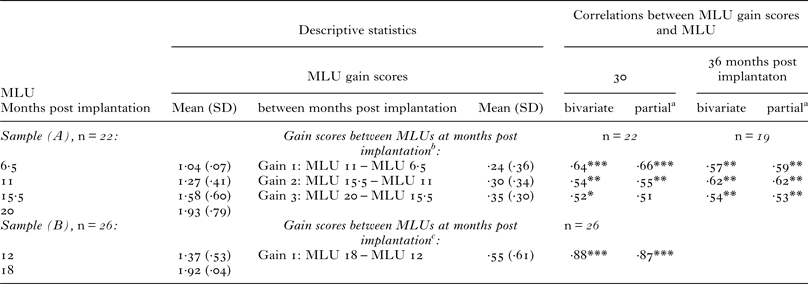
Means (SD) for MLU and MLU gain scores at early datapoints, and bivariate and partial correlations between early MLU gains and MLU 30 and 36 months post implantation
notes: *** p < ·001, Pearson, ** p < ·01, * p < ·05; a partialling out age at implantation; b MLU gain in 4½ months; c MLU gain in 6 months.
Early MLU gain scores and later MLU
This section addresses the question of stability in grammatical growth from the initial stage onwards (research question 2). Correlations between children's early MLU gains and MLU 30 and 36 months after implantation are calculated. We define as early MLU gains increases in MLU during a period of transition from one- to two-word utterances when children have not yet passed to multiword combinations. Table 6 displays mean MLU values per datapoints used for the analysis. All mean values remain below 2·25, i.e. they do not exceed the stage of two-word combinations according to Brown's (Reference Brown1973) grammar stages. The difference between MLU at a particular datapoint and MLU of the preceding datapoint constitutes a gain score. For Sample (A) three gain scores are calculated: Gain 1: MLU 11 – MLU 6·5 months post implantation; gain 2: MLU 15·5 – MLU 11 months post implantation; gain 3: MLU 20 – MLU 15·5 months post implantation. The gain scores were correlated with children's MLU 30 and 36 months post implantation. At 36 months after implantation, the sample was reduced to nineteen, as data collection had ceased for three children whose parents were not attending regular appointments at CIC Hannover any more. For Sample (B), there was one gain score: gain 1: MLU 18 – MLU 12 months post implantation. Descriptive statistics for MLU and MLU gain scores are presented in Table 6 for both samples. Bivariate and partial correlation coefficients (Pearson) are also presented in Table 6. All correlations are significant (p < ·05, p < ·01, and p < ·001), and the values of bivariate and partial coefficients hardly differ. In both samples, MLU gains between earlier datapoints are significantly associated with MLU at 30 and, where applicable, 36 months post implantation.
Early use of determiners and of lexical words and later MLU
Next, we examine to what extent early use of determiners and lexical words is associated with grammatical complexity one to two years later (research question 3). For determiners, type and token frequencies will be analyzed, for lexical words only type frequencies. Different determiner word types were defined as follows: for definite articles the word types were der, die, das, den, dem ‘the’; for indefinite articles ein, eine, einen, einem ‘a’. Except for einen ArtMasAcc, all these forms can fulfil different grammatical functions. Thus, der can be der ArtMasNom, der ArtFemDat, der ArtFemGen, or der ArtGenPl. Such functions are ignored in the word type count. In addition to definite and indefinite articles, children produced the following determiners: kein DetNeg ‘not a’, dieser DetDem ‘this’, mein DetPoss ‘my”. Word types denoting gender and case-marked forms of these determiners were counted equivalently to word types of indefinite articles. Lexical word types included nouns, lexical verbs, adjectives, and adverbs.
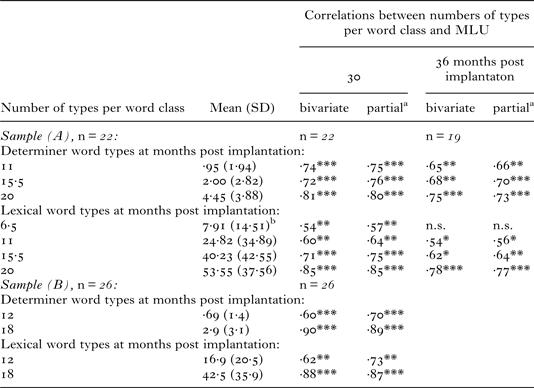
The same datapoints as for the early MLU gains analysis are used covering the period of transition from one- to two-word utterances (see Table 6 for mean MLU values of these early datapoints). The analyses are performed for each sample separately. In Sample (A) datapoints used are: 11, 15·5, and 20 months post implantation. Children did not yet produce determiners at the first datapoint. For lexical words this first datapoint, 6·5 months post implantation, was also used. In Sample (B) the datapoints 12 and 18 months post implantation were used for both word classes. For Sample (A), number of determiner word types and number of lexical word types at the respective datapoints were correlated with children's MLU 30 and 36 months post implantation. Thus, between the early use of determiners and MLU 30 months, there were time spans of 19, 14·5, and 10 months, and for MLU 36 months, the time spans were 25, 20·5, and 16 months. The corresponding time spans regarding the early use of lexical words were 23·5, 19, 14·5, and 10 months for MLU 30 months and 29·5, 25, 20·5, and 16 months for MLU 36 months post implantation. For Sample (B), the corresponding early datapoints of determiner and lexical word use were 12 and 18 months post implantation, and 30 months for subsequent MLU. This is a time span of 18 and 12 months after early determiner use and subsequent MLU. Bivariate and partial correlation coefficients (Pearson) are presented in Table 7. For Sample (A), all correlations between number of determiner word types 11, 15·5, and 20 months and MLU 30 and 36 months post implantation are significant (p < ·01 and p < ·001). From 11 months post implantation, all correlations between number of lexical word types and MLU 30 months post implantation are significant (p < ·05 and p < ·01). Lexical vocabulary at 6·5 months post implantation does not significantly relate to MLU at 36 months. At the two earliest datapoints, the correlation coefficients for determiner word types are higher than those for lexical word types (see Table 7). For Sample (B) all correlation coefficients are significant (p < ·01 and p < ·001). The values of bivariate and partial correlation coefficients are very similar.
Means (SD) for number of determiner and lexical word types and bivariate and partial correlations between numbers of determiner word types, lexical word types, and MLU 30 and 36 months post implantation
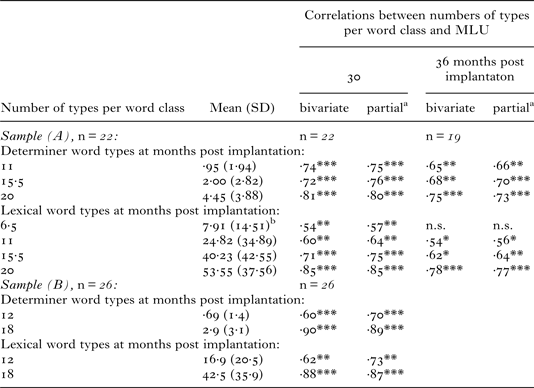
notes: * p < ·05; ** p < ·01; *** p < ·001, Pearson; a partialling out age at implantation; bn = 15 at this datapoint.
In summary, both diversity of determiners and diversity of lexical words at early datapoints are significantly associated with subsequent grammatical complexity one to two years later. In one sample, this association is somewhat stronger for determiners. Higher numbers of determiner word types and of lexical word types are associated with higher subsequent MLU levels.
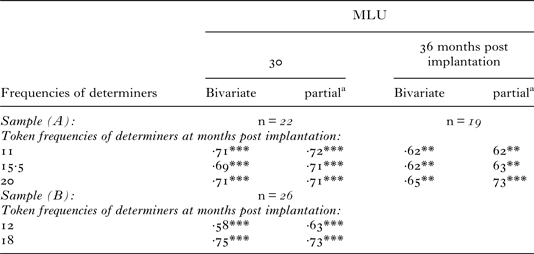
For determiner token frequencies, the same datapoints were used as for the analysis of type frequencies. Again, the analyses are performed for each sample separately. Bivariate and partial correlation coefficients (Pearson) are presented in Table 8. All correlations are significant (p < ·01 and p < ·001), and values of bivariate and partial coefficients are very similar. Early use of determiners in terms of token frequencies is significantly associated with higher MLU one to two years later. Higher token frequencies are associated with higher MLU levels.
Bivariate and partial correlations between token frequencies of determiners and MLU 30 and 36 months post implantation
notes: ** p < ·01; *** p < ·001, Pearson; a partialling out age at implantation.
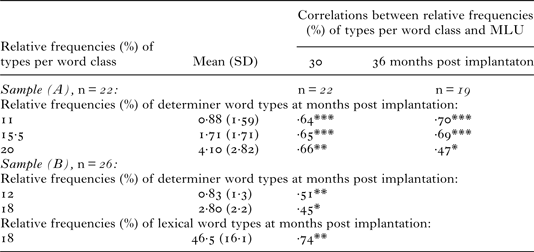
In the construction of an initial grammar, the proportion of determiner and lexical word types out of the total vocabulary may be of relevance. A higher proportion of determiners would be regarded as supportive for grammar building. Therefore we also looked at the relation between the proportional use of determiner and lexical word types and later MLU. The percentage of determiner and lexical word types was calculated out of the total number of types per speech sample. Again, the analyses are performed for each sample separately using the same datapoints as in the previous analyses. Descriptive statistics for relative frequencies (%) of determiner and lexical word types are presented in Table 9. Overall, the mean frequencies at datapoints close in time in the two samples are fairly similar. Non-parametric correlations (Spearman) were calculated between relative frequencies of determiner and lexical word types at early datapoints and subsequent MLU. Correlation coefficients (Spearman) are presented in Table 9. For Sample (A), correlations between relative frequencies of determiner word types 6·5, 11, and 20 and MLU 30 and 36 months post implantation are significant (p < ·01 and p < ·001). None of the correlations between relative frequencies of lexical word types and subsequent MLU were significant. In Sample (B), relative frequencies of determiner word types at 12 and 18 months are significantly associated with MLU 30 months post implantation (p < 0·5 and p < ·01). Relative frequencies of lexical word types at datapoint 18 months correlate significantly with MLU 30 months (p < ·01), but for datapoint 12 months the correlation is not significant.
Means (SD) for relative frequencies (%) of determiner and lexical word types and correlations between relative frequencies (%) of determiner word types, lexical word types, and MLU 30 and 36 months post implantation
notes: * p < ·05; ** p < ·01; *** p < ·001, Pearson.
In summary, the proportional use of determiner word types relates more strongly to grammatical complexity than the proportional use of lexical word types. Higher proportions of determiner word types at all early datapoints are associated with higher levels of grammatical complexity subsequently.
DISCUSSION
In a first analysis, this study examined the relative influence of age at implantation, parental expansions, and child initial language level on later and more advanced language. Following this, we examined if specific features of CI children's early language, such as initial MLU gains and the use of grammatical and lexical words, are predictive of later grammatical skills. The present results show that early parental expansions and child MLU, both at 12 months post implantation, and age at implantation significantly predict child MLU 24 and 30 months post implantation. When only age at implantation and parental expansions are considered, the latter uniquely explain a considerably larger proportion of the variance in subsequent child MLU than age at implantation. When, however, early child language level is included as a predictor variable, it uniquely explains the largest proportion of variance in subsequent child MLU. Early parental expansions have a stronger influence on child language after a time lag of one year than after a time lag of one-and-a-half years.
A series of correlational analyses revealed associations between various measures of language at early datapoints and subsequent grammatical complexity, irrespective of age at implantation. Larger early MLU gains were associated with higher MLU levels one to two-and-half years later and vice versa, indicating stability of individual differences. Early use of types and tokens of determiners and of lexical word types was associated with subsequent grammatical complexity. More diverse and more frequent early determiner use and a larger vocabulary of content words early on were related to greater grammatical complexity subsequently. The proportion of determiner word types was more strongly related to subsequent grammar than the proportion of lexical word types.
First, we will discuss the relative effects of parental expansions, early child language level, and age at implantation. The present findings add to recent evidence for the positive effects of a supportive language environment on the language development of children with CIs (Rüter, Reference Rüter2011; Szagun & Stumper, Reference Szagun and Stumper2012; Cruz et al., Reference Cruz, Quittner, Marker and DesJardin2013; Quittner et al., Reference Quittner, Cruz, Barker, Tobey, Eisenberg and Niparko2013). Expansions of children's incomplete or incorrect utterances may be viewed as a form of implicit feedback about grammatical correctness. Such feedback has long been known to have a beneficial effect on typically developing children's language (Farrar, Reference Farrar1990; Saxton et al., Reference Saxton, Backley and Gallaway2005), and its positive effect is increasingly being confirmed for children with CIs. In the present analysis, we assessed the predictive value of expansions in two different regression models, one with only expansions and age at implantation as predictors, the other adding early child language level as a predictor. In the second model, the uniquely explained variance by expansions is smaller, since parental expansions and child MLU 11–12 correlate highly, thus explaining a substantial part of the variance in subsequent child MLU conjointly. There are different views on how to deal with the interdependency of child and adult language. It can be argued that removing the variance due to child effects from adult input does not adequately reflect relevant environmental influences on the child's language development (Rutter, Pickels, Murray & Eaves, Reference Rutter, Pickels, Murray and Eaves2001; Hoff, Reference Hoff2003). Children contribute to their own linguistic environment in the sense that adults produce language partly contingent on the child's (Richards, Reference Richards, Gallaway and Richards1994; Hoff, Reference Hoff2003; Tomblin et al., Reference Tomblin, Barker and Hubbs2007). The resulting language environment is partly shaped by the child. Removing variance from adult input that is attributable to the child's language level removes developmentally relevant information and may result in underestimating the effect of the language environment (Rutter et al., Reference Rutter, Pickels, Murray and Eaves2001; Hoff, Reference Hoff2003). Thus, our second regression model may underestimate the effect of expansions. The somewhat reduced effect of expansions on child MLU 30 months as opposed to 24 months post implantation in both models may be due to the larger time lag between measurement points of parental expansions and subsequent child MLU. As expected, the effect of children's initial MLU on later MLU was strongest. Age at implantation does not share much variance with any other predictor, and its effect remains relatively constant in both regression models, increasing mildly between 24 and 30 months since implantation. Our hypothesis regarding the relative influence of the three predictor variables receives support insofar as initial child language level has the strongest influence on children's subsequent linguistic progress. It is, however, only partly supported regarding the effects of expansions and age at implantation, as the effect of expansions is not consistently larger than that of age at implantation.
The age-at-implantation effect has been discussed within the framework of a ‘sensitive period’ for language learning (Svirsky et al., Reference Svirsky, Teoh and Neuburger2004; Holt & Svirsky, Reference Holt and Svirsky2008; Leigh et al., Reference Leigh, Dettman, Dowell and Briggs2013). Better language learning of children with CIs who are implanted younger within the time window of the sensitive period may be indicative of a particularly high sensitivity earlier on within this period. On a physiological level, experience which occurs initially during a sensitive period has a particularly strong effect on shaping connectivity (Knudsen, Reference Knudsen2004). Earlier access to auditory linguistic experience can make use of this heightened sensitivity of neural circuits involved in language learning and ready for language input. In this way, auditory linguistic experience earlier during the sensitive period for language may have a stronger effect, and less time may be needed for laying the foundations on which further language learning builds. This corresponds to observations in language behaviour that very early implanted children appear to have somewhat steeper growth curves initially (Tomblin et al., Reference Tomblin, Barker, Spencer, Zhang and Gantz2005; Szagun & Stumper, Reference Szagun and Stumper2012). What does not fit well with this explanation is that variability in language outcomes of very early implanted children is as large as that in children implanted somewhat later within the sensitive period of language learning up to four years of age (Lesinski-Schiedat, Illg, Heermann, Bertram & Lenarz, Reference Lesinski-Schiedat, Illg, Heermann, Bertram and Lenarz2004; Holt & Svirsky, Reference Holt and Svirsky2008; Szagun & Stumper, Reference Szagun and Stumper2012).
Next, we explored language-internal factors as possible sources of variance in the linguistic progress of children with CIs, controlling for age at implantation. A first research question was whether early individual differences in grammatical growth remain stable over time. As ‘early’, we defined datapoints with MLU levels within the one- and two-word stages and successive MLU gains between such datapoints. Our results show that early MLU gains were associated with MLU two-and-a-half and three years after implantation. Thus there was stability of individual differences in language growth over time independently of age at implantation. The results from Sample (A) allow a comparison of different MLU gains and their predictive value as data at successive time-points are available from six months post implantation. Contrary to our expectation, the strength of the association did not increase over time. Even the initial MLU gain, which is smaller than the two succeeding ones, is already strongly associated with MLU levels two to two-and-a-half years later. These results are in accordance with growth curve modelling, which shows small initial changes of a system to be highly predictive of its later states (van Geert, Reference van Geert1994; Plunkett & Elman, Reference Plunkett and Elman1998). Unlike the instability in language growth rates observed in many children with language delay (Dale et al., Reference Dale, Price, Bishop and Plomin2003; Feldman et al., Reference Feldman, Dale, Campbell, Colborn, Kurs-Lasky, Rockette and Paradise2005), individual differences in language growth of children with CIs are stable from the very beginning – at least in our samples. It appears that for these children the stage for language growth is set from the very beginnings of grammar construction.
Turning to the predictive role of the early use of determiners and lexical words, the results showed that early higher levels of word types in both word classes were associated with greater grammatical complexity two years later. As children need lexical and grammatical words for building a grammar, this was to be expected. However, the association is somewhat stronger for determiners. When proportional use of determiner and lexical word types is analyzed, in general only higher proportions of early determiner word types are significantly associated with later greater grammatical complexity, with the exception of the datapoint 18 months post implantation in Sample (B). These associations are independent of age at implantation, and they are of a similar magnitude at each of the early datapoints. The data confirm our hypothesis of the greater predictive power of early frequent and diverse determiner use as opposed to lexical vocabulary for subsequent grammatical complexity.
This impact could be explained as follows. In German, determiners mark case and gender relations, and are thus essential for expressing syntactic roles in the sentence and for congruence relations in the noun phrase. If children use the same determiners (tokens) early and frequently, this would help them practise such grammatical relations and promote grammar building. If they use different types of determiners, the same grammatical relations are practised with different words, and in this way grammatical relations are generalized across determiner word types. Thus, the degree to which children use determiners early on can be said to lay the early foundations for further grammar building. The greater impact of early determiners as opposed to early lexical words argues for a stronger role of such grammatical words in grammar building than early lexical vocabulary. This result is in line with the results for typically developing French-speaking children, for whom grammatical words are strongly predictive of MLU during early language development (Le Normand et al., Reference Le Normand, Moreno-Torres, Parisse and Dellatolas2013). At least concerning determiners, children with CIs may use a similar route to grammar construction as typically developing children. Determiners could be early markers of subsequent grammatical proficiency for children acquiring German.
We think that having identified properties of early grammar construction which relate to later grammatical complexity has significance beyond adding yet another source of variability for language outcomes in children with CIs. An important aspect of our results is that individual differences leading to more or less proficiency in grammar, such as stable growth rates and presence or absence of determiners, are present at the outset of the grammar-building process. Furthermore, this type of early stage setting cannot be explained by age at implantation. It is unlikely to be strongly a result of parental language input, as there would not have been enough time in six to twelve months to have had such a profound effect. It would seem plausible that variability in access to spoken language input through the cochlear implant may contribute to the children's grammatical growth, particularly as there is stability in this process right from the beginning. Variability in adult cochlear implant users has been shown to be related to varying degrees of speech perception, which in turn are due to the quality of the electrode–neuron interface (Bierer, Faulkner & Tremblay, Reference Bierer, Faulkner and Tremblay2011). While such issues are beyond the scope of this study, such considerations may well be applicable to CI children's access to spoken language and the degree to which auditory information is passed on to the brain in order to construct a grammar from the auditory signal. If the implant allows good access to spoken language input, this will have a positive effect on language learning for early and later implanted children, particularly in combination with an optimal timing, i.e., implantation early within the sensitive phase for language. If the implant allows less good access to spoken language input, language learning will progress less well and this process cannot be influenced strongly by very early implantation. Impaired access to spoken language input would impact particularly on grammatical morphemes, such as determiners, as these are in unstressed prenominal position. Such considerations might explain why some later implanted children make good progress in language and some early implanted children do not.
This study has a number of shortcomings. The combined sample and the separate samples are not large enough to carry out statistical analyses which allow the successive testing of the influence of all the variables, including the different language-internal variables. Regarding the two samples, it could be argued that cochlear implant devices have changed since the time of data collection for Sample (A) during the years 1996 to 2000, and therefore the type of device will affect language outcomes. We did, however, group children in the combined samples according to type of device, and no significant differences were found. Another difference between the samples is the children's implantation age. Children in Sample (B) were on average nine months younger at the time of implantation, and this sample included eighteen children implanted before 2;0, whereas in Sample (A) only eight children were implanted by this age. Nevertheless, earlier studies rendered a significant effect of age at implantation for the older sample (Szagun, Reference Szagun2001) and not the younger one (Szagun & Stumper, Reference Szagun and Stumper2012). In view of these considerations, it is unlikely that the results based on data from Sample (A) are less relevant. The advantage of using data from this sample is that recordings of spontaneous speech started only 6·5 months after implantation. Therefore, the data allow the tracking of grammatical development from very early on. The strength of the present analysis is that it draws on detailed longitudinal corpora of spontaneous speech. In contrast to test results, such data allow the qualitative and quantitative analysis of children's language and the analysis of specific linguistic structures and their developmental trajectories. We see our present contribution in this area.
Finally, we would like to comment briefly on the implications of our results for clinical practice. The predictive value of early linguistic indicators of subsequent language outcomes calls for detailed monitoring of children's language development from very early on. Such monitoring can spot the extent to which indicators for successful grammatical development are present. This, in turn, can inform therapy strategies. The consequences of few signs of the use of grammatical words, e.g. determiners, would be that a visual language is introduced early enough to enable the child to construct abstract linguistic categories as early as possible and during the period of heightened sensitivity for language learning.
Appendix 1
Participant characteristics of Sample (A), n = 22
Appendix 2
Participant characteristics of Sample (B), n = 26
Appendix 3
Sampling times for files used in the present analyses per separate and combined sample, and initial language level per separate and combined sample