Clostridium difficile infection (CDI) accounts for 20%–30% of cases of antibiotic-associated diarrhea; it is the most commonly recognized cause of infectious diarrhea in healthcare settings.Reference Cohen, Gerding and Johnson 1 CDI is among the top 5 most costly healthcare-associated infections in the United States, with an estimated annual cost of $1.5 billion.Reference Zimlichman, Henderson and Tamir 2
The use of stool specimens for the detection of C. difficile has the limitation that collection of a stool specimen takes time, and empiric CDI treatment may be started before the stool is collected. Perianal swabs offer an easy alternative to stool samples because a perianal swab can be readily performed when needed and the procedure is safe, even for patients with severe neutropenia.Reference Montecalvo, Jarvis and Uman 3
The purpose of this study was to compare perianal swabs with stool specimens for detection of toxigenic C. difficile in patients with symptomatic CDI.
METHODS
This prospective observational study was conducted at the Westchester Medical Center, a 643-bed tertiary-care teaching hospital in Valhalla, New York. From February 1 to July 31, 2014, all adult inpatients with a positive stool test for C. difficile toxin B (tcdB) gene using real-time polymerase chain reaction (PCR) (Xpert C. difficile/EPI assay, Cepheid, Sunnyvale, CA) were candidates for a perianal swab. The hospital laboratory tests only unformed stool samples for toxigenic C. difficile. Testing was performed daily.
Patients with a positive stool test were identified through the TheraDoc infection control surveillance system (Salt Lake City, UT). After obtaining verbal consent when possible, perianal samples were collected using the dual-prong Transystem sterile transport swab (Copan Italia S.p.A., Brescia, Italy) moistened with nonbacteriostatic sterile saline. The perianal skin was swabbed in a circular manner 3 times. One prong was tested for toxigenic C. difficile (TCD) and the North American pulsed-field gel electrophoresis type 1 (NAP 1) C. difficile strain using the Xpert C. difficile PCR assay, and the other prong was used for culture. Specimens from stool to be used for culture were obtained by placing a swab into the stool sample that had previously tested positive for C. difficile by PCR. Perianal swabs and stool specimens were processed for culture using the same methods. Each specimen was inoculated into cycloserine cefoxitin mannitol broth with taurocholate and lysozyme (CCMB-TAL) or directly plated onto cycloserine cefoxitin fructose agar (CCFA). All cultures were incubated anaerobically for 24–48 hours at 35°C. Broths with a color change to yellow were further plated onto CCFA agar and reincubated for 24–48 hours at 35°C. Mixed cultures were subcultured onto a new CCFA plate until a pure colony was obtained. Colonies were identified as C. difficile by morphology, and the presence of TCD genes was confirmed using a multiplex real-time PCR assay as described by Luna et al.Reference Luna, Boyanton and Mehta 4
Data on patient demographics and receipt of C. difficile treatment were extracted from patient medical records. Patients and caregivers were questioned about whether bathing had occurred on the same day prior to perianal swab collection. Data on the detection of the NAP 1/027 strain, the cycle threshold (Ct) to PCR positivity, and time from stool collection to perianal collection were collected from the microbiology laboratory. All data were entered into a standardized database.
CDI was classified as (1) healthcare-facility onset, (2) community-onset healthcare facility associated, (3) community onset, or (4) recurrent. Complications of CDI (eg, admission to intensive care unit, colectomy, or death within 30 days of CDI diagnosis) were defined in accordance with National Healthcare Safety Network (NHSN) definitions. 5 Severe CDI was defined according to the criteria of the American College of Gastroenterology (ACG)Reference Surawicz, Brandt and Binion 6 and the Society of Healthcare Epidemiology of America (SHEA).Reference Cohen, Gerding and Johnson 1 Receipt of antibiotics for C. difficile was recorded as the number of doses of oral vancomycin, oral metronidazole, or intravenous metronidazole received before collection of stool and before perianal swab collection. If doses were not continuous, only doses with a lapse <24 hours were recorded.
Descriptive and relative frequencies were used to assess the distribution of cases and CDI-specific characteristics. For unpaired comparisons, Fisher’s exact test and the Wilcoxon rank-sum test were used to assess differences between perianal swab positive and negative cases. When comparisons involved paired data, the Wilcoxon signed-rank test and McNemar’s test were used. Correlations between perianal PCR Ct and respective stool PCR Ct were assessed using Spearman’s rank correlation. Odds ratios and 95% confidence intervals (CI) were computed using logistic regression. All analyses were performed using Stata version 14.1 software (StataCorp, College Station, TX). This study was approved by the New York Medical College Committee for the Protection of Human Subjects.
RESULTS
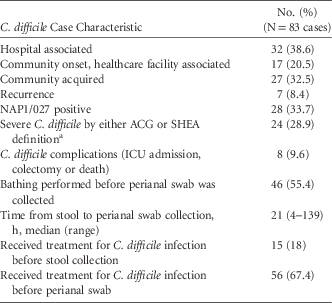
During the study period, 85 of 103 cases of CDI had a perianal swab collected; 5 patients refused; and in 13 cases the perianal swab could not be obtained due to patient unavailability or because the patient’s condition precluded turning the patient to obtain the swab. Only 2 cases were excluded from analysis: In 1 case, a repeat swab was obtained within the same CDI episode, and in another case a perianal swab had an indeterminate result. A total of 83 cases remained for analysis. The 83 perianal swabs were collected from 77 patients; 6 patients had a perianal swab during a CDI recurrence. Overall, 40 patients (51.9%) were male and their median age was 58 years (range, 20–89 years). Characteristics of the 83 cases are presented in Table 1. The median time elapsed between stool sample collection and the perianal swab was 21 hours (range, 4–139 hours). Significantly more patients had received CDI treatment before the perianal swab compared with stool collection: 56 patients (67.4%) were treated before perianal swab vs 15 (18%) patients treated before stool collection (P<.01).
Characteristics of Clostridium difficile Cases With a Perianal Swab Tested for C. difficile tcdB Gene by PCR

NOTE. PCR, polymerase chain reaction; ACG, American College of Gastroenterology; SHEA, Society of Healthcare Epidemiologists of America; ICU, intensive care unit.
a C. difficile treatment defined as receipt of oral vancomycin, oral metronidazole, or intravenous metronidazole.
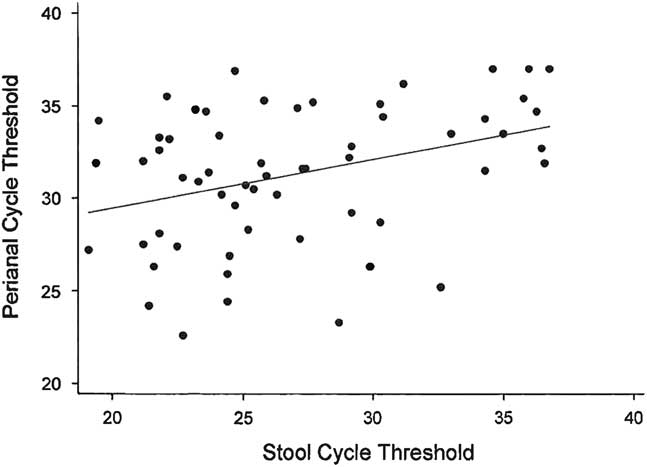
Of the 83 perianal swabs, 59 (71.1%) tested positive for the C. difficile tcdB gene; the sensitivity of the perianal swab was 79% for swabs collected within 24 hours of collection of the stool sample. Perianal swabs were less likely than stool specimens to have TCD grow in culture: 32 of 83 (38.6%) positive perianal cultures vs 51 of 83 (61.4%) positive stool cultures (P=.001). When the 59 perianal positive PCR results were compared with the respective stool samples from the same patient, the perianal swab had a significantly higher median Ct for C. difficile PCR positivity: 31.9 cycles (range, 22.6–37.0) vs 25.7 cycles (range, 19.1–36.8) (P<.001). For the positive perianal swabs, the Ct to PCR positivity was directly but weakly correlated with the Ct to PCR positivity for the respective stool sample (r=0.36; P =.006) (Figure 1). When only the 21 untreated perianal PCR-positive cases were evaluated, the correlation was similar (r=.42; P=.06).
Cycle thresholds to polymerase chain reaction (PCR) positivity for detection of C. difficile tcdB gene for 59 positive perianal swabs and the respective stool samples. The correlation is r=0.36; P=.006.

Case patients who received CDI treatment before the perianal swab received a median of 4 doses of antibiotics (range, 1–20 doses), which included oral vancomycin, intravenous metronidazole, or oral metronidazole. Oral vancomycin was the treatment most commonly administered. There was no significant difference in the number of doses of CDI treatment before perianal swab collection for perianal PCR-positive versus PCR-negative cases (Table 2). However, when no treatment was used as the referent category, perianal positivity was 27% less for cases receiving 1–3 doses of treatment (odds ratio [OR], 0.73; 95% CI, 0.21–2.58; P=.63), and 48% less for cases receiving 4–20 doses of treatment (OR, 0.52; 95% CI, 0.16–1.67; P=.27). This finding suggests an inverse dose-response relationship between CDI treatment and perianal swab result (P=.27). There was no association between positive perianal swab results and CDI severity. Patients with perianal PCR-positive cases more often had bathed on the same day before the swab was collected, and the time elapsed between stool sample and perianal swab collection was shorter, but neither difference reached statistical significance (Table 2).
Characteristics of Cases with a Perianal Swab that Tested Positive Versus Those that Tested Negative for Clostridium difficile tcdB Gene by PCR

NOTE. PCR, polymerase chain reaction; ACG, American College of Gastroenterology; SHEA, Society of Healthcare Epidemiologists of America.
a Clostridium difficile treatment defined as receipt of oral vancomycin, oral metronidazole or intravenous metronidazole.
DISCUSSION
In this study of patients with symptomatic CDI in which perianal swabs were obtained after the stool specimen had been collected and tested positive, the overall sensitivity of the perianal swab for detection of C. difficile tcdB gene by PCR was 71%, with a sensitivity of 79% for swabs collected within 24 hours of the stool sample. Our population included 60% hospital acquired/healthcare-facility–associated cases, and approximately 10% of these cases had CDI complications, predominantly ICU admission. The principal limitation of our study is that stool samples and perianal swabs were not collected simultaneously. Simultaneous collection of stool samples and perianal swabs would have required a much larger sample size (~550 cases) because only 15% of stool samples sent for C. difficile PCR test positive at our hospital.
The sensitivity of the perianal swab PCR test may have been partly influenced by CDI antibiotic treatment; significantly more patients had received CDI treatment when the perianal swab was collected compared with the time of stool collection. The reduction in perianal PCR positivity associated with treatment (27% decrease in perianal positivity after 1–3 doses of treatment) is consistent with the reported reduction in C. difficile tcdB gene PCR positivity found in stool samples during CDI treatment.Reference Sunkesula, Kundrapu, Muganda, Sethi and Donskey 7
The perianal swab has the advantage that the swab does not enter the anus at all and simply samples the perianal skin. Our data contribute to the literature evaluating swabs for detection of C. difficile. In a study of rectal swabs, which enter the anus, 22 patients had rectal swabs collected after the stool sample was known to be positive. Compared with stool sample PCR, the rectal swab PCR test had a sensitivity of 100% and a specificity of 100%.Reference Shakir, Thompson, Marlar and Ali 8 The time elapsed between stool specimen and rectal swab was not reported. Using less invasive techniques, Kundrapu et alReference Kundrapu, Sunkesula, Jury, Sethi and Donskey 9 evaluated symptomatic patients using perirectal swabs. Personal communication with a coauthor indicated that the perirectal specimen was essentially a perianal specimen; that is, the sample was obtained without entering the anal vault (personal communication, C. Donsky, February 22, 2016). In the Kundrapu et al study, 139 symptomatic patients had perirectal swabs collected before the stool sample (0.7 days earlier). All perirectal swabs had visible fecal staining. Compared with the stool specimen PCR test, the perirectal PCR test had a sensitivity of 96% and a specificity of 100%.Reference Kundrapu, Sunkesula, Jury, Sethi and Donskey 9
In another study by Rogers et al,Reference Rogers, Kundrapu, Sunkesula and Donskey 10 asymptomatic patients were evaluated by both perirectal swabs (ie, perianal as discussed above) and rectal swabs that were collected simultaneously. In their study, compared with rectal swabs, the perirectal swab had a sensitivity of 95% and a specificity of 100% to detect C. difficile colonization using culture combined with a cytotoxicity assay. Furthermore, the majority (85%) of the perirectal swabs had visible fecal staining. Therefore a perianal swab could be very useful for detection of asymptomatic colonization, which has been increasingly recognized as a source of C. difficile transmission in hospitalized patients.Reference McFarland, Mulligan, Kwok and Stamm 11 – Reference Curry, Muto and Schlackman 16
Our study is the first to compare Ct values to PCR positivity for perianal swabs and for the respective stool samples. Perianal swabs had a significantly higher PCR Ct values than stool samples previously collected from the same patients. In addition, culture was significantly less likely to be positive from perianal swabs than from stool specimens. Both observations are consistent with the perianal swab having sampled a lower bacterial load of C. difficile. There was a direct but weak correlation between the perianal swab Ct value and that of the respective stool sample for perianal positive cases. The weakness of this correlation is unlikely to have been related to CDI antibiotic treatment because the findings were similar when only the untreated cases were evaluated. This finding implies that other variables affect the PCR Ct value obtained using perianal swabs. Ensuring that the perianal swab specimen has visible fecal staining might improve the sensitivity of the test.
We were surprised to find that bathing on the day of perianal swab collection did not reduce the rate of PCR positivity; indeed, the patients who had bathed had a somewhat higher perianal positivity rate. It is possible that bathed patients may have had more diarrhea prompting more cleansing of the skin. Gaining a better understanding of what drives the variability in perianal swab PCR results will be important, particularly as infection control programs begin to use perianal/perirectal swabs to detect asymptomatic C. difficile colonization.Reference Longtin, Paquet-Boulduc and Gilca 14
Although a perianal swab is a simple method to detect C. difficile infection when stool samples are unavailable, our data are limited by the lack of simultaneous sampling of stool and the perianal skin. The perianal swab sample was 71% sensitive when collected approximately 1 day after the stool sample. The perianal samples were also less likely to grow C. difficile in culture and the Ct to PCR positivity was higher, likely due to the receipt of CDI treatment before perianal swab collection, lack of adequate sampling, and/or other unknown factors affecting perianal skin colonization. A study of stool samples collected simultaneously with perianal swabs, preferably with visible fecal staining on the swab, collected before, during and after CDI treatment, is needed to understand the role of the perianal swab in detection of C. difficile infection and to understand the natural history of perianal skin colonization.
ACKNOWLEDGMENTS
The authors thank Lynda Mack for assistance with collection of perianal swab, Leslee Morton, Dawn Ip, and Christine Zeren for assistance with microbiology, Janet Haas for assistance with the Theradoc alert system, and Stephen Dusza for the statistical analysis.
Financial support: No financial support was provided relevant to this article.
Potential conflicts of interest: Dr Montecalvo receives funding from the New York State Department of Health, Bureau of Healthcare Associated Infections (grant no. RFA# 1203311156). Dr Wormser reports receiving research grants from Immunetics, Institute for Systems Biology, Rarecyte, and Quidel. He owns equity in Abbott; he has been an expert witness in malpractice cases involving Lyme disease; and he is an unpaid board member of the American Lyme Disease Foundation. All other authors report no conflicts of interest.