Introduction
Paediatric cochlear implantation has been the subject of many studies. Hearing impairment affects approximately one in 1000 newborns and 4 per cent of individuals younger than 45 years.Reference Estivill, Fortina, Surrey, Rabionet, Melchionda and D'Agruma1 Inherited hearing loss accounts for at least 60 per cent of deafness cases; of these, hearing loss is syndromic in 30 per cent and nonsyndromic in 70 per cent. Nonsyndromic hearing loss is largely heterogeneous, having different patterns of inheritance. The most common form of nonsyndromic hearing loss is autosomal recessive, which accounts for approximately 80 per cent of cases.Reference Van Camp, Willems and Smith2 To date, nearly 150 gene loci, related to many different kinds of nonsyndromic hearing loss, have been reported. From these known loci, approximately 50 genes have been identified.
Currently, the most important gene to be identified is the GJB2 gene, which is located on chromosome 13q11.12 (DFNB1 locus) and encodes the gap junction protein connexin 26. Nearly 50 per cent of autosomal recessive nonsyndromic hearing loss cases are believed to be related to disruption in connexin 26 function, across many populations (especially Europeans and those of Mediterranean origin,Reference Kenneson, Van, Braun and Boyle3–Reference Zelante, Gasparini, Estivill, Melchionda, D'Agruma and Govea5 but also, with less frequency, some Asian populations).Reference Santos, Wajid, Pham, Hussan, Ali and Ahmad6–Reference Najmabadi, Nishimura, Kahrizi, Riazalhosseini, Malekpour and Daneshi10
Connexin 26 belongs to a family of more than 20 members which share a common structure of four transmembrane segments. Connexin 26 appears to play a role in maintaining a high extracellular electrical potential in the cochlea, by facilitating the circulation of potassium ions.Reference Forge, Becker, Casalotti, Edwards, Evans and Lench11
Cochlear implantation is an accepted rehabilitation method for deaf children with bilateral, severe-to-profound, sensorineural hearing loss, and is accessible to many children around the world. Some studies have found better outcomes in cochlear-implanted children with GJB2-related deafness,Reference Green, Scott, McDonald, Teagle, Tomblin and Spencer12, Reference Fukushima13 while others have not.Reference Lustig, Lin, Venick, Larky, Yeagle and Chinnici14, Reference Wiley, Choo, Meinzen-Derr, Hilbert and Greinwald15
In this study, we investigated the prevalence of mutations in the coding exon of the GJB2 gene in cochlear-implanted children in Iran. We also compared the auditory perception and speech production of children with and without connexin 26 production.
Materials and methods
The Iranian cochlear implantation programme began in 1991 and has grown rapidly. To date, over 1600 patients have been implanted at the Iran Cochlear Implant Center.
The subjects of this study were 166 prelingually deaf children who had undergone cochlear implantation at the Iranian Cochlear Implant Center. Their ages at implantation ranged from 15 to 240 months (mean = 66 months, standard deviation = 32.3 months). These 166 children were selected from a group of 428 cochlear-implanted children, based on the following criteria: (1) absence of other abnormal clinical features that would be consistent with syndromic hearing loss; and (2) a familial autosomal recessive pattern of inheritance (not sporadic).
A 10-ml blood sample was taken from each patient by venepuncture, and genomic DNA was extracted.
The first step of molecular analysis was an allele-specific polymerase chain reaction assay to test all study participants for the 35delG mutation, using previously described primers.Reference Scott, Kraft, Carmi, Ramesh, Elbedour and Yairi16 No further testing was performed on children homozygous for the 35delG allele variant of the GJB2 gene; these children were diagnosed with DFNB1 deafness.
In 35delG heterozygotes, the coding sequence of GJB2 (exon 2) was analysed using denaturing high-performance liquid chromatography. This was complemented by direct sequencing if elution profiles were not consistent with the 35delG heterozygote state. Children were diagnosed with DFNB1 deafness if a second deafness-causing GJB2 allele variant was identified in exon 2. In samples in which the elution profile was consistent only with the 35delG carrier state, the non-coding exon of GJB2 (exon 1) was sequenced and a polymerase chain reaction based assay was used to screen for del(GJB6-D13S1830), as previously described.Reference Del Castillo, Villamar, Moreno-Pelayo, Del Castillo, Alvarez and Telleria17 If either of these other mutations was identified, a diagnosis of DFNB1 deafness was made. Denaturing high-performance liquid chromatography screening of exon 2 of the GJB2 gene was also completed in all patients in whom the 35delG mutation was not detected by allele-specific polymerase chain reaction. If abnormal elution profiles were observed, the sample was sequenced, and if two deafness-causing allele variants of GJB2 were identified, a diagnosis of DFNB1 was made. If only a single deafness-causing allele variant of the GJB2 gene was identified, we screened the non-coding exon of GJB2 for del(GJB6-D13S1830), as described above.Reference Del Castillo, Moreno-Pelayo, Del Castillo, Brownstein, Marlin and Adina18 The finding of either of these mutations together with a deafness-causing allele variant of exon 2 of the GJB2 gene resulted in a diagnosis of DFNB1 deafness.
In order to compare outcomes in subjects with and without GJB2 deafness, we selected 36 cochlear implanted children with non-GJB2 deafness. These subjects were matched based on their chronological age, age of implantation, duration of deafness and sex.
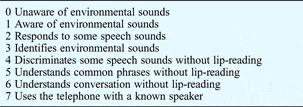
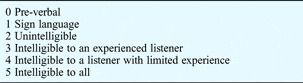
The Categorization of Auditory Performance and Speech Intelligibility Rating scales were used to measure patients' speech perception and speech production.Reference Archbold, Lutman and Nikolopoulos19, Reference Allen, Nikolopoulos and O'Donoghue20 The Categorization of Auditory Performance scale quantifies the auditory receptive abilities of linguistically compromised, profoundly deaf children, in a clinical setting. It has an eight-point scale ranging from category 0 (= no awareness of environmental sounds) to 7 (= ability to use a telephone with a known speaker) (Table I). The Speech Intelligibility Rating scale provides a standardised rating of a child's speech production skills in five categories, ranging from ‘pre-verbal’ to ‘intelligible to all’ (Table II).
Auditory performance scale: categories

Speech intelligibility rating scale: categories

All children received auditory verbal therapy sessions twice a week for a minimum of one year following cochlear implantation. No child had additional disability, based on the therapist's reports. Speech perception and speech production were evaluated two, six, 12 and 18 months after the child's cochlear implant was switched on.
Data are given as means and standard deviations. The Wilcoxon test was used for comparing results in two groups. The Friedman test was used to analyse Categorization of Auditory Performance and Speech Intelligibility Rating scale scores, to detect differences between test intervals.
Results
Frequency of GJB2 gene mutation
We analysed the connexin 26 encoding region of the GJB2 gene in 166 children referred to the Iranian Cochlear Implant Center, these children were selected from a pool of 428 cochlear-implanted children. All children had nonsyndromic deafness.
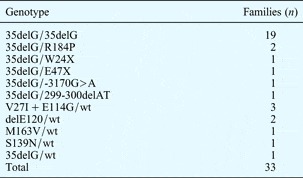
Thirty-three of the 166 probands (19.9 per cent) were found to have GJB2 allele variants which caused deafness, and were diagnosed with DFNB1 deafness. The identified genotypes of GJB2-related deafness are listed in Table III. The most frequent genotype, homozygosity for the 35delG mutation, accounted for 19 cases of GJB2-related deafness. Seven probands were heterozygous for the 35delG mutation. Of the 33 probands (19.9 per cent) found to have GJB2 deafness, allele variants included 35delG, -3170G>A, W24X, E47X, R184P, 299-300delAT, delE120, V27I-E114G, M163V and S139N; all were diagnosed with DFNB1 deafness.
Genotypes detected in iranian patients of GJB2-deafness probands

The genotypes of the children with GJB2-related deafness are listed in Table III. The most frequent genotype, homozygosity for the 35delG mutation, was found in 19 families. Six patients were heterozygous for the 35delG mutation.
Speech perception outcomes
In order to compare outcomes in cochlear-implanted children with and without GJB2 deafness, we selected 37 cochlear-implanted children with non-GJB2 deafness who matched the GJB2 deafness group in terms of chronological age, age at implantation, duration of deafness and sex.
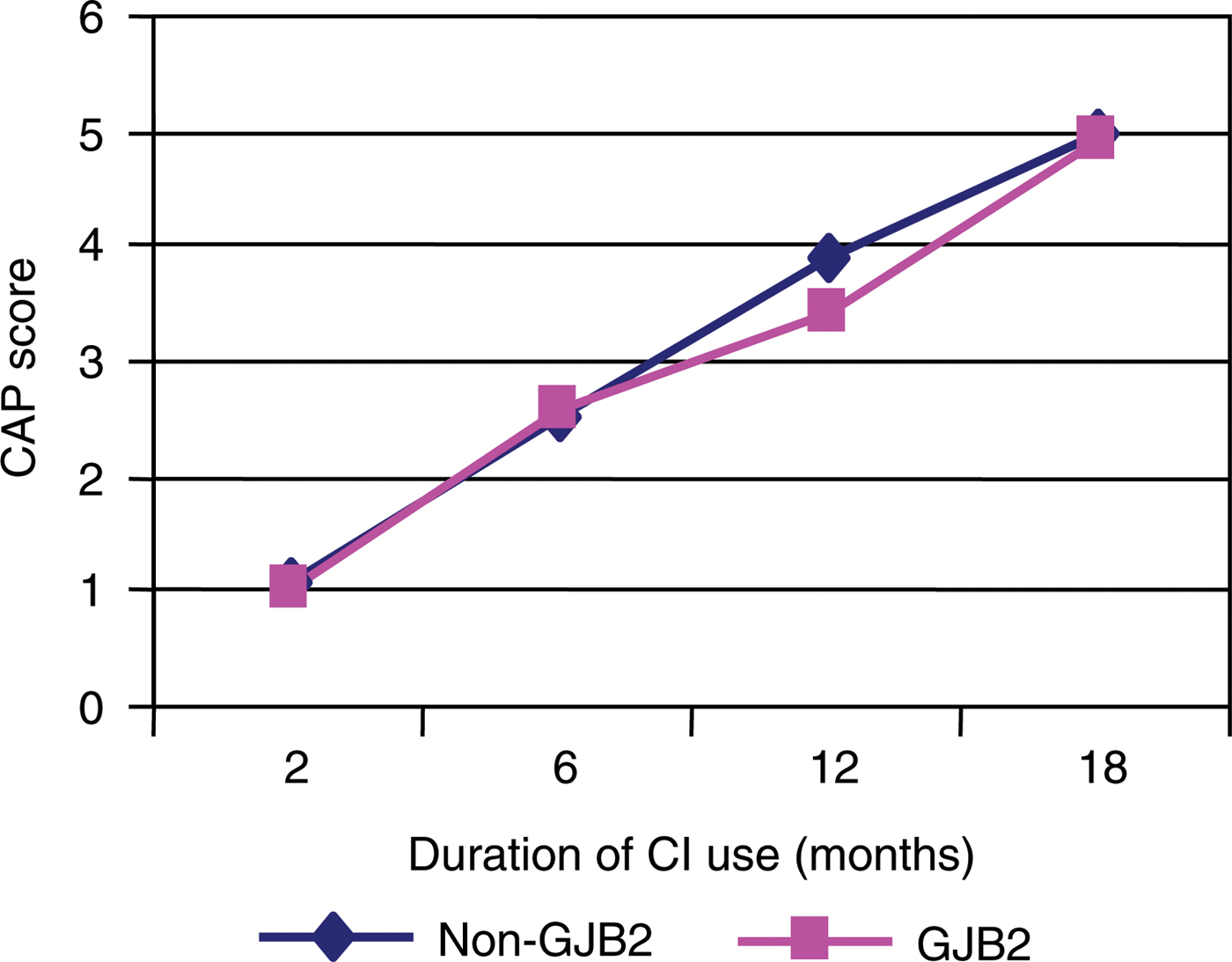
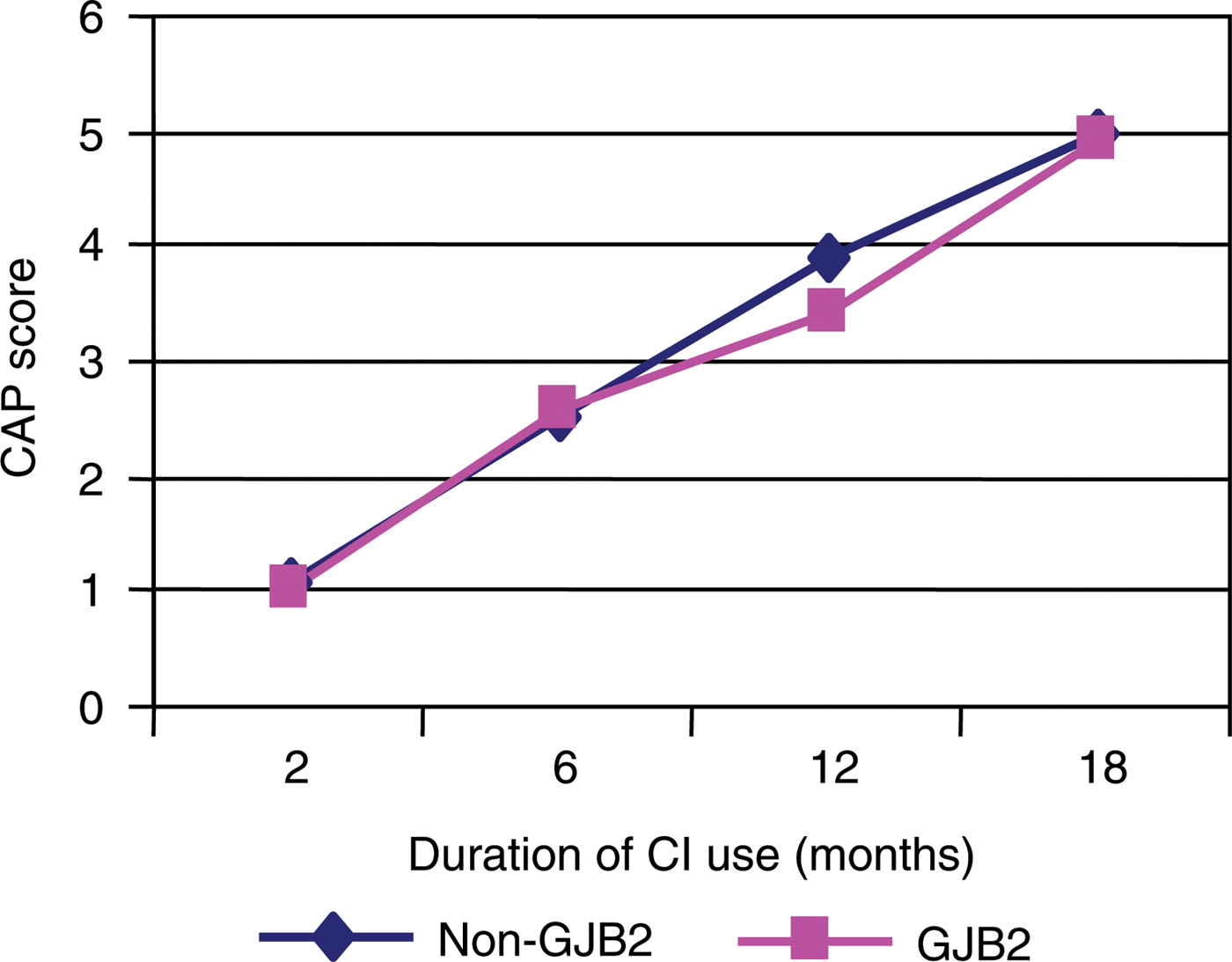
Results indicated a significant improvement in auditory performance scores over time in both the GJB2-deafness and non-GJB2-deafness groups. In the GJB2-deafness group, the mean auditory performance score was 1.52 (SD = 0.33) following two months of cochlear implant use; this increased to a mean score of 7.30 (SD = 0.684) after 18 months of use. In the non-GJB2-deafness group, the mean auditory performance score was 1.09 (SD = 0.291) after two months of cochlear implant use, increasing to 7.54 (SD = 0.564) after 18 months of use. The Friedman test revealed a statistically significant improvement in auditory performance in each group over time (p < 0.01). However, comparison of the two groups' auditory performance results, using the Kruskal–Wallis test, indicated no statistically significant differences.
The distribution of auditory performance scores over time is shown in Figure 1.
Categories of Auditory Performance (CAP) mean scores following cochlear implantation (CI) in GJB2-deafness and non-GJB2-deafness groups.
Speech production outcomes
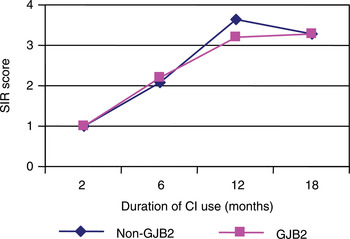
Results indicated a significant improvement in speech intelligibility rating scores in each group over time. In the GJB2-deafness group, the mean speech intelligibility score was 1.00 (SD = 0.000) after two months of cochlear implant use, increasing to a mean score of 3.27 (SD = 0.674) after 18 months of use. In the non-GJB2-deafness group, the mean speech intelligibility score was 1.00 (SD = 1.000) after two months of cochlear implant used, increasing to 3.636 (SD = 0.08) after 18 months of use. The Friedman test revealed a statistically significant improvement in speech intelligibility scores in each group over time (p < 0.01). However, comparison of the two groups' speech intelligibility results, using the Kruskal–Wallis test, indicated no statistically significant differences between the two groups.
The distribution of speech intelligibility scores over time is shown in Figure 2.
Speech Intelligibility Rating (SIR) mean scores following cochlear implantation (CI) in GJB2-deafness and non-GJB2-deafness groups.

Discussion
Cochlear implantation is a common rehabilitation option for patients with severe to profound hearing loss. The aetiology of deafness can affect the results of cochlear implantation. Therefore, we investigated the prevalence of mutations in the coding exon of the GJB2 gene in 166 Iranian children who had undergone cochlear implantation.
The GJB2 gene is located on chromosome 13q11.12 (DFNB1 locus) and encodes the gap junction protein connexin 26. It is the most important gene related to autosomal recessive nonsyndromic hearing loss. Nearly 50 per cent of autosomal recessive nonsyndromic hearing loss cases are related to disruption in connexin 26 function, across many populations (especially Europeans and those of Mediterranean origin,Reference Kenneson, Van, Braun and Boyle3–Reference Zelante, Gasparini, Estivill, Melchionda, D'Agruma and Govea5 but also, with less frequency, some Asian populations).Reference Santos, Wajid, Pham, Hussan, Ali and Ahmad6–Reference Najmabadi, Nishimura, Kahrizi, Riazalhosseini, Malekpour and Daneshi10
The current study found a lower rate of GJB2 gene mutations (19.9 per cent), compared with findings from Italy and Spain (49 per cent) and Lebanon (33 per cent).Reference Estivill, Fortina, Surrey, Rabionet, Melchionda and D'Agruma1, Reference Mustapha, Salem, Delague, Chouery, Ghassibeh and Rai21 Earlier Iranian studies also found lower rates of GJB2 coding exon mutations.Reference Hashemzadeh, Farhud, Taylor, Hadavi, Patton and Afzal7–Reference Najmabadi, Nishimura, Kahrizi, Riazalhosseini, Malekpour and Daneshi10 Worldwide patterns of GJB2-related deafness are clinically important, as they constitute one of many diverse influences affecting the incidence of autosomal recessive nonsyndromic deafness in discrete populations. In some deaf children, the aetiology of deafness can be determined by genetic testing. The current study findings indicate that, for every five Iranian patients with non-syndromic hearing loss, one will be affected by GJB2 genotypes related to deafness. Therefore, investigation of all deaf Iranian children for GJB2 deafness would improve our knowledge of the genetics of deafness in this population, and may assist the future development of patient management.
• This study investigated the prevalence of GJB2 coding exon mutations in cochlear-implanted children in Iran
• A lower rate (19.9 per cent) of GJB2 mutations was found, compared with European study findings
• Children with GJB2-related deafness gain the same benefit from cochlear implantation as those with non-GJB2-related deafness
The current study also retrospectively assessed auditory performance and speech intelligibility as major outcomes of cochlear implantation, both in GJB2-deafness cases and in a matched group with non-GJB2-deafness. Results indicated no statistically significant differences between the two groups.
This preliminary study suggests that the presence or absence of GJB2 gene mutations does not affect the outcome of cochlear implantation, at least during the first 18 months of using the device. Other study findings have suggested more consistent survival of spiral ganglion cells along the length of the cochlea in GJB2-related hearing loss compared with non-GJB2-related hearing loss (this appears to involve a decreasing gradient of spiral ganglion cell survival from the apex to the base of the cochlea).Reference Propst, Papsin, Stockley, Harrison and Gordon22 However, this difference does not lead to better cochlear implantation outcomes.Reference Lustig, Lin, Venick, Larky, Yeagle and Chinnici14, Reference Wiley, Choo, Meinzen-Derr, Hilbert and Greinwald15 A lower rate of GJB2 mutations was found in Iran, as compared with European study findings.
Conclusion
In the light of our results, we conclude that children with GJB2-related deafness benefit from cochlear implantation to the same extent as those with non-GJB2-related deafness.