


Over 272 million international migrants live in a country different from where they were born, an increase of 78% since 1990 (UNDESA 2019). Recent research has begun to address the political consequences of this unprecedented global mobility in destination countries (e.g., Dancygier and Laitin Reference Dancygier and Laitin2014; Hainmueller and Hopkins Reference Hainmueller and Hopkins2014), as well as in countries of origin (e.g., Kapur Reference Kapur2014). Despite increased attention on immigrant inclusion into electoral politics in the Global North, emigrant inclusion in home country elections, particularly in the Global South, remains theoretically underdeveloped and empirically less documented.
In 1990, only 37 countries gave diaspora citizens the right to vote. Today, 135 countries—the majority of UN member-states—legally extend voting rights to emigrants (Allen, Wellman, and Nyblade Reference Allen, Wellman and Nyblade2019). The rate of diaspora enfranchisement is particularly remarkable in Africa. Before 1990, not a single country in sub-Saharan Africa (SSA) had adopted external voting; today, 32 out of 48 SSA countries officially extend the franchise abroad. The rapid rise suggests emigrant enfranchisement is an emerging norm associated with democratization (e.g., Rhodes and Harutyunyan Reference Rhodes and Harutyunyan2010; Turcu and Urbatsch Reference Turcu and Urbatsch2015). Other scholars cite extending political rights as a strategy to strengthen ties to diaspora citizens (e.g., Gamlen Reference Gamlen2008; Leblang Reference Leblang2017), often in response to emigrant lobbying (e.g., Collyer Reference Collyer2013; Itzigsohn Reference Itzigsohn2000). These explanations view external voting as a signaling mechanism, either as a signal to international audiences that states are democratic or to emigrants that the state recognizes them as valued citizens.
This article develops and tests a theory of diaspora enfranchisement that focuses on emigrant voter access (de facto enfranchisement) following the legal adoption of voting rights (de jure enfranchisement). During third-wave democratization, extending voting rights to diasporas has often occurred as part of broader reforms, including the provision of new constitutions (Escobar Reference Escobar2007; Wellman and Whitaker Reference Wellman and WhitakerForthcoming), introduction of multiparty competition (Rhodes and Harutyunyan Reference Rhodes and Harutyunyan2010), or transitional negotiations (Brand Reference Brand2014). These reforms include numerous actors, including independent commissions, international organizations, judiciaries, and civil society groups. Yet following legal extension, most aspects of implementation are primarily influenced by politicians, either directly through electoral legislation or indirectly through agencies in charge of external voting. Thus, documenting and analyzing variation in de facto emigrant enfranchisement—emigrant voter access—is critical for understanding how, why, and to what extent governments include citizens abroad as voters.
Organizing diaspora voting poses a dilemma for politicians, especially in the Global South. Given globalization and widespread democratization, there are numerous incentives for governments in developing countries to enfranchise citizens living abroad, whether as a strategy to increase remittances or comply with norms of universal suffrage. However, providing the ability for emigrants to vote is costly. External voting is disproportionately expensive compared with domestic costs per vote (Ellis et al. Reference Ellis, Navarro, Morales and Wall2007). Electoral commissions struggle with the challenges of managing elections within the country, let alone around the world. Even the number of eligible voters abroad is difficult to determine given most governments collect little to no data on emigration (IOM 2011).
There are also potential electoral consequences. In Cape Verde, emigrant votes decided two presidential elections. In 2001, incumbent president Carlos Veiga narrowly won the domestic vote, but diaspora votes tipped the election to Pedro Pires in the run-off (CNE 2001). After his victory, Pires worked to expand emigrant participation ahead of the next election. From 2001 to 2006, the number of registered voters abroad nearly doubled in size (CNE 2001; 2006). The 2006 election was also closely contested, with Veiga, now the opposition candidate, again winning the domestic vote. Yet Pires beat Veiga abroad 65% to 35%, with enough of a vote margin to secure re-election without a second round. The understanding within Cape Verde is that the diaspora—particularly votes from America—swung both the 2001 and 2006 elections to Pires (Baker Reference Baker2006).
The core of the argument is simple: when organizing emigrant participation in home country elections, ruling parties prioritize their electoral interests above all else.Footnote 1 Whereas all parties will have preferences over diaspora voting, I focus on incumbent party perceptions of support abroad, as the actor most affected by expanding the electorate, particularly given the high levels of political uncertainty that characterize developing democracies (e.g., Lupu and Riedl Reference Lupu and Riedl2013). My argument suggests incumbent parties work closely with implementing bureaucracies—electoral commissions and the foreign service—to expand or restrict emigrant voter access depending on their assessment of diaspora support. The theory also implies that the availability of voting abroad is sensitive to changes in electoral competition, emigration patterns, and ruling party alternation.
To illustrate this mechanism, I leverage the within-case variation of emigrant enfranchisement in South Africa, which experienced two policy reversals over diaspora voting since its transition to multiparty democracy in 1994. Drawing on archival documents, emigrant voter data, and several original interviews with political party officials and staff from the Independent Electoral Commission (IEC), I trace how the African National Congress (ANC) worked to expand, and then restrict, emigrant voter access depending on the party’s changing perceptions of political support abroad.
To further examine the implications of partisan logic, this article next introduces and analyzes an original dataset of emigrant voter access in all national elections in sub-Saharan Africa from 1990 to 2015 where diaspora citizens had the legal right to vote abroad (n = 141).Footnote 2 Sub-Saharan Africa is the ideal region to analyze contemporary emigrant enfranchisement. Whereas almost all African countries underwent democratic reform in the early 1990s and now conduct regular multiparty elections, they exhibit tremendous variation on factors that may influence decisions over external voting access. African states vary in levels of electoral competition, regime stability, and bureaucratic capacity. Countries also exhibit significant diversity in emigration histories, including labor migration patterns, colonial legacies, and internal conflict. Moreover, many countries in Africa appear to be “most likely” cases for signaling explanations of emigrant enfranchisement, as incentives to appear democratic are high and remittances are an important source of income.
Although this article is not alone in suggesting that electoral calculations play a role in emigrant enfranchisement, it is one of the first to derive observable implications and systematically test partisan logic against alternative explanations at the level of implementation. The lack of systematic data on external voting access during elections, particularly in Africa, has been a major challenge for this emerging research field. Scholars of external voting have identified a pervasive pattern of restricted or delayed implementation following de jure enfranchisement (e.g., Allen, Wellman, and Nyblade Reference Allen, Wellman and Nyblade2019; Palop-García and Pedroza Reference Palop-García and Pedroza2019). However, most have left the question of whether limited access is caused by logistical challenges or political calculations unanswered (Hutcheson and Arrighi Reference Hutcheson and Arrighi2015; Iheduru Reference Iheduru2011; Turcu Reference Turcu2018), in part due to a lack of information about implementation details at the electoral level (Hartmann Reference Hartmann2015; Jaulin and Smith Reference Jaulin and Smith2015; Lafleur Reference Lafleur2015).
For every African election where diaspora citizens had de jure voting rights, I thus code multiple dimensions of emigrant voter access, including polling locations, registration requirements, and the elections in which citizens abroad were allowed to participate (i.e., executive, legislative, or both). This empirical approach departs from prior cross-sectional analyses of diaspora voting that focus on the initial moment of extension (Erlingsson and Tuman Reference Erlingsson and Tuman2017; Rhodes and Harutyunyan Reference Rhodes and Harutyunyan2010; Turcu and Urbatsch Reference Turcu and Urbatsch2015), or more recent work that analyzes external voter turnout rates, primarily in European elections (Burgess and Tyburski Reference Burgess and Tyburski2020; Ciornei and Østergaard-Nielsen Reference Ciornei and Østergaard-Nielsen2020; Turcu and Urbatsch Reference Turcu and Urbatsch2020a). As voter turnout is significantly shaped by policies that raise or lower costs of participation (e.g., Downs Reference Downs1957), including registration procedures, voting modalities, and polling station placement (e.g., Brady and McNulty Reference Brady and McNulty2011; Highton Reference Highton1997; Karp and Banducci Reference Karp and Banducci2000), it is crucial to analyze this intermediary step that shapes effective emigrant inclusion.
To preview the main findings, I find a positive and significant relationship between emigrant voter access and diaspora support for the incumbent party. This relationship holds across multiple measures of emigrant voter access and alternative modeling specifications. Other factors, including regime type, electoral commission capacity, and relative diaspora size, do not appear to influence the degree of external voting access. Together, the case-study and cross-national analysis provide compelling evidence that de facto enfranchisement is driven by the partisan interests of the incumbent party. The findings suggest an emerging form of transnational voter suppression, indicating that low diaspora turnout is the result of restricted access rather than limited capacity or political apathy.
The Partisan Logic of Emigrant Inclusion
Parties wanting to expand voting to groups likely to support them is intuitive and builds on the robust literature on mass enfranchisement and democratization, including of lower classes (Collier Reference Collier1999; Lizzeri and Persico Reference Lizzeri and Persico2004) and women (Braun and Kvasnicka Reference Braun and Kvasnicka2013; Teele Reference Teele2018). Emigrant enfranchisement similarly has been linked to a presumed ideological alignment between incumbent parties and diaspora constituents (e.g., Turcu and Urbatsch Reference Turcu and Urbatsch2020a; Verdery Reference Verdery1998). Whereas some theories contend incumbent parties will only enfranchise new groups if they are electorally vulnerable (e.g., Boix Reference Boix1999; Teele Reference Teele2018), the literature on electoral authoritarianism argues that dominant parties benefit by expanding their winning coalition to demoralize and deter potential opposition challengers (Magaloni Reference Magaloni2006; Simpser Reference Simpser2013). Both of these arguments presume that the incumbent party will enfranchise new groups to strategically increase votes from potential supporters.
Yet the diaspora may be a particularly difficult population for parties to determine political affiliation. Given the numerous reasons why people emigrate and the diversity of destinations where people move, the “diaspora” is in fact a highly diverse constituency with unpredictable political leanings (Hutcheson and Arrighi Reference Hutcheson and Arrighi2015; Østergaard-Nielsen and Ciornei Reference Østergaard-Nielsen and Ciornei2019). In Europe, emigrant enfranchisement is more often supported by right-wing parties (Østergaard-Nielsen, Ciornei, and Lafleur Reference Østergaard-Nielsen, Ciornei and Lafleur2019), yet diaspora voters disproportionally support green parties compared to domestic voters (Turcu and Urbatsch Reference Turcu and Urbatsch2020b). In Latin America, de jure enfranchisement more often occurs under left-wing parties (Erlingsson and Tuman Reference Erlingsson and Tuman2017) but parties across the ideological spectrum actively campaign abroad (Paarlberg Reference Paarlberg2017).
Moreover, home country politics is assumed of little interest to the majority of migrants. Despite numerous accounts citing the pivotal role of emigrant lobbying in securing voting rights (e.g., Itzigsohn Reference Itzigsohn2000; Lafleur Reference Lafleur2013; Pallister Reference Pallister2020), overall only a small minority of emigrants are politically active (Guarnizo, Portes, and Haller Reference Guarnizo, Portes and Haller2003); diaspora electoral participation is usually low and therefore considered inconsequential (e.g., Lafleur Reference Lafleur2015; Paarlberg Reference Paarlberg2017). This minimal participation abroad is often attributed to emigrant indifference or limited political experience pre-migration (Waldinger Reference Waldinger2015), as well as the high costs of participating abroad (Bauböck Reference Bauböck2006), particularly if living in precarious conditions (Caramani and Grotz Reference Caramani and Grotz2015). In short, the political alignment and interest of diaspora populations is not straightforward, even in the context of established party systems.
Outside of Europe and Latin America, it may be even more difficult for parties to gauge diaspora support. Within sub-Saharan Africa, multiparty systems are relatively new and vary in organizational and institutional strength (LeBas Reference LeBas2013; Riedl Reference Riedl2014); parties rarely fall along traditional ideological lines (Conroy-Krutz and Lewis Reference Conroy-Krutz and Lewis2011) or have reliable membership information (Erdmann Reference Erdmann2004). In contexts of low political information, ethnicity often provides a low-cost signal for both parties and voters (Chandra Reference Chandra2007; Conroy-Krutz Reference Conroy-Krutz2013; Posner Reference Posner2005); in Africa, ethnic and regional parties are the most prevalent and enduring party type (Elischer Reference Elischer2013), often relying on clientelistic linkages (e.g., Van de Walle Reference Van de Walle2003). However countries, let alone parties, rarely know the precise size, ethnic composition, or locations of citizens abroad. Without reliable demographic information and the ability to easily distribute locally targeted goods, parties cannot assess (or assume) support of co-ethnics abroad, let alone whether they are more or less likely to vote along ethnic lines (Whitaker and Inyanji Reference Whitaker and Inyanji2015). Given an electorate of uncertain size and ideology, it may be preferable to effectively disenfranchise these potential “swing” voters than attempt to buy them (Robinson and Torvik Reference Robinson and Torvik2009).
Moreover, there are numerous reasons incumbent parties may assume that emigrants are unlikely to vote for them. Particularly in Africa, better economic and educational opportunities abroad interact with domestic discontent, lack of opportunity, and conflict. A significant portion of a diaspora may have been endogenously created by the policies and behavior of the incumbent party. Opposition parties, motivated in part by electoral calculations (e.g., Burgess Reference Burgess2018; Østergaard-Nielsen and Cironei Reference Østergaard-Nielsen and Ciornei2019) can capitalize on antipathy abroad to mobilize resources and potential supporters.Footnote 3 In short, if a party believes that the diaspora supports their party, they prefer to increase emigrant voter access to maximize their participation during elections. If a party believes the diaspora is hostile to the regime, or unsure of their alignment, they prefer to restrict emigrant voter access.
These preferences should intensify under conditions of high electoral competition, which increase the risk (or potential reward) of including diaspora voters. The benefits of political office are particularly salient in sub-Saharan Africa, given volatile party systems (Lupu and Riedl Reference Lupu and Riedl2013) and the potential for additional income-generation through patronage (e.g., Baturo Reference Baturo2010; Van de Walle Reference Van de Walle2001). The stakes of losing elections are thus especially high, underscored by the number of politicians attempting to stay in office through electoral manipulation (Simpser Reference Simpser2013), deploying violence (Hafner-Burton, Hyde, and Jablonski Reference Hafner-Burton, Hyde and Jablonski2014), and extending (or ignoring) term limits (Baturo Reference Baturo2010; McKie Reference McKie2017). Across Africa, installing biased electoral commissions is also a key tool for controlling elections (Kerr and Lührmann Reference Kerr and Lührmann2017); truly independent commissions are rare (Bleck and Van de Walle Reference Bleck and Van de Walle2019). Appointments remain an enduring form of patronage (Arriola Reference Arriola2009), as ruling parties manage bureaucracies in ways that seek to maximize compliance (Hassan Reference Hassan2020) by rewarding supporters with state jobs, including the foreign service (Kopeckỳ Reference Kopeckỳ2011). Thus, although all parties will have preferences over emigrant voting, incumbent parties are able to work with their appointees in electoral commissions and diplomatic bureaus to expand or restrict emigrant voter access.Footnote 4
Indeed, organizing voting abroad is a substantive logistical challenge, requiring significant resources and bureaucratic capacity. In many developing democracies, electoral commissions are already stretched thin by ambitious reform agendas, limited resources, and issues of electoral integrity in-country; implementing voting abroad may be low priority given the challenges of larger reforms (Pallister Reference Pallister2020). Overviews of diaspora voting have concluded that implementation is primarily shaped by considerations of costs and electoral security (Ellis et al. Reference Ellis, Navarro, Morales and Wall2007; Lafleur Reference Lafleur2015). Indeed, numerous African countries organize extremely limited voting abroad, or cancel it altogether, citing logistical difficulties.Footnote 5
Limited capacity is thus an important alternative explanation—as well as credible cover. There is no international agreement or protocol that compels states to enfranchise external citizens and no international agency that evaluates or enforces their inclusion (Grace Reference Grace2007; Lafleur Reference Lafleur2013). The failure to organize voting abroad does not have nearly the level of “naming and shaming” potential as does, for example, refusing to allow international election monitors (Hyde Reference Hyde2011). Diaspora citizens also have little leverage in forcing governments to implement their right to vote. Despite explanations that view diaspora voting as a signal of democratic inclusivity to the international community, or to signal recognition of citizens abroad, there are minimal consequences for restricting external voting or not implementing it at all.
Together, uncertainty over diaspora support, paired with political uncertainty at home, the challenges of organizing voting abroad, and low consequences, suggest that on the whole, incumbents will be averse to enabling widespread diaspora participation. Under what conditions would we expect ruling parties to overcome costs and increase emigrant inclusion? We should observe governments expanding access when incumbents are confident of partisan support abroad. In addition to Cape Verde, the example of external voting in Senegal also follows this logic. In the highly competitive presidential election in 2000, longtime opposition leader Abdoulaye Wade came from behind to win the presidency after losing the first round to incumbent President Abdou Diouf.Footnote 6 After Wade took office, the electoral commission dramatically expanded the number of countries eligible for foreign polling stations and doubled the number of Senegalese voters registered abroad (Smith and Nolan Reference Smith and Nolan2015). If the impetus to expand external voting access was to strengthen Wade’s voter base, the efforts were successful. In 2000, around 40,000 Senegalese voted at polling stations in 15 countries; in 2007, over 84,000 Senegalese voted in 38 countries (Smith Reference Smith2015). A total of 69.2% of the diaspora voted for Wade’s re-election, higher than his in-country support of 55.9% (Dedieu et al. Reference Dedieu, Chauvet, Gubert, Mesplé-Somps and Smith2013).
Yet despite nearly all countries holding routine multiparty elections since the early 1990s, most elections in Africa remain uncompetitive. The “typical” African electoral system is a dominant presidential party, often with a legislative super-majority, competing against small, volatile opposition parties who may or may not form a coalition (Bleck and Van de Walle Reference Bleck and Van de Walle2019). Out of the 412 national elections that occurred in sub-Saharan Africa from 1990 to 2015, only 47 (12%) were decided by a vote margin of less than 5%. In uncompetitive contexts, the electoral risks of emigrant inclusion are minimal. Thus, in contexts where incumbent parties are assured of electoral victory we should observe incumbent parties organizing diaspora voting in ways that reduce costs (e.g., limiting diaspora voting to diplomatic bureaus), target supporters geographically, or block detractors through registration requirements.
For example, Mozambique adopted emigrant voting following the end of the civil war and transition to multiparty politics in 1993, but the ruling party initially perceived low levels of support abroad (Turcu Reference Turcu2018). For 10 years the government did not organize any external voting in the 1994 and 1999 elections, with the National Electoral Commission (NEC) concluding that “material conditions were not met” to organize external voting (Nanitelamio Reference Nanitelamio, Ellis, Navarro, Morales and Wall2007). In 2004, with their increasing electoral dominance over the political opposition, NEC appointees from the incumbent party voted 10 to 8 to implement external voting. Opposition parties opposed diaspora voting because registration and voting occurred only in areas perceived to be incumbent party strongholds, with polling stations located at consulates and therefore overseen by incumbent party appointees (Nanitelamio Reference Nanitelamio, Ellis, Navarro, Morales and Wall2007).
In summary, emigrant enfranchisement entails two distinct policy processes: (1) the initial decision to legally extend voting rights (i.e., adoption or de jure enfranchisement) and (2) decisions over emigrant inclusion during subsequent elections (i.e., implementation or de facto enfranchisement).Footnote 7 Whereas states may be compelled to adopt diaspora voting rights as an emerging global norm, this does not explain variation in emigrant inclusion during subsequent elections, especially limited or delayed implementation (Hutcheson and Arrighi Reference Hutcheson and Arrighi2015; Lafleur Reference Lafleur2015; Palop-García and Pedroza Reference Palop-García and Pedroza2019; Turcu Reference Turcu2018). I argue that emigrant voter access reflects the partisan preferences of the incumbent party, outlining conditions under which we should observe expanded or restricted diaspora voting depending on their perceptions of political support abroad and electoral uncertainty at home.
Illustrating the Mechanism: South Africa
The next section charts the turbulent history of emigrant enfranchisement in South Africa, beginning with the 1994 transitional election from apartheid to democracy, the repeal of foreign voting in 1998, and its subsequent reinstatement following a Constitutional Court ruling in 2009. Within the context of external voting, South Africa is a rare case, one of only a handful of countries that have extended, but then rescinded, voting rights to citizens abroad.Footnote 8 Even rarer is that emigrant enfranchisement was then reinstated, but in a much more limited manner. By holding the country constant and leveraging variation on the outcome variable (i.e., emigrant voter access), cases of policy reversals can help identify the key variables and mechanisms that shape conditions under which governments expand or limit emigrant inclusion in elections (George and Bennett Reference George and Bennett2005; Rohlfing Reference Rohlfing2012).
Signaling logic would predict South Africa as a “most likely” case for high levels of emigrant voter access given its commitment to democratic inclusion and desire to regain international standing following decades as a pariah state. In fact, the South African case is so surprising that most empirical surveys of external voting have it wrong.Footnote 9 I draw on data collected during eight months of fieldwork in South Africa, including interviews with officials from multiple political parties and senior staff members of the Independent Electoral Commission (IEC) tasked with implementing voting abroad.Footnote 10 I also collected extensive archival materials, including: public and internal IEC documents related to foreign voting in the 1994, 2009, and 2014 elections; transcripts of National Assembly debates and related legislation between 1993 and 2013; and the written submissions and video recordings of the 2009 Constitutional Court cases.
The South African case illuminates a number of the proposed mechanisms linking incumbent perceptions of political support to emigrant voter access. First, it provides a vivid example of how the evolving demographics of “who” was abroad critically reshaped party preferences over emigrant enfranchisement, particularly the ANC. It also highlights the link between incumbent parties and the bureaucracies that organize external voting by showing how government appointees from the IEC and embassies expanded or restricted emigrant voter access in ways that corresponded with partisan preferences. Finally, it reveals the efforts and alternative channels employed by opposition parties to expand emigrant voter access when they perceive political support abroad in the presence of incumbent resistance.
South Africa 1994–2014
April 27, 1994, marked the first election in South Africa’s history wherein everyone had the right to vote. Securing the right to vote for all South Africans, particularly the black majority disenfranchised under apartheid, had been a central tenet of the liberation struggle led by the once-exiled African National Congress (ANC) and subsequent negotiations. One of the fundamental challenges of organizing the transitional 1994 election was how to establish who qualified as a voter in the absence of a voter’s roll and systematic denaturalization of the majority of the population.
The ANC thus pushed for voting procedures that allowed as many people as possible to participate in the watershed election, including South Africans abroad. “So many people had been denied papers, or identity documents, or had screwed up ones, or were in exile,” explained a longstanding member of the ANC elections team. “We wanted it to be as inclusive as possible.”Footnote 11 Just prior to the election, it was decided that anyone that had South African identity documents of any kind could vote. “The suggestions came from inside of the ANC. I don’t think it was opposed in any way,” said an adviser to the negotiations. “It was a give and take so that everybody’s interests were really represented in the voting requirements … it was no question the exiles in all probability would be ANC people.”Footnote 12
The strong desire from the ANC to include South Africans abroad was reflected in the significant resources allocated for external voting. The Electoral Act of 1993 explicitly mandated foreign voting stations, earmarking a 16 million rand budget (4.4 million USD in April 1994) with an additional 3.2 million rand (0.8 million USD) for publicity.Footnote 13 The transitional electoral commission included dedicated personnel in charge of foreign voting, who coordinated extensively with the United Nations and transnational anti-apartheid organizations to establish polling stations around the world, identify and accredit monitors, and promote emigrant participation, including prominent advertisements in the Wall Street Journal and USA Today.Footnote 14
Citing concerns that the consulates remained staffed by appointees from the apartheid regime, the ANC also advocated for multiple polling stations in neutral locations. An ANC official based in Boston wrote the electoral commission in March 1994: “There is no confidence by Black South Africans in the Embassy and Consulate employees. They are being obstructionist, hostile, and deceptive. They are giving out incorrect information purposely so that they can discourage potential voters and play with time.”Footnote 15 The ANC request for additional polling stations outside of diplomatic bureaus was granted; in all, over 96,000 South Africans cast ballots at 187 polling stations in 78 countries around the world during the 1994 election (IEC 1994).
Once the ANC was in power, the South African diaspora quickly changed. From the perspective of the ANC, “basically everyone came back. People who were active in the [liberation] movement, all came back.”Footnote 16 Yet also during the first five years of ANC rule, emigration rates reached the highest levels in the history of the country (Myburgh Reference Myburgh2004); white South Africans comprised an estimated 90% of those moving abroad (Du Preez Reference Du Preez2002). “The demographics of those outside the country [were] overwhelmingly white, upper middle class, and deeply antagonistic to the ANC,” described an ANC source. “Many left because of the ANC being in power.”Footnote 17
The ANC’s first major piece of electoral legislation, the 1998 Electoral Act, explicitly repealed all foreign voting—a surprising move for a political party who had fought for decades, in exile, for universal suffrage. A member of the ANC elections team explains: “I suppose it may have been different if we still had a lot of people living in exile but at the moment a lot of the people who are overseas are people who left South Africa because they didn’t want to live in the new democratic dispensation.”Footnote 18
Given the dominance of the ANC in the National Assembly, opposition parties believed they had to find an alternative pathway to increase emigrant voter access. “The ANC have no real incentive to provide the vote to South Africans abroad,” explained an official from the opposition party Democratic Alliance (DA). “We would have never have got it through legislatively.”Footnote 19 In 2009, four opposition parties joined forces to petition the Constitutional Court. An official from the right-wing Freedom Front Plus Party confirmed: “We took them to court to force them to allow the people overseas to vote.”Footnote 20 The Constitutional Court unanimously ruled that all South African citizens must have a reasonable ability to vote wherever they are in the world (O’Regan Reference O’Regan2009).
The leadership of the IEC, tasked with organizing voting abroad, is staffed by political appointees of the ANC. A few weeks after the court ruling, at a meeting between political party officials and the IEC, “We were having a polite conversation, [but] when it got to the subject of voters abroad, somewhere along the line a nerve was hit in the chairperson of the IEC,” recounted a DA member present that day. “She got angry about these South Africans abroad who had left the country, deserted the country, and were not deserving of the vote.”Footnote 21
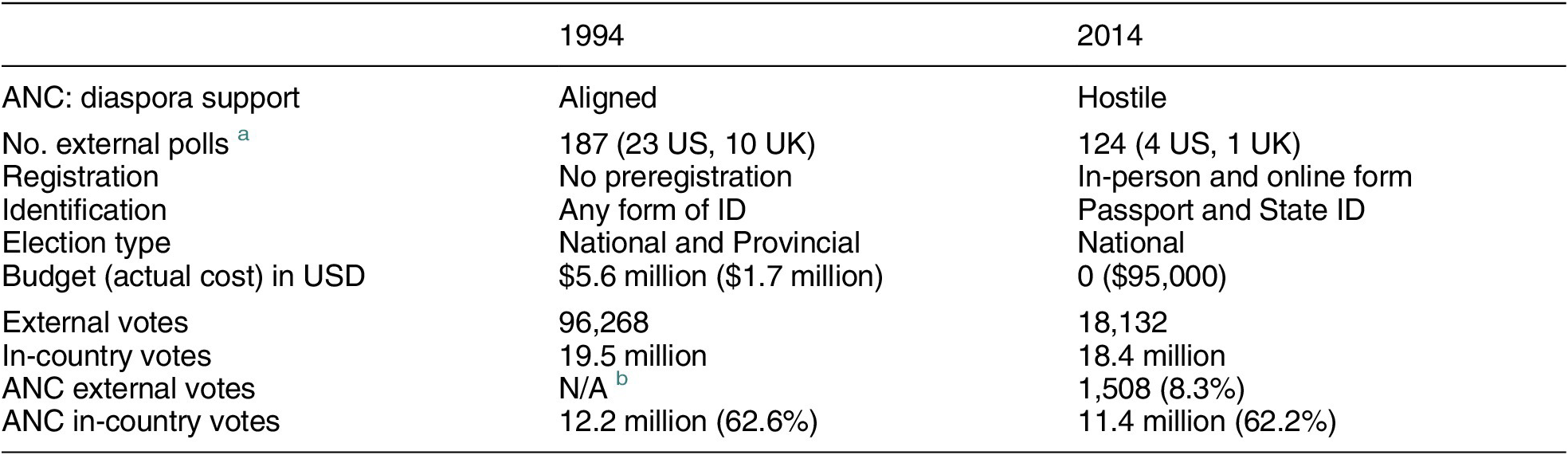
Although the South African government organized external voting in 1994 and 2014, the degree of emigrant voting access was dramatically different. Table 1 compares emigrant voter access in the 1994 election compared with the 2014 election. In 1994, the IEC allocated millions for foreign voting; in 2014, the IEC allocated no additional money.Footnote 22 For the 1994 elections, South Africans abroad did not need to register and voted with minimal identification. For the 2014 elections, the IEC required South Africans abroad to preregister through an online form and then required both a valid passport and state ID to vote. In 1994, the large numbers of South Africans living in the United Kingdom and the United States could vote in multiple cities around the country. In 2014, South Africa only organized polling at embassies and consulates run by DIRCO, South Africa’s diplomatic corps. South Africans, particularly in London, had to queue for hours at the single polling station in the country. Moreover, during the 2014 election, consulates started closing although South Africans were still waiting to vote.Footnote 23 “Understand that a lot of DIRCO staff members abroad [are] deployed cadres of the ruling party, and there wasn’t really much incentive for them to be very cooperative,” explained a DA politician.Footnote 24 In the 2014 election, only 18,000 South Africans voted from abroad, with only 8% voting for the ANC, in stark contrast to the 62% that supported the ANC domestically.
South Africa Emigrant Voter Access 1994 vs. 2014

a Source for all figures: IEC archival documents.
b In 1994, South Africans abroad voted in both provincial and national elections. Emigrant votes were integrated into provincial vote counts, making it impossible to distinguish votes by party. Beginning in 2009, South Africa counted foreign voting as a separate constituency.
To summarize, as the IEC explained in their 2009 Constitutional Court affidavit, during the 1994 election “foreign voting took place against the background of the fact that our people were in exile” (IEC 2009, 16, italics added). When the ANC believed they had the political support of South Africans abroad, they facilitated expansive emigrant voter access through flexible identification requirements and numerous polling stations in areas with high concentrations of South Africans. When the ANC believed that the diaspora was increasingly hostile toward their party, they abolished external voting altogether. After opposition parties secured emigrant enfranchisement through a Constitutional Court ruling, the IEC and DIRCO, staffed by ANC appointees, implemented external voting in a highly restrictive manner, limiting the costs on the state and placing numerous requirements on diaspora voters. As a former IEC officer further confirmed: “I know that we normally play this out and say it is going to be overly expensive but we know that even when we say that, that is not true. The budget [needed] is minimal.”Footnote 25
However, there are many reasons South Africa may be an anomaly, given the dramatic demographic shifts in emigration and relatively high levels of state capacity. In order to assess the generalizability of the argument, it is critical to analyze the variation of emigrant voter access between countries as well (e.g., Rohlfing Reference Rohlfing2012). Yet when it comes to diaspora voting, scholars have not been able to test the implications of partisan logic due to a lack of systematic data on how, where, and when governments organize voting abroad. The next section thus introduces and analyzes a new dataset covering external voting access in all national elections in sub-Saharan Africa (SSA) from 1990 to 2015 where diaspora citizens had voting rights.
Measuring Emigrant Voter Access
This dataset is the first to systematically document multiple dimensions of emigrant voter access for SSA at the electoral level, including voting modalities, external polling stations, and voter eligibility criteria.Footnote 26 To document external voting policies, I collected a variety of primary sources including constitutions, electoral laws, and court rulings. For evidence of implementation, I consulted electoral commission and embassy websites, electoral observation reports, news stories, and social media posts of voting abroad.Footnote 27 Whenever available I also collected emigrant voter data, including number of registered external voters, emigrant voter turnout, and the breakdown of the diaspora vote for each candidate or party.
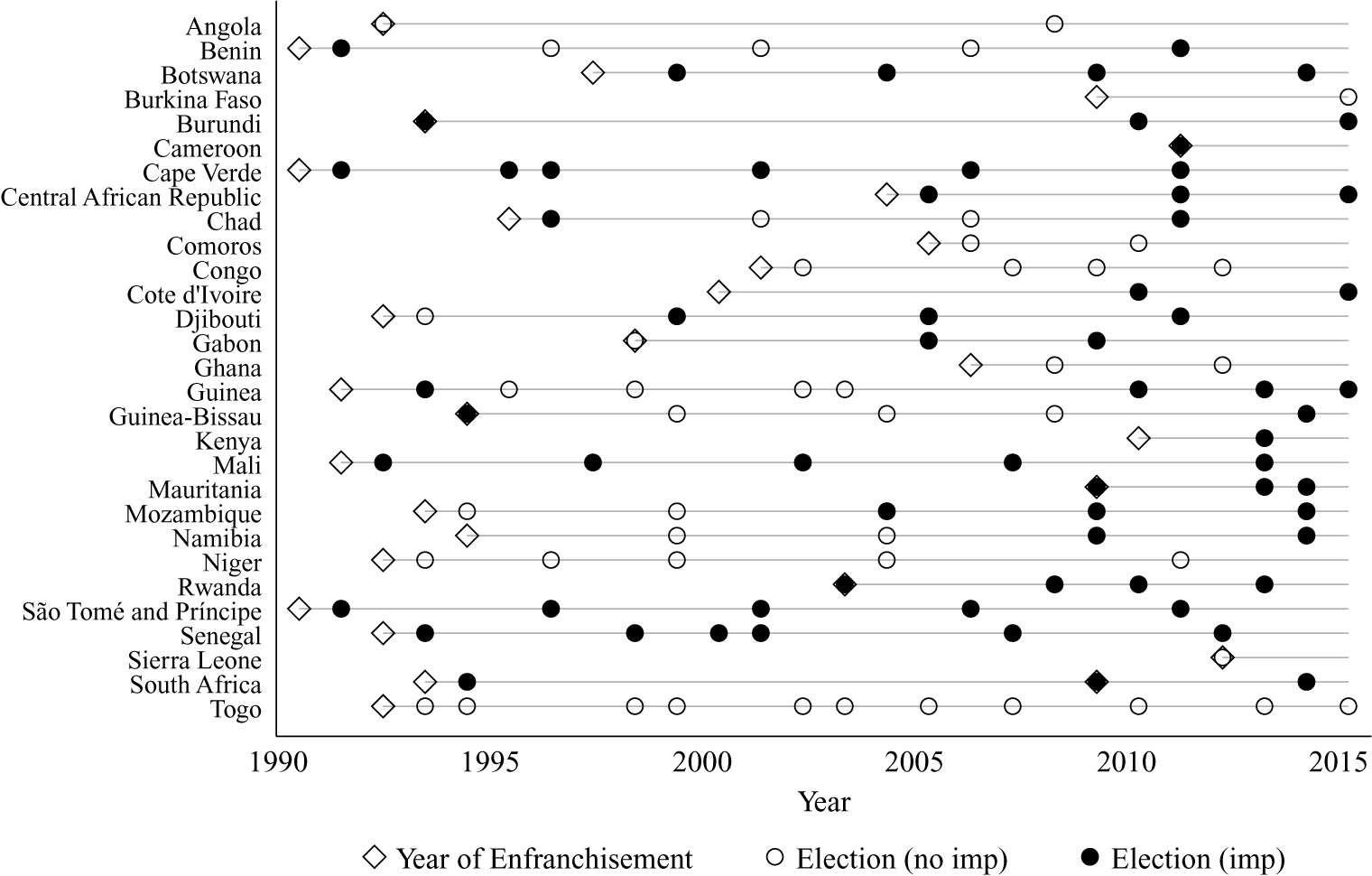
Between 1990 and 2015, 32 out of 48 countries in sub-Sarahan Africa legally extended voting rights to citizens abroad. Out of the 412 national elections held in SSA during that period, emigrants had voting rights in 141 executive and legislative elections.Footnote 28 Figure 1 visualizes the countries and elections included in the dataset and whether emigrant voting occurred. It is worth noting that out of the 32 countries with voting rights on the books, only 21 provided emigrant voting access in 85 of the 141 national elections with de jure emigrant enfranchisement (60%).
Elections in sub-Saharan Africa with De Jure Emigrant Enfranchisement
Note: Closed circles indicate elections where external voting was implemented (imp), open circles are elections where no external voting occurred despite de jure enfranchisement. Diamonds designate year of enfranchisement, with closed diamonds if an election featured diaspora participation the same year.

However, a binary measure of de facto enfranchisement obscures the extensive and important variation in the degree of emigrant voter access amongst elections that feature external voting. Some governments organize hundreds of polling stations around the world, while others limit voting to a handful of embassies. Some elections feature flexible identification requirements for diaspora citizens that are even more lenient than in-country rules; in others, governments require specific and multiple forms of identification above and beyond domestic procedures. These provisions substantively expand or restrict emigrant electoral participation (Lafleur Reference Lafleur2013).Footnote 29
Unlike external voting in other regions of the world, not a single country in SSA organizes postal absentee ballots or online voting for citizens abroad. In other words, the only way an African emigrant can vote abroad is by personally casting a ballot in an external polling station.Footnote 30 Therefore, in African elections, the two dimensions that most significantly shape emigrant voter access are (1) the number and location of polling stations abroad and (2) diaspora voter identification and registration requirements.
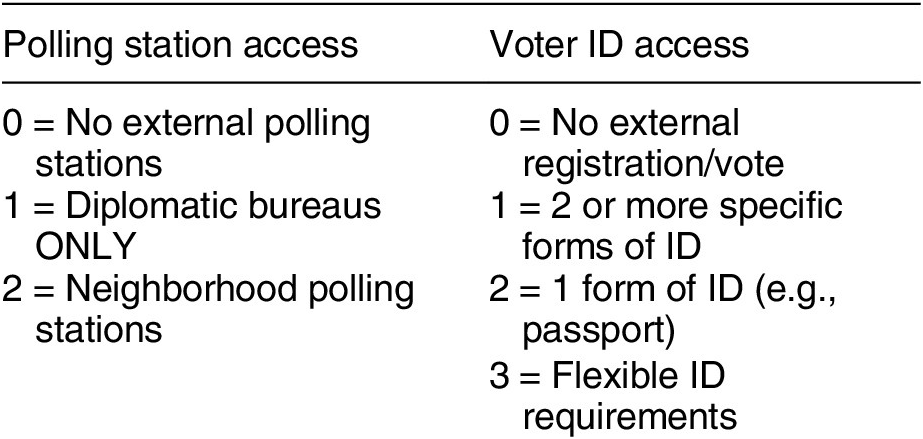
I thus measure emigrant voter access using these two policy provisions. For each election, I code external polling stations (Polls) and voter eligibility requirements (ID access) as ordinal categorical variables (Table 2). Ideally I would have the exact number and locations of all the external polling stations for every election where external voting occurred; unfortunately, this does not exist for many elections. In order to include all of the elections with external voting given the available data, I code external polling stations for each election as one of three categories: no external polling stations, only diplomatic polling stations, or neighborhood polling stations in addition to embassies and consulates. This coding enables inclusion of all 85 elections in the analysis, though it obscures the more fine-grained expansions and retractions of external polling stations we observe within countries from election to election.Footnote 31
Measuring Emigrant Voter Access

Diaspora voting most often occurs at embassies and consulates, requiring few costs on the state and, in many instances, places external voting firmly under the bureaucratic jurisdiction of the incumbent party, as illustrated in the South African example above. In contrast, organizing additional polling locations in areas with high concentrations of diaspora citizens requires additional logistical and technical infrastructure, not to mention establishing agreements with destination countries to place voting stations throughout their territory.Footnote 32 Organizing neighborhood polling stations should increase emigrant voter access, as it reduces the time and travel costs associated with voting in an embassy or consulate. Out of the 85 national elections with external voting in sub-Saharan Africa, 46 elections featured neighborhood polling stations beyond embassies and consulates (54%).
The difference in emigrant participation between elections with neighborhood polls compared with only diplomatic voting stations is striking. For example, over 80,000 Senegalese emigrants voted in 651 external polling stations in 42 countries in the 2012 presidential election (Smith Reference Smith2015). Contrast this with Kenya, which limited voting to their high commissions in four neighboring countries for the 2013 presidential election; only 2,328 diaspora Kenyans voted (IEBC 2013). The available external voter turnout data for 61 (out of 85) SSA elections with external voting provide further evidence that organizing extra polling stations substantively increases emigrant participation. Elections where polling is limited to diplomatic bureaus average a total of 5,690 diaspora votes; elections where governments organize additional neighborhood polling stations average 38,888 diaspora votes.
As for emigrant voter registration, nearly the majority of SSA countries require emigrants to preregister with their diplomatic bureau in order to vote, with some countries implementing additional hurdles, including in-person registration or requiring proof of employment in the host country. However, I am less confident in ID access as a measure of emigrant voting access for a number of reasons. First, it is harder to find explicit external voter registration provisions for many countries, particularly those that have legally extended rights but never implemented voting abroad. Second, given numerous reports of arbitrary disenfranchisement by diplomatic staff during registration and voting periods, I suspect there are many unobserved occasions where the reality on the ground does not match the legal and policy documents that I primarily used to code this variable.Footnote 33 Thus I employ Polls as my primary outcome variable, with ID access as an alternative measure.
To my knowledge, this is the most comprehensive, systematic accounting of emigrant voting procedures in Africa to date. Nevertheless, it is important to address concerns for valid inference given the specific limitations of this dataset. Given the relatively small number of elections with any external voting (n = 85), results should be interpreted with caution. Further, the small number of close elections (n=16) precludes the ability to statistically analyze emigrant voting access under different electoral contexts, especially as the theory suggests electoral competition interacts with perceptions of political support abroad.Footnote 34 Finally, data availability varies, particularly for coding ID access; in cases where I did not find sufficient information to code a particular election or country, I drop the observation, further reducing the sample size.
Analysis
I estimate a series of linear unobserved effects models with standard errors clustered by country.Footnote 35 For these analyses I reduced the panel to one national election in each country per year (n = 107) so as to not double count (nearly) identical observations for a given country in the same year (e.g., cases where national and legislative elections occur on the same day).Footnote 36 As I am interested in both between-country variation of emigrant voter access as well as within countries over time, I employ a random effects estimation method as opposed to fixed effects (Bell and Jones Reference Bell and Jones2015).Footnote 37 Given concerns over using maximum likelihood estimators on relatively small samples (e.g., Long Reference Long1997, 54), I present linear models rather than ordered logistic regression.Footnote 38 Because the panel is unbalanced and contains time gaps, I am unable to use panel-corrected standard errors (Beck and Katz Reference Beck and Katz2011). As a next-best option I account for serial autocorrelation with robust standard errors clustered by country (Cameron and Miller Reference Cameron and Miller2015). The main outcome variable, emigrant voter access, is primarily operationalized using the Polls variable as outlined above, with ID access as an alternative outcome measure.
Creating a systematic, straightforward measure for Diaspora Support at the electoral level is challenging for numerous reasons, including variation in reliable data on citizens abroad and the extreme variation in political stability during this period in SSA. While recognizing a broad continuum of potential dynamics, for the analysis Diaspora Support takes the value of 0 if the diaspora appears unsupportive of the incumbent party, 1 if diaspora support is uncertain, and 2 if the diaspora supports the incumbent party.Footnote 39 Given that partisan support abroad is largely unknown to political parties prior to enfranchisement (Østergaard-Nielsen and Ciornei Reference Østergaard-Nielsen and Ciornei2019), and that uncertainty should be highest at the initial moment of implementation (Hutcheson and Arrighi Reference Hutcheson and Arrighi2015), I code Diaspora Support as equal to 1 (uncertain) for the first election following legal enfranchisement. Whereas in more established party systems diasporas may be able to signal party affiliation prior to enfranchisement (e.g., Turcu and Urbatsch Reference Turcu and Urbatsch2020a), this coding also accommodates for the numerous cases of transitional and postconflict elections in sub-Saharan Africa organized by interim governments (e.g., Guinea 2010; Mali 2013). Moreover, pre-election opinion polling is not nearly as prevalent in SSA as in OECD countries, it is often plagued by measurement challenges and controversy (e.g., Heath, Fisher, and Smith Reference Heath, Fisher and Smith2005), and it is rarely conducted in diaspora communities. Thus, given low political information, prior electoral results are often the strongest signal available to incumbent parties (Eibl and Lynge-Mangueira Reference Eibl and Lynge-Mangueira2017, Somer-Topcu Reference Somer-Topcu2009). Where diaspora voter turnout results by party are available (n=47), I code Diaspora Support as equal to 2 for cases where the majority of the diaspora voted for incumbent party in the prior election and 0 in cases where the majority of diaspora voters supported the opposition.Footnote 40 Yet only 16 out of 29 governments organized any external voting during the first cycle following de jure enfranchisement. In the absence of electoral data, I assume incumbent parties rely on other (noisier) signals to assess political support abroad, including whether opposition parties have established international branches or if diaspora citizens have protested their regime; if so, I code as Diaspora Support as equal to zero. In line with partisan logic, I expect Diaspora Support to have a positive and significant association with expansive external voting access, particularly when the diaspora has voted for the incumbent party in the prior election (as opposed to being uncertain).
I also control for additional factors that may influence the degree of emigrant voting access.Footnote 41 We may expect external voting access to be positively associated with higher levels of state capacity as well as consolidated democracies; I thus include a measure for State Capacity as the percentage of government revenue of the Gross Domestic Product (GDP) (ICTD/UNU-WIDER 2020) and Political Regime, measured by the Polity2 variable from the Polity5 dataset (Marshall and Gurr Reference Marshall and Gurr2020). Numerous scholars have identified colonial legacies as an explanatory variable of institutions, particularly as it pertains to African citizenship laws and migration trajectories (e.g., Herbst Reference Herbst2000). Overviews of diaspora voting in Africa link external voting provisions in Francophone and Lusophone countries to inherited colonial tradition (Hartmann Reference Hartmann2015; Iheduru Reference Iheduru2011). Thus, from Treisman (Reference Treisman2007), I include a variable for whether the country is a Former French or Portuguese Colony.
Relative Diaspora Size also likely influences emigrant voter access, but it is unclear in which direction. On one hand, the larger the diaspora, the greater the incentives and demand for governments to signal recognition to the sizable percentage of citizens abroad. On the other hand, the larger the diaspora, the greater the electoral risks and logistical challenges associated with their electoral inclusion. To measure relative diaspora size I extend Leblang’s (Reference Leblang2017) estimate of emigrant populations with The World Bank’s Bilateral Migration data (2013; 2017) and then divide the diaspora estimate by the estimated country population from World Bank’s World Development Indicators (2020). In sub-Saharan Africa, relative diaspora size ranges from 0.4% to 37% of a country’s population; these numbers likely underestimate the actual size of emigrant populations due to irregular, seasonal, and undocumented migration.
Finally, I include two variables to assess alternative explanations: international diffusion and bureaucratic capacity. The pioneering cross-national analysis of emigrant enfranchisement found that the likelihood of enfranchisement doubles in the two years after a nearby country enacts voting (Turcu and Urbatsch Reference Turcu and Urbatsch2015), suggesting diffusion mechanisms of competitive signaling and policy learning. I reproduce the main outcome variable of the study, Recent Nearby Implementation, which takes the value of 1 if any of the nearest six countries implemented diaspora voting the previous 2 years. In many cases when governments do not implement emigrant voting following legal extension, officials and scholars cite the logistical difficulties and costs involved—that is, a lack of capacity within electoral management bodies (EMBs) (Lafleur Reference Lafleur2015; Pallister Reference Pallister2020). If a lack of capacity is the limiting factor, we would expect emigrant voter access to be positively and significantly associated with higher levels of electoral commission capacity. I include a measure of EMB Capacity taken from the Varieties of Democracy dataset (V-Dem) (Coppedge et al. Reference Coppedge, Gerring, Knutsen, Lindberg, Teorell, Altman and Bernhard2020). EMB Capacity is a 5-point ordinal scale (0–4) capturing the degree that the electoral commission has the staff and resources to organize a quality election.Footnote 42
Results
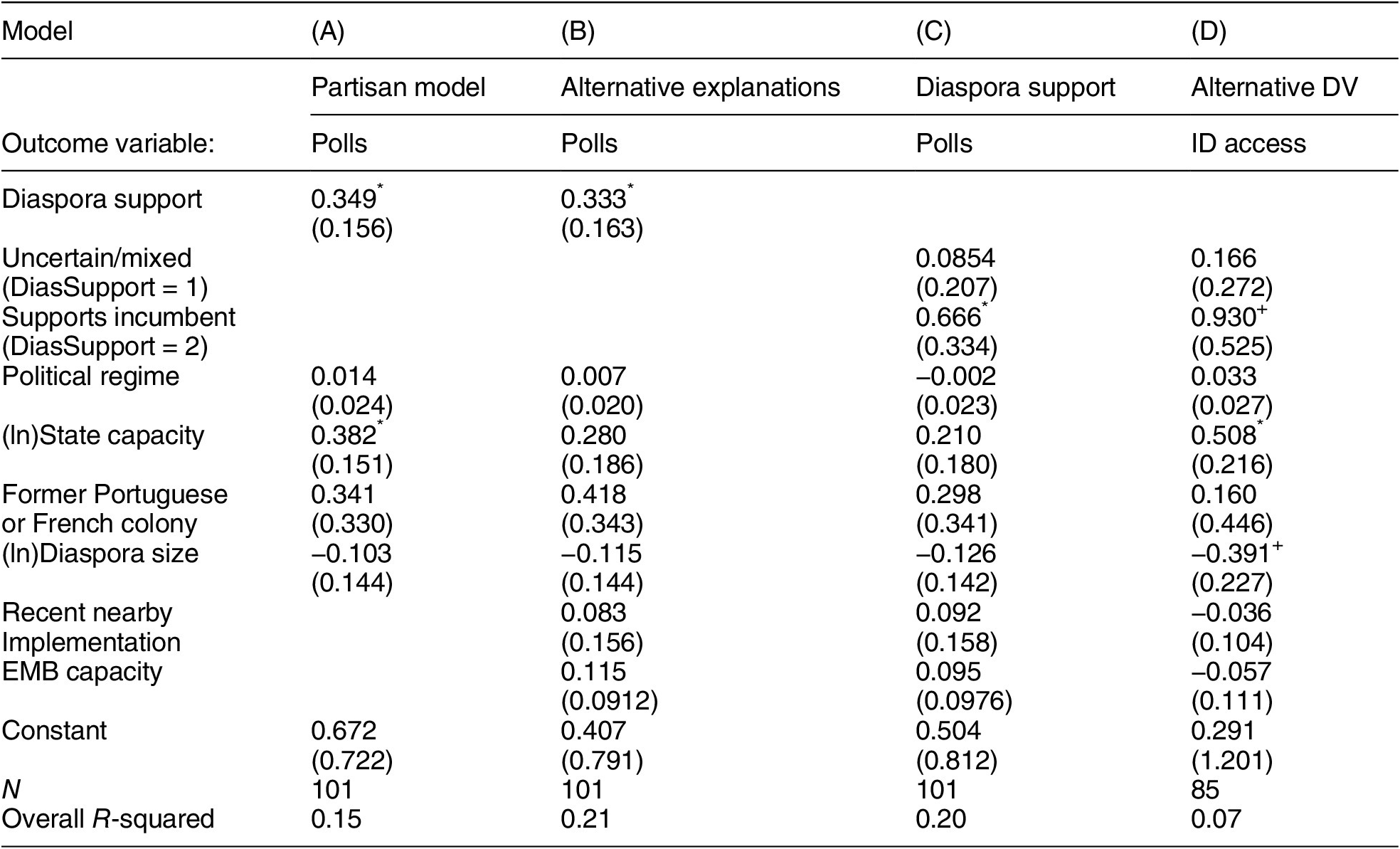
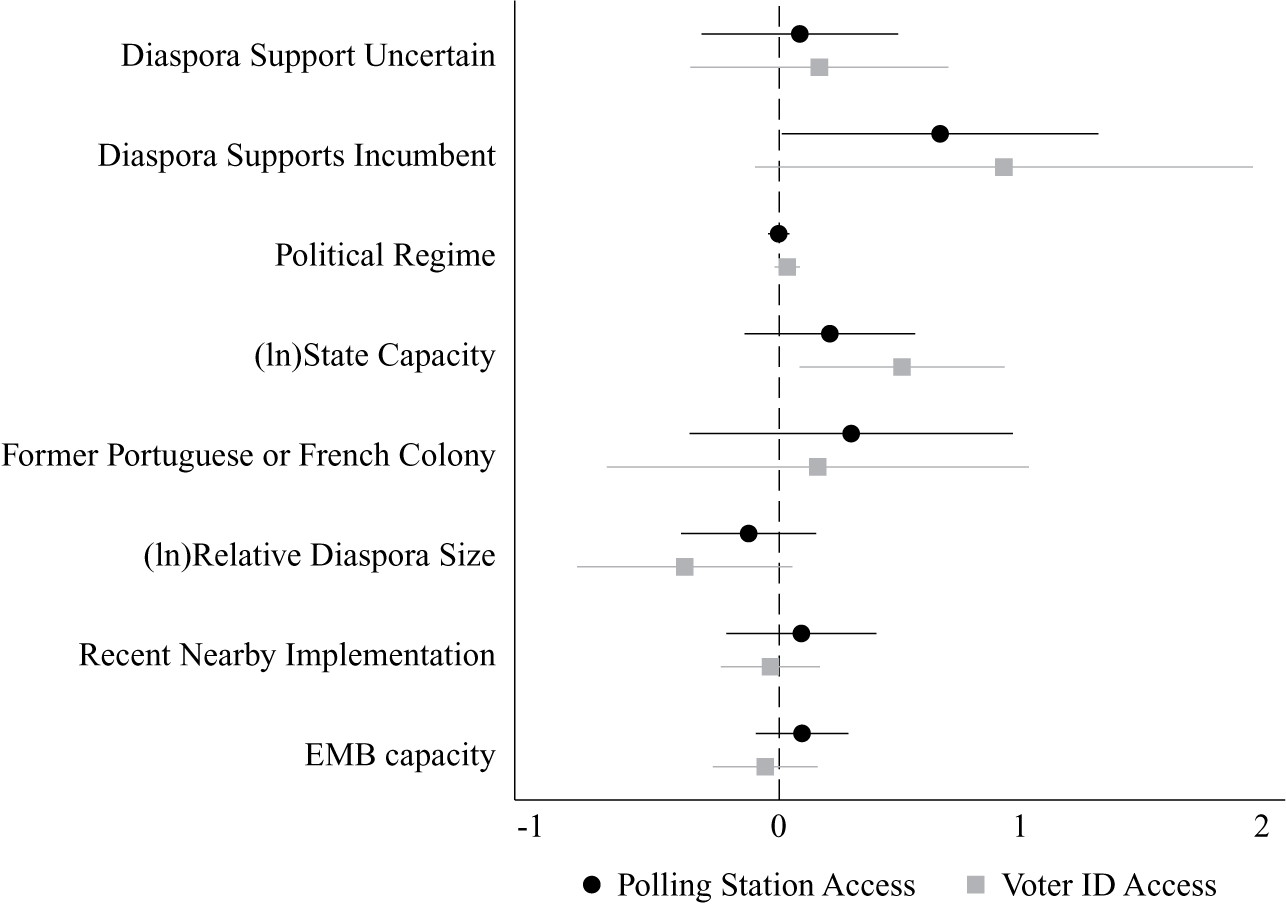
Table 3 presents four models. First, a baseline model (Model A) including the key explanatory variable Diaspora Support with controls. The full model (Model B) adds variables representing the alternative explanations of international diffusion and EMB capacity. The next model (Model C) disaggregates Diaspora Support to differentiate the effect of when an incumbent is uncertain of diaspora support versus having a supportive diaspora. The final model (Model D) presents the full model but with the alternative outcome measure of external voter ID access.
Emigrant Voter Access: Random Effect Panel Model Results

Note: Observations are country-election year given legal emigrant enfranchisement. Numbers presented are the coefficients with robust standard errors clustered by country in parentheses.
+p < 0.10, *p < 0.05, **p < 0.01.
There is a positive and statistically significant relationship between diaspora support for the incumbent party and degree of emigrant voter access. This relationship is constant across all models in Table 3 and also holds under numerous robustness checks, including using ID access as a measure for emigrant voter access, alternative modeling strategies, and additional control variables.Footnote 43 Moreover, disaggregating the Diaspora Support variable (Models C and D) further indicates that the results are primarily driven by contexts where the incumbent knows they have electoral support abroad, empirically supporting the argument that governments are averse to enfranchising an emigrant electorate of uncertain size and partisan affiliation. The relatively large confidence intervals, particularly for the Diaspora Support estimates, reflect the long tenures of dominant incumbent parties over the past 25 years in SSA elections (e.g., Bleck and Van de Walle Reference Bleck and Van de Walle2019).
As for the alternative explanations, Recent Nearby Implementation does not have a significant effect, suggesting that emigrant voter access is driven more by domestic concerns than international influences; this finding compliments a recent analysis of emigrant enfranchisement in Latin America that also did not find significant neighbor effects (Erlingsson and Tuman Reference Erlingsson and Tuman2017). Also, EMB capacity does not appear to be associated with emigrant voter access, ceteris paribus.Footnote 44 As coefficient estimates of random effects models include both between and within-country effects, substantive interpretation is difficult; Figure 2 thus visually presents the coefficient estimates of both measures of external voter access (Polls and ID access) with 95% confidence intervals. Overall, the estimates are remarkably consistent, showing the positive relationship between diaspora support for the incumbent and higher levels of emigrant voter access.
Comparing Dimensions of Emigrant Voter Access
Note: The black circles are the coefficient point estimates from Model C in Table 3, presented with 95% confidence intervals (Outcome variable: Polls). The gray squares are the coefficient point estimates from Model D in Table 3, presented with 95% confidence intervals (Outcome variable: ID access).

Conclusion
Given the norm of universal suffrage and burgeoning international mobility, migrant electoral participation is the mass enfranchisement issue of the twenty-first century. Extending voting rights to emigrants signals both recognition of their citizenship and adherence to democratic practices. Although the majority of countries now legally enfranchise citizens abroad, implementation and subsequent diaspora turnout remain limited. This article argues that documenting and analyzing variation at the electoral level is critical for understanding emigrant inclusion in elections. Tracing the variation of emigrant voter access within South African elections as well as analyzing an original dataset of external voting provisions throughout sub-Saharan Africa, I find that the degree of emigrant inclusion primarily depends on the electoral interests of incumbent parties.
Why should we care? First, as illustrated by Cape Verde, emigrant votes change elections. Cape Verde is not the only country where the diaspora determined the winner; emigrant votes have altered other presidential (e.g., Romania 2009) and parliamentary elections (e.g., Italy 2006). The argument also suggests fascinating counterfactuals. If external voting had been widely accessible to diaspora citizens during recent close elections (e.g., Ghana 2008; Zambia 2015; Zimbabwe 2018), how many could have had alternative outcomes? Second, the implication of strategic disenfranchisement through restrictive implementation (or no implementation at all) also contributes to scholarship on voter suppression, electoral manipulation, and migrant political engagement. Although scholars attribute relatively low external voting rates to emigrant apathy and lack of political experience (e.g., Caramani and Grotz Reference Caramani and Grotz2015; Waldinger Reference Waldinger2015), my findings suggest diaspora participation is a function of incumbent party strategy rather than low emigrant interest, a conclusion in line with recent analyses of external voter turnout (Burgess and Tyburski Reference Burgess and Tyburski2020; Turcu and Urbatsch Reference Turcu and Urbatsch2020a). Finally, the inclusion of emigrant voters raises normative implications (e.g., Bauböck Reference Bauböck2006; Reference Bauböck2015; Lopez-Guerra Reference Lopez-Guerra2005; Song Reference Song2009). Should people who no longer live in a country decide the country’s leadership? Is it more fair to link suffrage rights to local residency rather than national citizenship? If so, what are the implications for the destination countries where emigrants are moving?
Future research can proceed in a number of directions. First, we can continue to expand the empirical focus beyond Europe and Latin American contexts, bringing additional African, Asian, and Middle Eastern experiences with diaspora voting into comparative analysis (e.g., Brand Reference Brand2010; Reference Brand2014; Dedieu et al. Reference Dedieu, Chauvet, Gubert, Mesplé-Somps and Smith2013; Jaca and Torneo Reference Jaca and Torneo2019). Second, the literature on emigrant enfranchisement would benefit from more negative case studies in order to build theory and broaden our empirical knowledge (e.g., Arrighi and Lafleur Reference Arrighi and Lafleur2019; Pallister Reference Pallister2020; Wellman and Whitaker Reference Wellman and WhitakerForthcoming). These could include cases of stalled legislative proposals, dismissed court cases, or failed external voter registration drives. Finally, the data introduced in this article make a significant empirical contribution by providing comprehensive emigrant voter access data for all African countries at the election level. The dataset enables new possibilities in employing emigrant voting access as an explanatory variable. Does increasing polling stations abroad lead to increased remittances? How does the ability to participate in home country elections influence political participation in destination countries? As international migration reshapes politics around the world, the effects of emigrant inclusion on the electoral politics of both origin and destination countries will be of increasing interest to scholars and policy makers for decades to come.
Supplementary Materials
To view supplementary material for this article, please visit http://dx.doi.org/10.1017/S0003055420000866.
Replication materials can be found on Dataverse at https://doi.org/10.7910/DVN/SWSY7T.




Comments
No Comments have been published for this article.