The Betting Act 1926Footnote 1 revolutionised the business of bookmaking in Ireland. Up until this point, bets could only legally be placed with bookmakers on horseracing courses, or on credit over the telephone and by telegram through commission agents. The hitherto illegal activity of cash betting, conducted clandestinely on the street and in retail premises and public houses, would now be transacted in state-regulated offices operated by licensed bookmakers. The activity would also become a source of revenue for the government through direct taxation and licence fees. The figure of the street bookmaker, often maligned as a devious, exploitative character, would be replaced by a diverse cluster of legitimate businessmen and businesswomen, subject to the watchful gaze of the police and the revenue authorities. This article focuses on the time period between the legalisation of cash betting and the introduction of the Betting Act 1931,Footnote 2 a piece of legislation designed to remedy the perceived excesses occasioned by the 1926 act. It will examine the figure of the bookmaker, the bookmaker’s business practices, clientele and geographical distribution in these years. The perception of betting as an activity and a business changed in the period leading to the introduction of the 1931 act. This change, and the prejudices underpinning it, provide an insight into contemporary values and social mores.
I
Ostensibly, the liberalisation of betting in Free State Ireland appears out of step with other legislative measures. The Catholic church exercised considerable influence on public debate in this period and successive administrations were keen to uphold standards of public morality.Footnote 3 The Censorship of Films Act 1923 was followed in 1927 by the Censorship of Publications Act. Regulation of alcohol consumption and public dancing were enacted through the Intoxicating Liquor Acts of 1924 and 1927, and the Public Dancehalls Act 1935. Issues relating to sex were a contemporary obsession with the sittings of the Carrigan Committee (1930–31) exemplifying grave official concerns with the nation’s moral condition.Footnote 4 Despite its questionable moral connotations, the Catholic church did not perceive betting as a major problem so long as it was not conducted to excess. As early as 1912 the Revd Nicholas Fagan, before a congregation at the pro-cathedral in Dublin, wondered whether or not gambling was a sin before laconically concluding that ‘it is and it isn’t’.Footnote 5 Something of the prevailing attitude that informed debate on the legislative approach in the 1920s can be garnered from the submission of Revd J. J. Flood, representing the Catholic church, to the joint committee on the Betting Act which sat in 1929: ‘It must be stated at the outset, that Catholic teaching does not consider ordinary betting as an ethical wrong. If a man wishes occasionally to risk in a fair bet a moderate sum of money which he really owns and can freely dispose of, he is perfectly entitled to take the risk.’ This was not an endorsement of betting. Flood outlined in some detail his belief that women, children and the poor should be prevented from laying bets and that the conduct of betting offices should be stringently regulated lest the activity should become ‘morally risky’.Footnote 6 Betting, therefore, was not a target for outright prohibition.
The Betting Act 1926, when introduced, was the latest in a litany of legislative instruments designed to regulate an activity that had been popular in Ireland for centuries. Betting had been central to the popularity of sport in Ireland from the seventeenth to the nineteenth centuries; activities such as horse racing, cock-fighting, pugilism and drag-chasing could scarcely have garnered any popular appeal without the opportunities they afforded punters to place bets.Footnote 7 As an activity, gambling gave rise to little concern when it was conducted by the elite but was vigorously condemned by the elite as dangerous and degenerative when indulged in by the ‘lower classes’.Footnote 8 This was a remarkably durable attitude that would survive down to the debates of the 1920s. From the early 1800s, sports of all kinds, and the disorderly ancillary activities associated with them, became subject to a moral onslaught in Britain and Ireland. Gambling was very much in the cross hairs of this crusade and legislation in 1845 and 1853 prevented betting from taking place on premises away from race courses.Footnote 9 Further acts dealing with street betting (1906) and cash betting on football matches (1920) followed. The sole piece of gambling legislation passed by Dáil Éireann prior to 1926 was the Gaming Act 1923, an uncontentious piece of legislation relating to the legal rights of bookmakers and gamblers in respect of recovering debts incurred through betting.Footnote 10
In Ireland, then, entering into betting transactions in exchange for cash in public, and away from the racecourse, was illegal. This prohibition had given rise to what was, by 1926, the widespread and long-established practice of illegal street betting.Footnote 11 This covert activity, despite its name, did not generally take place on the street but was organised in existing retail premises where it was a lively adjunct to otherwise legitimate business. Legal racecourse bookmakers and publicans were specifically blamed for the prevalence of illegal cash betting but a diverse range of business people were involved. In his evidence to the joint committee on the Betting Act in 1929, the Garda Commissioner, Eoin O’Duffy, asserted that: ‘A great many people who frequented racecourses as bookmakers had common betting houses in their own homes or in some place convenient best known to themselves and many publicans also carry on betting transactions’.Footnote 12
In the years leading up to the 1926 legislation it became commonly perceived that illegal bookmaking was becoming both ubiquitous in certain localities and that trying to enforce its prohibition was pointless. Speaking in his capacity as defence counsel for two men charged with illegal betting in Limerick in 1925, J. S. Gaffney considered
… betting prosecutions the most utter farce in view of what they all knew about the practice of betting. It seemed to him that there was one law for the rich in regard to this matter and another for the poor. The rich man could make his bet with impunity, if he did so by letter, by phone, or telegraph, methods which were not open to the poorer members of the community. The result was that every laneway and dive of the city was being made use of for betting purposes by those who could not otherwise gratify their desire to place a bet.Footnote 13
As will become evident, class prejudice heavily influenced debates as to the rectitude of betting. In this case, it was also clear that the community’s moral guardians were also worried about the socially degenerative effects of betting as the prosecuting Garda, Superintendent Reilly, pointed out that ‘priests and people were making complaints about the growth of the betting evil’.Footnote 14
Yet, bearing in mind the negative commentary that these individuals inevitably drew, the Betting Act 1926 was arguably a boon for illegal bookmakers. Bookmaking was not a business that one could engage in from a standing start. Successful bookmaking required relatively complex mathematical skills, detailed knowledge of the vagaries of sporting activities (especially horseracing) and a solid network of customers and contacts. It was almost inevitable, then, that bookmaking’s transition from an illegal covert activity to a legitimate set of business practices was characterised in Ireland by continuity rather than change. This is borne out by even the most cursory examination of evidence relating to betting prior to the 1926 act. Cases of illegal bookmaking brought before the courts in the years prior to the 1926 legislation suggest two patterns. First, many of the individuals who successfully took out licences after legalisation had been operating illegally for years. And secondly, legalisation did little to alter the social geography of betting: new, legal offices were opened in premises and in areas that had a long-standing tradition of betting.
A typical case, in 1924, saw one Walter McConnell charged with carrying out illegal bookmaking at Marlborough Street in Dublin.Footnote 15 When a legal betting office opened at the same location in 1927, it seems exceedingly likely that the licensee, William McConnell, was either the accused’s brother or father.Footnote 16 The latter opened further offices on Aungier Street and Middle Abbey Street.Footnote 17 In Limerick, Robert Quinlan of Parnell Street was convicted on more than one occasion of illegal betting before becoming a legitimate operator in 1927.Footnote 18 In 1924, Thomas Curtin of Winthrop Avenue in Cork was fined £20 for illegal betting, before becoming a legal bookmaker at the same address in 1927.Footnote 19 In a similar case in 1923, Patrick Lally was fined £10 for using his premises at 17 Wellington Quay in Dublin ‘for the purposes of betting’.Footnote 20 In 1926, Lally opened a betting office at the same address.Footnote 21 In June 1925, a raid by six Gardaí was carried out on a billiards room in Roscrea on the day of the Epsom Derby. Thomas Reardon was arrested and charged with illegal betting when 159 betting slips were found bearing the names of horses running in the race. Reardon was fined £2 and eventually became Roscrea’s first legal bookmaker when he opened a licensed office on Church Street following the 1926 act.Footnote 22
New offices opened after 1926 were often situated at locations where there was a pre-existing tradition of illegal betting. In 1924, Thomas Watson was charged with carrying on illegal bookmaking at 11 East Essex Street, the precise address at which William Coffey opened a licensed operation in 1927.Footnote 23 The same scenario arose in the case of Thomas Fitzsimons, fined two pounds for illegal bookmaking at 63 Manor Street in 1925. Fitzsimons pleaded that he was unemployed and that ‘as he had a couple of pounds, he thought he would make a small “book”’.Footnote 24 By 1927, 63 Manor Street housed one of six betting offices owned by David O’Connor and Michael Buckley.Footnote 25 In 1924, 19 Fowne’s Street in Dublin was raided and one John O’Flaherty was charged with illegal bookmaking.Footnote 26 The same premises were later a legal office operated by Richard Power. In these latter cases it is possible that at least some of the men brought before the courts may have been proxies, helping established bookmakers to avoid prosecution in return for payment. Power, later doyen of Irish bookmakers (see below), was fined £25 for carrying on an illegal betting business at 8 Pembroke Street in Cork. By 1927, the same premises was being operated as a legitimate betting office by the same operator.Footnote 27
Illegal bookmaking, then, took place where one would logically expect it to do so. There was a long-standing tradition of bookmaking in public houses and other retail premises in Britain and Ireland. Moreover, there was a clear skills overlap between operating as a bookmaker and running a retail business. Familiarity with keeping accounts and knowledge of arithmetic were crucial in both the legitimate and proscribed spheres of business. The 1926 act was something of an amnesty for existing cash bookmakers, an opportunity to come clean and operate legally. Ernest Blythe admitted as much when speaking before the Dáil during the debates on the 1926 Betting Act: ‘The present position is that we have a number of premises on which betting is carried on illegally and the first step should be to bring them into the open, to have people who carry on betting register themselves and the premises.’Footnote 28
It was in the context of this perceptibly thriving black economy that moves were eventually made to legalise and regulate cash betting. In a letter to the government in 1925, John T. Kelly of the General Valuation Office estimated that there were some 500 people engaged in the business of bookmaking in Ireland. As well as those who operated on the racecourse, ‘a far greater number … do betting business in “offices”, on licensed and other business premises, and on the streets of larger towns and cities’.Footnote 29 Its widespread popularity and the failure of legislative measures to curb it provided a strong rationale for government to legalise cash betting. Kelly added: ‘All intelligent unbiased people are agreed that betting cannot be abolished. Every legislative attempt to render its operations difficult and expensive completely failed in its purpose.’Footnote 30 This was a point later endorsed by O’Duffy who, speaking after legalisation, admitted that ‘There were frequent prosecutions for keeping betting houses and for street betting, and usually when these cases were brought to the court very heavy penalties were imposed by magistrates, but they had not very much effect.’Footnote 31
Most crucially of all, pragmatic considerations weighed heavily on those responsible for legislation. When introducing the 1926 Act, Ernest Blythe focused, again, on the anomalies of the existing situation:
It seems to us that if a law of that kind cannot be enforced – when the law deals with something that in itself is not wrong, something that can only be objected to if it is done to great excess or carried on in such a way as to lead to abuses growing up alongside it – the proper thing to do is to remove the legal disability, to recognise the existence of this practice and to regulate and control it.Footnote 32
Beyond the futility of trying to implement seemingly unenforceable laws, the fiscal dimension of betting regulation also influenced the government. In his letter to the government, Kelly proposed a rather grandiose scheme for the licensing of bookmakers and the direct taxation of betting that he estimated would raise revenue of £2,000,000 per year. Ernest Blythe was much more circumspect in this regard, however, and predicted revenue of £150,000–£200,000 from betting tax.Footnote 33 In the second full tax year in which the legislation was operational, betting raised revenue of £212,000.Footnote 34
Unlike Britain, and due, perhaps, to the Catholic church’s ambiguous attitude on the matter, there was no coordinated anti-gambling movement in Ireland and the forces of Protestant nonconformism cannot be said to have had a strong influence on the Free State’s legislative process. In Britain, the National Anti-Gambling League had been founded in 1890 and though it was an umbrella organisation for a loose coalition of interest groups, it had a strong religious complexion. Loud and vociferous in its opposition to any hint of political tolerance of betting, the anti-gambling movement in Britain was well-coordinated and much more audible in the public sphere than opponents of betting in Ireland. When, for example, betting taxation was the subject of a select committee in Britain in 1923, the vast majority of resolutions submitted came from religious groups, with Primitive Methodists and Wesleyans featuring prominently.Footnote 35 Moreover, the Catholic church in Britain, in common with its Irish equivalent, had a relatively easy-going attitude to gambling, and only worried when it was done to excess.Footnote 36
The Betting Act was not, therefore, a conspicuously controversial measure in the context of public morality in Ireland. The legislation passed through Dáil Éireann without a great deal of fuss and there was little negative commentary in the press. The Irish Times, for instance, commented in favour, if quite wryly, of the new legislation: ‘Doubtless, it will be criticised, but, in all circumstances, we believe that the experiment ought to be tried; for, much as some people may object to betting, who can pretend that it does not flourish in the Free State?’Footnote 37
Some opposition to the legislation emanated from the Church of Ireland. In his presidential address to the United Synod of Dublin, Kildare and Glendalough, the archbishop of Dublin, John Gregg, assuming fecklessness and idleness on the part of the better, asserted that:
The normal way to acquire money is by working for it. There is the suggestion here that there is a shorter and easier way of acquiring it. The effect of this … was that the normal relation of men to money was completely disturbed, and that men thought of money and their duty of stewardship in regard to it was largely destroyed … Was the habit of living from chance to chance in feverish hope of snatching unearned money here, if not there, likely to make thrifty, steady-going citizens?Footnote 38
Of all the issues that concerned the moral guardians of 1920s Ireland, betting, with its apparent subversion of industry and hard work, was probably one matter upon which the Church of Ireland felt comfortable pronouncing.Footnote 39
The legalisation of cash betting, then, was a utilitarian, pragmatic measure. The result was legislation that erred on the side of the liberal, with few restrictions on where bookmaking could take place, or who could carry it out. The government, with little available in the way of similar legislation elsewhere to use as a guide, took something of a risk. Indeed, it was always acknowledged that the 1926 Act, with its liberal thrust, would require alteration if and when problems arose. As Blythe pointed out when introducing the 1930 Betting Bill:
The 1926 Act was in the nature of an experiment. It provided for the licensing of houses in which bookmakers might carry on the business of cash betting legally, subject to a certain measure of regulation and control. While certain defects came to light, in my opinion that Act on the whole operated moderately successfully.Footnote 40
The Betting Act eventually came into operation in November 1926. Under the legislation a tax of five per cent would be paid on bets taken in newly licensed offices, while a tax of two-and-a-half per cent would apply to bets taken on racecourses. Individuals wishing to become licensed bookmakers applied, initially, to the local Garda superintendent for a certificate of personal fitness. On receiving this, an application for a licence was made to the Revenue Commissioners to whom a fee of £10 was paid. Licences were valid for one year and applicants were obliged to advertise, in two local newspapers, their intention to seek a new licence or the renewal of an existing one.Footnote 41 In addition, a fee of £20 was applicable to each premises operated by a bookmaker.Footnote 42
II
Legal off-course bookmaking and betting were part of the broader commercialisation of leisure in Ireland in the 1920s. Cinemas, dance halls and sporting activities were among a variety of activities that offered potential diversion in a period characterised by stern conservatism. In 1926, for instance, entertainments and sports accounted for approximately £1.5 million of national expenditure in the Free State.Footnote 43 This was an encouraging portent for the newly legalised form of betting. Moreover, newly-established bookmakers would benefit from extensive newspaper coverage of their core business, English horseracing.Footnote 44
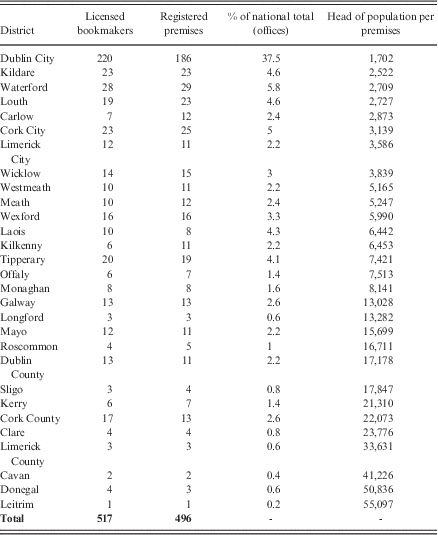
In attempting to establish the key quantitative and geographical patterns of licence uptake in the first year of the legislation, two sources may be called upon. The broad contours can be discerned from figures supplied to the joint committee on the Betting Act 1926 which began its hearings in November 1928. More precise patterns can be ascertained from the ‘Record of bookmakers’ licences issued and premises entered in the Register of Bookmaking Offices’, a government document printed in 1927.Footnote 45 The evidence of the latter suggests a sharp uptake of licences in the initial months of legalisation. Within four months of the Betting Act coming in to operation, 509 individuals were legally engaged in the business of bookmaking in Ireland. Of these, 387 were carrying out business from a total number of 485 registered premises.Footnote 46 The rate of applications decreased thereafter and by October 622 licences had been issued. By November 1928, the number of legal bookmakers had decreased modestly to 517, with 496 premises in operation, a slight increase from early 1927.Footnote 47 Numbers remained steady in the years following and by 1930, when the business had somewhat settled down, perhaps, there were 545 licensed premises in operation.Footnote 48 Unsurprisingly, the bookmaking profession was largely, but not exclusively, male-dominated. Of the 509 licensees recorded in early 1927, just eight (1.6 per cent) were issued to women. Though such a small proportion allows for little in the way of confident generalisation, it is worth noting that just three of the eight women were from cities, with the remaining five operating premises in provincial towns.Footnote 49
Geographical distribution of licensed betting offices per head of population, November 1928

Sources: Report of the Joint Committee on the Betting Act 1927, pp 3–4; ‘Record of bookmakers’ licences’.
When matched to census records and the census definition of what constituted a town,Footnote 50 the geographical breakdown of licensed premises indicates that the legal bookmaking business was a predominantly urban activity. This is quite obvious when one examines the larger centres of urban population. Dublin city, with 186 registered premises, accounted for well over a third of the total number. Many of these, in turn, were clustered in inner-city residential and retail areas either side of the River Liffey. Indeed the number of bookmakers in Dublin city was well out of proportion with the city’s population when compared to the national average, an issue that, as we will see below, caused some anxiety in official circles.
By head of population Limerick and Cork cities had fewer bookies than Dublin but were still well above the national average. Other counties with large proportions of their population living in substantial towns, particularly Louth, were well served with betting offices. Some ostensible anomalies are apparent. Kildare, though not a particularly urban county by the census definition of the term, had a proportionately large number of registered offices. It seems likely that this was associated with the county’s status as a centre of Irish racing, with the Curragh racecourse situated between Newbridge and Kildare town. At the other end of the scale, offices were sparse in predominantly rural counties such as Leitrim, Donegal and Limerick (excluding Limerick city). Any tradition of illegal bookmaking could easily have persevered in these areas, perhaps, with bookmakers limiting their dealings to a small number of trusted and discreet clients.
Bookmakers became a feature of the business landscape of the provincial town. The largest settlement in Ireland without a betting office, by 1927, was Kilrush, County Clare. Practically all other towns of any note had at least one licensed bookmaking premises and many had more than one. Dundalk, albeit one of the largest towns in the country, had nineteen betting offices, amounting to one for every 736 citizens.Footnote 51 It seems implausible that County Kerry, with several substantial towns, was as devoid of bookmakers (one for every 21,310 natives) as the official figures suggest and it seems likely that the industry persevered there in its unlicensed form in the years following legislation. This exemplified, perhaps, the perseverance of a long tradition of distrusting or ignoring officialdom and bureaucracy emanating from Dublin. Moreover, the Kerry situation may have been symptomatic of the state’s continued efforts to establish law and order and, indeed, its legitimacy in certain parts of the country.Footnote 52
Another key socio-geographical pattern was the dense clustering of offices in inner-city Dublin. If one cross-references the addresses of licensed bookmaking premises with trade directories published before the legislation, it becomes quite clear that betting was part and parcel of life among some of the poorer citizens of the city. This is revealed by examining the prior usage of 135 bookmakers’ premises in Dublin city. Of these twenty-two were listed as tenements in the street directory for the year prior to legalisation, a further twelve were listed as small houses, typical of the terraced dwellings that better-off sections of the working class inhabited, while a further two premises were listed as ruins.Footnote 53 Just over a quarter of Dublin betting offices, then, were seemingly ad hoc operations, a variety of 1920s ‘pop-up shops’ that the authorities sanctioned for use as bookmaking businesses. Many more were situated in close proximity to tenement areas. Accompanying these were the numerous betting offices that were set up in premises that had a pre-existing retail function.Footnote 54 This is as one might expect it to have been given the tradition of illegal betting within otherwise legitimate business premises in urban areas.
III
So who were these bookmakers? The stereotype of the bookmaker as a mendacious, exploitative figure dominated much popular discussion in Britain and Ireland on the subject of betting. It has been asserted elsewhere that this was a crude, inaccurate characterisation.Footnote 55 Indeed, the first generation of legal off-course bookmakers in Ireland was a diverse group both in their geographical dispersion and social background. This was evident during the sittings of the joint committee on the Betting Act where it was tacitly acknowledged by most witnesses that there were different ‘classes’ of bookmakers ranging from the well-financed, fair and scrupulous agents to the skulking, devious characters for whom, in the words of one witness to the joint committee, ‘the strain of protracted honesty proved too much’.Footnote 56 Unsurprisingly witnesses from the various churches and the thrift movement were prone to offering negative portrayals of all bookmakers. In his evidence to the joint committee, Rev. H. B. Kennedy, dean of Christ Church Cathedral, Dublin, and representing the Church of Ireland, claimed that: ‘The bookmakers are entirely unproductive members of the community. They produce nothing. They make nothing for anybody except themselves. Their occupation is a wholly selfish one.’Footnote 57 As already pointed out, the equation of industry with morality, and vice-versa, was typical of the Protestant critique of betting.
The Irish Times, which, as we have already seen, initially considered the legislation an experiment worth trying, quickly adopted a hostile attitude to working-class betting and bookmakers:
People with hardly a boot to their foot can be seen going into these betting saloons where the ‘agent’ is quite willing to accept such amounts as 3d. and 6d. Most of these bookmakers can boast the possession of motor cars, while their clients part with money raised in the pawnshop. That such a state of affairs should be allowed to exist is a disgrace to the Free State Government.Footnote 58
These objections did not prevent the Irish Times from publishing that day’s schedule at Haydock, along with betting selections.Footnote 59
Bookmakers came from different walks of life with levels of involvement in the industry varying quite significantly. Indeed, contemporary discourse invites us to categorise bookmakers according to scale of involvement in the business. If we were to classify the first generation of Irish bookmakers thus, at the top in terms the public profile that they garnered would be those individuals who, post-legalisation, quickly built large betting businesses. Of the 387 licensed off-course bookmakers recorded in early 1927, fifty-one (thirteen per cent) owned more than one betting office. Some of these, in turn, quickly became betting magnates. The two biggest operators in the period covered by this article were Francis Slater of Carlow and Richard Power from Waterford. Beyond these was a large amorphous group of bookmakers, most of whom had just one licensed office and who operated in cities and provincial towns. There were clusters: as we have seen, inner-city Dublin was well-served with bookmakers; and the bookies in the poorer parts of the city did business that attracted the most unfavourable publicity.
Power and Slater quickly became the two largest owners of betting offices in the Free State. Within months of the 1926 act coming into law Slater had opened thirteen offices in Leinster, located in medium-sized towns in Counties Wicklow, Wexford, Carlow and Laois.Footnote 60 By 1933, his bookmaking enterprise had expanded significantly, with eighty-three offices now bearing his name, dispersed across the twenty-six counties of the Free State. And by the time of his death, in 1937, he owned 108 betting offices.Footnote 61 Bookmaking, for Slater, was one branch of an extensive array of entrepreneurial activities. His main interests prior to the Betting Act were in the poultry and baking businesses and he also opened the first cinema in Carlow town. When he died, in 1937, the Nationalist and Leinster Times paid him the following tribute:
To a man of Mr Slater’s calibre nothing was impossible. He possessed those rare qualities of making everything he touched an undoubted success, and this was possible owing to his amazing courage and foresight … Mr Slater was known to all for his charity and generosity. No organisation with the least spark of worthiness ever went to him for help without coming away the better of their visit.Footnote 62
Owning a chain of outlets in a heavily regulated industry created problems for businesses of the scale of Slater’s and Power’s. In 1933, Slater’s entire bookmaking operation was jeopardised by a conviction under the Betting Act after a wager was taken by a boy aged under eighteen in his office in Bandon, County Cork. This led to a refusal of a licence and suitability of premises applications in two shops and similar moves regarding seventeen further outlets. The judge at Slater’s appeal, impressed by his otherwise exemplary record in observing the terms of the betting legislation, granted the licences while acknowledging a lack of intentional illegal activity on Slater’s part.Footnote 63
Power, as we have seen, was an illegal bookmaker off the course prior to the 1926 act. A native of Waterford, Power started his working life as a draper’s assistant before becoming a turf accountant. This reflected a longstanding interest in sport, and particularly racing. Under his stewardship, Power’s bookmaking interests extended to ninety-three offices in the Free State (and would eventually, through merger, become the huge Paddy Power operation). In his native Tramore he was a local notable and patronised several sports clubs. Notwithstanding the misgivings of the various churches towards gambling, Power (the one-time ‘street’ bookmaker) was a devout Catholic and was said to have been ‘endowed with great Christian principles and deep religious fervour’.Footnote 64
For all the respectability that these large operators garnered, they were tough individuals and aggressively expansionist in their business practices. Power frequently applied for licences in small provincial towns where multiple offices were often already trading. It seems likely that his modus operandi was to dilute the market share of a small one-off bookmaker in a given town and thereby force the competitor out of business. Operations of a scale such as Power’s could absorb initial losses in any given office while this process took its course. Slater and, in particular, Power, were frequently before the courts appealing against decisions to refuse them bookmaking licences in towns where, in the eyes of the authorities, there were sufficient offices to satisfy the local betting public. They often won on appeal on the basis that their new office would not increase betting but only compete with existing bookmakers for their business. In the 1930s Power appeared before courts to request licences in towns as geographically dispersed as Monaghan, Clones, Oldcastle, Rathkeale, Castleisland, and Kinsale.Footnote 65 He was generally successful and was even, on occasion, treated with deference by judges. In granting Power a licence on appeal in Templemore in 1937, Justice Flood noted that Power ‘was a very decent man and one of the best known men in Ireland at his profession’.Footnote 66 Slater displayed similar tendencies.Footnote 67
A small number of big bookmakers, then, were aggressively competitive in their business practices. Richard Duggan, later chairman of the Irish Hospitals’ Sweepstakes, was another high profile bookmaker. Operating out of his headquarters on Camden Street but also owning a premises on St Stephen’s Green and Dame Street, Duggan encouraged punters to place bets with him via telegraph and money order and declared flamboyantly in a newspaper advert: ‘Betting Act in force. Every Post Office is now my office.’Footnote 68 Duggan had operated on the wrong side of the law as a promoter of illegal sweepstakes before taking control of the Irish Hospitals’ Sweepstake from 1930 and had also become embroiled in a long and drawn-out tax evasion case.Footnote 69 In 1929, he was on the receiving end of as many as ninety-three summonses for failure to pay tax on betting transactions. With each count potentially carrying a £500 fine, Duggan was lucky, perhaps, that the Revenue Commissioners accepted a £9,000 settlement out of court.Footnote 70 This was not the first time that the outcome of legal proceedings had gone in Duggan’s favour. In 1928, the Supreme Court had effectively exempted Duggan from paying income tax on his sweepstakes’ profits on the basis that these had been unlawful activities and were not, therefore, subject to tax.Footnote 71
Despite all of this, Duggan was treated with a certain level of deference. The Irish Times wrote a reverent obituary on Duggan’s death in 1935, referring to him as the ‘man who brought millions to Dublin’ and paying tribute to his ‘good work’ in the Irish Hospitals’ Sweepstakes, while the Irish Independent praised his ‘probity and uprightness’ as a businessman.Footnote 72 Moreover, Duggan’s diverse business interests, including racehorses, a hotel and the Irish Glass Bottle Company, were also noted. Ultimately, bookies like Duggan were, to some extent, establishment figures themselves. They were notable, well-respected and influential people within their communities.
Below these in terms of public profile were the large and amorphous group of bookies that operated just one premises. Almost nine out of ten bookmakers in 1927 worked legally out of just one office.Footnote 73 Of major concern to those in positions of power and influence were bookies whose customer base was drawn from working-class areas, particularly in Dublin. In fact many of these bookmakers were condemned merely for the constituency they served. The police, the revenue authorities and the churches saw small inner-city operators as parasitic usurers who preyed on the modest means of the urban working classes. Initially, at least, individuals such as Power and Slater limited their activities to provincial towns and Dublin did not have a major bookmaker operating a large chain of shops until into the 1930s (by which time both Slater and Power owned a string of offices in the city). In 1927, the biggest operations were those run by David O’Connor and Michael Buckley, who owned six shops in their joint business, and Charles Scott who owned four. The consolidation of the industry among a few large companies was a development for the future and, to begin with, Dublin betting offices were largely one-off businesses.Footnote 74
The apparent exploitation of the working class market by these businesses was seen as the most worrisome outcome of the 1926 legislation by some commentators. The Irish Times, in language that would surely appeal to its respectable readership, commented within six months of the legislation that ‘The introduction of Mr Blythe’s Betting Act is a further menace to the industrial life of the country … it is not surprising to find that the gambling craze has demoralised all classes in Dublin. In the slum quarters of Dublin the very poor can be seen parting with their small savings at the betting offices, which heretofore they placed in a penny book.’Footnote 75 The joint committee on the Betting Act lined up a series of witnesses to pronounce on the undesirability of working-class gambling. Garda Commissioner Eoin O’Duffy complained that: ‘It is the betting house in the poorer and more congested areas that is doing all the harm.’Footnote 76 Further criticism came from the various churches and the thrift movement (in the form of the Central Savings Committee).
Blame, in turn, was laid squarely on the shoulders of the small-time bookmaker whose offices served the poorer areas. In the initial sittings of the joint committee, an exasperated deputy, Alfred Byrne, asked O’Duffy if he had any ‘authority or power to stop the issue of licences to little wee hucksters in the slums of the city?’Footnote 77 Yet the available evidence suggests that those operating ‘betting saloons’ in the slums were not a homogenous group. The 1911 census returns (in conjunction with some data from contemporary trade directories) provide a useful, if far from perfect, insight into the social background of bookmakers operating in Dublin in 1927.Footnote 78 From a total number of 509 bookmakers on the 1927 return, we have occupational data for twenty-nine. Five of the individuals in the sample were course or credit bookmakers in 1911, a proportion likely to have increased between then and 1926. Of the remainder of the sample, thirteen had worked in and around businesses of different kinds. These were individuals who, perhaps, had acquired many of the practical skills necessary for bookmaking. Moreover, those working in the retail sector were also in a position to build up the network of clients required to successfully enter the business. One illustrative example is Bryan Lynar, a licensed bookie in Dublin from 1927, who was in court as early as 1907 charged with illegal bookmaking from his shop and home on Talbot Street. Lynar, who was a tobacconist, claimed in court that he occasionally accepted bets from people known to him.Footnote 79 These ‘occasional’ betting acquaintances clearly were enough to justify entering the betting business officially. Given the expense of leasing a new premises and paying licence fees, it seems plausible to infer that Lynar built up his betting business illegally over many years in advance of the 1926 act.
The rest of the sample included five skilled tradesmen; the remainder came from opposite ends of the social scale with a landowner and a solicitor’s clerk at one end and two labourers at the other. This sample, of course, is of limited use: it is a small proportion of the total occupational group and it relates to the lives of the individuals fifteen years before they entered the bookmaking profession. Yet we can deduce that the legalised practice of running a betting office attracted individuals from respectable backgrounds, many of whom had long been immersed in the business and retail culture of contemporary Dublin. Another hallmark of respectability was the existence of two representative associations: the Irish Turf Accountants’ Protection Association and the Irish Bookmakers Association. Representatives of both gave measured and reasoned evidence to the joint committee on the Betting Act.Footnote 80 As the census findings indicate, many Dublin bookmakers were already businessmen who either diversified by opening a betting office or changed their line of business altogether. Michael Brogan, for instance, set up shop on the same premises as his family’s chandler’s business.Footnote 81 James Campion, already a restaurant owner on 120 Capel Street, opened a betting office at the same address from 1927.
In inner-city Dublin in the 1920s retail areas ran indiscriminately into residential areas and determining the precise number of bookies who set up shop in exclusively residential slum areas is difficult. We have already noted that around a quarter of Dublin betting offices were ad hoc operations set up in tenements, cottages and ruins. Of these, it has been possible to deduce that at least one third of the offices situated in what Thom’s defined as a tenement were operated by tenement dwellers.Footnote 82 The most confident conclusion we can reach, however, is that the majority of betting offices in Dublin were grafted onto the city’s existing retail geography.
The negative portrayals of small inner-city bookies says more about the persistence of a much older cultural stereotype of the street bookmaker than it does about any of these individuals’ characters. Some contemporary observers noted this point. Giving evidence to the joint committee, C. J. Thorpe of the Irish Bookmakers Association observed that ‘Experience has shown that the possession of a large banking account is no [guarantee of] integrity. A large number of bookmakers in a small way of business bear a high reputation for straight dealing.’Footnote 83 Dishonesty was not a vice exclusive to the small-time bookie.
IV
The everyday humdrum and rhythm of the betting shop is difficult to capture. Official and press sources only offer insights into practices about which those in positions of power were concerned. Evidence to the joint committee on the Betting Act stressed the prevalence of undesirable trends such as overcrowding, loitering, the publication of race results (seen as an inducement to loiter and bet continuously), oversupply of betting offices, long opening hours and so on.Footnote 84 Indeed, British legislators, themselves grappling with demand for reform of betting laws, were discouraged from introducing a licence and registration system on the basis of their observations on the Irish situation.Footnote 85 What we can further discern in the Irish case, however, are the assumptions and social prejudices underpinning the concerns of the powerful, and how these influenced the framing of revised gambling legislation in the early 1930s. Age, social class, and gender were the key variables in deciding who should legitimately engage in bookmaking or betting. As one Irish Times editorial noted:
… we perceive a very wide difference between the poor man who gambles ignorantly – to nobody’s gain, as a rule, save the bookmaker’s – in a public office and the man who is able to pay for admission to a race meeting, presumably can afford to bet, presumably bets with some knowledge, and by his presence assists a national sport and industry.Footnote 86
Social rank was equated with intellectual capacity and knowledge of the ‘turf’. Fecklessness was no doubt a feature of gambling but to characterise all working-class betting in such a manner is likely to be wide of the mark. As Ross McKibbin has argued of British working-class gambling, the principal aim of betting is reducing risk and doing so successfully was the hallmark of the skilful gambler.Footnote 87 Moreover, irregularity of income, common among the Irish working class, was a disincentive to save and a proportion of spare income, when it appeared, was likely reserved for the betting shop.
Anti-gambling broadsides, then, always boiled down one, or a combination of the three variables of age, gender and class. An Irish Times exposé managed to capture all three:
One had to go to the tenement slum areas, however, to see the scandal at its worst. There every betting place had its crowds inside and outside. In these areas the ‘pay after every race’ system is almost universal, and the ‘saloons’ are numerous. In one case our representative saw two little girls waiting for a chance to enter, the elder, who could not have been more than eight years old holding her little sister by the hand in the other grasping the ‘slip’ and the money entrusted to her for delivery to the bookmaker.Footnote 88
The same newspaper, with a nod, no doubt, to its Protestant readership, was also prone to offering commentaries reflective of a Christian critique of betting: ‘These poor people are sheer gamblers, knowing nothing of the healthy excitement of sport and the betting shops … furnish them with easy and unlimited opportunity to gratify their passion.’Footnote 89 There were echoes here of the evidence presented by the abstinence movement to the intoxicating liquor commission in 1924, where residents of the Dublin slums were represented as the principal victims of an overly-permissive drinking culture.Footnote 90 Moreover, the concerns expressed about numbers, location and opening hours of pubs were replicated in debates on betting offices.Footnote 91
While the involvement of perceptibly working-class men in the business of bookmaking drew ambiguous responses from those in power, women were definitively excluded from betting and associated activity. The involvement of women as betters or bookmakers was frowned upon and reflected contemporary social concerns. There was considerable unease, for instance, at women’s activities outside of the domestic sphere and a belief that their ‘appearance and presence in public life was deemed to have upset the moral order’.Footnote 92 In submissions to the joint committee, a compelling reason offered for reform of the existing betting laws was the perceived prevalence of gambling among women and, of extra concern, women with their children in tow. Working-class women in Dublin drew particular attention from the committee with one witness, Michael Byrne of the newspaper Sport, venturing to suggest that these women should be legally excluded from betting.Footnote 93 Women, it was pointed out by various witnesses, ought to prioritise childcare and in any case they should not indulge in a pastime about which they knew nothing. H. B. Kennedy, dean of Christ Church Cathedral, was quite representative of the entire proceedings in stating that ‘These women ought to be looking after their children.’Footnote 94 While the State Savings Committee speculatively offered the view that ‘Women appear to bet without any particular knowledge of their chances of winning. They are known to club together and place small bets in a lump sum with a bookmaker.’Footnote 95
A more marginal figure was the female bookmaker. Just eight of the 509 licences issued by early 1927 were held by women, with the bulk of these attached to premises in provincial towns. In January 1929, Josephine Lally appealed the rejection of her application for a certificate of personal fitness to operate a bookmaker’s shop at Phibsborough Road, Dublin. While ostensibly the rejection had been ‘by reason of her general character and habits’, her legal representative protested that the ‘real objection to Mrs Lally was that she was a married woman’. This point was confirmed by the presiding judge, Mr Justice Collins, who asserted that ‘he hoped that no-one would suggest that a married woman and the mother of a family was a fit and proper person to carry on a bookmaker’s business’, while the Garda involved, Inspector Long, implying that women clearly did not possess the wherewithal to run a business ‘said that there was no objection to the character of Mrs Lally; but the fact that she was a married woman, who proposed to carry on the business under her own supervision and employing a clerk did not work out satisfactorily. Such being her proposed habits, he could not see his way to grant the certificate.’Footnote 96 The judge duly confirmed the rejection.
Yet, the worlds of everyday finance and credit were not unfamiliar to inner-city women in Ireland. Women often dealt with moneylenders and pawnbrokers. Therefore the betting shop should be situated within the broader context of working-class microfinance. There was a certain touchiness about women’s involvement in business in Ireland. Speaking before the select committee on the Moneylenders’ Bill 1929, a Dublin moneylender, Samuel Horwich, gave evidence that over fifty per cent of his business was conducted with married women, mainly street traders, and that he had never ‘had any trouble as regards transactions with married women’.Footnote 97 This did not prevent the Dáil from imposing a bill that prevented a married woman from borrowing money without her husband’s consent.Footnote 98
V
The Betting Act 1931 gave legislative expression to the recommendations of the joint committee on the Betting Act 1926. The government, as we have seen, always assumed that the 1926 act would be excessively liberal and would eventually require amendment.Footnote 99 By 1929, the government felt that sufficient experience of the workings of the 1926 act justified the convening of a joint committee with a view to amending the law. The committee, chaired by Fianna Fáil’s P. J. Ruttledge, took submissions from representatives of the Gardaí, the Revenue Commissioners, various churches, savings committees, and the betting industry. There was unanimity that the act had given rise to socially objectionable practices but there was also a general consensus that legal betting offices were more desirable than street bookmaking and the committee did not consider reversion to the law pre-1926. After two weeks of evidence, the committee made a series of recommendations. Betting among young people was to be curbed through the introduction of a minimum age of eighteen for those entering legal transactions. The diminution of loitering would be achieved by prohibiting the payment of winnings immediately after races and by banning the very act of congregating around betting offices. The introduction of a minimum stake of one shilling and the banning of betting among those in receipt of unemployment assistance would, it was hoped, reduce betting among the poor. And a desire to see a general reduction in betting and inducements to bet were enshrined in the recommendations that offices should close for a number of hours during the day, that the display (as to be visible from the street) of lists of runners and odds should be banned, and that the number of betting offices across the country should be reduced.Footnote 100
When the Betting Bill 1930 came before the Oireachtas, almost all of these recommendations were included. The government, however, decided not to insist on the closure of offices during the day and also drew back from the idea of banning betting among those in receipt of dole payments, with Blythe describing the latter recommendation as ‘rather draconic’.Footnote 101 The bill was largely uncontentious and was supported by the opposition. One mildly surprising feature of the debates, perhaps, was the absence of any strong contributions from Protestant parliamentarians. During the sittings of the joint committee, there had been subtle differences of opinion between the churches. The Catholic representative, Revd J. J. Flood, while he viewed betting as potentially harmful, emphasised that the practice was not ethically wrong in itself. By contrast, E. J. McKee and Herbert Kennedy, representing the Presbyterian church and the Church of Ireland respectively, saw all forms of betting as wrong.Footnote 102 Yet in parliament, Protestant contributors made little protest against the principle of betting. William Thrift, for instance, wearily rather than stridently rehearsed his opposition to the ‘betting evil’ but, having supported the 1926 act, was inclined to the same in 1930.Footnote 103 Ernest Alton endorsed the government line: ‘I think it is better that it should have been legalised than have it carried on as it was before.’Footnote 104
Among the now-specified grounds for refusing a certificate of personal fitness to practise bookmaking was the deliciously subjective: ‘that the applicant is by reason of his general character or his known habits not a fit person to hold a bookmaker’s licence’.Footnote 105 What constituted acceptable ‘general character’ and ‘known habits’ was to be left to the local Garda Superintendent. Needless to say, large-scale operators such as Richard Duggan, who had no qualms about operating on the wrong side of the law, had no trouble acquiring such a certificate. On the other hand, smaller bookies, those from working-class areas, and those who happened to be women could not expect to receive the same treatment. Indeed, if all of the recommendations to the joint committee had been implemented, the business of bookmaking would have become the exclusive province of the rich businessman through punitive licence fee increases.Footnote 106
So what does this series of betting legislation tell us about the state and society in 1920s Ireland? While it is tempting to read the betting legislation as running completely counter to contemporary legislative trends, Blythe stressed two salient features of betting, as he and others in positions of influence saw it: it was not intrinsically wrong and it could not possibly be prohibited. All that was required for a betting transaction to take place, after all, was a brief conversation between two people, preferably accompanied with a written record of some description. Moreover, there may have been a general reluctance to pursue outright prohibition, especially in the case of activities that did not threaten sexual mores. Writing in Studies in 1925, the Cork solicitor, ex-home ruler and writer John Horgan may have been expressing a widely-held opinion when he asserted that: ‘The attempt has often been made to deal with various forms of vicious self-indulgence, to abolish extravagance with sumptuary laws, to suppress idleness, prostitution and gambling, and the main result generally has been to bring the law into contempt.’Footnote 107 While the legal tolerance of prostitution would have been unthinkable, it seems appropriate in the case of betting to conclude that an examination of how it was regulated and discussed, rather than its prohibition or otherwise, offers the historian broader insights into the preoccupations of those in positions of influence in framing social legislation.
Eoin O’Duffy’s submission to the joint committee, for instance, reflected the growing eagerness of the Gardaí to regulate different aspects of the law in the 1920s and his own fixation with youth and morality.Footnote 108 As Fearghal McGarry has pointed out, O’Duffy felt that ‘the Garda could and should play a central role in the shaping of a new moral order in independent Ireland’.Footnote 109 Of legalised betting, O’Duffy warned that ‘we feel that the minds of the youth are being distracted from their work or their study … The topic of conversation around these booking saloons is gambling, and there is no talk about athletics or any other form of manly sports; and if that position should continue I fear it will have very serious results so far as the physical development of our race is concerned.’Footnote 110 A similarly paternalistic attitude inflected attitudes to women and betting. Involvement in the industry as betters or bookies was, in the official mind, a flagrant transgression of gender roles, the moral order, and undermined the domestic sphere. The anxieties about loitering and the quantity, type and location of betting offices spoke to a contemporary inclination to regulate spaces, particularly those that carried the potential for morally questionable behaviour. While the motor car and the dance hall were spaces of latent sexual immorality, sites for surveillance and regulation, the campaign against Monto (Dublin’s notorious ‘red light’ district) in the early 1920s was a more direct onslaught on moral iniquity in the slums.Footnote 111 And while betting and prostitution were not morally equivalent, it is worth noting that Monto and its environs was well-served by betting offices by 1926.Footnote 112 Moreover, anxieties about women as bookmakers and betters carried a spatial dimension given contemporary concerns about women in public spaces and workplaces.Footnote 113 Even a banal feature of the 1931 legislation, such as the prohibition of displaying lists of runners or odds from the windows of betting shops, was straightforward for a government accustomed to censorship.
By way of comparison, the legalisation of betting offices in Britain in some ways mirrored the Irish experience. In purely legal terms, of course, both countries shared the same betting legislation down to Irish independence. The debates leading to legalisation in both jurisdictions were also suffused with one shared concern: the unenforceability of the street betting legislation. In evidence to the Royal Commission on Betting, Lotteries and Gaming, which reported in 1951, one policemen claimed, with more than a hint of resignation, that street betting ‘will never be suppressed, that is our experience; the situation is one simply of frustration’.Footnote 114 When betting offices were finally legalised in Britain in 1961, the legislation, as in Ireland, was a deliberate attempt to regularise the status of illegal bookmakers.Footnote 115 Moreover, the precise restrictions applied to offices in England largely copied Irish law. Indeed, members of the royal commission who visited Dublin to witness the operation of the betting laws there, were impressed at how orderly Irish betting offices were, even during busy periods.Footnote 116 Where the two countries diverged, of course, was the thirty-five year gap between the arrival of legal betting offices in Ireland and Britain. While it is difficult to hazard a definitive explanation for this divergence, some explanations do suggest themselves. As already pointed out, there was no Irish equivalent to the National Anti-Gambling League. And although the political influence of nonconformism declined after 1914, the League was still a vigorous and energetic opponent of betting in the inter-war years in Britain, and a characteristically Protestant inclination towards outright prohibition persevered in parliament and obstructed the legalisation of offices.Footnote 117 By 1961, a prohibition that was seen as an instrument of class discrimination was no longer acceptable in the context of increased working-class affluence and the decline of deference.
In Ireland, whether it was by aggressively expansionist business practices, by greed, or by serving a working-class constituency, most bookmakers probably offended one moral framework or another, yet not enough to warrant excessively prohibitive legislation. The betting office did not offend in the same manner as the dance hall, the public house, the cinema or ‘evil’ literature and it was a permanent feature of Irish social, cultural and economic life. Moreover, with the practice of betting now firmly legitimated, the way was paved for the expansion of other forms of gambling and by the early 1930s, totalisator machines had been legalised, greyhound racing had become popular and the Irish Hospitals’ Sweepstakes had been established.Footnote 118