According to the cognitive model of depression (Beck, Reference Beck1963; Reference Beck1964; Beck et al., Reference Beck, Rush, Shaw and Emery1979), people suffering from major depressive disorder (MDD) tend to interpret environmental experiences in a negative fashion. It has been argued that this maladaptive information processing is caused by dysfunctional cognitions reflecting a negative view on oneself, the environment and the future (‘cognitive triad’) (Beck et al., Reference Beck, Rush, Shaw and Emery1979). Thus, negative future expectationsFootnote †Footnote 1 have been considered to be core features of MDD since Beck's early studies. This crucial role of dysfunctional expectations in MDD has recently been emphasized and further specified (Backenstrass et al., Reference Backenstrass, Schwarz, Fiedler, Joest, Reck, Mundt and Kronmueller2006; Kube et al., Reference Kube, Siebers, Herzog, Glombiewski, Doering and Rief2018b).
According to Laferton et al. (Reference Laferton, Kube, Salzmann, Auer and Shedden Mora2017), expectations can differ with regard to their degree of generalization v. specificity. Generalized expectations refer to a variety of situations, while, at the opposite end of this continuum, situation-specific expectations refer to a certain situation, e.g. the performance on a given task (Rief et al., Reference Rief, Glombiewski, Gollwitzer, Schubo, Schwarting and Thorwart2015). A growing body of research has linked depressive symptoms to both dysfunctional generalized (Ludman et al., Reference Ludman, Katon, Bush, Rutter, Lin, Simon, von Korff and Walker2003; Strunk et al., Reference Strunk, Lopez and DeRubeis2006; Gopinath et al., Reference Gopinath, Katon, Russo and Ludman2007; Gordon et al., Reference Gordon, Tonge and Melvin2011; Vilhauer et al., Reference Vilhauer, Young, Kealoha, Borrmann, IsHak, Rapaport, Hartoonian and Mirocha2012), and situation-specific expectations (Backenstrass et al., Reference Backenstrass, Schwarz, Fiedler, Joest, Reck, Mundt and Kronmueller2006; Kube et al., Reference Kube, D'Astolfo, Glombiewski, Doering and Rief2017a, Kube et al., Reference Kube, Siebers, Herzog, Glombiewski, Doering and Rief2018b). Specifically, a recent study has indicated that the lack of positive expectations about future events rather than overly negative expectations predicts depressive symptoms and suicidal behavior 2 years later (Horwitz et al., Reference Horwitz, Berona, Czyz, Yeguez and King2017). Thus, expectations might be a particularly important subgroup of cognitions, because unlike some other cognitions, expectations specifically refer to future events or experiences, and therefore they might impact present and future well-being (Rief and Glombiewski, Reference Rief and Glombiewski2017).
The clinical relevance of expectations in major depression further increases if negative expectations are maintained despite experiences that disconfirm patients’ expectations. With reference to the literature on cognitive flexibility (Kashdan and Rottenberg, Reference Kashdan and Rottenberg2010), it appears adaptive to change negative expectations after continued positive experiences that disconfirm expectations. However, research has shown that MDD is associated with cognitive inflexibility (Stange et al., Reference Stange, Alloy and Fresco2017). Therefore, it has recently been suggested that people suffering from MDD tend to maintain negative expectations despite expectation-disconfirming experiences. More specifically, it has been hypothesized that this persistence of expectations is due to maladaptive information processing involving ‘cognitive immunization’ (Kube et al., Reference Kube, Rief and Glombiewski2017b).
In the clinical psychology literature, cognitive immunization has recently been defined as a reappraisal of expectation-disconfirming experiences in such a way that the individual's expectations are maintained (Rief et al., Reference Rief, Glombiewski, Gollwitzer, Schubo, Schwarting and Thorwart2015). For instance, individuals could engage in cognitive immunization strategies by considering an unexpected positive event to be an exception rather than the rule. Alternatively, the credibility of an expectation-disconfirming experience could be called into question, e.g. by appraising an unexpectedly friendly reaction of another person as being unauthentic (Kube et al., Reference Kube, Rief and Glombiewski2017b). Up to now, no attempts have been made to operationalize the construct of cognitive immunization in clinical psychology research. The present study aims to fill this gap by examining this novel construct in the context of performance-related expectations, since previous studies have shown that (1) individuals with MDD hold negative expectations of their personal performance (Beck, Reference Beck2011; Kube et al., Reference Kube, D'Astolfo, Glombiewski, Doering and Rief2017a), and (2) that change of performance-related expectations can be well investigated in an experimental setting (Kube et al., Reference Kube, Rief, Gollwitzer and Glombiewski2018a). Of note, the concept of cognitive immunization has similarities with the concept of ‘locus of control’ (Rotter, Reference Rotter1966; Lefcourt, Reference Lefcourt1976; Rotter, Reference Rotter1990). In terms of this well-established construct, we hypothesize that people with MDD tend to engage in cognitive immunization strategies by attributing unexpectedly positive performance feedback to external factors (such as luck or situational circumstances), while healthy individuals may attribute positive feedback to internal factors (such as own abilities or effort), thus changing their expectations. The difference between these two constructs, however, is that locus of control solely refers to explanations for past events, while cognitive immunization can also refer to calling the credibility of an unexpected information into question (Kube et al., Reference Kube, Rief and Glombiewski2017b).
Of note, to understand the phenomenon of expectation persistence in depression, it appears important to consider the emotional valence of the disconfirmatory experience, since one interesting experimental study has found an asymmetry in belief updating for healthy participants compared with MDD patients when distinguishing between desirable and undesirable information (Korn et al., Reference Korn, Sharot, Walter, Heekeren and Dolan2014). Specifically, the authors found an optimistic bias among healthy participants, but not among MDD patients, in updating their beliefs about the future after receiving desirable information. However, healthy individuals and MDD patients did not differ in updating their beliefs in response to undesirable information (Korn et al., Reference Korn, Sharot, Walter, Heekeren and Dolan2014). Therefore, given that healthy individuals and people with MDD seem to differ particularly in responding to unexpectedly positive information, we aim to further investigate this phenomenon by focusing on the change of expectations after positive expectation-disconfirming experiences.
The hypothesized persistence of expectations in depression is supported by a recent study indicating that individuals with MDD have difficulty in processing inferential expectation-disconfirming information (Liknaitzky et al., Reference Liknaitzky, Smillie and Allen2017). Additionally, it is supported by research on cognitive rigidity (Lefebvre, Reference Lefebvre1981; Watkins, Reference Watkins2008; Bridges and Harnish, Reference Bridges and Harnish2010; Brose et al., Reference Brose, Schmiedek, Koval and Kuppens2015) and cognitive inflexibility in depression (Stange et al., Reference Stange, Alloy and Fresco2017). Ultimately, the hypothesized maintenance of negative expectations despite disconfirming evidence is in line with the traditional cognitive model of depression, assuming that dysfunctional core beliefs shape the individual's perception of environmental information in a negative fashion (Beck et al., Reference Beck, Rush, Shaw and Emery1979).
Overview of the Present Studies and Hypotheses
We conducted two experimental studies to investigate (1) whether people with MDD, in contrast to healthy individuals, maintain their expectations despite expectation-disconfirming experiences; and (2) if so, whether this persistence of expectations is due to cognitive immunization. For this purpose, we developed a novel paradigm for investigating the influence of performance feedback on intra-individual changes in performance expectations, the EXperimental Paradigm to investigate Expectation Change in Depression (EXPECD). In a previous study investigating the validity of this paradigm, we found that healthy individuals were able to change their expectations for personal performance after receiving expectation-disconfirming performance feedback (Kube et al., Reference Kube, Rief, Gollwitzer and Glombiewski2018a).
In Study 1, we used the EXPECD among people suffering from MDD and healthy individuals to examine differences in expectation change between these groups. In doing so, we distinguished between task-specific expectations and generalized performance expectations. Generalized performance expectations have been defined as the degree to which an individual expects to perform successfully across a variety of situations, whereas task-specific expectations refer to the expectation of working successfully on a particular task (Kube et al., Reference Kube, Rief, Gollwitzer and Glombiewski2018a). We expected that individuals with MDD may change task-specific expectations to some degree following expectation-disconfirming performance feedback, but would not change their generalized expectations. Changing generalized expectations requires transferring knowledge from a specific experience to other situations, and we hypothesize that MDD patients may be less likely to execute this transfer because, according to the cognitive model of depression, they often hold dysfunctional core beliefs about themselves which shape the individual's interpretation of environmental information (Beck et al., Reference Beck, Rush, Shaw and Emery1979).
In Study 2, all participants received expectation-disconfirming performance feedback, and we investigated cognitive immunization as a possible mechanism for the persistence of expectations in depression by varying the ease v. the difficulty of engaging in cognitive immunization processes. More specifically, we examined the effect on expectation change v. maintenance of experimentally manipulating the appraisal of the performance feedback by using an immunization-inhibiting v. immunization-enhancing manipulation. Given the greater clinical relevance of generalized expectations, we defined a change in generalized performance expectations as the primary outcome in both studies. In particular, we tested the following hypotheses:
(1) After receiving positive expectation-disconfirming performance feedback, healthy individuals will change their generalized performance expectations, while individuals with MDD will not. No such difference between healthy individuals and individuals with MDD will occur after receiving expectation-confirming performance feedback.
Hypothesis 1 suggests a three-way interaction effect between group (i.e. MDD v. healthy controls), condition (expectation-confirming v. -disconfirming feedback), and time (before feedback, after feedback) on generalized expectations. This interaction effect will be tested in Study 1.
(2) Among individuals reporting elevated levels of depression, varying immunization by using an immunization-enhancing or -inhibiting manipulation after expectation-disconfirming feedback will lead to different levels of intra-individual change in generalized performance expectations. In particular, we hypothesized that expectation change in an immunization-enhancing condition would be smaller than in a control condition and an immunization-inhibiting condition, respectively.
Hypothesis 2 suggests a two-way interaction effect between condition (immunization-enhancing condition v. immunization-inhibiting condition v. control condition) and time (before feedback v. after feedback) on generalized expectations. This interaction effect will be tested in Study 2. If this hypothesis is confirmed, it would suggest that cognitive immunization is indeed a potential mechanism explaining expectation persistence in depression.
General Method
Procedure
The two experimental studies are based on a paradigm developed and validated in a previous study, in which conceptual issues and pilot studies are reported in detail (Kube et al., Reference Kube, Rief, Gollwitzer and Glombiewski2018a). In the present paper, we focus on the methodological aspects that are most crucial for understanding the present studies.
Ethics
Both studies were approved by the local ethics committee (reference number 2016–28k). The authors assert that all procedures contributing to this work comply with the ethical standards of the relevant national and institutional committees on human experimentation and with the Helsinki Declaration of 1975, as revised in 2008. All participants gave written informed consent and were treated in accordance with the ethical guidelines of the German Psychological Society.
Study 1 Methods
Participants
The sample size was determined via a-priori power analysis. We estimated the expected effect size based on the existing literature on expectation change cited above (Loeb et al., Reference Loeb, Beck and Diggory1971; Hammen and Krantz, Reference Hammen and Krantz1976; Post et al., Reference Post, Lobitz and Gasparikova-Krasnec1980; Cane and Gotlib, Reference Cane and Gotlib1985) as well as our previous study (Kube et al., Reference Kube, Rief, Gollwitzer and Glombiewski2018a). Accordingly, we expected a small to medium effect size of the hypothesized three-way interaction. Thus, the power analysis (expected ɳ 2p = 0.16; power = 0.80) indicated a required sample size of at least 112 participants. We, therefore, planned to recruit N = 135 participants; this surplus would allow us to exclude participant data if necessary due to experimental or statistical issues without substantially losing power. The total sample consisted of a clinical population (N = 63) and healthy individuals (N = 72). The clinical sample was recruited at two German inpatient psychosomatic hospitals (n = 50) and one German psychiatric day-care clinic (n = 13). Inclusion criteria for the clinical sample were: current diagnosis of MDD, BDI-II sum score ⩾10Footnote 2, at least 18-years-old, and sufficient German language skills. Participants were diagnosed by clinical psychologists working at the three clinics using clinical interviews and the BDI-II sum score. Healthy individuals were recruited via email lists, newspaper advertisements, and postings in public spaces. Inclusion criteria for the healthy sample were: at least 18-years-old, sufficient German language skills, the absence of a currently diagnosed mental disorder, and absence of prior major depressive episodes. As an incentive for participation, participants had the chance to win gift vouchers for a popular bookshop, or they received financial compensation (10€).
Procedure
Experimental sessions for the healthy sample were conducted at the Philipps-University of Marburg, Department of Clinical Psychology, in a laboratory room. Experimental sessions for the clinical sample were conducted at the respective clinic. All measures were completed online via the commercial survey platform Unipark®.
Instruction
Participants were told that the study aimed to evaluate a test procedure for its applicability for clinical diagnostic use. As part of the cover story, participants were informed that they were about to take a very difficult, unknown test. The goal was to induce a neutral to negative performance expectation among all participants in order to minimize possible baseline differences in initial expectations.
Performance test
Participants completed the Test for the measure of EMotional INTelligence (TEMINT) (Schmidt-Atzert and Buehner, Reference Schmidt-Atzert and Buehner2002). This test was chosen based on the results of a pilot study in a student sample (Kube et al., Reference Kube, Rief, Gollwitzer and Glombiewski2018a), which showed that both task-specific and generalized performance expectations were highly susceptible to change after positive performance feedback. The TEMINT contains brief descriptions of situations with one acting person who experienced the situation (e.g. ‘I had a dispute with a colleague’). The participants’ task is to empathize with the acting person and to evaluate to what degree the acting person experienced different emotions in the given situation. For each situation, participants rate between 5 and 10 emotions of the acting person (e.g. fear, anger, sadness etc.). Participants are asked to rate a total of 12 situations with 85 emotional states. Answers are scored by comparing the participant's answers with the acting person's actual ratings. The TEMINT sum score reflects the overall deviations from the actual ratings, with low sum scores indicating good performance. In the supplementary material, we describe how the sum score of the TEMINT is computed.
Standardized feedback and experimental conditions
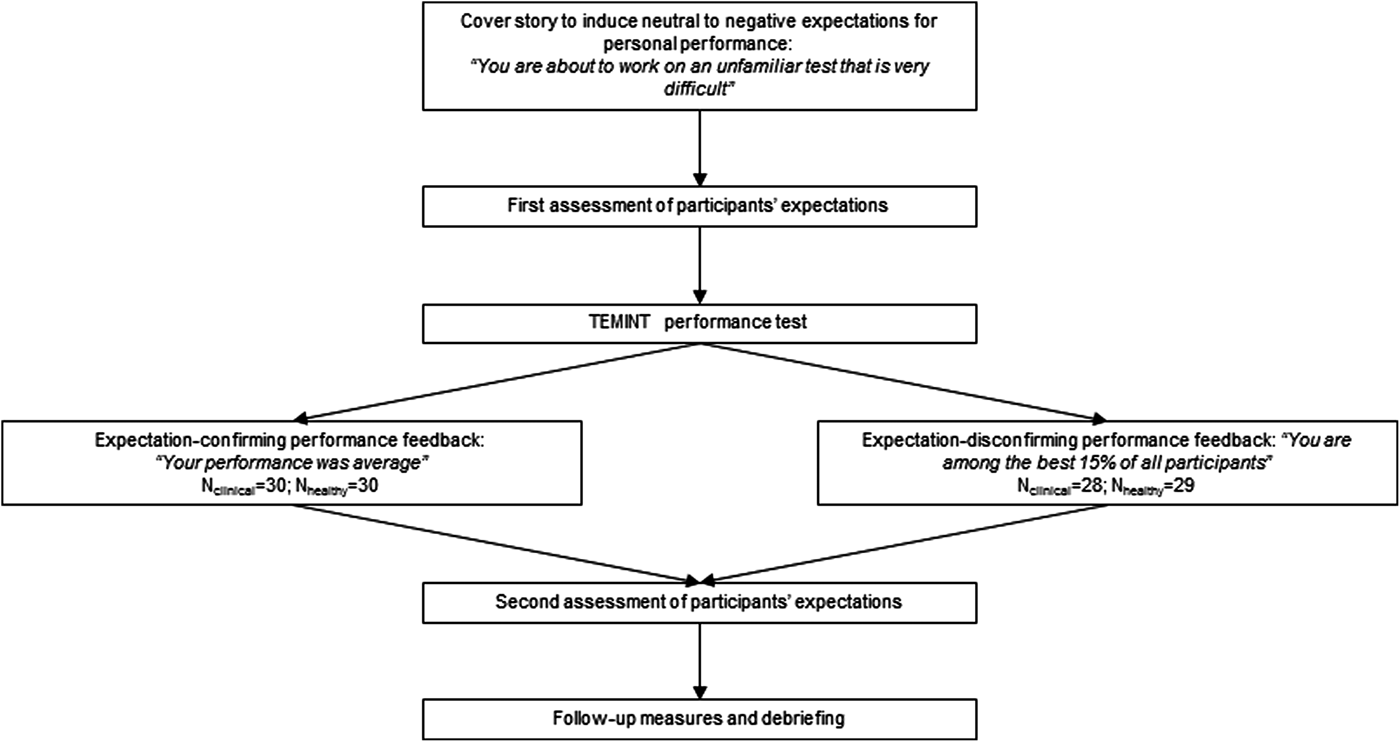
After each of three blocks of the TEMINT, participants received standardized performance feedback that either confirmed or disconfirmed their previous expectations. After each block, participants in the expectation-disconfirmation condition were told that they solved almost all tasks correctly. After the last block, they were informed that they are among the best 15% of all participants taking the TEMINT. The expectation-confirmation condition differed from the expectation disconfirmation condition only with regard to the standardized performance feedback. In this condition, participants were told after each block that participants’ performance was average compared with all participants. Participants were randomly assigned to one of the two experimental conditions.
Follow-up measures and debriefing
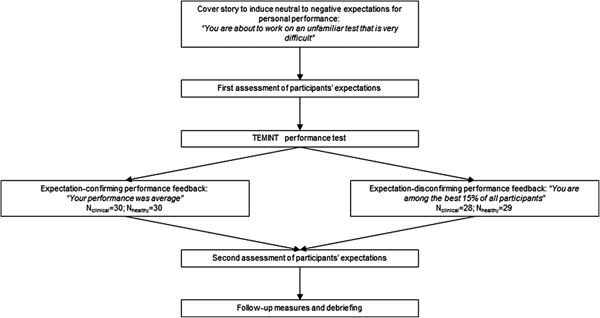
After completing the TEMINT, several follow-up questionnaires were administered to assess sociodemographic variables and depressive symptoms. Further, to examine the credibility of the cover story, participants were asked whether they suspected that the study would have another aim than the one mentioned in the study information. Finally, participants were debriefed regarding the true purpose of the study. Figure 1 illustrates the study procedure.
The basic procedure of the EXperimental Paradigm to investigate Expectation Change in Depression (EXPECD). After inducing neutral to negative expectations about one's ability to work successfully on an unknown test, participants’ expectations are assessed for the first time. Next, participants perform the Test for the Measure of Emotional Intelligence (TEMINT), on which they receive standardized performance feedback that either confirms or disconfirms their previous expectations. Subsequently, participants’ future expectations are assessed again, followed by a follow-up measure and debriefing.
Measures
Change in generalized expectations
After reading the instructions, participants rated their initial expectations for their personal performance. After completing the test, participants rated their expectations again. As mentioned above, we primarily focused on generalized expectations, and therefore the primary outcome of the study was the intra-individual difference in generalized performance expectations. The generalized expectation item that participants rated before working on the test read as follows: ‘I will be successful in working on unknown tasks in general.’ The generalized future expectation item after completing the test was, ‘I will be successful in working on unknown tasks in general in the future.’ In addition to these generalized expectations, participants also rated their task-specific expectations, which read, ‘I will be successful in working on the tasks from the test’ (before working on the test) and, ‘In the future, I will be successful in working on tasks similar to the ones from the test, even if I am not familiar with them’ (after feedback). Expectation items were rated on a 7-point Likert Scale ranging from (1) ‘I totally disagree’ to (7) ‘I totally agree.’ This measure of task-specific and generalized performance expectations has been validated in a previous study (Kube et al., Reference Kube, Rief, Gollwitzer and Glombiewski2018a). The intercorrelation of the two subscales was r = 0.815, p < 0.001 before working on the test and r = 0.650, p < 0.001 after feedback.
Depressive symptoms
Depressive symptoms were assessed using the second edition of the Beck Depression Inventory [BDI- II; (Beck et al., Reference Beck, Steer, Ball and Ranieri1996)], which includes 21 items assessing depressive symptoms on a 4-point scale ranging from 0 to 3. The sum score ranges between 0 and 63, and lower values indicate fewer depressive symptoms. In our sample, the internal consistency of the BDI-II was α = 0.96.
Socio-demographics
Socio-demographic variables, including age, sex, education, and employment status, were assessed using a brief self-report questionnaire.
Other measures
To assess for potential confounding variables, we measured participants’ self-concept using the ‘overall performance’ (internal consistency: α = 0.94) and ‘general self-esteem’ (internal consistency: α = 0.95) subscales from the Frankfurt Self-Concept Scale (Deusinger, Reference Deusinger1986). We also assessed perfectionism using the ‘personal standards’ subscale (internal consistency: α = 0.75) from the Frost Multidimensional Perfectionism Scale (Frost et al., Reference Frost, Marten, Lahart and Rosenblate1990). In addition, for the clinical sample, we assessed duration of treatment at the clinic.
Statistical analyses
First, we conducted data screening according to the suggestions made by Tabachnick and Fidell (Reference Tabachnick and Fidell2014) and tested the assumptions of analyses of variance (ANOVAs). There were no missing values due to the study design (participants could only continue if they entered all values). Univariate outliers were inspected via standardized values of measured variables and their histograms (Kline, Reference Kline2005). Multivariate outliers were identified via Mahalanobis distance and Cook's distance (with α = 0.5-quantile of the F distribution), as suggested by Cohen et al. (Reference Cohen, Cohen, West and Aiken2003) and Stevens (Reference Stevens2002). Following the recommendations by Stevens (Reference Stevens2002), participants were excluded as outliers in case of conspicuous values for baseline expectations or the dependent variable (pre to post change of expectations), and for this decision, we considered both z-scores and critical Mahalanobis/Cook's distance to ensure that the analyses reflect most of the data and are not influenced by highly influential/errant data points. With respect to the credibility of the cover story, participants were excluded if they suspected that the study entailed elements of deception and guessed the real purpose of the study to prevent that results are influenced by demand effects. We conducted a multivariate analysis of variance (MANOVA) to examine possible baseline differences between the two samples (clinical v. healthy) or the two experimental conditions (expectation confirmation v. expectation disconfirmation) on initial expectations, TEMINT performance, depressive symptoms, and age. Further, we examined differences between patients from the inpatient clinics and the day-care clinic using MANOVA. Next, we conducted a 2 (Sample: clinical v. healthy) × 2 (Condition: expectation confirmation v. expectation disconfirmation) × 2 (time: before feedback, after feedback) factorial ANOVA. Analyses of covariance (ANCOVAs) were performed to control for self-concept, or perfectionism. Likewise, sociodemographic variables were included as covariates to examine whether possible group differences in these variables affected the results of the main analyses. Further, to examine the association of the discrepancy between initial expectations and the degree of expectation change, we computed the correlation of these two difference variables (feedback – initial expectations; expectations after feedback – initial expectations). Type-1 error levels were set at 5%. We provide 95% confidence intervals (CI) for each effect size, that is ɳ 2p or Cohen's d, respectively. All analyses were conducted using IBM SPSS Statistics Version 21.
Results
Sample characteristics
Clinical sample
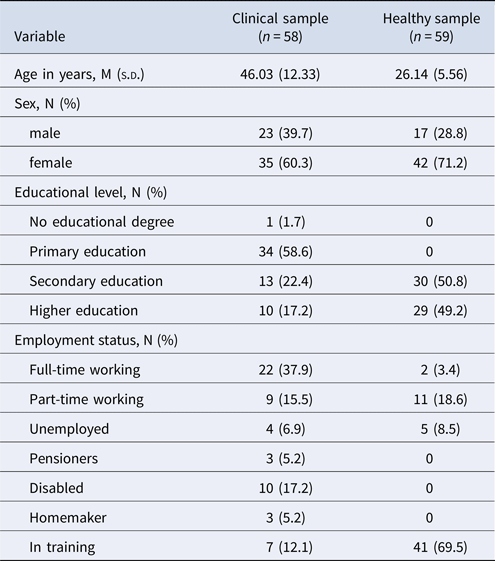
After data screening, three participants were identified as outliers and were therefore excluded. One participant had to be excluded because of serious doubts about the cover story, and another participant was excluded due to a BDI-II sum score <10, indicating the absence of depressive symptoms (Beck et al., Reference Beck, Steer, Ball and Ranieri1996). Thus, subsequent analyses are based on data from 58 participants in the clinical sample (with n = 30 for the expectation confirmation condition and n = 28 for the expectation disconfirmation condition). The mean BDI-II score in the clinical group was 29.44 (s.d. = 10.93), indicating severe symptoms of depression (Beck et al., Reference Beck, Steer, Ball and Ranieri1996). We were able to obtain diagnostic information for 46 patients (79%); the remaining 12 patients ensured that they were diagnosed with a MDD, but did not give consent for their data to be matched with their individual clinical treatment records. Of those for whom full diagnostic information was available, most (63.0%) were diagnosed with a recurrent depressive disorder, 28.3% with a major depressive episode, and 8.7% with a ‘double depression’ (dysthymia plus current major depressive episode). A majority (63.0%) had at least one comorbid mental disorder, among them anxiety disorders (36.9%), somatoform disorders (21.7%), eating disorders (15.2%), hyperkinetic disorder (8.7%), personality disorders (8.6%), and obsessive-compulsive disorder (2.2%). Sociodemographic characteristics of the clinical sample are shown in Table 1.
Sociodemographic characteristics of Study 1 participants
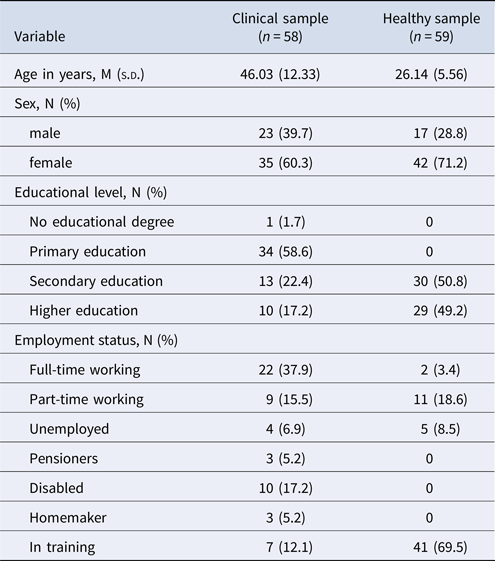
M, mean; s.d., standard deviation; N, number.
Healthy sample
After data screening, we excluded three participants in the healthy control group who were identified as outliers. An additional 10 participants were excluded because they expressed serious doubts about the cover story. Thus, subsequent analyses are based on data from 59 participants in the health control group (with n = 30 for the expectation confirmation condition and n = 29 for the expectation disconfirmation condition). The mean BDI-II score in the healthy control group was 6.17 (s.d. = 4.56), indicating the absence of clinically relevant depressive symptoms (Beck et al., Reference Beck, Steer, Ball and Ranieri1996). Sociodemographic characteristics of the healthy sample are shown in Table 1.
Differences between samples
A MANOVA indicated that participants from the healthy sample were significantly younger than those from the clinical sample, F (1, 113) = 126.729, p < 0.001; ɳ 2p = 0.529, 95% CI (0.402, 0.620), and had lower levels of depressive symptoms, F (1, 113) = 223.159, p < 0.001; ɳ 2p = 0.664, 95% CI (0.563, 0.731). The two groups did not differ on initial task-specific expectations, F (1, 113) = 0.037, p = 0.849; ɳ 2p < 0.001, 95% CI (0, 0.014), generalized expectations, F (1, 113) = 3.209, p = 0.076; ɳ 2p = 0.028, 95% CI (0, 0.110). Importantly, the two samples did also not differ on TEMINT performance, F (1, 113) = 0.017, p = 0.897; ɳ 2p < 0.001, 95% CI (0, 0.006). The distribution of male and female participants was not significantly different across the two groups, χ2 = 1.528, p = 0.246. However, healthy participants had significantly higher educational degrees, χ2 = 52.978, p < 0.001, and were more likely to be students than were participants from the clinical group, χ2 = 57.057, p < 0.001. The two experimental conditions (expectation confirmation v. disconfirmation) did not significantly differ on any baseline, sociodemographic, or clinical variables, as can be found in the supplement. Likewise, with regard to the clinical sample, participants from the inpatient clinics and the day-care clinic did not differ on any variable, as can be seen in the supplement.
Main analyses
Change in generalized expectations
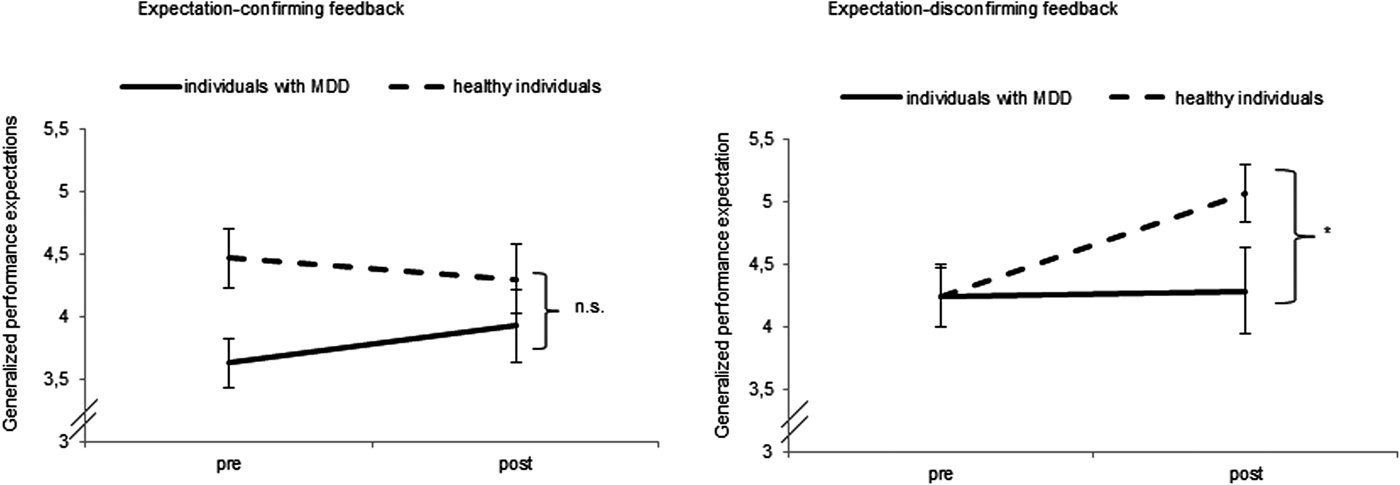
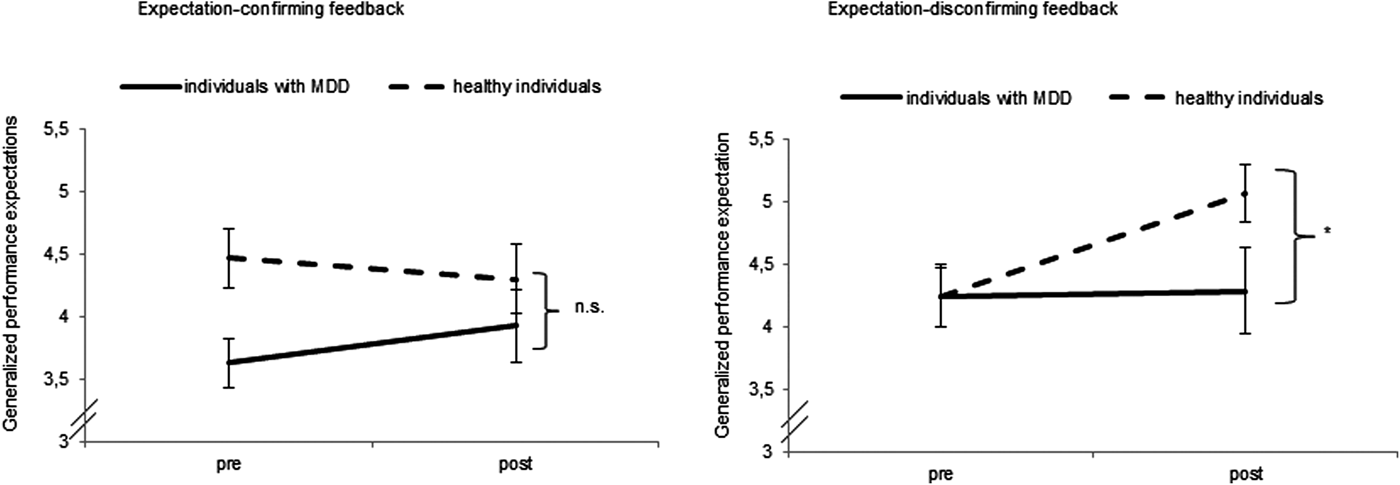
The Time × Sample × Condition three-factorial ANOVA with generalized expectations as the dependent variable indicated no significant main effect of Time, F (1113) = 3.395; p = 0.068; ɳ 2p = 0.029, 95% CI (0, 0.112). The main effect of Condition was also non-significant, F (1113) = 2.898; p = 0.091; ɳ 2p = 0.025, 95% CI (0, 0.105). However, there was a significant main effect of Sample F (1113) = 4.938; p = 0.028; ɳ 2p = 0.042, 95% CI (0.001, 0.133), with more optimistic expectations among the healthy sample (M = 4.520, s.d. = 1.318) compared with the clinical sample (M = 4.015, s.d. = 1.500). The Time × Sample interaction was not significant, F (1113) = 0.361; p = 0.549; ɳ 2p = 0.003, 95% CI (0, 0.053), nor was the Time × Condition interaction, F (1113) = 1.821; p = 0.180; ɳ 2p = 0.016, 95% CI (0, 0.087), or the Condition × Sample interaction, F (1113) = 0.229; p = 0.633; ɳ 2p = 0.002, 95% CI (0, 0.048). There was a significant Time × Sample × Condition interaction, F (1113) = 5.414; p = 0.022; ɳ 2p = 0.046, 95% CI (0.004, 0.139). After expectation-confirming feedback, neither healthy individuals, t(29) = 0.740; p = 0.465; d = 0.135, 95% CI (−0.226, 0.493), nor depressed individuals, t(29) = −0.942; p = 0.354; d = 0.172, 95% CI (−0.190, 0.531), significantly changed their generalized expectations. In the expectation-disconfirmation condition, expectation change occurred only among healthy individuals, t(28) = −3.722; p = 0.001; d = 0.691, 95% CI (0.280, 1.092), but not among individuals with MDD, t(28) = −0.118; p = 0.907; d = 0.022, 95% CI (−0.342, 0.386). Figure 2 shows the results for change in generalized expectations.
Illustration of the main results from Study 1. Results indicated that after receiving expectation-confirming performance feedback, neither healthy individuals nor individuals with major depression changed their generalized performance expectations. In the expectation disconfirmation condition, however, healthy individuals significantly changed their generalized expectations, while individuals with major depression maintained their previous expectations.
Change in task-specific expectations
The Time × Sample × Condition three-factorial ANOVA with task-specific expectations as the dependent variable indicated a significant main effect of Time, F (1113) = 16.027; p < 0.001; ɳ 2p = 0.124, 95% CI (0.033, 0.240), with more optimistic expectations after feedback (M = 4.95, s.d. = 1.558) than before feedback (M = 4.34, s.d. = 1.327). There was also a significant main effect of Condition, F (1113) = 7.364; p = 0.008; ɳ 2p = 0.061, 95% CI (0.004, 0.161), with more optimistic expectations in the expectation-disconfirmation condition (M = 4.940, s.d. = 1.254) compared with the expectation-confirmation (M = 4.365, s.d. = 1.544) condition. The Time × Sample interaction was not significant, F (1113) = 0.535; p = 0.466; ɳ 2p = 0.003, 95% CI (0, 0.059), nor was the Sample × Condition interaction, F (1113) = 0.978; p = 0.325; ɳ 2p = 0.009, 95% CI (0, 0.070). However, there was a significant Time × Condition interaction, F (1113) = 5.100; p = 0.026; ɳ 2p = 0.043, 95% CI (0.001, 0.135), with overall greater change in task-specific expectations in the expectation disconfirmation condition (M = 0.965, s.d. = 1.603) compared with the expectation confirmation condition (M = 0.267, s.d. = 1.745). Further, there was a significant Time × Sample × Condition interaction, F (1113) = 5.100; p = 0.026; ɳ 2p = 0.043, 95% CI (0.001, 0.135). After receiving expectation-confirming feedback, neither the healthy, t(29) = −0.128; p = 0.899; d = 0.023, 95% CI (−0.334, 0.381), nor the clinical sample, t(29) = −1.361; p = 0.184; d = 0.249, 95% CI (−0.117, 0.610), significantly changed their task-specific expectations. In the expectation-disconfirmation condition, healthy individuals significantly changed their task-specific expectations, t(28) = −4.421; p < 0.001; d = 0.821, 95% CI (0.393, 1.238), whereas individuals with MDD did not, t(27) = −1.964; p = 0.060; d = 0.382, 95% CI (−0.015, 0.751).
Analyses of covariance
When measures of self-concept and perfectionism were included as covariates, the pattern of results for expectation change did not significantly change. Similarly, the pattern of results did not change when including age, sex, education, and employment status as covariates. None of these variables had unique effects on the dependent variables, and their inclusion did not change the significance of any of the other main or interaction effects. Effect sizes in the ANCOVAs were similar to those in the ANOVAs for the effects of most interest, that is, the three-way interaction effects.
Additional analysis
The correlation of the discrepancy between feedback and initial generalized expectations and pre to post change of generalized expectations was significant, r = 0.364, p < 0.001. For task-specific expectations, this correlation was also significant, r = 0.542, p < 0.001. This indicates that the larger the discrepancy between initial expectations and actual feedback was the larger was degree of expectation change. This association was also found for the two samples separately (clinical sample: r generalized = 0.323, p = 0.013; r task-specific = 0.419, p = 0.001; healthy sample: r generalized = 0.444, p < 0.001; r task-specific = 0.653, p < 0.001).
Discussion
The aim of the study was to examine whether individuals with MDD and healthy individuals differ with regard to expectation change v. maintenance after expectation-disconfirming experiences. In line with our first hypothesis, results indicated that after (overly positive) expectation-disconfirming performance feedback healthy individuals changed both their generalized and their task-specific expectations; in contrast, people with MDD maintained their previous expectations. As hypothesized, no such difference between healthy individuals and MDD patients was found for expectation-confirming feedback. Of note, healthy individuals and individuals MDD did not differ on actual test performance; thus, differences in expectation change cannot be attributed to performance differences. Interestingly, additional analyses revealed that the degree of expectation change was associated with the discrepancy between initial expectations and actual feedback in both samples.
The present study empirically confirmed previous clinical observations suggesting that people with MDD are less likely than healthy individuals to update their expectations in light of disconfirming evidence (Rief and Glombiewski, Reference Rief and Glombiewski2016; Kube et al., Reference Kube, Rief and Glombiewski2017b). Further, these results are in line with studies of cognitive rigidity (Lefebvre, Reference Lefebvre1981; Watkins, Reference Watkins2008; Bridges and Harnish, Reference Bridges and Harnish2010; Brose et al., Reference Brose, Schmiedek, Koval and Kuppens2015) and cognitive inflexibility (Stange et al., Reference Stange, Alloy and Fresco2017) in depression. In addition, the current results are in line with a study revealing an absence of optimistically biased belief updating about future life events in MDD patients (Korn et al., Reference Korn, Sharot, Walter, Heekeren and Dolan2014).
Study 2
This study aimed to further explore the results of Study 1 by examining cognitive immunization as a possible mechanism underlying the persistence of expectations in depression. For this purpose, we experimentally varied cognitive immunization after expectation-disconfirming feedback to examine the influence of immunization on expectation change v. maintenance. Study 2 used the basic procedure of the expectation disconfirmation condition from Study 1, with the addition of an immunization-enhancing and immunization-inhibiting manipulation. We also included a control group, which received no manipulation. We hypothesized that the three groups (immunization-enhancing group v. immunization inhibiting group v. control group) would differ on expectation change.
Methods
Participants
Similar to the procedure from Study 1, we determined sample size via a-priori power analysis, and we estimated the expected effect size based on the existing literature on expectation change cited above (Loeb et al., Reference Loeb, Beck and Diggory1971; Hammen and Krantz, Reference Hammen and Krantz1976; Post et al., Reference Post, Lobitz and Gasparikova-Krasnec1980; Cane and Gotlib, Reference Cane and Gotlib1985) as well as our previous study (Kube et al., Reference Kube, Rief, Gollwitzer and Glombiewski2018a). As we have argued in previous work that people experiencing depressive symptoms are prone to a devaluation of positive expectation-disconfirming experiences via immunization tendencies (Kube et al., Reference Kube, Rief and Glombiewski2017b), we expected a medium to large effect for the immunization-varying manipulation. Thus, the power analysis (expected ɳ 2p = 0.20; power = 0.80) indicated a total required sample size of at least 66 participants. Participants were recruited via email lists, newspaper advertisements, and postings in public spaces. As we aimed to include only individuals reporting elevated levels of depression, interested individuals completed a pretest, and were invited to participate if they met the criterion of a BDI-II sum score ⩾10 (indicating at least minimal symptoms of depression). A total of 67 participants completed the study. Participants received course credit or financial compensation in exchange for their participation.
Procedure and study design
The basic procedure was the same as the procedure for Study 1. However, in Study 2, all participants received expectation-disconfirming performance feedback. After completing the TEMINT, the two experimental groups also received standardized information to vary the ease v. the difficulty of engaging in cognitive immunization processes. A note on methodology: we could have examined cognitive immunization as a mediator variable given that it is a cognitive process that occurs after expectation-disconfirming experiences, and that results in maintenance of expectations. However, according to a recent methodological paper, the classical mediational analysis is often problematic in experimental psychology (Lemmer and Gollwitzer, Reference Lemmer and Gollwitzer2017). The recommended approach [described also by (Jacoby and Sassenberg, Reference Jacoby and Sassenberg2011] is to experimentally vary the psychological process (e.g. cognitive immunization) that is being tested as an explanation for a given phenomenon (e.g. expectation change v. maintenance). We, therefore, decided to use this approach.
Group 1 received an ‘immunization-inhibiting’ manipulation suggesting that the TEMINT has been shown to be highly relevant for daily life and professional success. In particular, participants in this condition were told that previous research had found that individuals who perform well on the TEMINT have more professional success, measurable on both subjective (e.g. work satisfaction) and objective measures (e.g. higher income). In addition, participants were told that people who perform well on the TEMINT are more satisfied with their social lives, including the quality of their relationships. We anticipated that after receiving this fake information about the TEMINT, it would be difficult for participants to engage in cognitive immunization processes because the validity and utility of the expectation-disconfirming experience were explicitly highlighted. Thus, we expected that emphasizing the general validity of the positive test experience would enhance the change of generalized expectations. Group 2 received an ‘immunization-enhancing’ manipulation, with the goal of triggering the type of appraisal of positive feedback typical of individuals with depression (e.g. appraising the good performance as an exception or questioning the general relevance of the feedback). The length and writing style of this manipulation was equivalent to the immunization-inhibiting manipulation. The immunization-enhancing manipulation indicated that the TEMINT has neither been found to predict professional success nor other aspects of life satisfaction. We anticipated that after being given this information about the TEMINT, it would be easy for participants to engage in cognitive immunization processes because the validity and utility of the expectation-disconfirming experience were explicitly questioned. Thus, this manipulation was intended to decrease the likelihood of a change of generalized expectations after the positive feedback. Group 3 received no further information after completing the test and receiving performance feedback. Hence, the procedure for group 3 was identical to the procedure for the expectation-disconfirming condition in Study 1. Participants were randomly assigned to one of the three conditions.
After completing the TEMINT and (for groups 1 and 2) receiving the immunization-varying manipulation, participants completed several follow-up questionnaires. Next, one of two trained interviewers administered the affective disorders section from the Structured Clinical Interview for DSM-IV (SCID) (Wittchen et al., Reference Wittchen, Wunderlich, Gruschwitz and Zaudig1997) to assess whether participants met criteria for MDD. Two female psychology master's students who were specifically trained in the administration of the SCID conducted all study procedures. Finally, participants were debriefed regarding the actual aim of the study. The entire procedure lasted between 45 and 75 minutes.
Measures
Expectation change
Expectations were assessed as described in Study 1. In Study 2, the intercorrelation of the two subscales was r = 0.657, p < 0.001 before working on the test and r = 0.697, p < 0.001 after feedback. As in Study 1, the primary outcome in Study 2 was an intra-individual change in participants’ generalized performance expectations. As the main goal of the experimental manipulation was to impact generalized expectations, results for task-specific expectations are not of primary interest in this study. However, for experimental completeness, we report the results for task-specific expectations in the supplement.
Other measures
Depressive symptoms, TEMINT performance, and sociodemographic variables were assessed as described in Study 1. Further, the credibility of the cover story was examined as described in Study 1.
Statistical analyses
Data screening was conducted as described in Study 1. One-way ANOVAs were used to check for baseline differences between the conditions (immunization-inhibiting condition v. immunization-enhancing condition v. control condition) in task-specific expectations, generalized expectations, TEMINT performance, depressive symptoms and age. Next, we conducted a 3 (Condition: immunization-inhibiting condition v. immunization-enhancing condition v. control condition) × 2 (Time: before feedback v. after feedback) ANOVA with generalized performance expectations as the dependent variable. To examine specific group differences, we computed paired samples t tests with Bonferroni–Holm adjustments (Holm, Reference Holm1979). Type-1 error levels were set at 5%, except for the analysis using the Bonferroni–Holm adjustments (with α fam = 5%, α 1 was set at 1.7%, α 2 at 2.5%, and α 3 at 5%). We provide 95% CI for each effect size, that is ɳ 2p or Cohen's d, respectively. As in Study 1, there were no missing values due to the study design. All analyses were conducted using IBM SPSS Statistics Version 21.
Results
Sample characteristics
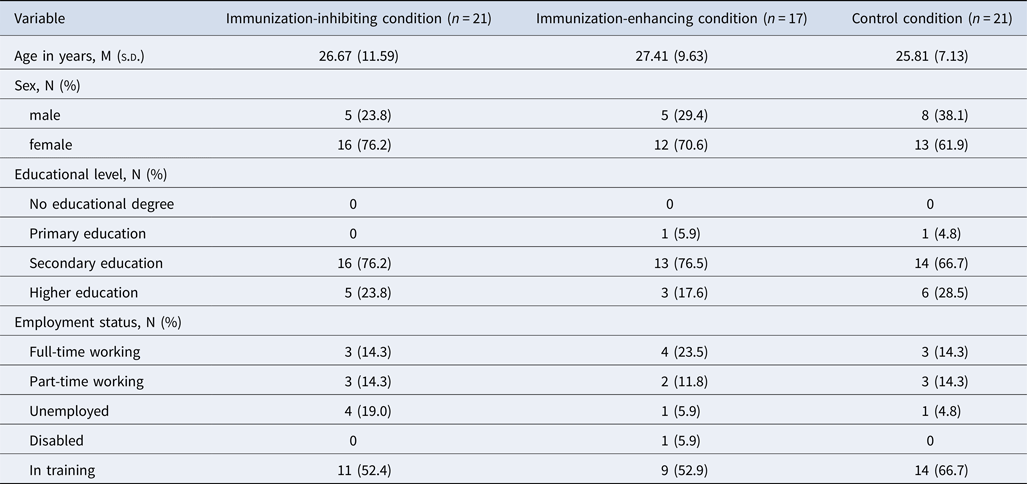
Of the 67 individuals who participated in the study, six were identified as outliers and were therefore excluded. An additional two participants were excluded from analyses because they expressed serious doubts about the cover story. Accordingly, subsequent analyses are based on data from 59 participants (21 in the immunization-inhibiting condition, 17 in the immunization-enhancing condition, and 21 in the control condition). The mean BDI-II score was 24.88 (s.d. = 9.66), indicating moderate levels of depression (Beck et al., Reference Beck, Steer, Ball and Ranieri1996), and 17 participants (28.8%) met criteria for a major depressive episode. Sociodemographic characteristics are presented in Table 2.
Sociodemographic characteristics of Study 2 participants

M, mean; s.d., standard deviation; N, number.
Differences between conditions
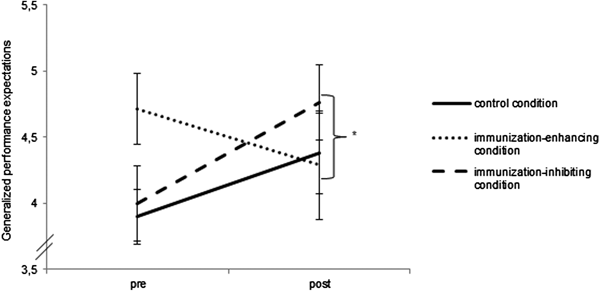
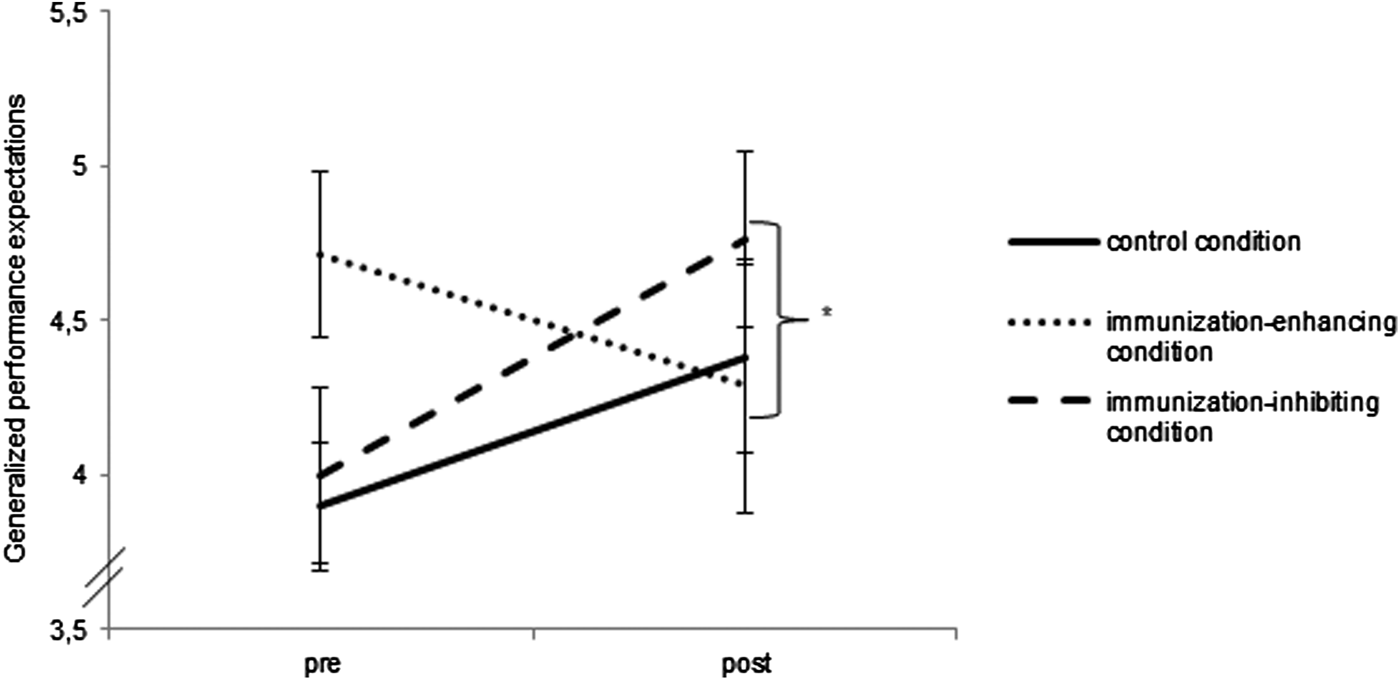
Initial generalized expectations did not significantly differ across the immunization-inhibiting condition (M = 4.00, s.d. = 1.30), the immunization-enhancing condition (M = 4.71, s.d. = 1.11), and the control condition (M = 3.90, s.d. = 0.94), F (2,56) = 2.734, p = 0.074, ɳ 2p = 0.089, 95% CI (0, 0.223). The three groups also did not significantly differ on initial task-specific expectations, F (2,56) = 0.623, p = 0.540, ɳ 2p = 0.022, 95% CI (0, 0.117), depressive symptoms, F (2,56) = 2.075, p = 0.135, ɳ 2p = 0.069, 95% CI (0, 0.200), TEMINT performance, F (2,56) = 0.848, p = 0.434, ɳ 2p = 0.029, 95% CI (0, 0.133), or age, F (2,56) = 0.132, p = 0.877, ɳ 2p = 0.005, 95% CI (0, 0.066).
Main analyses
The Time × by Condition ANOVA indicated no significant main effect of Time, F (2,56) = 3.216; p = 0.078; ɳ 2p = 0.054, 95% CI (0, 0.246), or Condition, F (2,56) = 0.475; p = 0.624; ɳ 2p = 0.017, 95% CI (0, 0.103). However, there was a significant Time × Condition interaction, F (2,56) = 4.977; p = 0.010; ɳ 2p = 0.151, 95% CI (0.010, 0.303). To further examine group differences in expectation change, we computed independent samples t tests with Bonferroni–Holm adjustments. The difference in expectation change between the immunization-enhancing condition and the control condition was significant, α 1 = 1.7%, t(36) = 2.916; p = 0.006; d = 0.951, 95% CI (0.269, 1.621). The difference between the immunization-inhibiting condition and the immunization-enhancing condition also reached significance, α 2 = 2.5%, t(36) = −2.658; p = 0.012; d = 0.867, 95% CI (0.192, 1.531). The difference between the immunization-inhibiting condition and the control condition was not significant, α 3 = 5%, t(40) = −0.775; p = 0.444; d = 0.239, 95% CI (−0.370, 0.845). Paired-samples t tests indicated significant change in expectations among participants in the immunization-inhibiting condition, t(20) = −2.307, p = 0.032, d = 0.503, 95% CI (0.043, 0.953) and the control condition, t(20) = −2.911, p = 0.009, d = 0.635, 95% CI (0.159, 1.099), while no significant change in expectations was found among participants from the immunization-enhancing condition, t(16) = 1.514, p = 0.150, d = 0.367, 95% CI (−0.130, 0.854). The main results from Study 2 are shown in Fig. 3.
Illustration of the main results from Study 2. Results indicated that varying immunization processes led to significant differences in change in generalized expectations. Participants from both the control condition and the immunization-inhibiting condition significantly changed their expectations, whereas participants from the immunization-enhancing condition did not significantly change their expectations.
Discussion
The aim of this study was to experimentally vary the ease v. the difficulty of engaging in cognitive immunization strategies after receiving expectation-disconfirming performance feedback, and to examine the influence of cognitive immunization on the change v. maintenance of generalized performance expectations. Results indicated that varying immunization processes led to significant differences in expectation change, suggesting that cognitive immunization may be a core mechanism underlying the persistence of expectations in depression.
In particular, this study demonstrated a significantly smaller change in expectations after an immunization-enhancing manipulation compared with an immunization-inhibiting condition and a control condition. The immunization-enhancing manipulation was intended to trigger an appraisal of the positive performance feedback that would be typical of appraisals found among depressed individuals. Thus, enhancing immunization tendencies (e.g. by initiating an appraisal of an expectation-disconfirming experience as an exception) decreased the likelihood of expectation change. We also examined whether expectation change could be boosted by an immunization-inhibiting manipulation that emphasized the general relevance of an expectation-disconfirming experience. However, results indicated that this immunization-inhibiting manipulation did not significantly enhance change in generalized performance relative to a control condition.
Examination of the magnitude of expectation change among the three groups indicated that the magnitude of expectation change in the immunization-inhibiting condition was similar to the degree of change in generalized expectations found among healthy individuals in the expectation disconfirmation condition from Study 1. This suggests that emphasizing the general relevance of an expectation-disconfirming experience may be a promising strategy to initiate a healthy degree of expectation change among individuals suffering from depression. However, we found that also participants in the control group significantly changed their expectations after receiving expectation-disconfirming feedback. This is somewhat inconsistent with the results of Study 1, in which we found no significant expectation change among individuals with MDD. It is possible that this different pattern of results is due to different sample characteristics. While the participants from the clinical sample examined in Study 1 reported severe symptoms of depression, met criteria for MDD, and were seeking psychotherapeutic treatment, the participants from Study 2 reported only moderate symptoms of depression, and only 28.8% met full criteria for MDD. Thus, it is possible that expectation change in the Study 2 control group would have been attenuated if we had included participants with more severe depression.
General Discussion
The aim of these two studies was to examine whether and why people experiencing depressive symptoms tend to maintain their expectations despite expectation-disconfirming experiences. In Study 1, we provided empirical evidence for the clinical observation that individuals with MDD have more difficulty than healthy individuals with changing their expectations after expectation-disconfirming experiences. Study 2 results indicated that cognitive immunization may be an important mechanism underlying the persistence of expectations in depression.
The results of the present studies are in line with previous research indicating the crucial role of negative expectations in MDD (Catanzaro and Mearns, Reference Catanzaro and Mearns1990; Backenstrass et al., Reference Backenstrass, Schwarz, Fiedler, Joest, Reck, Mundt and Kronmueller2006; Strunk et al., Reference Strunk, Lopez and DeRubeis2006; Vilhauer et al., Reference Vilhauer, Young, Kealoha, Borrmann, IsHak, Rapaport, Hartoonian and Mirocha2012; Kube et al., Reference Kube, Siebers, Herzog, Glombiewski, Doering and Rief2018b). The current research extends these previous findings by demonstrating that not only the presence of negative expectations but also their maintenance despite the disconfirming evidence, may be a core feature of MDD. Thus, the present studies provide new insights into the psychopathology of MDD: while healthy individuals are able to utilize environmental information to update their expectations after disconfirming experiences, people suffering from MDD tend to cognitively reappraise potentially useful environmental information (e.g. by considering the contradictory experience to be an exception rather than the rule). This cognitive immunization results in expectation persistence despite the disconfirming evidence.
The findings of the present studies can be linked to the larger body of research showing reward processing dysfunctions in depression [for reviews see (Eshel and Roiser, Reference Eshel and Roiser2010; Whitton et al., Reference Whitton, Treadway and Pizzagalli2015)]. Specifically, research has demonstrated that MDD is associated with the inability to modulate behavior in response to intermittent rewards (Pizzagalli et al., Reference Pizzagalli, Iosifescu, Hallett, Ratner and Fava2008; Pechtel et al., Reference Pechtel, Dutra, Goetz and Pizzagalli2013; Vrieze et al., Reference Vrieze, Pizzagalli, Demyttenaere, Hompes, Sienaert, de Boer, Schmidt and Claes2013) and with blunted reward anticipation and willingness to exert effort to obtain rewards (Treadway et al., Reference Treadway, Bossaller, Shelton and Zald2012; Rawal et al., Reference Rawal, Collishaw, Thapar and Rice2013). To integrate these two lines of research, future studies using the EXPECD paradigm may ask participants before working on the test whether positive feedback would represent a reward for them, thus enabling researchers to examine both responsiveness to rewarding stimuli and change of expectations. Furthermore, the present studies are in line with research on the role of optimism, defined as a generalized outcome expectation (Scheier and Carver, Reference Scheier and Carver1985), in depression. In particular, it has been shown that depression is related to the absence of an optimistic bias in updating beliefs about future events (Korn et al., Reference Korn, Sharot, Walter, Heekeren and Dolan2014), which is consistent with the present work indicating the persistence of expectations in depression. Since optimism-enhancing interventions have been shown to reduce depressive symptoms (Sergeant and Mongrain, Reference Sergeant and Mongrain2014; Miranda et al., Reference Miranda, Weierich, Khait, Jurska and Andersen2017), it might also be worthwhile to modify other types of expectations among MDD patients, as will be discussed in the clinical implications.
Theoretical implications
Recent clinical research has often investigated how symptoms change; however, our studies illustrate the importance of also examining how and why patients’ expectations persist. These results may contribute to a reformulation of the traditional cognitive model of depression (Beck et al., Reference Beck, Rush, Shaw and Emery1979): the development of depressive symptoms might be caused by negative expectations for the future rather than by present-related beliefs (Strunk et al., Reference Strunk, Lopez and DeRubeis2006; Korn et al., Reference Korn, Sharot, Walter, Heekeren and Dolan2014; Kube et al., Reference Kube, Siebers, Herzog, Glombiewski, Doering and Rief2018b), and these negative expectations become increasingly immune to disconfirming experiences, hence resulting in the maintenance of depressive symptoms. Of note, this model has conceptual similarities to Jerome Frank's model of demoralization (Frank, Reference Frank1973; Reference Frank1974; Frank and Frank, Reference Frank and Frank1991), suggesting that distressed people are characterized by diminished ability to respond effectively to stressful events, resulting in negative consequences for the individual such as isolation and despair (Frank, Reference Frank1974; Connor and Walton, Reference Connor and Walton2011). Further, this suggested model is in line with the theory of cognitive inflexibility in depression (Stange et al., Reference Stange, Alloy and Fresco2017).
Clinical implications
According to Wampold's (Reference Wampold2015) contextual model, patients’ expectations strongly influence psychotherapy outcomes. It has recently been argued that an increased focus on patients’ expectations may optimize cognitive-behavioral treatment of mental disorders (Rief and Glombiewski, Reference Rief and Glombiewski2016). For example, therapists may aim to disconfirm patients’ expectations using behavioral experiments. In behavioral experiments, therapists may focus on a negative expectation a patient strongly endorses (such as ‘When I ask someone for help, I will be rejected’) and guide the patient to test the validity of this expectation. Gaining positive expectation-disconfirming experiences in behavioral experiments is assumed to facilitate cognitive restructuring, and may lead to the reduction of depressive symptoms (Dobson and Hamilton, Reference Dobson, Hamilton, O'Donohue and Hayes2003; Rief and Glombiewski, Reference Rief and Glombiewski2016). However, the present studies show that in major depression, dysfunctional expectations are likely to be maintained despite disconfirming experiences because of cognitive immunization. Therefore, therapists should aim to inhibit immunization processes to enhance expectation change.
To inhibit immunization, therapists might emphasize the general relevance of an expectation-disconfirming experience, as in the immunization-inhibiting condition in Study 2, to prevent patients from appraising the experience as an exception. It may also be important for therapists to stress the relevance of paying attention to expectation-disconfirming experiences, and to emphasize the personal importance of disconfirming experiences for the individual. Therapists could also encourage patients to repeat a behavioral experiment under different circumstances to enhance the credibility of the information gained from an expectation-disconfirming experience. Moreover, prior to conducting a behavioral experiment, we recommend exploring potential immunization strategies with the patient and considering how to address these immunization strategies. As part of this discussion, therapists should discuss with their patients the conditions under which they would change v. maintain their expectations. Future research should examine which strategies are most effective in preventing cognitive immunization and enhancing expectation change. However, given the experimental procedure of the present studies, conclusions regarding psychotherapy have to be drawn with caution because the expectation-disconfirming experience in the current research was based on rigged feedback, whereas psychotherapeutic interventions ought to be based on reliable corrective experiences. Further, it should be noted that it remains unclear whether the immunization-inhibiting intervention in Study 2, linking performance in the TEMINT to professional success and higher satisfaction with social lives, is transferable to psychotherapy with people reporting severe levels of depression, given that MDD patients experiencing anhedonia might not be motivated by this information.
Strengths and limitations
To our knowledge, the present studies are the first to systematically investigate differences between healthy individuals and individuals with depression with respect to a change in generalized expectations following expectation-disconfirming experiences. Furthermore, we established the EXPECD as an experimental paradigm for manipulating immunization processes and thereby examining cognitive immunization as a possible mechanism of expectation persistence.
However, as the current studies were designed as a first step in investigating the underappreciated area of expectation persistence in depression, they also have several limitations. For instance, we examined only a small section of the multifaceted topic of expectation persistence by focusing on change of negative expectations after positive disconfirming experiences. We did so because this is conceptually closer to theoretical models of depression (Beck et al., Reference Beck, Rush, Shaw and Emery1979; Seligman et al., Reference Seligman, Abramson, Semmel and von Baeyer1979; Abramson et al., Reference Abramson, Alloy and Metalsky1989), but future studies should also investigate how people with MDD react to negative disconfirming experiences. Another limitation of both studies is that we focused only on performance-related expectations. Although expectations for personal performance have been shown to be relevant in depression (Beck, Reference Beck2011; Kube et al., Reference Kube, D'Astolfo, Glombiewski, Doering and Rief2017a), future studies should examine change in other types of expectations, such as expectations about social rejection. Further, in both studies, task-specific and generalized expectations were each assessed with a single item. This may have limited the precision of our measurement of expectations. However, we reasoned that an assessment with more items, although psychometrically superior, could raise participants’ doubts about the cover story, as the cover story indicated that the study was about the evaluation of the test rather than participants’ expectations. Moreover, assessing expectations with a single item is quite common in experimental research on expectations (Cane and Gotlib, Reference Cane and Gotlib1985; Corsi and Colloca, Reference Corsi and Colloca2017), and the measure used in the present studies has been successfully evaluated in a previous study (Kube et al., Reference Kube, Rief, Gollwitzer and Glombiewski2018a).
An additional limitation of Study 1 is that the healthy sample was significantly younger and more highly educated than the clinical sample, thereby limiting the comparability of the two samples. Further, specific psychiatric diagnoses were not available for all participants. Another limitation of Study 1 refers to the expectation-confirming feedback. On the one hand, the feedback, ‘your performance was average’, might have been expectation-confirming for most of the participants, because the majority of the participants had average initial expectations for their personal performance. On the other hand, for participants with very low initial expectations, this feedback might have been unexpectedly positive. Similarly, participants with very positive initial expectations may have considered this feedback to be unexpectedly negative. A limitation of Study 2 is that the sample size did not satisfy the a-priori power analysis. Regarding Study 2, the majority of the sample experienced moderate depressive symptoms, and only 28.8% of the participants met full criteria for MDD. Future studies should, therefore, investigate cognitive immunization among samples with more severe levels of depression. Further, it would also be interesting to apply the experimental procedure from Study 2 among healthy individuals to examine whether susceptibility to immunization tendencies is specific to depressed individuals. In addition, when interpreting the results of Study 2, it should be noted that although the group differences in initial expectations were not statistically significant, they were of considerable size. Thus, future studies should aim to rule out regression to the mean as an alternative explanation for the findings regarding expectation change in this study. Moreover, future studies may aim to use additional measures for constructs related to cognitive immunization, such as locus of control, to better understand the specific mechanisms underlying the change v. maintenance of expectations.
Concluding Remarks
The present research aimed to examine whether and why dysfunctional expectations in depression persist despite expectation-disconfirming experiences. In Study 1, we found that people suffering from MDD, contrary to healthy individuals, maintained previous performance expectations despite surprisingly positive performance feedback. In Study 2, we investigated whether the persistence of expectations may be accounted for by cognitive immunization strategies (i.e. disregarding the disconfirming experience) using a sample with elevated levels of depression. Indeed, we found that varying cognitive immunization led to differences in expectation change, highlighting the crucial role of cognitive immunization in expectation change v. maintenance. These findings provide new insights into the psychopathology of MDD, and suggest that psychological interventions may be enhanced by actively addressing cognitive immunization.
Supplementary material
The supplementary material for this article can be found at https://doi.org/10.1017/S0033291718002106
Acknowledgements
We are very grateful to our master students who contributed to the study: Caroline Woderich, Eva Schumann, Eva Hüttenrauch, Ricarda Konrad. This study was conducted in the context of the Research Training Group ‘Expectation Maintenance v. Change in the Context of Expectation Violations: Connecting Different Approaches’, located at the Philipps-University of Marburg, and was funded by the Philipps-University of Marburg. Funding was unconditional, and funding source had no influence on study conduct or the reporting of results.
Conflict of interest
None.