Introduction
The treatment of choice for non-functioning pituitary adenomas (NFPA) is transsphenoidal surgery (TSS).Reference Dekkers, Pereira and Romjin1–Reference Jane and Laws3 Tumour recurrence rates can be as low as 20% and as high as 49%, depending on the series.Reference Dekkers, Pereira and Romjin1, Reference Roelfsema, Biermasz and Pereira4 Since these tumours do not produce a syndrome of hormonal hypersecretion, the diagnosis of recurrences relies on clinical (visual impairment signs) an imaging data [magnetic resonance imaging (MRI) showing the presence of tumour].Reference Molitch2, Reference Jane and Laws3 Patients who are left with significant tumour remnants after TSS are likely to recur after long-term follow-up.Reference Dekkers, Pereira and Romjin1, Reference Roelfsema, Biermasz and Pereira4, Reference Chandler and Barkan5 Although tumour regrowth is usually slow and it can be monitored with serial pituitary imaging studies, in many patients it can be clinically significant and generate compressive complications.Reference Molitch2, Reference Jane and Laws3 A minority of NFPA are actually silent corticotroph adenomas that are known to behave more aggressively and recur more frequently.Reference Webb, Laurent, Oknokwo, Lopes, Vance and Laws6 However, in the majority of patients with NFPA, an accurate prediction of recurrence remains an elusive goal.Reference Roelfsema, Biermasz and Pereira4, Reference Ramírez, Cheng and Vargas7 Thus, in this scenario, the risk of a significant tumour recurrence has to be established primarily based on the size and location of the remnant after surgery. On the other hand, even tumours that are completely removed by surgery also have a risk, albeit lower, of recurrence and a careful clinical and imaging follow-up is indicated.Reference Dekkers, Pereira and Romjin1, Reference Jane and Laws3, Reference Roelfsema, Biermasz and Pereira4
There is extensive evidence supporting the effectiveness of external beam radiation therapy (XRT) in preventing recurrences of NFPA after surgery.Reference Boelaert and Gittoes8–Reference Wilson, De-Loyde, Williams and Smee11 However, the decision to submit a patient to XRT is not always an easy one. Some centres recommend postoperative XRT routinely to all NFPA patients, even in those with complete resection of their tumours, whereas others do so on a more individual basis, taking into account the size and location of the remnant and the pituitary hormone status. One of the major disadvantages of XRT is the induction of hypopituitarism, which may impact quality of life; however, many of these patients already have one or more anterior pituitary hormone deficiencies because of the tumour itself and/or to the surgical procedure.Reference Dekkers, Pereira and Romjin1, Reference Jane and Laws3, Reference O'Sullivan, Woods and Glynn12, Reference Dekkers, Pereira and Roelfsema13 The purpose of this study was to establish whether or not the adjunctive use of XRT in patients with NFPA is effective and safe in preventing tumoural recurrences using a case–control design.
Methods
Patient population
Both our local ethics and scientific committees approved the study; all patients signed an informed consent. Both, cases and controls were selected from a large database (n = 450) of patients diagnosed with and treated for NFPA between January 2000 and December 2010 at our centre. In the case group, we included patients with NFPA who had been submitted to TSS and later on (1–2 years after surgery) received XRT because of the presence of a tumour remnant (defined as a >5 mm lesion, readily identifiable on MRI). The control group consisted of patients with NFPA, who had undergone TSS but who did not receive XRT, despite the presence of a tumour remnant. Both the radiated, and the non-radiated patients were free of tumour compressive symptoms and their pituitary hormone deficiencies were adequately replaced. Groups were carefully matched for age, gender, tumour volume and presence of cavernous sinus invasion. Imaging and hormonal information was gathered at baseline, and thereafter yearly, the end-points being tumour regrowth and the development of new pituitary hormone deficiencies.
The same two neuroradiologists evaluated baseline and follow-up MRIs; tumour volume was calculated using the DeChiro Nelson formulaReference Ertekin, Acer, Turgut, Aycan, Özcelik and Turgut14:
 $$volume\: = \:(sagital\:\times \:coronal\:\times \:axial\,diameters)\,{\rm{\pi }}\:/\:6\eqno\rm$$
Panhypopituitarism was diagnosed when three or more hormone deficiencies could be documented. Hypocortisolism was defined by a morning serum cortisol below 3 μg/dL; insulin-induced hypoglycemia was performed in borderline cases when am cortisol was between 3 and 10 μg/dL. Central hypothyroidism was defined by a free T4 below 0·5 ng/dL irrespective of the TSH level; and the diagnosis of central hypogonadism was established when the serum estradiol level was below 10 pg/mL in females and the serum total testosterone was below 300 ng/dL in males. Anterior pituitary hormones, as well as testosterone, estradiol, IGF-1, cortisol and free T4 were all measured by commercially available assays.
Radiation therapy (RT) protocol
Three-dimensional, conformal, external beam radiotherapy was administered by means of a lineal accelerator, at a mean total dose of 52 Gy (range 50–57), delivered as 2–2·5 Gy daily fractions, 5 days a week, over 5 weeks. Optic apparatus radiation dose was kept below 50·4 Gy using a multi-leave collimator.
Statistical analysis
For quantitative variables, data are presented as medians and interquartile ranges or means ± SD depending on data distribution, which was determined using the Shapiro-Wilks test. Differences in categorical variables were analysed by the χ 2-test. The Wilcoxon's signed-rank test was used to compare medians among the groups. A step wise, lineal, multiple regression analysis was performed to explore which patient characteristic was associated with tumour volume reduction in both groups. A p-value of <0·05 was considered statistically significant. Statistical software package consisted of STATA version 11.0 and SPSS version 16.
Results
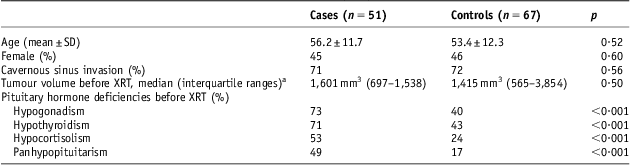
Baseline characteristics (Table 1)
The case group consisted of 51 patients (45% women) with a mean age of 56·2 ± 11·7 years; XRT was administered 2–8 months after the last pituitary surgery and the median follow-up was 5 years. The control group included 67 non-radiated patients (46% women), whose mean age was 53·4 ± 12·3 years. Median tumour remnant volume before radiation therapy (RT) was similar between cases and controls (cases: 1,601 mm3, controls: 1,415 mm3). A similar proportion of subjects in both groups had cavernous sinus invasion (cases: 71%, controls: 72%). The number of pituitary surgeries was similar among patients who did and those who did not receive XRT (39% one, 41% two and 20% three). Immunohistochemical analysis of tumour tissue revealed the same proportion of gonadotroph, null cell and corticotroph tumours in both groups.
Baseline characteristics
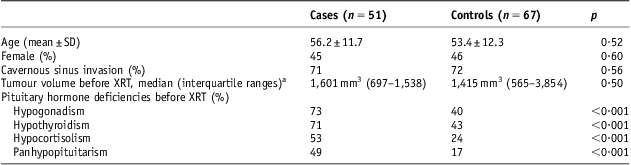
Note: aIn the non-radiated controls, this refers to tumour volume at matching time.
Abbreviations: SD, standard deviation; XRT, external beam radiation therapy.
Tumour volume changes
Median tumour volume decreased progressively in the radiated group from a baseline value (after last surgery, before XRT) of 1,601 mm3 (697–1,538), to 1,124 mm3 (382–2,638) and 816 mm3 (92–1,866) after 3 and 5 years of follow-up, respectively (p = 0·01); tumour volume reduction in the radiated subjects after 5 years of follow-up was 50% (Figure 1). In contrast, in the non-radiated controls median tumour volume apparently decreased at 3 years follow-up but in fact increased again after 5 years [baseline 1,415 mm3 (565–3,854), at 3 years 1,066 mm3 (227–3,351), at 5 years 1,204 mm3 (620–2,623), p = 0·93] (Figure 1). Lineal regression analysis revealed a tumour volume reduction in the radiated patients of 388 mm3/year (p = 0·02, 95% CI: −714 to −62), whereas in the non-radiated patients a tumour volume increment of 592 mm3/year was documented (p = 0·05, 95% CI: 12–1,198). The estimated tumour recurrence rate was 4% (2 out of 51) for the radiated group and 29% (20 out of 67) for the non-radiated controls (OR 0·10, 95% CI 0·01–0·04, p = 0·02).
Median tumour volumes at baseline, 3 and 5 years of follow-up, in the radiated (solid line) and control groups (dotted line).
Note: *p = 0·03.

Pituitary hormone deficiencies and XRT-related adverse events
The group of radiated patients had a higher prevalence of pituitary hormone deficiencies after the last surgery than the non-radiated group (Figure 2); in fact, this was the main reason for avoiding XRT in the control group. At 5 years follow-up, pituitary hormone deficiencies had increased significantly in both groups; TSH deficiency was present in 80% of cases and 68% of controls, gonadotrophin deficiency in 95% of cases and 50% of controls, Adrenocorticotropic hormone deficiency 62% of cases and 42% of controls and panhypopituitarism in 60% of cases and 38% of controls (Figure 2). No cerebrovascular events, cases of optic neuritis, secondary tumours or deaths were recorded.
Prevalence of pituitary hormone deficiencies at baseline and after 5 years of follow-up in the radiated (a, *p < 0·001), and non-radiated controls (b, **p < 0·01).
Discussion
Pituitary surgery remains the primary treatment of choice for NFPA.Reference Dekkers, Pereira and Romjin1–Reference Jane and Laws3 However, a significant proportion of these tumours will recur upon long-term follow-up.Reference Dekkers, Pereira and Romjin1–Reference Roelfsema, Biermasz and Pereira4 Unfortunately, there are neither clinical/imaging characteristics, nor histopathological features or biomarkers capable of accurately predicting recurrences and therefore indicate the need for prophylactic therapeutic interventions such as postoperative XRT.Reference Roelfsema, Biermasz and Pereira4, Reference Ramírez, Cheng and Vargas7 Although the efficacy of postoperative XRT in preventing tumour regrowth has been documented, most if not all published studies have been retrospective and suffer from a selection bias whereby XRT is reserved for the largest or more invasive tumours.Reference Boelaert and Gittoes8–Reference Wilson, De-Loyde, Williams and Smee11 On the other hand, the potential side effects of radiation, particularly the development of pituitary hormone deficiencies, preclude a more generalised use of this therapeutic tool.Reference Al-Mefy, Kersh, Routh and Smith15–Reference Chang, Zada and Kim17 Hypopituitarism because of NFPA has been associated with a decreased quality of life and in some studies, with increased mortality.Reference Van den Bergh, van den Berg and Schoorl16, Reference Tomlinson, Holden and Hils18 Studies in this regard have shown rather discrepant results, likely because of the myriad of variables involved in determining life quality and expectancy in this scenario, including the adequacy of hormone replacement.Reference Van den Bergh, van den Berg and Schoorl16, Reference Tomlinson, Holden and Hils18 Thus, in view of the available data, withholding XRT in patients with a complete adenoma resection and no evidence of a tumour remnant on postoperative MRI seems undoubtedly reasonable, particularly if the patient has few or no anterior pituitary hormone deficiencies. However, a significant proportion of NFPA are large and invasive and complete surgical resection is not always possible.Reference Chandler and Barkan5, Reference Barker, Klibanski and Swearingen19 Therefore the fundamental question is whether XRT should be administered routinely to patients with evident tumour remnants after pituitary surgery.
In the present study we have used a case–control design to overcome these caveats and have confirmed that RT is highly effective in reducing tumour remnant volume and regrowth. The main reason for withholding XRT in the control group was in fact the relatively well-preserved pituitary function in these patients (the other reason being patient's and/or treating physician's preference). We did not include cases with complete adenoma resection and tumour remnant volumes were similar in both cases and controls. Only two of the 51 (4%) patients who received XRT had recurred after 5 years, whereas 20 of the 67 (29%) who did not receive XRT showed tumour regrowth at the end of the follow-up period.
Recurrence rates for patients with NFPA who do not receive postoperative XRT can be as low as 9%Reference Dekkers, Pereira and Roelfsema13, Reference Chang, Zada and Kim17 and as high as 50%,Reference O'Sullivan, Woods and Glynn12–Reference Barker, Klibanski and Swearingen19 at follow-up periods that range between 5 and 10 years. Multivariate analyses performed in some of these studies show that the presence of an extraselar remnant, an incomplete resection of the adenoma and cavernous sinus invasion are all associated with an increase risk of recurrence.Reference O'Sullivan, Woods and Glynn12, Reference Chang, Zada and Kim17, Reference Barker, Klibanski and Swearingen19 In our study, multivariate analysis revealed that the use of XRT in NFPA patients effectively prevents tumour regrowth.
Although the development of pituitary hormone deficiencies has traditionally been an argument against the use of XRT, hypopituitarism is highly prevalent in patients with NFPA at diagnosis and is unlikely to improve after surgery, even in those subjects who do not undergo XRT. Our data confirms this notion, since the non-radiated group of patients also showed a significant worsening of pituitary function upon follow-up, likely as a result of previous pituitary surgeries but also because of the effects of the growing adenoma itself.
Although cases of radiation-induced damage to the optic chiasm have been well documented,Reference Al-Mefy, Kersh, Routh and Smith15 the use of modern techniques with carefully planned dosing schedules has made this complication an extremely rare event.Reference Boelaert and Gittoes8, Reference Erridge, Conkay and Stockton9 Accordingly, no cases of optic neuropathy were documented in our patients. The development of secondary brain tumours after XRT for pituitary adenomas has also been a concern and has been estimated to be around 2·4% at 20 years of follow-up.Reference Erridge, Conkay and Stockton9, Reference Minitti, Traish, Ashley, Gonsalvez and Brada20, Reference Sattler, van Beek and Wolffenbuttel21 Although our patients have only been followed for 5 years, so far no cases of secondary brain tumours have been detected.
A reduced life expectancy has been reported in patients with pituitary tumours treated with both surgery and RT.Reference Sattler, van Beek and Wolffenbuttel21–Reference Erfurth, Bulow, Nordström, Mikoczy, Hagmar and Strömberg24 This increased mortality rate, which in the majority of cases is due to cardiovascular and cerebrovascular causes, has been related to hypopituitarism.Reference Tomlinson, Holden and Hils18, Reference Bates, Bullivant, Sheppard and Stewart23, Reference Erfurth, Bulow, Nordström, Mikoczy, Hagmar and Strömberg24 In contrast to GH-secreting pituitary adenomas, where XRT has been associated to an increased mortality rate,Reference Ayuk, Clayton, Holder, Sheppard, Stewart and Bates25 in NFPA the contributory role of XRT is still a matter of debate.Reference Erridge, Conkay and Stockton9 All patients included in our study are alive and no cardiovascular or cerebrovascular events have occurred. We are aware that our patients have been followed for only 5 years and thus need long-term surveillance to be able to ascertain whether those who received XRT have a higher mortality rate than those who did not.
Based on the present case–control study we can conclude that postoperative conventional XRT is a highly effective intervention to prevent tumour regrowth in patients with NFPA showing tumour remnants on imaging studies. The fact that hypopituitarism is highly prevalent even in non-radiated patients should allow a more generalised use of this treatment modality.
Conflict of interest
The authors declare that they have no conflict of interest.