Healthcare-associated infections (HAIs) are an important cause of morbidity and mortality that affect more than 640,000 patients yearly in the United States.Reference Magill, Edwards and Bamberg 1 Multidrug-resistant organisms (MDROs) are also common; annually, they infect >2 million people and cause 23,000 deaths in the United States alone.Reference Christian, Ijaz and Dowell 2
Prevention of HAIs and MDROs in healthcare facilities is often coordinated by a hospital epidemiologist.Reference Hughes 3 The field of hospital epidemiology has grown and has endured many changes, including the emergence of new MDROs,Reference Christian, Ijaz and Dowell 2 changing definitions for and public reporting of HAIs, 4 evaluation of new technologies for preventing HAIs, and growing focus on antimicrobial stewardship. All of these changes have occurred at a time when hospital budgets are stable or shrinking.
To better understand the evolving role of healthcare epidemiologists, we compiled results from an SHEA Research Network (SRN) survey that asked members about responsibilities in 2013 and anticipated responsibilities in 2014.
METHODS
The SRN is a consortium of >200 hospitals conducting multicenter research projects in healthcare epidemiology. An invitation to participate in the survey was sent to all SRN members using Real Magnet Surveys (Real Magnet, Bethesda, MD) via a primary email and 2 follow-up email reminders between December 17, 2013, and March 14, 2014. The survey is posted publicly at the SHEA Research Network website. 5 Data were maintained using Microsoft Excel software. Responses were stratified based on hospital location (United States vs outside the United States). This project was categorized by the University of Maryland Institutional Review Board (IRB) as nonhuman research.
RESULTS
Primary investigators (who are principally hospital epidemiologists) from 69 of 202 eligible SRN institutions in 25 US states and 22 countries completed the survey (response rate, 34%). Information on size of hospital was reported by 52 respondents (of which 27 hospitals had <440 beds) and on community versus teaching hospital was reported by 49 respondents (of which 6 were community hospitals) (Table 1).
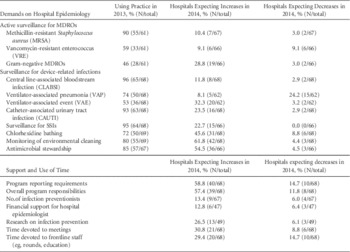
Types of Surveillance, Infection Prevention Practices, and Hospital Epidemiologists’ Use of Time and Resources in 2013 and Expectations for 2014 Compared to 2013

Active surveillance culturing for MDROs was common among respondents in 2013. Active surveillance culturing was performed for methicillin-resistant Staphylococcus aureus (MRSA) in 90% of responding hospitals (55 of 61), for vancomycin-resistant Enterococcus (VRE) in 59% (36 of 61), and for Gram-negative MDROs in 46% (28 of 61). Surveillance for central line-associated bloodstream infection (CLABSI) was reported by 96% of hospitals (65 of 68); surveillance for ventilator-associated pneumonia (VAP) was reported by 74% (50 of 68); surveillance for ventilator-associated events (VAEs) was reported by 53% (36 of 68); surveillance for catheter-associated urinary tract infection (CAUTI) was reported by 93% (63 of 68); and surveillance for surgical site infections (SSIs) was reported by 94% (64 of 68).
Chlorhexidine bathing was used in at least 1 inpatient unit in 72% of hospitals (50 of 69). Environmental cleaning was monitored in 80% of hospitals (55 of 69). This monitoring was performed using a checklist approach in 45% of hospitals (31 of 69), using fluorescent markers in 36% (25 of 69), and using adenosine triphosphate (ATP) testing devices in 28% (19 of 69). Newer touchless technology for environmental cleaning was used in 28% of hospitals (19 of 68), of which 9% (6 of 68) used hydrogen peroxide vapor techniques and 19% (13 of 68) used fluorescent ultraviolet (UV) light.
Antibiotic stewardship programs were present in 85% (57 of 67) of hospitals. Programs included post-prescription review (54%, 36 of 67) and prior approval for restricted antibiotics (57%, 38 of 67). Most of these programs supported a pharmacist (54%, 36 of 67) and a physician director (52%, 35 of 67). Antimicrobial stewardship in 2014 was expected to increase in 55% of hospitals (36 of 66). Influenza immunization was mandated for healthcare workers in 41% of hospitals (28 of 69), of which 14% (10 of 69) allowed reasons to decline vaccination. Another 28% of hospitals (19 of 69) required mandatory vaccination.
Sites outside the United States comprised 22 of 69 total respondents. Due to the limited number of non-US participants, responses were not analyzed by country. Notable differences between US and non-US participants included active surveillance for Gram-negative bacteria (37% in the United States vs 72% outside the United States), monitoring of environmental cleaning (88% in the United States vs 65% outside the United States), antimicrobial stewardship programs (92% in the United States vs 72% outside the United States), and presence of a mandatory influenza immunization program (69% in the United States vs 15% outside the United States). Given smaller numbers for subanalyses by size or teaching status, these were not reported.
DISCUSSION
This survey identified practices in 2013 and expected areas of growth for hospital epidemiology and infection prevention. In 2014, hospitals expected more surveillance for MDROs and device-related infections. Furthermore, new interventions and initiatives are being implemented, including chlorhexidine bathing, monitoring of environmental cleaning, and antimicrobial stewardship. Most hospital epidemiologists report no additional resources to support the growing responsibilities and complexity of infection prevention programs and challenges.
The use of active surveillance cultures (ASCs) for MDROs is stable or increasing in frequency. The most significant increase in active surveillance is for Gram-negative MDROs, which may be due to the Centers for Disease Control and Prevention (CDC)’s guidance for control of carbapenem-resistant Enterobacteriaceae (CRE) in 2012. 6 Hospitals reported an increase in multiple-infection prevention strategies including chlorhexidine gluconate (CHG) bathing. Antimicrobial stewardship was expected to grow in 2014; half of respondents reported support for a pharmacist and physician director and report that their roles are increasing. Focus on environmental cleaning is increasing. Touchless fluorescent UV or hydrogen peroxide vapor technology was used by approximately a quarter of respondents. The use of touchless UV technology was reported more commonly than the use of hydrogen peroxide.
Infection prevention often lacks resources in the United States and abroad.Reference Garrett and Jarvis 7 While mandatory reporting of infection rates and other infection control indices have been leveraged in some institutions to garner additional support, the majority of facilities have not seen additional support despite the growth of responsibilities.
The fields of hospital epidemiology and infection prevention are growing in multiple areas. Resources are needed to meet the increasing demands for new and continued research.
Acknowledgments
Financial support: This manuscript was supported by the SHEA Research Network. Potential conflicts of interest: DJM has held consultant roles with Welch Allyn, Sanogiene/Biomed, and 3 M. AP has received research grants from and has had contracts with AstraZeneca. AM has received research support from Sage Products. All other authors have nothing to disclose.