Introduction
In ambient conditions of high air temperature, the sensible heat loss is reduced, making it difficult for production animals to control their body temperature, causing a heat stress situation (Azoulay et al., Reference Azoulay, Druyan, Yadgary, Hadad and Cahaner2011; El-Sabrout, Reference El-Sabrout2018; Mascarenhas et al., Reference Mascarenhas, Costa, Pereira, Caldas, Batista and Andrade2018). In this type of environment, the thermal equilibrium of birds is affected since they do not have sweat glands (Egbuniwe et al., Reference Egbuniwe, Ayo and Ocheja2018), leading to productive losses (Attia and Hassan, Reference Attia and Hassan2017; Silva et al., Reference Silva, Nascimento, Rodrigues, Leite, Sobrinho and Furtado2017; Attia et al., Reference Attia, Al-Harthi and El-Naggar2018). This thermal challenge motivates animals, especially broilers, to adjust their behaviour during the hottest times of day (Gonçalves et al., Reference Gonçalves, Ferreira, Pereira, Oliveira, Amaral, Garbossa and Fonseca2017; El-Deek and El-Sabrout, Reference El-Deek and El-Sabrout2019) in order to maximize the dissipation of excess body heat to avoid overheating (Egbuniwe et al., Reference Egbuniwe, Ayo and Ocheja2018; Tickle and Codd, Reference Tickle and Codd2019), which causes mortality (Attia et al., Reference Attia, Barbara, Böhmer and Roth-Maier2006; Pawar et al., Reference Pawar, Basavaraj, Dhansing, Pandurang, Sahebrao, Vitthal, Pandit and Kumar2016).
Thus, nutritional strategies have been used to improve bird welfare and to maximize their productive potential (Syafwan et al., Reference Syafwan, Kwakkel and Verstegen2011; Attia et al., Reference Attia, El-Naggar, Abou-Shehema and Abdella2019; Lima et al., Reference Lima, Souza, Batista, Andrade, Soares, Filho, Leonardo, Costa and Lima2019). The manipulation of the physical appearance of the feed is one such strategy (Fronte et al., Reference Fronte, Bayram, Akkaya, Rossi and Bagliacca2013; Nawab et al., Reference Nawab, Ibtishama, Li, Kieserb, Wua, Liu, Zhaoa, Nawab, Li, Xiao and An2018) since it directly affects feed intake and the productive performance of broilers (Attia et al., Reference Attia, El-Tahawy, Abd El-Hamid, Nizza, El-Kelway, Al-Harthi and Bovera2014). When feed ingredients have a coarse particle size, birds increase their feed intake and consequently gain body weight (Amerah et al., Reference Amerah, Ravindran, Lentle and Thomas2008; Attia et al., Reference Attia, El-Tahawy, Abd El-Hamid, Hassan, Nizza and El-Kelaway2012; Naderinejad et al., Reference Naderinejad, Zaefarian, Abdollahi, Hassanabadi, Kermanshahic and Ravindran2016).
However, Souza et al. (Reference Souza, Oliveira, Arruda, Silva and Costa2015) verified that laying hens fed different maize particle sizes in the diet had different responses. These authors showed that although hens fed with coarser maize particles consumed more feed, laying performance was not affected. In addition, laying hens’ thermoregulation was adversely affected, with a consequent decrease in eggshell quality.
Therefore, there is no evidence that manipulating the physical form of maize in the diet affects the broilers’ thermoregulation, especially if these animals modify their behaviour to deal with thermally stressing conditions. Since behavioural adjustments are an important line of defence against thermal stress, either due to their energy efficiency or to preventing overheating, we aimed to evaluate whether broilers fed different maize particle sizes adjusted their behaviour to cope with the heat stress challenges. In this study, we hypothesized that broiler chickens fed a diet with coarse maize particles size modify their behaviour to face the high temperatures during the hottest times of the day (10:00 to 14:00 h).
Materials and methods
Location and animal model
In this study, 220 naked neck broiler chickens (Gallus gallus domesticus) were used from 3 weeks of age, in the environmental conditions of Mossoró, RN, Brazil (5°11′ latitude south, 37°22′ longitude west, and 16 m above sea level). The broilers were divided randomly into two mixed groups (110 males and 110 females) and accommodated in two 5.0 m × 3.8 m × 2.5 m (length × width × height) sheds, resulting in a density of 6 birds/m2. The broilers were not subjected to beak trimming until the end of the experiment. The side walls of the sheds were approximately 0.4 m high and made of plain wire mesh and curtains. The floor was covered by a 6 cm wood shavings bed. Each shed had three automatic drinking fountains and four tubular feeders. No artificial lighting or air conditioning system was used. The side curtains of the sheds were opened at 7:00 h and closed at 17:00 h to control the microclimate inside the sheds (luminosity, temperature and humidity).
Diet
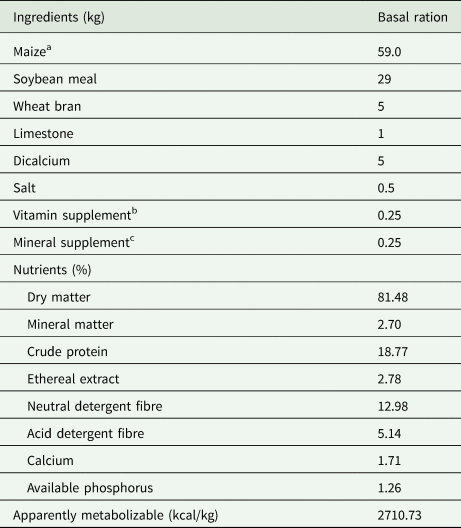
The isonutritive mash rations were prepared according to the recommendations of Rostagno et al. (Reference Rostagno, Albino, Donzele, Paulo, Rita and Lopes2011) for slow-growing broilers (Table 1). The maize was ground in a hammer mill with 2 and 8 mm sieves. The mean geometric diameter (GMD) of the maize particles was measured using a granulometer according to the methodology described by Zanotto and Bellaver (Reference Zanotto and Bellaver1996). The dietary treatments consisted of two diets with a GMD of 605 and 2280 μm. The feeding took place at 7:00 and 15:00 h. Water was supplied ad libitum throughout the experimental period.
Diet composition used for broilers during the experimental period

a Maize grain, ground into different particle sizes (geometric mean diameters of 605 and 2280 μm).
b Assurance levels per kilogram of product – 10 000 000 IU vitamin A, 2 000 000 IU vitamin D, 30 000 IU vitamin E, 3.0 g vitamin K, 2.0 g thiamine, 2.0 g riboflavin, 6.0 g pyridoxine, 1.5 g cobalamin, 12 g pantothenic acid, 1.0 g folic acid, 1.0 g biotin and 50 g niacin.
c Assurance levels per kilogram of product – 20 g copper, 100 g iron, 0.25 g selenium, 2.0 g iodine, 160 g manganese, 100 g zinc, qs vehicle.
Ethogram and observation methods
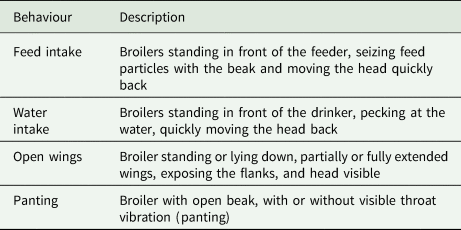
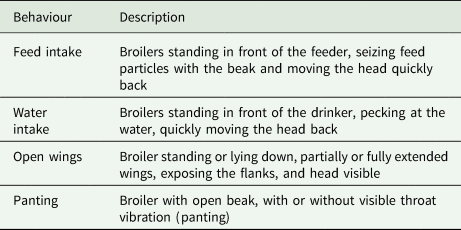
The ethogram included four broiler behavioural adjustments in response to thermal stress (Table 2). Samples were taken at 26, 30, 34, 38 and 42 days old. A single observer recorded the birds’ behaviour on all sampling days to avoid reactivity to a new observer (Bokkers and Koene, Reference Bokkers and Koene2003). The behaviours were monitored simultaneously in the two sheds at 1 h intervals, from 07:00 to 17:00 h, by scan sampling. This sampling method consists of the rapid observation of a group of individuals at regular intervals, with a simultaneous record of the behaviour of each member of that group (Altmann, Reference Altmann1974; Martin and Bateson, Reference Martin and Bateson2007). A short and approximately constant time was spent observing each bird. Thus, the scan sampling could be analysed as distinct points, since the time interval between them was much higher than the duration of the observed behaviour (Martin and Bateson, Reference Martin and Bateson2007). This methodology can be used even when individual identification within a group is impractical (Palestis and Burger, Reference Palestis and Burger1998).
Description of behaviours included in the ethogram for broilers
To facilitate the observation of the birds at the required time, the area of the shed was visually divided into five sections perpendicular to the longitudinal axis of the facility. The sections (i.e. birds) were monitored from left to right of the observer. Should any broiler move between two or more sections during the observation, the procedure was restarted. The 1 h interval between behavioural records allowed this procedure to be repeated as many times as needed.
Environmental data
Environmental variables were monitored during all observation days. The air temperature (TA, °C), relative humidity (RH, %), wind speed (U, m/s) and black globe temperature (BGT, °C) were measured regularly at each hour in the two sheds. The TA and RH were checked simultaneously with a digital thermohygrometer (model HT-300, Instrutherm, São Paulo, Brazil). The U was measured with a precision anemometer (model YK-2005AH, Lutron, Kolkata, India). The BGT was measured using thermosensors (type K) inserted in the centre of black globes (0.15 m-diameter copper hollow black sphere) and connected to digital thermometers (Minipa, MT-600, São Paulo, Brazil).
Data analysis
All statistical analyses were performed using a general linear model using the PROC GLM procedure of the Statistical Analysis System, version 8.0 (SAS Institute Inc., Cary, NC, USA). In this study, the shed was considered as an experimental unit. A repeated-measures ANOVA (two-way) was used to test the effects of maize particle size and the time of day on the broiler behavioural responses. The time of day was considered as repeated measures in time. We used the Tukey test to verify potential differences between the means (P < 0.05). In addition, Pearson's correlation coefficients among environmental and behavioural variables were estimated.
Results
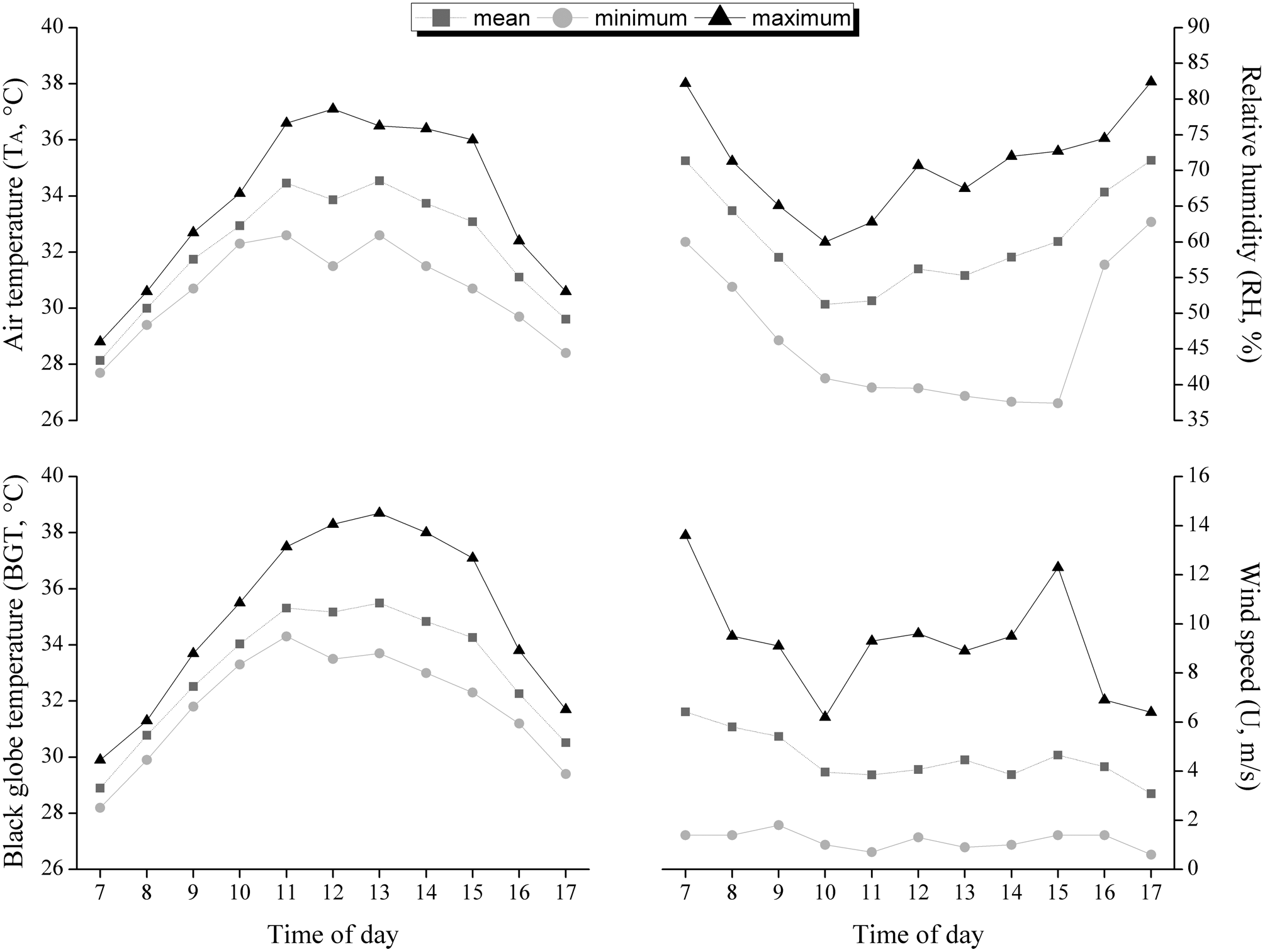
The values referring to the meteorological conditions inside the sheds during the experimental period are shown in Fig. 1. The TA showed a daily average of 32.11°C with an amplitude of 10°C throughout the day. The highest values were found between 11:00 and 15:00 h, with the TA being low at the beginning of the day and in the late afternoon (<30°C). The RH ranged from 51.3 to 82.2% during the day with a mean of 61.89%. Early in the morning, the RH was highest and its lowest values were identified between 10:00 and 15:00 h when the TA was high. The BGT had a mean of 33.12°C during the study, with maximum values higher than 38°C between 12:00 and 14:00 h, which are the times with the highest radiation incidence in the geographic region of this study. The U showed high variation during the day, mainly in relation to its maximum values. The U had an average value of 4.52 m/s but reached a maximum value of 13.6 m/s.
Mean, minimum and maximum values of meteorological conditions recorded during the experimental period.

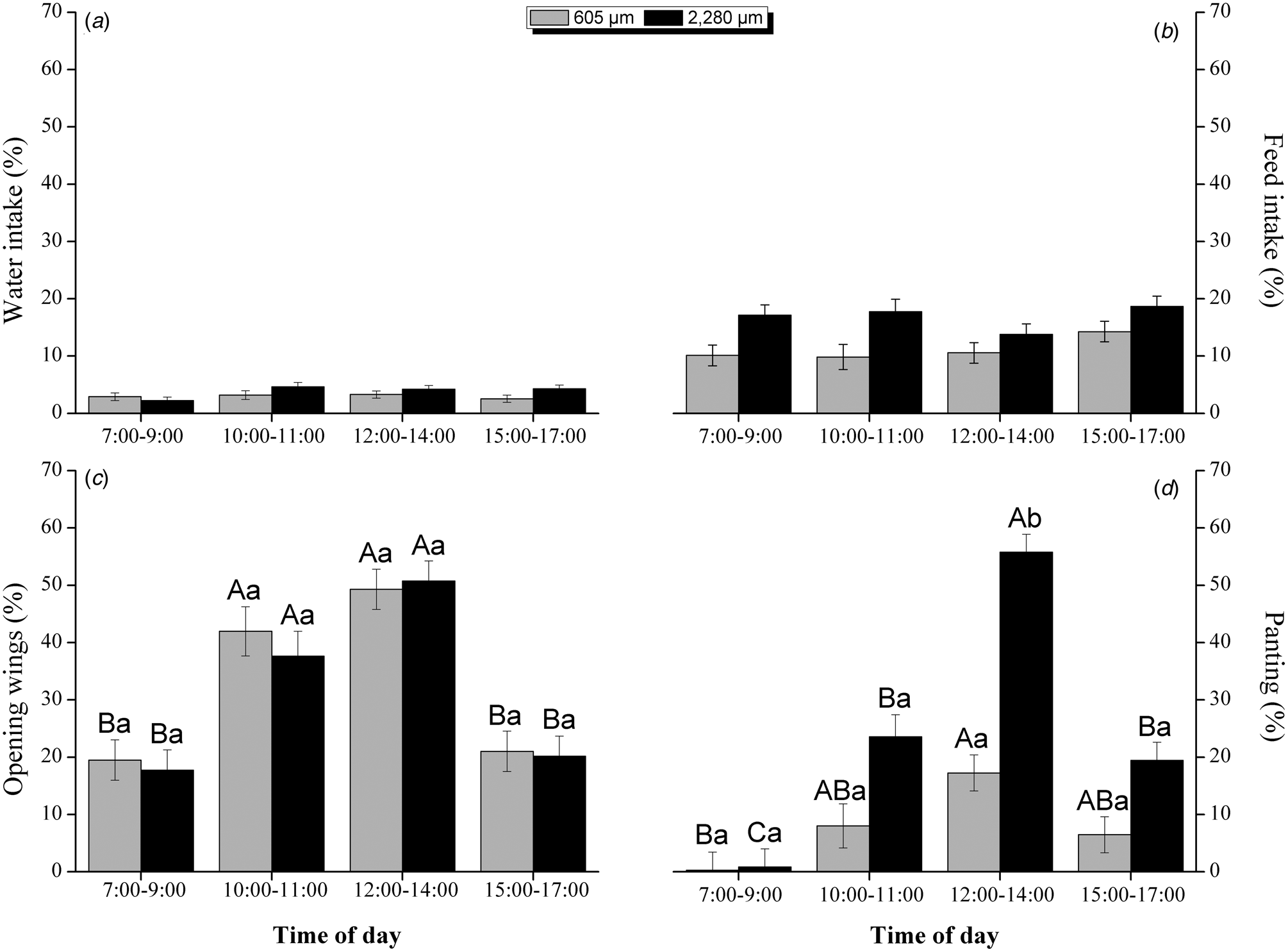
The behavioural adjustments according to the time of day are presented in Fig. 2. Panting and open wings were the only behaviours observed that presented differences between the different times of day (P < 0.05). However, the GMD showed a significant effect on feed intake and panting (P < 0.05). The interaction between GMD and time of day was significant only on panting (P < 0.05). Although no daily variation was observed, the highest feed intake was observed in broilers fed the diet containing maize with a GMD of 2280 μm. Less than 5% of the broilers were observed drinking water during the day. Open wings was the behavioural adjustment most used by broilers from 10:00 h, and remained elevated until 14:00 h for both dietary treatments. The birds panted more when fed the diet containing maize with a GMD of 2280 μm. This behavioural adjustment was not used by the broilers early in the morning (7:00–9:00 h), but showed high values between 12:00 and 14:00 h, when the TA was high and RH was low.
Values related to behavioural adjustments (water intake (A), feed intake (B), open wings (C) and panting (D)) of broilers fed with different maize particle sizes in the diet and according to the time of day. Different upper case letters show significant differences according to a Tukey's test (P < 0.05) between the times of day with the same GMD. Different lowercase letters show differences according to a Tukey's test (P < 0.05) between the GMDs of maize at the same time of day.

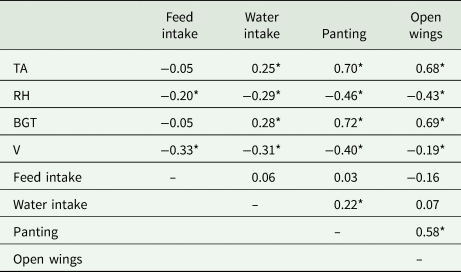
The TA and BGT were highly correlated with panting (r = 0.70 and r = 0.72, respectively) and open wings (r = 0.68 and r = 0.69, respectively) behaviours. A moderate and negative correlation was found between U and panting (r = −0.41). The RH correlated negatively with all behaviours observed in the study. Among the behaviours studied, we highlight the positive and significant relationship between open wings and panting (r = 0.58, Table 3).
Pearson's correlation coefficients between environmental variables (air temperature (TA, °C), wind speed (V, m/s) and black globe temperature (BGT, °C)) and behavioural adjustments

* P < 0.01.
Discussion
The climatic changes that have occurred in recent years are linked to rainfall and temperature changes, and are predicted to cause an increase in the planet's surface temperature of between 0.4 and 2.6°C by 2065 (IPCC, Reference Pachauri and Meyer2014; Giannini et al., Reference Giannini, Costa, Cordeiro, Imperatriz-Fonseca, Saraiva, Biesmeijer and Garibaldi2017). These environmental modifications can be stressful for domestic animals, especially birds, and directly affect their productive performance and lead to an increase in the mortality rate (Kumari and Nath, Reference Kumari and Nath2018; Nawab et al., Reference Nawab, Ibtishama, Li, Kieserb, Wua, Liu, Zhaoa, Nawab, Li, Xiao and An2018). According to King'ori (Reference King'ori2011), for an adult broiler to maintain its minimum metabolic rate, the ambient temperature should be between 12 and 26°C. However, the air temperature inside the shed throughout the day in the present study conditions was outside the thermal comfort range for broiler chickens described by King'ori (Reference King'ori2011). This thermal challenge led the naked neck broilers to modify their behaviour in order to dissipate excess body heat.
The regulation of feed and water intake is dependent on the autonomous mechanism of body heat control (Silva, Reference Silva2000). In hot environments, birds tend to decrease feed intake and increase water intake (Gowe and Faifull, Reference Gowe, Fairfull and Daghir2008; Mack et al., Reference Mack, Felver-Gant, Dennis and Cheng2013; Attia et al., Reference Attia, El-Naggar, Abou-Shehema and Abdella2019) in an attempt to reduce heat stress (Attia et al., Reference Attia, Barbara, Böhmer and Roth-Maier2006; Attia and Hassan, Reference Attia and Hassan2017). However, our results show that even with high air and black globe temperatures, the broiler chickens did not increase their water intake nor did they decrease their feed intake. Only 5% of the broilers drank water during the hottest times of day (10:00–14:00 h). This can be attributed to the gene expression of naked neck broilers (Fathi et al., Reference Fathi, Galal, EL-Safty and Mahrous2013) and the ability of the birds to adjust their behaviour to the thermal environment (Queiroz et al., Reference Queiroz, Souza, Lima, Costa, Costa and Arruda2014).
Among the behaviours exhibited in thermal challenge situations are open wings and panting (Attia et al., Reference Attia, Barbara, Böhmer and Roth-Maier2006; Wang et al., Reference Wang, Yan, Hu, Amen and Cheng2018). By opening wings, birds increase the body surface involved in sensible heat exchange (Etches et al., Reference Etches, John, Gibbins and Daghir2008) and expose body regions with low feather insulation (i.e. flanks), thus enhancing heat loss. Queiroz et al. (Reference Queiroz, Souza, Lima, Costa, Costa and Arruda2014) reported that, at elevated temperatures (~37°C), approximately 35–45% of broilers used this behavioural adjustment to avoid overheating.
As the air temperature approaches the broilers’ body surface temperature, the sensible heat loss is hampered. Since birds do not have sweat glands (Mohammed et al., Reference Mohammed, Jacobs, Murugesan and Cheng2018), they become dependent on respiratory evaporation to dissipate excess body heat since this mechanism does not depend on a thermal gradient. According to Robertshaw (Reference Robertshaw2006) and Attia et al. (Reference Attia, Barbara, Böhmer and Roth-Maier2006), breath is the most important thermoregulatory mechanism for the maintenance of homeothermy in hot environments. Our results show that panting was influenced by maize GMD and the time of day (P < 0.05); 55.8% of broilers fed maize with a GMD of 2280 μm were panting from 12:00 to 14:00 h. The increase in the respiratory rate in thermally stressful environments can lead to an excessive loss of CO2 from the blood, increasing the plasma pH, and causing metabolic alkalosis (Akbarian et al., Reference Akbarian, Golian, Kermanshahi, De Smet and Michiels2015), which can lead to the death of birds (Liu et al., Reference Liu, Feng, Chao, Chen, Wei, Wang, Sun and Zhang2016).
Our study showed that the broilers preferred to consume a ration containing coarser maize particles than finer maize particles. This might be related to the untrimmed beaks of the birds (Safaa et al., Reference Safaa, Moreno, Valencia, Frikha, Serrano and Mateos2009), as previously observed by Souza Jr et al. (Reference Souza, Oliveira, Arruda, Silva and Costa2015) studying laying hens. These authors observed that the higher feed intake with coarser maize particles causes deleterious effects on thermoregulation, such as a respiratory rate increase in an attempt to dissipate the excess heat from the caloric increase provided by the high maize particles. In the present study, the panting behaviour was the more observed (~55.8%) among broilers fed a diet of coarse maize and at the average air temperature of 33.7°C (10:00 to 14:00 h). Our results show that opening wings is the first behavioural adjustment performed by broiler chickens in warmer environments. Under thermal and metabolic challenge conditions, such as those generated by maize with a high GMD, panting became the main thermolysis pathway.
In conclusion, the results of the present study demonstrate that broilers adjust their behaviour to dissipate excess body heat from the thermal environment and due to feed intake. Since coarse particles of maize in the diet increase the thermal challenge of naked neck broilers since the environment also provides stressful thermal conditions, we suggest a smaller diameter of the maize particles in the diet.
Financial support
This research received no specific grant from any funding agency, commercial or not-for-profit sectors.
Conflict of interest
The authors declare that they have no conflict of interest.
Ethical standards
Animal care and handling procedures followed the guidelines of the Animal Experiment Ethics Committee of Universidade Federal do Semi-Árido (CEUA-UFERSA).