Introduction
Chronic fatigue syndrome (CFS), or myalgic encephalomyelitis (ME), is characterized by severe persistent or relapsing fatigue, lasting 6 or more consecutive months, that is not relieved by rest and is accompanied by a number of other somatic and cognitive symptoms (Fukuda et al. Reference Fukuda, Straus, Hickie, Sharpe, Dobbins and Komaroff1994). Despite significant research interest, the aetiology of CFS/ME remains unclear (Afari & Buchwald, Reference Afari and Buchwald2003; Prins et al. Reference Prins, van der Meer and Bleijenberg2006). There has, however, been a consistent finding of a strong association between CFS/ME and psychiatric disorder found in numerous case–control and cross-sectional studies (David, Reference David1991). Possible explanations for this relationship include psychiatric disorders occurring as a consequence of CFS/ME, psychiatric disorders having a causal role in the aetiology of CFS/ME or misdiagnosis and/or bias occurring within these studies (Wessely et al. Reference Wessely, Hotopf and Sharpe1998). Differentiating between these possible explanations has not been possible because of the retrospective or cross-sectional nature of most previous research. Attempts have been made to investigate the temporal relationship between CFS/ME and psychiatric symptoms using prospective studies of fatigue following viral illness; however, the results in such studies have been inconclusive (Hotopf et al. Reference Hotopf, Noah and Wessely1996; White et al. Reference White, Thomas, Kangro, Bruce-Jones, Amess, Crawford, Grover and Clare2001; Petersen et al. Reference Petersen, Thomas, Hamilton and White2006). Larger, population-based, prospective studies examining CFS/ME have been difficult because of the relatively low prevalence of this outcome. Analysis of prospectively studied birth cohorts has shown that neither maternal nor childhood psychological disorders were associated with increased risk of CFS/ME as an adult (Viner & Hotopf, Reference Viner and Hotopf2004). Similar analysis of adult psychiatric disorder has not previously been possible.
In this study we used the Medical Research Council National Survey of Health and Development, a British national birth cohort, to examine prospectively the relationship between prior psychiatric disorder and self-reported CFS/ME. We aimed to test the hypothesis that individuals with CFS/ME would have increased levels of psychiatric disorder prior to the onset of their fatigue symptoms compared to those without CFS/ME.
Method
Sample
The Medical Research Council National Survey of Health and Development was established in 1946. A random social class-stratified sample of 5362 participants was selected from all single, legitimate births occurring in England, Wales and Scotland in one week of March 1946. This sample has been prospectively followed with over 20 separate data collections up to the age of 53 years. The sampling procedure and follow-up have been described in detail elsewhere (Wadsworth et al. Reference Wadsworth, Kuh, Richards and Hardy2006).
Prior psychiatric disorder
Psychiatric disorder was ascertained at several points in the adult life of the sample. At each follow-up point participants were asked about any contacts with medical practitioners and about any hospital out-patient or in-patient treatments. If any hospitalizations were reported, the hospital was contacted and asked to proved details of the admission. This information was used to construct a summary of any psychiatric disorders that occurred between the ages of 15 and 32 years. Participants were assessed to either have no mental illness, mild to moderate mental illness or severe mental illness. Severe mental illness was defined as an illness with duration of more than one 1 year; or an illness that recurred more than four times; or that required care from a specialist mental health team.
At age 36 years, participants were visited at home and the 40-item version of the Present State Examination (PSE; Wing et al. Reference Wing, Cooper and Sartorius1974) was administered by a trained nurse interviewer (Rodgers & Mann, Reference Rodgers and Mann1986). Psychiatric disorder was defined at a threshold level of ⩾5 on the Index of Definition score (Wing et al. Reference Wing, Mann, Leff and Nixon1978), and the total PSE score was used as a measure of the severity of psychiatric symptoms (Rodgers & Mann, Reference Rodgers and Mann1986).
Participants at age 43 years were again visited at home, and interviewed by trained nurses using the Psychiatric Symptom Frequency scale (PSF; Lindelow et al. Reference Lindelow, Hardy and Rodgers1997). The PSF is an 18-item scale measuring psychiatric symptoms, particularly of depression and anxiety, over the past year. A cut-off score of ⩾14 was used to define psychiatric disorder (Lindelow et al. Reference Lindelow, Hardy and Rodgers1997).
At ages 36 and 43 years, participants were also asked if they, or either of their parents, had ever had ‘nervous or emotional trouble or depression’. Participants' mothers were also asked about a family history of ‘nerves’ in 1961. At age 13 years, participants completed a Pintner Personality Inventory (Pintner et al. Reference Pintner, Loftus and Alster1937). This inventory requires the child to read 114 statements and then mark themselves as ‘same’ or ‘different’. It provides a measure of the child's personality along the spectrums of neuroticism and introversion/extroversion. At ages 16 and 26 years, individuals completed the short form of the Maudsley Personality Inventory (MPI; Eysenck, Reference Eysenck1959), which also provides a measure of personality along the neuroticism and extroversion spectrums.
Sociodemographics
Sociodemographic details including gender, father's social class (in 1961), participant's social class (at age 53 years) and educational level were also obtained. Social class was derived from the participant's occupation using the Registrar General's classification (ONS, 1990) and highest education level achieved was coded using the Burnham classification (Department of Education and Science, 1972). The direction of any social mobility throughout the adult life was assessed by examining whether the participant's social class had altered between the ages of 15 and 53.
Outcome
At age 53 years, participants were again interviewed at home by trained nurses. During this semi-structured interview they were asked if they had ever been diagnosed with CFS or ME. If so, they were asked at what age this problem had begun. Hospital records were reviewed for all participants who reported suffering from CFS/ME. If these indicated any psychotic or serious medical disorder that would invalidate the diagnosis of CFS then they were excluded from further analysis. Individuals with a psychotic mental disorder were also excluded from the control group. As we aimed to investigate predisposing factors, any participants who reported CFS/ME symptoms beginning prior to the age of 44 years were excluded from the analysis of measures collected at the age of 43 years.
To address the issue of early CFS being misdiagnosed as a psychiatric disorder, measures of participants' fatigue and fitness levels were taken at ages 15, 31, 36 and 43 years. Reports of energy levels at age 15 were given by the participants' teachers while at ages 31, 36 and 43 years they were self-reported.
Statistical analysis
Statistical analysis was performed using Stata software (StataCorp, 2005). Differences between those with CFS and the remainder of the sample interviewed at age 53 were initially explored using univariate analysis. Logistic regression analysis was then used to calculate odds ratios (ORs) corrected for known sociodemographic confounders, such as gender.
Ethical approval
Ethical approval was given by the London area multi-centre research ethics committee for the data collection at age 53 years. Cohort members gave informed consent for each assessment. Ethical approval and consent procedures at earlier ages conformed to contemporary best practice.
Results
At age 53 years, 3035 of the original participants were interviewed. After exclusion of those who had died, moved abroad or had been permanent refusers, this indicated a follow-up rate of 83%. Analysis reported elsewhere has shown the sample at age 53 years to remain representative of the national population (Wadsworth et al. Reference Wadsworth, Kuh, Richards and Hardy2006).
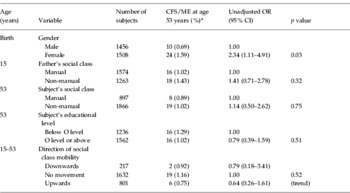
At age 53, 37 (1.2%) of the sample reported a diagnosis of CFS/ME. Hospital admission notes for these participants revealed that two had serious medical conditions (meningitis and chronic active hepatitis) and one had a psychotic disorder (schizophrenia) that required them to be excluded from further analysis. After these exclusions the lifetime prevalence estimate for CFS/ME was 1.1% [95% confidence interval (CI) 0.8–1.5]. The age that participants reported their fatigue symptoms beginning varied between 41 and 53 years. Table 1 shows the associations between sociodemographic factors and a diagnosis of CFS/ME. Women were more likely to report a diagnosis of CFS/ME, but neither social class, social mobility nor educational levels were associated with reported CFS/ME.
Sociodemographic variables and unadjusted odds ratios (95% confidence intervals) for reported diagnosis of CFS/ME

CFS, Chronic fatigue syndrome; ME, myalgic encephalomyelitis; OR, odds ratio; CI, confidence interval.
a Expressed as a percentage of the relevant exposure group.
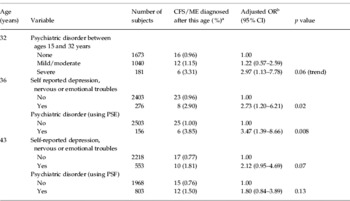
The relationships between prior psychiatric disorder and a later diagnosis of CFS/ME are shown in Table 2. At each psychiatric assessment between ages 15 and 43 years there was a trend towards increased levels of psychiatric disorder in those who later developed CFS/ME. Analysis of the PSE subscale scores, obtained at age 36 years, revealed that those who were later diagnosed with CFS/ME had significantly raised scores in the depressed mood, generalized anxiety and tension subscales. Seven of the participants who reported CFS/ME at age 53 years reported their CFS/ME symptoms beginning between the ages of 41 and 43 years, and thus were not included in the analysis involving psychiatric disorder measures at age 43 years. Their exclusion caused a reduction in the power of these analyses.
Prior psychiatric disorder measures and adjusted odds ratios (95% confidence intervals) for a later reported diagnosis of CFS/ME
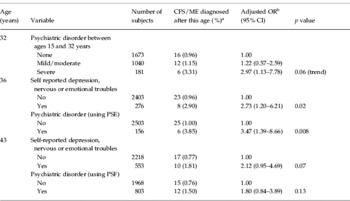
CFS, Chronic fatigue syndrome; ME, myalgic encephalomyelitis; OR, odds ratio; CI, confidence interval; PSE, Present State Examination; PSF, Psychiatric Symptom Frequency scale.
a Expressed as a percentage of the relevant exposure group.
b Adjusted for gender.
At age 15 years there were no significant differences in the levels of energy reported by participants' teachers between those who later went on to report a diagnosis CFS/ME and those who did not. At age 31 years, those who were later to report CFS/ME tended to rate themselves as having higher levels of fitness (data not shown). Despite this, there was a non-significant trend towards decreased levels of energy at age 36 years. However, only three of the participants who later reported a diagnosis of CFS/ME scored highly (above the median) on the lack of energy PSE subscale, indicating that the vast majority of those who were later to report CFS/ME were not suffering significant fatigue at age 36 years. Therefore, measures of psychiatric disorder up to the age of 36 years should be representative of participant's pre-fatigued state. By the age of 43 years, those who were later to be diagnosed with CFS/ME were beginning to report significantly more fatigue than the rest of the sample (data not shown), suggesting measures of psychiatric disorder taken at this age may not represent true preceding psychiatric disorder.
Combining the various measures of psychiatric disorder taken up to the age of 36 years produced an OR (adjusted for sex) for a later diagnoses of CFS/ME in those with any prior psychiatric disorder of 2.65 (95% CI 1.26–5.57, p=0.01).
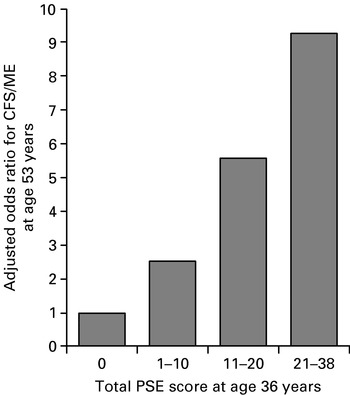
To investigate the dose–response relationship between prior psychiatric symptoms and a later diagnosis of CFS/ME, the total PSE score at age 36 was used to construct ORs (adjusted for sex) for a diagnosis of CFS/ME at age 53 years. This is demonstrated in Fig. 1.
Total Present State Examination (PSE) score at age 36 and odds ratios (adjusted for gender) for a later diagnosis of chronic fatigue syndrome/myalgic encephalomyelitis (CFS/ME). p value for trend=0.001.

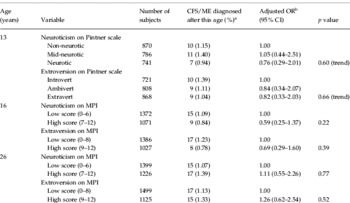
The relationships between personality measures, parental psychiatric disorder and a later diagnosis of CFS/ME are shown in Table 3. None of the personality measures used had any significant impact on the later risk of CFS/ME, but parental psychiatric disorder was more common among those who later reported CFS/ME.
Measures of personality and parental psychiatric disorder with adjusted odds ratios (95% confidence intervals) for a later diagnosis of CFS/ME

CFS, Chronic fatigue syndrome; ME, myalgic encephalomyelitis; OR, odds ratio; CI, confidence interval; MPI, Maudsley Personality Inventory.
a Expressed as a percentage of the relevant exposure group.
b Adjusted for gender.
Discussion
Principal findings
The finding of an association between psychiatric disorders and CFS/ME is not a new observation. However, what is unique about this study is that it was able to demonstrate that those who report a diagnosis of CFS/ME had increased levels of psychiatric disorder, in particular depression and anxiety, prior to the onset of fatigue symptoms. Those with a psychiatric disorder in early adult life were around two and a half times more likely to report a diagnosis of CFS/ME later in life.
Possible causal pathways
Up to the age of 36 years, those who later went on to develop CFS/ME did not have significant differences in their levels of energy or fatigue, suggesting that misdiagnosis of early fatigue symptoms as a psychiatric disorder is not a likely explanation for these results. The temporal, dose–response relationship demonstrated provides some evidence for psychiatric disorders having a causal role in the aetiology of CFS/ME. Alternatively, our results may be explained by psychiatric disorders and CFS/ME sharing common vulnerability factors. A recent study using the Swedish Twin Registry demonstrated that those who reported higher levels of stress in their early adult life were at increased risk of developing a chronic fatiguing illness (Kato et al. Reference Kato, Sullivan, Evengard and Pedersen2006). It may be that persistent stress, or the perception of persistent stress, is a shared risk factor for both psychiatric disorder and CFS/ME. Personality traits are another potential shared risk factor, but our findings suggest that neither neuroticism, introversion nor extroversion are independent risk factors for CFS/ME. It may be that elements of personality or attitudes not captured on these scales act as shared risk factors. Other studies have found an association between CFS/ME and personality factors such as emotional instability (Kato et al. Reference Kato, Sullivan, Evengard and Pedersen2006) and Cluster C personality traits (Henderson & Tannock, Reference Henderson and Tannock2004) suggesting this is an area that requires further investigation. The increased level of family psychiatric illness among individuals who report CFS/ME is also a novel finding (Endicott, Reference Endicott1999; Torres-Harding et al. Reference Torres-Harding, Jason and Turkoglu2005). Although this may point to a common genetic susceptibility, it is perhaps most likely to be explained by the confounding effect of the strong relationship between family and personal history of psychiatric disorders.
Strengths and limitations
The strengths of this study include its large size and prospective data collection. The high follow-up rate and the sample's generalizability to the British population are also strengths. Increased loss to follow-up at age 53 years was seen in males, participants from a manual social class, individuals with lower levels of education, individuals more fatigued at 43 years and those without a personal or family history of psychiatric illness in early life, although this did not affect the overall representativeness of the sample (Wadsworth et al. Reference Wadsworth, Kuh, Richards and Hardy2006).
Although the use of self-reported CFS/ME is the main limitation of this study, it may also provide some benefits. Fatigue is a subjective experience that is difficult to define and therefore difficult to measure (Dittner et al. Reference Dittner, Wessely and Brown2004). At present, there is no accepted standardized interview for diagnosing CFS/ME in the community, with self-reported levels of fatigue remaining at the core of the diagnostic criteria (Fukuda et al. Reference Fukuda, Straus, Hickie, Sharpe, Dobbins and Komaroff1994). Any attempt to use more structured diagnostic interviews may fail to capture the phenomena of patients who complain of fatigue in a clinical setting. In examining those who report a diagnosis of CFS/ME, we have studied both those who have been given a diagnosis of CFS/ME by the medical profession and those who have self-diagnosed. We feel this method is likely to have a high degree of clinical and face validity. Clinical experience suggests that it is uncommon for a patient to complain of CFS or ME and to not have sufficiently severe symptoms to warrant the diagnosis. Despite this, the use of self-reported diagnosis may have caused an under-ascertainment of cases as some individuals who would meet the criteria for CFS/ME may not report this as a diagnosis. Provided this misclassification was random, the effect of this will have been an underestimate of the strength of the associations we report. These assumptions are supported by our prevalence estimate being lower than previous estimates of broadly defined chronic fatigue states (Steele et al. Reference Steele, Dobbins, Fukuda, Reyes, Randall, Koppelman and Reeves1998), while being higher than that reported in studies using stricter diagnostic criteria (Jason et al. Reference Jason, Richman, Rademaker, Jordan, Plioplys, Taylor, McCready, Huang and Plioplys1999; Reyes et al. Reference Reyes, Nisenbaum, Hoaglin, Unger, Emmons, Randall, Stewart, Abbey, Jones, Gantz, Minden and Reeves2003). The use of self-reported diagnosis is also supported by post-hoc analysis showing that the association between prior psychiatric disorder and CFS/ME remained, and was in fact slightly stronger, when patients who had not received their diagnosis of CFS/ME from a doctor were excluded. The OR (adjusted for sex) of individuals with physician-diagnosed CFS/ME having prior psychiatric disorder was 3.78 (95% CI 1.38–10.28, p=0.009).
While the number of individuals who reported a diagnosis of CFS/ME was in line with previous prevalence estimates, the fact that CFS/ME is a relatively rare outcome reduced the power of this study. This will have increased the chance of type 2 errors, although the fact we were able to find a series of relatively strong associations suggests that this was not a major problem. Another potential limitation of this study is that our findings are restricted to those who reported CFS/ME at a relatively older age. Although participants were asked about their energy levels at earlier assessments, they were only asked about a diagnosis of CFS/ME at the age of 53 years. As a result our study only examined individuals with CFS/ME diagnosed at an older age, with symptoms in our sample beginning between the ages of 41 and 53 years. While some community-based studies have found the prevalence of CFS/ME to peak between ages 40 and 59 years (Reyes et al. Reference Reyes, Nisenbaum, Hoaglin, Unger, Emmons, Randall, Stewart, Abbey, Jones, Gantz, Minden and Reeves2003), it remains uncertain if this sample and conclusions based upon it are representative of those who complain of CFS/ME at a younger age.
Conclusions
Those who report a diagnosis of CFS/ME have increased levels of psychiatric disorder prior to the onset of their fatigue symptoms. When present, this psychiatric disorder typically appears to be depression or anxiety. While further studies are needed to investigate possible shared vulnerability factors, including personality traits, attitudes and stress, it seems likely that psychiatric disorders, or risk factors for these disorders, have an aetiological role in some cases of CFS/ME. An increased understanding regarding the roles of these factors in the aetiology of CFS/ME will help to provide guidance on the prevention and treatment of this debilitating and stigmatized condition.
Acknowledgements
The MRC National Survey of Health and Development is funded by the Medical Research Council. M. H. and S. W. are part-funded by the South London and Maudsley NHS Foundation Trust/Institute of Psychiatry National Institute of Health Research Biomedical Research Centre.
Declaration of Interest
None.