Introduction
By the year 2021, over a million people in the United Kingdom will have dementia. At present one-third of those with dementia in the United Kingdom live in care homes and at least two-thirds of care home residents have dementia (Knapp et al., Reference Knapp2007).
One in four vulnerable older people are abused, yet only a small proportion of this abuse is reported (Cooper et al., Reference Cooper, Selwood and Livingston2009a). Care home residents are more likely to have dementia, challenging behavior and be dependent on others for personal care, factors associated with a higher risk of abuse (Cooper et al., Reference Cooper, Manela, Katona and Livingston2008a; Reference Cooper, Selwood and Livingston2008b). In recent surveys, a quarter of relatives of older people in care homes have reported at least one incident of physical abuse (Schiamberg et al., Reference Schiamberg2012); 16% of long-term care staff have reported committing significant psychological abuse (Cooper et al., Reference Cooper, Selwood and Livingston2008b); and over 80% of nursing home staff have observed abuse although far fewer were willing to admit to acting abusively (Pillemer and Moore, Reference Pillemer and Moore1989).
In the United Kingdom, the Department of Health defines abuse as “a violation of an individual's human and civil rights by another person(s),” which may not be intentional (Department of Health, 2000). Unintentional abuse might include, for example, neglect by a caregiver who was unaware of the needs of a care recipient. Abuse is defined by the impact of actions or inactions on an individual; some actions such as ignoring a care recipient's request may or may not result in abuse, depending on how frequently this occurred, and whether others compensated to meet the person's needs.
Care workers reporting abuse face potential adverse legal, employment, and social consequences. No reported study has asked care workers about abuse anonymously. Only one previous study in a Czech care home has asked paid care workers to describe their experiences of abuse toward residents in care homes. They reported physical abuse, such as not relieving pain, excessive use of restraints, neglect of personal care, and verbal and financial abuse (Buzgova and Ivanova, Reference Buzgova and Ivanova2009). We used focus groups to develop the first measure for anonymous reporting of abuse and neglect in care homes by eliciting care workers’ views about common abusive situations that arise and how to ask about them in a way they found acceptable.
Method
Setting
We recruited older people's nursing and residential homes in inner and outer London.
Recruitment
We used purposive sampling to include care workers from a range of care settings (private, voluntary, or local authority; nursing or residential; dementia specialist or not) and with different levels of experience. We approached care home managers from organizations that had agreed to participate in our research. Care workers employed to give direct (hands-on) care to people with dementia were invited to participate. This included care assistants and nursing staff. After the first focus group, in which we felt the presence of a manager had an impact on the frank participation of other care workers, we excluded managers from the group.
North West London Research Ethics Committee (11/LO/493) approved the study. Participants gave informed consent after receiving an information sheet and an opportunity to ask questions. This explained the study was to find out what helps professionals to provide high quality care to people with dementia and what makes it harder for them to do so, and to ask their views about a new questionnaire to ask carers anonymously about potentially harmful behavior towards people with dementia. They were asked not to disclose identifying information about staff or residents. They were advised that if researchers believed that a person was at significant risk of harm from the information disclosed, then the appropriate manager would be informed. The information sheet specified that “we respect confidentiality but cannot keep it a secret if anyone is being seriously harmed or is at high risk of serious harm.”
Procedures
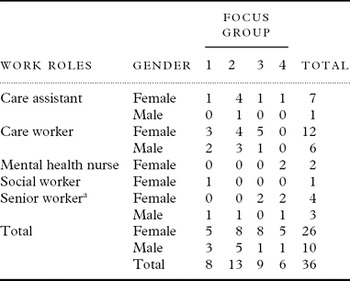
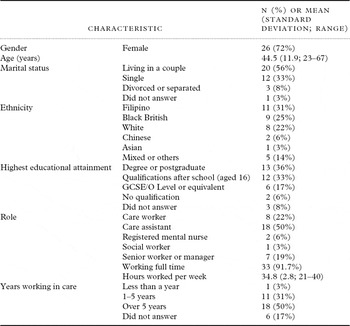
Focus groups were facilitated by two to three researchers (SH, CC, and DL), lasted 60–90 minutes, and had 6–13 participants (Table 1). Participants completed a brief demographic survey prior to the group (see Table 2 for details).
Work roles and gender of focus group participants

aSenior workers included senior care workers, team leaders, and activity managers.
Demographic characteristics of participants

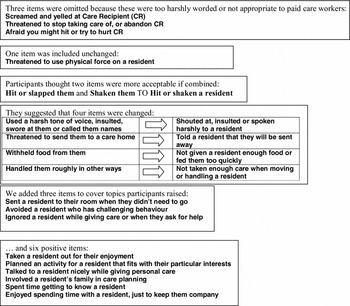
Discussions focused on barriers to delivering good quality dementia care. Care workers were encouraged to give examples from their practice of situations when good quality care had not been delivered or when they had been concerned that abuse had occurred. We did not ask care workers to distinguish between residents with and without dementia. Most residents of care homes have dementia but most are not diagnosed or care workers may not be aware of diagnoses (Knapp et al., Reference Knapp2007). In the first focus group care workers had difficulty thinking how any abuse would apply to their care setting, so in subsequent groups we used a vignette (about a resident with severe dementia and urinary incontinence who was refusing shower and hitting out at staff) to generate discussion of good and unhelpful ways of managing difficult situations. In the first group, the participants were shown the Modified Conflict Tactics Scale (MCTS), a measure developed and validated to ask people with dementia living at home and their family caregivers about abuse, which asks about neglect, and psychological and physical abuse (Figure 1) (Beach et al., Reference Beach, Schulz, Williamson, Miller, Weiner and Lance2005). They were asked which of the questions were relevant to care home workers, whether the items would be acceptable in an anonymous measure, and what else should be included. After each group, the research team revised the instrument using participants’ feedback, and presented the revised version to the next group. Thus, each group was aware of the types of potentially harmful behaviors raised by previous groups, although we did not ask them specifically about different types of abuse that had not been discussed in previous groups. Participants were asked what would make them more or less likely to complete it.
How we changed the Modified Conflict Tactics Scale to make it the Care Home Conflict Scale.

Analysis
We digitally recorded discussions and transcribed them verbatim. We analyzed using a “theoretical” thematic framework approach. This is driven by the researcher's theoretical or analytic interest in the area, and is thus more explicitly analyst-driven technique than other qualitative analysis techniques such as the grounded theory. The researchers undertaking the analysis (BD/SH) were from social work and medical psychiatric backgrounds respectively (Braun and Clarke, Reference Braun and Clarke2006). We began analysis with the first two groups. Two researchers (BD and SH) independently read the transcripts and identified initial themes and categories. They compared these and jointly developed a thematic map, with a hierarchy of themes and categories. This map was then used to code transcripts using Nvivo 9. During the coding, the themes and categories were altered and developed to reflect the content of the transcripts. There were two main areas of analysis, based on the study questions. These were types of abuse witnessed and opinions on the acceptability and content of the MCTS. We continued data collection until the research team agreed that data saturation has been attained. We then contacted the participants individually in the care homes by post and asked them to make comments or recommend further changes to the instrument and not to complete it. We enclosed a stamped addressed envelope. We did not ask them for any identifying information.
Results
Demographics
We held four focus groups with a total of 36 care workers. The four care facilities were as follows: a local authority residential care home for older people with dementia, a charity run residential care home providing personal and dementia care, a private nursing home for people requiring general and dementia nursing, and a private residential care home for older people specializing in dementia care. Participants’ demographic characteristics are displayed in Tables 1 and 2.
Potentially abusive behaviors described
Reports of abusive behaviors witnessed could mostly be divided into three categories: (1) Situations which the care workers thought were due to insufficient resources or competing demands, such as residents waiting too long for personal care, or being denied care they needed to ensure they were moved safely or were not emotionally neglected. (2) Instances when staff acted in potentially abusive ways, which they judged better for residents than alternatives; for example, care workers made threats in order to coerce residents to accept care, or restrained them, as they saw no alternative way of preventing them being unclean; and a resident at high risk of falls was required to walk as care workers were concerned that otherwise he would forget the skill. (3) Situations related to institutional practices; for example, residents not being given enough time to eat meals because of kitchen closing time. One caregiver described an act of deliberate physical abuse that took place in an earlier employment.
Waiting for personal care
In all the groups, care workers described residents sometimes waiting longer than they felt was acceptable for personal care:
You're dealing with one person, suddenly there's something over there . . . so one person's going to get fobbed off . . . you can quite easily give the impression that you don't care . . . it's like a regular thing. (Focus group 1)
One caregiver explained how a resident had to wait for personal care because of a decision to prioritize discharging another resident on time:
One of the senior carers was supposed to change one of the residents because she was dirty . . . I had to explain to this resident why this person hadn't come to clean her up at the time she stated. (Focus group 3)
Shortcuts
Care workers described situations where taking short cuts when giving personal care had consequences that were potentially or actually abusive:
I've seen cases where with lifting a resident . . . you could probably break the arm . . . you probably should've used a hoist-but that would've taken up too much time so you know, shortcuts. (Focus group 2)
Sometimes they have to go to the toilet. And the hoist is not working . . . sometimes when they're going to transfer, they cut their leg or get stuck in the wheelchair. (Focus group 4)
Neglecting residents’ emotional needs
One participant described the opportunity to chat with residents as a rewarding and enjoyable aspect to their work, but two others commented that often this did not happen due to time and staffing constraints:
Other people with less difficult behavior who may need just as much attention won't get it because you're always focused on the one that's flavour of the month . . . others fall slightly by the way. (Focus group 1)
Sitting down and having a five-minute chat with [residents] all those kinds of things go out the window. (Focus group 1)
Making threats
Some participants described using threats to persuade residents to eat or agree to personal care:
Especially if they don't eat. Okay, we're going to call your son, you're not eating. (Focus group 3)
I've heard [carers] threat[en] to send them to hospital, I'll send you to your room, . . . because they don't want to go to their room . . . [or threatened to send them] to another care home. (Discussion between three participants in Focus group 2)
Restraining
In response to our vignette, one focus group discussed using force to give personal care:
One of us restrained them to change, it is forced . . . I'm not leave them like that. . . . we are forcing [care] in a way-but for their own good and we take care of everything we . . . have to do it. (Focus group 2)
Risking falls
One caregiver was concerned that rules about using a hoist for residents at risk of falling may reduce their independence, suggesting that procedures designed to protect residents were not always understood by staff:
I know that if we start using the hoist all the time with this individual he'll completely forget how to walk altogether and he'll never walk again . . . I would rather risk my back so that this guy doesn't forget how to walk. (Focus group 1)
Residents not having enough to eat
Two of the four focus groups described instances when residents were deprived of food, because the kitchen was closing or other residents needed the dining room:
Because we have to get them out – Breakfast and lunch – is coming . . . they will give them two spoons and the food will be chucked – I've seen this. (Focus group 2)
Physically hurting
One caregiver described witnessing physical abuse in a previous home:
[The carer] would just go over to her. . . drive the resident to the shower and she didn't even want a shower, she probably just wanted a wash, . . . if the resident tries to resist . . . the resident hitting the carer or the carer hits the resident . . . [the resident] keeps thinking . . . I upset her so she hit me, she thinks it's her fault . . . she doesn't want to get this carer in trouble, she's scared of her. (Focus group 2)
What makes abuse more or less likely
The likelihood of abusive situations was determined by factors related to the institutions, the care workers, and the residents.
Institutional factors
In two groups participants expressed concern that you do not really know what happens “behind closed doors.” Bureaucracy was frequently raised as a barrier to providing high-quality care:
A lot of policies [are] thrown on top of you that will not allow you to carry out your duties. (Focus group 1).
A lack of information about residents was also perceived as a cause of poor care, with knowledge about new residents not being shared with front line staff:
It's very complicated to find out what actually resident have got. Focus group 3)
All the groups gave examples of how inadequate staffing levels or problems with equipment could result in negative outcomes for residents. In some instances, the need to prioritize getting residents to groups on time meant other residents needing to wait or their needs being unmet.
Care worker conditions
Care workers who felt disempowered were less likely to speak out about problems, such as equipment failure or residents not getting basic care, which were consequently more likely to continue.
All the groups discussed care workers feeling undervalued, ignored, underpaid, or blamed when things went wrong or not wanting to do the job, and that this led to abusive practice:
Most of the time, the carers, they do not have the voice . . . they are scared for their livelihood. Especially as most of the care workers are from foreign countries, they are sending money to their families back home, and they know if their managers will not permit their work permits then they cannot continue feeding their families. . . . the short staffing, the low salaries, and the equipment, it's existing. (Focus group 4)
A lot of us are not paid very well. Sometimes I think that a carer would say that this is as far as I go for £6 an hour. (Focus group 2)
Conversely, it helped when the care workers felt part of a team and could ask for help with problems. All the groups talked about the importance of training and knowledge, and ways they had learnt to de-escalate aggression without recourse to abuse:
It's just being able to talk in a calm way and I think that can sometimes help.
Not being loud and high-pitched. (Focus Group 4)
It's different, depending on the situation. Sometimes I leave the [uncooperative] client for a while, go out to cool down and sometimes I try to convince him. (Focus group 1)
They also emphasized the importance of knowing residents as individuals.
Knowing where a new resident likes her bed. Moving it meant she started to sleep.
So it's just finding out those little things – that make that place a home for them. (Focus group 2)
All the groups referred to the importance of wanting to be a caregiver, with a greater likelihood of lower quality, including abusive care by staff that did not want to do the work:
Some . . . people we work with . . . seem to me that they hate [the residents] and hate the work and what – what can you expect? (Focus group 1)
One group described how some staff might ignore a resident's need for personal care to avoid work:
They are ignoring them or they just don't wanna know. (Focus group 3)
Resident factors
Abusive situations were felt to be more likely when residents were aggressive or changeable in their responses. Many reported verbal or physical aggression from residents:
One of the residents [gets] upset every time we go there, call you Hitler or [other participant interjects] she lifted up her stick and she whacked me over the arm with it. (Focus group 3)
Care workers felt hurt by or angry toward residents who reacted badly to them and this may have made problems worse. Some residents had favorite care workers, sometimes because the care worker had a particular way of interacting with them that worked for that resident.
Some resident they like certain staff – so all you have to do is send that staff to them. (Focus group 3)
All the groups discussed racism by residents (for example, not wanting a black caregiver).
Development of the Care Home Conflict Scale (CHCS) (Figures 1 and 2)
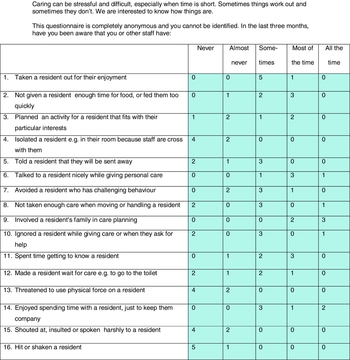
Figure 1 shows how we changed the MCTS to make it the CHCS. Participants in the first three groups responded negatively to the wording, particularly the use of the word “threatened.” They said that if they physically abused a resident, they would be sacked. Participants thought care workers would be more likely to complete the survey if negative items were interspersed with positive items, and suggested the items that we included. Participants in the Focus group 4 thought that the measure was relevant and acceptable, but that they would be more likely to answer honestly if the survey was sent to their home address rather than being distributed at work but conversely would not want to give out this address. We posted the final version of the scale (as shown in Figure 1) to 28 group participants via the care home (we excluded the first group as the home was closing). Six replied. They did not suggest further changes. Two made positive comments about the focus group and the measure, and one commented (regarding item 3) that not all staff were involved in planning activities. All completed the scale despite being asked not to. Results are shown in Figure 2.
The Care Home Conflict Scale showing results from six care workers who completed it anonymously.

Discussion
Main findings
Situations with abusive consequences were a common occurrence. Care workers in all the groups described abusive situations occurring due to insufficient resources or competing demands, such as residents waiting for personal care, or being denied the attention they needed to have enough to eat, to be moved about safely, or to meet their emotional needs. The care workers believed that with more time, team working, or institutional flexibility they could provide better quality care. Some potentially abusive behaviors happened because care workers did not know of better alternatives or understand the illness, such as making threats to coerce residents to accept care, or restraining residents rather than not giving essential personal care; or requiring a resident at high risk of falls to walk due to fear that he might otherwise forget the skill.
There is a wide range of opinion among professionals and families and across cultures about what constitutes abusive acts (Selwood et al., Reference Selwood, Cooper and Livingston2007). We used the UK Department of Health definition of abuse, “a violation of an individual's human and civil rights by another person(s) . . . which may or may not be intentional” to decide whether scenarios described by caregivers were potentially abusive and should therefore be included in the abuse scale. Some, such as withholding food, were likely to be abusive even if they only happened once, whereas others, such as ignoring a resident, would probably only be abusive if they were happening more frequently. Most researchers studying elder abuse have used scales that include potentially abusive items of a range of severities with a cut-point so that people only experiencing psychologically abusive acts or having their needs neglected very occasionally are not identified as abuse cases (Cooper et al., Reference Cooper, Selwood and Livingston2008b). This has parallels in the more extensive child abuse literature, which also describes a spectrum of harm, and most definitions of child abuse do not suggest intent. For example, a UK National charity defines child abuse as any form of physical, emotional, or sexual mistreatment or lack of care that leads to injury or harm (Radford et al., Reference Radford2011). Similarly, the US Centers for Disease Control and Prevention (CDC) and the Department for Children And Families (DCF) define child maltreatment as any act or series of acts of commission or omission by a parent or other caregiver that results in harm, potential for harm, or threat of harm to a child (Centers for Disease Control and Prevention, 2012).
An alternative approach would have been to use a less inclusive definition of elder abuse, for example, that of the US National Research Council: “(a) Intentional actions that cause harm or create a serious risk of harm to a vulnerable elder by a caregiver or other person who stands in a trust relationship to the elder, or (b) failure by a caregiver to satisfy the elder's basic needs or to protect the elder from harm” (National Research Council, Reference Bonnie and Wallace2003). Unlike the UK Department of Health definition, this includes an element of judgement about intentions of perpetrators and impact of abuse on recipients, so it would likely to be more specific but less sensitive, and therefore less appropriate for designing a screening instrument. We have argued that the concept of an abuse case is troublesome and artificial as abusive behavior occurs on a spectrum. For research purposes, it may be better to record abuse score (Cooper et al., Reference Cooper, Selwood, Blanchard, Walker, Blizard and Livingston2009b).
This is the first study to ask care workers to describe abusive or potentially abusive situations they have witnessed, but the perceptions of managers as threats rather than as enablers of good practice mirror previous findings (Livingston et al., Reference Livingston, Pitfield, Morris, Manela, Lewis-Holmes and Jacobs2012). Descriptions of individuals not knowing who to help and who to leave are striking and disturbing. The reported concerns about understaffing are not new (Train et al., Reference Train, Nurock, Kitchen, Manela and Livingston2005); we do not know whether higher levels of skill and team working would free up staff time.
There are currently no evidence-based interventions to reduce or prevent abusive behavior. With a quarter of relatives of people in care homes reporting physical abuse (Schiamberg et al., Reference Schiamberg2012), such interventions are urgently needed. Our findings suggest that training about dementia, team working, and managing challenging behavior would be helpful intervention strategies. Addressing institutional abuse, such as food only being available during kitchen opening time, would require organizational change. Any effective intervention would need to change care home culture.
To develop and test effective interventions to reduce and prevent abuse, we need to detect and measure abuse accurately. This is inherently difficult. The majority of care home residents have moderate or severe dementia, and may be reluctant and frightened to report abuse by people on whom they depend. There are legal, employment, and social barriers to care home workers reporting abuse they have witnessed or perpetrated, but they are the most likely to witness abuse. Anonymous reporting by care workers raises ethical concerns, as this reported abuse cannot be acted upon directly even if it is serious. Nonetheless, we think this approach is necessary in order to obtain accurate information about the extent of abuse in care homes and to develop and evaluate interventions to reduce it. We describe the first instrument to measure abuse by care homes workers anonymously. The care workers in focus groups indicated that they would be willing to complete it, and a fifth of those contacted for comments and asked specifically not to complete the measure did so anyway. All endorsed abusive items and all the items were endorsed by at least one person.
Strengths and weaknesses
This is the first study to ask care home workers about actual abusive behavior. The focus groups encouraged discussion, but there may have been situations that care workers were unwilling to discuss in a group. Only one caregiver mentioned an intentionally abusive act; perhaps such situations are unusual or maybe care workers were less willing to report them. The potentially abusive situations described may or may not have amounted to abuse in practice. We only interviewed care workers from four care homes, all in London, so findings may not reflect all the UK homes. Our measure asks about psychological and physical abuse and neglect. Financial and sexual abuse were not discussed by the groups, so these are not included.
Conclusion
Situations with unintended abusive consequences were described as a common occurrence in care homes. Our findings indicate that our new measure, the CHCS, has content validity; we now need to test its wider acceptability and psychometric properties.
Conflicts of interest
None
Description of authors’ roles
All authors contributed to the conception and design of the study. Susan Hay, Deborah Livingston, and Claudia Cooper ran the focus groups; Briony Dow and Susan Hay independently analyzed the data, and all the authors read and reread the transcripts to contribute to data analysis and interpretation. Claudia Cooper, Briony Dow, and Susan Hay drafted the paper and all the authors revised it critically for important intellectual content and gave final approval to the version to be published. Claudia Cooper will act as a guarantor.