Introduction
The pine processionary moth (PPM) Thaumetopoea pityocampa (Denis & Schiffermüller) (Lepidoptera: Notodontidae: Thaumetopoeinae) is a phytophagous insect that generally reproduces on trees of the genus Pinus L. (Devkota & Schmidt, Reference Devkota and Schmidt1990) and, to a lesser degree, on other conifer species. The species is widespread in the pine forests of the Mediterranean, including southwestern Europe, the Balkan Peninsula and North Africa (Huchon & Démolin, Reference Huchon and Demolin1971). Outbreaks of the species in areas previously unaffected by the insect can be favored by the presence of Pinus hosts (Stastny et al., Reference Stastny, Battisti, Petrucco Toffolo, Schlyter and Larsson2006) or as a result of climate change (Battisti et al., Reference Battisti, Stastny, Netherer, Robinet, Schopf, Roques and Larsson2005, Reference Battisti, Stastny, Buffo and Larsson2006). Infestations of PPM impair the vitality of pine forests (Devkota & Schmidt, Reference Devkota and Schmidt1990; Masutti & Battisti, Reference Masutti and Battisti1990; Hodar et al., Reference Hodar, Zamora and Castro2002) and can affect humans and animals that come into direct contact with an infected tree, because of the urticating hairs of the moth, which are responsible for allergic pathologies (Ducombs et al., Reference Ducombs, Lamy, Mollard, Guillard and Maleville1981; Lamy et al., Reference Lamy1990; Werno & Lamy, Reference Werno and Lamy1994; Battisti et al., Reference Battisti, Holm, Fagrell and Larsson2011). Adults lay the eggs during the summer; in February–May, larvae that are ready to pupate leave the tree in single file in a head-to-tail procession, searching for suitable pupation sites in the soil. Adults emerge and fly throughout the summer (Bonsignore & Manti, Reference Bonsignore and Manti2013). The hypogeic pupal period is variable in relation to the climate (Battisti et al., Reference Battisti, Bernardi and Ghiraldo2000; Pimentel et al., Reference Pimentel, Calvão, Ferreira and Nilsson2010). Prolonged yearly diapause is known for pupae of this species, but does not always occur (Pimentel et al., Reference Pimentel, Calvão, Ferreira and Nilsson2010; Bonsignore et al., Reference Bonsignore, Manti, Castiglione and Vacante2011).
Parasitoid insects are important enemies of many insects (Godfray & Shimada, Reference Godfray and Shimada1999), and could have an important role in terminating the cyclic outbreak dynamics of forest Lepidoptera populations (Berryman, Reference Berryman1996; Hassell, Reference Hassell2000; Turchin et al., Reference Turchin, Wood, Ellner, Kendall, Murdoch, Fischlin, Casas, McCauley and Briggs2003). Although there is no clear evidence for the impact of parasitoids on PPM populations, several studies have suggested that parasitoids cause significant mortality of this species (Buxton, Reference Buxton1990; Tarasco, Reference Tarasco1995; Schmidt et al., Reference Schmidt, Tanzen and Bellin1999; Battisti et al., Reference Battisti, Bernardi and Ghiraldo2000). During their development, PPMs are susceptible to attack by a range of hymenopteran and dipteran parasitoid species, including parasitoids of egg, larvae and pupae (Biliotti, Reference Biliotti1955; Du Merle, Reference Du Merle1969; Tsankov et al., Reference Tsankov, Schmidt and Mirchev1996; Schmidt et al., Reference Schmidt, Tanzen and Bellin1999; Lòpez-Sebastián et al., Reference Lòpez-Sebastián, Tschorsning, Pujade–Villar, Guara and Selfa2007; Bonsignore et al., Reference Bonsignore, Manti, Castiglione and Vacante2011). PPMs are also attacked by invertebrate predators, including ants, beetles and spiders, as well as by vertebrates, such as birds, shrews and voles, and also by pathogens (Way et al., Reference Way, Paiva and Cammell1999; Battisti et al., Reference Battisti, Bernardi and Ghiraldo2000; Er et al., Reference Er, Tunaz and Gökçe2007; Ince et al., Reference Ince, Hatice, Yilmaz, Demir and Demirbaģ2008; Hatice et al., Reference Hatice, Ince, Kazim, Serife and Zihni2009; Barbaro & Battisti, Reference Barbaro and Battisti2011). However, it has been difficult to quantify the effect of parasitoids on PPM developmental stages that occur underground, in particular, which species of parasitoids are involved and how they influence the PPM population dynamics. Furthermore, knowledge of the life-history parameters and the host stage that they attack is limited for many of the parasitoid species identified thus far (Bonsignore et al., Reference Bonsignore, Manti, Castiglione and Vacante2011). Such data could provide valuable insights into the strategies that different parasitoids use to exploit suitable PPM hosts. In addition, the control of PPM relies on the use of microbiological agents, aimed primarily at controlling the larvae, because of the current lack of data on other developmental stages (Triggiani & Tarasco, Reference Triggiani and Tarasco2002; Er et al., Reference Er, Tunaz and Gökçe2007).
In addition, the influence of soil variables on PPM pupal mortality is not known, although earlier studies reported some effect of soil variables on PPM density and the action of parasitoids (Tarasco, Reference Tarasco1995). Therefore, the aims of the current study were to describe and quantify the parasitoid species of the pupal stage of the PPM and to relate this parasitism to different external factors, such as density of host and phenological traits of the PPM species.
Methods
Experimental site
Two experimental sites were selected in a region where Pinus nigra occurs and where outbreaks of PPM are common. To quantify the parasitoid complex and their life-history traits associated with PPM pupae, the study was performed in two clearings in a P. nigra forest in the Aspromonte National Park (southern Italy; latitude 38°04′10′N, and 15°49′38′E, 1200 m above sea level). These monitoring sites were on the southernmost mountain of the Calabrian peninsula, characterized by a heterogeneous topography and altitudes up to 2000 m above sea level. Precipitation in this area shows strong seasonal variability as a consequence of a Mediterranean climate (Federico et al., Reference Federico, Avolio, Pasqualoni, De Leo, Sempreviva and Bellecci2009). The study was conducted over 3 years (2010–2012) and two sites of PPM pupation were identified based on their position, altitude, exposure and characteristics of the wood stand. The two clearings [Sites A (~180 m2) and B (403 m2)] were approximately 70 m part and characterized by an absence of arboreal vegetation, although grass and low-lying small shrubs (ilex and brooms) were present. The clearings were located on side of the mountain, were exposed to the sun and had a gentle gradient (5% for site A and 4% for site B).
The period of presence of moth pupae and their density
In each year of the study from February onwards, the two sites were monitored weekly to determine when the larvae began their procession that would result in pupation. Individual larval colonies in both sites that began burial were identified with a different-colored flag for weekly monitoring. Field observations were carried out until 3 weeks after the last procession had been detected, generally during April or May depending on the year. No information concerning the number of larvae buried was collected to avoid disturbing pupation. Pupal abundances were estimated using this method yearly during the study. PPM pupae were collected from each site on a weekly basis during May–June until all individuals from each original colony were found. At random in each site, the soil under each colony was gently removed to collect any pupae. The general condition and absence of pupae were recorded. Each pupa was measured (length and the two orthogonal diameters) and weighed. Pupae with a low weight (<30% of the general mean) were observed to find any exit holes and to identify any parasitoid species that emerged. Only pupae that were not damaged anything other than parasitoids were used to study PPM parasitoid emergence and for statistical analysis. Dead pupae with the presence of external mycelium were separated for fungal pathogen identification. The pupae were placed individually, in labeled alveolar polystyrene containers covered with cotton fabric. During the study period, these containers were maintained in darkness at temperatures ranging ≈30°C (July)–6°C (February) of each year study.
Laboratory observations
In each year of the study, the pupae were examined daily for 7 months during the emergence of adult parasitoids and moths and then once weekly for the remaining duration of the study until 3 years. After emergence, each individual was identified. Observations of pupae are still ongoing so that we can include any long-term diapause effects.
To evaluate the effect of the external cocoon on parasitism, we counted the number of pupae without cocoons. The brood size of polyembryonic parasitoids was calculated as the number of adults emerging from a pupa. Specimens of any adult parasitoids and entomopathogenic fungi that emerged were stored in the laboratory and identified by specialist experts [H. Baur (Pteromalidae), L.E.N. Sijstermans (Tachinidae) and K. Zwakhals (Ichneumonidae); S.A. Rehner (entomopathogenic fungi)].
Data analysis
The data relating to weight and measurements were processed to exclude outliers in normality tests (Kolmogorov–Smirnov’ test, P = 0.05) and in data processing. Single extreme values were first visualized in prior box and whiskey plots, subjected to normality and then further excluded by SPSS after observing pupae.
Pupal parasitism over the 3 study years was analyzed by a binomial (0 = not parasitized; 1 = parasitized) regression analysis in a General Linear Model (GLM). Variables included in the model were: site of pupation, number of cocoons, pupal size, pupal average diameter (from the two orthogonal diameters) and date of burial. We restricted the statistical analyses to number of emerged pupae.
Relations between the different species (parasitoids and PPM) and the meaningful independent variables obtained from GLM were evaluated with a classification tree. The independent variables considered were the site of emergence in 2010 and 2011, and the date of burial in 2012. The species considered in the analysis were those represented most numerically, such as Villa brunnea and Phryxe caudata. The species Conomorium pityocampa and Coelichneumon rudis were not included because of their low number. This exploratory technique enabled us to identify possible differences in the data in the context of likely species groups in relation to the site and date when the larvae were buried. The analyses were carried out on data relating only to the pupae that resulted in adult moths.
Results
Pupal abundance and parasitism rates
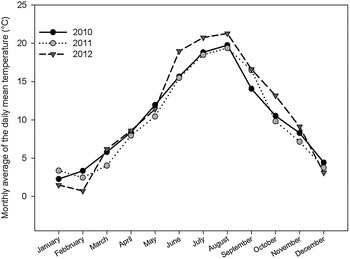
The total number of pupae collected during the study varied substantially, with more pupae occurring in 2010 and fewer pupae in 2012. In 2010, 12,662 pupae were collected from the study sites but only 3634 were healthy pupae and so were used in the study. In 2011 and 2012, 8358 and 5440 pupae were collected, respectively, although only 2018 and 646 pupae were undamaged, respectively. Processions started in March in 2010 and 2011, and in April in 2012, ending in April or May depending on the year, and ranged from 30 days in 2010 to 45 days in 2012. The timing of larval procession was related to temperature (late winter–early spring). In 2012, it was characterized by a lengthening of the period of processions to May, preceded by the lowest temperature during January and part of February over the study period (fig. 1).
Environmental temperature of the study area 2010–2012. Lower temperatures were recorded in January and February 2012 compared with the previous study years.

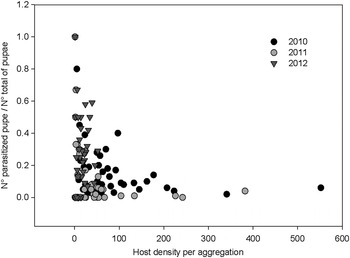
The relation between the size of pupal colonies and the rate of parasitism showed a decrease in individual colony size in 2012 correlated with an increased level of parasitism (fig. 2).
Relation between the size of pupae aggregation and the rate of parasitism. Inverse density-dependent parasitism was evident over different years. Equation fitting to data: y = yo + (a/x) + (b/x 2) + (c/x 3); Rsq = 0.263; F = 3.85; P < 0.001. The coefficients varied for each year of the study.

The rate of parasitism of pupae collected in 2010 was 20.9% (n = 1737 of total), amounting to 19.2% for V. brunnea and 1.70% for Ph. caudata. In 2011, the parasitism rate was 11.40% (n = 683 of total), with 8.8% for V. brunnea and 2.6% for Ph. caudata. In 2012, the overall parasitism rate was 77.6 % (V. brunnea 76.7%, Ph. caudata 0.90%). Only one specimen of C. rudis emerged in 2011 from one pupa collected in 2010 and specimens of C. pityocampa from six moth pupae collected in 2012.
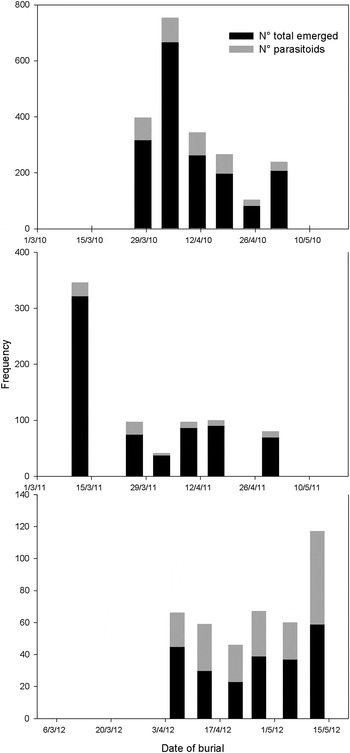
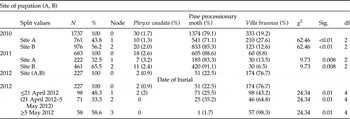
GLM analysis showed that parasitism differed for 2010 and 2011 between the two sites, while it was influenced by the date of burial in 2012 (table 1). No other variable considered (e.g., presence of a cocoon or pupal size) influenced the parasitism rate. The site with the highest level of parasitism was site A in 2010 and 2011 (table 2), being 28.9% versus 14.6% of site B in 2010, and 16.7% versus 8.9% of site B in 2011. No difference in the rate of parasitism was detected in across the two sites in 2012 (tables 1 and 2). In this year, the classification tree analysis highlighted that 64.8% of the pupae buried after April 21 and before May 5 were parasitized, whereas 98.3% of those buried after May 5 were parasitized (table 2). In general, for all dates of burial in 2012, there was a high percentage of parasitism (fig. 3).
Parasitoid abundance according to the burial date of PPM larvae.

GLM with binomial distribution results evaluating the effect of different variables on the parasitism of PPM cocoons 1 .

1 [2010, Akaike's information criterion (AIC) value 1733.40; 2011, AIC value 476.74; 2012, AIC value 240.28]. The likelihood ratio of χ2 was 59.044 for 2010, and 20.36 and 16.61 (df = 5; P < 0.001) for 2011 and 2012, respectively.
The classification accuracy and tree size of emerged adult species from PPM pupae in the study site (A, B), and in relation to the date of burial of larvae in 2012 1 .

1 The results were obtained by running a decision-tree algorithm tailored to the species-emerged data set (Growing Method: Chaid and Bonferroni adjusted). The independent variables (site of pupation and date of burial) that determined the use of the decision tree were those that emerged from GLM.
Parasitoid load and the dynamics of adult emergence
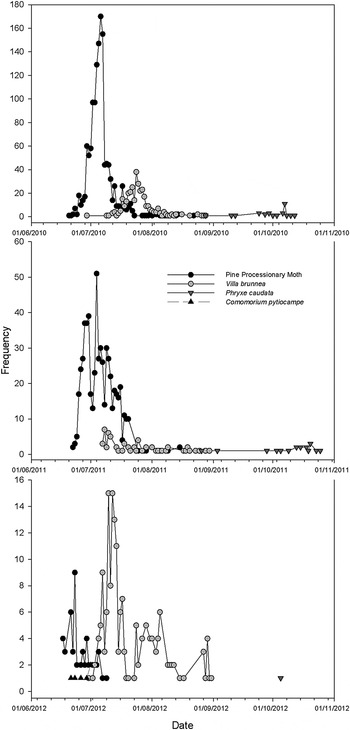
The complex of parasitoids includes Diptera (V. brunnea and Ph. caudata) and Hymenoptera (a few individuals of C. pityocampa and C. rudis). PPM adults and C. pytiocampa pupated first, followed by V. brunnea and Ph. caudata in October and November (fig. 4), whereas C. rudis emerged the following year in May. The appearance of parasitoids in the field before, during and after the formation of PPM cocoons reflects the different behaviors and development of these PPM parasitoids. In a similar experiment, Ph. caudata and V. brunnea were found to have longer diapauses, but occurred in very low numbers (Bonsignore et al., Reference Bonsignore, Manti, Castiglione and Vacante2011). At least four strains of Isaria fumosoroseus Wize (Cordycipitaceae; Hypocreales) were identified from pupae that showed signs of fungal mycelium (S. Rehner communication).
Timeline of pupal parasitoid and PPM adult emergence.

Discussion
In this study, we analyzed a host–parasitoid relation in a Mediterranean Pinus forest. The rate of parasitism recorded in the study was closely related to pupal density. The highest rate of parasitism occurred when the host density was low. PPM abundance could be related to other biotic and abiotic factors that might influence the mortality of other developmental stages of the moth. In the experiments that excluded parasitoids, considerable changes occurred in the autumnal moth Epirrita autumnata (Borkhausen) abundance (Klemola et al., Reference Klemola, Andersson, Ruohomaki and Klemola2010). In our study, data showed for PPM what has been reported for other forest lepidopterans, namely a time lag between the level of parasitism and the density of the moth (Tanhuanpää et al., Reference Tanhuanpää, Ruohomäki and Kaitaniemi2003; Klemola et al., Reference Klemola, Kapari and Klemola2008, Reference Klemola, Andersson, Ruohomaki and Klemola2010). The decline in the PPM population was related to an increase in parasitism with a delay of 2 years compared with the maximum density of the moth. In our study area, additional time-series of data will enable us to verify these findings or to determine further ecological relations. The termination of PPM outbreaks in the study area could not be explained only by parasitism of pupae or of other stages of PPM (Biliotti, Reference Biliotti1955; Schmidt et al., Reference Schmidt, Tanzen and Bellin1999). This is probably because our study primarily focused on the localized effect of parasitism on a small scale (Hagen et al., Reference Hagen, Jepsen, Schott and Ims2010; Schott et al., Reference Schott, Hagen, Ims and Yoccoz2010). The variability in the host–parasitoid dynamics was evident in the first 2 years of the study, where differences in the degree of parasitism occurred across the two sites. These differences were less obvious when the degree of parasitism was higher. It might be that the difference in parasitism was related to the sample area, given that Site A was smaller than Site B, and so parasitoids might have had greater success given the greater abundance of pupae in a smaller area. The area of a clearing favored by larvae in which to pupate might also affect parasitism by V. brunnea. The life cycle of this species includes a planidium stage, which actively searches for a host in which to pupate. If its hosts are spread over a wide geographical area (e.g., site B), then they will be harder to locate, thus resulting in lower levels of parasitism. The planidium stage can exceed 1 month, although they are unable to move further than 1 m from their hatching site (Du Merle, Reference Du Merle1979). Therefore, the heterogeneity of parasitism distribution could explain why the overall population density of hosts and parasitoids remained approximately constant for the first 2 years of our study. Worthy of consideration was the relation between the period of descent and burial processions and the rate of parasitism. The highest rates were present in the processions that were buried later during April and May. This might be because an enlarged cohort of emergent parasitoids at the beginning of a season would tend to suppress host numbers.
For each year of the study, parasitism was not pupal size dependent, although this is the case for the egg stage of PPM, where there is preferential parasitism of clutches of large-sized eggs (Pérez-Contreras & Soler, Reference Pérez-Contreras and Soler2004).
In our study sites, we have recorded the formation of pupae since 2008, enabling us to confirm the importance of such clearings in PPM population dynamics and in the parasitism of the resulting pupae. However, the results of these previous investigations (2008–2009) for the same area on parasitism cannot be compared with the current study because different monitoring protocols were used (Bonsignore et al., Reference Bonsignore, Manti, Castiglione and Vacante2011). Further investigations in the sample area will be necessary to evaluate the overall effect of parasitism on PPM population dynamics, and the influence of other animals, such as mammals and birds that prey on pupae and of pathogens (especially entomopathogenic fungi). The identification of clearly defined pupation sites will help to better define the relation between PPM and their parasitoids. These pupation sites within clearings in a forest have a central role in maintaining PPM population abundance, and perhaps have greater importance than the marginal areas of the forest, where the processions are usually observed.
Specialized enemies, such as parasitoids, can generate population cycles of herbivores (which are well known for some species, see Berryman, Reference Berryman1996; Turchin et al., Reference Turchin, Wood, Ellner, Kendall, Murdoch, Fischlin, Casas, McCauley and Briggs2003). Such studies have provided a framework in which it is thought that delayed density-dependent mortality resulting from specialized parasitism is a driver of regular cycles of lepidopteran defoliator populations, and could stimulate a dynamic feedback process with their host species. We found that PPM pupae were parasitized mainly by dipteran parasitoids, with V. brunnea and Ph. caudata being the most abundant. A more marginal role in PPM parasitism was found for C. rudis and C. pityocampa. The bombylid V. brunnea emerged almost simultaneously with adult PPMs. This is a solitary parasitoid species that, with V. quinquefasciata (Wiedemann. 1820) for the pine processionary (Biliotti et al., Reference Biliotti, Demolin and Du Merle1967; Du Merle, Reference Du Merle1979, Reference Du Merle1981) is a specialist parasitoid of PPM. V. brunnea can emerge the year following parasitization, which suggests that it has a prolonged diapause (Du Merle, Reference Du Merle1969; Bonsignore et al., Reference Bonsignore, Manti, Castiglione and Vacante2011). The second most abundant parasitoid species was Ph. caudate, which emerged during the season after V. brunnea (fig. 3) and was collected in each year of the survey. The species also parasitizes Traumatocampa ispartaensis in cedar forests (Avci & Kara, Reference Avci and Kara2002). Other species in the same genus as Ph. vulgaris (Fallen) are known parasitoids of other Lepidoptera and some species of Phryxe are highly polyphagous (Elzinga et al., Reference Elzinga, Zwakhals, Harvey and Biere2007). It is thought that Ph. caudata can also have a prolonged diapause (Bonsignore et al., Reference Bonsignore, Manti, Castiglione and Vacante2011). Phryxe species deposit their eggs on the outside of the host. After hatching shortly after, the larvae then perforate the larval cuticle and burrow into the host. C. pytiocampa is a gregarius, primary endoparasitoid of pupae of T. pytiocampa. The species was the first to emerge simultaneously with adult PPMs and, given the low abundance of this species, it is likely to have only a marginal role in managing the PPM population. However, because of its early emergence in the field, it is possible that the impact of parasitism by C. pytiocampa has been underestimated. The species was recorded for T. pytiocampa and was reared from PPM pupae in northern Italy (Battisti et al., Reference Battisti, Bernardi and Ghiraldo2000). Other species of Conomorium spp. are recognized parasitoids of Lepidoptera and include C. cunae and C. amplue for Hyphantria cunea (Drury, 1773), (Boriani, Reference Boriani1994; Zhong-Qi & Baur, Reference Zhong-Qi and Baur2004). Adult ichneumonid C. rudis were found to emerge 1 year after pupal parasitism, confirming results from similar studies reported elsewhere (Tarasco, Reference Tarasco1995; Bonsignore et al., Reference Bonsignore, Manti, Castiglione and Vacante2011). In the current study, C. rudis from pupae in 2010 emerged in May 2011, corroborating the presence of adults in the field during May and June (Tarasco, Reference Tarasco1995 for South Italy). C. rudis is a species-specific PPM parasitoid, similar to the ichneumonid Pimpla processioneae Ratzeburg, 1849 that is, a parasitoid specific to the oak processionary moth, T. processionea Linnaeus 1758 (Zwakhals, Reference Zwakhals2005). The low abundance of C. rudis could be the result of a generally small population in the study area. In previous studies in the same area, the species was also found at low densities (Bonsignore et al., Reference Bonsignore, Manti, Castiglione and Vacante2011).
It seems likely that the entomopathogenic fungi, I. fumosoroseus, could have an effect on PPM population dynamics, but more studies on this fungus in the soil are necessary. Studies carried out by Er et al. (Reference Er, Tunaz and Gökçe2007) in the laboratory demonstrated the pathogenicity of I. fumosoroseus, which appeared to be the most promising among the isolated fungi tested against PPM. The soil-borne filamentous fungus I. fumosoroseus is a common insect pathogen that has been isolated throughout the world (Jackson et al., Reference Jackson, McGuire, Lacey and Wraigtht1997; Gauthier et al., Reference Gauthier, Dalleau-Clouet, Fargues and Bon2007). For this species, light exposure is important in the production of conidia (Sanchez-Murillo et al., Reference Sanchez-Murillo, de la Torre-Martınez, Aguirre Linares and Estrella2004) and successful dissemination of the fungus in the environment requires the production of abundant reproductive structures, which only occur under high light conditions, which we have recorded in our study sites.
In our study, we found evidence of a PPM population decline in response to increased parasitism at the pupal stage. The effect of parasitoids on pupae during prolonged diapauses is unknown and it was not possible to determine whether pupae undergoing diapause act as a refuge for parasitoids (Ringel et al., Reference Ringel, Rees and Godfray1998).
Parasitoid dormancy for V. brunnea was reported in a previous study (Bonsignore et al., Reference Bonsignore, Manti, Castiglione and Vacante2011) but comparison of the rate of prolonged diapause of this species is necessary for further conclusions to be reached. A prolonged pupal diapause can prove adaptive in unpredictable environments, where the emergence of adults can occur over a longer period of time (Corley & Capurro, Reference Corley and Capurro2000). We found no evidence for whether younger pupae were more susceptible to the action of parasitoids or to autoparasitism compared with older pupae, as has been reported for hymenopteran parasitoids (Gerling & Rejouan, Reference Gerling and Rejouan2004).
Conclusion
This study investigated the role of parasitoids on PPM pupae and the interaction of parasitism with the external environment over a 3-year period. Dipteran parasitoids were found to have an important role in regulating the population density of PPM. Understanding this role could be a crucial step to understand the population dynamics of PPMs and for determining the optimum time for the targeted application of parasitoids to avoid outbreaks of this economically important pest. In the research done it was highlighted as the clearings could be a feature that favors the presence of the natural enemies against the caterpillars in the pine forest. These areas should be considered more carefully since they represents the fundamental points for the maintenance of PPM but also for its specific parasitoids.
Acknowledgements
We thank Liekele Sijstermans, Kees Zwakhals, Hannes Bauer and Stephen A. Rehner for identification of parasitoids and entomopathogenic fungi. This research was partially supported financially by the National Park of Aspromont (decision number 270 of the 07.09.2012 to C.P. Bonsignore).