1. Doha: the changing context
The world is emerging from a severe global economic crisis. Industrial production and trade, after falling by unprecedented amounts worldwide, bounced back substantially at the end of 2009 and early 2010. However, at the time of writing, economic activity is still below pre-crisis levels, and unemployment has reached double digits in many countries. Given the depth of the crisis and the continued need for restructuring in the global banking system, the recovery is expected to be relatively weak.Footnote 1
Maintaining an open trade regime and removing policies that impose negative spillovers on trading partners is an important part of the path for getting out of the crisis, in particular for developing countries. Given that a central focus of the Doha Development Agenda is to promote the trade prospects of developing nations, the WTO membership can collectively make an important direct contribution to supporting a more rapid exit from the crisis by concluding the Doha Round. Concluding Doha can help by: (i) reinforcing policy stability and reducing the probability that governments will resort to protectionism – of paramount importance to developing countries given their reliance on trade as a driver of growth and a key mechanism to exit the crisis;Footnote 2 (ii) assisting governments to reduce fiscal expenditures once economies recover by allowing them to credibly pre-commit to lowering agricultural subsidies – a significant expenditure item in many OECD countries; and (iii) bolstering confidence and the prospects for multilateral cooperation in other critical areas – such as aid for trade and the trade dimensions of climate change.
Skepticism about what Doha offers is based primarily on the limited extent to which proposals will reduce applied average levels of protection. As an assessment of the outcome of negotiations, this dimension is important but far too narrow – even when certain analyses project significant welfare or income gains from the likely liberalization that is implied by what is now on the table. The Doha round is first and foremost about creating greater security of market access, through the negotiation of rules of the game (e.g. prohibition of discrimination against foreign services) and policy disciplines (e.g., outlawing agricultural export subsidies and placing tighter limits on the level of permitted tariffs and production subsidies). The main outcome of a multilateral trade negotiation is not and has never been dramatic liberalization of access to markets. On the contrary: the primary deliverable of GATT/WTO trade rounds is policy bindings: a set of enforceable (and thus credible) commitments by governments that they will not raise protection/support for domestic industries above levels that they have often reduced unilaterally, and will not apply certain policies that are detrimental to trading partners.Footnote 3 As noted by Martin and Messerlin (Reference Martin and Messerlin2007), some two-thirds of tariff reductions between 1983 and 2003 were the result of unilateral decisions – what the GATT did was mostly to lock in these autonomous trade reforms.
The value of such commitments has been demonstrated in the global downturn that started in early 2008. The last time the world economy went through a global downturn, following the second oil price shock and the winding down of inflation at the end of the 1970s, large trading nations resorted fairly widely to protectionism, including in the form of ‘voluntary’ export restraints for cars and quantitative restrictions on trade in textiles and steel. NTBs came to apply to over one-third of all developing country exports in the early 1980s (Nogues et al., Reference Nogues, Olechowski and Winters1986), on top of average tariffs that were significantly higher than they are today. So far, significant reversals of policy have largely been avoided in the current downturn. Assessments reveal that a growing number of countries have put in place some protectionist measures, but that there has not been a large-scale increase in the level of discrimination against foreign suppliers of goods and services by major trading states (Evenett and Hoekman, 2009; Evenett, Reference Evenett2009b; WTO, 2009). Concluding Doha would strengthen, substantively and symbolically, the valuable role the WTO is already playing in restraining protectionism.
Regional trade agreements are only an imperfect substitute for a multilateral agreement. It is true that many countries frustrated by the slow progress of WTO negotiations are turning to bilateral or regional trade agreements, which are only weakly constrained by multilateral rules. It is also true that certain issues, such as the mutual recognition of standards or the liberalization of air transport, may be easier to deal with bilaterally or regionally. But issues of profound trade significance, such as agricultural subsidies, can only be negotiated multilaterally – no country would accept significant restraints in a narrow regional context without the assurance that other large countries were accepting similar disciplines. As important, it should be recognized that there are no preferential trade agreements between the large trading nations (with the exception of NAFTA): the political challenges of obtaining legislative approval of any such agreement may not be much less than that of passing a multilateral trade deal. Furthermore, even in a world where preferential agreements are assuming greater significance, multilateral trade rounds are needed to reduce the extent of discrimination against non-members of such arrangements – and each country is an outsider with respect to at least some economically significant preferential agreement.
Finally, there are potentially important systemic implications of not concluding Doha in the near future. First, there is the possibility of negative knock-on effects on the WTO's highly valued dispute settlement mechanism (e.g. greater recourse to unilateral retaliation; non-compliance with rulings). Second, there is likely delay and difficulty in dealing with new trade challenges, such as the possibility of resort to trade policies in the context of divergent responses to climate change, preferential government procurement in the context of economic stimulus programs, and new nationalistic export restrictions in the context of food and financial crises.
2. Revisiting what is on the table
Martin and Mattoo (Reference Martin and Mattoo2010) have summarized what was on the table in the Doha negotiations in July 2008 when talks broke down. What was on the table implied five key benefits:
• more secure market access in goods,
• some new market opening in agriculture and manufacturing,
• new or stronger disciplines to prevent negative policy spillovers,
• somewhat greater security of access in services,
• initiatives to expand exports of poor countries.
2.1 Reduced scope for protection
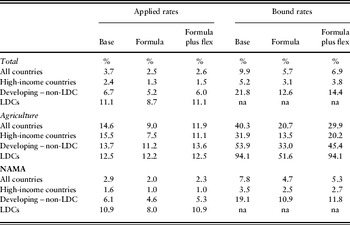
WTO members have offered to reduce significantly legally bound levels of protection in goods and services. These cuts in bound rates are valuable because they limit the scope for future restrictive measures. Proposals under discussion would reduce the world average bound tariff for agricultural products from 40% to 30% and that for non-agricultural goods from 8% to 5% (Table 1).
Weighted average applied and bound rates levied by WTO members

Note: Country groups defined using World Bank and UN definitions. Formula plus flex column allows for flexibilities for country groups such as the least developed countries (LDCs) or recently acceded members (RAMS) and for flexibilities for sensitive and special products using the political-economy weights developed in Jean et al. (Reference Jean, Laborde and Martin2010) and the data reported in Laborde et al. (2010b).
The tiered formula under discussion for liberalization in agriculture involves larger cuts in the higher tariffs, and would, if implemented without exceptions, cut average bound tariffs almost in half – from 40.3% to 20.7%. But exceptions for ‘sensitive’ and ‘special’ products reduce the tariff cuts and allow many higher tariffs to be subjected to smaller cuts. For most developing countries, bound rates would, on average, still be much higher than currently applied rates. For example, in agriculture the larger developing countries would still have a margin of about 30 percentage points (compared to the actual tariff of 13%) to deal with any unexpected consequences of liberalization; in manufacturing this margin would be 6.2%, slightly higher than the actual tariff.
Agricultural export subsidies in the industrial countries – a longstanding concern of developing countries – will be banned. This is important because it rules out the re-emergence of wasteful and price-depressing export subsidies in the future. The re-imposition of export subsidies in mid 2009 for dairy products by the EU and the US illustrates the relevance of a ban on export subsidies.
The proposed rules on domestic agricultural subsidies involve sharp reductions in maximum allowed levels of support – by 70% in the EU and 60% in the USA. New rules may not lead to significant cuts in actual subsidies which are at historically low levels because commodity prices remain at levels substantially above those prevailing in the late 1990s and early 2000s. But the rules are likely to constrain industrial country subsidies, especially for products such as cotton, peanuts, and sugar, which are of particular export importance for many developing countries.
2.2 Some new market opening
Today's legal tariff ceilings are in many cases much higher than applied levels of protection – so even drastic cuts in bound rates frequently result in only modest cuts in applied protection. There are, however, likely to be some real benefits for developing country exporters: the average farm tariffs they face would fall from 14.2% to 11.5%, and the tariffs on their exports of manufactures from 2.9% to 2.1%. Exporters of agricultural products from industrial countries would see the tariffs they face fall from 14.9% to 12.1%. Tariffs facing high-income country exporters of non-agricultural products would fall from 3% to 2.4%.
These cuts in average applied tariffs substantially understate what is on the table for highly protected products such as textiles and clothing, as the formula will bring down peak tariffs much more. The modalities would cut the highest tariffs the most. This is important from a welfare perspective as the social cost of protection rises with the square of the tariff. And it is important for many developing countries as tariff peaks are concentrated in products in which they have a comparative advantage, such as clothing, footwear, and agriculture.
2.3 New rules
A key, if underappreciated, function of the WTO is to offer a mechanism to countries to negotiate collective disciplines on policies that impose negative spillovers. Two important examples of the ‘public goods’ that the system provides are greater stability of prices in world food markets and enhanced environmental sustainability. In both cases, Doha promises some strengthening of the relevant rules.
World food markets
In addition to lowering somewhat applied average levels of protection and constraining the ability of government to raise barriers in the future, a Doha deal would also help address some of the factors that have contributed to severe volatility of food prices on world markets. Given the potentially large impact of changes in staple food prices for poverty (Ivanic and Martin, Reference Ivanic and Martin2008), policy makers in developing countries are deeply concerned about the sharp spikes in prices that are a feature of world markets for staple foods (Deaton and Laroque, Reference Deaton and Laroque1992). Trade policies in OECD countries in particular have helped to reduce the amount of food that is traded internationally, and have acted to stabilize domestic prices to the detriment of developing countries who are confronted with greater instability of world prices and the consequent adjustment burdens. The welfare costs of price volatility can be significant, as was illustrated during 2007–08, when world prices of key staples such as rice doubled. National efforts to insulate markets made matters worse at the global level. A trading system that disciplines the ability of governments to insulate domestic markets and hence make world markets thicker would be a major source of welfare gain for developing countries.
Significant progress was made on this issue in the Uruguay Round, with the introduction of a double penalty (through market access and domestic support disciplines) on protection provided under administered price arrangements, and a ban on variable import levies. These provisions resulted in a number of industrial countries reducing their use of high and inflexible administered prices that automatically required import barriers and/or export taxes to offset the effects of changes in world prices on domestic markets. Additional disciplines on price insulation associated with lower tariff bindings in the industrial countries under the Doha Development Agenda (DDA) proposals would further reduce the importance of industrial country policies as a source of instability in world food markets.
While Doha will usefully limit the scope for using import restrictions to insulate national markets, proposals have also been made to limit insulating action on the export front. These have not yet borne fruit. During the recent food crisis, many exporting countries imposed export restrictions and many importing countries lowered their import barriers in attempts to insulate themselves from the price spike. Unfortunately, these attempts to insulate national markets from the initial price increase substantially increased the magnitude of the resulting price spike. This illustrates a serious collective action problem that might potentially be addressed through actions to reduce the extent of price insulation, combined with measures to reduce other sources of instability, such as biofuel mandates,Footnote 4 and to ensure the availability of food for vulnerable consumers (Wright, Reference Wright2009).
Improving environmental sustainability
Trade policies can have adverse consequences on the environment. Agricultural support programs have led to the use of production methods that are excessively polluting, as have fossil fuel subsidies and policies to restrict imports of the most environmentally efficient biofuels. Subsidies have also encouraged the over-exploitation of natural resources. Doha can help limit the negative environmental externalities.
Over 75% of global fish stocks are underperforming – they are over-exploited or significantly depleted – resulting in an annual loss for the world economy of US$50 billion, equivalent to more than 60% of the landed value of the global catch (World Bank and FAO, 2009).Footnote 5 Many small island states and poor coastal regions in developing countries depend on fisheries for livelihood and food security. Taking action to reduce the losses from unsustainable exploitation of fish resources would benefit both developing country producers and consumers around the world.
The global welfare loss associated with over-fishing is the result of policy. Sharp and Sumaila (Reference Sharp and Sumaila2009) calculate that direct federal and state subsidies to US commercial fishing averaged $700 million annually (in 2007 dollars) in the 1996–2004 period, equivalent to 21% of the value of the commercial fish harvest during those years. Although some types of subsidies may encourage conservation of fishery stocks, Sharp and Sumaila estimate that at least three-fifths of all support went towards expansion of production, the largest being fuel subsidies and state sales tax exemptions. Subsidies in the EU are of the same order of magnitude as in the US, with the majority of subsidies having the effect of supporting production (e.g., subsidies for vessel construction and improvements of port and processing facilities) (Mulvad and Thurston, Reference Mulvad and Thurston2009). Overall, subsidies that enhance fishing capacity of developed countries were some $7.8 billion in 2000 (World Bank and FAO, 2009).
The Doha Ministerial Declaration called for negotiations to ‘clarify and improve WTO disciplines on fisheries subsidies, taking into account the importance of this sector to developing countries’. Although disciplines on the use of production-expanding subsidies must be complemented by improvements in the property rights to fish stocks – a matter that lies outside the purview of the WTO – phasing out fishery subsidies is an important part of the solution, and is one where the WTO can deliver. The draft text of a new WTO agreement on subsidies for fisheries put forward by the Chair of the Negotiating Group on Rules in July 2008 represented a major potential advance in terms of using the trading system to pursue both environmental and development objectives. It suggested prohibiting a wide range of subsidies while recognizing the need for flexibility in the application of subsidy disciplines to small-scale, labor-intensive fishing in developing countries. While many specifics remained to be agreed, this element of the DDA is an example of how ignoring the rule-making dimensions of the negotiations results in greatly underestimating the value of what is on the table.
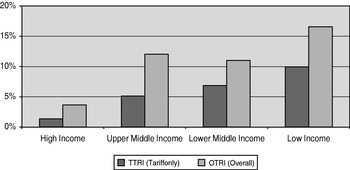
A similar observation applies to the negotiations aimed at reducing barriers to trade in environmental goods and services. Trade policy has a role to play in mitigating and adapting to global climate change by increasing incentives to use the most energy efficient environmental goods and services. Removing policies that restrain trade in energy efficient environmental goods and services – which tend to be the highest in developing countries (Figure 1) – and ensuring that production or consumption of products using inefficient technologies is not supported through subsidies can help both to harness the potential of trade to enhance sustainable growth and to improve environmental outcomes.
Environmental goods – tariff-only and overall trade restrictiveness

2.4 Somewhat enhanced security of access in services
Services are a puzzling aspect of Doha. In principle, the stakes are huge for the key protagonists. Some 80% of GDP in the US and the EU originates in services. Together they account for over 60% of world services exports. The business service exports of India, China, and Brazil have grown by well over 10% every year for the last decade, and India may soon export more services than goods. But in practice, negotiating attention has been focused mostly on agriculture and manufactured goods rather than on services.
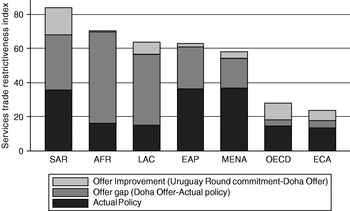
Most services liberalization around the world has been undertaken unilaterally. In all regions of the world, actual policy is substantially more liberal than the policy commitments (bindings) made by WTO members in the GATS during the Uruguay Round. The latter on average are 2.3 times more restrictive than currently applied policies – i.e., countries could more than double their average levels of restrictiveness without violating their commitments. As they stand today, Doha offers on services do not offer any liberalization of actual policy.Footnote 6 Furthermore, two of the currently most protected areas, transport and professional services, are either not being negotiated at all or not with any degree of seriousness.
Doha offers improve on GATS commitments, but at this stage the gap between offers and actual policy is still large: the best offers submitted so far improve on current GATS commitments by about 13%, but remain on average 1.9 times more restrictive than actual policies (Figure 2). There is a reasonable prospect that offers will be improved. A report on the status of the services negotiations noted that further discussion was needed on issues relating to participants' level of ambition, their willingness to bind existing and improved levels of market access and national treatment, as well as specific reference to Modes 1 and 4 with respect to the treatment of sectors and modes of supply of export interest to developing countries. In 2008, the chair of the Trade Negotiations Committee also held a ‘signaling exercise’ among a group of ministers, at the time that ‘modalities’ in agriculture and non-agricultural market access were being discussed. At the signaling exercise, participating ministers indicated that they might significantly improve their services offers.
Existing commitments, Doha offers and actual policy by region

2.5 Initiatives to expand exports of low-income countries
Key elements of the Doha Round from a development perspective are enhanced market access for LDCs, actions to facilitate trade (lower trade transactions costs), and the aid for trade initiative.
Better market access for least developed countries (LDCs)
The proposed ‘duty free and quota free’ (DFQF) initiative will improve existing access to foreign markets for the LDCs. But the initiative will add significantly to existing access only if industrial and more advanced developing countries do not exclude vital products such as garments or agricultural products. In most of the potential major markets that do not already offer 100% DFQF access, limiting such access to at least 97% of tariff lines – as called for in the 2005 Hong Kong ministerial declaration – implies that a large share of all exports may continue to be subjected to restrictions.Footnote 7 For example, in 2006, over 70% of Bangladesh's exports to the US were covered by some 70 tariff lines, which together accounted for less than 1% of all US tariff lines.Footnote 8 Only 39 tariff lines accounted for 76% of Cambodia's exports to the US. Nonetheless, Carrère and de Melo (Reference Carrère and De Melo2009) estimate that if the US were to apply DFQF access for 97% of lines, LDCs could expand exports by 10%, or $1 billion.Footnote 9
The utility of preferential access to LDCs depends significantly on the rules of origin that are applied by the importing jurisdiction. Experience has shown that liberal rules of origin – those that allow for cumulation and significant use of imported inputs sourced from third countries – are a critical determinant of a large export supply response by firms located in LDCs. Such rules are not on the negotiating table; they remain at the discretion of importing economies. Recent initiatives by the US and the EU demonstrate a willingness to address this constraint and offer an opportunity to make a specific commitment to the LDCs in this area.Footnote 10
Of particular importance for LDC exporters of cotton is that the complete removal of tariffs and quantitative restrictions on their exports be complemented by deeper cuts in trade distorting support programs maintained by high-income countries than for agricultural support more generally, and that this is implemented more expeditiously (Baffes, Reference Baffes2005). This is widely regarded as a litmus test for the Doha Development Agenda to live up to its name. Global support to the cotton industry, including direct subsidies, border protection, crop insurance subsidies, and minimum support price mechanisms have risen more than twofold from $2.7 billion in 2007/08 to an estimated $5.9 billion in 2008/09, more than half of which will be provided by the United States (International Cotton Advisory Council, 2009).Footnote 11 The recent increase in support again illustrates the value of commitments to bind (cap) permitted levels of support – lower levels of permitted subsidies and other forms of support would have constrained the ability of governments to increase assistance levels.
Trade facilitation
Trade facilitation is a critical dimension of leveraging the market access component of the DDA: if a focus on the trade costs agenda stimulated by a Doha agreement catalyzes a reform program in this area, it can have large positive trade effects. Pursuit of trade facilitation is particularly important for lower-income countries, especially LDCs, that otherwise may not benefit significantly from the Doha market access negotiations – because they have duty-free, quota-free access to major markets and will not be asked to reform their own trade policies. Negotiations on a trade facilitation agreement have been progressing well. An agreement offers great prospects for real income gains – indeed, as discussed below, analysis suggests that this is an area where the potential gains for developing countries are higher than what might emerge from any other part of the DDA. The reason is that domestic trade costs in many countries constitute a major tax on firms (Djankov et al., Reference Djankov, Freund and Pham2006). This agenda is of particular importance to landlocked developing countries, as their trade costs depend critically on the efficiency and cost of transit through neighboring states.
Aid for trade
For many low-income countries, the binding constraint to export growth is a lack of competitiveness. This makes it particularly important that DFQF access be associated with liberal rules of origin, to allow firms to use imported inputs from the lowest cost source of supply anywhere in the world. But more generally, what is now increasingly recognized is that competitiveness is a function of the domestic business environment in the exporting countries. This is the major driver behind the ‘aid for trade’ initiative, which is playing a valuable catalytic role in mobilizing trade-related assistance. Such aid has already increased – according to WTO/OECD figures and definitions, aid for trade grew by more than 10% in real terms in both 2006 and 2007, with total new commitments from bilateral and multilateral donors reaching US$ 25.4 billion, with an additional US$ 27.3 billion in non-concessional trade-related financing.Footnote 12 Realism suggests that aid budgets will come under increasing pressure as OECD governments seek to reduce expenditures following the fiscal expansion of the last 18 months. While aid for trade is not linked to the DDA, concluding the round could help translate the aid for trade commitments into additional resource transfers.
3. ‘Quantifying’ the value of Doha
Much of the discussion and debate about the ‘value’ of Doha has centered on the results of global modeling exercises. A serious problem with any effort to assess the value of what was on the table using empirical models is that these can only assess the implications of proposed agreements for applied levels of protection. Thus, they completely ignore the benefits of new policy disciplines and the effects of additional policy bindings. As a result, discussions of the value of the DDA that are based on numerical models will, by definition, be missing a big part of what is on the table.
Given this very important caveat, it is nonetheless useful to briefly discuss what empirical studies suggest will be the impact of what is on the table on average levels of applied protection in trade in merchandise. Recent analyses by Laborde et al. (Reference Laborde, Martin and van der Mensbrugghe2010a, 2010b) that incorporates new methodological advances that allow much more disaggregated trade data to be used in general equilibrium simulation models – some 5,100 tariff lines/product categories – suggest that overall global gains would be up to $160 billion for the agricultural and non-agricultural market access agreements alone, even after allowing for exceptions for sensitive and special products. Compared to recent models that use more aggregate data, the gains are about 65% higher for developed countries and some 100% higher for developing countries as a group. The reason disaggregation is important is that the analysis results in a better measure of the welfare effects of tariff peaks. As the welfare cost of protection goes up with the square of the tariff, using more aggregate data on the average level of the tariff for a broad group of products results in lower welfare cost estimates (because the average is by definition much lower than the peak tariffs that often apply to specific tariff lines).
Decreux and Fontagné (Reference Decreux and Fontagné2009) identify a US$57 billion world GDP gain as a result of implementing what was on the table in July 2008 in terms of liberalizing trade in merchandise, based on the modalities that had emerged and again including the likely exceptions and the differentiated nature of the commitments that will be made by different groups of countries. If the potential gains from trade facilitation are also considered, the gains would rise significantly – in their preferred scenario by another $99 billionFootnote 13 – giving a total gain associated with liberalization of merchandise trade of $150 billion per year in additional income for the world as a whole.
In another recent paper, Adler et al. (Reference Adler, Brunel, Hufbauer and Schott2009) use a different approach to quantify the market access impacts of what is on the table, relying on a partial equilibrium, tariff-line by tariff-line assessment of the trade, and tariff revenue effects of applying the July negotiating modalities to the trade of the 22 largest WTO members. Overall, they estimate that the associated increase in global exports would raise real GDP by some $99 billion annually for the countries in their sample (which account for about three quarters of world trade). Adding sectoral agreements to reduce tariffs on chemicals, environmental goods, and electronic and electrical goods beyond the formula cuts would roughly double this figure to $200 billion. A trade facilitation agreement is estimated to generate the largest trade and real income gains – some $385 billion. The implied reforms go well beyond what is being discussed in the negotiating group by including improvements in service-sector infrastructure and the domestic regulatory environment, though some improvement in these areas can be expected through the aid for trade initiative.
The model results illustrate that even if the focus is limited to reductions in applied levels of trade restrictions, taking into account likely exclusions for sensitive and special products, the associated trade expansion and real income gains are non-trivial – in the $60 to $160 billion range. They also illustrate that the non-market access parts of the DDA are very important. Quantifying these is extremely difficult, but the estimates of potential gains from improved trade facilitation illustrate that there is significant scope to generate more trade over and above what is on the table in narrow market terms, especially for many developing countries.Footnote 14
In good times all this may not have seemed worth enough…
Historically, the multilateral trade liberalization process has been driven by corporate interests, notably in the United States and Europe, seeking better and more secure access to foreign markets. But the DDA has suffered from a deficit of private sector interest, which trapped negotiations in a low-level equilibrium. Private sector disengagement can be explained by the recent years of steady trade and investment growth, with industrial countries maintaining open markets, apart from pockets of protection in agriculture, clothing, and labor services. At the same time, many developing countries have been unilaterally dismantling their trade barriers or doing so in the context of regional trade agreements. Since the early 1980s, most quantitative restrictions have been eliminated and tariffs have been lowered considerably. With this happening largely outside the WTO framework – with the exception of those countries that acceded to the WTO post-1995 – countries do not need to negotiate within the WTO to secure outcomes that their firms and people are obtaining without ‘cost’. Perhaps as important, the process of globalization may have come to be seen as irreversible, with a low perceived probability of re-imposition of higher barriers, thus resulting in serious discounting of the value of additional policy bindings and disciplines.
… but in bad times, the value of what is on the table increases
With a few notable exceptions, private sector apathy, as revealed by negotiating stances and positions taken by the business community pre-2008, contributed to the ‘equilibrium’ of limited demands being placed on the multilateral trading system and the system producing limited results. However, the global financial crisis has disturbed this equilibrium. The economic downturn and the resulting under-employment of resources have created new macroeconomic sources of protectionist pressure. Furthermore, as countries inject demand into the economy via fiscal stimuli, pressures arise to not let this demand ‘leak’ abroad.
To date there is little evidence that, where multilateral disciplines exist, there has been substantial recourse to protectionism (Messerlin, Reference Evenett, Hoekman and Cattaneo2009). For example, in a sector that in the 1970s and 1980s became a bastion of protectionism, textiles and apparel, the liberalization negotiated in the Uruguay Round (the abolition of the Multifibre Arrangement) has been implemented and is being sustained. For the most part, we have seen only low-grade protectionism through a range of measures not inconsistent with WTO rules: tariff increases up to bound limits, state aid (especially in the auto and financial sectors), and anti-dumping actions have assumed greater importance in industrial countries because of the increased role of the state and higher government expenditures. While the trade policy measures are often discriminatory and inconsistent with the letter (and spirit) of the G20 declarations in 2008 and 2009, they are relatively transparent and are constrained by multilateral rules. Indeed, instruments of administered or contingent protection are often described as ‘safety valves’ that need to be included in trade agreements in order to give governments the assurance that in times of need – as is the case today – they will be able to re-impose a certain level of protection if this is needed for political purposes. While the use of trade policy is second-best – fiscal and monetary policy is more effective and efficient – using instruments of contingent protection to manage pressures for restricting imports in specific sectors is typically superior to a government having recourse to non-tariff barriers (such as voluntary export restraints (VERs) in 1980s, which were outlawed as a result of the Uruguay Round). So far, the amount of imports targeted by antidumping and safeguards remains relatively small: less than one half of 1% of the total merchandise imports of G20 countries (Bown, Reference Bown, Evenett, Hoekman and Cattaneo2009a).
The cumulative number of new requests for protection through trade remedy instruments – antidumping, countervailing duties, and safeguards – in the first three quarters of 2009 was 30% higher than the number of such requests in the first three quarters of 2008 (Bown, Reference Bown, Evenett, Hoekman and Cattaneo2009b). However, the number of final measures imposed has not shown an upward spike to date and the share of investigations launched that result in the imposition of final measures has been declining in recent months relative to the average observed in earlier years. The latter can be explained by the existence of WTO rules and criteria, in particular the need to show injury caused by imports, which is much harder to do given that trade was falling in 2009.
Where multilateral disciplines do not exist or are currently weak and/or have limited coverage, countries have been less able to resist protectionist pressures. The recent reintroduction of export subsidies for dairy products by the EU and the US is illustrative.Footnote 15 The lack of multilateral disciplines on the movement of natural persons providing services implies that countries are free to unilaterally redefine the rules of the game and (re-)introduce barriers to the local employment of foreign service professionals. A number of countries did just that in 2008–09.Footnote 16 The absence of any disciplines in the WTO on measures that affect the export of services implies that source countries are free to take actions that have the effect of raising the costs and/or reducing the flow of financial services.
The temptation to discriminate against foreign suppliers in procurement will be strong if stimulus efforts are not coordinated and governments wish to reduce the spillover into import demand. The limited coverage of WTO disciplines on public purchasing (procurement) and subsidies mean that (certain levels of) governments may be free to require that stimulus funds be spent on domestic producers.
The general GATT national treatment rule does not apply to public procurement. Instead, non-discrimination disciplines apply through the plurilateral Agreement on Government Procurement (GPA). This binds only signatories – in practice mostly OECD members.Footnote 17 A number of examples of explicit discrimination can be found in the implementing regulations of the American Recovery and Reinvestment Act at the state and local levels (Evenett, 2009a). Similar provisions have been adopted in the Australian state of New South Wales and by China – neither of which is bound by the relevant WTO disciplines on procurement because neither Australia nor China has joined the GPA.
McKibbin and Stoeckel (Reference McKibbin and Stoeckel2009) examine the effects of a situation where most countries raise their protection in a beggar-thy-neighbor attempt to divert demand towards domestically produced goods. They find that the welfare costs of a protectionist tussle in which most countries raise their tariffs by between 5% and 10% have major, adverse impacts, with GDP falling by between 1% and 3% in most countries. The reductions in output are larger in countries such as China, which are relatively open, than in countries like the United States that rely less on trade. While tariffs divert demand towards domestic goods, raising tariffs increases the cost of capital goods and lowers investment demand, with the result that total output falls, rather than rises. Increasing protection is not just beggar-thy-neighbor, it beggars the country itself.
The pattern of policy responses to the crisis demonstrates the value of multilateral disciplines and suggests (re-)engaging in negotiations to strengthen such disciplines will have longer-term payoffs that go beyond whatever reductions in applied policies are agreed. Bouët and Laborde (Reference Bouët and Laborde2010) conduct an implausibly pessimistic but nonetheless salutary exercise. Using the highest applied or bound rate imposed by countries from 1995 to 2008 as an indicator, this study presents several scenarios regarding the economic costs of a failed Doha Round and a subsequent rush into protectionism. For example, in a scenario where the applied tariffs of major economies would go all the way up to currently bound tariff rates, world trade would decrease by 7.7% and world welfare by US$353 billion.Footnote 18 The plausibility of this extreme scenario arising is not very high, in part as the result of the increasingly globalized nature of production and value chains, which greatly reduce the incentive for firms to lobby for protection. However, the threat of greater pressure for protection should not be underestimated. As the recovery takes off in 2010–11 – generating greater trade in the process – high levels of unemployment imply that such pressures will persist for some time, increasing the value of additional multilateral disciplines for all exporters and consumers.
Resisting the protectionist temptation is not a matter of luck or chance. The crisis has revealed that rules matter: WTO disciplines have played a positive role in constraining recourse to protectionism. The monitoring of members' policies by the WTO secretariat and the Global Trade Alert initiative have been important instruments for transparency and accountability, but the impact of these initiatives would be greatly attenuated in the absence of WTO disciplines on the various trade-related policies. That said, concrete steps towards reinforcing the global trade system are needed. Rapid conclusion of the Doha Round will limit the ability of governments to increase tariffs or agricultural subsidies in the future, send a strong signal of the international community's commitment to keep trade and investment flowing, and help countries resist pressures for protection as unemployment rates rise and when they begin to unwind their current expansionary policies. The crisis has made more visible that the value of the DDA and the WTO more generally should be measured on the basis of a counterfactual in which governments are under pressure to raise levels of protection.
4. Contentious issues – should they prevent a deal?
Much has already been agreed in the Doha Round, most notably the structure of the modalities to be used to reduce tariff bindings for agricultural and non-agricultural tariff lines for different groups of WTO Members. There are three broad outstanding issues, all market access-related. First, there are significant differences in views regarding the implications of the creation of multilaterally sanctioned categories of ‘sensitive’ and ‘special’ products, and the design of a Special Safeguard Mechanism in agriculture. Second, there is divergence of views on the extent of actual liberalization commitments for manufactures, notably whether there should be a movement to free or freer trade in specific sectors. Third, attaining agreement on the scope and coverage of additional services policy commitments.Footnote 19
We argue in what follows that in all these areas Members need to determine how to best strike a balance between additional liberalization and security of access, i.e. how far to push for new market-opening rather than to be content with legally binding (locking-in) existing market access through tighter and more comprehensive bindings.
4.1 Agriculture: the SSM and product exceptions and exclusions
As was widely reported at the time, a proximate cause of the July 2008 breakdown was disagreement between countries on the specifics of a special safeguard mechanism (SSM) for agricultural imports. This became an issue in part because of the inclusion of flexibilities to designate certain products as ‘special’ or ‘sensitive’ and to exclude these from the application of the formula cuts. Given that as a result of these flexibilities the Doha modalities would not reduce global average agricultural tariff bindings below 45% in non-LDC developing countries, agricultural exporters argued there was no need for a new SSM. They also objected to the specifics of the SSM proposal, which would allow governments to raise tariffs on the basis of a mechanical rule, triggered by either an import price or quantity change.
The principle of safeguard mechanisms is firmly embedded in the WTO (and trade agreements more generally). Safeguards are a common element of trade agreements – the price of getting agreement on tariff bindings and other policy commitments. As noted above, the trade policy responses to the global recession largely took the form of instruments that are permitted by the WTO for governments to temporarily assist domestic import-competing industries. While the purported rationales for these instruments differ, the major ones all serve the same purpose: to provide a safety valve for protectionist pressure that is tied to import surges generated by external shocks or structural changes in the world economy. It is not only developing countries that insist on access to safeguards, OECD countries are regular users of antidumping, safeguards, and countervailing measures. Many WTO Members – developed and developing – insisted on being able to use special safeguards against China upon its accession to the WTO; and high-income countries negotiated the right to use a special safeguard (SSG) during the implementation of the Uruguay Round commitments to reduce agricultural support.
From an economic perspective, safeguards are second best instruments to deal with shocks or the adjustment pressure generated by greater import competition resulting from liberalization. However, the negotiated multilateral disciplines that apply to their use, such as an injury test or a link to prior liberalization, reduce the likelihood that such actions are used as a backdoor mechanism to undo negotiated liberalization while still allowing countries an escape valve. Embedding such mechanisms in the WTO also has the benefit of providing a basis for multilateral surveillance of the type that was a prominent feature of WTO activities in 2009 (i.e., monitoring of the policy responses to the financial crisis).
Getting a Doha deal done and reaping the gains from what is on the table is conditional on governments being able to demonstrate to constituencies that they have access to safeguard mechanisms if needed. However, the proposed SSM is different from traditional WTO safeguards in that it is purely mechanical, and not conditioned on a demonstration that imports have caused injury. In fact, the SSM is not as much a safeguard as one of the ingredients of a proposed deal that defines the product coverage of agricultural liberalization commitments, including the set of allowed exceptions for ‘sensitive’ and ‘special’ products. Analyses of the SSM proposal conclude that the suggested combination of price and quantity triggers to invoke the mechanism will in any event be unlikely to achieve the objective of food security (Finger, Reference Finger2010; Hufbauer and Adler, Reference Hufbauer and Adler2008).Footnote 20 Indeed, Finger (Reference Finger2010) shows that the proposed criteria would frequently permit protection when it is unlikely to be sought by policymakers – such as when imports ‘surge’ because of a harvest failure, or prices fall from very high to normal levels.
The specific criteria that are agreed as potential triggers for action do matter (Hertel et al., Reference Hertel, Martin and Leister2010), but the experience with safeguards of different types suggests that the key source of discipline on their use is domestic – countervailing pressure by groups that are negatively affected by higher trade barriers. This in turn suggests that what is most important in terms of multilateral disciplines is to ensure that instruments of contingent protection are not ‘mechanical’ or ‘automatic’, but require a judgment by policymakers regarding the net impact of taking action on the economy as a whole. This will be facilitated by all economic interests having the opportunity (legal standing) to be heard in the decision-making process whether or not to apply temporary protection to assist import-competing industries (Finger, Reference Finger, Hoekman, Mattoo and English2002).
4.2 Sectorals
A perception that the formulae-based market access negotiating modalities would not generate ‘enough’ actual liberalization of applied tariffs has generated a push for sectoral deals in specific sectors by some WTO members. What would be the implications of agreeing to sectorals?
For illustrative purposes what follows focuses on the case of the US. We compare a baseline scenario where all countries reduce bound tariffs by 40% and all tariffs are capped at 50% to one where tariffs are eliminated in six sectors where the US and other countries have indicated an interest from an exporting perspective – chemicals, electronics and electric equipment, forest products, jewelry, industrial machinery, and sport equipment. These sectors are identified in WTO (2008). Under the baseline scenario, US exports are projected to increase 2.2%. Under a zero-for-zero deal for the six sectors, the overall change in US exports is 4.2%. Free trade in these sectors would therefore increase US exports by an additional 2 percentage points.Footnote 21 The marginal impact of zero-for-zero deals in the six sectors would roughly double the increase in US exports compared to the Doha baseline used for comparison purposes. Adler et al. (Reference Adler, Brunel, Hufbauer and Schott2009) come to a similar conclusion: sectoral deals on chemicals, electronic and electrical products, and environmental goods would double the trade gains for their sample of 22 large countries.
These simulations suggest that sectoral agreements can be important in increasing the incentives of the relevant export industries to support multilateral trade negotiations. Zero-for-zero and sectoral agreements were a feature of the Uruguay Round. Examples of such agreements – under which subsets of (mostly) OECD countries agreed to eliminate tariffs, either immediately or following a transition path – included deals on agricultural, construction and medical equipment; beer; furniture; paper; pharmaceuticals; and toys (Mann and Liu, Reference Mann, Liu, Baldwin and Low2009). The most prominent example of a zero-for-zero deal that was incorporated into the WTO is the Ministerial Declaration on Trade in Information Technology Products, generally called the Information Technology Agreement (ITA), concluded in 1997 by 39 countries accounting for 90% of world trade in the products covered (Fliess and Sauvé, Reference Fliess and Sauvé1998). Signatories agreed to eliminate tariffs over a three-year period on a MFN (most favoured nation) basis.
A well-known feature of multilateral trade negotiations is that participants seek to limit free-riding by other countries. For example, internalization, defined by Finger (Reference Finger1974, Reference Finger, Amacher, Haberler and Willett1979) as the sum of all imports originating in countries with whom a country exchanges concessions as a percentage of total imports of goods on which concessions are made, was about 90% for the US in the Dillon (1960–1) and Kennedy (1964–7) Rounds. A sectoral agreement that is applied on a MFN basis is basically a mechanism to formalize a high level of ‘internalization’ among the largest traders in a given product.
The ITA is an example of a critical mass agreement, as are the agreements on finance and basic telecoms concluded in 1997 after the end of the Uruguay Round negotiations. The Uruguay Round experience – and the general feature of GATT/WTO negotiations that an internalization ratio of some 90% is required by participants no matter whether the focus is on a small group setting or all members – suggests that the closure of the Doha Round need not be made conditional on agreement on specific sectoral agreements. Instead, efforts to conclude such agreements can proceed after concluding the Doha Round. Thus, harvesting what is already on the table can be accompanied by an agreement among the major traders to commence (continue) sectoral negotiations after the entry into force of a Doha deal. As argued by Gallagher and Stoler (Reference Gallagher and Stoler2009), Harbinson (Reference Harbinson2009), and Abbott (Reference Abbott2009) among others, an explicit shift towards ‘critical mass’ negotiations that aim at agreements that are applied on a MFN basis would move the WTO back towards a negotiating modality that has a proven track record of success. Such a shift is conditional upon conclusion of the Doha talks, which are premised on the principle that negotiations are a single undertaking.Footnote 22
4.3 Services
Services have to date not been an area of disagreement and impasse. However, they are an area where opportunities for enhancing national and global welfare have only begun to be tapped and where much could be achieved in the DDA. They also constitute a part of the Doha Round that is of interest to a large number of major industries – recall that in OECD countries services account for 70% or more of total employment and value added.
Despite significant unilateral liberalization, most countries have so far been wary of engaging in multilateral negotiations on services. For one, it is difficult to make the deep legislative and regulatory changes needed to open services markets in the context of international trade negotiations. More importantly, scope for reciprocity within services has been drastically curtailed by the unwillingness of industrial countries to consider greater openness where developing countries have a comparative advantage – notably in the supply of services through the temporary movement of persons. As noted earlier, the wedge between the reality of present-day regulatory regimes and the level of bound commitments in the GATS often remains large. There is therefore considerable scope for improving commitments to lock in prevailing levels of openness – that is, significantly reducing the ‘water’ that is implied by current GATS commitments.
Rather than taking the view that the multilateral system is not very effective in delivering real opening of services markets worldwide and giving up on the WTO – which appears to be the position of many service sector firms (Hoekman, Reference Hoekman2008) – industries should recognize that this is an area where the WTO can deliver a lot in terms of greater security of market access. It should also be recognized that the interests of some service providers are on the table in other negotiating groups and there are opportunities to complement agreements in other fora with additional commitments under the GATS. Trade logistics is an example: efforts to improve trade facilitation-related regulation in the negotiations of trade facilitation can be leveraged by seeking greater locking in of existing levels of market access openness in the GATS. Substantially expanding services commitments is likely to be a pre-condition for concluding the DDA. It is also one area where greater ambition is feasible – what is implied is expansion of the coverage of the GATS to additional sectors and modes of supply, not further liberalization of applied policies.
5. The bird in hand: locking in existing openness
Instead of judging what is on the table in the DDA by the metric of the quantitative significance of new liberalization, it should be recognized that the WTO is primarily an institution that provides a mechanism for members to make policy commitments. This suggests that the aim should be as far as possible to bind the current level of openness in industry, agriculture, and services, and for industrial countries, current levels of subsidization in agriculture. As is always the case in multilateral trade rounds, countries are also seeking to negotiate limited exemptions and exceptions for certain products from the full application of the formula cuts, as well as the ability to re-impose protection under certain conditions. Even accounting for these flexibilities, there is a significant deal on the table – one that compares well with what was achieved in previous GATT/WTO rounds (Martin and Messerlin, Reference Martin and Messerlin2007).
For the round to live up to its name, any outcome should address demands by developing countries for significant reforms in key areas such as cotton. What is now on the table will do less than many developing countries would like to achieve. For example, the inability to agree on providing 100% duty-free, quota-free access implies that the market access gains for LDCs are less than they could have been. Deeper cuts in agricultural production support by rich countries would be better than the 60% to 70% reduction in permitted support that is now on the table. Disciplines on agricultural export restrictions would enhance the benefits for net food importing countries. While there are clearly important ‘gaps’ between what is desirable from a development perspective and what is feasible, an outcome that is largely centered on what is currently on the table would be a significant step forward for developing countries.Footnote 23
The recent crisis has demonstrated the value of reducing the scope for governments to raise levels of protection. As argued above, pressures to restrict imports are likely to continue to mount in the course of 2010, as a recovery in growth and associated trade flows will occur in an environment of high levels of unemployment in many countries. Similarly, the limits that will be imposed on agricultural subsidy programs have become more valuable as these will help governments in the efforts that are needed to reduce the deficits that have been generated as a result of fiscal stimuli programs. Since the major threats to the global economy come from actions by the large trading partners, it is these countries that must make deeper commitments to desist from protectionism. The G-20 has proven to be a natural forum for initiating commitments to refrain from beggar-thy-neighbor trade policy actions but the WTO provides the institutional infrastructure through which such commitments can be made enforceable.
Although in our view the primary benefits of the DDA will come from the reduction in policy uncertainty that is associated with greater binding of tariffs, subsidy ceilings, specific commitments in services, and rules, it is important to recognize that there will also be benefits in terms of improvements in market access. Despite the doubts we have expressed over the ability to accurately quantify the true benefits of Doha, it is important to note that even taking into account likely product exceptions and sensitivities, the modalities on the table will generate increased trade that in turn could produce an additional US$160 billion in real income for the world. This is significantly less than would be generated by a more ambitious Doha deal, but is nonetheless important, especially in the current economic context, as it would provide a boost to world demand during a period when many governments will be seeking to reduce fiscal stimulus measures.
Apart from the benefits of the DDA itself, an important reason for concluding the negotiations is to create space for multilateral cooperation on critical policy matters outside the current negotiating agenda.Footnote 24 Climate change is the most obvious example where there is an urgent need for governments to consider the implications for the trading system of concerted action to reduce carbon emissions and green house gas emissions. Other areas for negotiating rules of the game include public procurement, other non-tariff barriers including export restrictions, and subsidies, including investment incentives. The absence of international rules in these areas allows discrimination to be pursued with impunity. While many government policy responses to the crisis are presumably temporary, regulatory responses, subsidy programs, investment restrictions, and ‘buy national’ requirements could have enduring discriminatory effects if they result in emulation. For example, it is noteworthy that some of the countries that have ‘buy national’ policies are among those that have been most interested in seeing developing countries accede to the Agreement on Government Procurement. The signal that is being sent may have long-term negative consequences for the realization of this objective. Finally, closure on Doha could also help launch a deeper reflection on how services trade negotiations could be pursued more fruitfully, and whether broader regulatory cooperation – e.g. on prudential regulation in finance and pro-competitive regulation in transport and other network services – is a necessary underpinning for market access negotiations at the WTO.