Experimental
Lupin seed germination and greenhouse seedlings
Lupin seeds were scarified with a scalpel and wrapped in heavy paper treated with Captan 400-C fungicide (Bayer CropScience, Research Triangle Park, NC, USA) and then germinated for 4 d at 20°C in 100% humidity. The seedlings were planted into styrofoam flats (~7.5 cm deep) containing Sunshine® #5 soil mix (Sun Gro Horticulture Canada Ltd., Vancouver, BC, Canada). After 2–3 weeks of plant growth, all the seedlings were assayed for potyviruses by indirect enzyme-linked immunosorbent assay (ELISA) in four-plant pools. Individual plants from the tested-virus-positive pools were re-assayed. Individual infected plants were then destroyed if less than 10% of the accession population tested potyvirus positive. However, when greater than 10% of the plants in the accession population were infected, then the diseased plants were segregated from the healthy plants, and grown to maturity in the greenhouse. The collected seed was then denoted as ‘virus-infected’. All ‘virus-tested-free’ seedlings were transplanted into field plots, grown to maturity, and the seeds were collected.
Enzyme-linked immunosorbent assay
Indirect ELISA assays for potyvirus group detection were conducted with reagents from Agdia Inc. (Elkhart, IN, USA) as directed with minor modifications. Briefly, 1 cm square leaf tissue from each of four seedlings and 3 ml sample extraction buffer were homogenized in a Brickman Polytron, and 100 μl of the homogenate was added to a well in a 96-well microtitre plate. After 1 h incubation, and three washes in phosphate buffered saline solution with the detergent Tween 20 (PBST buffer), 100 μl diluted (1:200) monoclonal antibody was added to each well, and held at 4°C for 20 h. The antibody was aspirated from the wells, and rinsed three times in wash buffer. Anti-mouse IgG alkaline phosphatase conjugate was diluted in IgG conjugate buffer (1:1000), and 100 μl was added to each well. The plate was incubated at room temperature for 1.5 h, and again washed three times in buffer. A 100 μl solution of p-nitrophenyl phosphate was added to each well, and allowed to turn colour for at least one h. The product of the enzymatic reaction was quantified by measurement at 405 in an Anthros Labtec microplate reader (Eugendorf, Austria).
Discussion
Lupins provide a variety of uses for agriculture and restoration/remediation sites. The genus Lupinus (Fabaceae) includes over 165 annual and perennial species which are distributed around the world from tropical to arctic climates and from sea level to alpine elevations (Gladstone et al., Reference Gladstone, Atkins and Hamblin1998).
Lupin seed acquisition, maintenance and distribution are the responsibility of the United States Department of Agriculture, Agricultural Research Service, Western Region Plant Introduction Station, at Pullman, Washington (a subset of the National Plant Germplasm System; available online only at www.ars-grin.gov/npgs). On site for distribution and maintenance are 76 lupin species of 1301 accessions. One of the most important aspects of the program is to have sufficient quantities of healthy and genetically diverse seed accessions available for research scientists (Hampton, Reference Hampton1983). Lupins are particularly susceptible to a number of viruses, which may adversely affect seed quality and production during seed regenerations. The first comprehensive review of destructive virus diseases of lupin included two aphid transmitted potyviruses, Bean yellow mosaic virus (BYMV) and Clover yellow vein virus (CYVV), of which BYMV is seed-borne, and not CYVV, in lupins (Jones and McLean, Reference Jones and McLean1989).
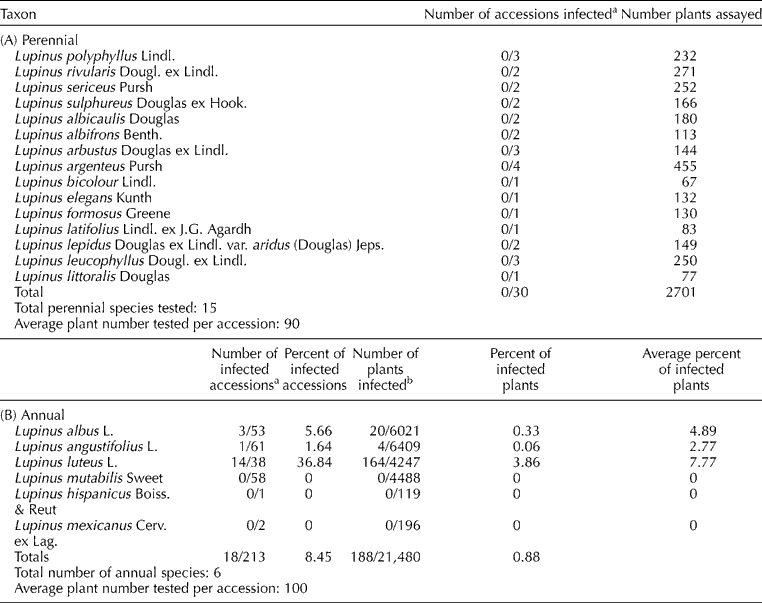
Between 2002 and 2005, 15 perennial lupin species from 30 accessions did not test positive for potyviruses (Table 1(A)). The seed originated from the USA, Spain, and Mexico. In contrast, three out of six of the annual lupin species had 18 accessions with a total of 118 plants infected with potyvirus. Potyvirus-infected plants occurred in three accessions of Lupinus albus from Bulgaria, France and The Netherlands, and, one Lupinus angustifolius accession from Belarus. Lupinus luteus L. contained the most infected accessions, originating from the former Soviet Union, Germany, Morocco, The Netherlands, Poland, Spain and Yugoslavia (Table 1(B)). BYMV was isolated and identified from L. luteus tissue of potyvirus ELISA tested-positive accessions in 2005 and 2008 (Robertson, unpublished data). Historically, the first lupin species identified with BYMV was L. luteus in Germany (Merkel, Reference Merkel1929). By 1955, BYMV had been confirmed in L. luteus, L. albus and L. angustifolius from south eastern United States (Decker, Reference Decker1950; Weimer, Reference Weimer1950; Corbett, Reference Corbett1958). Naturally infected BYMV L. luteus seed lots may range from 3 to 5% (Jones and McLean, Reference Jones and McLean1989).
Greenhouse-germinated perennial (A) and annual (B) lupin accessions assayed for potyvirus by enzyme-linked immunosorbent assay using a monoclonal group-specific antibody

a Numerator = number of potyvirus-infected accessions, denominator = total number of accessions.
b Numerator = number of potyvirus-infected plants, denominator = total number of plants.
The reasons for the striking contrast between annual and perennial lupin potyvirus susceptibility are not known, but may be due to chance, genetic resistance in perennial lupin plants to potyvirus infection (undocumented), and a relatively low percentage of potyvirus seed-borne transmissions in perennial lupins.(undocumented). The majority of the lupin research involving viruses thus far has been focused on agroeconomical annual species, ignoring perennial species.
These results are the first report of the potyvirus status of Lupinus sp. ex situ germplasm. Further, the results reinforce the lupin virus prevention strategy of testing and rogueing ELISA-potyvirus-positive transplants in the greenhouse. Rogueing infected transplants will not only reduce the potential of secondary plant-to-plant spread by aphid vectors, but may also coincide with a risk of reduction in genetic diversity as found in rogueing virus-infected pea germplasm (Alconero et al., Reference Alconero, Weeden, Gongalves and Fox1985). However, as noted by Gillaspie et al. (Reference Gillaspie, Hopkins, Pinnow and Jordan1998), seed-borne virus must be considered in the acquisition and distribution of germplasm because the virus could also cause diseases in other leguminous crops.
Acknowledgements
We would like to thank Kathryn Brown, Michael Cashman, Gail Wright and Robert Yarbrough for their excellent technical assistance in the laboratory and greenhouse. This research was conducted with support from ARS Project Nos 5341-21 000-004-00D (NLR) and 5348-21 000-017-00D (CJC).