INTRODUCTION
The Chinese mitten crab Eriocheir sinensis H. Milne Edwards, Reference Milne Edwards1853 (Clark, Reference Clark2006) was introduced into northern Europe, being first recorded in Germany in 1912 (Panning, Reference Panning1939), and this species is now widespread and considered established from Finland to southern France, including England (Herborg et al., Reference Herborg, Rushton, Clare and Bentley2003; Panov, Reference Panov2006; Robbins et al., Reference Robbins, Sakari, Baluchi and Clark2006). This species is native to the Far East, where its range extends from Hong Kong (≈22°N) to the border with North Korea (≈40°N) (Hymanson et al., Reference Hymanson, Wang and Sasaki1999). Two factors are suggested as being the vectors of this introduction: through ballast water (Peters, Reference Peters, Peters, Panning and Schnakenbeck1933; Cohen & Carlton, Reference Cohen and Carlton1997) and through escapes or deliberate releases associated with maritime transport. The Chinese mitten crab is a catadromous species that returns to the sea to reproduce once or rarely twice during its lifetime (Peters, Reference Peters1938). The downstream migration of sexually mature crabs takes place from August to October in the rivers Elbe and Weser (Peters, Reference Peters, Peters, Panning and Schnakenbeck1933, Reference Peters1938) and from September to December in the river Thames (Robbins et al., Reference Robbins, Smith, Rainbow, Clark, von Vaupel Klein and Schram1998). After mating, the females migrate to higher estuarine salinities and release up to three batches of larvae in early spring (Peters, Reference Peters, Peters, Panning and Schnakenbeck1933). E. sinensis reaches sexual maturity at the age of 1–3 years in China (Jin et al., Reference Jin, Li and Xie2001) and 3–5 years in Europe (Schubert, Reference Schubert1938). Larval development consists of six pelagic stages (one prezoea and five zoea stages) lasting 90 days at 12°C (Anger, Reference Anger1991; Montu et al., Reference Montu, Anger and de Bakker1996), with juvenile crabs migrating upstream after settlement. During the upstream migration of juveniles from estuaries, mitten crabs can reach rivers, lakes and ponds as far as 1200 km from the coast (Peters, Reference Peters, Peters, Panning and Schnakenbeck1933).
MATERIALS AND METHODS
Study area
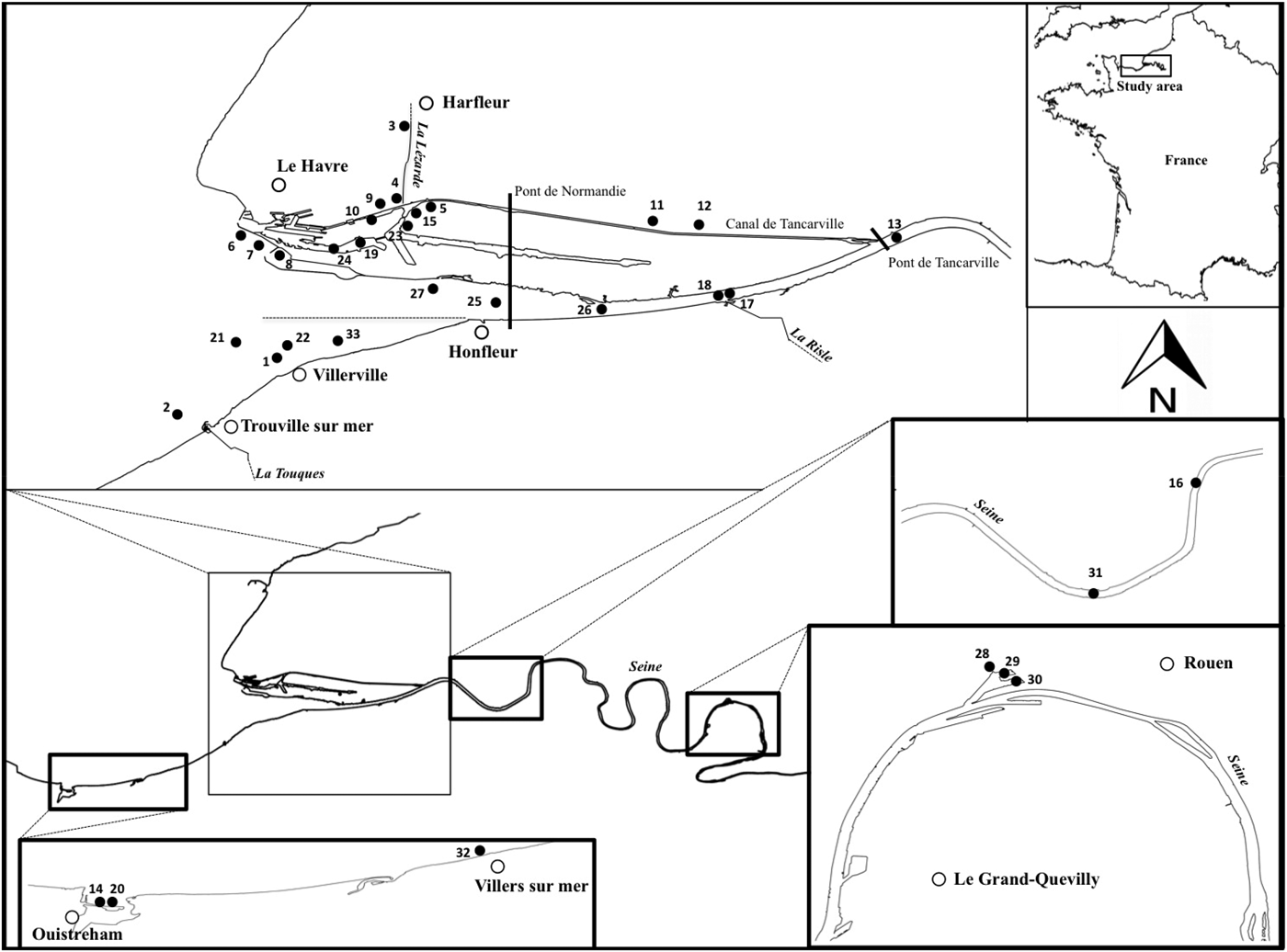
The study area corresponds to the eastern part of the Bay of Seine, and especially from the mouth of the Seine estuary to Rouen (120 km from the sea). Figure 1 presents a map showing the 33 locations in Normandy, including the three harbours (Le Havre, Rouen and Ouistreham), where the Chinese mitten crab Eriocheir sinensis was recorded from March 1943 to April 2014.
Distribution of Eriocheir sinensis in Normandy from information recorded between 8 March 1943 and 11 April 2014.

Sampling procedure
Observation of the Chinese mitten crab along the Normandy coast remains unpredictable due to its lifestyle. Captures can be made due to fishing activities (when Chinese mitten crabs are caught in nets), by diving on wrecks, by setting up traps in ports or by amateur fishermen.
In this paper, we present the data recorded by Thierry Vincent in his 1996 publication on the Bay of Seine as well as new observations acquired by this author after 1996. Data from 2013 and 2014 correspond to the observations of the present study.
RESULTS
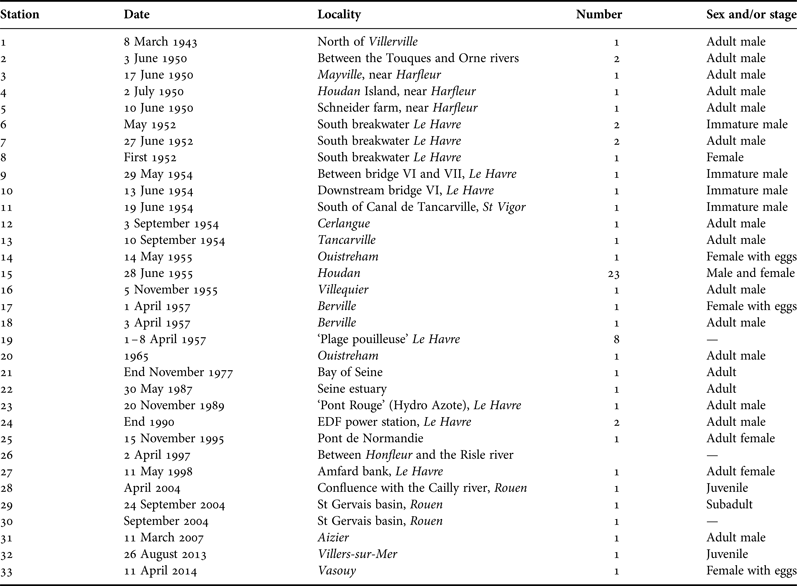
The locality and date of capture of the Chinese crab are summarized in Table 1. For each date, the number of individuals is listed along with sex and, if possible, the growth stage. From 1943 to 1998, observations of the Chinese crab focus on the Seine estuary and the port of Le Havre; only two supplementary observations concern the western part of the Seine estuary (Ouistreham). Before 1998, Eriocheir sinensis was never observed in the upper part of the Seine estuary farther upstream from Villequier. In 2004, three individuals were sampled in the Rouen harbour basins, probably indicating an upstream migration in the Seine. In 2013, the presence of a single 2.0 mm-sized juvenile in an intertidal mussel bed at Villers-sur-Mer (Figure 1) suggests that this site is a potential favourable habitat for larval settlement.
Reports of Eriocheir sinensis in Normandy: (a) station (number reported in Figure 1), (b) date of record, (c) locality of record, (d) number of individuals and (e) sex, stage of development and presence of eggs.
DISCUSSION
The Chinese mitten crab is a catadromous species, which, due to the lack of frequency of catches and the paucity of regular observations, may be considered as an occasional component of the estuarine marine fauna of the Bay of Seine and the Seine estuary. This species was observed in Normandy for the first time in 1943 (Hoestlandt, Reference Hoestlandt1943, Reference Hoestlandt1948) but other authors have indicated that the species has been found in Le Havre harbour since the 1930s (Breton & Vincent, Reference Breton and Vincent2002; Vincent & Noël, Reference Vincent and Noël2002; Breton, Reference Breton2005). In 70 years of records, only two ovigerous females have been observed, in May 1955 and in April 1957. The colonization of the Seine and its estuary can be regarded as being represented by isolated or erratic individuals (Vincent, Reference Vincent1996). The lack of ovigerous females prevents us from corroborating the sustainability of the species. However, during the summer of 2013, a juvenile specimen with a carapace width of 2.0 mm was sampled in the ‘Vaches Noires’ mussel bed near Villers-sur-Mer in Normandy. Additionally, in April 2014, an ovigerous female was observed at Vasouy in a fishing net. These two last observations demonstrate that Eriocheir sinensis reproduces and develops in the Bay of Seine area. The mussel beds offer a potential habitat for the settlement and development of crustacean larvae. This is the case for the Japanese invasive crab Hemigrapsus sanguineus, which is found at a density of 197 individuals per m2 when sized smaller than or equal to 5 mm, and also for the autochthonous crab Carcinus maenas showing a density of 338 individuals per m2 (Pezy & Dauvin, Reference Pezy and Dauvin2014). Supplementary summer sampling should be carried out in the future in the eastern part of the Bay of Seine to confirm these preliminary observations.
Along the French coast of the Channel, an E. sinensis female was discovered in August 2013 at Cap Hornu (Bay of Somme) (IFREMER Port en Bessin, Nicolas Goascoz personal communication), and individuals have been reported at Portel (May 2009) and Boulogne-sur-Mer (1930) (Dewarumez et al., Reference Dewarumez, Gevaert, Massé, Foveau and Grulois2011; Martin, Reference Martin2011). Occasional observations of E. sinensis have been made along the Opal coast in the rivers Canche, Liane, Wimereux and Slack (Nord-Pas-de-Calais) (Dewarumez et al., Reference Dewarumez, Gevaert, Massé, Foveau and Grulois2011). The Chinese mitten crab became established in the United Kingdom only in 1973, much later than elsewhere in Northern Europe (1912) (Herborg et al., Reference Herborg, Rushton, Clare and Bentley2005). The population distribution of this species has shown a large increase in the river Thames during the interval 1992–1996 (Herborg et al., Reference Herborg, Rushton, Clare and Bentley2005).
At the end of 2010, the French Ministry of Ecology launched a call for a scientific development project on marine ecosystems and depletion of the oceans, with the publication of scientific articles on non-native species (http://www.biotope.fr/projets/oceans/). This development project aims to spread information about non-native species such as the Chinese mitten crab, hoping to involve the general public as potential observers. A similar approach is also being adopted in the United Kingdom (see http://www.nonnativespecies.org/; www.mittencrabs.org.uk).
ACKNOWLEDGMENTS
The authors thank IFREMER ‘Port en Bessin’ for the Bay of Somme information and M.S.N. Carpenter for correcting the English grammar, syntax and style.