

INTRODUCTION
Crandall & Norenburg (Reference Crandall and Norenburg2001) compiled a checklist of nemerteans of the continental United States and of Alaska, Hawaii, and Puerto Rico and the Virgin Islands based on literature reports which comprises a total of 257 species with 108 of these occurring on the Atlantic coast. Of the Atlantic coast species, only 19 have been documented thus far from South Carolina (SC) with two others tentatively identified to genus only (see Fox & Ruppert, Reference Fox and Ruppert1985 for checklist). Here I report the discovery of the hoplonemertean Emplectonema gracile (Johnston, Reference Johnston1837) along the South Carolina coast, which represents the first documented record for this species on the Atlantic coast of North America. In addition I provide notes on its distribution as well as a description of features that will allow non-specialists to identify this species.
MATERIALS AND METHODS
Specimens of Emplectonema gracile were collected during low tides in November 2007, April, May and November 2010, and in May and July 2011 at Pawleys Island, SC, USA from two granite rock groins (Groin A: 33°24′38.2″N 79°07′54.0″W; Groin B: 33°24′43.6″N 79°07′50.5″W) oriented perpendicular to the shoreline and extending from the supralittoral zone into the Atlantic Ocean. The regions of the groins sampled are subjected to considerable wave energy at high tide but are completely above the low water mark during low tide when they receive no wave impact. To collect worms, mussels, oysters, fragments of concrete or barnacle (Megabalanus sp.) skeletons were removed from the granite rocks with a table knife during low tides, and worms were carefully transferred to zip-seal bags (1-l or 4-l volume) or sealable plastic containers (236-ml volume) partially filled with seawater. Specimens were transported to the laboratory and their identity confirmed using the descriptions of Bürger (Reference Bürger1895), Coe (Reference Coe1905), and Corrêa (Reference Corrêa1955). Worm dimensions were measured from digital images obtained from extended, crawling worms using Image J software (Abramoff et al., Reference Abramoff, Magalhães and Ram2004). Ocelli distribution and stylet morphology were documented with images obtained using a digital camera mounted on a Nikon E600W compound microscope. Voucher specimens have been deposited in the National Museum of Natural History in Washington DC, USA.
RESULTS AND DISCUSSION
The worms were found in the intertidal zone under mats of the scorched mussel Brachidontes exustus, associated with valves of the eastern oyster Crassostrea virginica, in crevices between granite rocks of the groin and an overlying concrete layer, and within the vacant skeletons of the non-indigenous barnacle Megabalanus sp. Other associated fauna include the barnacle Chthamalus fragilis, the isopod Sphaeroma quadridentatum and the nemertean Nemertopsis bivittata. Emplectonema gracile does not occur in large numbers at these localities and by far the dominant nemertean of the groin fouling community is Nemertopsis bivittata (personal observations).
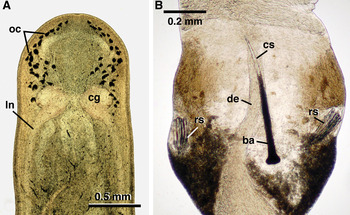
Under natural light, the dorsal side of these worms is green to olive-green punctuated with black streaks and blotches (Figures 1, 2A). Ventrally they are cream coloured to nearly white (Figure 1). The head is characterized by numerous ocelli (60–73, N = 4) forming two groups, a left and right antero-lateral row and a pair of cerebral aggregates (see Coe, Reference Coe1905) situated in the region of the dorsal cerebral ganglia (Figures 1, 2A). The cerebral clusters are not always clearly delimited from the anterolateral rows (Figures 1, 2A). One or more of these cerebral ocelli extend behind the ganglia in some individuals (Figure 1). Cerebral ganglia appear red when viewed under reflected light (Figure 1), and this colour is likely attributable to intracellular haemoglobin, which is not uncommon in nemertean neurons (see Vandergon & Riggs, Reference Vandergon and Riggs2008). These worms can be quite long, with one intact crawling worm measuring ~655 mm in length and 0.4–0.8 mm in width depending on the extent of muscle contraction. This specimen did not completely detach its posterior end from a shell fragment, so the length measurement is somewhat underestimated. Another individual was approximately 390 mm long and between 0.5 and 1.0 mm wide while crawling. These lengths are consistent with published ranges (see Bürger, Reference Bürger1895; Coe, Reference Coe1905). Individuals of E. gracile are typically observed coiled or knotted on substrata in the field and will typically assume this configuration in culture dishes (Figure 1). Both reproductive males and females were collected in May 2011.
Image of live Emplectonema gracile relaxed in MgCl2.

(A) Anterior end of Emplectonema gracile revealing ocelli (oc), cerebral ganglion (cg), and lateral nerve cord (ln); (B) stylet apparatus of Emplectonema gracile. ba, basis; cs, central stylet; de, ductus ejaculatorius; rs, reserve stylets.

The stylet apparatus consists of a nail-shaped basis bearing a curved stylet, which is one half the size or less of the basis, and a pair of reserve stylet sacs containing up to eight curved reserve stylets (Figure 2A). The curved stylet is a unique feature of this species. In other Emplectonema species the stylet is straight and attached to a bulb-shaped basis (Coe, Reference Coe1943; Corrêa, Reference Corrêa1961).
Emplectonema gracile has a relatively wide distribution being found previously on the northern European coast (Atlantic and North Sea), the coast of Madeira, the Mediterranean and Black Sea coasts, as well as along the Pacific coasts of Russia (Kamchatka Peninsula), Japan and North America (see Bürger, Reference Bürger1895; Coe, Reference Coe1905; Iwata, Reference Iwata1960; Gibson, Reference Gibson1995). After reporting the distribution of this species, Coe (Reference Coe1905) mentions that ‘the form has not yet been found anywhere on the east coast of America’.
Two other Emplectonema species have been recorded along the Atlantic coast of North America, the deep-water E. giganteum off the coast of Nova Scotia, Maine and Massachusetts (see Verrill, Reference Verrill1892; Coe, Reference Coe1943) and the fouling community inhabitant E. osceolai (Corrêa, Reference Corrêa1961), described only from Virginia Key, Miami, Florida. These species are easily distinguished from E. gracile by size, coloration, and differing stylet and stylet basis morphology.
Although the possibility that this species may have been previously overlooked in SC and elsewhere along the Atlantic coast of North America cannot be ruled out, it seems unlikely given the size of this species and its occurrence in the intertidal zone coupled with the extent of comprehensive faunal surveys inclusive of nemerteans conducted along the Atlantic coast (e.g. Verrill, Reference Verrill1873; Coe, Reference Coe1943; Corrêa, Reference Corrêa1961; McCaul, Reference McCaul1963; Fox & Ruppert, Reference Fox and Ruppert1985; Preznat et al., Reference Preznat, Toll, Rollins and Chapman2002). I have also qualitatively monitored the nemertean fauna of these groins periodically since the publication of a comprehensive checklist of marine macro-invertebrates of SC (Fox & Ruppert, Reference Fox and Ruppert1985) but did not discover E. gracile until 2007, suggesting that it is a recent introduction. Because individuals were present in 2007, 2010 and 2011, with reproductive individuals occurring in May, it is also reasonable to assume that a population is established at these localities in SC.
Multiple dispersal modes are possible for this species. There is a lecithotrophic pelagic larva (Delsman, Reference Delsman1915; Iwata, Reference Iwata1960) in its life history, but though the residence time of the larvae in the plankton is unknown, the larvae have been maintained for about 17 days in the laboratory (Iwata, Reference Iwata1960), suggesting that the larva could have moderate dispersal potential, depending on larval behaviour (see Shanks, Reference Shanks2009). However, the absence of expanses of suitable hard substrate along the South Atlantic Bight, which includes the region sampled here, could potentially limit successful dispersal of this species in this region. Because these worms are common members of the fouling community, juveniles and adults could be transported long distances by rafting on debris and on boat hulls (see Highsmith, Reference Highsmith1985; Thiel & Gutow Reference Thiel and Gutow2005a, Reference Thiel and Gutowb). The potential for long distance dispersal via boat from Europe or the Pacific coast of North America to the Atlantic coast of North America has existed for several centuries, and it is estimated that most non-endemic marine invertebrates in the South Atlantic Bight have been introduced from ship hulls or ballast water (Power et al., Reference Power, Mitchell, Walker, Posey, Alphen and Belcher2006). However, what accounts for the recent range expansion of E. gracile is unclear. Food availability would not seem to have been a distribution-limiting factor in the past, as this species is known to be a barnacle predator (see McDermott & Roe, Reference McDermott and Roe1985), and will feed on Chthamalus fragilis, the dominant barnacle on the groin rocks at Pawleys Island, SC (laboratory observations). Assuming that the potential for colonization from ships has long existed, this recent distribution shift could be related instead to a habitat disturbance that favoured colonization or simply the increased opportunity for introduction resulting from greater frequency of ship transport and shortened transit times (see Power et al., Reference Power, Mitchell, Walker, Posey, Alphen and Belcher2006). These worms could have been introduced as adults or juveniles or as larvae from ballast water. This range expansion of E. gracile is unlikely to be related to global climate change as this species thrives in both cooler waters of the Pacific, the north-eastern Atlantic, and North Sea as well as warmer Atlantic waters around Madeira and of the Mediterranean Sea.
The extent of the distribution of this worm in SC and along the east coast of North America will require additional surveys, and planned molecular phylogeographic analyses have the potential to reveal the source of the SC population.
ACKNOWLEDGEMENTS
I thank Serena Caplins for a critical review of the manuscript and observations on feeding. I also appreciate the input of two anonymous referees.