The social capital and health literature covers many disciplines: epidemiology, medicine, sociology, health care organization, political science, and economics. Economics can contribute to this group by offering an economic model but only if it connects with the theory and empirical work done by others. The present paper attempts to bridge the interdisciplinary work with economic modeling by adapting a well-developed economic theory to that purpose.
The interdisciplinary literature
This literature, most especially from epidemiology and political science, develops both empirical work and theoretical essays.
The empirical work
Following Putnam (Reference Putnam1995, Reference Robison, Schmid and Siles2000) most social capital and health empirical research defines social capital as a set of community characteristics, such as sociability, community-mindedness, community participation, trust in one's fellows, and belief that people are generally honest. The literature often measures these variables by sample surveys of the community. Although mixed evidence exists, the predominance of results finds a positive statistical association of social capital and health when health is measured positively, for example, by life expectancy or by self-reported health, or takes a negative relation when health is measured negatively, for example, by age-adjusted mortality rates. Within these studies, we find a variety of samples and econometric frameworks. Early studies featured correlation analyses (e.g. Weitzman and Chen, Reference Weitzman and Chen2004; Lynch et al., Reference Lynch2004; Putnam, Reference Putnam2000; and Kawachi, Reference Kawachi1999). But the most recent work tends to feature multivariate studies (e.g. Lindstrom, Reference Lindstrom2006; Kim et al., Reference Kim2006; Saegert and Winkel, Reference Saegert and Winkel2004; Kim and Kawachi, Reference Kim and Kawachi2006; and Subramaniam and Kawachi, Reference Silva2006). Recent research includes a few panel studies (Folland, Reference Folland2007; Poortinga, Reference Poortinga2006; Bolin et al., (Reference Andreoni2003); Kennelly et al., Reference Kennelly, O'Shea and Gavey2003). Together they represent a variety of samples from Australia, North America, and Europe, with a focus on either groups or individuals and with various time frames. The studies generally support the social capital and health hypothesis, though the issue of identification that economists take much more seriously is only beginning to be addressed. Durlauf (Reference Durlauf2002) has even questioned whether this latter task is practicable. Many obstacles must yet be overcome for economists to claim a model that is identified and describes a causal relation.
Interdisciplinary theory of social capital and health
It is likely that the excitement of the social capital and health hypothesis, as evidenced by the rapid growth of publications on the subject, derives from the hope that the relation is causal and that cost effective investment in this form of capital will prove possible. But the evidence so far lacks a convincing case for causality. Gains may be made by each step to remove impediments in our statistics that cause the estimates to be biased or otherwise that cause the true social capital effect to remain unidentified. Papers that employ instrumental variables to offset endogeneity problems in the social capital variables are steps in the right direction (Folland, Reference Folland2007; Rocco et al., Reference Rocco2006), though it has been suggested that natural experiments may prove to be a better method for this, that is to find situations where we can observe unambiguous changes in social capital along with any associated changes in health or health risky behaviors. Also, development of time series may eventually permit Granger causality estimation.
However, theory needs to support a claim of causality; it can offer an explanation, where the mechanisms themselves can be tested, and it can provide an understanding, provided that it is still based on the data. By refining our understanding of the avenues and mechanisms by which social capital affects health, we are more likely to discover empirical implications that are more persuasive of the hypothesis. In this Popperian view, we develop confidence in the hypothesis that survives increasingly challenging empirical tests. What theory do we have?
The interdisciplinary literature contains several theoretical ideas on how social capital may improve health. Among them, the following ideas are prominent:
1. Social capital reduces stress
Stress reduction, sometimes called buffering stress, may occur through sympathetic relationships, a trusting environment, or through the benefits of socializing. This is thought to work on physical as well as mental condition (Szreter and Woolcock, Reference Szreter and Woolcock2004; Kawachi and Berkman, Reference Kawachi and L.F.2001; Silva et al., Reference Silva2005; Cohen et al., Reference Cohen1997; Sapolsky, Reference Sapolsky1998).
2. Social capital provides information
A sociable milieu generates more opportunities for personal contacts. These may provide information on the effectiveness of health care or health behaviors. Durlauf and Fafchamps (Reference Durlauf and M.2004) describe social capital as one means to ameliorate the inefficiencies caused by imperfect information.
3. Social capital invites responsibilities to oneself and others
Participation in the community and with other personal contacts may generate a sense of responsibility not only to others but also of self-responsibility. For example, the arrival of children may be accompanied by the decision to take a less risky job (DeLiere and Levy, Reference DeLiere and H.2004), perhaps to quit smoking (Folland, 2006).
Of these three ideas, stress reduction and information are the most prominent in epidemiology and health care organization literature, the role of responsibility is an idea from economics. It may prove helpful to develop an economic model that incorporates these social capital and health ideas and connects them to a rich body of economic theory. That is the goal of this paper.
Defining social capital
Several definitions of social capital exist, and sometimes they clash. Researchers may insist that it is solely a group (or community) concept, while others define an individual social capital (Szreter and Woolcock, Reference Szreter and Woolcock2004; Durlauf and Fafchamps, Reference Durlauf2004). It would be wrong at this stage of research, especially given the remaining disagreements, to make any attempt to insist on one definition; in contrast, a proposed definition needs to attract its adherents. I will propose one here for consideration, and this definition will be applied in the remaining sections.
Two criteria might reasonably be preferred of a good definition of social capital. First, it is best that a definition have an identifiable physicality. In this view, social capital exists in identifiable people or things; in other words, one might prefer no metaphysics. Second, definitions should be able to incorporate the ‘social capital’ that is found in the interdisciplinary research.
An approach that fits these criteria is one that many researchers now apply by defining social capital as a network of relationships, the elements being formed of connections or bonds between pairs of people. These bonds, like a set of Legos, are able to form very complex relational structures; even more complexity is added by the reality of broadcast relationships, for example, such as happens with a public speech.
The approach is consistent with prominent depictions in both literatures. Glen Loury described social capital as ‘naturally occurring social relationships among persons’ (as quoted in Islam, Reference Islam2006: 4). Robert Putnam likewise described social capital as ‘connections among individuals in social networks and norms of reciprocity and trustworthiness that arise from them’ (Putnam, Reference Putnam2000: 19). Also, in agricultural economic literature, Robison and Flora (Reference Robison and Flora2003), Robisonet al. (Reference Robison, Schmid and Siles2002), and Robison and Hanson (Reference Robison and Hanson1995), described the person-to-person sympathetic bond as elemental of social capital.
A case can also be made that the domain of social capital should not be arbitrarily limited. Some would propose to limit the bonds that can be included by excluding family relations, yet family relations are well known to affect health very strongly (Cohen et al., Reference Cohen1997). And they plausibly affect health in the same way as do community ties: a well-functioning family will reduce stress, family is a source of information, and spouse and children invoke a sense of responsibilities to one's rewarding relationships. Putnam saw this when he said ‘…the family is the most fundamental form of social capital’ (1995: 65). It is also known that marriage and children lead people to reconsider health-risky behaviors (Folland, Reference Folland2006; DeLiere and Levy, Reference DeLiere and H.2004; Akerlof, Reference Akerlof1998).
Measuring the extent and characteristics of a social network is very difficult. Commonly, samples of opinion and behaviors are taken as a proxy measure. For example, a sample of persons in the community will be asked questions like the following: ‘Do you agree that most people can be trusted?’ ‘Do you agree that most people are honest?’ ‘How often do you entertain people in your home?’ or ‘How often do you attend club meetings?’ Means of such questions, or a weighted sum of such means, are taken as the measure of community social capital. This social capital is indirect, however it has the advantage of being easy to measure, and correlations of health with such measures are predominantly significant.
I propose an alternative, which, while more difficult to measure, is measurable in principle and may help to explain the social process underlying the survey approach. For this purpose, let social capital be

where social capital of person j is the sum of (inverse) demands for him among all the social bonds that he experiences. The individual is a public good in these relationships, his benefit to one does not diminish his benefit to another. For example, he can be a benefit to one of his children usually without diminishing his benefit to the other. In this simple conception, his friends and others in effect express his worth to them. His ‘reciprocity’ is better understood as an impure altruism (Andreoni, Reference Andreoni1990): he benefits in the process of benefiting them; he becomes a willing agent for the needs of these others. His continued presence to them requires that he remain healthy. There is no reason not to include the reflexive relation, he values himself. This conception, thus has a double service: (1) S measures the sum of his relationships weighted by their importance; and (2) S serves as a proxy for his own valuation of his life.
Social capital and health: complements or substitutes
The most succinct theory of the relation of social capital and health may be to adapt a similar model from Becker and Murphy (Reference Becker and K.M.2000), which they developed to explain a Veblenesque influence of the popularity of certain goods on the individual consumer's choices. A key assumption of the BM model is that ‘social capital’, the popularity of good y, is a complement of good y. The concept easily extends to the economics of social capital and health.
Let social capital be defined as in Section 2, so that S represents the network of relationships and their strengths. To the extent that increased positive bonds enhance one's sense of responsibility to self and to these relationships, an increase in social capital would reasonably enhance the benefit from becoming and staying healthy. Taken in this sense, social capital is naturally a complement to health. The person who enjoys entertaining friends in his home, would enjoy this more when he is healthy. The woman who serves as an officer in a club, will wish to be healthy so as to sustain that role. A new father may quit smoking.
While I believe this is the probable role for social capital, at least among adults, complementarity with health is not proposed as an assumption of the model. Nor is substitution merely assumed between social capital and health bads, such as cigarettes. It has been recognized in this literature that one's social group may mutually encourage negative, harmful behaviors. For example, it has been reported that teenagers may effectively encourage smoking by sharing cigarettes. Complementarity or substitutability is essentially and empirical issue. Yet in cases like cigarettes, when the bad behavior introduces a risk of death, social capital also plays a different and unambiguously positive role, as we will see shortly.
A simple model of social capital and health
Let the individual's utility function, U, be a function of social capital, S, a health good, H, and other goods, x. So that

Suppose as a first step that health can be purchased at a constant price, for example, H might represent an amalgam of health care and health behaviors. Further, let the other good, x, be purchased at a constant price, but treat it as the numeraire. Finally, let the individual's budget, B, constrain his expenditures so that  . Then the consumer's problem is

Solving this problem and then also deriving the effect of social capital on the health good, we get

The determinant |D| is positive by the conditions for a maximum. Increments to social capital will improve health if they are complements, but on the condition that the social capital effect on the marginal utility of good x (weighted by price) is not strong enough to offset this. These circumstances would imply that  provided that
 . While, in the case so far, the effect of social capital is assumed as to enhance the utility value of staying healthy, we must be mindful that cases may exist where social capital and health, to the contrary, may be substitutes for each other. Yet even where social capital and health are complements, we are reminded of the fact that social capital may also enhance the value of other goods. For example, the individual may join a club for antique collecting, this increases his social capital, but he may choose to spend a great deal on antiques and he may even draw down his spending on health to pay for the antiques.
Health goods, bads, and social capital as inputs in health production
The above results place the social capital and health hypothesis within the context of several possibilities. Yet the conception thus far lacks an explicit role for social capital in the production of health, and this role is needed to exemplify the stress buffering effect of social capital.
To introduce health production, let the production function be  where social capital, S, is as before, and let C represent another health input. We can get double duty out of C by conceiving it alternately as a health ‘good’, such as the Clinical visit, and at other times as a health ‘bad’, such as consumption of Cocaine or Cigarettes. Let the individual's choice problem be

In this formulation, we find the effect of social capital on the purchase of C as follows

As before, the determinant, |D|, is positive. Consider Equation (6) as if the C good were productive of health,  ; for example, let C represent checkups at a clinic. If health and social capital are complements in utility,
 , we now must consider as well their relationship in production, HCS, which in the same circumstance would reasonably be nonnegative. The center term,UCS, by intuition, is essentially zero in the case of checkups; checkups are unlikely to provide utility in themselves (though it is said that the elderly sometimes find them to be a positive social experience). With these conditions, demand for productive health goods would arguably increase in response to increments in social capital, but even so this is provided that complementarities with the other goods do not outweigh the health effects.
In contrast, let C represent a health bad, such as the ingestion of cocaine. Reconsidering Equation (6), we apply the new fact that HC < 0. Under the case where social capital and health were complements, a logical extension of the BM model is that C and S become substitutes in utility, that is UCS < 0. An example case would be where the reduction in stress provides greater ability to get along without the ingestion of drugs or cigarettes. The right-hand term within the brackets, however, has become perverse in this case. It suggests that the effect of social capital may be to partially offset or relieve the harm of the cocaine, i.e. HCS > 0, perversely inducing the consumer to purchase more cocaine. Aside from this, perhaps dismissible effect, the response of health bads is reasonably clear under the case being considered – social capital increments would be followed in sequential data by a reduction in the consumption of health bads. In this case of health bads, also note that the possible complementarity of social capital with other goods,  , reinforces the negative effect on the purchase of C, not detract from it.
Cigarette smoking as a risk-increasing choice
Risk of death, a common issue in health economics, can be introduced simply into this framework. To limit the added complexity, let cigarette consumption, C, be the sole input into health. And let the risk of death, ω, be an increasing function of cigarette consumption,  : The consumer's problem is to maximize

It follows that

By comparing with Equation (6), the introduction of death risk implies that the marginal utility of social capital, US, now enters directly into the decision to smoke. The simplest explanation here is probably correct, the individual takes fewer risks with his life because he has more to lose. Otherwise, the other terms imply that the direction of change in cigarette smoking is determined exactly as before, the smoker is more likely to quit following an increase in social capital.
Social capital as an influence that modifies one's risk/reward tradeoff
To illustrate the role of social capital in risk evaluation, let the expected utility function be

Here let the probability of death, ω, be a choice variable. Let the risk of death depend solely on cigarette consumption so that ω is also a sufficient representation of smoking, i.e. a choice of ω implies a choice of how much is smoked,  , and
 . Holding expected utility constant along an indifference curve, the tradeoff between risk and reward is the slope of the indifference curve between ω and x, i.e.

Differentiating the above by S yields

Notice that social capital and other goods are valued intrinsically, US > 0, and Ux > 0; that again let us emphasize the case where social capital is a complement with other goods,  and that smoking and social capital are substitutes,
 ; and note that smokers must find the pleasure of smoking to outweigh the risks of smoking, so that
 . Together these imply that Equation (11) is positive,
 . Thus, in this case, the increment to social capital will cause the individual to downgrade the value of the risky good relative to all other goods; added S implies that the slope of the indifference curve, i.e. indicated in Equation (10), becomes flatter; and the individual is willing to give up a greater amount of the risky pleasure of smoking to get more of all other goods. Flatter indifference curves imply that the associated risk of cigarette smoking is now deemed less worthwhile.
Empirical examples
This theory connects the conventional social-capital-and-health hypothesis with microeconomic theory, and in doing so it reveals several obstacles to the hypothesis. In the main, these are that for some people their social milieu may encourage harmful behaviors (e.g. smoking and social capital for them could be complements) and that social capital may alter demands for other goods and indirectly affect the demand for health bads. We must ask whether and how well the conventional social capital hypothesis works in practice. Two cases are presented here: (1) regressions of several risky behavior aggregates for a cross-section of states; and (2) individual smoking behaviors for people living in US cities.
Health risky behaviors across states
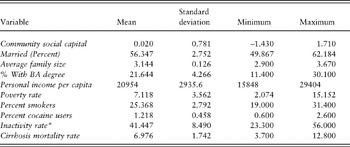
It is convenient to draw state data from 1994, because that is directly comparable with work by Putnam (Reference Putnam2000). The following tables were devised from data in Folland (Reference Folland2006). Table 1 presents the descriptive statistics for the variables in the regressions.
Descriptive statistics for the independent variables used in the state aggregate regression equations, 1994

Notes: These are the variable values for the 50 United States. Community Social Capital is the Putnam (2000) Index for 1994 aggregated at the US state level. The Inactivity Rate is assessed for people 65 or older. Cigarette and Cocaine date represent the percentage of people aged 26 years or older who smoke cigarettes or use cocaine.
The choice of variables to represent social capital may be understood more clearly by offering a characterization of what is found in the theory. Social capital increments add to self-valuation, whether by the enjoyment of the relationships or the sense of responsibility gained in the mutual relationships. The Community Social Capital indicators used here capture these benefits as occur outside family and close friends. It must be recognized that associations can prove negative or even harmful, but the common statistical findings suggest that these statistical associations are generally positive in net. Net positive relationships also make sense inasmuch as we tend to favor and seek out positive relationships. The variable, Married, is intended to connect family influences to social capital. Like its community counterpart, this influence can be harmful, but we would be ruling out substantive work in medicine as well as actuarial findings to conclude it to be predominantly so. Average Family Size is a proxy variable to measure the relative portion of statewide survey respondents who have children; it is calculated as the total number of youth divided by total marrieds.
The control variables – BA Percentage, Personal Income per Capita, and the Poverty Rate – each have plausible relations to health and each are common to health econometric studies. The baccalaureate rate, an education level measure, was developed in Grossman's (Reference Grossman1972) theory of health capital demand, which claimed that education enhanced the individual's ability to produce his own health. This view has been supported by unusually innovative research by Lleras-Muney (Reference Lleras-Muney2005). Income has a more mixed history, it is questioned in relation to health for developed countries, but clearly related to health for developing countries (see Deaton and Paxson, 2001; and Pritchett and Summers, Reference Pritchett and Summers1996). Income likely enhances one's ability to purchase either healthful products or health bads. Poverty is intimately related to social capital. It may impose barriers to communication between segments of society and thus lower social capital; yet, it may have direct effects on health (see Kawachi, Reference Kawachi1999 and Reference Kawachi1997). It is included to offset a possible masking effect of social capital.
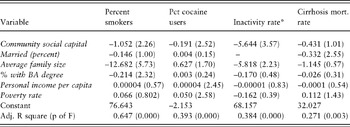
While a few examples cannot thoroughly test the hypothesis, the ordinary least squares equations in Table 2 illustrate and suggest that the social capital and health hypothesis is viable at this level. Putnam's community social capital index, especially, conforms to the hypothesis and is usually easily significant at the 5% level. Table 2 reports regression data predicting the consumption of several health bads in the US states in a 1994 cross-section of the states. Note that in addition to the effectiveness of Putnam's community social capital index in the two equations, the family variables also show effects, though more mixed. These data are presented for illustration, for a full discussion see Folland (2006).
Predicting health risky behaviors with social capital variables and controls, ordinary least squares for 1994

Notes: Community Social Capital in these data is represented by the original Putnam (2000) social capital index. t values are given in parentheses. The data, from Folland (2006), represent cross-section regressions on the 50 US states in 1994. *The Inactivity Rate is based on surveys of couples 65 years or older.
Since the states vary considerably in population, the Breusch–Pagan test for heteroscedasticity was applied in each case. The Critical Chi Square value at the 5% level is 11.07, while the LaGrangian multiplier values were 3.95, 0.35, 7.22, and 1.72 for the regression equations in order (Smokes, Cocaine, Inactivity rate, and Cirrhosis); thus, homoscedasticity could not be rejected in any of these cases. Extensive multicolinearity diagnostics for the independent variables seemed unnecessary because the Pearson correlations between them are very small. To illustrate, the Pearson correlation coefficients ranged from a high of 0.64 (Personal income per capita and BA percentage) and 0.57 (for Personal income per capita and Married percentage) to the correlations for the remaining pairs of variables, which ranged from 0.38 to 0.02 (in absolute value). Naturally, a few pairs of independent variables are related, as seen above, but in no case is the degree of correlation so extreme as to suggest multicolinearity. It should also be noted that most of the coefficient estimates are fairly robust in any case.
Individual smoking behavior
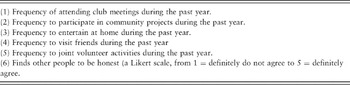
Data on individuals provides a closer look at the hypotheses. To construct a social capital data set on the health risky behavior of cigarette smoking, I merged the National Longitudinal Survey of Youth 79 with a dataset on marketing surveys of samples of people in SMSAs collected by the DDB marketing corporation in Chicago and covering the years from 1976 to 1998. The choice of DDB data has the side benefit in that it provides six of the social capital indicators used in Putnam's work. These also represent standard variables applied in social capital studies, as may be seen by examining their definitions in Table 3.
Items representing community social capital in this study

Notes: These six items were among the 14 used by Putnam (2000), and they are available in the DDB Marketing survey database, a web resident database. The DDB coverage samples over 200 cities and ranges from 1976 to 1998.
The social capital variables here have a similar relation to the theory as in the previous case. Community Social Capital will enhance the likelihood of forming bonds in the community and the types of indicators chosen suggest that these bonds will be positive influences on self-valuation. To this extent at least, the social capital favors a reduction in smoking, though some social groups in contrast may be found that encourage smoking. Married and GotMarried represent perhaps the most influential bonds in one's network. Has Children and First Born represent perhaps the best examples of how, in the theory, utility gains may come from one's direct pleasure from the bond and also from the sense of responsibility to some bonds. ‘Age’ plays an unusual role here. In these longitudinal data, all individuals are followed from the age, on average, of 17 years in 1979. Within these cohorts, there is an approximately seven-year range of ages. Since seven years can make a big difference when the cohort is young, Age, is used to remove any within-cohort age effects.
Each of the econometric equation estimates reported in Table 5 includes the six indicators, then the effect of social capital is tested by the Wald statistic where the six estimated coefficients are each which weighted by their respective indicator means. Family social capital is measured as a zero–one variable for Married (one if marital status indicates ‘married’ at a given year) and GotMarried (one if marital status changed from not married to married from beginning to end of the indicated time range); the variables for family social capital of children are Has Children (one if the individual has children in the home at the given year), and First Born (one if the individual's first child was born during the period). Table 4 presents the descriptive statistics on these variables.
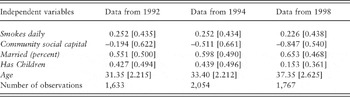
Descriptive statistics for the independent variables for the predictive equations on smoking behavior to follow, means with standard deviations in brackets

Notes: Community Social Capital is a Putnam style index created from the means of surveys of over 200 SMSAs in the United States, the questions inquired about sociability and community participation. Has Children indicates that the individual has his or her children living in the home, Smokes Daily indicates that the individual smokes more than one cigarette per day. Please note that for compactness in presenting these descriptive statistics standard deviations are highlighted by inserting them in brackets, and minimum and maximum values of the variables have been omitted.
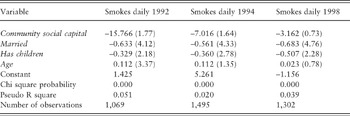
‘Smokes daily’ responds to social capital variables, logit regressions

Notes: Detailed variable definitions are provided in the text. The data base combines the NLSY79 with the marketing database of the firm DDB Inc of Chicago. The community social capital result is the Wald coefficient for the six indicators described in Table 3. Absolute values of the t statistic are given in parentheses.
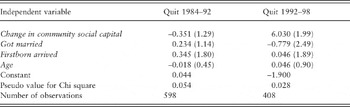
The remaining two tables, Table 5 and Table 6, explore the relation of social capital and smoking in two ways: first, in Table 5, logit is used to predict the likelihood of Smokes Daily as conditional on the three types of proposed social capital. Community Social Capital, Married, and Has Children each tend in effect to reduce smoking with the negative sign in each of the three data sets, and all but one are significant at the 5% level in a one tail test given that t values equal or exceed 1.645. Then in Table 6, logit regressions are used to test the association of the social capital variables with the decision to quit smoking. This quitting behavior may entail different precursors than for the probability of smoking, and note that the Quit Smoking samples are quite different from a case of first differencing. The equation for the 1992–98 period show changes in Community Social Capital and for First Born support the conventional hypothesis in that they enter with positive signs and are significant at the 5% level in a one tail test as demonstrated by t values greater than 1.645. (Though the quitting estimates are less precise than those for the smoking rates, and GotMarried incurs a negative sign counter to intuition.)
Characteristics of persons and their environment who quit smoking during the indicated period, logit regression.

Notes: Community Social Capital is a Putnam style index created from the means of surveys of SMSAs in the United States, SMSAs with at least 70 survey respondents are included in the data for this table. QuitSmoking is defined equal to one if the individual was a smoker at the beginning of the period and a nonsmoker at the end of it. GotMarried indicates a person who was single at the start of the period and married at the end of it. Firstborn Arrived is the arrival on the first child in the family during the interval between the listed dates. Absolute values of the t statistic are given in parentheses.
Discussion and conclusions
The paper has set out for discussion a definition of social capital and has applied this in a theory of social capital and health that employs economic concepts and models, yet attempts to capture the sense of the hypotheses that has been developed in the interdisciplinary literature. Social capital as conceived here is closely related to the concept of self-valuation of life in the health economics literature. The individual serves as a public good to many other people who value him. The existence of these interpersonal bonds provides utility, and the value of health is increased by them. When risk of death stems from a behavior such as smoking, social capital increments provide added incentive to quit the behavior.
The theory makes clear several cautions to overdrawn simplifications, yet it shows cases that appear reasonable where social capital enhances healthful behaviors. This was shown both for state aggregate regressions as well as for individual behaviors via the National Longitudinal Survey of Youth 79. While many obstacles remain for the study of social capital and health, the argument is made that a coherent economic model of the concept can be developed and given good albeit imperfect support from the empirical literature including the results provided here. These together suggest that social capital, as it applies to many health related behaviors, makes sense within the context of microeconomics.