Introduction
Emerald ash borer (EAB), Agrilus planipennis Fairmaire (Coleoptera: Buprestidae), is an invasive insect pest of ash (Fraxinus Linnaeus; Oleaceae) trees, introduced to North America from Asia (Haack et al. Reference Haack, Jendek, Liu, Marchant, Petrice and Poland2002). Since initial detection in Michigan, United States of America in 2002, this pest has been found in 24 other states and two Canadian provinces, killing tens of millions of ash trees and causing severe damage to forested ecosystems (Cappaert et al. Reference Cappaert, McCullough, Poland and Siegert2005; Poland and McCullough Reference Poland and McCullough2006; Herms and McCullough Reference Herms and McCullough2014; Bauer et al. Reference Bauer, Duan, Gould and Van Driesche2015). Most recently, Orlova-Bienkowskaja (Reference Orlova-Bienkowskaja2014) proposed that EAB infestations detected in the European region of Russia would likely expand throughout Europe. Early EAB eradication efforts in North America were unsuccessful, and chemical control is expensive and environmentally unacceptable in natural forests. Therefore, efforts to manage EAB now emphasise the use of classical biological control (Bauer et al. Reference Bauer, Liu, Miller and Gould2008, Reference Bauer, Duan, Gould and Van Driesche2015; Duan et al. Reference Duan, Ulyshen, Bauer, Gould and Van Driesche2010, Reference Duan, Bauer, Abell, Lelito and Van Driesche2013; Abell et al. Reference Abell, Bauer, Duan and Van Driesche2014). This well accepted, long-term, and sustainable approach to the management of invasive species, involves the introduction and establishment of co-evolved natural enemies from the native range of an invasive pest (Van Driesche et al. Reference Van Driesche, Hoddle and Center2008; Van Driesche Reference Van Driesche2014).
Following the invasion of North America by EAB, field surveys of EAB natural enemies were conducted in low to heavily infested ash stands in plantations, city parks, and in semi-natural rural and urban forests in the native range of EAB in northeast China, Russian Far East, and South Korea (Liu et al. Reference Liu, Bauer, Gao, Zhao, Petrice and Haack2003, Reference Liu, Bauer, Miller, Zhao, Gao and Song2007; Duan et al. Reference Duan, Yurchenko and Fuester2012c; Bauer et al. Reference Bauer, Duan and Gould2014, Reference Bauer, Duan, Gould and Van Driesche2015). These field surveys led to the discovery and description of several species of hymenopteran parasitoids: the egg parasitoid Oobius agrili Zhang and Huang (Hymenoptera: Encyrtidae) (Zhang et al. Reference Zhang, Huang, Zhao, Liu and Bauer2005), and the larval parasitoids: Spathius agrili Yang (Hymenoptera: Braconidae) (Liu et al. Reference Liu, Bauer, Gao, Zhao, Petrice and Haack2003; Yang et al. Reference Yang, Strazanac, Marsh, van Achterberg and Choui2005), Tetrastichus planipennisi Yang (Hymenoptera: Eulophidae) (Yang et al. Reference Yang, Strazanac, Yao and Wang2006), Sclerodermus pupariae Yang and Yao (Hymenoptera: Bethylidae) (Yang et al. Reference Yang, Wang, Yao, Gould and Cao2012) from China, and Spathius galinae Belokobylskij and Strazenac (Hymenoptera: Braconidae) from Russian Far East and South Korea (Belokobylskij et al. Reference Belokobylskij, Yurchenko, Strazanac, Zaldívar-Riverón and Mastro2012; Duan et al. Reference Duan, Yurchenko and Fuester2012c). Other hymenopteran parasitoids of Agrilus Curtis species known to attack EAB in Asia and Europe are summarised in Bauer et al. (Reference Bauer, Duan, Gould and Van Driesche2015).
In an effort to manage EAB in the United States of America, introductions of three parasitoid species from China, O. agrili, S. agrili, and T. planipennisi, began in Michigan in 2007 and subsequently expanded to other states (Federal Register 2007; Bauer et al. Reference Bauer, Liu, Miller and Gould2008, Reference Bauer, Duan and Gould2014, Reference Bauer, Duan, Gould and Van Driesche2015). By 2009, the introduced parasitoids were recovered at many of these early release sites, prompting the United States Department of Agriculture to initiate an EAB biocontrol programme and construct a parasitoid-rearing facility, leading to the expansion of EAB biocontrol to other EAB-infested regions of North America (Bauer et al. Reference Bauer, Duan, Gould and Van Driesche2015).
Researchers evaluating EAB population dynamics at long-term study sites in Michigan have discovered that only two species, O. agrili and T. planipennisi, have successfully established stable and increasing populations (Duan et al. Reference Duan, Bauer, Abell, Lelito and Van Driesche2013, Reference Duan, Abell, Bauer and Van Driesche2014; Abell et al. Reference Abell, Bauer, Duan and Van Driesche2014). Besides the introduced parasitoids attacking EAB in North America, the results of recent field studies have also revealed that some native parasitoids of wood-boring larvae, such as species of Atanycolus Förster (Hymenoptera: Braconidae) and Spathius Nees (Hymenoptera: Braconidae), have acquired EAB as a novel host (Cappaert and McCullough Reference Cappaert and McCullough2009, Reference Cappaert and McCullough2010; Duan et al. Reference Duan, Fuester, Wildonger, Taylor, Barth and Spichiger2009, Reference Duan, Ulyshen, Bauer, Gould and Van Driesche2010, Reference Duan, Taylor and Fuester2011, Reference Duan, Bauer, Abell and Van Driesche2012a; Marsh et al. Reference Marsh, Strazanac and Laurusonis2009; Taylor et al. Reference Taylor, Duan, Fuester, Hoddle and Van Driesche2012; Bauer et al. Reference Bauer, Duan and Gould2014, Reference Bauer, Duan, Gould and Van Driesche2015). However, these parasitoids are apparently opportunists, more specific to a niche than to host. Moreover, they are associated with high density EAB populations in some heavily infested areas and may not significantly suppress EAB populations at the leading edge of the invasion or in the aftermath forest where EAB densities are still low (Bauer et al. Reference Bauer, Duan and Gould2014, Reference Bauer, Duan, Gould and Van Driesche2015; Duan et al. Reference Duan, Abell, Bauer and Van Driesche2014). Woodpecker predation was also higher at sites with more dense EAB populations (Jennings et al. Reference Jennings, Gould, Vandenberg, Duan and Shrewsbury2013). Thus, co-evolved natural enemies associated with low pest densities in the native range of EAB may be more effective at suppressing the target population than generalist and opportunistic natural enemies that capitalise on pests during outbreaks.
Here we report on EAB natural enemy surveys conducted from 2008 to 2013 in EAB-infested ash stands in northeastern China where EAB densities were generally low in native ash trees (mainly Fraxinus mandshurica Ruprecht) or high in exotic ash trees, mainly F. velutina Torrey. Based on the results of our surveys, we assessed the relative abundance and rate of EAB stage-specific mortalities caused by different groups of natural enemies in relation to different host ash tree species, geographic regions, and seasonality in China.
Materials and methods
Study sites
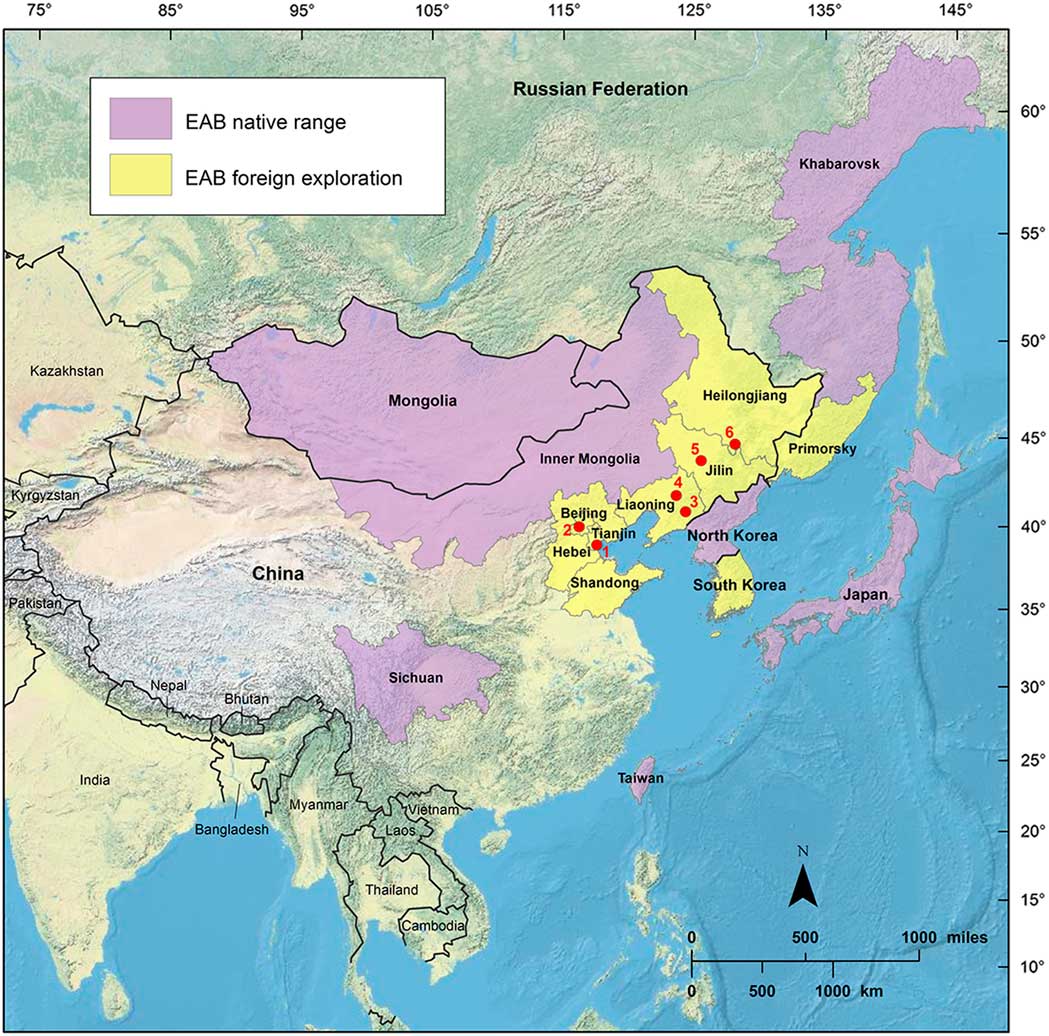
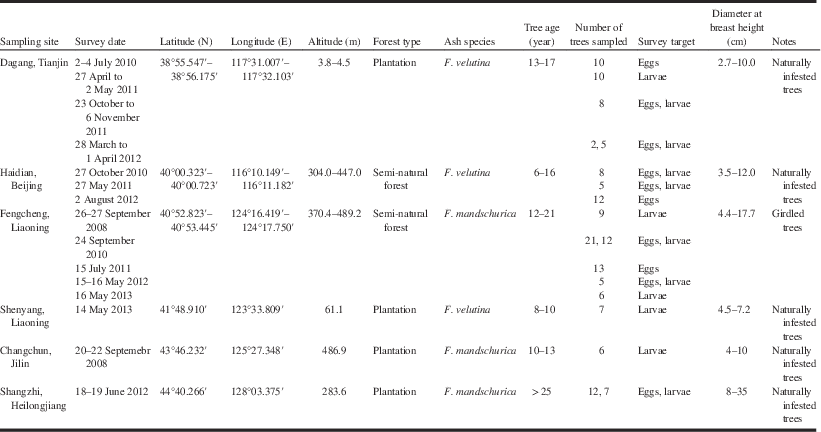
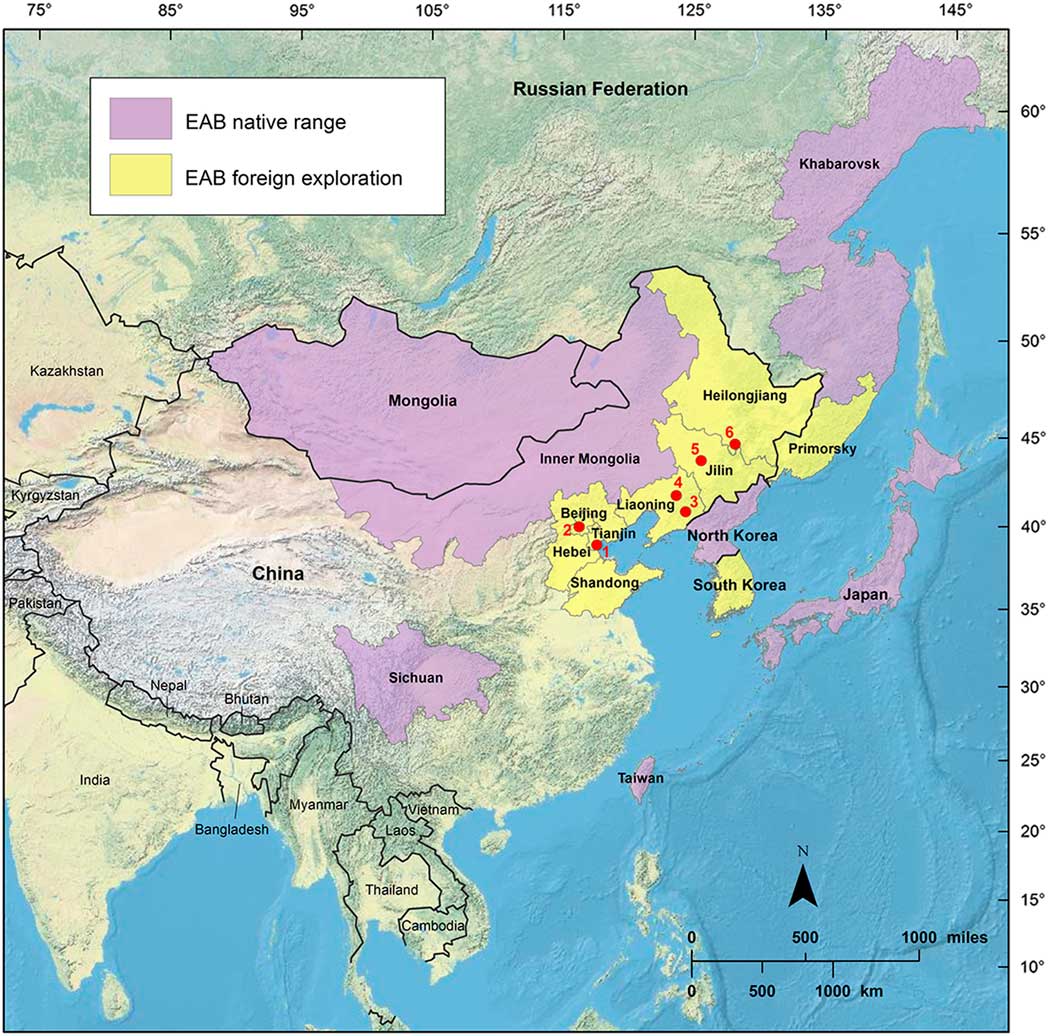
Field surveys were conducted in north and northeast China at six study sites in the two provincial cities of Beijing and Tianjin and in the provinces of Liaoning, Jilin, and Heilongjiang from 2008 to 2013 (Fig. 1, Table 1). Native F. mandshurica and exotic F. velutina trees growing in parks, semi-natural forests or monoculture plantations were sampled for EAB eggs and larvae. Because the EAB can develop in one or two years depending on climate, surveys of EAB larvae and associated mortality factors were conducted in either spring or autumn, or both seasons every year. Emerald ash borer eggs and associated natural enemies were also sampled in summer seasons. The life cycle of EAB varies with different study regions. For example, EAB is univoltine in Beijing and Tianjin, but a mixture of both univoltinism and semivoltinism occurs in Liaoning Province. In contrast, a majority of EAB populations exhibit semi-voltinism in Jilin and Heilongjiang provinces (Wei et al. Reference Wei, Wu, Reardon, Sun, Lu and Sun2007; Wang et al. Reference Wang, Yang, Gould, Zhang, Liu and Liu2010).
Sample locations in China. The native range of EAB in Asia as reported in the literature, and regions of Asia where EAB natural enemies were surveyed prior to this report. The red dots indicate EAB study sites surveyed for natural enemies from 2008 to 2013, with the numbers corresponding to the following locations: 1. Dagang, Tianjin; 2. Haidian, Beijing; 3. Fengcheng, Liaoning; 4. Shenyang, Liaoning; 5. Changchun, Jilin; 6. Shangzhi, Heilongjiang. Numbers on the top line of graph frame are east longitude degrees, while numbers on the right side are north latitude degrees. Service layer credits: United States National Park Service. Data source for the native range of EAB: https://sites.google.com/site/eduardjendek/world-distribution-of-agrilus-planipennis. Map created by United States Department of Agriculture, Forest Service, Northeastern Area State and Private Forestry, Office of Knowledge Management (Durham, New Hampshire, United States of America).
Survey sites and forest habitat description.
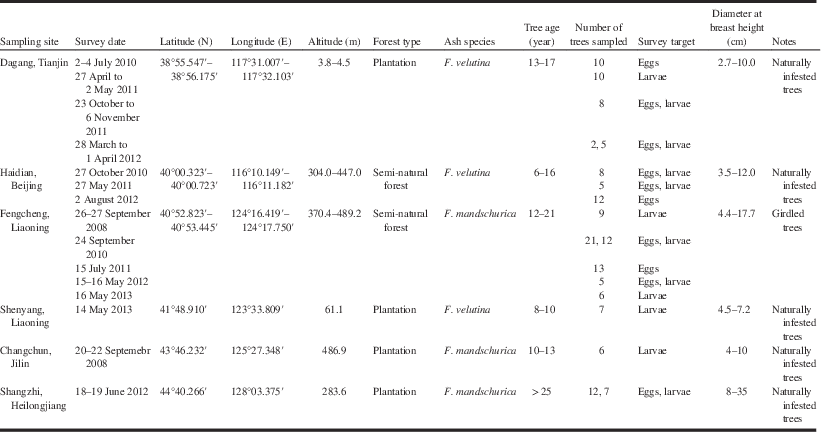
The ash species, sizes, and age, forest type as well as level of EAB infestations varied with study sites across different provinces or cities. In general, levels of EAB infestation on both F. velutina and F. mandschurica trees in either plantation or semi-natural forests were relatively low in Beijing, Liaoning, Jilin, and Heilongjiang provinces and no chemical control measures were undertaken against EAB there during the course of these surveys. At one of the study sites (Saima Township, Fengcheng) in Liaoning Province, EAB infestations on F. mandschurica trees in a semi-natural, managed forest, were rarely found. At this site, we girdled 10–15 F. mandshurica trees approximately 1.5 years prior to sampling EAB and its associated parasitoids every year during 2007–2012. In Tianjin, populations of EAB frequently reached outbreak levels in F. velutina plantations, where chemical control measures were undertaken once or twice a year against EAB, although trees in our sample stands were not treated.
Sampling: natural enemies associated with EAB eggs
For sampling eggs, sections of bark from two to 21 trees for each site, season, and year combination was removed from the main trunk within 2 m above the ground using a drawknife and returned to the laboratory for examination. In addition, the trunk of stressed ash trees within a 2-m section above the ground was visually searched for approximately one hour per site by three observers. Eggs were counted and examined either in the field with assistance of a hand-held magnifying lens or in the laboratory under a dissecting microscope. The fate of each EAB egg was classified according to methods described in Liu et al. (Reference Liu, Bauer, Miller, Zhao, Gao and Song2007) and Duan et al. (Reference Duan, Bauer, Hansen, Abell and Van Driesche2012b): (1) hatched EAB larva (egg shell brown, full of larval frass with exit hole on bottom); (2) parasitised by O. agrili (egg shell usually black, with small round emergence hole on top if parasitoid already emerged); (3) preyed upon by unknown predators (remaining egg shell with jagged feeding damage; and (4) died from unknown factors or infertile (unhatched dead eggs dry and flattened without frass inside the egg shell).
Natural enemies associated with EAB larvae/prepupae
At each site, 5–12 trees were felled every sampling period and the main trunk of each tree was cut into 1-m-long sections. The logs were then returned to laboratory and debarked with a drawknife. Upon debarking, the number of immature EAB stages and their fates were determined using methods described by Liu et al. (Reference Liu, Bauer, Gao, Zhao, Petrice and Haack2003, Reference Liu, Bauer, Miller, Zhao, Gao and Song2007) and Duan et al. (Reference Duan, Ulyshen, Bauer, Gould and Van Driesche2010). Parasitism of immature EAB stages by different species or groups of parasitoids was based on the association of parasitoid egg, larvae, cocoons and/or adults with dead EAB remains in the EAB gallery or pupation chamber. The parasitoid larvae, pupae or cocoons were collected and reared to adult stage in laboratory for further identification. In addition to parasitism, we recorded two other categories of mortality associated with EAB larvae and pupae: (1) woodpecker predation and (2) undetermined mortality. Woodpecker predation was determined based on visual evidence of missing or partially consumed EAB associated with destruction of bark and sapwood caused by woodpecker feeding (Lindell et al. Reference Lindell, McCullough, Cappaert, Apostolou and Roth2008; Duan et al. Reference Duan, Yurchenko and Fuester2012c, Reference Duan, Abell, Bauer and Van Driesche2014). Dead EAB larvae associated with fungi, bacteria, or covered with tree callus tissues were assigned to the “undetermined biotic factors” (Duan et al. Reference Duan, Yurchenko and Fuester2012c, Reference Duan, Abell, Bauer and Van Driesche2014).
Insect identification
The identification of Tenerus Laporte (Coleoptera: Cleridae) species was determined by Dr. Gan-Yan Yang at the Institute of Zoology, Chinese Academy of Science, Beijing, China; and Xenoglena quadrisignata Mannerheim (Coleoptera: Trogossitidae) was identified by author L.M.C. The hymenopteran parasitoids were identified by author Z.Q.Y. All voucher specimens were deposited in the Insect Museum, Chinese Academy of Forestry, Beijing, China.
Statistical analyses
Data analyses were performed with SAS software Version 10.0.0 (SAS Institute Inc. 2012). Likelihood χ2 tests were used to compare the percentages of EAB eggs parasitised by O. agrili, and the other mortality factors among sample sites and sampling times, as well as total EAB larval mortality at different sites (SAS Institute Inc. 2012). To compare the effects of parasitoids, woodpeckers, and other undetermined biotic factors, we calculated the total real parasitism rates of EAB larvae by all parasitoids combined for each site separately. Real parasitism is calculated as the ratio of the parasitised host number relative to the total number of the host larvae observed. To evaluate the contribution of each parasitoid species to host mortality, we calculated the larval parasitism rate of each species using the apparent parasitism for each site. Apparent parasitism is calculated by excluding from the data analysis those EAB larvae preyed on by woodpeckers (unable to determine if these larvae were parasitised before predation) and individuals that died as first instars or second instars (parasitoids generally parasitise third instars and fourth instars).
Results
Natural enemies of EAB eggs
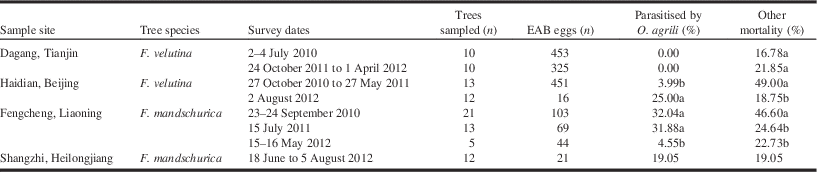
The egg parasitoid O. agrili was consistently recovered from EAB eggs collected from both F. mandschurica and F. velutina grown in both semi-natural forests and ash plantations at all sample sites except Tianjin. Parasitism of EAB eggs by O. agrili varied significantly with sampling times (e.g., from 4.0% in winter 2011 to 25.0% in summer 2012 in Beijing) as well as sample locations (e.g., 0% in Tianjin and 32% in Liaoning) (Table 2). Among all the study sites, parasitism of EAB eggs by O. agrili was highest in Fengcheng, Liaoning (4.6–32% during 2010–2012). In addition to parasitism by O. agrili, predation and/or undetermined factors also caused varying levels of EAB egg mortality across different study sites and sampling times – e.g., 16.8–21.9% in Tianjin from 2010 through 2012, 18.8–49.0% in Beijing (2010–2012), 22.7–46.6% in Liaoning (2010–2012), and 19.1% in Heilongjiang in 2012 (Table 2). The levels of parasitism and other mortality factors on EAB eggs also differed among years in both Beijing and Liaoning sites (df=1, χ2=8.1535, P=0.0043 for egg parasitism in Beijing; df=1, χ2=6.1446, P=0.0132 for other mortality in Beijing; df=2, χ2=17.4467, P=0.0002 for egg parasitism in Liaoning; df=2, χ2=12.4220, P=0.0020 for other mortality in Liaoning) (Table 2).
Prevalence of EAB egg parasitism by Oobius agrili.
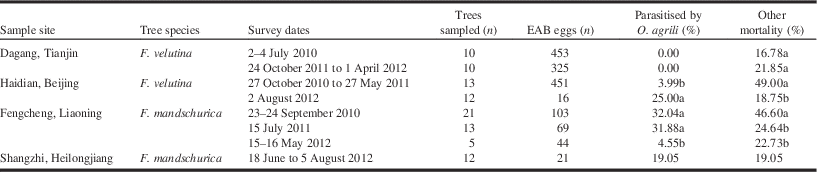
Notes: Percentages followed by the same lowercase letters in the same column and same site were not significantly different in different years based on likelihood χ2 test at α=0.05 level.
Natural enemies of EAB larvae
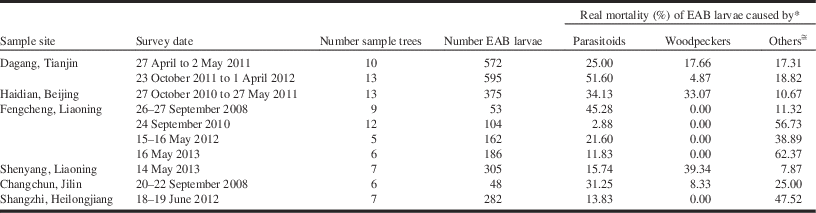
A total of 2682 EAB larvae from 88 girdled or naturally infested ash trees, were sampled in Tianjin, Beijing, Liaoning, Jilin, and Heilongjiang from 2008 to 2013 (Table 3). Among the EAB larvae observed at different sampling times and sites, a range of 3.0–51.6% were parasitised by different groups of larval parasitoids, 0–33.1% were preyed on by woodpeckers, and 7.8–62.0% killed by other undetermined biotic factors (e.g., diseases, competition, and putative plant resistance (i.e., EAB larvae killed by growth of host plant tissue or phytochemicals)). There were significant variations in larval parasitism and woodpecker predation rates as well as other undetermined biotic and abiotic mortality factors.
Biotic factors and their suppression against emerald ash borer populations during larval stages.
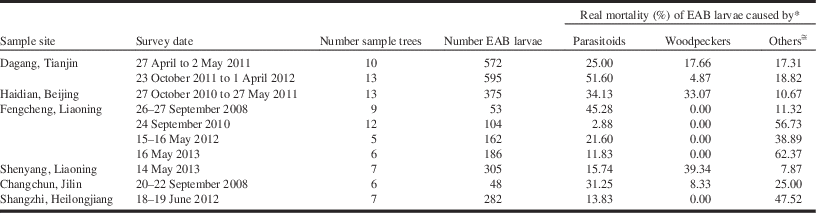
Notes:
* Real mortality is the ratio of the number of dead EAB larvae to the total number of EAB larvae sampled.
≅ Others include diseases, competition, and putative plant resistance.
Hymenoptera
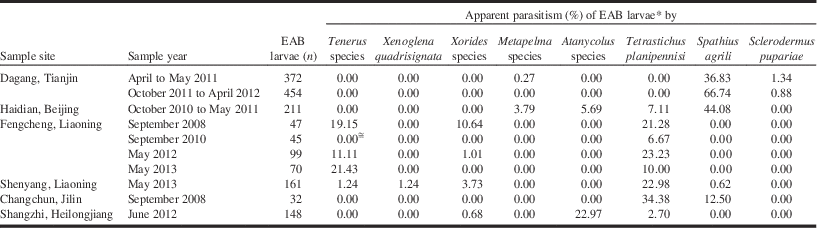
A total of six species of parasitic wasps (Hymenoptera) and two species of beetles with apparently parasitic larvae (Coleoptera) were recovered from or in association with EAB larvae (mostly 3rd–4th instars) and/or prepupae at different study sites (Table 4). Parasitism and distribution of the different species of parasitoids varied greatly between sampling locations but less so among years at the same location. For example, the braconid wasp S. agrili was the most prevalent parasitoid attacking EAB larvae in both Beijing in 2010–2011 (44.1% apparent parasitism) and Tianjin in 2011–2012 (36.8–66.7% apparent parasitism), whereas few EAB larvae were parasitised by S. agrili in the northeast provinces. In contrast, the eulophid wasp T. planipennisi was consistently found in Beijing and northeast provinces, contributing 2.7–34.4% larval parasitism, but no parasitism by this wasp was observed in Tianjin. In addition, some minor hymenopteran species were also found attacking EAB larvae in the field, such as Xorides Latreille (Hymenoptera: Ichneumonidae) species, Atanycolus Förster (Braconidae) species, Sclerodermus pupariae Yang and Yao (Hymenoptera: Bethylidae), and Metapelma Westwood (Hymenoptera: Eupelmidae) species. A parasitic Tachinidae (Diptera) was also found attacking EAB larvae, but with very low parasitism rates (0.4–1.4%).
Insect natural enemies of EAB larvae and their apparent parasitism.
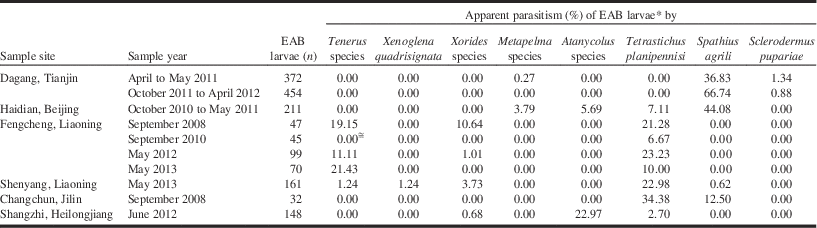
Notes:
* EAB larvae preyed on by woodpeckers and those that died as young larvae due to other biotic factors were excluded from the larval cohort used to estimate apparent parasitism.
≅ Tenerus species was found parasitising a long-horned beetle larvae on Manchurian ash.
Coleoptera
In addition to the parasitic wasps, two species of beetles, Tenerus Laporte (Coleoptera: Cleridae) species and X. quadrisignata Mannerheim (Coleoptera: Trogossitidae), with apparently parasitic larvae, were recovered in the two study sites in Liaoning Province. Parasitism ranging from 1.2% to 21.4% at different sampling times for the Coleoptera (Table 4). To the best of our knowledge, this is the first report of EAB larval parasitism by beetles. Although both beetles are probably predatory as adults, the association of their larvae with single EAB larvae suggests parasitic behaviour.
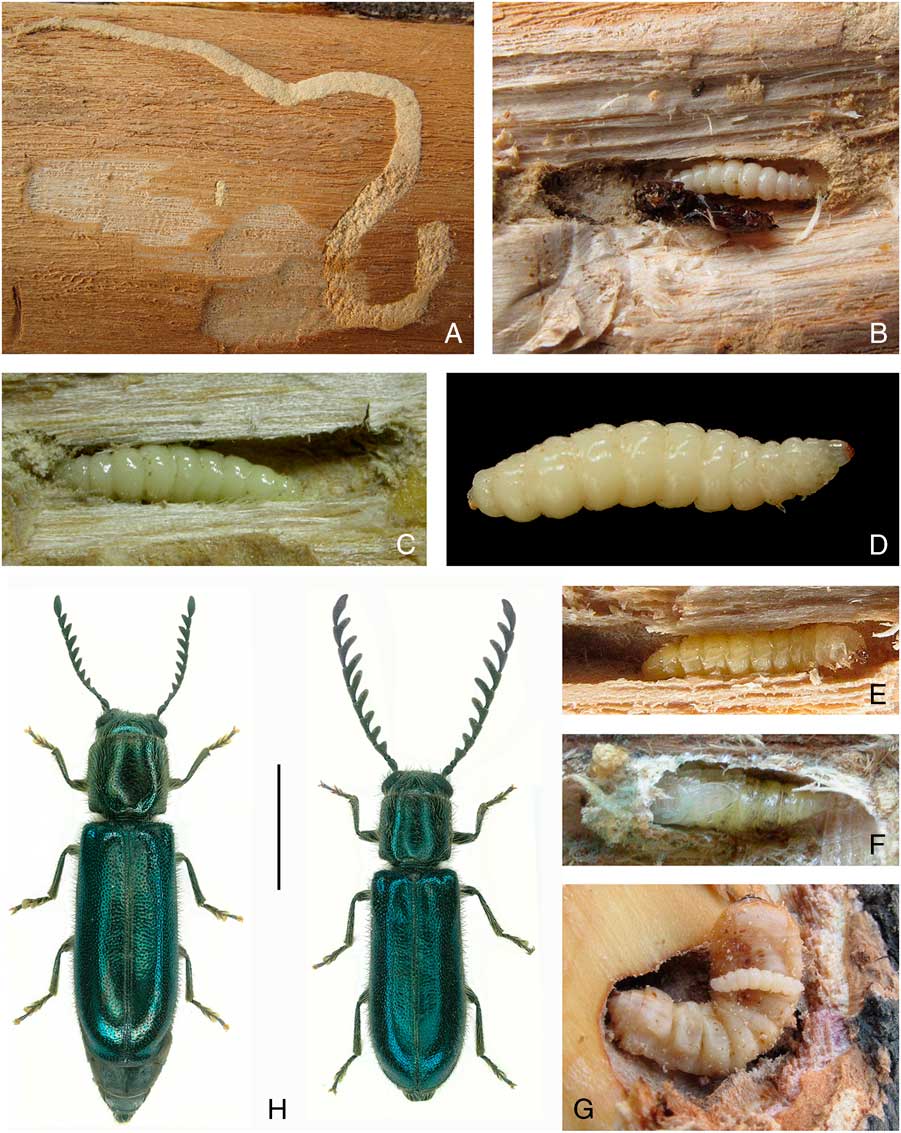
Larvae of Tenerus species were first found in the overwintering chambers of J-shaped mature EAB larvae (Figs. 2A–2D) from girdled Manchurian ash trees in Saima Township, Fengcheng, Liaoning Province in late September 2008. It appears to be a solitary parasitoid of the mature larvae of EAB and the predominant natural enemy during winter in this location, with an average ~13% parasitism (Table 4). We collected 37 mature larvae of this beetle in EAB pupation (overwintering) chambers at the end of September 2008 and 2010, as well as in May 2012 and 2013. When held at room temperature in the laboratory, Tenerus species pupated in early August and adults emerged from late August to early September (Figs. 2E, 2F). However, we also collected 13 pre-emergent adult beetles in EAB pupation chambers in field in late April 2015, as well as some prepupae and mature larvae. In September 2010, we found Tenerus species parasitising larvae of a long-horned beetle (probably Massicus raddei (Blessig) Coleoptera: Cerambycidae) on the same host plant (F. mandschurica) (Fig. 2G). We collected four long-horned beetle larvae, two of which were parasitised by Tenerus species.
Life stages of Tenerus species (Coleoptera: Cleridae). A. Exterior view of EAB pupation chamber; B. larva inside EAB pupation chamber; C. mature larva in EAB pupation chamber; D. Mature larva; E. prepupa; F. pupa; G. larva parasitising a long-horned beetle larva in ash tree; H. adults (left: female; right: male). Scale bar =2.0 mm.
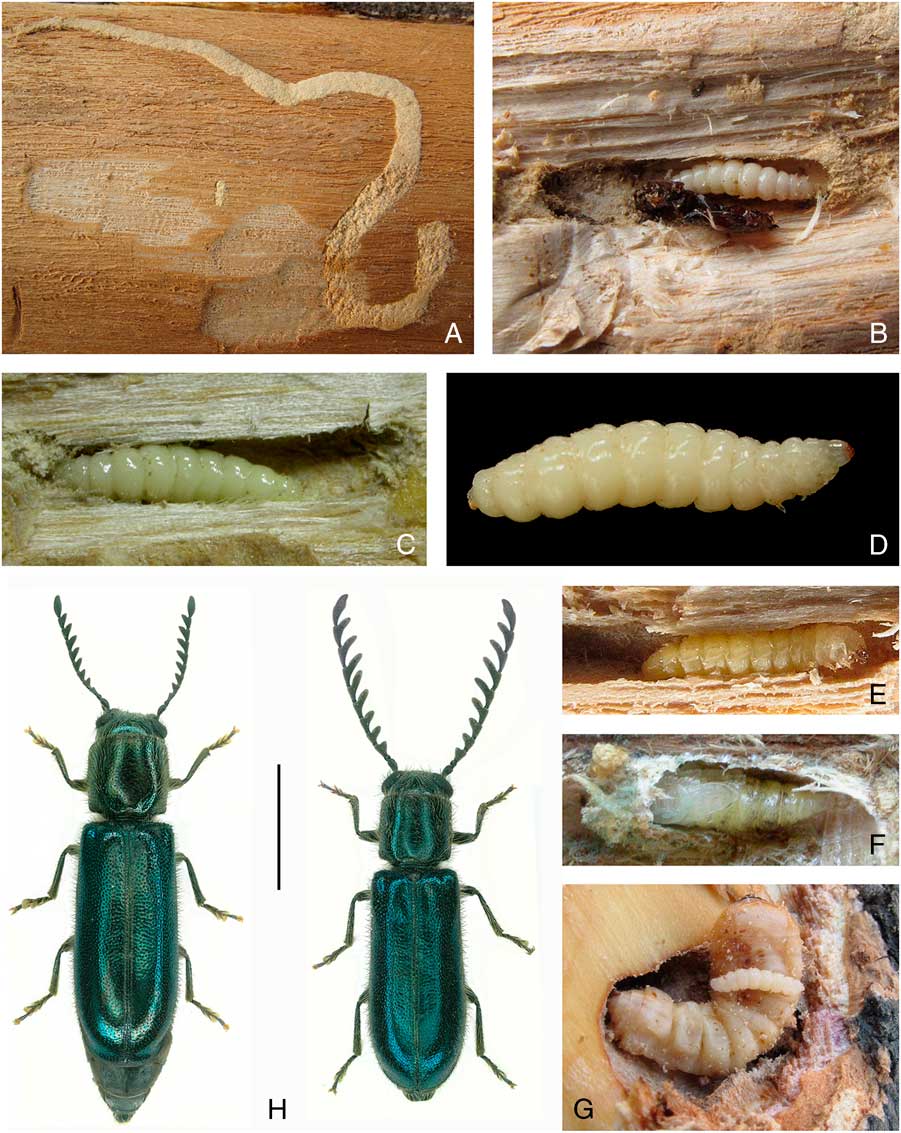
Tenerus species has one generation per year in Liaoning Province, China. They appear to overwinter primarily as mature larvae, however, a few immature larvae were also recovered in EAB pupation chambers. The distribution of this beetle was aggregated in the field, as we observed parasitism of EAB larvae by this beetle often occurring on a single tree rather than on many different trees.
The mature larvae are creamy white in colour, spindle shaped (Figs. 2B, 2C), and 8–15 mm in length. Adult beetles are 5.5–7.0 mm long, cylindrical, dark metallic blue with reddish-brown, erect setae. The head and pronotum are covered with dense coarse punctures (Fig. 2H). Antennomere 3 is narrow and triangular, antennomeres 4–10 are strongly pectinate, and the apical antennomere is fusiform.
This newly discovered Tenerus beetle is similar to Tenerus lewisi Lohde, which is recorded from South Korea and Japan, however host range and biological information of T. lewisi are unknown (Kim and Jung Reference Kim and Jung2006). Several morphological characters of this new Tenerus beetle differ from T. lewisi including: (1) posterior margin of pronotum triundulate with a large median lobe, middle of lobe obviously concave (versus T. lewisi posterior margin of pronotum nearly subtruncate); (2) body metallic dark blue (versus T. lewisi brilliant metallic blue); (3) antennomere 4 bigger and more prominent (versus T. lewisi antennomere 4 smaller and normal) (Fig. 2H).
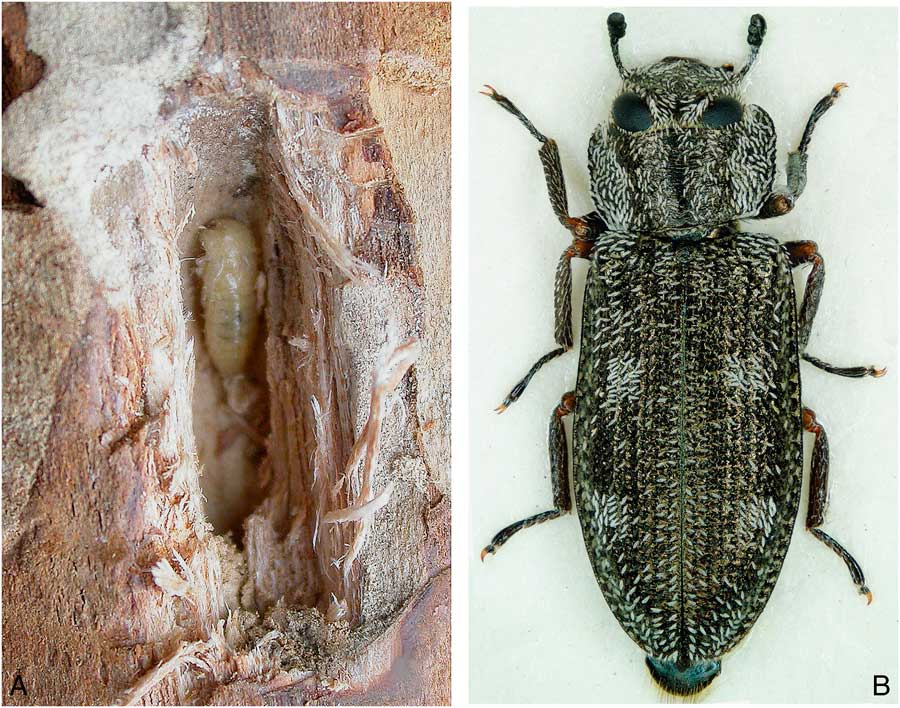
Xenoglena quadrisignata Mannerheim (Coleoptera: Trogossitidae), the bark-gnawing beetle, was first observed in EAB pupation chambers (Fig. 3A) on F. velutina in the Nursery Garden of Shenyang Agricultural University, Shenyang, Liaoning Province, in mid May 2013. Parasitism of EAB larvae by this beetle was very low (<1%). We observed that X. quadrisignata is a solitary parasitoid, attacking mature larvae of EAB in the overwintering chambers, where it develops to the adult stage the following spring. To our knowledge, no literature on its natural history and host records is available. Trogossitids are part of the superfamily Cleroidea (with Cleridae). Our observations of EAB larval parasitism by X. quadrisignata appear to represent the first record of a parasitic habit in this family, and parasitism is also rarely seen in the clerids (Clausen Reference Clausen1940).
Life stages of Xenoglena quadrisignata Mannerheim (Coleoptera: Trogossitidae); A. pupa inside EAB pupation chamber; B. adult (male).
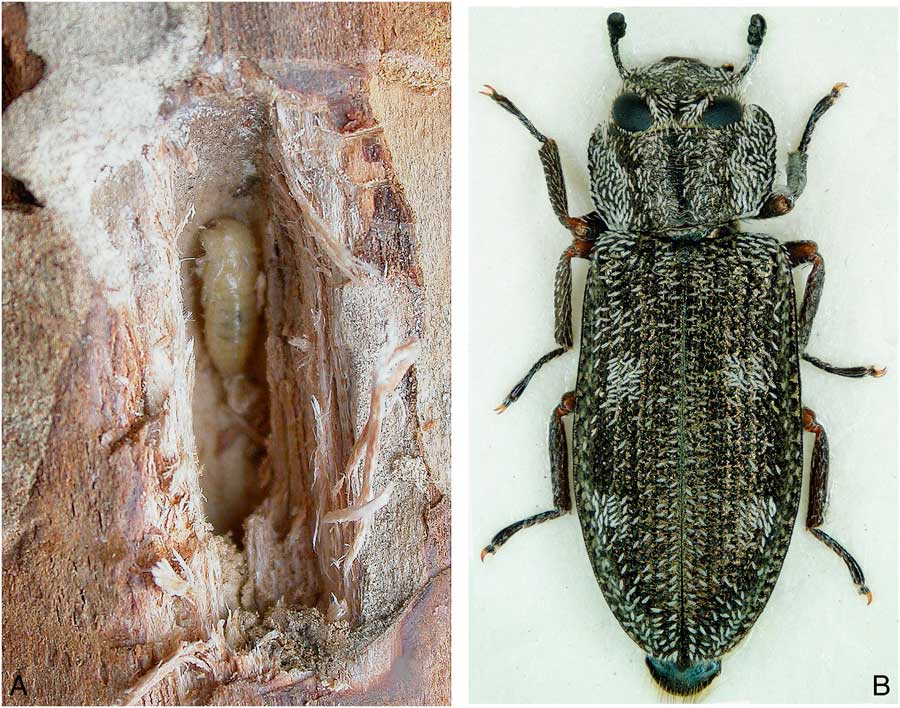
Xenoglena quadrisignata adults are light grey and ~8.0 mm long (Fig. 3B). The last three antennomeres, eyes, and tarsi are black; all the apical portion of the femora and basal portion of the tibia are dark yellow; while the basal half of the claw is black and the distal half is yellow. The body is elongate, elliptical and flat in shape. The head, pronotum, edge, and median four round points of the elytron are covered with scaly setae. The last three antennomeres are swollen and obviously different from other antennomeres. The entire eye is elliptical and slightly prominent as seen from dorsal view. The anterior margin of the pronotum is U-shaped, surrounding the eyes and posterior head, while the sub-lateral pronotum is concave, the two lateral margins are nearly parallel, and the posterior margins are straight.
Discussion
Field surveys conducted in north and northeastern China revealed a complex of parasitoids attacking immature EAB. In addition to parasitism, EAB eggs and larvae suffered mortality from other agents such as woodpeckers, disease, and undetermined factors including competition and putative plant resistance. Our survey also indicated that the parasitoid complex and their impacts on EAB mortality varied with different sampling seasons and geographic regions. Liu et al. (Reference Liu, Bauer, Gao, Zhao, Petrice and Haack2003, Reference Liu, Bauer, Miller, Zhao, Gao and Song2007) previously reported similar findings. For example, the egg parasitoid O. agrili and the larval parasitoid T. planipennisi were not observed in Tianjin, but these two species were frequently observed attacking EAB eggs or larvae in Beijing, Jilin, Liaoning, and Heilongjiang. On the other hand, S. agrili was a major parasitoid of EAB larvae in Tianjin and Beijing. Our results indicate that during the spring season (the late overwintering period), EAB egg parasitism and mortality caused by other factors were lower than that during the late summer. This suggests that mortality by egg parasitoids increases gradually during the adult EAB flight season.
Our study suggests that classical biological control programmes should consider the spatial and temporal variations in the parasitoid complex and parasitism rates in EAB’s native range. The affinity of certain parasitoid species for different habitats and possibly climatic conditions highlights the need for post-release monitoring of parasitism levels in North America. The spatial distribution and variability of parasitism across latitudinal ranges within China implies that the egg parasitoid O. agrili, as well as the larval parasitoid T. planipennisi, are suitable for introduction as biological control agents against EAB in the northern regions (>40°N latitude) of North America, whereas S. agrili would be more appropriate in the southern parts (<40°N latitude). This may explain why S. agrili has not successfully established in Midwest and northeast United States of America (Duan et al. Reference Duan, Bauer, Abell and Van Driesche2012a; Bauer et al. Reference Bauer, Duan, Gould and Van Driesche2015).
The discovery of two apparently parasitic beetles, Tenerus species and X. quadrisignata, in association with EAB larvae or prepupae is novel. Tenerus species appears to be an important parasitoid of mature EAB larvae or prepupae (~13% parasitism), at least at one study site (Fengcheng, Liaoning Province). In contrast, parasitism of EAB larvae by X. quadrisignata, was very low.
Currently, we have little knowledge of the natural history and host range of Tenerus species other than contemporaneous observations of attack on larval long-horned beetles. This newly discovered Tenerus beetle may have a lifecycle similar to Dastarcus helophoroides (Coleoptera: Bothrideridae), a coleopteran parasitoid, which externally parasitise long horned beetle hosts during its larval stage (Wei et al. Reference Wei, Yang, Poland and Du2009). Although the great majority of species of the family Cleridae are predaceous, a few species appear to develop as external parasites (Clausen Reference Clausen1940). In our study, beetle larvae were found within intact chambers with no visible entrance holes from the bark surface.
Further studies are needed to determine whether these two species of parasitic beetles can be potentially useful for classical biocontrol introduction against EAB in North America, especially for Tenerus species because of its relatively higher parasitism in field. Although we surveyed only a limited number of sites within the range of EAB, the presence of novel natural enemies and large variation in mortality among regions suggests that an expanded foreign exploration for EAB natural enemies throughout its native range in Asia may prove valuable.
Acknowledgements
The authors thank Mr. Xian-Wen Zhang and Mr. Yun-Cheng Liu of Saima Forest Station of Fengcheng City, Liaoning Province for assistance during our field investigation. They thank Professor Shou-Hui Sun and his two master students (College of Forestry, Shenyang Agricultural University) for helping of partial dissection work in Nursery of Shenyang Agricultural University. They thank Dr. Gan-Yan Yang (Institute of Zoology, Chinese Academy of Sciences) for identification of Tenerus species, and Professor Mao-Ling Sheng (General Station of Forest Pest Management, State Forestry Administration, Shenyang, Liaoning, China) for identification of Xorides species. The authors thank Tom Luther (United States Department of Agriculture, Forest Service) for creating the map. This work was partially supported by United States Department of Agriculture, Animal and Plant Health Inspection Service, Plant Protection and Quarantine Program, United States Department of Agriculture, Forest Service International Program, and United States Department of Agriculture, Agricultural Research Service. Xiao-Yi Wang is grateful to the China Scholarship Fund (201203270012) for supporting his visit to United States Department of Agriculture, Agricultural Research Service, Beneficial Insects Introduction Research Unit. They appreciate comments on an early draft of this manuscript by Dr. David E. Jennings (University of Maryland), and they thank two anonymous reviewers for their valuable suggestions.