Introduction
This article examines the relationship between the family and work histories of older women in the UK and the association with their personal incomes in later life. Women are less likely to be in paid employment and more likely to be working part-time, especially if they have children. However, the extent to which periods of caring place women at a disadvantage in acquiring pension entitlements depends also on the structure of the pension system, including the balance between state and private provision and the redistributive features within different pension schemes. The pension problem for women stems from their different life-course experiences in combination with a pension system that was not designed to meet women's needs (Falkingham and Rake, Reference Falkingham, Rake, Ginn and Arber2001).
The British welfare state was constructed on the assumption that women would be largely dependent on their husbands’ earnings during their working lives and their husbands’ pensions in retirement – the so-called ‘breadwinner’ model (Land, Reference Land, Baldwin and Falkingham1994; DWP, 2005). Hence, the state pension was designed to provide a basic income for married couples, based on the main earner's contributions. However, changes in social norms and the decline of marriage as a lifelong contract have made reliance on a husband for income in later life an increasingly unacceptable and risky strategy for women. As argued in the first report of the Pensions Commission, ‘an effective pension system for the future must be one in which the vast majority of women accrue pension entitlements, both state and private, in their own right’ (Pensions Commission, 2004: 259).
The UK system consists of a contributory flat-rate state pension at a relatively low level and a relatively small public earnings-related scheme, topped up by means-tested benefits for those on low incomes and by private pensions for those with middle and high incomes (Pensions Policy Institute, 2009). To receive the full-rate Basic State Pension (BSP), women retiring prior to 6 April 2010 required 39 years of contributions (from 6 April 2010 onwards the reforms of the Pension Act 2007 have come into effect, lowering the contribution requirement to 30 years). Married women are entitled to a pension equal to 60 per cent of their husband's BSP if this is more than they would receive on the basis of their own contributions. In the late 1990s, only a quarter of married women were receiving a BSP based solely on their own contributions.
Membership of private pensions grew rapidly from the 1960s and was encouraged by favourable tax treatment and options to contract out of the public earnings-related scheme into private pension schemes. However, coverage of occupational pensions – the most prevalent type of private pensions – is very variable and substantially lower in jobs typically undertaken by women, such as part-time jobs and jobs in the service sector (McKay et al., Reference McKay, Heaver and Walker1999). Furthermore, benefits are heavily skewed in favour of employees who are already advantaged in the labour market, such as white-collar men with stable and continuous full-time careers and rising earnings (Ginn, Reference Ginn2000). Regulatory changes from the late 1970s onwards have sought to improve the pension rights of early leavers and part-time employees, but the impact will be gradual and these changes were introduced too late to benefit most of the women in our sample, albeit not those women working in the public sector. Weak entitlement to private pensions combined with low levels of BSP mean that means-tested benefits play a significant role for many older British women.
It has been argued that the dramatic increase in women's employment rates since the 1950s will mean that future cohorts will retire with higher state and private pensions (for example, DWP, 2005) and that current inequalities in the pension incomes of men and women will narrow as their employment rates converge. Others are more sceptical that changes in women's employment rates will enable the majority of women to achieve pension incomes comparable with men's (for example, Ginn et al., Reference Ginn, Street, Arber, Ginn, Street and Arber2001). Using retrospective data on family and work histories, this article explores their association with women's personal incomes in later life. How do marriage, divorce, widowhood and having children influence women's employment patterns and how, if at all, does this impact on their incomes in retirement? To what extent does the British welfare state help to cushion some of the adverse effects on women's pension outcomes? While the data we have can help to answer these questions only for the current generation of pensioners – those who have already completed their working lives – the results help to define more clearly the challenges to be addressed in reforming the pension system if pensioner poverty and inequalities in older women's incomes are to be reduced.
Previous research findings
Two previous studies have employed the same data set to address similar research questions. Bardasi and Jenkins (Reference Bardasi and Jenkins2002) examined the effect of men's and women's work histories on the probability of having a low equivalised household income in later life. Subsequent research by the same authors (Bardasi and Jenkins, Reference Bardasi and Jenkins2004) investigated gender differences in the receipt and value of private pension income. This article differs from, and builds on, these studies in several respects. Firstly, its primary focus is on the impact of family history, using information on work history as a means to understanding one of the main channels through which marital and fertility events affect women's ability to accumulate their own pensions and savings. Secondly, the analysis is exclusively concerned with the incomes of older women with different family and work histories, as opposed to gender differences in older people's incomes. Thirdly, the variables summarising individuals’ family and work histories are configured in various ways in order to examine in more detail the impact of the duration and timing of family and work history events. Fourthly, we use a different income measure – total personal income, as opposed to equivalised household income (Bardasi and Jenkins, Reference Bardasi and Jenkins2002) or private pension income (Bardasi and Jenkins, Reference Bardasi and Jenkins2004) – for the reasons discussed below. And we use a continuous measure of income because we are interested in the effects at the top, as well as at the bottom, of the income distribution.
Other studies have addressed the same or related issues, using alternative data sets and methodologies. Rake et al. (Reference Rake, Davies, Joshi and Alami2000) used a simulation model to estimate incomes over the life-course for a set of hypothetical individuals with different levels of education and different marital and fertility histories. Ginn (Reference Ginn2003) explored the likely impact of changes and continuities in the gender division of labour and in patterns of partnering on gender inequalities in pensioner incomes, using cross-sectional data on the labour market participation, earnings and private pension coverage of different population sub-groups. By making use of retrospective data on women's family and work histories, we are able to examine the relationship between individuals’ family and work histories over their whole working lives, as opposed to a snapshot of their family and employment status at a particular point in time. We can also observe directly the impact of different family and work histories on incomes in later life, rather than having to infer this (as in Ginn, Reference Ginn2003) or simulate their likely impact on hypothetical individuals with stylised biographies (as in Rake et al., Reference Rake, Davies, Joshi and Alami2000), useful as such studies can be. The advantage of using actual data on ‘real’ people is that our results reflect the complexities of people's lives and of the evolving pension system which they lived through, rather than a simplified biography in a ‘policy constant’ world. The disadvantage with this approach is that we can observe outcomes only for the current generation of older people who have already reached retirement. Hence, the relevance of our findings to subsequent generations of older people needs to be considered carefully in light of changes in society and reforms to the British pension system.
Methodology and data
Our analysis focuses on women's personal incomes, because these will be more strongly related to their own family and work histories. While equivalised household income is arguably a better measure of people's material living standards, the inclusion of partners’ incomes will in many cases obscure the financial impact of married women's own family and work histories, which our analysis is designed to uncover.
The premise underlying this article is that women's marital and fertility histories primarily affect their incomes in later life through the impact on their work histories and hence the ability to accumulate their own private and public pension rights and other savings for retirement. This broad conceptual framework motivates the structure of this article, which looks first at the relationship between women's work histories and their incomes in later life; secondly, at the relationship between women's family and work histories; and, thirdly, at the relationship between family histories and incomes in later life.
In practice, family and work histories are interdependent. Women who have children are more likely not to work or to work fewer hours to fit around their caring responsibilities. But decisions about whether and when to have children will also be related to individuals’ career choices. For example, women with a stronger a priori attachment to the labour market and greater earnings potential are perhaps more likely to postpone having children, because the opportunity costs are greater (Walker et al., Reference Walker, Heaver and McKay2000). Our analysis does not explicitly model the endogeneity of this relationship. In considering the results of our regression analysis, the coefficients on the family or work history variables should therefore be seen as indicating the strength of association with incomes in later life, rather than implying a causal relationship.
This analysis of the family and work histories of older women – aged 65 and over – is based on data from the first 15 waves of the British Household Panel Survey (BHPS) (1991–2005). For the purposes of this analysis, the crucial data are contained in the survey's retrospective employment, marital and fertility history files, which are described in more detail below.
In the second wave of the BHPS, individuals were asked about their labour market status retrospectively since first leaving full-time education. In each successive wave, individuals are asked to provide the same information for the period since the last interview date, which is used to extend individuals’ employment histories up to wave 15. The retrospective data are from a derived data set deposited at the UK Data Archive (UKDA) by the Institute for Social and Economic Research (Halpin, Reference Halpin1997, Reference Halpin2000) and data covering the panel period are from a separate data set also deposited at the UKDA. The derived data set consists of information on individuals’ self-reported employment status at monthly intervals, using the following categorisation: full-time employed, part-time employed, self-employed, unemployed, long-term sick or disabled, family care, full-time student, retired or other. This is used to construct a series of work history variables, based on different ways of classifying individuals’ work histories, including the total number of years in different types of employment and the phasing of employment over the working life.
The marital history data consist of the dates and current status of any marriages, including end dates for marriages that ended in divorce, separation or widowhood (Pronzato, Reference Pronzato2007). The fertility history data consist of the number and birth dates of any natural children. Again, these data are used to construct a series of family history variables to summarise women's experience of marital and fertility events, such as divorce, early widowhood and the number and timing of children.
Work and family histories are both defined over the 40-year period between the ages of 20 and 60, covering all or most of women's working lives up to the current state retirement age. Subsequent changes in employment or marital status (that is, post-60) are controlled for in our regression analysis, but are not counted as part of their work or family ‘history’. To be included in the sample, individuals must have complete work and/or family histories. In addition, they must be aged over 65 at some point during the panel period (1991–2005) and have non-missing income data. Most individuals are observed more than once over the panel period. Although their work and family histories will be identical, their marital status and income may change. Rather than forgoing this additional information, all observations of the same individual are included in the sample, provided they meet the above criteria. Cross-tabulations are weighted and regression estimates adjusted to allow for multiple observations of the same individual.Footnote 1 The weight used for multiple observations is equal to 1/n, where n is the number of times each individual appears in the data set. This yields a total sample of 11,101 observations on 1,420 individuals with complete work histories, and 11,306 observations on 1,447 individuals with complete family histories. The sub-sample covers around 80 per cent of older women in the original BHPS sample and is representative of the total sample in terms of the major socioeconomic characteristics, such as age, education and incomes.
The income measure comprises four main components: (i) own private pension income from occupational and personal pension schemes; (ii) other private income, including survivors’ pensions, income from savings and investment, earnings (for the minority still in paid work) and other private transfers; (iii) public pension income, including the basic state pension and state earnings-related pension; and (iv) other public transfers, including means-tested benefits, disability-related benefits and other non-means-tested benefits. Assets that are reported to be jointly held and benefits that are jointly received are split evenly between partners, using existing derived variables in the BHPS data set. This includes all means-tested benefits, which are calculated on the basis of the combined income and assets of the benefit unit.
As individuals are observed at multiple points in time, up to 14 years apart, incomes in earlier years are adjusted upwards in line with the growth in average earnings over the intervening period, using the OECD's seasonally adjusted earnings index for the manufacturing sector. A small number of observations with very low or very high incomes are trimmed from the sample to prevent the results being unduly influenced by these outliers, some of which are likely to be due to reporting or recording error.
In examining the relationship between family and work histories and incomes in later life, it is important to control for other factors that may be correlated with both. The control variables included in our analysis include a set of background variables and post-60 controls, which are expected to influence individuals’ retirement incomes independently of, or in combination with, their work or family history. The background controls are birth cohort and education, and the post-60 controls are current employment status, current marital status and the number of years since reaching 65. Dummy variables are also included for each survey year to control for the effects of policy change over the study period.
Impact of work history
The first stage of the analysis investigates the association between women's work histories and their incomes in later life. We begin by examining bivariate relationships between older women's incomes and different categorisations of work histories, and then examine the significance of these associations in a multivariate setting (see Appendix for definition of work history variables and summary statistics).
There is wide variation in levels of economic activity among the older women in our sample. On average, they spent 14 years in full-time employment, seven years in part-time employment, one year in self-employment and 18 years in one or more of the economically inactive categories. Around 16 per cent of older women were predominantly full-time employed for between 15 and 30 years, and 20 per cent were predominantly full-time employed for 30 or more years – defined as spending two-thirds of more of their employed years in full-time employment. The remainder were either predominantly part-time employed (16 per cent), in mixed part-employmentFootnote 2 (17 per cent), or economically active for fewer than 15 years (32 per cent).
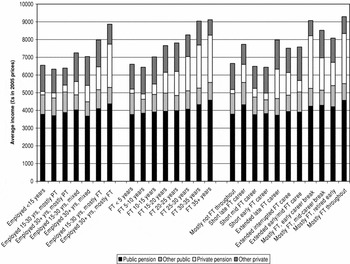
Older women who worked predominantly part-time for most of their working lives are no better off than women who had shorter part-time careers or women who were predominantly inactive. Women who had shorter, but predominantly full-time, careers are better than off than women who had longer part-time or mixed careers, though not as well off as those with longer predominantly full-time careers. Longer periods in full-time employment are associated with progressively higher personal incomes, but the phasing of employment also appears to matter. Comparing older women who worked a similar length of time, those who had a later career have higher average incomes than those whose employment was concentrated earlier in their working lives (see Figure 1).
Older women's personal incomes by work history.
Source: own analysis using waves 1–15 of the BHPS.

Work history-related differences in older women's incomes are due largely to differences in private pension income. The mean value of women's own private pension income ranges from close to zero for women who were predominantly inactive to around £2,500 per year for those who were full-time employed for most of their working lives. State pension income also increases with duration of employment, but the association is much weaker than for private incomes, which is what we would expect given the design of the state pension system. Although the state pension system is contributory, many older single women qualify for a partial or full state pension on the basis of their current or former husband's contributions; even among women who have been employed for fewer than 15 years, only 5 per cent are not in receipt of a state pension, although many will not be entitled to the full amount. The implementation of the State Earnings Related Pension Scheme (SERPS) in the late 1970s may have strengthened the link between public pensions and past earnings among younger pensioners, but the effect will weaken again in future due to subsequent reductions in the generosity of SERPS and its recent replacement by the more redistributive State Second Pension (S2P) scheme. As public transfers comprise around two thirds of older women's total personal incomes, on average, this dilutes the differentials in private incomes. Women who had predominantly full-time careers receive more than twice as much in private income as women who were predominantly inactive, but only around a third more in total income.
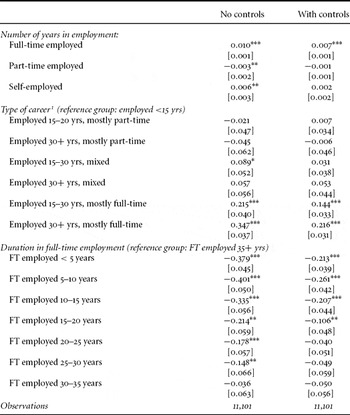
The significance of most of these bivariate associations between work histories and incomes in later life is confirmed in multivariate analysis, controlling for a range of socioeconomic characteristics, including birth cohort, education, current employment status and marital status. Separate regressions are run for each way of categorising women's work histories. For example, the top panel in Table 1 shows the results of the regression with three work history variables denoting the total number of years spent in full-time employment, part-time employment or self-employment. The dependent variable is logged income, so the coefficients can broadly be interpreted as percentage effects (relative to the reference category in the each case). The interpretation of the first line in Table 1 (‘with controls’) is that an extra year in full-time employment is associated with approximately a 0.7 per cent increase in older women's incomes.
Regression of older women's incomes by type and duration of employment

Notes: Dependent variable is logged individual income.
Standard errors in brackets. *Significant at 10%; **significant at 5%; ***significant at 1%.
Control variables are: birth cohort (3 categories), highest educational qualification (3 categories), marital status (married or single), current employment status, years since reaching 60, and survey year. Analysis is based on sample of 1,420 individuals (and 11,101 observations) who are aged over 65 and have non-missing income data in one or more waves of the BHPS and provided complete retrospective employment histories over their working lives (between the ages of 20 and 60).
1 Where individuals have been employed full-time (or part-time) for more than two thirds of that period, their career is defined as ‘mostly full-time’ (or ‘mostly part-time’). Other careers are defined as ‘mixed’, which includes women who spent roughly equal amounts of time in full-time and part-time employment and women who were self-employed for more than a third of their career.
Source: own analysis using waves 1–15 of the BHPS.
Women with higher educational qualifications generally have a stronger attachment to the labour market, so controlling for this variable weakens the association between employment and retirement incomes. The inclusion of current marital status also has quite a strong dampening effect on the work history coefficients for reasons that are discussed below, but in nearly all cases they remain statistically significant. The notable exceptions are the coefficients on the number of years in part-time and self-employment and the coefficient on ‘mixed’ employment careers. Even long periods in employment are not associated with significantly higher incomes in later life if these were in predominantly part-time or ‘mixed’ employment.
Many women who had children returned to part-time employment after a career break, at least while their children were growing up. And, as a consequence, they will have benefited little in pension terms, even if they were economically active for most of their working lives. Part-time employment is much less likely to be covered by a private pension scheme (Pensions Commission, 2004) – and, as we have seen, work history-tested differences in older women's incomes are driven primarily by private pension receipts. Periods spent out of the labour market or in part-time employment may also damage women's career progression, adversely affecting their future earnings and pension prospects. Women cannot necessarily start up their career again where they left off, often missing out on a critical period in their career when their male counterparts are being promoted (Manning and Petrongolo, Reference Manning and Petrongolo2004). They may also have to take a less-skilled job in order to find part-time work, as part-time jobs are heavily concentrated in lower-status occupations.Footnote 3
As time spent in part-time or self-employment is not associated with significantly higher incomes for older women, we focus on the duration and phasing of full-time employment in our subsequent analysis. First, we categorise the number of years of full-time employment into five-year bands to examine whether there is a linear relationship between full-time employment and older women's incomes. This analysis provides some evidence of a pensions poverty trap. Older women who have worked full-time for up to 15 years are no better off in retirement than those who worked full-time for less than 5 years. For those women who have combined full-time with part-time or self-employment, the pensions poverty trap is even deeper. Older women who worked 30 years or more in predominantly non-full-time employment are no better off, on average, than women who were economically inactive for most of their working lives.
Perhaps more surprisingly, women who have worked full-time for between 20 and 25 years are no worse off in retirement than those who worked full-time for more than 35 years, after controlling for differences in their socioeconomic characteristics. The most plausible explanation is that work history-related differences in private pension incomes are obscured by other sources of income that are unrelated to women's own work histories, such as derived pension rights,Footnote 4 or that are only weakly related to them, such as state pensions.
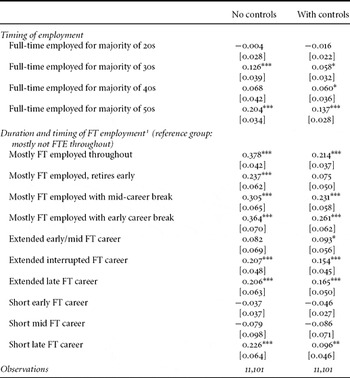
The differences by timing of employment are also striking. Older women who were full-time employed for most of their 20s do not have significantly higher incomes than women who were not, while having worked full-time for most of their 50s is more strongly associated with higher retirement incomes than having doing done so in their 30s or 40s. For similar reasons, older women whose employment was concentrated towards the end of their working lives have significantly higher incomes than women who worked for similar length of time early on in their working lives (see Table 2). A short later career is associated with better outcomes than a short early career; and it is better to have had an early career break and worked the rest of your working life than to have worked most of your working life and retired early. Interrupted careers are more similar in their effects to late careers; what seems to matter most is that the individual continued working well into their 50s. This has obvious implications for carers who reduce their hours or stop work altogether in order to look after elderly relatives, as it is in their 50s that women are most likely to become carers.Footnote 5
Regression of older women's incomes by timing of full-time employment

Notes: 1Dependent variable and controls as in Table 1. For this categorisation, individuals’ working lives are divided into four ten-year periods, covering their 20s, 30s, 40s and 50s. The reference group consists of individuals who were not full-time employed for the majority of any of these four ten-year periods. Individuals who were full-time employed for the majority of all four ten-year periods are defined as ‘mostly full-time employed throughout’. The other categories consist of individuals who were full-time employed for the majority of one of the four ten-year periods (short career), two of the four ten-year periods (extended career) and three of the four ten-year periods (‘mostly active with career break’). These categories are further broken down according to the phasing of full-time employment; for example, the ‘extended late career’ comprises individuals who were full-time employed for the majority of their 40s and 50s, but not in their 20s or 30s.
Source: own analysis using waves 1–15 of the BHPS.
This finding is most likely to be accounted for by a combination of two factors. Firstly, most occupational pension schemes penalise those who retire before the official retirement age unless they are part of an early retirement scheme. In the past, early leavers would often lose all their rights to an occupational pension.Footnote 6 Since leavers’ rights were introduced – the key changes were in 1975 and 1986 – they now have ‘preserved’ rights based on their accumulated contributions up to the point they left, but these are indexed to inflation and not to earnings, eroding their value over time relative to those who remain in the scheme. Secondly, there is a ‘period’ effect: as women's membership of private pension schemes has been increasing gradually over time, it follows that women who worked later in their working lives are more likely to have been covered.
Interaction effects
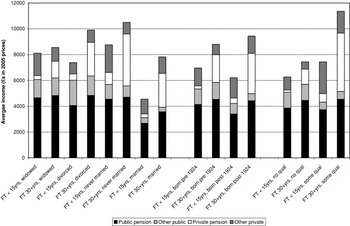
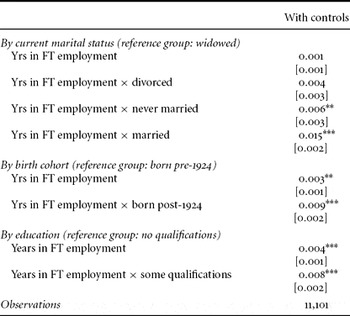
The analysis presented in Tables 1 and 2 assumes that the association between work histories and incomes in later life is the same for all sub-groups of older women. This assumption is now relaxed by introducing various interaction effects, allowing the impact of work history to vary by birth cohort and other characteristics that we might expect to influence the relationship between work history and retirement incomes. To simplify the analysis, we use the number of years in full-time employment as a summary measure of individuals’ work histories, which is interacted in turn with current marital status (widowed, divorced, never married or married), birth cohort (born pre- or post-1924) and level of education (none or some formal qualifications). Bivariate results are presented graphically using a three-way categorisation of the number of years in full-time employment. Average incomes for each of these sub-groups are presented in Figure 2 and the significance of the observed income differentials are tested formally using regression analysis (see Table 3). The first coefficient in each panel measures the strength of the association for the reference category and the other coefficients represent the additional effect of being in one of the other categories relative to the reference group.
Interaction effects involving work histories.
Source: own analysis using waves 1–15 of the BHPS.

Interaction effects involving work histories

Notes: Dependent variable is logged individual income, excluding one case with zero reported income. Standard errors in brackets. Significant at 10%; **significant at 5%; ***significant at 1%. Controls variables are as in Table 1.
Source: own analysis using waves 1–15 of the BHPS.
Interacting work history with current marital status shows that the association between work histories and incomes in later life is not significant for older widows – the reference group in this particular regression. Widowed women who have been in full-time employment for longer do have larger private pensions of their own, but this is offset by other private sources of incomes – most notably derived pension rights – and diluted by large public transfers. Widows are entitled to a Category B pension based on their partner's contributions record if this is better than their own, disproportionately benefiting those women with the weakest contributions record of their own. Many widows also become eligible for means-tested benefits, which reduces the number of women with very low incomes, including those with little or no employment history and few derived pension rights.
The interaction effects are positive for all the other marital status groups and statistically significant in the case of never-married women and still-married women. For these sub-groups of older women, the association between work histories and later-life incomes is due largely to differences in their own private pension incomes. State pensions are only weakly associated with the amount of time spent in full-time employment, because married women receive at least 60 per cent of their husband's entitlement if this exceeds their own entitlement, while divorced women can lay claim to their former husband's contributions record for the period they were married; and all individuals are credited for periods out of the labour market due to unemployment or long-term sickness or disability.
The interaction term between work history and birth cohort is also highly significant, implying that work history matters more for younger cohorts than for older ones. Part of the explanation is that younger cohorts are less likely to be widowed (when we observe them in the panel) and, for the reasons given above, work history-related income differentials are greater among women that are still married. But this only accounts for part of this effect. Private pension coverage has been rising over time, so women who were born later are more likely to be in receipt of a private pension than older cohorts with similar work histories.Footnote 7 Since private pension income is more closely related to past employment than other sources of income, the growth in private pensions over time produces a stronger association between work history and retirement incomes among younger cohorts of pensioners.
Finally, work history matters more for more educated women. The majority of unqualified women are not in receipt of a private pension even if they have worked full-time for 30 or more years (only 37 per cent, compared with 78 per cent for women with some qualifications) and among those who were receiving a private pension, its mean value was around half that of their qualified counterparts. Less-qualified women have less to gain from having a long full-time career and therefore have less to lose from being economically inactive for long periods.
Relationship between family and work histories
We know from previous research that women with young children are much less likely to be in work and, if employed, are more likely to be working part-time. Such analyses are based largely on cross-sectional data, examining the relationship between family status and employment status at a given point in time (for example, Ginn, Reference Ginn2003). Retrospective data enable us to examine the relationship between family and work histories over women's entire working lives. Again, we are interested in how the timing of family events, such as marriage and having children, impacts on women's employment patterns. We also look at the impact of divorce and widowhood on women's employment histories, differentiating between women who remained single and those who re-married.
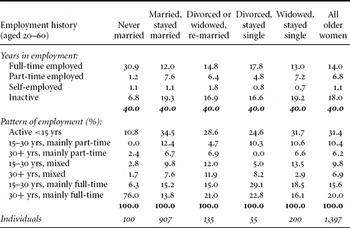
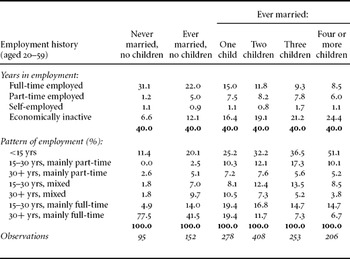
Table 4 examines the relationship between marital and work histories, while Table 5 examines the relationship between fertility and work histories. As we would expect, never-married women have by far the strongest attachment to the labour market. They are full-time employed for an average of 31 years (between the ages of 20 to 60) and inactive for only seven of those years, compared with an average of 14 years in full-time employment and 18 inactive years for all older women in our sample. The next most economically active group are women who experienced divorce and did not re-marry, which is also the smallest group, though one that is expected to grow in future; these women worked full-time for an average of nearly 18 years. Women who were widowed and stayed single have work histories that are very similar to those who married and stayed married. Many of these women were widowed in their mid or late 50s and had little time to modify their own work history in response to widowhood.
Relationship between older women's marital and employment histories

Source: own analysis using waves 1–15 of the BHPS.
Relationship between older women's fertility and employment histories

Source: own analysis using waves 1–15 of the BHPS.
Having children is, not surprisingly, associated with fewer years in employment. The average number of economically inactive years increases from around 12 years for older women who married and did not have children to more than 24 years for women who married and had four or more children. Although women who had small families worked longer than women with larger families, the biggest step change is between women with no children and women with at least one child. Among married women without children, 42 per cent had worked predominantly full-time for 30 years or more, falling to 19 per cent of women who had one child, 12 per cent of women who had two children and 7 per cent of women who had three or more children (see Table 5).
There are also very marked differences in the work histories of never-married women who did not have children and those who married and did not have children. For this generation at least, marriage appears to be a major influence on women's employment patterns, independently of the effect of having children. Among older cohorts, many women were expected, or even compelled, to give up their job upon marriage, as it was assumed they would be financially dependent upon their husband.
Impact of family history
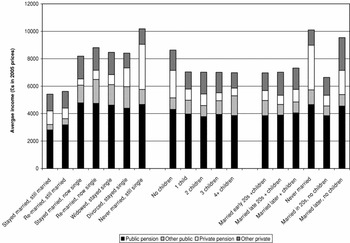
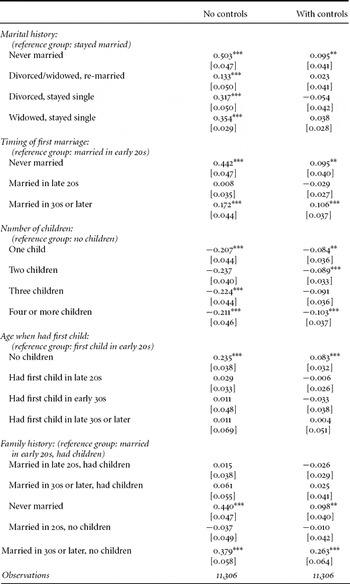
This penultimate section examines the relationship between women's family histories and incomes in later life, using the analysis in previous sections to help interpret the results. Our expectation, which is supported by empirical evidence, is that women's family histories will mostly influence retirement incomes through the impact on their work histories.Footnote 8 The results are presented graphically in Figure 3, but our discussion focuses on the regression results.
Older women's personal incomes by family history.
Source: own analysis using waves 1–15 of the BHPS.

In the first regression reported in the top panel of Table 6, we investigate the impact of women's marital histories. Without controls, ‘never-married’ women (comprising around 7 per cent of the sample) have significantly higher incomes than ‘ever-married’ women. Never-married women are twice as likely to have a private pension as other women (56 per cent vs 28 per cent) and, for those in receipt, the mean value of their pension is more than twice as much, which in turn is closely related to differences in their work histories (see Table 6). Controlling for current marital status – whether still married or single – and for other socioeconomic characteristics substantially reduces the size of the coefficient, but it remains significant and positive. This is because widows receive large public transfers and, in some cases, survivor benefits that compensate in part for work history-related differences in private pension income between ‘never-married’ and ‘ever-married’ single women.
Regression of older women's incomes by family history

Notes: Dependent variable is logged individual income, excluding one case with zero reported income.
Standard errors in brackets. *Significant at 10%; **significant at 5%; ***significant at 1%.
Control variables are: birth cohort (4 categories), highest educational qualification (3 categories), currently marital status (single or married), currently employment status (not employed, full-time or part-time), number of years since reaching 65, and survey year.
The analysis is based on a sample of 1,447 individuals (and 11,306 observations) who are aged over 65 and have non-missing income data in one or more waves of the BHPS and provided complete retrospective marital and fertility histories over their working life (between the ages of 20 and 60).
Source: own analysis using waves 1–15 of the BHPS.
Older women who experienced divorce or early widowhood and remained single are no worse off, or better off, in later life than women who stayed married and were widowed later in life. Women who were divorced have higher private pensions of their own, because they have more complete work histories, but fewer derived pension rights than women who were widowed – and these two effects appear to cancel each other out. Private pension schemes typically provide partial protection for the widows of scheme members, but no automatic protection for partners of divorced members. The state pension system offers some protection to divorced women, but again this is less generous than its treatment of widows as widows receive a survivors’ pension from SERPS (and the ‘new’ State Second Pension), whereas divorcees only rarely receive a portion of their husband's SERPS/S2P as part of the divorce settlement.
Women who re-married have similar incomes, on average, to women who stayed married throughout their working lives; any differences are statistically insignificant after controlling for other socioeconomic characteristics. Re-married women have marginally more complete work histories, but not sufficiently different to be reflected in significantly higher private pension incomes. And both groups have similar derived pension rights; women lose any pension rights relating to their former husband when they re-marry, but acquire rights based on the contributions of their new spouse.
Having children is associated with significantly lower incomes in later life, even after controlling for other factors, including current marital status. The size of this effect is relatively small, however: equivalent to a reduction of less than 10 per cent in their personal income. Substantial differences in work histories between women with and without children are translated into small differences in retirement incomes, due largely to differences in private pension and investment income. Perhaps more surprisingly, there is no significant association between the incomes of older women and the size of their family. As we saw earlier, women who had fewer children generally worked for longer periods, but this is not reflected in higher retirement incomes; the average value of private pension income is only marginally higher for women who had one child than for those who had larger families. The extra years of employment worked by women who had fewer children do not appear to improve their pension prospects, because much of it is part-time or in lower-status occupations that are not typically covered by private pensions.Footnote 9
The timing of children does not appear to affect women's pension prospects, but the timing of marriage does make a difference. Compared with women who marry in their early 20s (the reference group), women who married in their 30s (or later) have higher incomes in later life, after controlling for other factors. Further analysis suggests that later marriage is only associated with significantly higher incomes for the sub-group of women who did not have children (around 4 per cent of all older women). These women are much more likely to have a private pension than other married women and receive a larger state pension; they also have more investment income, perhaps because they were more career-oriented and were able to save more without the financial pressures of bringing up children. By contrast, women who married in their 20s and did not have children (around 6 per cent of our sample) do not have significantly higher incomes than the reference group. This group are typically less qualified and concentrated in lower-status occupations, which helps to explain why their longer work histories are not associated with higher retirement incomes (see below).
Interaction effects
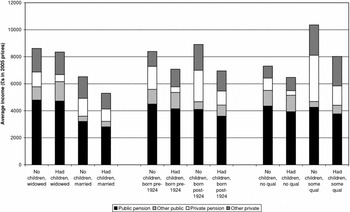
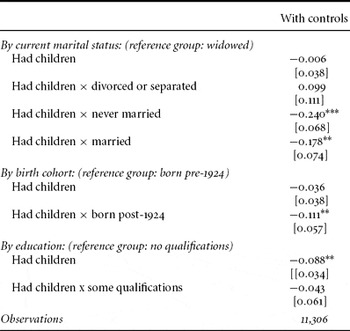
We now consider various interaction effects between family history and other demographic and social variables, mirroring the earlier analysis of work histories. More specifically, we look at whether the relationship between having children and older women's incomes varies by current marital status, birth cohort or education. The results are shown graphically in Figure 4, and regression analysis is used to test the significance of the interaction terms in Table 7.
Interaction effects involving family histories.
Note: Results are not shown for divorced or never-married women, because the sample of divorced women who did not have children is too small and the sample of never-married women who had children is too small.
Source: own analysis using waves 1–15 of the BHPS.

Interaction effects involving family histories

Notes: Dependent variable is logged individual income, excluding one case with zero reported income.
Standard errors in brackets. *Significant at 10%; **significant at 5%; ***significant at 1%.
Source: own analysis using waves 1–15 of the BHPS.
As in our analysis of work histories, we find that the negative association between motherhood and incomes in later life is significantly larger for older women who are still married and for younger cohorts (born post-1924). The reasons for this are inter-linked. Widows, who comprise a high proportion of the older cohorts in our sample, receive a more generous state pension and, in some cases, a (private) survivors’ pension that cancels out any differences in the private pension entitlements of women with and without children. At the same time, higher rates of private pension coverage among younger cohorts have widened the income differential between women with and without children, by strengthening the relationship between women's work histories and their retirement incomes.
There is one trend that we might have expected to operate in the opposite direction. Women are now more likely to return to work after having children. Comparing the work histories of successive birth cohorts, there is a marked decrease in the number of years spent economically inactive – from an average of 23.2 years for women born pre-1920 to 16.8 years for those born post-1927. Other things being equal, we might have expected the increased economic activity of mothers to reduce the ‘pension penalty’ associated with having children for younger cohorts. That this has not happened in practice is because most of the increase was in mixed or predominantly part-time careers, which are not associated with significantly higher incomes in later life (see Table 1). Furthermore, analysis of the early work histories of women approaching retirement suggests that changes in mothers’ employment patterns are unlikely to reduce the pension penalty of having children for the foreseeable future unless private pension schemes start to provide much improved returns for scheme members with non-continuous non-full-time employment (Sefton et al., Reference Sefton, Evandrou and Falkingham2008).
The association between having children and incomes in later life is greater for more-qualified women, although this interaction term is not quite significant. Private pension coverage has been universally poor for less-qualified women, even those who have been in full-time employment for most of their working lives. As these women have less to gain in pension terms from working longer, it follows that they have less to lose from having children and other interruptions to their work history. This finding contradicts the results of the simulation model in Rake et al. (Reference Rake, Davies, Joshi and Alami2000), which concluded that the pension costs of having children were substantial for low- and mid-skilled mothers, but close to zero for women graduates. The reason for this becomes clear when we take a closer look at the assumptions underlying their simulation model. ‘High-skilled’ mothers are assumed to remain in almost continuous employment throughout their working lives, whereas the graduate mothers in our sample worked for an average of just 23 years, only 15 of which were in full-time employment. This is marginally higher than their less-qualified counterparts, but considerably less than for qualified women who did not have children.
Ginn and Arber (Reference Ginn and Arber2002) also found Rake et al.'s (Reference Rake, Davies, Joshi and Alami2000) projected minimal pension loss by graduate mothers to be at odds with empirical findings. Warren (Reference Warren2003), using data from the Family Resources Survey, found that although the most highly qualified women were better off in pay and occupational status than the majority of men, they were still worse off than equivalent men. Significantly, their advantages in pay and status did not translate into an equivalent advantage in terms of assets and pension wealth. Pension rights accrued were far less than for male peers and were also worse relative to lower-paid men; even these most privileged women fared poorly compared with men in general.
Conclusions and policy implications
The association between women's family histories and their incomes later in life is relatively weak, in many cases insignificant, explaining only a small proportion of the overall variation in older women's incomes. Divorce, early widowhood and re-marriage are not associated with any significant differences in older women's incomes, while motherhood is associated with only a small reduction in incomes later in life – and not at all for certain sub-groups of the population. While there are significant differences in the work histories of older women with different family histories, this translates into relatively small differences in their personal incomes, because the types of employment career pursued by most women are not associated with significantly higher pension incomes. Our analysis also demonstrates how effective public transfers are in dampening work history-related differentials, especially for widows.
On the one hand, this could be seen as a positive finding in that the ‘pension penalty’ associated with life-course events such as motherhood and divorce is not as severe as often anticipated. On the other hand, the main reason for this is that the pension returns to working longer are relatively low, particularly for women with few qualifications. As women's employment rates have been rising, today's younger women will retire with more complete employment histories than today's pensioners and this, it is sometimes argued, will mean that future cohorts of women retire on higher incomes. However, our analysis suggests that, at least under the pension system that has prevailed in the recent past, it is unlikely that women retiring over the next two decades will benefit significantly from the additional years they have spent in employment, because most of this increase has been in part-time employment.
It seems clear that much of the difference in older men's and women's incomes is attributable not to differences in their work and family histories, but rather to gender differences in the pension returns to employment. Some of the factors that have contributed to the latter are slowly being addressed – from explicit discrimination in the labour market to more subtle barriers to gender equality. The irony is that these changes will, in so far as they are effective, increase the pension penalty of motherhood and caring, by increasing work history-related differentials in incomes. The outcome will be more equitable as between men and women, but at the expense of greater inequality among women with different work and family histories. More could be done to bolster the pension rights of women with greater family commitments, but this is harder to do when, as successive governments have encouraged, private pensions are playing a growing role in the overall pension system.
Implications for recent pension reforms
These conclusions are based on the outworking of a different pension system to that likely to prevail in the future. To conclude this article, we briefly consider the implications of our findings in the light of the reforms announced in two White Papers (DWP, 2006a, 2006b) and legislated in the 2007 Pensions Act and 2008 Pensions Act.
The first major change is a commitment to up-rate the Basic State Pension (BSP) in line with earnings at some point between 2012 and 2015, and to relax the contribution conditions, so that a much higher proportion of women will qualify for a full-rate BSP – an estimated 90 per cent of women by 2020 (DWP, 2006a). At the same time, S2P will gradually be turned into a flat-rate top-up to the BSP (by around 2030), though with more stringent contributory requirements than for the BSP. For the reasons discussed earlier, maintaining the value of BSP will help to dampen work and family history-related differentials in retirement incomes, compared with a situation in which it was indexed only to prices. Changes in the contributions conditions will help those women who do not currently meet the requirements in full, although our analysis suggests this will make little difference in aggregate, because work history-related differentials in state pensions are already relatively small, due largely to spouse and widows’ benefits. The main effect is that more women will gain entitlement to a state pension in their own right, rather than on the basis of their current or former spouse's contributions.
The other major component of the proposed reforms is low-cost Personal Accounts with automatic enrolment for all employees (with an opt-out) and compulsory employers’ contributions. Introducing a stronger element of compulsion into private pensions should disproportionately benefit women, because they are concentrated in the sectors and types of jobs that are presently least likely to be covered by an employer-sponsored pension scheme. On average, future cohorts of women will clearly be better off in retirement once they have had sufficient time to accumulate a decent private pension of their own. It is more difficult, however, to predict how this will affect the relationship between women's family histories and their incomes in later life, including the ‘pension penalty’ of having children.
On the one hand, it should ensure that women who have worked in non-continuous non-full-time employment – many of whom are mothers – will receive significantly higher incomes in retirement in return for the time they have spent in work. They should also benefit from the shift from Defined Benefit to Defined Contribution schemes, which are more portable and work better for those whose careers are characterised by frequent moves into and out of employment and between jobs. This group will be better off than they would otherwise have been relative to their peers who have worked predominantly full-time for an employer that was already operating an occupational pension scheme. The proposed reforms will also reduce inequities in pension outcomes between women with similar work histories but in different occupations or sectors, by reducing disparities in private pension coverage.
Women with very limited work histories, including a disproportionate number of mothers with low or no qualifications, will benefit little, while the biggest beneficiaries will be women with complete or almost complete work histories in sectors or occupations that currently have poor occupational pension coverage, including less-qualified women who do not have children. Thus, for women with low qualifications or working in lower-status occupations, the ‘pension penalty’ of having children could well increase as a result of the proposed reforms. This is simply the converse of the point made earlier: as less-qualified women will have more to gain in pension terms from working longer under the new system, they will also stand to lose more from interruptions to their work history due to having children or to other factors. This motivates the call from various organisations for the government to offer direct state contributions or increased tax relief to the personal accounts of certain disadvantaged groups, including women who spend substantial periods of their life unable to work or save due to caring responsibilities (Age Concern, 2006; Fawcett Society, 2006).
As these same organisations have pointed out, recent reforms will also do little to help those women who are currently approaching retirement. Changes to the state pension system are not being applied retrospectively and, in the case of earnings-indexation, will not be implemented for several years, so will take many years to feed into women's retirement incomes – as will the introduction of Personal Accounts. Our analysis reinforces this point by showing that the differences in the early employment histories of women aged 45–60 and those who are already retired are unlikely in themselves to ensure better pension outcomes for the next generation of pensioners.
The analysis presented here serves to highlight the tensions between two objectives: rewarding work and protecting the most vulnerable such as carers, long-term disabled and unemployed. Improving the pension returns for women with extended periods of part-time work will necessarily penalise, in relative terms, those that have been unable to work. Resolving this dilemma points to moving away from the close (and growing ever-closer) association between pension entitlements and work history and towards universal entitlement based on a citizen's pension. The second report of the Pensions Commission (2005) recommended the adoption of a universal flat-rate pension based on residence. Perhaps it is time to revisit it.
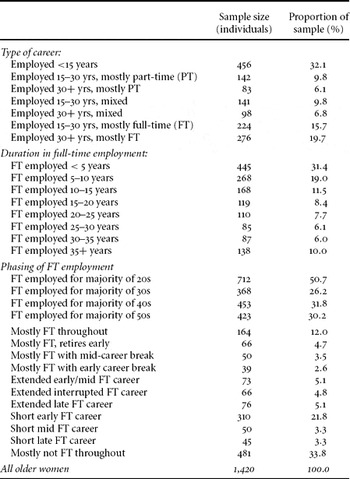
Appendix: Definition of work history variables
Type of career
This is based on the total number of years in employment (between the ages of 20 and 60) and the proportion of this time spent in full-time, part-time or self-employment. Categories are defined as follows:
• Employed <15 yrs: employed for less than 15 years in total.
• Short part-time (PT) career: employed for between 15 and 30 years, at least two thirds of which is part-time.
• Long PT career: employed for 30 or more years, at least two thirds of which is part-time.
• Short mixed career: employed for between 15 and 30 years, neither predominantly part-time or full-time.
• Long mixed career: employed for 30 or more years, neither predominantly part-time or full-time.
• Short full-time (FT) career: employed for between 15 and 30 years, at least two thirds of which is full-time.
• Long FT career: employed for 30 or more years, at least two thirds of which is full-time.
Timing of full-time employment
Whether full-time employed for the majority of their 20s, 30s, 40s or 50s – for at least five years out of each ten-year period.
Duration and timing of full-time employment
Respondents’ working lives are divided into four ten-year periods, covering their 20s, 30s, 40s and 50s and categorised as follows:
• Mostly full-time (FT) employed throughout: FT employed for majority of every ten-year period.
• Mostly FT, retired early: FT employed for majority of 20s, 30s and 40s, but not 50s.
• Mostly FT, mid-career break: FT employed for majority of 20s, 30s and 50s or 20s, 40s and 50s.
• Mostly FT, early career break: FT for majority of 30s, 40s and 50s, but not 20s.
• Extended early/mid FT career: FT for majority of their 20s and 30s or 30s and 40s.
• Extended, interrupted FT career: FT for majority of their 20s/40s, 20s/50s or 30s/50s.
• Extended late FT career: FT for majority of their 40s and 50s.
• Short early FT career: FT for majority of their 20s (but not in their 30s, 40s or 50s).
• Short mid FT career: FT for majority of either their 30s or 40s.
• Short late FT career: FT for majority of their 50s (but not their 20s, 30s or 40s).
• Mostly not FT throughout: not FT employed for majority of any of the four ten-year periods.
Summary statistics are provided in Appendix Table 1.
Work history variables: summary statistics

Acknowledgements
The authors would like to thank the Nuffield Foundation who funded this research (grant number AGE/00056/6). We are also grateful to Howard Glennerster and John Hills for helpful comments on an earlier version of this paper.