INTRODUCTION
Many of the world's languages grammaticalize how events unfold over time, for example, by marking events that are viewed as ongoing from those that are completed. In these languages the child's task is to learn how the temporal contours of an event are expressed in their language. The social, pragmatic, and referential context in which a child hears aspectual language is a rich source of information that may limit the degrees of freedom on what these constructions mean. It is this relationship between context and aspectual input that we focus on in this study.
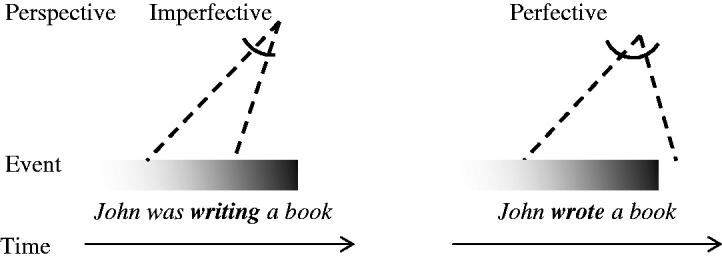
In English, one can say John was writing a book, but he never finished it, but it sounds odd to say John wrote a book, but he never finished it (note that they are both in past tense). The classic explanation for this is that the imperfective aspect, marked by-ing, coerces people into construing the activity ‘from within’, blurring the boundaries of the event so that there is no clearly defined beginning or end (Comrie, Reference Comrie1976). By contrast, unmarked non-progressive forms (verbs without the suffix -ing) bring into focus the boundaries of the event and thus activities are seen as accomplished. Lacking imperfective marking, the verb wrote, in the above example, is construed as a completed activity, which is why it sounds like a non sequitur to then add but he never finished it (see Figure 1). By mentally zooming in on the activity, the imperfective aspect can also turn actions into states, thus one has to say he knows the answer or he wants a drink, rather than he is knowing the answer or he is wanting a drink. Presumably, this is because the imperfective is redundant with verbs like know and want, which already denote statesFootnote 1 (Pinker, Reference Pinker2007: 203).
A schematic of the imperfective–perfective distinction in English. By focusing on the event from within, imperfective aspect construes the scene as open and ongoing. In contrast, perfective aspect construes the scene as a completed whole, bringing into focus event boundaries.

There is a large amount of work documenting the comprehension, production, and emergence of aspect in child language (e.g., Clark, Reference Clark, Johnson and Gilbert1996; Johnson & Fey, Reference Johnson and Fey2006; Li & Shirai, Reference Li and Shirai2000; Shirai & Andersen, Reference Shirai and Andersen1995; Wagner, 2001). For instance, Li and Shirai (Reference Li and Shirai2000) showed that children's tense–aspect use tends to fall into two prototypical clusters of features; one which groups atelic–durative–imperfective–present features together (e.g., the teacher is carrying the box) and one which groups telic–punctual–perfective–past features together (e.g., the woman won the race). Like children, adults find prototypical combinations easier to understand, and judge them as better sentences than those which draw on features from both groups, e.g., John will have been walking (Wagner, Reference Wagner2009). The relationship between the linguistic definition of grammatical aspect in English and children's experience of different temporal events in a naturalistic setting is less well understood. We know that the progressive -ing is one of the earliest morphological markers children control (Brown, Reference Brown1973). However, there seems to be relatively little, if any, research on the relationship between the communicative context in which aspectual language is used and the meaning of aspectual morphology such as -ing; including the role that the duration and timing of the event might play in this. We address this by investigating the mapping between the linguistic input (imperfective language in child-directed speech) and features of the child's experience (duration of the activity they perform relative to verb) in a naturalistic setting.
In theory, grammatical aspect is independent of tense, lexical aspect, modality, and verbal semantics, but of course in practice it interacts with these features in complex ways (Croft, Reference Croft2012; Li & Shirai, Reference Li and Shirai2000; Shirai & Andersen, Reference Shirai and Andersen1995). For example, one would predict that break, a verb that prototypically suggests a clear endpoint, would be incongruent with progressive aspect, as it is in John was breaking his leg. However, break can be construed in a relatively more progressive way if the semantics of other constituents in the phrase support this interpretation, as it does with John was breaking the speed limit. One foothold into this complexity is to pay attention to the different contexts in which adults use different chunks of language. Detecting the way adults reliably use language across different situations is a powerful learning mechanism children use for deducing the meaning of nouns, verbs, and other grammatical distinctions (Clark & de Marneffe, Reference Clark and de Marneffe2012; Scott & Fisher, Reference Scott and Fisher2012; Smith & Yu, Reference Smith and Yu2008). To test whether there are such reliable associations between communicative context and aspectual language, we focus on a relatively simple pattern that two- to three-year-olds might be sensitive to; those verbs with the suffix -ing and those without. The reason for this is that English does not have a marked form for the perfective (unlike many Slavic languagesFootnote 2) so we can divide aspect between the marked imperfective – anything with the form be V-ing – and everything else with the form be V. The child must somehow learn to map this linguistic pattern to the conceptual distinction of imperfectivity – the ongoingness of the event to which the verb refers. A potential source of information that could constrain this mapping process is the child's own experience of performing actions, a hypothesis that to our knowledge has not been previously explored. One possibility is that the embodied experience of performing an action facilitates construing the scene from within and blurring the boundaries of the event. This would be a possibility if there were enough instances where imperfective morphology, rather than the unmarked form, is predominantly experienced as the child was performing an ongoing action.
We consider the wider social–pragmatic environment because we know different linguistic symbols fit into different social niches in different ways, and this has an effect on how they are learned. For example, it seems nouns are easier to learn in ostensive contexts while verbs are learnt best in non-ostensive contexts (Ambalu, Chiat & Pring, Reference Ambalu, Chiat and Pring1997; Kuczaj, Carter, Sherman & Borys, Reference Kuczaj, Carter, Sherman and Borys1989; Tomasello & Kruger, Reference Tomasello and Kruger1992; Tomasello & Todd, Reference Tomasello and Todd1983; Whitehurst, Kedesdy & White, Reference Whitehurst, Kedesdy, White and Kuczaj1982). Tomasello (Reference Tomasello1992) notes that despite the verb-general preference for non-ostensiveness, a number of his subjects' early verbs did seem to be learned ostensively, especially those words for distinctive child actions such as sweeping, waving, swinging, and crying – note their imperfective marking. Although we do not know the exact pragmatic contexts in which children hear either the perfective or the imperfective, we would argue that the child's task is basically the same as it with verbs and nouns: to determine adults' focus of attention and assign some function to a linguistic symbol, in this case -ing. The actions children perform naturally vary in how ongoing and durative they are. We investigate how frequently and reliably this variation maps onto the perfective/imperfective language children hear in child-directed speech (CDS; see MacWhinney, Bates & Kliegl, Reference MacWhinney, Bates and Kliegl1984, for similar approaches to linguistic cues). First, we establish to what extent caregivers are narrating their children's actions as they perform them, in the here-and-now. This provides us with a broad estimation of how available the aspectual cue is at the time the child is performing the action. Second, we assess how reliable the cue is when it is present, that is, how consistently does the ongoingness of the action as performed by the child map onto the perfective/imperfective aspect used by the caregiver to describe that event. The results of these analyses tell us whether the child could potentially capitalize on this source of information to infer certain facts about the way grammatical aspect works in English, essentially learning the function of -ing.
METHODS
The corpus
For obvious reasons, traditional text-based corpora make it difficult to explore the nature of the event that verbs refer to, therefore we examine video-recordings. The data presented here are based on a total of six hours of mother–child interaction for two of the children studied in the Lieven, Tomasello, Behrens & Spears (Reference Lieven, Tomasello, Behrens and Spears2003) corpus. They are divided into three developmental periods approximately six months apart beginning at two years of age, with one hour's worth of data from each age. By choosing windows at either end of the available corpus we attempted to maximize our chances of capturing any developmental change. The videos recorded naturalistic play between the mother and the child.
Coding procedure
Using the video-recordings, for every verb uttered by the caregiver we coded two features; the ‘groundedness’ of the event that the verb referred to and the aspectual morphology of the verb. First, we were interested in whether the verb referred to an event that was grounded in the immediate context or displaced from the here-and-now. Whether an event is grounded in the here-and-now is a matter of degree. For this study we defined the here-and-now as a 60-second window, 30 seconds either side of the onset of the verb; this was timed from the clock display on the video recording. For example, if the mother said We baked a cake, didn't we? at T1, we searched for a ‘baking event’ between T1 minus 30 seconds and T1 plus 30 seconds. If we found no referent associated with the verb within this window – because the mother was talking about when they baked a cake yesterday, for example – we coded this reference as displaced. If the mother said Oh Thomas! You're hitting it, and the child was hitting something ±30 seconds from when verb was uttered, then this was coded as a grounded event. This gives us a rough estimate of how recoverable the event is from the immediate context at the time the verb is uttered. If the event did occur within the window, we then coded for properties of the event, namely the duration of the action relative to the verb that described the action. This gives us an approximation of how reliably the imperfective verbal morphology maps onto the child's action. Of course, the duration of actions naturally vary from the near instantaneous to those that extend over long periods of time. The lower limit was placed at one second for instantaneous events (e.g., you snapped his head off!), and the upper limit for ongoing events (e.g., are you hiding from me?) was the 60-second window we chose to search for the events. Thus the minimum an event could last was one second and the maximum was one minute. All verb forms analyzed in the study are provided in the ‘Appendix’.
Inter-rater reliability
We were interested in the reliability of two measures, the timing of the verb in relation to the event, and the duration of the event. We calculated the coding reliabilities between two raters for a 1-hour sample of video (∼18% of the data). Because both measures are continuous we could not use Cohen's kappa. The paired verb timing from the two raters showed a significant bivariate correlation coefficient (Pearson's r=0·62, N=56, p<·001) indicating agreement on the time at which a verb was uttered. The paired event duration timing between the two raters showed a non-significant difference (paired sample t-test (t=−0·48, df=57, p=·627)), indicating that there was no statistical difference between the two raters on the event duration.
RESULTS
Availability analysis: grounded versus displaced events and grammatical aspect
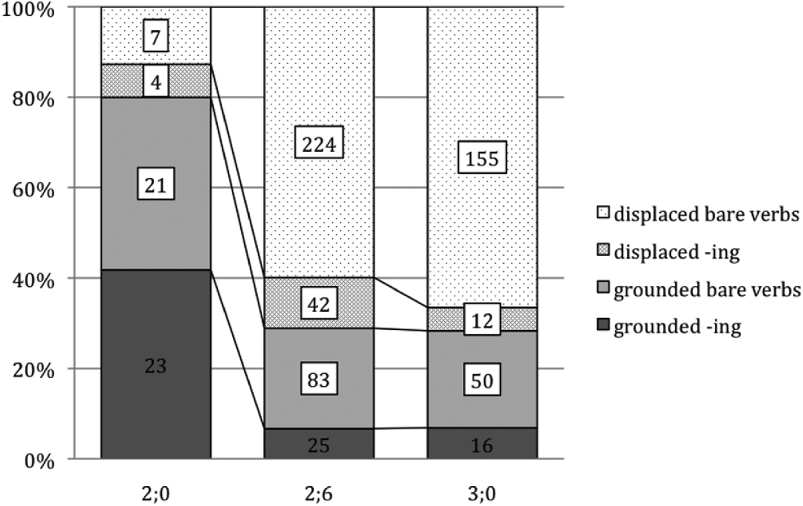
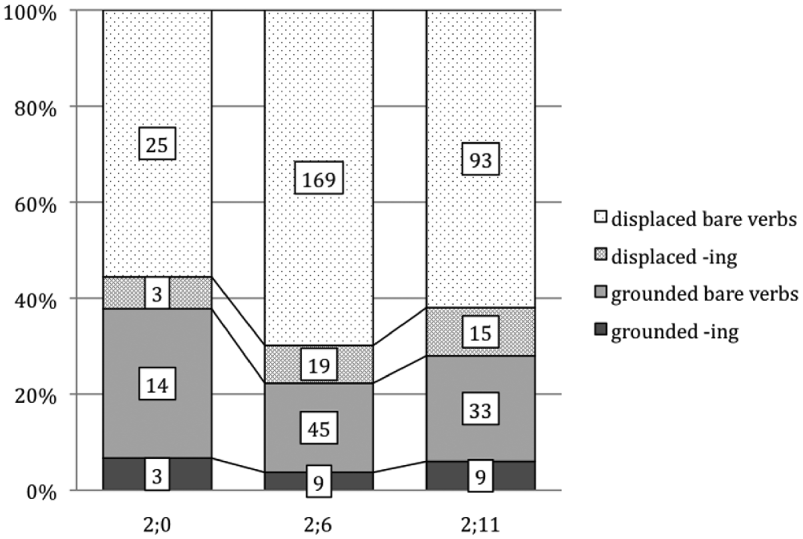
Figures 2 and 3 show the proportion of all verbs that are grounded versus displaced. These are further divided by those which carry imperfective morphology (-ing) and those which do not. The data are presented at the three developmental time-points for each child. Raw figures are displayed within the bars; proportion is displayed on the y-axis.
Thomas' CDS broken down by grammatical aspect and groundedness.
Eleanor's CDS broken down by grammatical aspect and groundedness.
In total there were 1,099 adult verbs coded across six hours of video-recording, 662 for Thomas and 437 for Eleanor. For Thomas, there was a reduction from 80% to 30% in grounded events between 2;0 and 2;6 (and sustained until 3;0). Eleanor's CDS had a much lower level of grounded events to begin with (38% at 2;0), reducing to about 22% at 2;6 then recovering somewhat to 28% at age 2;11. In this data, looking at verbs, there was only one developmental period for one child where ‘here-and-now’ utterances represented the majority (2;0, for Thomas). As we might expect, the unmarked perfective form is more frequent overall and at most ages it outnumbers the imperfective form 4:1. The exception to this is in Thomas' CDS at 2;0 for grounded events when both forms are approximately equally frequent. Averaging over both children and all ages, approximately 30% of verbs were grounded, that is, when a verb was uttered a clear referent could be recovered from the 60-second window. The next analyses looks at the nature of the 30% of verbs which do have a grounded referent, to see if there is a relationship between the nature of the events and the pattern in the perfective/imperfective language used to describe them.
Reliability analysis: nature of the event and grammatical aspect
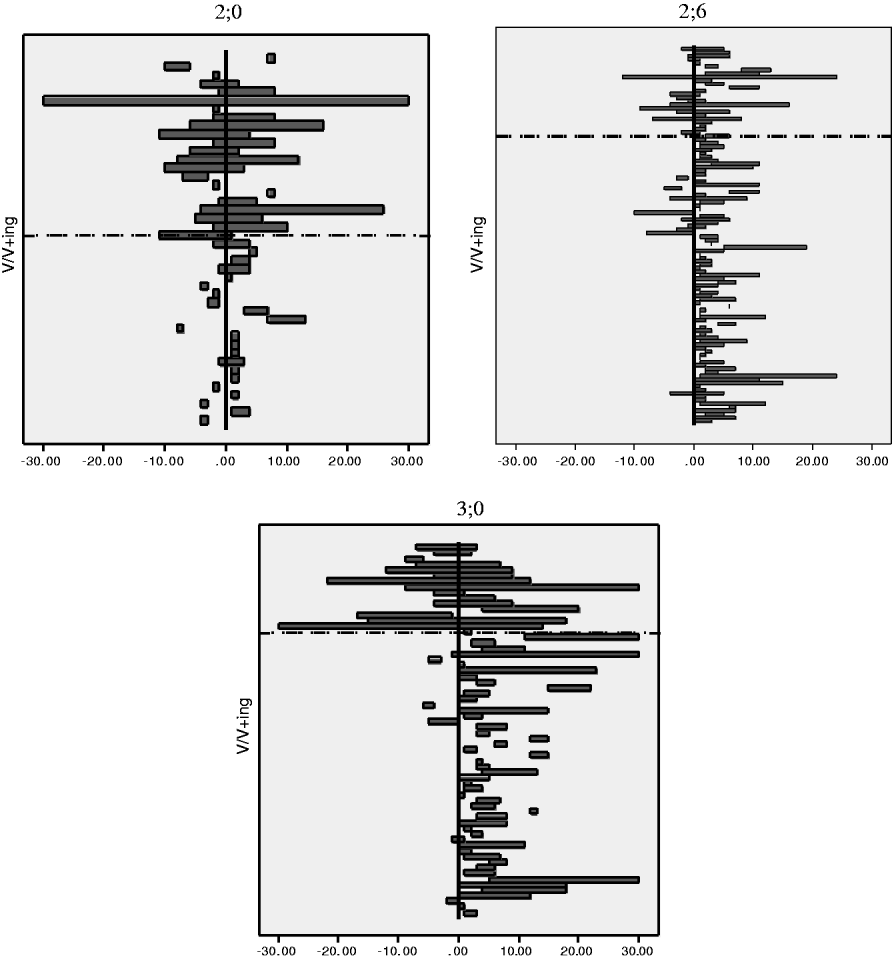
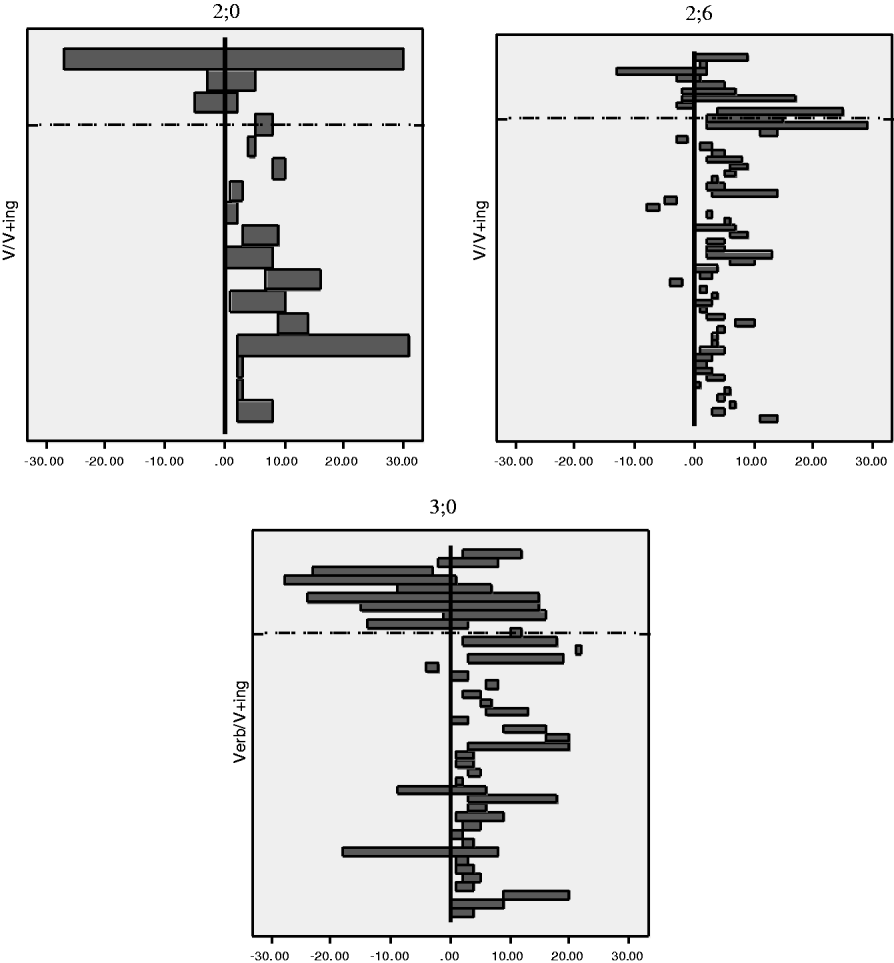
Figures 4 and 5 show the data from the 331 grounded verb–event pairs, codable from the video-recording. The horizontal bars represent the duration of the events. To compare one event with another we zeroed all verbal utterances, represented on the graph as the solid vertical line at 0. To do this, the beginning of the event was calculated as [beginning of event – time of verb utterance] and the end of event was calculated as the [end of event – time of verb utterance]. Events that appear to the right of this line are performed after the caregiver has uttered the verb, events to the left appeared before, and events that overlap the line are concurrent with the utterance. The dashed line divides all verbs into -ing verbs (above the line) and non-ing bare verb forms (below the line).
Thomas: duration of event and grammatical aspect.
Eleanor: duration of event and grammatical aspect.
Event duration
We examined event duration because ongoingness is a crucial part of the perfective/imperfective function. A Mann–Whitney U test was conducted between the duration (in seconds) of the -ing events and the non-ing events. Summing the data across all ages, for Thomas, this showed a significant difference (U(218), Z=4·92, p<·001) between events labelled with -ing (Med=6·5 seconds) versus those without (Med=3·0 seconds) such that events labelled with imperfective morphology were longer. Summing the data across all ages, for Eleanor, the same comparison showed the same result. There was a significant difference (U(113), Z=5·06, p<·001) between events labelled with -ing (Med=12·5 seconds) versus those without (Med=3·0 seconds), such that events labelled with imperfective morphology were longer. On average, across all time periods and both children, events described with -ing were over four times longer than those without.
Verb timing relative to event
We examined the timing of the verb since construing the event from within is a crucial part of the imperfective function. We calculated the proportion of verbs that were uttered as the child was performing the action (concurrent) against those which were not (non-concurrent). This was done by counting the frequency of those event times with a negative and a positive value, showing that they had crossed the 0 second timeline when the verb was uttered. We then divided those verbs into ones which had imperfective -ing and those which did not (Table 1).
A summary of frequency counts for those events that crossed the verbal utterance (X) versus those that did not (no X), displayed by aspectual marking

Chi-squared (with Yates' correction) on Thomas' data showed that there was a significant difference between the likelihood of imperfective and perfective verbs overlapping with the event (χ2(1, N=218) 76·49, p<·001). For Thomas a word with -ing morphology is 1·5 times more likely to occur within the boundary of the event (38/26). A word lacking -ing morphology is 18·2 times more likely to occur outside the boundaries of the event (146/8).
Chi-squared (with Yates' correction) on Eleanor's data showed that there was a significant difference between the likelihood of imperfective and perfective verbs overlapping with the verb (χ2(1, N=113) 58·85, p<·001). For Eleanor a word with -ing morphology is 2·5 times more likely to occur within the boundary of the event (15/6). A word lacking -ing morphology is 45 times more likely to occur outside the boundaries of the event (90/2).
The results from the reliability analysis show that imperfective form V-ing was associated with longer actions on average and much more likely to occur while the child is performing the action to which the verb refers. It is also worth noting that most of the perfective events are displaced to the right of the verb line, according with Tomasello and Kruger (Reference Tomasello and Kruger1992) who found that majority of verbs were used by mothers to refer to actions that mothers wished children to perform or that they were anticipating their performing.
Finally, we wanted to know whether verb type is confounded with aspectual morphology. Where an -ing verb occurred in a grounded context we examined whether that verb occurred at least once without -ing (Table 2). For example, for the verbs doing, taking, and giving we looked for at least one instance of do, take, and give.
Percentage of -ing verbs that also occur in the unmarked form (raw figures in parentheses)

There is clearly variability between the two children's CDS, but on average, when a -ing verb occurs it is available 64% of the time in a non-ing verb. This shows that verb type disassociates with respect to aspectual morphology in CDS. Interestingly, for both children this proportion increases with age, providing suggestive further evidence to the claim that, early on, children's verb-specific use falls into one of two prototypical tense–aspect clusters (cf. Li & Shirai, Reference Li and Shirai2000; Wagner, Reference Wagner2009).
In summary, Figures 4 and 5 demonstrate that for both Thomas and Eleanor the perfective–imperfective language used in CDS maps consistently onto the ongoingness of the event and how likely the verb is uttered at a time when the child will be in the midst of performing the action.
DISCUSSION
We set out to characterize the pragmatic context in which children hear grammatical aspect in English. We looked at the duration and timing of children's actions relative to the verb that described these actions in CDS. We interpret these findings following the structure of the data analysis; first we discuss availability and then the reliability results.
We established to what extent caregivers are grounding their descriptions of their child's activities in the immediate context. Averaging over both children and all developmental time-points, we found 30% of verbs referred to an event that was recoverable within a 60-second window of the verb being uttered. We also noted that the unmarked perfective verbal forms outnumber imperfective forms 4 to 1. This gave us a broad estimation of how available and recoverable the referent of the verb was from the immediate context.
At a general level, it is possible to think of the child's task in working out how language is used as a signal detection task in a noisy environment (e.g., MacWhinney et al., Reference MacWhinney, Bates and Kliegl1984). The 30% figure of the imperfective/perfective distinction in grounded contexts represents the availability of the signal. All following claims regarding the reliability of this signal or cue must be made with respect to this baseline denominator. In theory, the hardest pattern to detect would be an infrequent and unreliable cue. We don't know for sure whether the 30% rate reaches some critical threshold of tokens whereby we could say this cue is now ‘available’. But what we can say is that the less available the cue is – and in this case it is more unavailable than available – the more it will need to be reliable (when it is available) if it is to be detectable or learned. Of course, displaced referents can still be construed as either more ongoing – do you remember running yesterday – or less ongoing – remember when you broke your leg. Recalling these events (or projecting into the future) still construes in the mind of the speaker/addressee an event as seen from within and thus ongoing or from a ‘bird's-eye’ position and thus completed. One might speculate that a proportion of these displaced actions also received descriptions contemporaneously. It would indeed be interesting to look at these cases, but the present study did not analyze these examples for two practical reasons. First, the coding of the speakers' referential intention became unreliable much beyond a 60-second window from the verbal utterance, and second, in the case of events that happened off camera, they were completely uncodable in terms of measuring the duration and timing of the event.
One final point to be made regarding the availability analysis is that, for Thomas, the first development window showed a much higher level (80%) than the average grounding figure (30%). For Thomas at least, CDS was more grounded with respect to verbal referents early on in development. We know Eleanor's language ability is advanced in comparison to other children in this corpus (e.g., Lieven, Salomo & Tomasello, Reference Lieven, Salomo and Tomasello2009). It could be that we would have also seen higher levels of grounded CDS for Eleanor had we been able to measure at an earlier stage than our corpus allowed. The pattern seen in Thomas raises the possibility that adults gradually talk about a larger proportion of displaced events as language develops. More children and a more detailed analysis of the data would confirm the precise nature of this interaction. For example, do adults expand the proportion of displaced events as a result of children talking more about displaced events, or do adults, realizing that children have reached a certain proficiency in their language, start to introduce more displaced events into the conversation? There are claims that CDS can be characterized as relatively more grounded in the here-and-now relative to adult-to-adult speech (Brown & Bellugi, Reference Brown and Bellugi1964; Cross, Reference Cross, Snow and Ferguson1977; Dil, Reference Dil1971; Snow & Ferguson, Reference Snow and Ferguson1977). However, as our study testifies, there are large proportions of development in which speech is significantly displaced (see also Gleitman, Reference Gleitman1990).
We now turn to the reliability of the aspectual distinction. That is, regardless of how frequent the cue is, how consistently does the ongoingness of the action as performed by the child map onto the perfective/imperfective aspect used by the caregiver to describe that event? We found that the length of the child's action predicts both the caregivers' choice of grammatical aspect and the co-occurrence of action and verb. These features correspond with two functions of imperfective aspect, namely, that events are construed as ongoing and from within.
First, the association between child event duration and CDS imperfective morphology is fairly clear. Longer actions are more likely to be associated with verbs that have been inflected with -ing. This provides a strong cue to the child that one of the functions of imperfective morphology is to indicate how ongoing the activity is. The reliability of this cue is useful to the child in terms of signal detection, given the low availability rate of grounded events. The second claim regarding the timing of the verb and the child's action perhaps requires more unpacking. There is mounting evidence from the embodied cognition literature that language develops in a tight association with perception and action (Childers & Tomasello, Reference Childers and Tomasello2003; Ejiri & Masataka, 2001; Glenberg, Reference Glenberg and Gaskell2007; Goodwyn, Acredolo & Brown, Reference Goodwyn, Acredolo and Brown2000; Hahn & Gershkoff-Stowe, Reference Hahn and Gershkoff-Stowe2010; Iverson & Fagan, Reference Iverson and Fagan2004; Iverson & Goldin-Meadow, Reference Iverson and Goldin-Meadow2005). When one hears a linguistic symbol, for example running, this re-activates stored sensorimotor information associated with running events (Barsalou, Reference Barsalou1999, Reference Barsalou2008). The embodied cognition view emphasizes that cognition is a situated activity and as such we should include sensorimotor activities as part of the pragmatic context. This is very similar to a claim made by early developmental theorists such as Piaget (Reference Piaget1952), Werner and Kaplan (Reference Werner and Kaplan1963), and Nelson (Reference Nelson1974). With respect to grammatical aspect, the hypothesis is that the embodied event of performing the action facilitates construing the scene from within and blurring the boundaries of the event. This is because, if the verb has imperfective -ing, the child is much more likely to be in the midst of action than if the verb is in its perfective form. By building a record of these embodied events in association with the aspectual morphology they do or do not hear, children can begin to form a verb-general notion of what the function of -ing is. The Chi-squared analysis provides support for this hypothesis, namely, more events described with -ing morphology occur concurrently with the verbal utterance than those without -ing. Again, the reliability of this cue is useful to the child in terms of signal detection given the low availability rate of grounded events. However, it is noticeable that there is an even stronger pattern for verbs that lack -ing to not occur concurrently with the event. In short, the majority of -ing forms occur concurrently with the event but sometimes fall outside of it; the non-ing forms very rarely occur concurrently with the utterance. One could reason from this data (if one were a language learner) that whatever the function of the unmarked form, it is not associated with contexts where one has an internal perspective on an event. As mentioned above, there are a minority of grounded -ing forms that do not overlap with the child performing the event, for example sentences of the form you were hitting him, weren't you? Further analysis of the pragmatic context and associated linguistic material may be able to distinguish between grounded overlapping -ing use and non-overlapping -ing use.
As we have emphasized, the claims regarding reliability need to be understood in the context of the base rate 30% average verbal grounding figure (with the qualification about Thomas' developmental differences). More generally, the methodology we have used here advocates exploring linguistic cues in combination with the social–pragmatic context. By using video evidence we have been able to consider a broader range of cues than a traditional corpus-based approach. By doing so, we have been able to get closer to reconstructing the rich social–pragmatic–linguistic world in which the child grows up. The challenge is to explore ways in which social–pragmatic skills interact with prodigious pattern-finding abilities in a way that explains the emergence of linguistic knowledge. For instance, French has numerous homophones, especially in the form of infinitives and past participles for class 1 verbs. Similar to the approach taken in this study, Clark and de Marneffe (Reference Clark and de Marneffe2012) examined the pragmatic contexts in which children hear the crucial alternations. They found that adult speech to young children consistently distinguishes infinitival uses from participial ones: they are produced in different contexts, depending on the timing of the event being talked about, and they are presented in different constructions. Thus adults consistently mark the potentially ambiguous homophones by distinguishing the meaning carried by the infinitive from that carried by the past participle in the communicative context.
Grammatical aspect is potentially an abstract notion. However, the social, pragmatic, and referential context in which a child hears aspectual language is a rich source of information that may limit the degrees of freedom on what these constructions mean. Detecting the way adults reliably use language across different situations is a powerful learning mechanism (Clark & de Marneffe, Reference Dil2012; Scott & Fisher, Reference Scott and Fisher2012; Smith & Yu, Reference Smith and Yu2008). The data from these observations suggest the main perfective/imperfective distinction is available in grounded communicative contexts for approximately 30% of verbal utterances. Of these utterances there are two features of the communicative context that reliably map onto the functions of the imperfective–perfective distinction, namely the duration and the timing of the event. This may go some way to explaining why it is one of the first morphological markers to come under the child's control (Brown, Reference Brown1973). The data also provide one explanation of why imperfective aspect coerces people into construing the event from within. When the function of -ing was being constructed in development, the majority of actions associated with -ing are performed from within the action.
Appendix: all verb forms analyzed in the study