Traditionally, teaching of CHD has been conducted either using textbooks, medical journals, classroom lectures, grand rounds, and local, national, and international conferences. Reference Cohen, Jacobs and Cicek1–Reference Anderson, Kumar and Mussato4 These learning formats typically detail one specific area of CHD either physiology, anatomy, embryology, surgical, or medical management, arrhythmic problems, or psychosocial challenges.
In the COVID-19 era, our normal lives have been disrupted in a manner not witnessed in more than a generation. Reference Zhang and Ma5 Traditional group teaching methods such as grand rounds and conferences have been cancelled with the hope that they will be rescheduled soon. Reference Viglione6 To fill the void, several medical societies and educational groups have turned to utilising Webinars to deliver high-quality educational content to local, national, and international audiences.
A Webinar, or web-based seminar, is a lecture, seminar, or workshop that is transmitted to an audience via the web utilising video conferencing software. “A key feature of the Webinar is the interactive element and the capacity for the presenter to give, receive and discuss information in real-time” (Webopedia). It allows for synchronous teaching and learning over a wide geographical area with access to the Internet, which is the only requirement to learning. Reference Davis, Flannery and Payne7 It also allows several international experts to meet and deliver educational content in a manner that fits easily into their schedules. Webinars offer live streaming options or they can also be recorded and uploaded to Youtube and other streaming and storage media.
Another critical strength of the Webinar is its capacity to promote interdisciplinary learning through different stakeholders (cardiology, surgical, nursing, allied healthcare professional, and trainees) involved in presentation and discussion of the talks. Reference Goch, Rosiek and Leksowski8
Despite the proliferation of Webinar learning, there is little educational research examining the impact of this method of learning. The study aimed to explore whether first the Webinar facilitates learning and second whether it offers a viable alternative to more traditional teaching methods.
The focus of this study is a Webinar, which addressed the management of the patient with tetralogy of Fallot. The format allowed several experts to address specific problems pertaining to the lesion, each bringing their sub-specialty knowledge to the Webinar. The learner, therefore, had the ability to receive several viewpoints to the same topic with the potential that this would enhance their knowledge, and may promote further learning through cross-fertilisation of learning and deep questioning after each individual presentation. The Webinar was hosted by the Heart University, a new e-learning website in CHD. Reference Tretter, Windram and Faulkner9 It is a carefully curated open-access library of educational material for all providers of peadiatric and adult congenital cardiology health care, both trainees and practicing providers. The site is managed and curated by editorial boards for the component sites (Pediatric Cardiac Learning Center and Adult Congenital Heart Disease Learning Center) comprised an international group of experts covering a wide range of subspecialties with an endorsement from major international organisations in the fields of paediatric and adult CHD. The Heart University platform was used to promote this new form of CHD education, with additional marketing via e-mail and social media.
Deep human learning is defined as higher order cognitive understanding of complex concepts of a specific condition, including aspects of uncertainty related to the condition as opposed to superficial learning, which is learning facts or rote learning. Reference Ma and Vervoort10 It also involves critical analysis of new ideas linking them to previously known concepts and metacognitive thinking to promote long-term understanding.
The Webinar took place on 6 May, 2020. Following the Webinar, learners were invited to complete an anonymised online questionnaire following the presentation to determine if the Webinar had influenced their learning. The complete questionnaire is included in Appendix A.
Research Questions: The first research question is whether Webinar e-learning provides deeper human learning than standard educational formats (textbooks and journals)? The second question is what are the strengths and weaknesses of the Webinar? The third question asked what carbon footprint could be saved by switching from an international conference to a Webinar format?
Patients: All those who have registered and participated in the Webinar were eligible for inclusion in the study. The study was approved by the ethics department at the University of Alberta, Edmonton, Canada.
Methods
This was a cross-sectional survey design study using a web-based questionnaire. The tool for the assessment of learners was an online survey (Appendix A). All those who have registered and participated in the Webinar were eligible for inclusion in the study and were invited by e-mail to participate in the online survey.
This was a quantitative research methodology using descriptive statistical analyses instead of inferential statistics. There was a sequential explanatory design where quantitative results underwent further qualitative exploration. The philosophy was positivism with a deductive approach.
Demographic data was collected to assess the learner’s characteristics (age, location, gender).
A simple Likert 7-point scale was used to assess their opinions on various teaching points within the Webinar. Open and closed questions using SurveyMonkey was also used to document the learners’ opinions on the Webinar.
We also made the assumption that the Webinar was, in fact, an international conference held at Cincinnati Children’s Hospital Medical Centre (CCHMC) Cincinnati, Ohio, United States of America. From the registry of participants’ country and city of origin, we calculated the total distance (in addition to median and range, the latter represented by the shortest and longest distances) travelled by airline flights to and from each participants’ country of origin to gauge the carbon footprint of an international conference.
Results
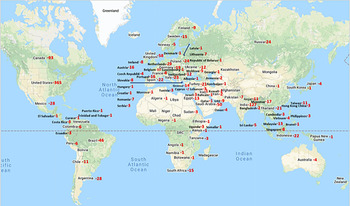
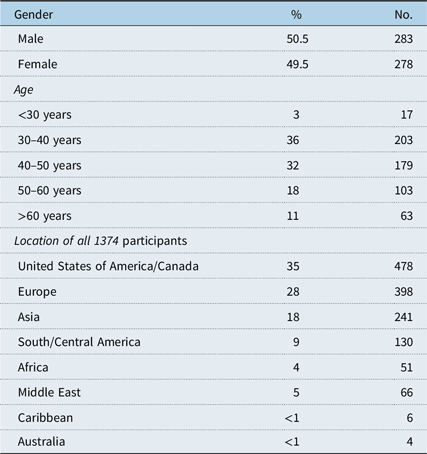
There were 2149 registrants for the Webinar, and the live educational event was attended by 1374 participants (64%) from 100 countries on 6 different continents. Five-hundred and fifty-seven participants (40%) completed the online questionnaire (Fig 1). The demographics of those involved in the Webinar are presented in Table 1. The professional mix of the participants included paediatric cardiologists (66%), followed by adult congenital cardiologists (13%), paediatric cardiology trainees (10%), cardiothoracic surgeons (9%), nurses (1%), and anaesthesiologists (1%). One-hundred countries were represented in the Webinar population with the largest number of 106 participants from the United States of America and the smallest number one participant from Somalia.
Global map of location and number of participants in the Webinar.

Demographics of 557 Webinar participants

Perception of Webinar compared to international conference attendance
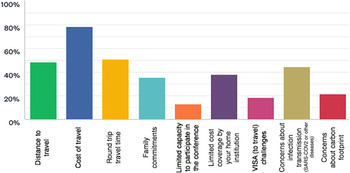
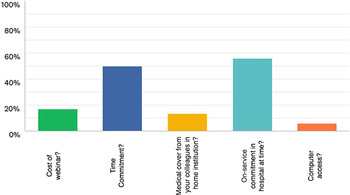
Sixty-six percent of participants expressed a desire to attend Webinars in place of international conferences. Over 80% of participants highlighted significant barriers to attending conferences including cost (79%), distance to travel (49%), time challenges (51%), and family commitments (35%) (Fig 2). Over 50% of participants reported barriers to attending the Webinar most commonly having an on-service commitment in the hospital (56%), time challenges (51%), needing medical cover from colleagues (13%), and potential Webinar costs (17%) (Fig 3). Just over half (53%) reported that they were worried by the carbon footprint of travel to and from the conference with them preferring a transition to Webinar platforms.
Barriers to attending international paediatric cardiology conferences.

Barriers to attending Webinar.

Preferences for timing of Webinar
Nearly 100% of participants found the Webinar useful, 73% having previously participated in a Webinar. Participant preferences for timing of the Webinar was in the evening (67%) or on the weekends (41%) with only 19% preferring it during working hours or 11% in the morning before work began.
Impact of the Webinar on deep learning related to each of the talks
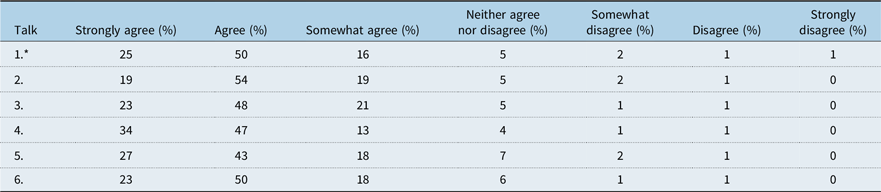
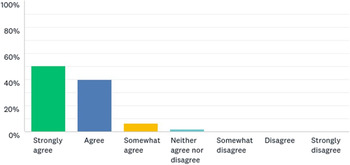
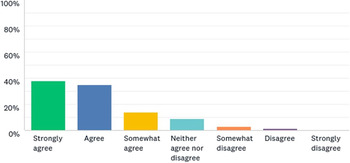
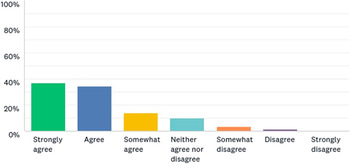
Each of the Webinar topics dealt with a unique aspect of post-operative tetralogy of Fallot management (Table 2) ranging from optimal surgical strategy to resource limitations of management in low- and middle-income countries. For each of the talks. the participants rated the talks as agree or strongly agree to providing deep learning regarding the subject matter (Table 2). The majority of trainees (>70%) also agreed that the Webinar provided deeper learning than traditional learning methods such as reading journals or textbooks (Figs 4 and 5). Furthermore, over 70% of trainees believed the multidisciplinary (Fig 6) and interdisciplinary approach provided deeper learning in the management of post-operative tetralogy of Fallot patients.
Response of participants to “do you have a greater understanding of each webinar talk?” (7-point Likert scale)

*1. Criteria for annulus-sparing tetralogy of Fallot repair?
2. Criteria for pulmonary valve replacement after tetralogy of Fallot repair?
3. Risk of endocarditis after melody valve replacement?
4. Utility of transthoracic echocardiography in repaired tetralogy of Fallot?
5. Indications for an electrophysiology study after tetralogy of Fallot repair?
6. Role of cardiac MRI in post-operative tetralogy of Fallot patients in low- and middle-income environments?
Participants who believed the Webinar provided deeper learning than textbooks.

Participants who believed the Webinar provided deeper learning than journals.

Participants who believed the multidisciplinary approach provided deeper learning in relation to post-operative tetralogy of Fallot management.

Strengths and weaknesses of the Webinar format
Participants expressed a variety of responses to the question of which areas they thought would improve Webinar education. Some stated that increased participation would help “allow more interaction from participants in terms of Q&A Session”. Some expressed their desire for there to be a CME component to the Webinar “CME credit” and “…. some form of CME, it would be greatly appreciated”. Some stated specific topics they would like to learn such as “single ventricle heart failure in CHD” and “heart failure in ACHD Fontan circulation”. Others felt that the approach to “recent updates and controversial issues” would aid their learning whilst others had no suggestions or were unsure as to what would help future Webinars.
Common themes mentioned as strengths were the quality and expertise of the speakers, talks being concise and to the point, use of evidence-based medicine, highlighting contentious issues, and the high quality of the technical platform.
The most common weakness was inadequate time to answer all the participant questions. At most 1–2 questions per talk could be addressed despite 10–15 questions being posed per talk. Inadequate time for interaction between each of the speakers, brevity of the talks, inadequate time breaks between the speakers, and audiovisual problems were also highlighted.
Carbon footprint of international travel
The median distance travelled from international countries (excluding the United States of America) to and from the virtual conference centre (CCHMC) was 17,424 km (range 1208–36,004 km), Australia being the furthest country. The cumulative roundtrip airline distance travelled for all the participants was 18,124,290 km.
Discussion
Online learning platforms have become essential to disseminate new scientific ideas and maintain the necessary ongoing education of trainees and practicing physicians given the cancellation of international, national, and regional conferences. Reference Tretter, Windram and Faulkner9,Reference Ma and Vervoort10 Heart University, a free educational online platform aiming to be “the go-to online resource” for e-learning in congenital and paediatric acquired heart disease, has become increasingly relevant during these changing times. Reference Hermida11 Recognising the pressing need for not only enduring education, but also contemporary live educational events for both trainees and practicing providers, the editorial boards of the component sites for Heart University, that being the Pediatric Cardiac Learning Center and the Adult Congenital Heart Disease Learning Center, discussed and implemented the idea of holding a periodic Webinar covering the most up-to-date practice of CHD, appropriately titled the Heart University Contemporary Questions in Congenital Heart Disease Webinar Series. On Wednesday, 6 May, 2020, the first Webinar in this series was held, titled Tetralogy of Fallot: How can we avoid poor outcomes late after repair? This was a historical event in that it represents the largest gathering of CHD providers for which we are aware of ever to assemble outside of the Quadrennial World Congress of Pediatric Cardiology and Cardiac Surgery.
Webinar e-learning appeared to have a dramatic impact on stimulating deep learning for the participants involved with >70% agreeing or strongly agreeing that they derived greater depth of learning from each of the Webinar talks than a more traditional textbook or medical journal methods of learning. The reasons for such deep learning may relate to the high-quality speakers, talks providing the current state-of-the-art knowledge, but then delving into unanswered questions and trying to formulate new ways of addressing such questions, robust question and answer sessions, and finally a moderator who succinctly summed up the relevant 3–4 points from each talk and at the end of the Webinar provided an overall conclusion. The fact such a wealth of expertise and international audience experience could be harnessed within 2 hours is strongly supportive of this pedagogical strategy into the future.
Whilst the Webinar format clearly fills a need during the ongoing global pandemic, it also challenges the current paradigm of attending meetings physically, which may resume in the post-pandemic period. As such we believe that it represents a COVID-19-facilitated disruption to our current approach. Joseph Schumpeter first described the concept of “creative destruction” in 1942, a dismantling of traditional practices in order to facilitate innovation most commonly in the manufacturing process (Henry Ford assembly line). Reference Schumpeter12 Clayton Christensen then went further in 1995 to describe the concept of “disruptive innovation”, which creates a new market and network which disrupts existing structures (e.g., Webinars displacing international conferences). Reference Christensen13
Like most disruptive technologies, it may not completely replace the traditional alternative (e.g., digital music versus vinyl), but it is difficult to envisage a complete return to pre-pandemic practices. There will be likely fewer in-person educational forums, they still will have a role. For example, a Webinar cannot replace the benefits of in-person networking, and the many other social, educational, and other benefits of a traditional in-person meeting. However, unlike some online learning experiences, an interactive Webinar can better address the dynamic social-educational needs for many providers and trainees, and provide the feeling of “inclusivity” and accessibility in the learning experience. At a more practical level, it facilitates interactive learning to those who may simply be unable to attend in-person meetings due to logistical barriers (i.e., being unable to free up the necessary time from their clinical duties). It also becomes increasingly relevant in low- and middle-income countries where monetary barriers related to travel and conference expenditures may additionally prohibit attending in-person conferences. Reference Ma and Vervoort10 Additionally, providing such high-quality educational experiences addresses an additional deficiency in consistent quality education, especially in specialty and sub-specialty education in many low- and middle-income regions.
Climate change remains another pressing crisis of our times in the setting of the COVID-19 pandemic. Reference Rossati14 Previous authors have called for a rationalisation of carbon footprint during conference attendances. Reference Spinellis and Louridas15 It was perhaps surprising that only a small majority of participants expressed concern about the carbon footprint of conference attendance. However, this Webinar would have saved 18 million carbon kilometres had all those attendees travelled to Cincinnati for an in-person conference. Given there are 1500 + international medical conferences per year and greater than 3000 general conferences (theconferencewebsite.com), the carbon footprint savings through Webinar use would be astronomical, promoting a “sustainable academia”.
Learning points regarding Webinar organisation
Although the benefits of the Webinar include potential for significantly greater numbers of participants, broader global participation including from developing countries, and greater engagement in questions and answers session, there are some critical components to making the Webinar successful. Standardising the operating procedure to the Webinar is advocated. Reference Hennus and van Dam16 This webinar was very thoughtfully designed as a series of provocative questions/statements that kindled the natural curiosity of the audience. A poorly designed webinar may cause the audience to “switch off”.
Adequate broadband is fundamental so people can clearly hear the speaker. The total Webinar duration should be short and focused perhaps less than 2 hours in total with speakers at most presenting for 10–12 minutes. Speakers should ideally be recognised experts in the field and have the academic/professional credibility to attract a large audience. Ideally, there should be 2–3 major points per speaker and the moderator is fundamentally important in steering the discussion to those critical points in addition to summarising at the end the take-home message. Attendees need to take something meaningful from the Webinar. If attendees tune out during the Webinar, they often will not return to the session.
Digital conferencing and Webinar technicalities
The platform employed depends on what each type of presentation demands, e.g., Zoom cannot typically play audio–videos, whereas GoToMeeting can play videos. Reference Hannon, Lappe and Griffin17 Sound production staff are often required to ensure high-quality sound and pitch in addition to ensuring there is no delay in initiating the webinar and keeping speakers on time. A neutral colour should be employed for the background to circumvent bookcase envy and distractions by the presenters’ literary tastes. Furthermore, a neutral background will block out any far-field activity or unexpected intrusions (Dr Robert Kelly and his children on the BBC). Reference Morris18 Lastly, the lighting should be orientated to spread evenly across the presenter’s face and avoid distracting shadows.
Limitations
Only 40% of participants completed the questionnaire, which may result in a confirmation bias towards Webinar participation. Although participants reported deeper learning from Webinar compared to textbook learning, this study did not actually quantify the outcomes of Webinar learning. A quantitative tool to measure pre- and post-Webinar learning would have provided additional data. Furthermore, artificial intelligence algorithms and a case-based scenario including a layer of human understanding and data processing could be explored in future studies. Carbon footprint use in conference attendance also relates to several other variables including hotels, non-airline transport (taxis, buses), electricity use, etc., which we did not include in this analysis. Many parts of the world are in a time zone not conducive to watching the Webinar, which may also have had a dramatic impact on the audience make up.
Conclusions
The global COVID-19 pandemic has dramatically altered the learning environment. Currently, two-thirds of Webinar attendees prefer to attend a Webinar rather than attend an international conference. Webinar learning promotes deep learning, greater audience participation including those from low-resource settings, wider multi- and interdisciplinary participation, and greater attendee satisfaction with fewer barriers to participation. Given the inherent networking benefits of medical conferences, it appears unlikely that e-learning Webinars will ever fully replace conference attendance as a disruptive innovation in the future. However, the adoption of a hybrid model as a “sustainable academic” approach would appear to be a pragmatic solution to the current pandemic crisis and a likely model for the future.
Acknowledgements
We are grateful to Drs Glen van Arsdell, Andrew Redington, Luc Mertens, Nico Blom, R.K. Kumar, Doff McElhinney for their participation in the Webinar.
Financial support
None.
Conflict of interest
None.
Ethical approval
The authors assert that all procedures contributing to this work comply with the ethical standards of the relevant national guidelines and with the Helsinki Declaration of 1975, as revised in 2008, and has been approved by the institutional committees (Ethics Committee University of Alberta, Edmonton, Alberta, Canada).
Appendix A Online questionnaire/survey of Webinar patients
Do you consent to take part in this online survey and that the data you provide can be analysed by the Heart University team? No third parties will be given this data.
Q1. How would you describe yourself?
Allied health care professional
Anaesthesiologist
Cardiologist
Paediatric
Adult CHD
Nurse
Surgeon
Trainee Which area?
Other area ________________________________
Q2. What level of training are you?
Trainee: resident or fellow (which year?),
Attending/consultant (how many years?)
Q3. What age are you?
<30
30-40
40-50
50-60
>60
Q4. Sex
Male
Female
Q5. Where do you live
City
Country
Q6. Have you previously participated in a webinar?
Y/N
Q7. Would you prefer to attend webinars than attend international cardiology meetings?
Y/N/undecided/both
Q8. If so why?
What barriers are there to travelling to international conferences for you?

Q9. Are you concerned about carbon footprint of travel to international conferences?
Q10. What barriers are there to you attending the Webinar?
Q11. Which time during the day would be optimal for you for Webinar?
During working hours
Early in morning before work
Later in evening after work hours
At the weekend
Q 12. Do you have a greater understanding of criteria for annulus-sparing TOF repair?
Strongly disagree/disagree/somewhat disagree/neutral/somewhat agree/agree/strongly agree
Q13. Do you have a greater understanding of the criteria for PVR after TOF repair?
Strongly disagree/disagree/somewhat disagree/neutral/somewhat agree/agree/strongly agree
Q14.Do you have a greater understanding of criteria for Melody valve placement after TOF repair?
Strongly disagree/disagree/somewhat disagree/neutral/somewhat agree/agree/strongly agree
Q15. Do you have greater understanding of risk of endocarditis after Melody valve placement TOF?
Strongly disagree/disagree/somewhat disagree/neutral/somewhat agree/agree/strongly agree
Q16. Do you have greater understanding of the utility of echocardiography in repaired TOF?
Strongly disagree/disagree/somewhat disagree/neutral/somewhat agree/agree/strongly agree
Q17. Do you have a greater understanding of the indications for EP study after TOF repair?
Strongly disagree/disagree/somewhat disagree/neutral/somewhat agree/agree/strongly agree
Q18. Do you have a greater understanding of the indications for MRI after TOF repair?
Strongly disagree/disagree/somewhat disagree/neutral/somewhat agree/agree/strongly agree
Q19. Did the multidisciplinary (Surgical, medical, anaesthesiology, EP, imaging) approach to the Webinar promote richer deeper learning for you in relation of postoperative TOF management?
Strongly disagree/disagree/somewhat disagree/neutral/somewhat agree/agree/strongly agree
Q20. Did the interdisciplinary (Different stakeholders cardiologist, nursing, AHP, trainees) discussion to the Webinar promote richer deeper learning for you in relation of postoperative TOF management?
Strongly disagree/disagree/somewhat disagree/neutral/somewhat agree/agree/strongly agree
Q21. Which part of the webinar do you think provided an increase in your deep learning regarding tetralogy of Fallot management?
Strongly disagree/disagree/somewhat disagree/neutral/somewhat agree/agree/strongly agree
Q22. Did you find the Webinar overall useful?
Strongly disagree/disagree/somewhat disagree/neutral/somewhat agree/agree/strongly agree
Q23. Do you prefer to watch a live webinar than watch a recorded webinar?
Strongly disagree/disagree/somewhat disagree/neutral/somewhat agree/agree/strongly agree
Q24. Having completed this webinar I will likely rewatch this webinar on the Heart University website to further my learning?
Strongly disagree/disagree/somewhat disagree/neutral/somewhat agree/agree/strongly agree
Q25. Having completed this webinar I will visit the Heart University website to further my learning?