Introduction
Even though during natural or human catastrophic events, disadvantaged people are universally known to be at a greater risk than others, rarely do they receive specific, tailored information.
In 2006, the United Nations (UN) Convention on the Rights of Persons with Disabilities launched the largest human rights treaty, 1 and Italy ratified it with the Law n. 18 of March 3, 2009. In Article 9, comma 1), letter b), this Convention required governments to ensure accessibility to “information, communications, and other services, including electronic services and emergency services.” In 2007, a UN optional protocol (effective since May 3, 2008) included a statement in Article 11 on the “humanitarian and risk situation” regarding the protection and safety of people with disabilities in the event of risk situations (armed conflicts, humanitarian emergencies, and natural disasters).2 In 2007, the “Charter of Verona,” drafted by the Italian Civil Protection Institution (Rome, Italy) and signed by other international organizations and various associations of people with disabilities, stated again the need for avoiding discrimination and providing equal opportunities, particularly to disadvantaged people.Reference De Cristan, Padovani and Bertacco3 This document described the operations needed, from planning to implementing, to involve people with disability, aiming at minimizing the risks and seeking suitable interventions. It also provided specific training for operators involved in risk management and in rescuing people with disabilities during emergencies and maxi-emergencies. In 2010, the European Parliament Resolution on natural and man-made disasters underlined this statement giving special attention to “the specific needs of people with disabilities, in all actions taken using civil protection mechanisms.”4
Despite authoritative international regulations ratified by several countries, difficulties still arise in the first emergency response during natural disasters or other maxi-emergencies involving people with disabilities. During disaster interventions, operators and practitioners are frequently unaware of the various communication tools needed by disabled people and fail to request access to services for interpreting and translating tailored information. Accordingly, disabled vulnerable people can experience physical, sensory, and cognitive dysfunctions in receiving and understanding alarms and emergency information, making it difficult to take appropriate measures. Generally, operators and practitioners tend to rely on the relatives of people with disabilities to disseminate specific information.Reference Skøt, Jeppesen, Mellentin and Elklit5 Additionally, natural disasters lead to a state of poverty. Hence, people with disabilities, regardless of their health status and caregiver assistance, need free access to prolonged tailored services.Reference De Cristan, Padovani and Bertacco3
In Italy, another important concern is the lack of specific municipal, regional, or national disability databases. Hence, despite the ratified international conventions and applied Italian norms, during the Amatrice earthquake disaster on August 24, 2016, information on disabled people came from the data available from the Italian National Providence Social Institution (INPS; Rome, Italy; Italian law n. 381/70 recognizes deaf people alone),6 and from an old study on deafness prevalence.Reference Bubbico, Rosano and Spagnolo7 Unfortunately, according to the Italian government rules on protecting sensitive data against possible computer attacks, the data on disabled and deaf persons involved in the earthquake were unavailable for several days. Although many difficulties arose in identifying people with specific needs, including children and their families, from data on hearing disabilities in infants, children, and young adults <18 years made by the Italian Institute of Statistics (ISTAT; Rome, Italy) in 2015 in the earthquake territory in Central Italy (Lazio, Marche), where a total 1,136 subjects lived.8
Today, most people, including disabled people who can easily access new media communication, use mobile devices and information channels such as social networks (Facebook [Facebook, Inc.; Menlo Park, California USA], Twitter [Twitter, Inc.; San Francisco, California USA], Instagram [Facebook, Inc.; Menlo Park, California USA], Telegram [Telegram Messenger, LLP; London, United Kingdom], and WhatsApp [Facebook, Inc.; Menlo Park, California USA]).Reference Leigh, Andrews and Harris9, Reference Choudhury, Dinger and Fichera10 Whereas hearing people gain information from both passive mass media (radio, television, and newspapers) and active social media, deaf persons nowadays, favoring the language of signs and video subtitles, have moved easily and affordably to social media. Although traditionally, deaf persons born to deaf parents tend to live within a community sharing the same cultural identity,Reference Leigh, Andrews and Harris9 they particularly appreciate deaf-deployed media platforms, technically adapted to deafness needs.Reference Choudhury, Dinger and Fichera10 These platforms provide easy social integration and support, even in natural disasters.Reference Morris, Mueller and Jones11, Reference Beaver12 These socially effective means should therefore be exploited during an emergency for disseminating information to disabled people with hearing loss, and for reaching families that include children with hearing loss.8, Reference De Vincentiis13 Approximately three to five children in every 1,000 are born deaf. In Central Italy, an estimated 8,000 deaf people and 1,140 young people with hearing loss are potential users of the dedicated Facebook service.Reference Bubbico, Rosano and Spagnolo7, 8
Prompted by social problems related to deafness raised by the disastrous Amatrice earthquake, given that deaf people or those with hearing impairment cannot listen to radio and television, to hasten access to safety information and increase satisfaction, two deaf persons immediately designed a new online information tool entailing a Facebook page tailored to deaf people, their family members, and caregivers. This information would also help emergency coordinators and disaster managers to locate deaf people and direct rescue services.
Methods
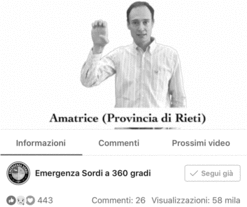
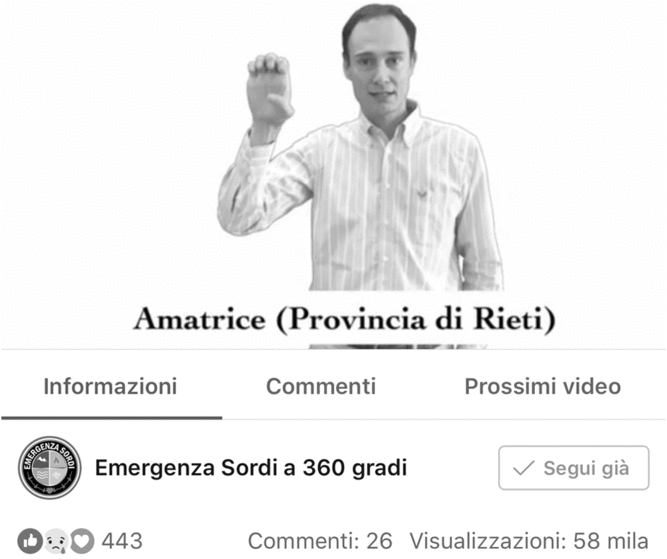
Within a few hours after the Amatrice earthquake, two authors (LR and MZ) created a Facebook page in Italian “Emergenza Sordi,” aiming to create a “bridge” to information on the service available, and favoring communication among deaf people, their family members, and earthquake rescuers (Figure 1).14 To also provide information on safety measures, one of the authors (LR), a deaf person qualified in “Protection against Chemical, Biological, Radiological, Nuclear, and Enhanced (CBRNE) conventional weapons events,” created a video on safety in maxi-emergencies, in the Italian sign language, including subtitles (Figure 1).15 The Facebook page also included current news and service numbers.Reference Beaver12, 14–15 Free access to the page allowed users to distribute the information through other social media (Twitter, Telegram, and WhatsApp). The page followed the basic rules, according to the “Deaf Emergency Communicator Theory” (DECT), designed for preparing an emergency video for deaf people.Reference Tannenbaum-Baruchi, Feder-Bubis, Adini and Aharonson-Daniel16 Based on these rules, a short video (up to 150 seconds) on the page explained what safety measures to take during an earthquake. The video used fixed, non-sliding subtitles to offer clear, straightforward, and direct language. To reach illiterate or non-digital users with hearing disabilities, thus improving information spread to support deaf people, a voice in the video directed information to hearing relatives and caregivers allowing them to help deaf people further. To implement and disseminate the video information, people with the latest generation mobile devices could also download the video at high resolution (1080p or 4K). The video included an integral text providing technologically accessible contact with other deaf people. To ensure clarity and accuracy, the text in the video contained as few understandable, assertive, and incisive words, favoring the current language used by the deaf public. According to the DECT, accuracy was assured by immediately copying written and broadcasted news provided by official radio-television sources, so as to ensure adapted sign language.15, Reference Tannenbaum-Baruchi, Feder-Bubis, Adini and Aharonson-Daniel16 The Facebook page also contained an online checklist designed to record data and to measure the results, including hearing conditions or hearing disadvantages, number of children with hearing impairment reached, and satisfaction or dissatisfaction with the information provided. Automatically, the Facebook software page numbered all the contacts (liked, viewed, and shared). The checklist data containing information on hearing and deaf people reached, and their satisfaction, were recorded in numbers and percentages.
Screen Shot from the Amatrice Deaf Tailored Online Video Showing Likes and Views. Accessed June 6, 2018.
Results
Of the total 43,507 Italian deaf persons, approximately 8,000 (5.4%) lived in the earthquake territory in Central Italy, and 1.3% were younger than 18 years of age. The Amatrice Municipality comprised 2,657 inhabitants (January 1, 2016). According to law n. 381/70, statistically, an estimated 30 persons living in Amatrice could be deaf, and 70 could presumably have had hearing impairment. The Facebook page online was accessed by approximately 58,000 Italian persons. Of the total accesses, 90% people declared deafness, and around 60% declared being hearing people (relatives, parents, and caregivers of children with hearing loss). Satisfaction level was 95% in deaf people and 60% in hearing people. A total of 60% deaf persons and 10% hearing people asked for more information, especially on the real state of research for missing deaf persons, or how to behave during an earthquake.
The video “360-Degree Deaf Emergency” received a total 443 likes, over 1,254 shares, and 58,047 views (Figure 1). 14
Discussion
The results the new online information tool obtained with a Facebook page tailored to people who are deaf or have hearing impairment during the earthquake in 2016 in Central Italy, including Amatrice, exceed expectations. Although the study protocol predicted that around 9,140 deaf people in the earthquake area would share the Facebook page and benefit from the tailored video, accesses from all over Italy were unexpectedly high. Within hours after the earthquake, a total 85% of deaf persons in Italy accessed Facebook. The numerous requests for more explanations on the video showed that a well-received social question-answer service could help to spread information on safety practices in a day-to-day, easy, and affordable way. Despite limitations related to the reported data recorded in the checklist provided, the Facebook page tailored to deaf people delivers fast access to safety information soon after an earthquake disaster.
The video created in the Italian sign language with subtitles proved remarkably effective. Even if Italian deaf people are a socio-linguistic minority, the entire deaf community should have access to advanced technologies, guaranteeing equity; also, to deaf foreigners or other excluded, potentially advisable, disadvantaged populations, including children and young persons with hearing impairment, even those staying in Amatrice as tourists.Reference Tannenbaum-Baruchi, Feder-Bubis, Adini and Aharonson-Daniel16–Reference Coombs and Holladay18 Thanks to the advanced technologies used in the latest generation mobile devices, high-quality video will be made available at a low cost.
The results from the reported experience on using a social media to disseminate information quickly to deaf people, deaf children, young adults, and their relatives soon after the Amatrice earthquakeReference Tannenbaum-Baruchi, Feder-Bubis, Adini and Aharonson-Daniel16, Reference Coombs19 show how a tailored tool in a Facebook page can overcome the lack of territorial disability databases. During natural disasters and maxi-emergencies, an appropriate use of social databases should help in mapping and categorizing people with disabilities, including vulnerable populations such as children and young persons, to permit official institutional rescue services to use well-defined protocols, thus enhancing safety.Reference Bianchini20, Reference Blasetti, Petrucci and Cofini21
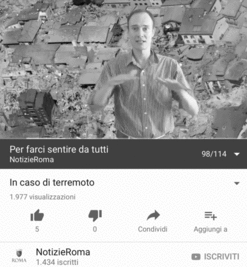
Thanks to the results of the online tailored tool, another project called “#perfarcisentiredatutti” is used by the Rome Municipality.22 This project is an online communication video aimed at providing general information, pre-emergency, and emergency alerts with full accessibility for deaf and hearing people, through several social media (including Facebook, Twitter, Instagram, and YouTube [YouTube, LLC; San Bruno, California USA). The Rome Town Hall video giving information on what to do during an earthquake received 1,323 likes, over 8,367 shares (Figure 2), over 475,806 views in Facebook, and over 1,977 views in YouTube (Figure 3).22
Screen Shot from the Rome Town Hall Deaf Tailored Online Video Showing Likes and Shares. Accessed June 6, 2018.

Screen Shot Realized by the Project “#perfarcisentiredatutti,” Used by the Rome Town Hall, Downloaded from You Tube. Accessed June 11, 2018.

Limitations
The first limitation is that to reduce inequality related to deaf people unskilled in using digitalized media, the authors failed to use means of communication other than social media, for example television, newspapers, or advertisements during cinema productions accessible to deaf people. A second limitation is that the Facebook page failed to collect information on the age of the deaf people accessing the page online. This information could have been used in monitoring and analyzing the data to develop tailored means of communication. Another limitation is that the authors neglected to inform the Italian Ministry of Civil Protection (Rome, Italy) about the project, mainly because two authors (LR and MZ) are deaf persons principally involved in providing help to deaf persons in the social context, with only recent experience in emergency events. A further limitation is that the original project written in Italian had to be translated into English to allow more wide-spread dissemination online.
Conclusion
Emergency coordinators, rescuers, and disaster managers should be aware and trained in giving fast emergency information and tailoring their communication to the needs of deaf people, thus increasing perceived social satisfaction. A tailored information tool disseminated via a world-wide social media, such as Facebook, can also be appreciated by deaf children and young adults and their families. To improve fast access and information safety, during natural disasters and other mass emergencies, online communication tailored to deaf people who use sign language needs to follow international guidelines.15
A tailored survey designed specifically to investigate the barriers and facilitators in Italian and foreign deaf people, by recording data particularly on children and young persons who access the tool, and the video proposed with the Facebook page, should widen further the information provided and shorten the time needed to gain the information in future earthquakes. Further studies need to investigate new online tools tailored to other disabled populations, living in various settings and countries, to disseminate information on services and safety measures quickly, using fast accessed social media after natural disasters and maxi-emergencies.