1. Introduction
The Sino-Korean Block (SKB; also called the North China Block) was one of the solitary tectonic blocks located east of the Palaeo-Tethys Ocean, when Laurentia and Gondwana formed the supercontinent Pangaea in Late Carboniferous times (Metcalfe, Reference Metcalfe2013; Domeier & Torsvik, Reference Domeier and Torsvik2014). It was during Early Triassic times when the SKB and the neighbouring blocks were finally amalgamated with each other to form present-day East Asia. Many plutons in the northern margin of the SKB (in present-day coordinates) recently identified as Carboniferous–Permian in age (Zhang et al. Reference Zhang, Zhao, Song, Hu, Liu, Yang, Chen, Liu and Liu2009; Jian et al. Reference Jian, Liu, Kröner, Windley, Shi, Zhang, Zhang, Miao, Zhang and Tomurhuu2010 and references therein) are interpreted to have been emplaced in a continental-margin arc during the southward subduction of the Palaeo-Asian Ocean. It is now believed that the subduction process built the Inner Mongolian Palaeo-Uplift (IMPU) in the northern margin of the SKB, and its exhumation supplied large amounts of detritus to the late Palaeozoic basins in North China (Cope et al. Reference Cope, Ritts, Darby, Fildani and Graham2005; Li et al. Reference Li, He, Xu and Huang2010; Ma et al. Reference Ma, Meng, Duan and Wu2014). In the southern margin of the SKB, it has gradually come to be agreed that oceanic subduction and accretion of microcontinents took place in between the SKB and the South China Block during middle–late Palaeozoic times, prior to their final amalgamation in Triassic times (Dong et al. Reference Dong, Zhang, Neubauer, Liu, Genser and Hauzenberger2011, Reference Dong, Liu, Neubauer, Zhang, Tao, Zhang, Zhang and Li2013; Wu & Zheng, Reference Wu and Zheng2013). Efforts have been made to clarify the exact timing and details of the tectonic events at this margin (Ding et al. Reference Ding, Ma, Li, Robinson, Deng, Zhang and Xu2011; Zhu et al. Reference Zhu, Zhu, Ge and Wang2014; Wang et al. Reference Wang, Deng, Liu, Zhao and Cai2016). The western margin of the SKB is more complex owing to the presence of the Qinling Shan and Western Ordos thrust belts and has become a subject of recent academic research (e.g. Yuan & Yang, Reference Yuan and Yang2015; Dan et al. Reference Dan, Li, Wang, Wang, Wyman and Liu2016; Zhang, Zhang & Zhao, Reference Zhang, Zhang and Zhao2016).
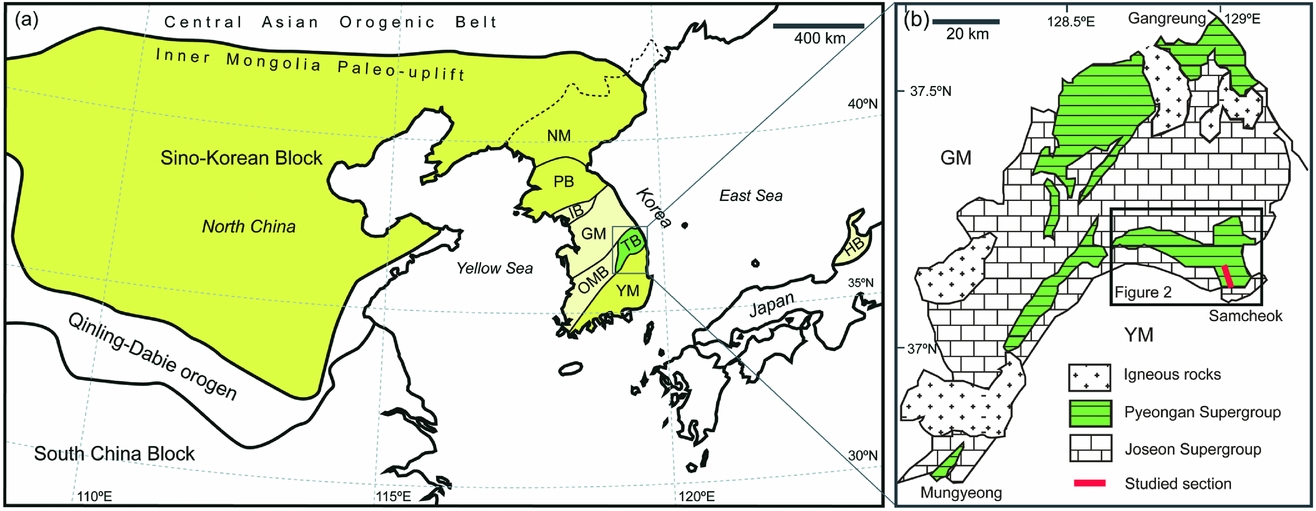
The above studies address the recent advances in the understanding of the late Palaeozoic tectonic evolution of the boundaries surrounding the SKB. However, little information regarding the eastern boundary of the SKB in late Palaeozoic times has been yet provided. Because the issue of how the tectonic provinces of the Korean Peninsula and Japanese islands are tectonically correlated with those of neighbouring North China or South China is still unresolved (refer to Chang & Zhao, Reference Chang and Zhao2012 for recent summary and discussion), the tectonic setting and the geologic events occurring in the eastern margin of the SKB remain largely unknown. In this regard, investigation of the upper Palaeozoic sedimentary succession in the Taebaeksan Basin, located in central eastern Korea (Fig. 1a), is of great importance. While the pre-Triassic tectonic setting of the Korean Peninsula is controversial, it is widely recognized that the Taebaeksan Basin, which encompasses the upper Palaeozoic – Lower Triassic Pyeongan Supergroup and the underlying lower Palaeozoic Joseon Supergroup, was part of the SKB (Chough et al. Reference Chough, Kwon, Ree and Choi2000; Lee & Lee, Reference Lee and Lee2003; Zhai et al. Reference Zhai, Guo, Li, Chen, Peng, Li, Hou and Fan2007). Good correlation between the Taebaeksan Basin sequence and the North China platform deposits is supported by various lines of evidence including stratigraphic, palaeobiogeographic and palaeomagnetic data (Doh & Piper, Reference Doh and Piper1994; Jeong & Lee, Reference Jeong and Lee2000, Reference Jeong and Lee2004; Choi, Kim & Sohn, Reference Choi, Kim and Sohn2001; Kim et al. Reference Kim, Lee, Li and Bai2001; Choi & Kim, Reference Choi and Kim2006; Lv & Chen, Reference Lv and Chen2014). Thus, the Pyeongan Supergroup in the Taebaeksan Basin is considered to preserve upper Palaeozoic sedimentary records in the eastern part of the SKB.
(a) Simplified tectonic map of the Sino–Korean Block (yellow colour). Light yellow colour in the Korean Peninsula and Japan represents the tectonic provinces under debate. NM – Nangrim Massif; PB – Pyeongnam Basin; IB – Imjingang Belt; GM – Gyeonggi Massif; OMB – Okcheon Metamorphic Belt; TB – Taebaeksan Basin; YM – Yeongnam Massif; HB – Hida Belt. (b) Simplified geologic map of the Taebaeksan Basin (modified after Korea Institute of Geoscience and Mineral Resources (KIGAM), 1995).

In this study, we examine the provenance of the Upper Carboniferous – Lower Triassic Pyeongan Supergroup in the Samcheok coalfield, Taebaeksan Basin, by using detrital zircon U–Pb geochronology. Although there have been some fragmentary analyses on the detrital zircon ages of upper Palaeozoic sediments in Korea, this study is the first to report the complete succession ranging from the Upper Carboniferous to the Lower Triassic in detail. We also analyse the Sm–Nd isotope composition of fine-grained rocks to compensate for the underrepresentation of certain sources (e.g. mafic rocks) in the detrital zircon age pattern and improve understanding of the sediment provenance. It is particularly notable that palaeoflows for upper Palaeozoic Pyeongan Supergroup sediments in the Taebaeksan Basin were from east–southeast (Kim, Reference Kim1971; Lee & Lim, Reference Lee and Lim1995), suggesting a source terrain different from late Palaeozoic basins in North China that were mostly supplied from the north. Thus, the results of this study may provide some insight into the tectonic setting of the eastern margin of the SKB during late Palaeozoic times and the potential geologic events that occurred at this margin.
2. Geological setting
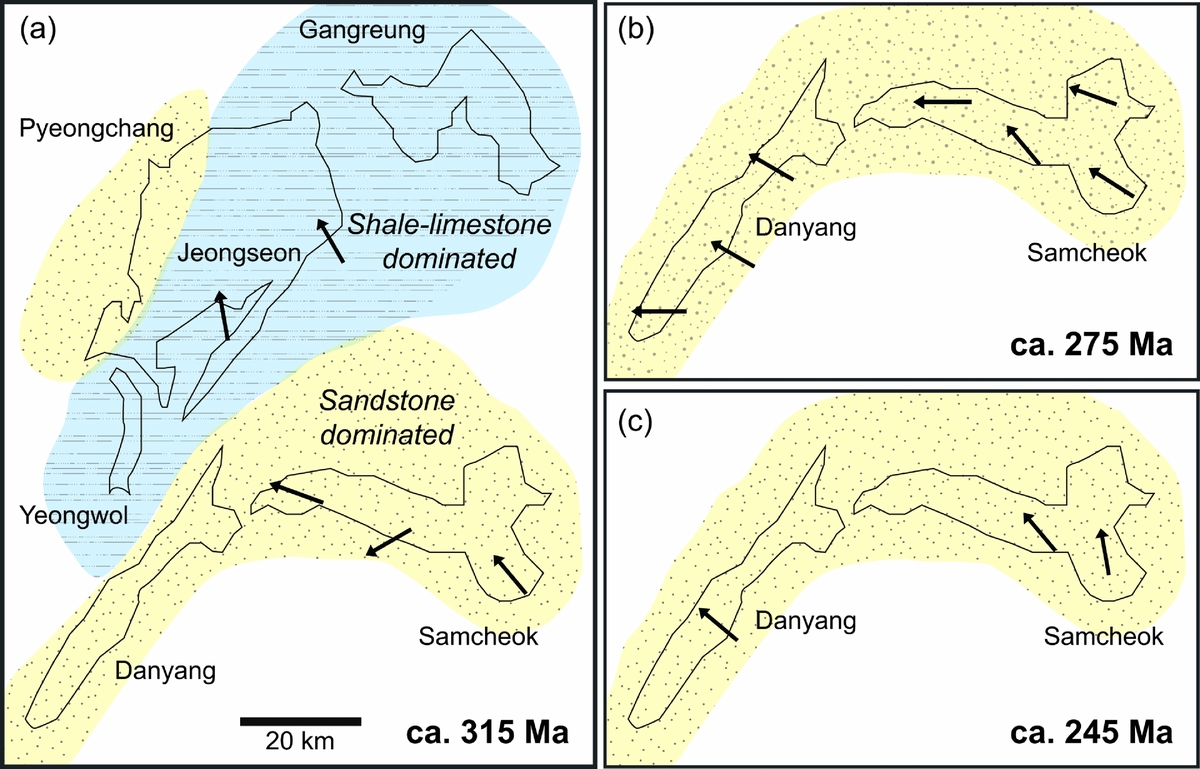
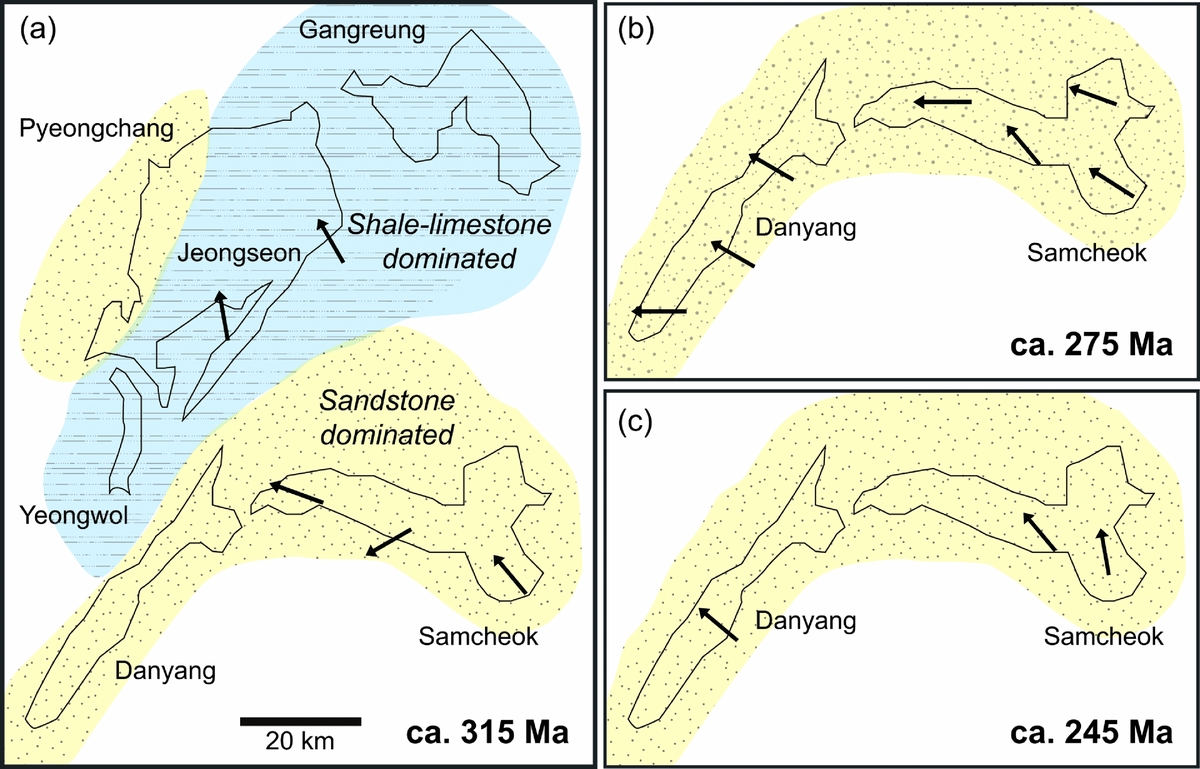
The study was conducted in the Samcheok coalfield, part of the Taebaeksan Basin developed on the Yeongnam Massif in central eastern Korea (Fig. 1). The Yeongnam Massif is one of the three Palaeoproterozoic tectonic provinces that make up the Korean Peninsula; the other two are the Nangrim Massif and the Gyeonggi Massif. Palaeozoic strata in the Taebaeksan Basin are divided into the Lower Cambrian – Middle Ordovician Joseon Supergroup and the Upper Carboniferous – Lower Triassic Pyeongan Supergroup. The Joseon Supergroup is composed of mixed siliciclastic rocks and carbonates, and shows basin-wide development over the Palaeoproterozoic Yeongnam Massif basement rocks. On top of that, the mainly siliciclastic Pyeongan Supergroup is distributed unconformably in several areas along synclines and faults. Each separate area has been called a ‘coalfield’ (e.g. Samcheok coalfield, Danyang coalfield, etc.), owing to the occurrence of coal measures in the lower part of the Pyeongan Supergroup. Among the coalfields in the Taebaeksan Basin, the Samcheok coalfield contains relatively well-preserved and well-exposed sections and therefore has been regarded as the type area of the upper Palaeozoic succession in South Korea. It has been suggested that the Samcheok coalfield was situated in the proximal part of the basin, while all coalfields shared the same provenance (Fig. 2; Lee & Lim, Reference Lee and Lim1995).
Simplified lithofacies map and the palaeocurrent directions (black arrows) in the Samcheok coalfield and nearby areas in (a) early Moscovian, (b) Kungurian, and (c) Early Triassic times. Palaeoflow data are from Lee & Lim (Reference Lee and Lim1995) and references therein.
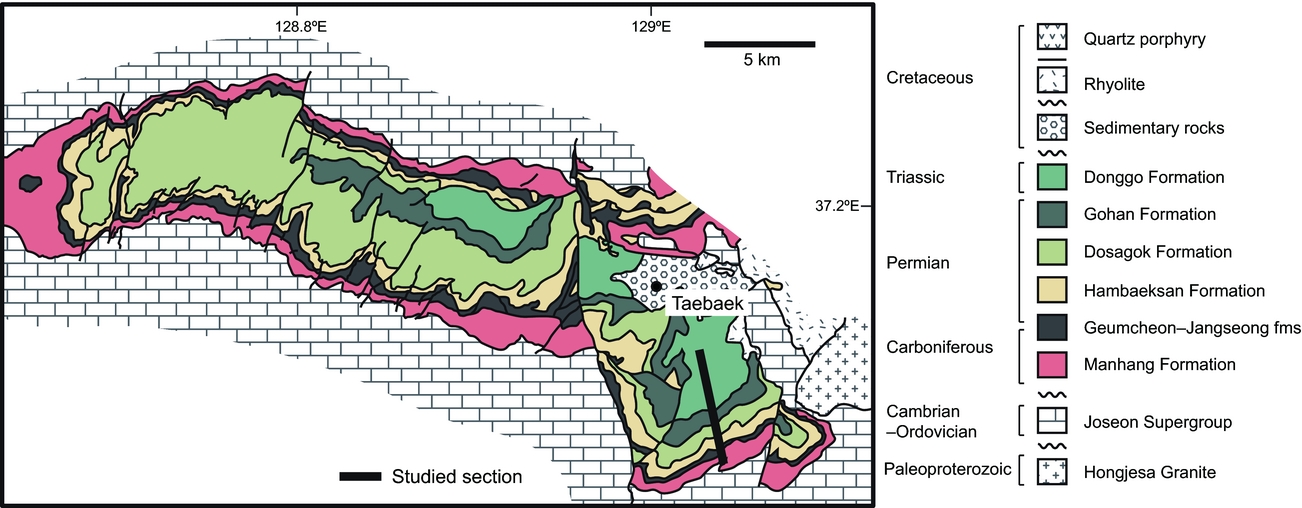
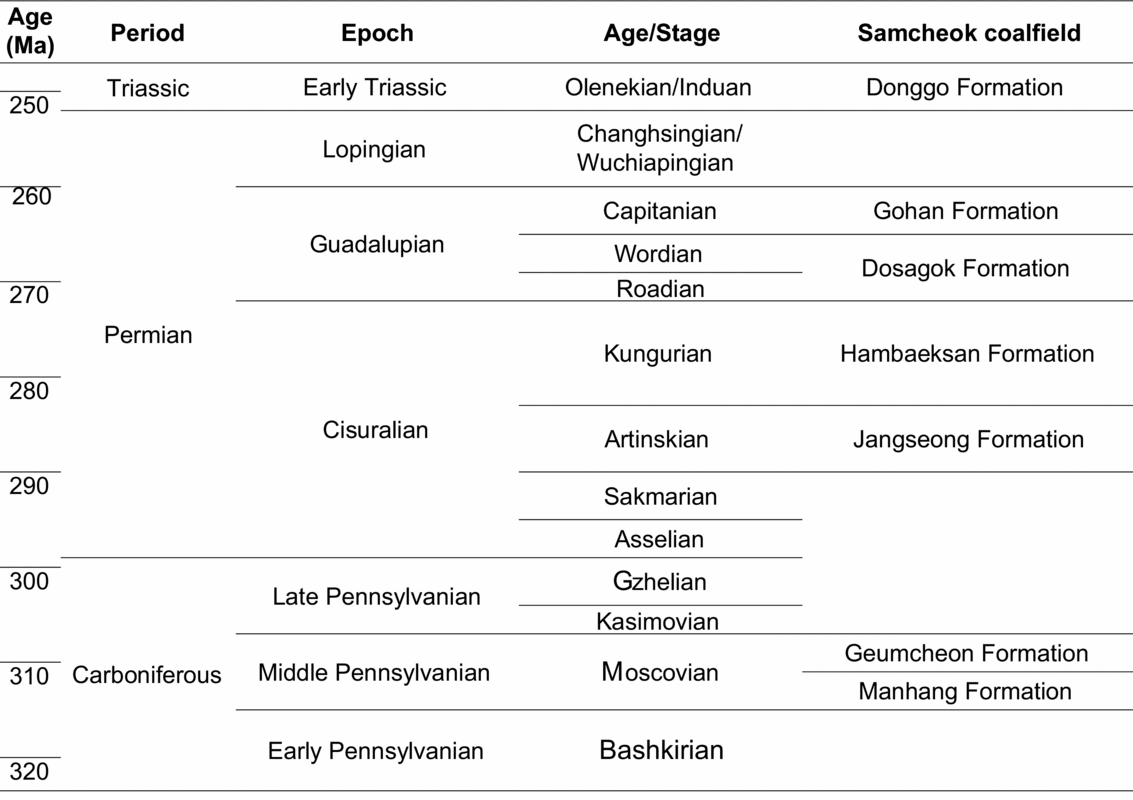
The Pyeongan Supergroup is generally composed of sandstones and shales, with minor occurrence of limestone beds in the lower part and was deposited in paralic to nonmarine environments. Cheong (Reference Cheong1969) divided the Pyeongan Supergroup in the Samcheok coalfield into seven lithostratigraphic units, the Manhang, Geumcheon, Jangseong, Hambaeksan, Dosagok, Gohan and Donggo formations in ascending order (Figs 3, 4). The Manhang Formation consists of reddish or grey mudstone and sandstone, fine-pebble conglomerate and laterally discontinuous limestone layers. It is overlain by the Geumcheon Formation, mainly composed of dark-coloured shale to fine sandstone, with minor limestone beds and thin coal seams. The unconformably overlying Jangseong Formation is also of dark colour, but contains coarser-grained sandstones and thick coal beds. The following Hambaeksan Formation is characterized by coarse-grained milky white sandstones with intercalating grey shales. The Dosagok Formation comprises purple/drab shale to sandstone and pebbly sandstone, while the Gohan Formation is an alternation of greenish grey sandstone and grey to black shale. The uppermost Donggo Formation overlies the Gohan Formation unconformably and includes green sandstone and purple mudstone. The total thickness of the Pyeongan Supergroup in the Samcheok coalfield is c. 1700 m.
Simplified geological map of the Samcheok coalfield (after Korea Institute of Geoscience and Mineral Resources (KIGAM), 1979) and the studied section.

Ages of the stratigraphic units of the Pyeongan Supergroup in the Samcheok coalfield. The geologic time scale of the late Palaeozoic to Early Triassic is after Walker et al. (Reference Walker, Geissman, Bowring and Babcock2012).

The age of each formation was determined based on the plant fossils and marine fossils such as fusulinids and conodonts (Cheong, Reference Cheong1969, Reference Cheong1973; Chun, Reference Chun1985, Reference Chun1987; Park, Reference Park1989; Park & Sun, Reference Park and Sun2014). The Manhang and Geumcheon formations are of Late Carboniferous age, and the Jangseong to Gohan formations all belong to the Permian. The contact between the Geumcheon Formation and the Jangseong Formation is unconformable with a significant time gap (Late Carboniferous – Early Permian) in fusulinid records (Cheong, Reference Cheong1969). The Gohan Formation is also unconformably overlain by the Donggo Formation (Fig. 4). The age of the Donggo Formation is not readily determined by fossil records, but its maximum depositional age has been assigned to the Early Triassic based on a detrital zircon U–Pb age and deformation history during the mid-Triassic Songrim disturbance (Lee, Choi & Orihashi, Reference Lee, Choi and Orihashi2012).
Previous petrographic studies have reported that Pyeongan Supergroup sandstones generally show high maturity in the lower to middle parts of the supergroup. Feldspar is virtually absent in sandstones below the Gohan Formation, in which plagioclase grains and volcanic rock fragments first appear (Yu & Lee, Reference Yu and Lee1993; Yu, Lee & Boggs, Reference Yu, Lee and Boggs1997; Lee & Sheen, Reference Lee and Sheen1998). Both plagioclase and potassium feldspar are abundantly present in the Donggo Formation (up to 25% of the framework grains). A recycled orogen provenance was suggested for the Manhang to Gohan formations, with additional volcanic input in the Gohan Formation. The sudden occurrence of abundant feldspar grains with plagioclase and potassium feldspar occurring in subequal amounts in the Donggo Formation was interpreted to indicate that the basement rocks were exposed, a result of unroofing during its deposition (Lee & Sheen, Reference Lee and Sheen1998). This provenance interpretation was supported by the geochemistry of mudrocks (Lee, Reference Lee2002). Based on the palaeocurrent direction from east–southeast (Fig. 2), the Precambrian basement of the Yeongnam Massif, mainly composed of granite, granite gneiss and metasedimentary rocks dated at 2.2–1.8 Ga (Lee & Cho, Reference Lee and Cho2012), could be inferred as being the ultimate source of recycled sediments as well as arkosic detritus to the Donggo Formation. Yet more information is needed to confirm this source.
3. Methods
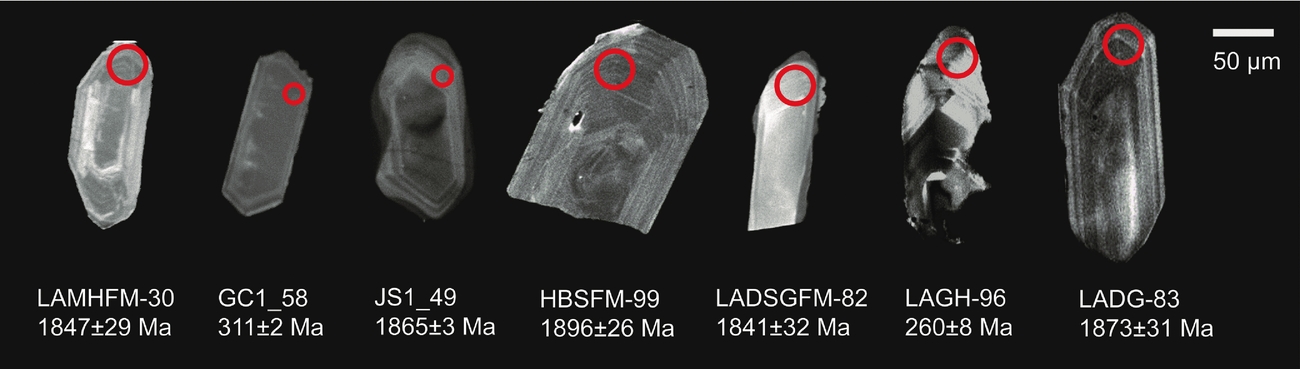
For detrital zircon U–Pb age analysis, seven Pyeongan Supergroup sandstone samples, one from each formation, were collected from the type section in the Taebaek area (Fig. 3). Zircon grains were extracted from the rock samples by conventional heavy mineral separation. One hundred randomly selected zircon grains per sample were embedded in PFA Teflon sheets. After polishing to expose the grain centre, cathodoluminescence (CL) images (Fig. 5) were obtained by using a scanning electron microscope (JEOL JSM-5400). U–Pb dating was conducted by using laser ablation inductively coupled plasma mass spectrometry (LA-ICP-MS) systems at the Earthquake Research Institute, University of Tokyo (Thermo Elemental PlasmaQuad3) for the Manhang, Hambaeksan, Dosagok, Gohan and Donggo sandstones and the Korea Basic Science Institute (Nu Plasma II MC ICPMS) for the Geumcheon and Jangseong sandstones. The analysis and data acquisition followed the recommended method for each device. For the LA-ICP-MS analysis at the University of Tokyo, isobaric interference by 204Hg was reduced by charcoal filter (Hirata, Iizuka & Orihashi, Reference Hirata, Iizuka and Orihashi2005), and common Pb was corrected from measured 204Pb assuming the initial Pb composition proposed by Stacey & Kramers (Reference Stacey and Kramers1975). Laser ablation was conducted at a spot size of 30 μm, energy density of 10–15 J/cm3 and pulse repetition rate of 10 Hz. Details of the analytical procedures are described in Lee et al. (Reference Lee, Choi, Lim and Orihashi2010). For the system at the Korea Basic Science Institute, laser ablation was conducted at a spot size of 15 μm, energy density of 2–3 J/cm3 and pulse repetition rate of 5 Hz. No correction for common Pb was employed based on the judgement that Hg interference cannot be effectively reduced. Both analyses were monitored by using the zircon 91500 standard (Wiedenbeck et al. Reference Wiedenbeck, Alle, Corfu, Griffin, Meier, Oberli, Von Quadt, Roddick and Spiegel1995). A single spot per grain was analysed. Age dating was mostly performed on the magmatic rim with consistent oscillatory zoning, but occasionally performed on the core when the mixing of different age domains was a concern. Metamorphic overgrowths were not usually present and were not analysed. Obtained data were processed using ISOPLOT (Ludwig, Reference Ludwig2003) with the age quoted at 2σ, and for a small number of Phanerozoic grains, a kernel density estimator was additionally drawn by using DensityPlotter (Vermeesch, Reference Vermeesch2012). For grains younger than 1000 Ma, 206Pb–238U ages were used for interpretation. In the case of grains older than 1000 Ma, 207Pb–206Pb ages were adopted. Ages with > 10% normal or reverse discordance were rejected.
Representative SEM-CL images of detrital zircon grains in the Pyeongan Supergroup sandstones from the Samcheok coalfield.

For Sm–Nd isotope analysis, a total of 18 siltstone–shale samples, two to four samples from each formation, were collected from the same Taebaek section. The approximate depositional age of each sample was determined by combining the known age range of each formation to which the sample belonged and the relative position of the sampling horizon within the formation. After powdering in an agate mortar, samples were dissolved and were analysed by using a thermal ionization mass spectrometer (TIMS; IsoProbe-T model (GV Instruments)) at the Korea Basic Science Institute following the procedures described in Cheong et al. (Reference Cheong, Jo, Jeong, Park and Cho2016). Nd isotopic measurements were normalized to 146Nd/144Nd = 0.7219. Analysis of the JNdi-1 standard yielded 143Nd/144Nd = 0.512101±0.000015 (n = 10, 2σ error). The total procedural blank level was below 0.1 ng for Nd.
4. Results
4.a. Zircon U–Pb ages
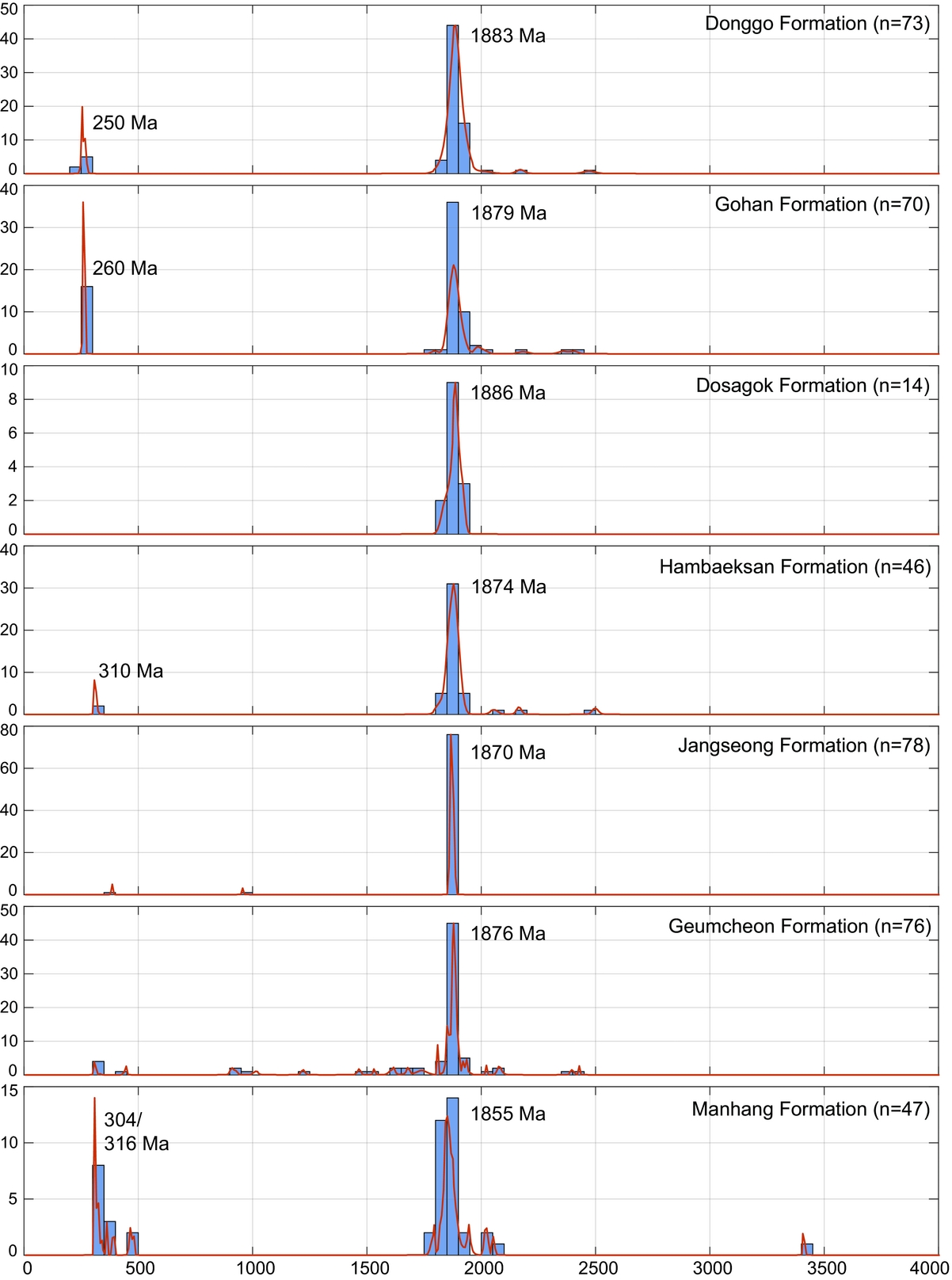
A total number of 369 concordant to slightly discordant ages, out of 644 analyses, were obtained (Fig. 6, online Supplementary Material Table S1 available at http://journals.cambridge.org). They have Th/U ratios higher than 0.1 except for 15 grains, and commonly show oscillatory zoning under CL imaging, suggesting a magmatic origin (Fig. 5; Hoskin & Black, Reference Hoskin and Black2000). The Palaeozoic portion of the zircon U–Pb data acquired from the Gohan and Donggo formations, 20 grains in total, were previously reported in Lee, Choi & Orihashi (Reference Lee, Choi and Orihashi2012) to discuss the maximum depositional ages of these two formations. In this paper, full age spectra including these ages are presented for both formations. Detrital zircon grains are generally subangular with some rounded and irregular-shaped grains, and some of the near-depositional grains also show euhedral shapes. The age data and the concordia diagrams are also presented in the online Supplementary Material available at http://journals.cambridge.org/geo (Fig. S1, Table S1).
Relative probability plot and age histograms for detrital zircon U–Pb age of the Pyeongan Supergroup in the Samcheok coalfield.

4.a.1. Manhang Formation
A total of 72 analyses were conducted on the zircon grains from the Manhang Formation, but only 12 ages passed the discordance filter owing to significant Pb-loss. Ten concordant to slightly discordant grains form a major age group with a peak at 1.87 Ga. The remaining two ages are late Palaeozoic, 321±4 Ma and 297±5 Ma. The latter Permian age is much younger than the known depositional age of the Manhang Formation, which is assumed to be early Moscovian (315–310 Ma; Cheong, Reference Cheong1969) and thus was removed from further consideration.
Li et al. (Reference Li, Peng, Xu, Han and Zhai2009) previously reported detrital zircon U–Pb dating results for a Manhang Formation sandstone collected from the same studied section in the Samcheok coalfield. In compensation for the small number of concordant grains in the present study, we combined their data with our measurements. Thirty-six grains from their data satisfied the discordance criterion applied in this study. The combined results similarly show the dominance of 2.0–1.8 Ga zircons (70%), followed by a minor amount of Carboniferous zircons (21%). One Palaeoarchaean (3408±8 Ma) and three early to middle Palaeozoic (387±4 Ma, 461±8 Ma and 474±6 Ma) zircons were observed.
4.a.2. Geumcheon Formation
Seventy-six zircon grains from the Geumcheon Formation yielded concordant to slightly discordant ages, with ages ranging from 307 to 2424 Ma. A single peak at 1.87 Ga is prominent, while some older and younger Palaeoproterozoic to Mesoproterozoic grains are observed in the age distribution, but they are not concentrated in a particular age. Two small age groups consisting of four Carboniferous zircons (332–307 Ma) and three Neoproterozoic (962–905 Ma) zircons are also recognized.
4.a.3. Jangseong Formation
Seventy-eight concordant to slightly discordant zircon ages were obtained from the Jangseong Formation. Almost all grains fall within a very narrow age range of 1856–1886 Ma. Only two grains appear as exceptions: one grain is Devonian (384±4 Ma) and the other grain is Neoproterozoic (955±6 Ma) in age.
4.a.4. Hambaeksan Formation
Forty-six concordant to slightly concordant zircon ages were obtained from the Hambaeksan Formation. Among them, 41 zircon grains belong to the Palaeoproterozoic with a narrow age range between 1816 Ma and 1907 Ma. Another three grains are of older Palaeoproterozoic age (2054±33 Ma, 2163±21 Ma and 2497±25 Ma). Two Carboniferous grains, 304±4 Ma and 315±6 Ma, are the only Phanerozoic grains.
4.a.5. Dosagok Formation
Among 101 analyses carried out, only 14 grains show concordant to slightly discordant U–Pb ages, owing to serious Pb-loss. They form a single age group within 1903–1841 Ma, very similar to the underlying Hambaeksan zircon ages. No younger or older grains than this age range have been observed.
4.a.6. Gohan Formation
Seventy out of 99 zircon grains from the Gohan Formation yielded concordant to slightly discordant U–Pb ages. While most of the grains fall in an age range between 1854 Ma and 1927 Ma (73%), a secondary peak at c. 260 Ma consisting of 16 grains (23%) is notable. The rest are three early Palaeoproterozoic grains (2181±43 Ma, 2355±37 Ma and 2403±36 Ma).
4.a.7. Donggo Formation
Seventy-three concordant to slightly discordant analyses were obtained from the Donggo Formation. A major age group is between 1819 Ma and 1939 Ma (87%), followed by a small population composed of six grains with a peak at around the end-Permian (250 Ma). In addition, three zircon grains show older Palaeoproterozoic ages (2010±66 Ma, 2169±34 Ma and 2469±50 Ma).
4.b. Nd isotope compositions
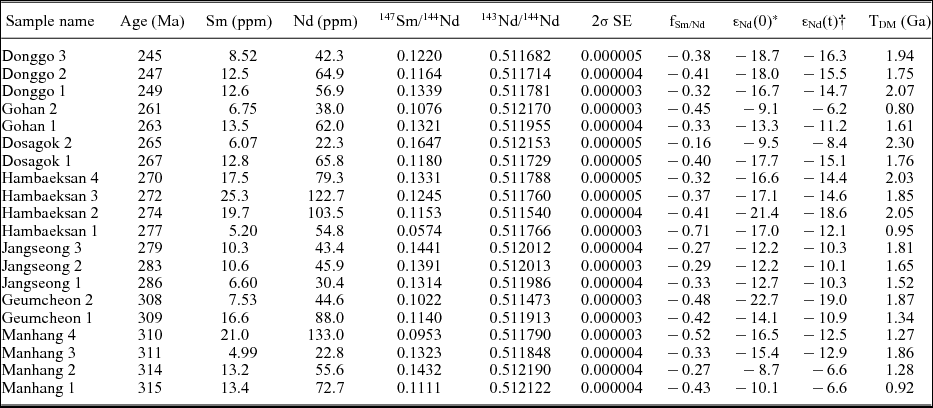
Nd isotope compositions of the samples analysed in this study are presented in Table 1. Sm/Nd ratios range from 0.0953 to 0.1441, with the exception of extreme minimum and maximum values (0.0574 and 0.1647). εNd(0) values vary widely from −22.7 to −8.7. Except for the Jangseong and Donggo formations, there are many differences in εNd(0) values in the remaining strata from 4.1 epsilon units (the Gohan Formation) to 8.7 epsilon units (the Geumcheon Formation). Particularly, high εNd(0) values (> −10.1) are observed in the lower Manhang Formation (c. 315 Ma) and the upper Dosagok to Gohan formations (c. 265 Ma). Depleted mantle Nd model age (TDM) ranged from 0.80 Ga (the Gohan Formation) to 2.30 Ga (the Dosagok Formation).
Sm–Nd isotope compositions of the Pyeongan Supergroup in the Samcheok coalfield

* εNd values were calculated assuming 143Nd/144Nd = 0.512638 and 147Sm/144Nd = 0.1966 for CHUR.
† Depleted mantle Nd model ages (TDM) were calculated assuming εNd(0) = +10 and 147Sm/144Nd = 0.2136 for the depleted mantle.
5. Discussion
5.a. Provenance of the Pyeongan Supergroup
The detrital zircon age patterns of the Pyeongan Supergroup in the Samcheok coalfield are generally consistent from the lowermost Manhang Formation to the uppermost Donggo Formation. One predominant peak occurs at c. 1.9 Ga, occasionally followed by a minor population of late Palaeozoic zircons. On the other hand, Meso- to Neoproterozoic and early–middle Palaeozoic zircon grains are rarely observed. The common age signature suggests that the provenance of the Pyeongan Supergroup remained constant during deposition through time.
The overall detrital zircon age pattern supports the general consensus that the Samcheok coalfield in the Taebaeksan Basin has a tectonic affinity with the North China Craton, and does not have a tectonic relationship with the South China Block or Qinling orogenic belt in late Palaeozoic times. U–Pb age spectra typical of the North China Craton are characterized by two age populations at 2.1–1.8 Ga and 2.6–2.4 Ga, the former being more prominent than the latter (Darby & Gehrels, Reference Darby and Gehrels2006). The detrital zircon analyses on upper Palaeozoic sediments distributed in South China commonly report several major age peaks in the Neo- to Mesoproterozoic, most notably at c. 800 Ma and 1000–950 Ma (Li et al. Reference Li, Li, He, Li, Li, Gao and Wang2012; Zhao et al. Reference Zhao, Wang, Li and Lei2013b; Hu et al. Reference Hu, Du, Cawood, Xu, Yu, Zhu and Yang2014, Reference Hu, Cawood, Du, Xu, Xu and Huang2015a,b). Less than 2% of the total detrital zircon age data gained from the Pyeongan Supergroup were from the Neo- to Mesoproterozoic. Besides, the Early Silurian peak (c. 440 Ma), which occurs in most of the upper Palaeozoic sediments in the South China Block as well as in some sediments in North China that were derived from the Northern Qinling Block (Li et al. Reference Li, He, Xu and Huang2010; Zhu et al. Reference Zhu, Zhu, Ge and Wang2014; Wang et al. Reference Wang, Deng, Liu, Zhao and Cai2016), is rarely observed in the Pyeongan Supergroup in the Samcheok coalfield. It is therefore inferred that the sediment provenance of the Samcheok coalfield in late Palaeozoic times was neither related to the South China Block nor the Northern Qinling Block. Similarly, the southeastern Central Asian Orogenic Belt (Xing-Meng Orogenic Belt) can also be excluded from the possible provenance, in that it produces a wide range of Neoproterozoic to early Palaeozoic zircon grains (Zhou & Wilde, Reference Zhou and Wilde2013) which are rarely observed in our data.
Once the contributions from external tectonic terrains are ruled out, the source of the sediment can easily be assumed to be the uplifted northern margin of the SKB, as is the case for many late Palaeozoic basins in North China. However, a closer inspection of the age pattern suggests that this may not be the case. Previous detrital zircon studies on upper Palaeozoic sediments distributed in North China report three major age groups: early Palaeoproterozoic to Neoarchaean (2.5–2.3 Ga), middle to late Palaeoproterozoic (2.0–1.8 Ga), and early to late Palaeozoic (Cope et al. Reference Cope, Ritts, Darby, Fildani and Graham2005; Yang et al. Reference Yang, Wu, Shao, Wilde, Xie and Liu2006; Li et al. Reference Li, He, Xu and Huang2010; Ma et al. Reference Ma, Meng, Duan and Wu2014; Zhu et al. Reference Zhu, Zhu, Ge and Wang2014). The relative distribution of these age groups varies according to stratigraphic positions and regions, but they have in common that the three age components are included in comparable amounts to some extent. While all three age groups also occur in the present data, the detrital zircon age pattern of the Pyeongan Supergroup is characterized by the predominance of 2.0–1.8 Ga zircons (> 70%) irrespective of stratigraphic position, while early Palaeoproterozoic to Archaean zircons are very scarce (< 5%) (Fig. 6). It is therefore inferred that the source terrain of the Pyeongan Supergroup in the Samcheok coalfield would have been composed mostly of middle to late Palaeoproterozoic igneous rocks or (meta-) sedimentary rocks derived from them.
Within the SKB, there are several regions in which the 1.8 to 2.0 Ga-aged rocks are concentrated: the Kondalite belt, Trans-North China Orogen, Jiao-Liao-Ji Belt and Korean Peninsula (Lu et al. Reference Lu, Zhao, Wang and Hao2008; Zhai et al. Reference Zhai, Hu, Zhao, Peng and Meng2015). However, weathered products of the former three might have to travel a long distance to reach the Taebaeksan Basin, and palaeoflows should have passed en route through the Nangrim Massif and/or the Eastern Block of North China, which are largely composed of ~2.5 Ga-aged basement rocks. However, the latter age component is scarcely observed in our studied Pyeongan Supergroup data. Therefore, it is not likely that any of those terrains in North China and northern Korea supplied sediments containing almost exclusively the 1.8 to 2.0 Ga-aged zircons to the Taebaeksan Basin. In the central and southern parts of the Korean Peninsula, on the contrary, few igneous rock bodies with zircon U–Pb ages exceeding 2.1 Ga have been reported (Lee & Cho, Reference Lee and Cho2012; Lee et al. Reference Lee, Cho, Cheong and Yi2014a and references therein). Thus, the results of this study are in good accordance with the hypothesis proposed by previous studies (Lee & Sheen, Reference Lee and Sheen1998; Lee, Reference Lee2002) that most of the Pyeongan Supergroup sediments consist of recycled sediments originally derived from the Yeongnam Massif.
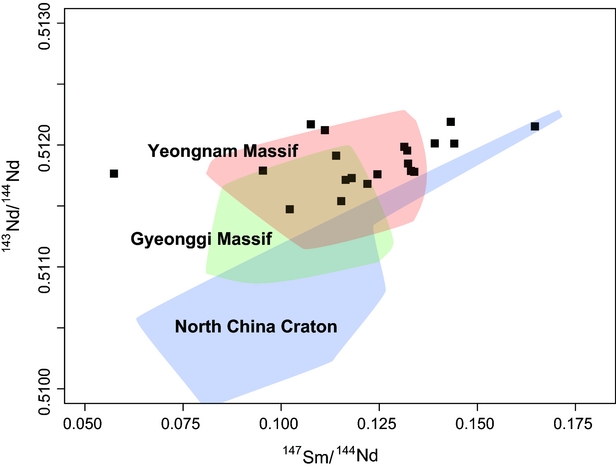
Further evidence for the Yeongnam Massif-origination of the sediments is provided by the Sm–Nd isotope composition of the fine-grained rocks. It has been reported that the Yeongnam Massif, the Gyeonggi Massif and the North China basement all have different Sm–Nd isotope signatures (Lee et al. Reference Lee, Cho, Hwang, Lee, Kim and Kim2003). Figure 7 shows the composition of the Pyeongan Supergroup mudrock samples plotted together with the known compositional ranges of the three tectonic provinces. The results confirm that the isotopic composition of the Pyeongan Supergroup most closely matches that of the Yeongnam Massif. Data are markedly different from those of North China, and also largely deviate from the field of the Gyeonggi Massif, particularly in terms of 143Nd/144Nd (i.e. εNd). Although potential mixing of some juvenile materials may have partly contributed to this deviation, the isotopic differences between the Pyeongan Supergroup and North China basements or between the Pyeongan Supergroup and the Gyeonggi Massif are too large to be explained by minor addition of juvenile materials, as expected from the small portion of zircon grains having ages younger than Palaeoproterozoic (Fig. 6).
147Sm/144Nd and 143Nd/144Nd values of the Pyeongan Supergroup, in comparison with the Palaeoproterozoic basement of the North China Craton, Gyeonggi Massif and Yeongnam Massif. Composition ranges for the three tectonic provinces are from Lee et al. (Reference Lee, Cho, Hwang, Lee, Kim and Kim2003) and references therein.

Sm–Nd isotope composition has been considered as a generally reliable provenance indicator (McLennan & Hemming, Reference McLennan and Hemming1992), but it is advisable to consider the influence of sedimentary and post-sedimentary processes, which may cause some disturbance in the isotopic system (Bock, McLennan & Hanson, Reference Bock, McLennan and Hanson1994; McDaniel et al. Reference McDaniel, Hemming, McLennan and Hanson1994). Some Sm-enriched samples (fSm/Nd > −0.3) in our data, for example, are possibly the artefact of the selective removal of light rare earth element (LREE)-enriched mineral phases during deposition. Such change may result in highly erroneous Nd model ages; therefore, we did not put much weight on the TDM in our interpretation. However, it is reasonable to expect that εNd did not change much from the original signal, considering the relatively young age of the sediments compared to the slow decay of 147Sm. Most of the Pyeongan Supergroup samples with normal Sm/Nd values show much less negative εNd values compared to the Gyeonggi Massif or North China basements. Collectively, we interpret that the materials derived from the Yeongnam Massif account for the majority of the sedimentary deposits in the Pyeongan Supergroup. The hypothesis of a palaeo-orogen existing during the deposition of the Pyeongan Supergroup suggested by Lee & Sheen (Reference Lee and Sheen1998) is accordingly supported as a viable explanation for the necessary sediment recycling processes linking between the granitic Yeongnam Massif basements and the quartzose composition of the Pyeongan Supergroup sandstones.
5.b. Tectonic environment of the eastern margin of the SKB during late Palaeozoic times
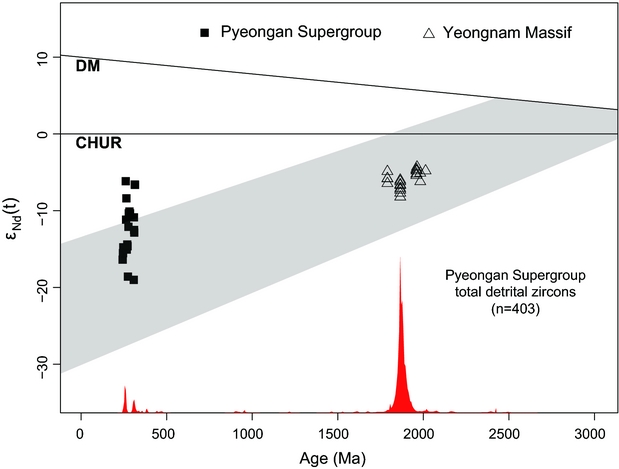
Based on the interpretation that the proximate provenance for the Pyeongan Supergroup sediments was originated from the Yeongnam Massif basement, we can deduce the mixing of additional components. In an εNd(t) versus age plot (Fig. 8), Pyeongan Supergroup sediments generally plot within the range of the evolutionary path of the rocks that make up the Yeongnam Massif. However, most samples are enriched in 143Nd to some degree, and some samples have high εNd(t) values out of this range. This suggests that these sediments contain materials with a higher εNd value than the magma that produced the Yeongnam Massif. Detritus generated from syn- to near-depositional volcanic activity is the most likely candidate, and this is backed by the second peak in the detrital zircon age pattern.
Plot of ƐNd (t) versus age for the Pyeongan Supergroup samples and the Yeongnam Massif basements. Literature data for the Yeongnam Massif basement rocks are from Lee, Kim & Lee (Reference Lee, Kim and Lee2011) and references therein. Grey-shaded area represents the Nd isotopic evolution path of the rocks that make up the Yeongnam Massif. Probability density plot for the total detrital zircon age data of the Pyeongan Supergroup is presented in red.

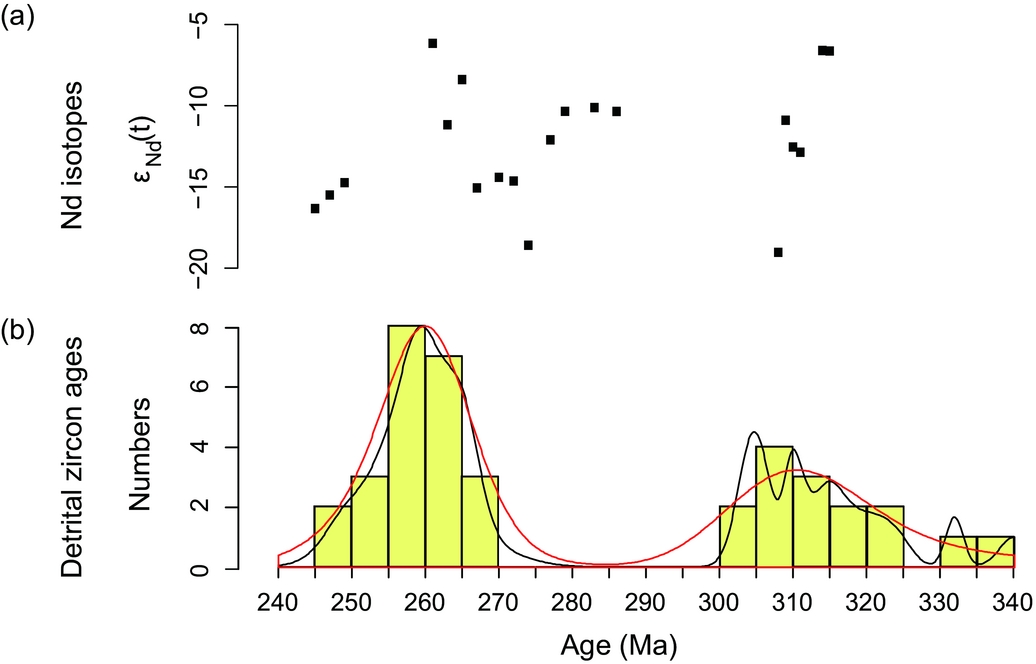
The inference is supported by the concurrent temporal trends observed in zircon U–Pb ages and Nd isotopes (Fig. 9). Phanerozoic detrital zircon age data from the Pyeongan Supergroup in the Samcheok coalfield comprise two late Palaeozoic age groups: 330–300 Ma and 270–250 Ma. Syn- to near-depositional detrital zircons are relatively abundant in the Manhang and Gohan formations. This age distribution is consistent with the time intervals generally coinciding with the intervals with relatively high εNd values (> −10.1): the lower Manhang Formation (315–310 Ma) and the upper Dosagok to Gohan formations (270–260 Ma). While the intervening intervals may represent a time of weakened magmatism rather than complete quiescence, the combined results clearly suggest two significant magmatic pulses, one in Late Carboniferous times and the other in middle–late Permian times.
(a) Temporal variation of Nd isotope composition (ƐNd(t)) of the Pyeongan Supergroup and (b) the Late Carboniferous – Early Triassic part of the detrital zircon age histogram, probability density plot (black line) and kernel density estimator (red line) for the Pyeongan Supergroup.

Between the two potential magmatic events, the younger signal is strongly supported by several lines of evidence. Minor volcanic input into the Gohan Formation has long been suspected from the occurrence of plagioclase grains and volcanic rock fragments in the sandstones (Yu, Lee & Boggs, Reference Yu, Lee and Boggs1997; Lee & Sheen, Reference Lee and Sheen1998). In addition, several plutons in the Yeongnam Massif margin have been recently identified as Middle–Late Permian to Early Triassic in age (Yi et al. Reference Yi, Cheong, Kim, Kim, Jeong and Cho2012; Cheong et al. Reference Cheong, Yi, Kim, Lee, Lee, Geng and Li2013, Reference Cheong, Kim, Kim, Yi, Jeong, Park, Li and Cho2014; Lee et al. Reference Lee, Yi, Cheong, Jeong, Kim and Kim2014b; Song et al. Reference Song, Lee, Park, Fitzsimons and Cawood2015). They generally exhibit positive to slightly negative εNd values, which supports the interpretation that the relatively high Nd isotope composition of the Gohan Formation is a result of mixing of Permian juvenile volcanic materials with the recycled sediments derived from the Yeongnam Massif basements (Fig. 8). From the adakitic composition of the Late Permian plutons in the northeastern Yeongnam Massif, previous studies inferred arc-related magmatism presumably caused by ridge subduction of the palaeo-Pacific plates (Yi et al. Reference Yi, Cheong, Kim, Kim, Jeong and Cho2012; Cheong et al. Reference Cheong, Kim, Kim, Yi, Jeong, Park, Li and Cho2014).
On the other hand, the supporting evidence for the older magmatic pulse in mid- to Late Carboniferous times is relatively poor. Neither feldspar grains nor volcanic rock fragments are readily visible in the sandstone petrography of the Manhang Formation (Lee, Reference Lee1990), and Carboniferous plutons are missing in southern Korea. Nevertheless, the occurrence of syn- to near-depositional zircons would provide solid evidence for active coeval magmatism somewhere in the source area. It is further supported by the occurrence of 330–300 Ma-aged zircons in the Manhang (Hongjeom) Formation in the Gangreung and the Mungyeong coalfields (Kim, Ree & Kim, Reference Kim, Ree and Kim2012; Kim, Seo & Yi, Reference Kim, Seo and Yi2014) located to the north and southwest of the Samcheok coalfield, respectively (Fig. 1b). The Late Carboniferous age peak (c. 322 Ma) is also clearly observed in the detrital zircons from modern river-mouth sediments of the Osipcheon river, which has a watershed basin with the Samcheok coalfield in the headwater region (Choi, Lee & Orihashi, Reference Choi, Lee and Orihashi2016). The combined information suggests a basin-wide supply of the detritus from syn- to near-depositional magmatism. The igneous activity is likely to have involved juvenile magma, considering the elevated εNd values in the lower Manhang Formation. In addition, a mafic to intermediate composition prone to weathering would better explain the lack of volcanogenic components in the Manhang sandstones.
In an attempt to find the missing information on the source rocks that provided Carboniferous zircons in the Gangreung coalfield, Kim, Ree & Kim (Reference Kim, Ree and Kim2012) speculated a potential linkage to the Hida Belt, central Japan. The Hida Belt is generally accepted as a remnant continental fragment that once belonged to the Asian continental margin prior to the opening of the East Sea (Sea of Japan) in Miocene times (Ehiro et al. Reference Ehiro, Tsujimori, Tsukada, Nuramkhaan, Moreno, Wallis, Kojima and Gibbons2016, p. 25). Gabbroic to dioritic dykes dated at 340–320 Ma in the Hida Belt have εNd(0) values ranging from −2.7 to +1.5 (Arakawa, Saito & Amakawa, Reference Arakawa, Saito and Amakawa2000). Such compositional characteristics match well with those inferred from our data. In addition, Yi et al. (Reference Yi, Cheong, Kim, Kim, Jeong and Cho2012) interpreted Late Permian magmatism in the Yeongnam Massif as having a potential tectonic relationship with the Hida Belt. Middle–Late Permian to Early Triassic plutons have been reported from the Hida Belt as well (Horie et al. Reference Horie, Yamashita, Hayasaka, Katoh, Tsutsumi, Katsube, Hidaka, Kim and Cho2010; Takahashi, Cho & Kee, Reference Takahashi, Cho and Kee2010; Zhao et al. Reference Zhao, Mao, Ye, Liu and Takahashi2013a). The concurrent Late Carboniferous and Late Permian magmatic pulses recorded in the Taebaeksan Basin and the Hida Belt support the view that both regions were together influenced by subduction occurring in the east–southeast of the two areas, in agreement with the palaeotectonic model of Ishiwatari & Tsujimori (Reference Ishiwatari and Tsujimori2003) and Chang & Zhao (Reference Chang and Zhao2012). Arc-type magmatism at c. 260 Ma recently reported from the most continent-sided part of southwest Japan, west of the Hida Belt provides other evidence for this tectonic view (Tsutsumi, Isozaki & Terabayashi, Reference Tsutsumi, Isozaki and Terabayashi2017).
Based on the results of this study and previous studies, it is interpreted that the eastern boundary of the SKB, like the northern boundary, corresponded to an active continental margin setting during late Palaeozoic times. Along with the presumed existence of a palaeo-orogen, the active magmatism in the eastern margin of the SKB can be traced back to as early as Late Carboniferous times. The first magmatic pulse reflected in the Manhang Formation clearly pre-dates the widespread Permo–Triassic Indosinian orogeny in eastern Asia, and may potentially link to the magmatism in the continental remnant in Japan. It suggests that oceanic subduction was already taking place in the east of the SKB before Permian times. The subduction-related magmatism might have rejuvenated in Middle–Late Permian times, as evidenced by the second magmatic pulse with the increased signature of direct volcanic input in the Gohan Formation.
6. Conclusions
Combined detrital zircon U–Pb geochronology and Nd isotope analysis on the Pyeongan Supergroup in the Samcheok coalfield indicates the major sediment provenance as being a recycled orogen originally derived from the Yeongnam Massif basements. This interpretation supports the previous hypothesis that a palaeo-orogen would have existed in the southeast. It is very characteristic that the ~1.9 Ga zircon population continues to appear predominantly throughout the Pyeongan Supergroup deposition. The concurrent occurrence of elevated εNd values and the syn- to near-depositional-aged zircons reflects the input of juvenile material produced by contemporaneous magmatic events, most notably at ~320 Ma and ~260 Ma. The younger magmatic events are consistent with the timing of the formation of Late Permian arc-related plutons in the Yeongnam Massif margin. The older Late Carboniferous magmatic events are not recorded as igneous rocks, but are well documented in sediment records deposited in the Taebaeksan Basin. With a potential link to the Hida Belt in central Japan, the two late Palaeozoic arc-related magmatic activities may indicate major tectonic events in the eastern margin of the SKB. Like the northern margin, the eastern margin of the SKB was an active continental margin during late Palaeozoic times.
Acknowledgements
This work was supported by the National Research Foundation of Korea (YIL, grant number 2014R1A2A2A01005404), (MGK, grant number 2012H1A2A1049032); and partly by the Earthquake Research Institute, the University of Tokyo (YO). We thank the journal editor, Prof. Lacombe, and two anonymous journal reviewers for their constructive comments to improve our manuscript.
Supplementary material
To view supplementary material for this article, please visit https://doi.org/10.1017/S0016756817000899