Introduction
In Iran, sugarcane is grown only in Khuzestan Province where the area available for cultivation exceeds 130,000 ha. Several invertebrate and vertebrate pests threaten sugarcane fields in this region, including the stalk borers Sesamia cretica Lederer and S. nonagrioides Lefebvre (Lepidoptera, Noctuidae) (particularly in areas where farmers plant sugarcane for the first time), sugarcane mite, Oligonychus sacchari McGregor (Acari: Tetranychidae), sugarcane whitefly, Neomaskellia andropogonis Corbett (Homoptera: Aleyrodidae), armyworm, Mythimna loreyi (Duponchel) (Lepidoptera: Noctuidae), migratory locust, Locusta migratoria L. (Orthoptera: Acrididae) and sugarcane beetle, Pentodon idiota Herbst (Coleoptera: Scarabaeidae). Vertebrate pests include the rat, Nesokia indica Gray (Rodentia: Muridae) and pig, Sus scrofa L. (Artiodactyla: Suidae).
After the borers, the mite and the whitefly are the most important pests of sugarcane in this region (Danialy, Reference Danialy1985). The sugarcane whitefly is distributed in sugarcane fields in the north and south of Khuzestan Province in Iran (Askarianzadeh and Manzari, Reference Askarianzadeh and Manzari2006). This pest sucks plant sap, producing large amounts of honeydew. The pest appears in areas where sugarcane has been planted for several years. Populations of all the developmental stages increase gradually from early August until late November. At this time, sugarcane is in the ripening stage, i.e. the sugar-storing stage. Nymphs suck the sap, and in cases of severe infestation, retard the growth of sugarcane plants. Sugar retrieval is also affected (Nayar et al., Reference Nayar, Ananthakrishnan and David1976).
In recent years, an outbreak of the sugarcane whitefly, N. andropogonis has occurred in sugarcane fields in Khuzestan Province (Askarianzadeh and Manzari, Reference Askarianzadeh and Manzari2006). Few detailed studies of this pest in Iran have been published. We conducted this study to investigate the biology and natural enemies of N. andropogonis and assess the damage it causes to sugarcane under laboratory and field conditions.
Materials and methods
Biology on different cultivars
The biology of N. andropogonis was evaluated on four commercial cultivars of sugarcane under laboratory conditions. In this experiment, pre-adult development, adult longevity and fecundity were determined in controlled-temperature incubators (27±1 °C, 60–70% R.H. and 12L: 12D photoperiod). Plastic leaf cages (3 × 1 cm) were used in the experiment with commercial sugarcane cultivars, including CP69-1062 and NCO-310 (late maturing cultivars), CP57-1062 (early maturing cultivar) and CP48-103 (intermediately maturing cultivar). These four cultivars represent the most commonly planted strains of sugarcane in Khuzestan Province.
Biology at different temperatures
The duration of different developmental stages of the pest was investigated at different temperatures under laboratory conditions. Each experiment was replicated five times. Adults were introduced on the CP69-1062 cultivar, which is a susceptible cultivar, for egg laying. Subsequently, leaves with eggs were transferred into a controlled temperature germinator under a 16:8 L/D photoperiod with daytime temperatures of 25±1 °C and nighttime temperatures of 20±1 °C, and with relative humidity at 60%. Eggs were examined daily and emerged nymphs and adults were recorded.
Two other trials were also conducted under the same conditions except that in the first trial daytime temperatures were 30±1 °C and nighttime temperatures were 25±1 °C, while in the second trial daytime temperatures were 40±1 °C and nighttime temperatures were 35±1 °C.
Fecundity and clutch size under laboratory conditions
To determine fecundity of female adults under laboratory conditions, a single newly emerged parthenogenetic female was put in a cage on cultivar CP69-1062. Fecundity and clutch size were studied under controlled temperature in germinators (60–70% RH, 16:8 L/D photoperiod with day and night temperatures of 30±1 °C and 25±1 °C). The experiment was replicated 20 times.
Determination of hibernation in the field
Insect activities cease during late November when temperatures decrease. To determine the stage in which the whitefly overwinters, in mid-January different developmental stages were collected from the field (over 100 samples of leaves with different stages of the pest). Leaf samples (including eggs, nymphs, pupae and adults) were put in a germinator under the same conditions as those described above. After 10 days, the survival of individuals and the percentage of egg eclosion, moulted nymphs and eclosed pupae was recorded.
Natural enemies
To collect and identify the natural enemies of the sugarcane whitefly, adult wasps were collected directly from leaves by an aspirator. Additionally, pest puparia were collected from the field and maintained under laboratory conditions (27 °C) until the emergence of adult wasps. Identification was done using a key and was later confirmed by Dr Shahab Manzari (Iranian Plant Protection Research Institute, Tehran, Iran).
Quality of damage on different cultivars
Whiteflies usually feed on the lower leaves of sugarcane. During this trial, for the purpose of analysis, stalks were assigned to one of seven groups based on the number of infested leaves (0, 1, 2, 3, 4, 5, >5). Syrup of stalks was extracted by mill and the percentage of Brix, pol, purity of juice and refined sugar (RS) was measured in each group using a polarimeter and refractometer according to ICUMSA (1998) methods. The experiment was conducted as a factorial experiment with five replications. Three commercial cultivars, including SP70-1143, CP57-614 and CP69-1062, were compared for estimated damage and sugar quality.
Statistical analysis
Data were analysed using the SPSS statistical program (Green et al., Reference Green, Salkind and Akey2000). Data were checked for normality prior to analysis. Data on the number of eggs were transformed using log10 before being analysed using analysis of variance (ANOVA). Data on the biology of N. andropogonis were analysed as completely randomized design (CRD) and sugarcane leaf-quality data were analysed as factorial experiment using ANOVA. Tukey's HSD test was used to separate means.
Results and Discussion
Biology on different cultivars
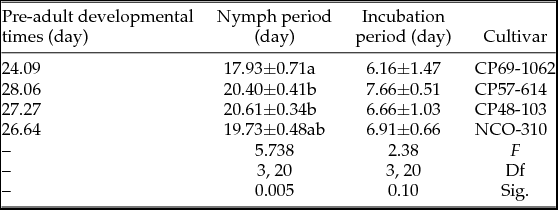
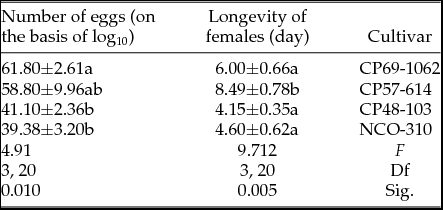
Mean incubation time was not significantly different among sugarcane cultivars, but mean nymphal period was significantly different among sugarcane cultivars. Mean pre-adult developmental times were 24.09, 28.06, 27.27 and 26.64 days on CP69-1062, CP57-614, CP48-103 and NCO-310 cultivars, respectively (Table 1), and only female progeny were produced. Mean longevity of females was significantly different among sugarcane cultivars. Mean longevity of females on the four cultivars was, respectively, 6, 8.49, 4.15 and 4.60 days. The mean number of eggs laid (log10 transformed) differed significantly among sugarcane cultivars. Females laid an average of 61.80, 58.80, 41.10 and 39.38 eggs on CP69-1062, CP57-614, CP48-103 and NCO-310, cultivars, respectively (Table 2). CP48-103 and NCO-310 cultivars were more resistant than other cultivars to sugarcane whitefly. Accordingly, and in the framework of a management programme (and in combination with other control techniques), they may be used to control N. andropogonis.
Mean duration (±SE) of pre-adult developmental stage of the sugarcane whitefly on CP69-1062, CP57-614, CP48-103 and NCO-310 cultivars in controlled temperature incubators (27±1 °C, 60–70% R.H. and 12L: 12L photoperiod)

Means followed by the same letter are not significantly different at the 5% level using Tukey's HSD comparison of means test.
Mean of longevity (±SE) of females and number of eggs of the sugarcane whitefly on CP69-1062, CP57-614, CP48-103 and NCO-310 cultivars in controlled temperature incubators (27±1 °C, 60–70% R.H. and 12L: 12L photoperiod)

Means followed by the same letter are not significantly different at the 5% level using Tukey's HSD comparison of means test.
According to David and Banerji (Reference David and Banerji1981), the fecundity of N. andropogonis in India ranged from 17 to 189 eggs per female and longevity was 2–5 days, which results are similar to ours. David and Banerji (Reference David and Banerji1981) also showed that cultivars such as Co419, Co775 and Co671, which have long and broad leaves, are highly susceptible to this pest.
Biology at different temperatures
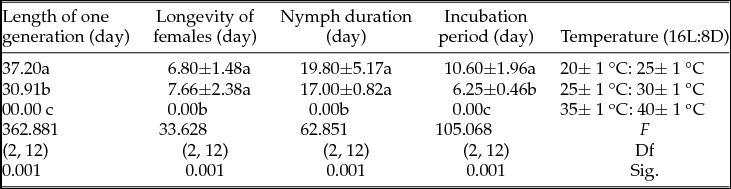
The means of the duration of different developmental stages differed among temperature regimens (Table 3). At temperatures of 20±1 °C: 25±1 °C, egg duration, nymphal duration (including first, second and third instar larvae and pupae), adult longevity and generation time on cultivar CP69-1062 were 10.60, 19.80, 6.80 and 37.20 days, respectively. At temperatures of 25±1 °C: 30±1 °C, the values were 6.25, 17.00, 7.66 and 30.91 days, respectively (Table 3). We observed no egg development at 35±1 °C: 40±1 °C; thus, we conclude that the optimum temperature for the development of different stages of N. andropogonis is between 25 and 30 °C. In India, the life cycle of N. andropogonis is completed in 18–20 days (David and Banerji, Reference David and Banerji1981). Shishehbor and Brennan (Reference Shishehbor and Brennan1996) reported that 30 °C is close to the most favourable temperature for a population increase of the castor whitefly, Trialeurodes ricini Misra.
Means of the duration (±SE) of developmental stages of the sugarcane whitefly at different temperatures

Means followed by the same letter are not significantly different at the 5% level using Tukey's HSD comparison of means test.
Fecundity and clutch size under laboratory conditions
Each female laid an average of 50.09 ± 29.65 eggs (maximum 100 eggs), and the mean clutch size was 27.87 ± 12.08. Females laid eggs on the under surface of the leaves, either distributed or in a single clutch. Eggs were creamy-yellow-white with a small curved stalk when freshly laid but soon turned brown. Fecundity and clutch size in N. andropogonis is similar to other sugarcane whitefly species. For example, in India and Pakistan, Aleurobus barodensis (Maskell) lays about 15 to 20 eggs in a row and an individual lays as many as 52 eggs (Nayar et al., Reference Nayar, Ananthakrishnan and David1976).
Determination of hibernation in the field
In the trial with the overwintering form, results showed that only 2.55% of eggs, 22.41% of nymphs and 18.25% of collected pupae survived the cold winter period. The nymphal and pupal stages appear to be the primary hibernation forms of N. andropogonis in Khuzestan Province.
Natural enemies
During the two years of the study, two parasitoid wasps were reared from whitefly nymphs: Encarsia inaron (Walker) and Eretmocerus delhiensis Mani (all Hym.: Aphelinidae). From our observations, E. inaron was the main enemy of the whitefly in the area. Encarsia inaron is about 0.5 mm in length and adults appear as minute flies moving about on leaves harbouring whitefly nymphs. Both the adult male and female have dark-coloured heads and eyes and transparent wings, but one can separate the sexes by the yellow abdomen of the female and the black abdomen of the male. Eretmocerus delhiensis appears to be a minor enemy of the whitefly in the area. All parts of its body are yellow-orange. During field studies, on several occasions, whitefly eggs disappeared when we observed ants in the vicinity, which may indicate predatory activity of ants on whitefly eggs.
In India and Pakistan, several parasitoids and predators, including Encarsia isaaci Mani and E. muliyali Mani (Aphelinidae), were reported to attack another sugarcane whitefly, A. barodensis (Maskell) (Inayatullah, Reference Inayatullah1984). Workers have reported A. barodensis in Pakistan but not in Iran. Vasantharaj and Ananthakrishnan (Reference Vasantharaj and Ananthakrishnan2006) reported in India that four species of Eretmocerus, including E. delhiensis, E. mundus Mercet, Encarsia neomaskelliae Prasad and E. tristis (Zehntner) attacked a third species of sugarcane whitefly, N. bergii (Signoret). The aphelinid, Eretmocerus serius Silvestri was reported on N. andropogonis in Pakistan (Inayatullah, Reference Inayatullah1984).
Quality of damage on different sugarcane cultivars
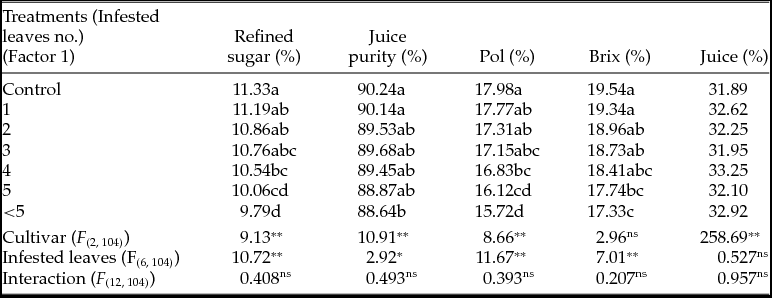
Analysis of data shows that percentage of Brix, pol, juice purity and RS factors is inversely and significantly correlated with infested leaf index (Table 4). Comparison of means using Tukey's test revealed that sugar quality of stalks with one infested leaf was similar to that of uninfested stalks, but that stalks with two or more infested leaves were significantly different. In stalks with more than four infested leaves, the damage was severe. For instance, on CP57-614, in comparison with uninfested stalks, those with five infested leaves had 8.2, 10.03, 1.9 and 11.2% reductions of Brix, pol, juice purity and RS, respectively.
Analysis of data and mean of qualified factors in different levels of infested leaves to the sugarcane whitefly

Means followed by the same letter are not significantly different at the 5% level using Tukey's HSD comparison of means test.
ns Non-significant.
* Significant at 5% level.
** Significant at 1% level.
The results also show that whitefly damage differs among cultivars and that it is possible to group cultivars into two categories, a higher and a lower category of damage. Whitefly damage to two cultivars, SP70-1143 and CP57-614, was higher than that seen on the CP69-1062 cultivar (Table 5). SP70-1143 and CP57-614 are early maturing cultivars. Based on the quality of damage, early maturing cultivars are more susceptible to whitefly damage.
Mean of qualified factors in different levels of infested leaves to the sugarcane whitefly on SP70-1143, CP69-1062 and CP57-614 cultivars

Means followed by the same letter are not significantly different at the 5% level using Tukey's HSD comparison of means test.
Heavy infestation of the aleurodids causes both quantitative and qualitative losses. Butani (Reference Butani1965) reported a reduction of 15–20% in tonnage in India due to the attack of the sugarcane whitefly, A. barodensis. According to Sandhu and Singh (Reference Sandhu and Singh1963), canes heavily infested with A. barodensis exhibited reduced sucrose (30–40%) and reduced total solids (20–25%). Besides, black sooty mould fungus, which develops on the honeydew of the whitefly, impedes photosynthesis and makes cane-tops unsuitable for cattle consumption (Byrne et al., Reference Byrne, Bellows, Parrella and Gerling1990).
Conclusion
Based on the results from this research, N. andropogonis produces only female progeny. CP48-103 and NCO-310 cultivars are more resistant than other cultivars to sugarcane whitefly. Accordingly, and in the framework of a management programme, and in combination with other control techniques, the two cultivars may be used to control N. andropogonis. Also, we conclude that the optimum temperature for development of different stages of N. andropogonis is between 25 and 30 °C and also, the nymphal and pupal stages appear to be the primary hibernation forms of N. andropogonis in Khuzestan province of Iran. From our observations, the wasp, E. inaron, is the main enemy of the whitefly in the area. Based on the quality of damage, early maturing cultivars are more susceptible to whitefly damage.
Acknowledgements
The authors thank the Sugarcane Research and Training Institute from the Sugarcane Development & By-Product Industries Co. in Ahvaz, Iran, for use of their facilities to carry out this research.