





No CrossRef data available.
Improving resource-use-efficiency with no-till and crop diversity
Published online by Cambridge University Press: 06 June 2016
Abstract
Recently, we conducted a case study that showed a no-till, diverse cropping system increasing corn yields in a semiarid climate compared with a tilled, corn–soybean rotation. Further analysis showed that the no-till system improved resource-use-efficiency of corn; inputs were reduced 42% averaged across five resources. The largest reduction with inputs involved nitrogen fertilizer and fuel. Reduced fertilizer input was attributed to greater soil microbial activity. A surprising trend was that cost of weed management in corn was 45% lower in the no-till system, due to resistant weeds being present only in the tilled, corn–soybean system. Crop diversity in the no-till system suppressed development of weed resistance. Integrating a diversity of crops with no-till can improve efficient use of resources.
Information
- Type
- Commentary
- Information
- Copyright
- Copyright © Cambridge University Press 2016
References
Anderson, R.L.
2008. Diversity and no-till: Keys for pest management in the U.S. Great Plains. Weed Science
56:141–145.CrossRefGoogle Scholar
Anderson, R.L.
2009. A 2-year small grain interval reduces need for herbicides in no-till soybean. Weed Technology
23:398–403.Google Scholar
Anderson, R.L.
2015. Integrating a complex rotation with no-till improves weed management in organic farming. A review. Agronomy for Sustainable Agriculture
35:967–974.Google Scholar
Anderson, R.L.
2016. Increasing corn yield with no-till cropping systems: A case study in South Dakota. Renewable Agriculture and Food Systems. doi: 10.1017/S1742170515000435.Google Scholar
Bender, S.F. and van der Heijden, M.G.
2015. Soil biota enhance agricultural sustainability by improving crop yield, nutrient uptake and reducing nitrogen leaching losses. Journal of Applied Ecology
52:228–239.Google Scholar
Cordell, D., Drangert, J., and White, S.
2009. The story of phosphorus: Global food security and food for thought. Global Environmental Change
19:292–305.Google Scholar
Dura, M., Therond, O., Martin, G., Martin-Clouaire, R., Magne, M.A., Justes, E., Journet, E.P., Aubertot, J.N., Savary, S., Bergez, J.E., and Sarthou, J.P.
2015. How to implement biodiversity-based agriculture to enhance ecosystem services: A review. Agronomy for Sustainable Development
35:1259–1281.CrossRefGoogle Scholar
FAO. 2016. What is Conservation Agriculture? Food and Agriculture Organization CA. Available at Web site http://www.fao.org/ag/ca/1a.thml (verified 10 December 2015).Google Scholar
Gerwing, J., and Gelderman, R.
2005. Fertilizer recommendation guide. South Dakota State University Extension Bulletin EC750. p. 27.Google Scholar
Gregory, M.M., Shea, K.L., and Bakko, E.B.
2015. Comparing agroecosystems: Effects of cropping and tillage patterns on soil, water, energy use, and productivity. Renewable Agriculture and Food Systems
20:81–90.Google Scholar
Haney, R.L., Jin, V.L., Johnson, M.V., Haney, E.B., Harmel, R.D., Arnold, J.G., and White, M.J.
2015. Analysis methods for the determination of anthropogenic additions of P to agricultural soils. Open Journal of Soil Science
5:59–68.Google Scholar
Harmel, R.D. and Haney, R.L.
2013. Initial evaluation of the agro-economic effects of determining nitrogen fertilizer rates with a recently-developed soil test methodology. Open Journal of Soil Science
3:91–99.Google Scholar
Heap, I.
2015. The International Survey of Herbicide Resistant Weeds. Available at Web site http://www.weedscience.org (verified 6 November 2015).Google Scholar
Hobbs, P.R.
2007. Conservation agriculture: What it is and why it is important for future sustainable food production. Journal of Agriculture Science
145:127–137.Google Scholar
Khan, S.A., Mulvaney, R.L., Ellsworth, T.R., and Boast, C.W.
2007. The myth of nitrogen fertilization for soil carbon sequestration. Journal of Environmental Quality
36:1821–1832.Google Scholar
Kirschenmann, F.L.
2007. Potential for a new generation of biodiversity in agroecosystems of the future. Agronomy Journal
99:373–376.Google Scholar
Kohl, L., Oehl, F., and van der Heijden, M.
2014. Agricultural practices indirectly influence plant productivity and ecosystem services through effects on soil biota. Ecological Applications
24:1842–1853.Google Scholar
Liebig, M.A., Tanaka, D.L., and Wienhold, B.J.
2004. Tillage and cropping effects on soil quality indicators in the northern Great Plains. Soil and Tillage Research
78:131–141.Google Scholar
Montgomery, D.R. and Bikle, A.
2015. The Hidden Half of Nature: The Microbial Roots of Life and Health. W.W. Norton and Company, New York. p. 312.Google Scholar
Richardson, A.E., and Simpson, R.J.
2011. Soil microorganisms mediating phosphorus availability. Plant Physiology
156:989–996.Google Scholar
Ryan, M.R., Mortensen, D.A., Bastiaans, L., Teasdale, J.R., Mirsky, S.B., Curran, W.S., Seidel, R., Wilson, D.O., and Hepperly, P.R.
2010. Elucidating the apparent maize tolerance to weed competition in long-term organic managed systems. Weed Research
50:25–36.Google Scholar
Senseman, S.A. and Grey, T.L.
2014. The future of herbicides and genetic technology: Ramifications for environmental stewardship. Weed Science
62:382–384.Google Scholar
Shaner, D.L.
2014. Lessons learned from the history of herbicide resistance. Weed Science
62:427–431.Google Scholar
Struik, P.C., Kuyper, T.W., Brussard, L., and Leeuwis, C.
2014. Deconstructing and unpacking scientific controversies in intensification and sustainability: Why the tensions in concepts and values?
Current Opinion in Environmental Sustainability
8:80–88.Google Scholar
Triplett, G.B. Jr and Dick, W.A.
2008. No-tillage crop production: A revolution in agriculture!
Agronomy Journal
100(Suppl.): S-153–S-165.Google Scholar
Wezel, A., Casagrande, M., Celette, F., Vian, J., Ferrer, A., and Peigne, J.
2014. Agroecological practices for sustainable agriculture. A review. Agronomy for Sustainable Development
34:1–20.CrossRefGoogle Scholar
Yamoah, C.F., Varvel, G.E., Francis, C.A., and Waltman, W.J.
1998. Weather and management impact on crop yield variability in rotations. Journal of Production Agriculture
11:219–225.Google Scholar
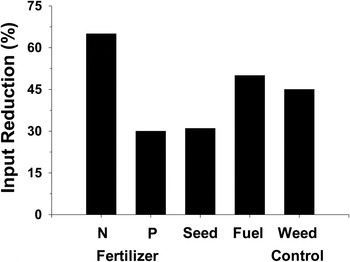
Figure 1. Reduction of inputs for corn production in a no-till, diverse cropping system compared with a tilled, corn-soybean rotation in South Dakota.
 You have
Access
- 6
- Cited by
The agricultural community has made advances in crop management to increase food production for the world's growing population. For example, development of no-till practices is restoring soil health by increasing microbial activity, organic matter levels and soil aggregation stability (Triplett and Dick, Reference Triplett and Dick2008). To facilitate adoption of no-till worldwide, the United Nations is encouraging conservation agriculture, which integrates no-till with crop diversity in rotation and soil cover by plant material (FAO, 2016). Land productivity has increased with conservation agriculture, especially in semiarid regions (Hobbs, Reference Hobbs2007).
However, there is also the global issue of limited resources, especially non-renewable resources such as phosphorus (P). Phosphorus is a key nutrient for crop production, yet global reserves may be depleted in 50–100 yr (Cordell et al., Reference Cordell, Drangert and White2009). A second concern is energy use, not only for fuel, but also for manufacturing fertilizers and pesticides (Kirschenmann, Reference Kirschenmann2007). Thus, a question facing the agricultural community is can resource-use-efficiency (RUE) be improved such that more food is produced with less resources? Struik et al. (Reference Struik, Kuyper, Brussard and Leeuwis2014), considering this concern with RUE, encouraged a farming approach that capitalized on ecological processes to increase agricultural output with less resources. Wezel et al. (Reference Wezel, Casagrande, Celette, Vian, Ferrer and Peigne2014) suggested that increasing crop diversity in farming systems could improve RUE.
Recently, we assessed impact of no-till on corn (Zea mays L.) yields across time, comparing a no-till, diverse cropping system [rotation was winter wheat (Triticum aestivum L.)–dry pea (Pisum sativum L.)–corn–soybean (Glycine max (L.) Merr.)–oat (Avena sativa L.)] to a tilled corn–soybean rotation (Anderson, Reference Anderson2016). In this case study, corn yield increased 116% in no-till across a 25-yr interval, but only 32% in the tilled system. The greater gain in corn yield with no-till was attributed to improved soil health and increased soil microbial activity. During the last 6 yr of the comparison (2008–2013), corn yielded 9500 kg ha−1 in the no-till system and 8700 kg ha−1 in the tilled system, even though precipitation at the no-till site was 125 mm lower. Corn yielded 9% more in no-till with 22% less rainfall. The sites were 160 km apart but located at the same latitude with soils having similar organic matter levels (4%) and textures (loams to silt loams). Both systems also grew similar hybrid maturities of corn. Because corn was more efficient in using precipitation in no-till, we examined corn use of other resources to see if use-efficiency of these resources also varied between the two systems.
Reduction in Resource Use with a No-Till, Diverse Cropping System
Production inputs for several resources were considerably less in the no-till system (Fig. 1). For example, corn density was 57,000 plants ha−1 in the no-till system, but 78,000 plants ha−1 in the tilled system. Thus, corn in the no-till system produced 45% more grain per plant than corn in the tilled system. Furthermore, nitrogen (N) and P fertilizer inputs were 65 and 30% less, respectively. Averaged across five resources, inputs for corn production were 42% lower in the no-till system. Corn in the no-till, diverse cropping system was more efficient in using resources to produce grain.
Reduction of inputs for corn production in a no-till, diverse cropping system compared with a tilled, corn-soybean rotation in South Dakota.
We believe that changes in the soil microbial community are involved in this improved efficiency. The 25 yr of no-till with a diverse crop rotation has increased microbial biomass. Assessment in a nearby research study showed that no-till and crop diversity increased soil microbial biomass almost 3-fold compared with a tilled monoculture after 17 yr (Liebig et al., Reference Liebig, Tanaka and Wienhold2004). Increased microbial biomass and activity due to no-till and crop diversity can improve land productivity (Kohl et al., Reference Kohl, Oehl and van der Heijden2014; Montgomery and Bikle, Reference Montgomery and Bikle2015). Yamoah et al. (Reference Yamoah, Varvel, Francis and Waltman1998) showed that, in favorable years, enhanced microbial activity increased corn yield 16% when comparing corn grown in a diverse rotation [corn–soybean–sorghum (Sorghum bicolor L. Moench)–oat/red clover (Trifolium pratense L.) mix for forage] with continuous corn. This yield increase occurred with the same inputs of water, N and P.
Reduced N and P Fertilizer Inputs
Higher soil microbial activity in the no-till system of our case study may have reduced the need for N and P fertilizer (Fig. 1). The 65% reduction in N fertilizer in the no-till system occurred because the producer calculates N need for corn based on 1.5 kg N 100 kg grain−1, which is 25% lower than the 2 kg N 100 kg grain−1 value used for tillage-based systems (Gerwing and Gelderman, Reference Gerwing and Gelderman2005). Less N fertilizer is needed because no-till and crop diversity increase the N-supplying capacity of soil with time. Bender and van der Heiden (Reference Bender and van der Heijden2015), comparing indigenous and enriched microbial communities in soil, showed that the enriched microbial community increased N and P concentration in corn 29 and 110%, respectively, and improved grain yield 22%. This gain in N and P concentration in corn was attributed to microbial enhancement of nutrient absorption and translocation. Richardson and Simpson (Reference Richardson and Simpson2011) also found that enhanced microbial activity increased both organic pools of nutrients and nutrient absorption by crops. Both teams of authors encouraged farming practices that increase microbial biomass and diversity in soil to improve nutrient-use-efficiency.
To more accurately match fertilizer input to crop N requirement, scientists are developing methodology to estimate nutrients supplied by the soil microbial community (Harmel and Haney, Reference Harmel and Haney2013; Haney et al., Reference Haney, Jin, Johnson, Haney, Harmel, Arnold and White2015). An intriguing consequence of reducing N fertilizer use is that it may preserve soil health. Khan et al. (Reference Khan, Mulvaney, Ellsworth and Boast2007) found that excess N fertilizer can promote breakdown of soil organic matter by stimulating microbial carbon use, and consequently, reduce organic matter content in soil across time.
Weed Management
One benefit of no-till is that fuel inputs are reduced. An assessment in the Great Plains showed that fuel consumption in no-till is 50% less than in tilled systems (Gregory et al., Reference Gregory, Shea and Bakko2015). A concern with no-till, however, is that reliance on herbicides for weed control will result in resistant weeds (Shaner, Reference Shaner2014). Yet, a surprising trend with our case study is that cost of weed management in corn was 45% higher in the tilled, corn–soybean system because of herbicide-resistant weeds. Both systems controlled weeds in corn with glyphosate and glyphosate-resistant hybrids, but management costs were higher in the tilled system because of glyphosate-resistant weeds such as common waterhemp (Amaranthus rudis Sauer), horseweed [Conyza canadenis (L.) Cronq.] and common ragweed (Ambrosia artemisiifolia L.) (Heap, Reference Heap2015). Weeds resistant to glyphosate have not been observed yet in the no-till system. Producers in the tilled system have to apply preemergence herbicides to control these resistant weeds (Senseman and Grey, Reference Senseman and Grey2014), thereby increasing cost of weed management.
Resistant weeds likely were not present in the no-till system because the diversity of crops (five different crops) allows rotation of herbicides with different modes of action, a key strategy for minimizing resistance (Shaner, Reference Shaner2014). This practice reduces the frequency that glyphosate is applied for weed control. A second benefit of diverse crop rotations is that weed population dynamics are more disrupted in crops with different life cycles, further suppressing population growth of resistant weeds (Anderson, Reference Anderson2008). Even though the no-till system relied on herbicides to manage weeds, resistance has not occurred because greater crop diversity provides more opportunities to minimize selection pressure for resistance (Shaner, Reference Shaner2014).
The no-till producer in our case study is growing cover crops after harvest of small grains to further improve soil health. Cover crops can also control weeds after small grain harvest and replace the use of glyphosate (Anderson, Reference Anderson2015). Furthermore, a 2-yr sequence of small grains and after-harvest cover crops reduces the need for herbicides in soybean grown after the small grain sequence (Anderson, Reference Anderson2009). Thus, cover crops could further minimize selection pressure for resistant weeds in no-till systems.
A further benefit of no-till, diverse cropping systems is that improved soil health increases corn tolerance to weed interference. Comparing a corn–soybean–spring wheat rotation with and without cover crops after 25 yr, Ryan et al. (Reference Ryan, Mortensen, Bastiaans, Teasdale, Mirsky, Curran, Seidel, Wilson and Hepperly2010) found that yield loss in corn was 20–30% less in the rotation with cover crops when uniform infestations of weeds were present. The rotation with cover crops increased soil microbial activity, organic matter levels and stability of soil aggregates, which the authors believed improved corn tolerance to weeds. Even in weed-free conditions, corn yielded 16% more with improved soil health.
Farming System Design
Kirschenmann (Reference Kirschenmann2007), reviewing the status of global agriculture facing limited resources, proposed that new farming systems be designed to conserve energy, restore soil health and favor biological synergies to reduce the need for external resources. Similarly, Dura et al. (Reference Dura, Therond, Martin, Martin-Clouaire, Magne, Justes, Journet, Aubertot, Savary, Bergez and Sarthou2015) suggested that farming systems be redesigned based on biodiversity to promote internal resources such as nutrient cycling to improve productivity and RUE.
The no-till, diversified cropping system in our case study is achieving these goals. Corn yields were 9% higher in the no-till system, yet inputs for five resources for corn production were 42% lower than with a tilled, corn–soybean rotation. A startling trend was that weeds’ resistant to herbicides have not been observed in the no-till system, but were present in the tilled system.
As our case study demonstrates, a diversified farming system that increases crop productivity can also reduce resource inputs by improving RUE. We believe that a critical component for improved efficiency in our case study was the multi-crop rotation. Crop diversity provides an array of ecological benefits to improve crop growth efficiency in no-till, as well as opportunities to minimize development of weed resistance.