1 Introduction
Place of articulation is one of the most important notions in phonetics. Place of articulation refers to the range of different locations within the oral cavity at which the major articulatory events involved in speech sound production occur (Ladefoged & Maddieson Reference Ladefoged and Maddieson1997). However, place of articulation has a wider significance in phonetics, because it fundamentally determines the shape of the whole vocal tract (Ladefoged & Maddieson Reference Ladefoged and Maddieson1997, Škarić Reference Škarić and Kovačec2007).
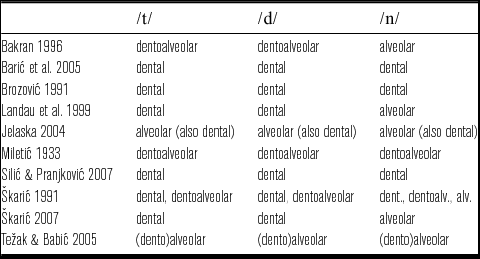
In this investigation we focus on an area of controversy regarding the place of articulation of the nasal /n/ in Croatian. There is disagreement among authors about the exact placement of the Croatian nasal /n/. Out of ten frequently used handbooks and grammars, three describe /n/ exclusively as dental (Brozović Reference Brozović1991: 404; Barić et al. Reference Barić, Lončarić, Malić, Pavešić, Peti, Zečević and Znika2005: 51; Silić & Pranjković Reference Silić and Pranjković2007: 13), three describe it exclusively as alveolar (Bakran Reference Bakran1996: 58; Landau et al. Reference Landau, Lončarić, Horga and Škarić1999: 66; Škarić Reference Škarić and Kovačec2007: 64), two as dentoalveolar (Miletić Reference Miletić1933: 45, 46; Težak & Babić Reference Težak and Babić2005: 55), and two authors assign several places of articulation: alveolar and dental (Jelaska Reference Jelaska2004: 49) and dental, dentoalveolar and alveolar (Škarić Reference Škarić1991: 125). The articulation of /n/ within the oral cavity is often compared with the articulation of /t/ and /d/ (especially with the voiced /d/). One reason for the comparison is that the linguopalatal contact of /n/ resembles that of other apical/laminal sounds because it is produced by a combination of lateral bracing and an upward movement of the tongue tip/blade, which results in a horseshoe shape of tongue-to-palate contact (Gibbon Reference Gibbon2004). However, as seen in Table 1, authors do not agree whether or not Croatian /n/ differs in the place of articulation from /t/ and /d/.
The description of the place of articulation in /t d n/ in ten different literature sources.

Although there is some disagreement about the place of articulation of /t/ and /d/, the majority of authors view their place of articulation as dental (Brozović Reference Brozović1991, Landau et al. Reference Landau, Lončarić, Horga and Škarić1999, Barić et al. Reference Barić, Lončarić, Malić, Pavešić, Peti, Zečević and Znika2005, Silić & Pranjković Reference Silić and Pranjković2007, Škarić Reference Škarić and Kovačec2007), while in three sources they are defined as dentoalveolar (Miletić Reference Miletić1933, Bakran Reference Bakran1996, Težak & Babić Reference Težak and Babić2005), and one author describes them as alveolar and dental (Jelaska Reference Jelaska2004). However, Jelaska (Reference Jelaska2004) cautions that /t/ and /d/ can also be produced at a dental place of articulation, thus partly agreeing with the majority. Škarić (Reference Škarić1991) allows both dental and dentoalveolar placement of /t/ and /d/. Despite some difference in opinion regarding the precise place of articulation for /t/ and /d/, all authors agree that it is located somewhere in the dental-alveolar region, which is generally similar to the classification of the nasal /n/. However, what is different between the plosives and the nasal is that the nasal is exclusively labelled as alveolar in three literature sources while an alveolar place of articulation is never exclusively assigned to the plosives.
Although there are languages which contrast dental and alveolar places of articulation, such as Malayalam and Javanese (Ladefoged & Maddieson Reference Ladefoged and Maddieson1997, Laver Reference Laver2002, Zsiga Reference Zsiga2013), dental and alveolar places of articulation are not contrastive in Croatian and that might be the reason for differences in classification (Jelaska Reference Jelaska2004: 50). Jelaska (Reference Jelaska2004) further explains that these anterior Croatian sounds are almost always produced at both dental and alveolar regions so they could best be described as dentoalveolar.
It should be noted that the alveolar status of the Croatian lateral approximant /l/ and trill /r/ is not controversial. Almost all the above authors define /l/ and /r/ as alveolar, Brozović (Reference Brozović1991) being the only exception describing /l/ as dental, although highly variable. The existence of the alveolar place of articulation in some Croatian speech sounds is therefore not in question.
Instrumental techniques, in particular palatography, can provide detailed and specific information about place of articulation, but these types of data on articulatory characteristics of Croatian nasal /n/ are rare and dated. Miletić (Reference Miletić1933) gathered static palatographic data of speech sounds in isolation. This is the only study which provides extensive instrumental data on Croatian (and Serbian) speech sounds. Apart from describing the place of articulation, Miletić briefly mentions increased tongue-to-palate contact variability in /n/ when compared to /t/ and /d/, but the description is qualitative rather than quantitative. Miletić also mentions a lower amount of linguopalatal contact in Croatian /n/ when compared with its non-nasal counterparts (Miletić Reference Miletić1933: 47), but does not present any contact measurements to back up this observation.
Increased variability might be the reason why researchers disagree on the exact placement of the nasal /n/ in Croatian. Increased variability of nasal sounds is reported in other languages including English and Spanish (McLeod Reference McLeod2006, Colantoni & Kochetov Reference Colantoni and Kochetov2012). Colantoni & Kochetov (Reference Colantoni and Kochetov2012) noted that nasals are notorious for their variability and mention several studies showing different factors that influence variability in nasals: increased linguopalatal contact in prosodically strong positions, decreased linguopalatal contact and vocalisation in prosodically weak conditions, deocclusivisiation (the occurrence of incomplete closures) in intervocalic position and assimilation in place under the influence of surrounding consonants. In their study, the authors report on three sources of nasal variability in Argentine and Cuban Spanish: dialectal variability (the majority of nasal productions in Argentine Spanish were alveolar, while velar realisations were much more frequent in Cuban Spanish), speech-style related variability (the higher frequency of deocclusivisations occurred in less formal speech tasks) and variability caused by different segmental and suprasegmental contexts (deocclusivisation was found to be highly dependent on vowel context, increasing in frequency with a more posterior vowel productions). The investigation was focused on nasals in word-final position and the authors note that variability in intervocalic position can differ. Furthermore, a lower amount of linguopalatal contact in nasals when compared with non-nasals is another characteristic often reported in other languages (McLeod Reference McLeod2006, Gibbon et al. Reference Gibbon, Yuen, Lee and Adams2007, Shosted, Hualde & Scarpace Reference Shosted, Hualde and Scarpace2012). The main reason for this seems to be higher intraoral pressure in /t/ and /d/ when compared with /n/ (Subtelny, Worth & Sakuda Reference Subtelny, Worth and Sakuda1966, cited in Gibbon et al. Reference Gibbon, Yuen, Lee and Adams2007: 86), resulting in higher lingual pressure and consequently increased linguopalatal contact in oral stops.
One way to find out more about whether placement for /n/ in Croatian is the same or different from /t d/ is to use the technique of electropalatography (EPG). EPG measures details of tongue-to-palate contact in the anterior region of the palate and is able to capture the dynamics of tongue-to-palate contact patterns (Stone Reference Stone, Hardcastle, Laver and Gibbon2013). Detailed technical accounts of the technique are presented in Wrench et al. (Reference Wrench, Gibbon, McNeill, Wood, Hansen and Pellom2002) and Wrench (Reference Wrench2007), while the development of EPG systems and an overview of its applications are given by Gibbon & Nicolaidis (Reference Gibbon and Nicolaidis1999).
From the data reviewed above, it is not clear whether /t/, /d/ and /n/ share the place of articulation in Croatian, or whether the places of articulation of those three sounds are different. Resolving this controversy is highly relevant for a full and accurate phonetic description of the Croatian sound system. Objective evidence, such as derived from EPG, about what sounds in the Croatian language share the place of articulation is important for phonological theory and understanding speech disorders where they occur in Croatian speakers. The use of EPG makes it possible to discover whether the oral and nasal targets are ‘separated’ from each other in terms of the place of articulation distance, which is predicted if /t/ and /d/ are dental and /n/ is alveolar. If, on the other hand, these sounds share the place of articulation, there should be no such articulatory separation revealed in the EPG data. The EPG data will also indicate whether placement can best be described as dental for /t d/ and alveolar for /n/ for these targets. As part of this, EPG data will also be used to analyse lateral tongue-to-palate contact, deocclusivisation (incomplete closures) and coarticulatory processes caused by different symmetrical vowel contexts.
Based on the previous reports on the place of articulation for coronal nasal and oral stops in Croatian reviewed above, we hypothesise that /n/ will be produced at a more posterior place of articulation than /t/ and /d/ and that it will be produced with less tongue-to-palate contact. This hypothesis is also warranted by the results obtained from other languages, since it has been reported that /n/ is often more posterior than /t/ and /d/ in several languages. We also hypothesise that productions of /n/ will be more variable than /t/ and /d/ productions, since it has been reported that anterior nasal is produced with relatively lower tongue-to-palate contact than anterior plosives and that nasals are generally more variable as well.
2 Method
2.1 Participants
The speech from six participants was analysed in this study: three female (F1, F2, F3) and three male (M1, M2, M3). They had no history of speech or hearing impairments and their participation in the study was voluntary. Participants’ age ranged between 26 and 35 years and the mean age was 30.8 years. The participants were originally from different parts of Croatia (southern, northern and western Croatia). However, at the time of recording they all had lived in Zagreb for more than five years (four of them for more than 10 years) and their speech can be characterised as the new Implicit Croatian Norm (see Liker & Gibbon Reference Liker and Gibbon2012). Therefore, their productions of the nasal and plosives presumably were not influenced by their origin, especially since there are no reports that sounds /t/, /d/ and /n/ differ in different Croatian dialects.
2.2 Speech material
Speech material used in this study was extracted from the simultaneous EPG and acoustic corpus of Croatian speech (CROELCO). A detailed description of the CROELCO corpus was presented in Liker (Reference Liker2009) and Liker, Horga & Mildner (Reference Liker, Horga and Mildner2012).
The speech material used in this study comprised 972 VCV sequences with analysed consonants in symmetrical and asymmetrical vowel contexts. Each consonant was recorded in nine VCV sequences (V = vowels /i a u/, C = consonants /t d n/, iCi, iCa, iCu, aCi, aCa, aCu, uCi, uCa, uCu), so the wordlist comprised 27 VCV sequences. Each speaker repeated the wordlist six times, with a short-falling accent placed on the first syllable. This is in agreement with accentuation rules in Croatian, because accent on the last syllable is not typical for Croatian. The short-falling accent on the first syllable represents a frequent pattern in Croatian speech and one that differs least in different varieties of Croatian.
2.3 Data acquisition and instrumentation
WinEPG system connected to a standard PC was used for data collection (Wrench et al. Reference Wrench, Gibbon, McNeill, Wood, Hansen and Pellom2002). The acoustic signal was recorded simultaneously via M-Audio MobilePre USB sound card/pre-amplifier with a standard microphone connected to the WinEPG system.
All speakers had a custom made artificial EPG palate to fit snugly against their respective palates. The palate used for EPG data collection was the latest of EPG palate designs: the Articulate palate (see Wrench Reference Wrench2007). There are 62 electrodes embedded in the palate, and they are arranged according to each speaker's individual palatal anatomical characteristics. The Articulate palate's main advantages over the similar Reading design are better dental and velar coverage and lower manufacturing costs (see Wrench Reference Wrench2007, Tabain Reference Tabain2011).
Prior to data acquisition all speakers underwent a two-stage desensitization procedure. The desensitization procedure was designed with reference to the results in McAuliffe, Robb & Murdoch (Reference McAuliffe, Robb and Murdoch2007), who found that speakers are able to adapt their speech to the presence of an artificial palate, but need from 45 minutes up to three hours to do that. Therefore, the first phase of the desensitization procedure in this investigation lasted for five days, with two-hour palate-wearing sessions each day. During those two hours speakers were instructed to engage in spontaneous conversations or occasionally read written passages out loud with the palate in the mouth. The second phase of desensitization procedure was prior to the recording and lasted for a maximum of one hour. The recording procedure started when the speaker's articulation was rated as acceptable by two trained phoneticians. Speakers where recorded while reading the individual words presented on a computer screen. They were instructed to read the words out loud with the short falling accent on the first syllable. Their ability to do so was checked prior to recording. Their productions were monitored by the first author of this paper and when a speaker made a mistake, the recording was repeated.
2.4 Data analysis
Segmentation and annotation were performed using the Articulate Assistant software (Wrench et al. Reference Wrench, Gibbon, McNeill, Wood, Hansen and Pellom2002, Wrench Reference Wrench2008). Annotation criteria followed a well-established set of criteria for stop articulations in similar studies (Gibbon & Wood Reference Gibbon and Wood2003, Gibbon et al. Reference Gibbon, Yuen, Lee and Adams2007): the start of the annotation was defined as the first EPG frame showing a complete linguopalatal contact in one or more rows of electrodes. Similarly, the end of the annotation was marked at the last EPG frame showing a complete linguopalatal contact across one or more rows of electrodes. Maximum contact points within the annotation were automatically determined by the software.
The Articulate Assistant software was used to calculate the EPG indices described in the remainder of this section. Statistical variability (Var) was calculated for all indices by dividing the standard deviation (SD) by the mean (M) and multiplying the result by 100:
 \begin{equation*}
Var = \left( {\frac{{SD}}{M}} \right) \times 100
\end{equation*}
2.4.1 Place of articulation
Place of articulation was estimated by means of the ACoG measure (Gibbon & Nicolaidis Reference Gibbon and Nicolaidis1999) at the maximum contact point:
 \begin{equation*}
ACoG = \frac{{(4.5xR4) + (5.5xR3) + (6.5xR2) + (7.5xR1)}}{{R4 + R3 + R2 + R1}}
\end{equation*}
The ACoG measure is an adaptation of the CoG measure (Hardcastle, Gibbon & Nicolaidis Reference Hardcastle, Gibbon and Nicolaidis1991), which is widely used to determine the location on the palate of the highest concentration of contacted electrodes on the palate and thus estimate the place of articulation of a particular sound (e.g. Gibbon, Hardcastle & Nicolaidis Reference Gibbon, Hardcastle and Nicolaidis1993, Mair, Scully & Shadle Reference Mair, Scully, Shadle, Bunnel and Idsardi1996, Gibbon et al. Reference Gibbon, McNeill, Wood and Watson2003, Gibbon & Wood Reference Gibbon and Wood2003, Simonsen & Moen Reference Simonsen and Moen2004, McLeod Reference McLeod2006, Cheng et al. Reference Cheng, Murdoch, Goozee and Scott2007). The ACoG measure is a relatively robust method of measuring place of articulation of anterior lingual sounds because it measures the area with the highest concentration of contacted electrodes in the four central electrodes over the four front rows of the palate (Gibbon & Nicolaidis Reference Gibbon and Nicolaidis1999). It reduces the influence of side electrodes and back electrodes (Gibbon et al. Reference Gibbon, Hardcastle and Nicolaidis1993), hence it provides more precise measurements with anterior consonants. A higher ACoG value indicates a more anterior articulation, while a lower value indicates a more posterior articulation.
The significance of difference was tested by means of the unequal variance t-test (heteroscedastic t-test) using MS Excel.
2.4.2 Amount of contact
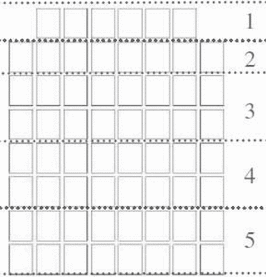
Amount of contact was measured separately in two articulatory regions: dental and alveolar (Figure 1) at the maximum contact point. The amount of contact equals the number of contacted electrodes in a particular articulatory region at the maximum contact point, divided by the total number of electrodes in the articulatory region. A higher amount of contact index indicates more linguopalatal contact in a particular articulatory region. Dentoalveolar place of articulation cannot be measured directly due to the articulatory zoning scheme of the Articulate palate. However, it is possible to infer dentoalveolar place of articulation indirectly. Places of articulation are classified as follows:
-
(i) The articulation is dental if the largest amount of contact is in the dental area and the difference between the amount of contact in the dental and the alveolar contact is statistically significant.
-
(ii) The articulation is alveolar if the largest amount of contact is in the alveolar area and the difference between the amount of contact in the dental and the alveolar contact is statistically significant.
-
(iii) The articulation is dentoalveolar if there is similar contact in the dental and the alveolar area, meaning that difference between the two amounts of contact is statistically non-significant.
The significance of difference was tested by means of the two-way ANOVA with replication using MS Excel.
Articulatory zoning schemes on the Articulate palate: 1 – dental region, 2 – alveolar region, 3 – postalveolar region, 4 – palatal and 5 – velar region (adapted from Wrench Reference Wrench2007).

2.4.3 Incomplete closure
The number of incomplete closures in each consonant was calculated relative to the total number of productions and expressed as a percentage. Repetitions without full electrode activation across one or more rows of electrodes were annotated according to the acoustic signal and marked as ‘incomplete closure’. The acoustic cues for the stops /t/ and /d/ were the beginning and the end of the occlusion silence on the spectrogram. The acoustic cues for the nasal /n/ were the presence of the nasal murmur and/or the nasal antiformant on the spectrogram (Bakran Reference Bakran1996, Kent & Read Reference Kent and Read2002). Percent of incomplete EPG closures for each speaker and each vowel context was calculated. The number of incomplete EPG closures was counted for each repetition and each vowel context, divided by the total number of repetitions (six) and multiplied by 100 in order to express it as a percentage.
2.4.4 Lateral contact
Lateral contact was measured by totalling the amount of contact at the two most lateral columns of electrodes at each side of the EPG palate at the maximum contact point (the lateral contact index). A higher lateral contact index indicates increased lateral contact.
The significance of difference was tested by means of the unequal variance t-test (heteroscedastic t-test).
2.4.5 Coarticulatory effects
Coarticulatory effects of different vowel contexts on anterior nasals and plosives were also investigated. Based on the previous studies on nasals in other languages, different vowel contexts were expected to influence placement and deocclusivisation processes. In order to investigate these processes, we analysed the ACoG measure in three symmetrical vowel contexts (iCi, aCa, uCu) and the occurrence of incomplete closures in all vowel contexts. Coarticulatory effects on the ACoG measure were measured in symmetrical vowel contexts only, because symmetrical contexts provided a more controlled experimental condition regarding coarticulatory direction (anticipatory vs. carryover coarticulation). The temporal extent and the directionality of coarticulatory processes were not within the scope of the investigation, so symmetrical vowel contexts provided enough information on how different vowels influence placement, without introducing an additional factor, i.e. the direction and the temporal extent of that influence. Therefore, asymmetrical vowel contexts were excluded from measuring how different vowel contexts influence the variability of the ACoG measure. All vowel contexts were taken into account for the analysis of deocclusivisation processes. The significance of difference was tested by means of the two-way ANOVA with replication using MS Excel.
3 Results
3.1 Place of articulation
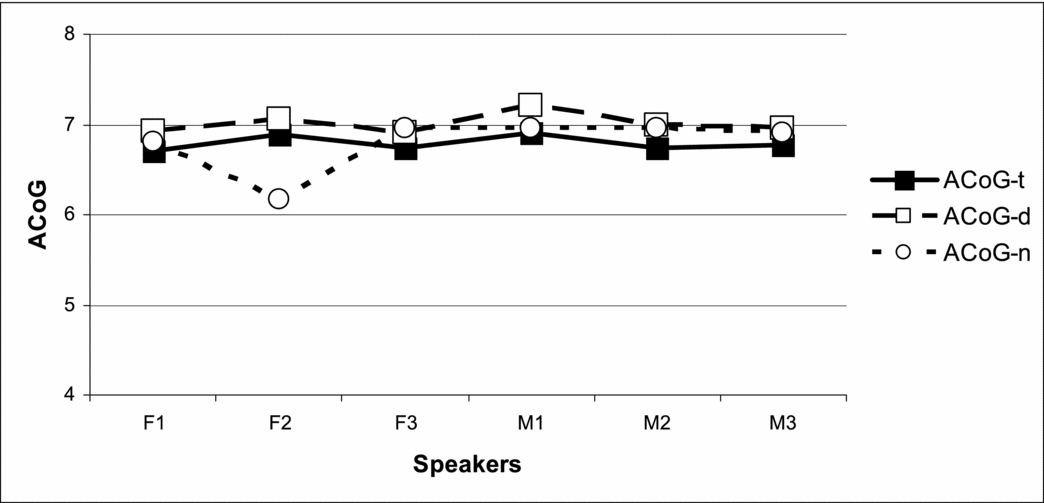
The analysis of the ACoG measure at maximum contact point does not show a clear separation of the place of articulation between /t/, /d/ and /n/ for most of the speakers (Figure 2). Average ACoG values, which reflect relative place of articulation in the three consonants, are very similar, the most fronted being /d/ (mean: 7.01, SD: 0.11), which is followed by /n/ (mean: 6.80, SD: 0.31) and /t/ (mean: 6.79, SD: 0.08). Only speaker F2 produces the nasal /n/ with a clearly more posterior place of articulation. All other speakers except F3 produce the stop /d/ as most fronted, which is followed by /n/ and then /t/ as the most posterior. The ACoG in /t/ ranges between 6.71 (SD: 0.28) in F1 and 6.89 (SD: 0.13) in F2, in /d/ that range is between 6.91 (SD: 0.19) in F3 and 7.20 (SD: 1.08) in M1, and in /n/ between 6.17 (SD: 0.69) in F2 and 6.96 (SD: 0.28) in F3. These results do not support the description of /n/ as alveolar and /t/, /d/ as dental. The similarity between the place of articulation of the nasal /n/ and oral stops is illustrated by average electropalatograms (Figure 3).
The place of articulation measured by the ACoG index in /t d n/ in each speaker.

Electropalatograms averaged across vowel contexts measured at maximum contact points in /t d n/ in each speaker. Articulatory zoning schemes are marked on the empty electropalatograms on the right: 1 – dental region, 2 – alveolar region, 3 – postalveolar region, 4 – palatal and 5 – velar region.

The high standard deviation indicates greater variability of the ACoG measure in /n/ (4.59) compared with /t/ (1.56) and /d/ (1.78).
Heteroscedatic t-test shows that the difference in ACoG is not significant between /t/ and /n/ (t(442) = 1.9654, p > .1), while the difference between /d/ and /n/ is significant (t(640) = 1.9636, p < .001). The significance of the difference between /d/ and /n/ is mainly due to the results obtained from speaker F2, because when F2 is excluded from the calculation, the difference between /d/ and /n/ becomes non-significant (t(502) = 1.9647, p > .05). The difference between /t/ and /d/ is also significant (t(461) = 1.96512, p < .001).
3.2 Amount of contact in dental and alveolar regions
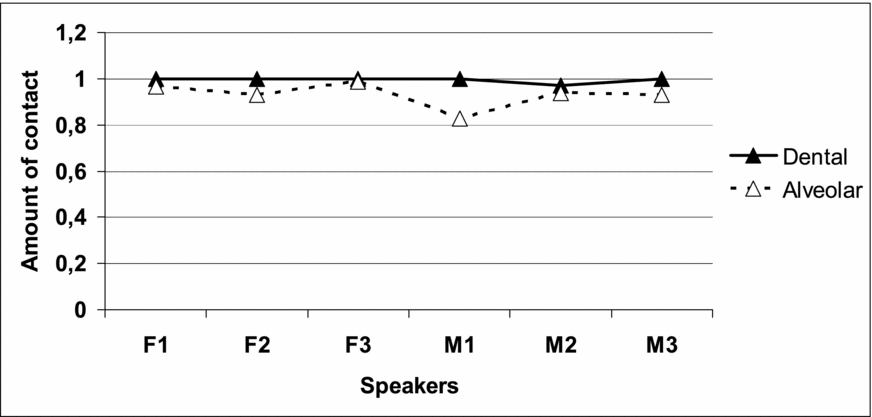
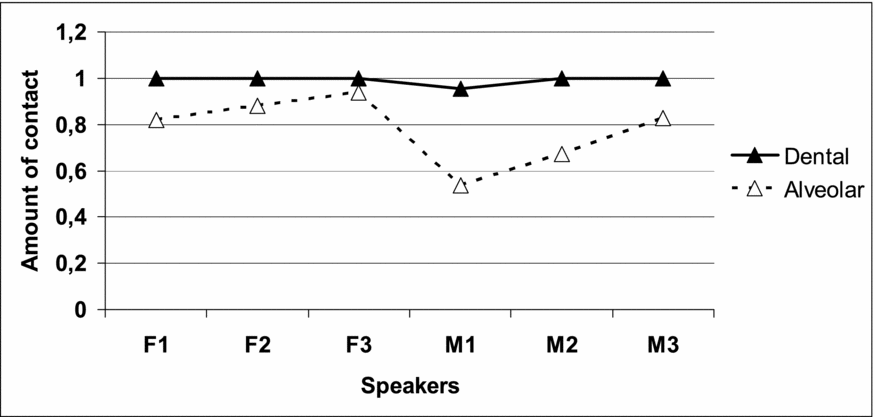
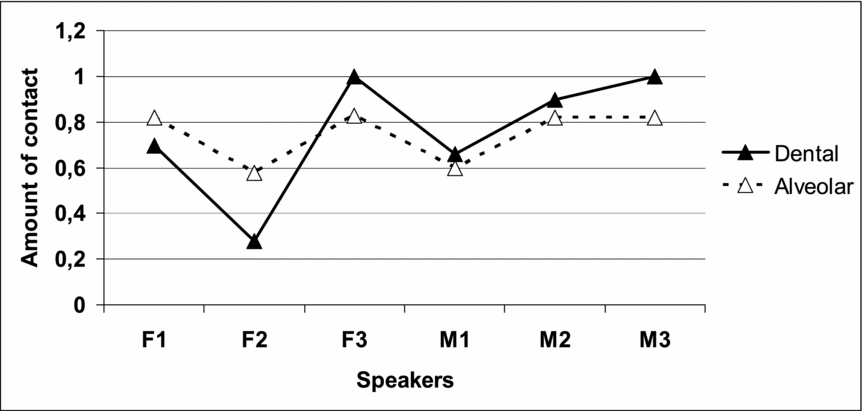
The analysis of the amount of contact data in different articulatory regions provides a more detailed view of the exact placement of the three coronal consonants. As expected, stops /t/ and /d/ are produced with most contacts in the dental region by all speakers (Figures 4 and 5). Voiceless stop /t/ is produced with almost maximal dental coverage (mean: 0.99, SD: 0.01) and a smaller amount of alveolar contact (mean: 0.93, SD: 0.06). Voiced stop /d/ shows a similar tendency, having almost maximal dental contact (mean: 0.99, SD: 0.02), while alveolar (mean: 0.78, SD: 0.15) contact is lower. Voiceless stop /t/ shows higher dental and alveolar contact than voiced /d/, which is a direct consequence of voiceless stops having increased total tongue-to-palate contact relative to their voiced counterparts (Farnetani Reference Farnetani, Hardcastle and Marchal1990, Dart Reference Dart1998, Moen et al. Reference Moen, Simonsen, Huseby, Grue, Dalsgaard, Lindberg, Benner and Tan2001, Fuchs & Perrier Reference Fuchs and Perrier2003, Fuchs Reference Fuchs2005).
The amount of contact in dental and alveolar articulatory regions in voiceless stop /t/ in each speaker.

The amount of contact in dental and alveolar articulatory regions in voiced stop /d/ in each speaker.

Nasal /n/ is produced with the highest amount of contact in the dental region (mean: 0.76, SD: 0.28) and similarly high contact in the alveolar region (mean: 0.74, SD: 0.12). When compared with the plosives, nasal productions show more inter-speaker variability, whereby four speakers demonstrate more dental than alveolar contact (F3, M1, M2, M3), while two speakers show the opposite articulatory strategy (F1 and F2) (Figure 6).
The amount of contact in dental and alveolar articulatory regions in nasal /n/ in each speaker.

The statistical variability measure shows a high degree of variability in /n/ in both articulatory regions (dental: 53.72%, alveolar: 37.64%), when compared with variability in /d/ (dental: 6.81%, alveolar: 26.44%) and /t/ (dental: 2.77%, alveolar: 13.04). Variability in the nasal is higher in the dental area, while in the plosives it is higher in the alveolar area, especially in /d/.
A two-way ANOVA with replication shows that the difference between dental and alveolar contact is significant in /t/ (F(1,5) = 35.05, p < .0001) and /d/ (F(1,5) = 175.18, p < .0001), but non-significant in the nasal (F(1,5) = 0.08, p > .1). Note that the p-values for the interaction between the amount of contact and speaker show significance for all three consonants: /t/ (p < .01), /d/ (p < .0001), and /n/ (p < .01). This result is important, because it shows that the difference between the dental and the alveolar contact is not consistent in all speakers.
3.3 Incomplete EPG closure
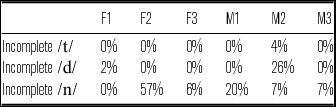
The results showed that incomplete closure was almost non-existent in the voiceless stop /t/, it was somewhat more frequent, although still low, in the voiced stop /d/, while the productions of the nasal /n/ had the highest percentage of incomplete closures (Table 2).
The percentage of incomplete EPG closures in /t d n/ in each speaker.

It is important to note that the number of incomplete closures is not proportionally distributed for each sound. For example, speaker F2 has the highest percentage of incomplete closures in /n/, but no incomplete closures in /t/ and /d/, while speaker M2 has the highest percentage of incomplete closures in /d/, but low percentage of /n/ productions with incomplete closures.
3.4 Lateral contact
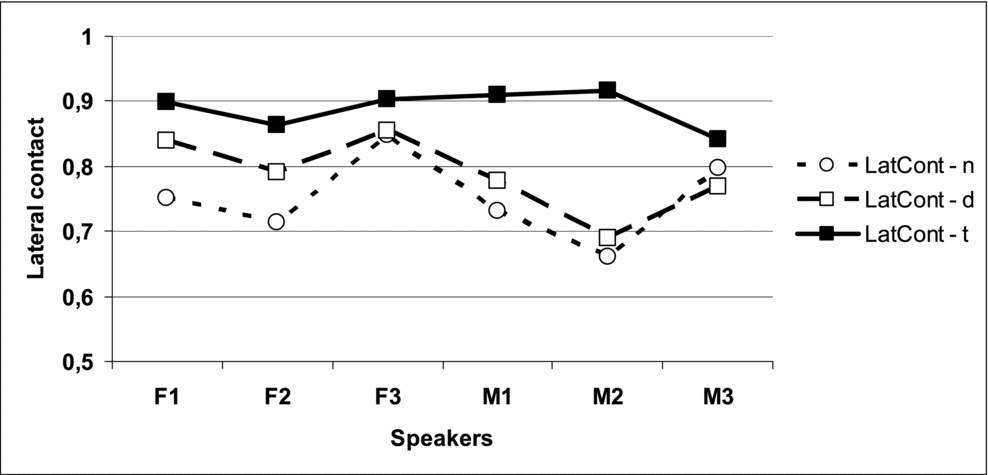
The lateral contact measure shows a very consistent difference between the nasal and the two stops (Figure 7). Five speakers (F1, F2, F3, M1 and M2) show very similar tendencies in differentiating between the nasal and the stops according to the lateral contact measure: /t/ is produced with the highest amount of lateral contact (mean: 0.89, SD: 0.03), /d/ with somewhat less lateral contact (mean: 0.79, SD: 0.06) and the nasal /n/ with the least amount of lateral contact (mean: 0.75, SD: 0.07). Only speaker M3 shows a different tendency, with the stop /d/ showing the least amount of lateral contact, followed by /n/ and then /t/. In speaker F3 the difference in lateral contact means between /d/ and /n/ is very small. The lateral measure in /n/ ranges between 0.66 (SD: 0.04) in M2 and 0.80 (SD: 0.02) in M3, in /d/ its values are between 0.69 (SD: 0.02) in M2 and 0.86 (SD: 0.02) in F3, while in /t/ the lateral measure ranges between 0.84 (SD: 0.01) in M3 and 0.92 (SD: 0.09) in M2.
The lateral contact measure in /t d n/ in each speaker.

Statistical variability of the lateral measure is higher in /n/ (8.79) than in /d/ (7.46) and /t/ (3.34).
Heteroscedastic t-test shows that the difference in lateral contact is significant between /t/ and /n/ (t(622) = 1.9637, p < .001) and between /d/ and /n/ (t(506) = 1.9638, p < .001). The difference between /d/ and /t/ is also significant (t(569) = 1.9641, p < .001).
3.5 Coarticulatory effects
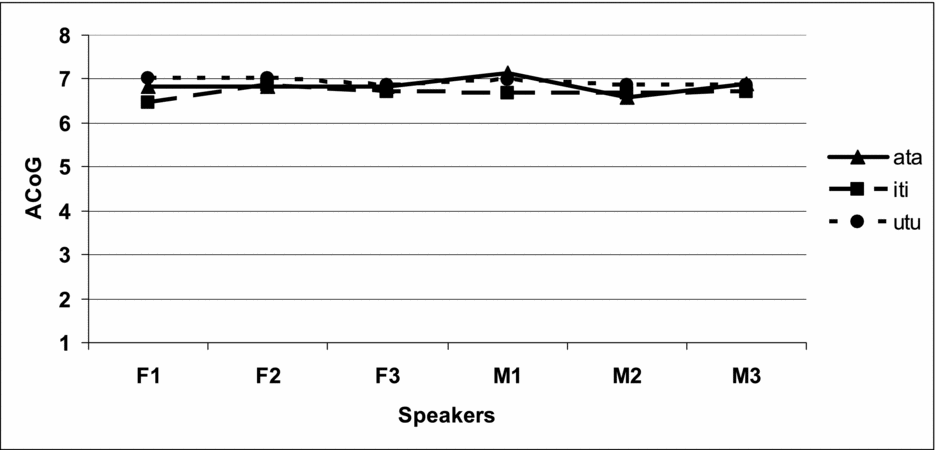
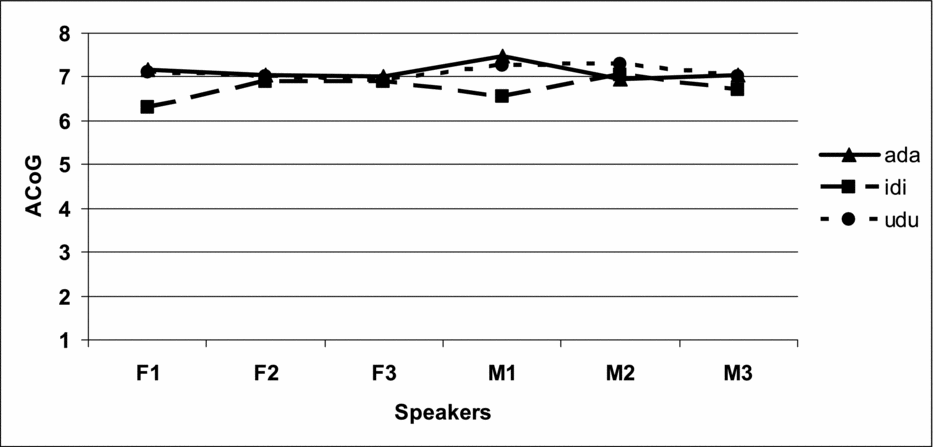
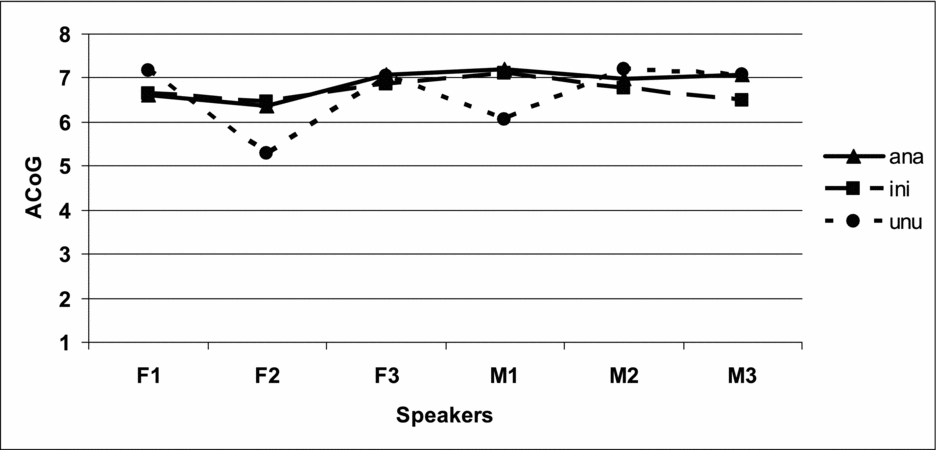
The influence of different symmetrical vowel contexts on the placement of anterior nasals and plosives is shown in Figures 8, 9 and 10. The data show that the vowel context has a relatively small influence on the placement of /t/, with more contextual variation in /d/, and the largest influence observed in /n/. The two-way ANOVA with replication shows that differences between different vowel contexts are significant in all three sounds: /n/ (F(2,10) = 4.474, p < .01), /d/ (F(2,10) = 19.781, p < .0001) and /t/ (F(2,10) = 19.238, p < .0001). Comparing ACoG means averaged across speakers and repetitions for each vowel context, the data show that vowel context influences placement of the nasal in a different way compared to the plosives. In /n/ the most posterior placement is in /u/ contexts (u = 6.64, SD: 0.85) followed by /i/ and /a/ (i = 6.72, SD: 0.36; a = 6.89, SD: 0.4), while in /d/ (i = 6.73, SD: 0.52; a = 7.1, SD: 0.2; u = 7.1, SD: 0.17) and /t/ (i = 6.68, SD: 0.27; a = 6.85, SD: 0.21; u = 6.93, SD: 0.11) vowel /i/ makes the placement most posterior, vowels /a/ and /u/ make it more anterior. These differences are also due to inter-speaker variability, especially in the case of the nasal. For example, it should be noted that only in two speakers /n/ shows the most posterior placement in /u/ contexts, while in two speakers /n/ is most fronted in /u/ context (Figure 10). This is confirmed by the two-way ANOVA analysis, which shows that the interaction between vowel context and speakers is highly statistically significant in all three sounds (p < .0001).
The place of articulation measured by the ACoG index in /t/ in symmetrical vowel contexts in each speaker.

The place of articulation measured by the ACoG index in /d/ in symmetrical vowel contexts in each speaker.

The place of articulation measured by the ACoG index in /n/ in symmetrical vowel contexts in each speaker.

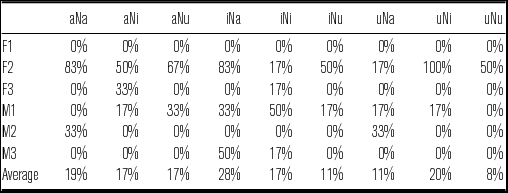
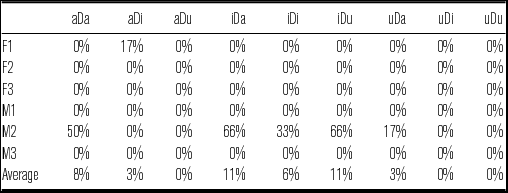
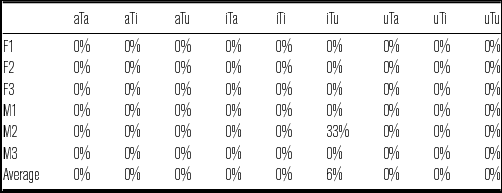
The percentage of incomplete closures (deocclusivizations) in the nasal shows that most incomplete closures occur in asymmetrical vowel context where /i/ is the initial vowel (Table 3). In symmetrical vowel contexts, most incomplete closure productions of /n/ occur in the /a/ vowel context, followed by /i/ and then /u/ (but note that there are more incomplete closures in symmetrical /ini/ compared to asymmetrical /inu/). In addition, /ani/ and /uni/ have more incomplete closures than /inu/. Similar results to those in /n/ are seen in /d/ (Table 4). Stop /t/ is produced with incomplete closures in one word only (33% of incomplete closures in the nonsense sequence /itu/ in speaker M2) (Table 5).
The percentage of incomplete EPG closures in /n/ in each vowel context and in each speaker.

The percentage of incomplete EPG closures in /d/ in each vowel context and in each speaker.

The percentage of incomplete EPG closures in /t/ in each vowel context and in each speaker.

4 Discussion and conclusions
Overall, the results of this study do not show evidence of a clear dental-alveolar separation in the place of articulation between the nasal and the oral stops. Instead, the data show that all three consonants are generally produced in the dentoalveolar region, with the variability of placement increasing from /t/ and /d/ to /n/. Data for /d/ and especially /n/ need to be interpreted with variations in individual speaker's productions in mind. Also, the study shows that relating quantitative EPG measurements to descriptive phonetic categories, such as the place of articulation, is not always straightforward and should be done cautiously. The results also show lower amounts of linguopalatal contact and higher articulatory variability/lower coarticulatory resistance in /n/ when compared with /t/ and /d/. These results will be discussed in light of what is previously reported on the productions of /n/ compared with /t/ and /d/ in Croatian, and also in light of findings from other languages.
The analysis of the place of articulation by means of the ACoG measure does not reveal a clear difference in placement between the nasal and the plosives. Only one speaker (F2) produces the nasal with a definitely more posterior placement. The majority of speakers (F1, M1, M2, M3) show very small differences in placement and produce /d/ as the most anterior of the three sounds, followed by /n/ and /t/, while only one speaker (F3) produces the nasal with a slightly more fronted placement than /d/ and /t/. The speaker with the retracted placement of the nasal compared with the plosives (F2) also had the highest number of incomplete closures (57%). Incomplete closures could be the reason for lower calculated average ACoG values in speaker F2, but visual inspection of the average electropalatograms shows that F2 indeed has a higher percentage of contacts in the second than in the first row of electrodes. Incomplete closure is often a consequence of an overall lower amount of contact. When speaker F2 was excluded from statistical analyses, the differences between /n/ and /t/ and /n/ and /d/ according to the ACoG measure were not statistically significant.
The analysis of the amount of contact in distinct articulatory regions (dental alveolar and indirectly dentoalveolar) shows that all three consonants are generally produced at the dentoalveolar articulatory region and confirms that there is no clear evidence of the nasal being exclusively alveolar, because the amount of contact is high both in the dental and in the alveolar articulatory region. The data for /t/ show that its placement is most consistently dentoalveolar in all six speakers, who produce /t/ with a similar dental and alveolar coverage. The data for /d/ are less consistent, but follow a similar trend: the majority of speakers produce /d/ with a similar coverage of dental and alveolar area (F1, F2, F3, M3). The other two speakers (M1 and M2) show a relatively smaller alveolar coverage, while the dental coverage is still high, which indicates a slightly more anterior (dental) articulation than in the other four speakers. Contact data for /n/ also show similar dental and alveolar coverage in most speakers (F1, F3, M1, M2, M3), but individual speaker's contact patterns do not follow a uniform trend observed in the two stops. In the stops most speakers have similar dental and alveolar coverage, and dental contact is always higher than the alveolar. In the nasal, the coverage of the dental and alveolar areas are also similar in most speakers, but not all speakers have higher dental than alveolar coverage. Two speakers show higher percentage of contacts in the alveolar region (F1 and F2), while the other four speakers show higher contact percentage in the dental region (F3, M1, M2, M3). Speaker F2 shows relatively low dental and alveolar contact, which explains the previously discussed low ACoG value. All those observations are confirmed by average electropalatograms presented for each speaker (Figure 3 above). The statistical analysis of the amount of contact data can be interpreted as evidence of a possible separation in placement between the nasal and the stops. The statistical variability measure shows that the nasal articulations are more stable in the alveolar than in the dental area, while the stops are more stable in the dental area. Furthermore, the two-way ANOVA with replication calculated across speakers indicates that the place of articulation in /t/ and /d/ could be considered potentially dental, rather than dentoalveolar, because there is significantly more dental contact when compared with alveolar contact. The same statistical measurement shows that the place of articulation of the nasal could be classified as dentoalveolar, rather than dental, because there is no significant difference between dental and alveolar contact. However, the two-way ANOVA shows that the interaction between the amount of contact in the two articulatory regions (dental and alveolar) and individual speakers is statistically significant, meaning that differences observed and quantified for the whole set are not consistent in every speaker. This prevents us from concluding that /t/ and /d/ are more anterior than /n/ and that they are dental. Moreover, the conclusion that /t/ and /d/ are dental and that they differ in placement from /n/ is not supported by the results of the ACoG measure, the visual inspection of the amount of contact data and average electropalatograms discussed previously.
Taking into account all the results from this study, the most reasonable conclusion is that all three consonants are generally produced at the dentoalveolar articulatory region and that there is no clear evidence of the nasal being consistently more posterior to the oral stops. This conclusion must be viewed in light of the increased variability in /n/ and to some extent in /d/. Inter-speaker differences in /n/ clearly show that Croatian anterior nasal can be produced with a wide range of tongue-to-palate patterns, while anterior placement of /d/ in two speakers opens a possibility that /d/ might have a more advanced placement than /t/ in some speakers of Croatian. Additional investigations are needed in order to examine this issue further.
This study also shows that relating quantitative physiological data to descriptive phonetic categories such as the place of articulation is not always straightforward. This is especially true for anterior articulations, in which small changes in the articulatory gesture can have significant acoustic effects. Even with the EPG, the technique which is designed to quantify the exact location and the timing of contacts that the tongue makes with the palate (Hardcastle Reference Hardcastle1972), it is sometimes challenging to translate those measurements into specific places of articulation. This is especially so in situations when different places of articulation occupy very small areas on the palate, which are at the same time close to each other, and in cases when variability in individual productions is relatively high. Both of those factors affect the conclusions of this study.
Of the ten previously reviewed literature sources, six describe /t/, /d/ and /n/ as having a similar place of articulation: dental (three sources) or dentoalveolar (three sources) (Miletić Reference Miletić1933, Brozović Reference Brozović1991, Jelaska Reference Jelaska2004, Barić et al. Reference Barić, Lončarić, Malić, Pavešić, Peti, Zečević and Znika2005, Težak & Babić Reference Težak and Babić2005, Silić & Pranjković Reference Silić and Pranjković2007), three state that /n/ differs in the place of articulation form /t/ and /d/ (Bakran Reference Bakran1996, Landau et al. Reference Landau, Lončarić, Horga and Škarić1999, Škarić Reference Škarić and Kovačec2007), while Škarić (Reference Škarić1991) essentially agrees with the view that all three consonants have similar place of articulation (dental or dentoalveolar), but notes that the nasal could also be classified as alveolar. The results from this study generally agree with the three sources showing that all three consonants have a similar place of articulation in the dentoalveolar region. The results presented here show no clear evidence of an exclusively alveolar or dental placement for any of the three sounds. It is important to note here that only one (Miletić Reference Miletić1933) of the ten cited references provides actual articulatory data to support the claims about the place of articulation of /t/, /d/ and /n/ in Croatian, and his results agree with the findings from the present study. Differences between traditional descriptions and physiological data for the nasal /n/ were also found in Hindi (Dixit Reference Dixit2003). Dixit found that /n/ in contemporary Hindi moved posteriorly from its traditionally described dental place of articulation and became alveolar.
One of the reasons for the disagreement between authors about the place of articulation of Croatian /n/ could be due to its inherently high variability. The results of this study show that the place of articulation of /n/ is almost three times more variable (the average ACoG variability of 4.59) than the place of articulation of /t/ (the average ACoG variability of 1.56) and /d/ (the average ACoG variability of 1.76). This fits nicely within the framework of the degree of articulatory constraint (DAC) model, which states that variability caused by coarticulation is inversely proportional to articulatory constraint exerted upon a particular articulator (Recasens Reference Recasens1985, Reference Recasens1999; Recasens, Pallarès & Fontdevila Reference Recasens, Pallarès and Fontdevila1997). The lower articulatory constraint in the context of the present study is shown by the lower amount of contact in the two anterior articulatory regions and lower lateral contact in /n/ when compared with /t/ and /d/. Expectedly, voiced /d/ has a lower amount of contact than voiceless /t/, which is frequently explained in the literature by the cavity enlargement strategy used by speakers during the production of voiced stops (Westbury Reference Westbury1983, Farnetani Reference Farnetani, Hardcastle and Marchal1990, Dart Reference Dart1998, Moen et al. Reference Moen, Simonsen, Huseby, Grue, Dalsgaard, Lindberg, Benner and Tan2001, Fuchs & Perrier Reference Fuchs and Perrier2003, Fuchs Reference Fuchs2005). Voiced stops employ a cavity enlargement strategy in order to maintain voicing. Voicing can be sustained if there is a transglottal difference in pressure, with the supraglottal pressure lower than the subglottal. In stops, an occlusion has the effect of stopping the air and supraglottal pressure increases very quickly. In order to prolong the period of a transglottal pressure difference (and voicing), voiced stops employ a cavity enlargement strategy, whereby the supraglottal pressure is kept under control for as long as possible. The inversely proportional relationship between the amount of contact and contact variability has been confirmed by several studies (e.g. Farnetani Reference Farnetani, Hardcastle and Marchal1990), but some studies have found that the opposite relationship can occur (see Liker & Gibbon Reference Liker, Gibbon, Lee and Zee2011, Liker et al. Reference Liker, Horga and Mildner2012). Bladon & Nolan (Reference Bladon and Nolan1977, cited by Chafcouloff & Marchal Reference Chafcouloff and Marchal1999: 70) rank nasals among the group of sounds with the lowest degree of coarticulatory resistance, thus the highest degree of articulatory variability.
However, increased variability in /n/ compared with /t/ and /d/ does not seem to be a universal phenomenon, with at least some EPG studies reporting that English data do not show increased variability in /n/ (Gibbon et al. Reference Gibbon, Yuen, Lee and Adams2007). It is worth noting that variability in the present study was calculated across vowel contexts and speakers, thus representing both inter- and intra-speaker variability, which is different from variability caused by coarticulation only. Increased variability in Croatian /n/ could also be explained by perceptual factors. The acoustic spectrum of nasals is characterised by a rapid rate of sound energy absorption (especially above 1 kHz), which results in a highly damped sound (Bakran Reference Bakran1996, Kent & Read Reference Kent and Read2002). Therefore, slight changes in place of articulation might not be so critical for their perceptual identification. On the other hand, the acoustic characteristics of stops /t/ and /d/ are much more influenced by changes in place of articulation, which result in low placement variability. The issue of linguopalatal variability in nasals is clearly interesting and needs further investigation.
The lateral contact measure showed that nasal /n/ was produced with the least lateral contact and that difference is statistically significant between /n/ and /t/ and well as between /n/ and /d/. Lower lateral contact has not been previously reported for the Croatian nasal, although Miletić (Reference Miletić1933) observed that overall there was less contact for /n/. Lateral contact is important for the production of all speech sounds, although its importance is often underestimated (Fletcher Reference Fletcher Samuel1992, Gibbon et al. Reference Gibbon, Yuen, Lee and Adams2007, Gick, Wilson & Derrick Reference Gick, Wilson and Derrick2013). It is important because it enables the speaker to stabilise the tongue dorsum and to produce precise articulatory movements with the tongue tip/blade. The Croatian nasal proved to be relatively unstable at the place of articulation, which could be caused by a low degree of lateral seal. Lateral linguopalatal contact is also important for speech aerodynamics, because it creates a complete oral seal in stops. Being a nasal, /n/ is produced with a continuous air stream passing through the nasal cavity, which prevents the increase of the air pressure. Since the increase of the air pressure is not required for the production of nasal sounds, a strong oral seal becomes less important than for the production of anterior lingual stops. This is also reflected in a relatively high percentage of incomplete closures in /n/ found in this study. Previous studies show that incomplete closures of anterior lingual nasals are quite common (Gibbon et al. Reference Gibbon, Yuen, Lee and Adams2007, Shosted et al. Reference Shosted, Hualde and Scarpace2012). Previous research also shows that weakening of /d/ is not atypical and that incomplete closures can be an important indication of cavity enlargement strategies (Fuchs & Perrier Reference Fuchs and Perrier2003). It should be noted that an overall reduced tongue body and tongue tip/blade gesture for /n/ may relate to the possible enhancement of cues for the perception of nasal sounds through the spreading of nasality to neighbouring vowels. However, the correlation between the tongue-gesture reduction and the spread of nasality on neighbouring vowels was not investigated in this paper, so this remains only a speculation. Lower lateral contact in anterior nasal sounds was reported in other languages (Recasens et al. Reference Recasens, Farnetani, Fontdevila and Pallarès1993, McLeod Reference McLeod2006, Gibbon et al. Reference Gibbon, Yuen, Lee and Adams2007). The universality of this characteristic of nasal sounds remains to be investigated. Languages like Bulgarian might provide interesting insights into this issue, because the Bulgarian apical nasal is produced with less contact and the alveolar nasal with more contact (Ladefoged & Maddieson Reference Ladefoged and Maddieson1997: 23, 24). Therefore, analysing data from languages with true alveolar nasals (presumably laminal as opposed to apical) could shed light on this issue.
Coarticulatory processes in the nasal and the plosives give another perspective to the issue of placement differences and variability of /n/ compared with /t/ and /d/. The analysis of coarticulatory processes shows that vowel context influences placement of all three consonants to some degree, but that influence is largest in the nasal. The place of articulation of the nasal is mostly influenced by the back vowel /u/, making the place of articulation of /n/ more posterior when compared with /t/ and /d/ in two speakers (F2 and M1), while making it somewhat more anterior in one speaker (F1). Previous studies on this issue show similar results. For example, retracted placement of /n/ in the context of /u/ and /a/ was reported in Catalan (Recasens et al. Reference Recasens, Farnetani, Fontdevila and Pallarès1993) and in the context of /a/ in Greek Lombard speech (Nicolaidis Reference Nicolaidis2012). Details of coarticulatory processes found in the present investigation show some unexpected results. Overall, the most fronted articulations of /t/ and /d/ measured across speakers are those in the symmetrical /u/ and /a/ contexts, while /i/ is relatively more retracted. In the case of the nasal, /i/ and /u/ vowel contexts result in the most retracted productions of the nasal, while the production in the context of vowel /a/ is relatively more anterior. Although all these differences are statistically significant, the two-way ANOVA shows that the source of variation is the interaction between the speakers and the vowel context. This means that these strategies are highly speaker-dependent and consequently more speakers should be analysed in order to draw definite conclusions about the influence of vowel context on the place of articulation of these three consonants.
The process of deocclusivization in the nasal is surprising. In symmetrical vowel context, most incomplete closures occur in the context of /a/, followed by /i/, while the least amount of incomplete closures can be observed in the context of /u/. This is unexpected since previous research has shown that /n/ is deocclusivised in the context of back vowels more often than in the context of front vowels (Colantoni & Kochetov Reference Colantoni and Kochetov2012). This result can partly be explained by the fact that vowel /a/ is the lowest (most open) vowel in Croatian. Since the tongue is low during the production of the vowel, it does not fully reach its target during the nasal, which is, according to Colantoni & Kochetov (Reference Colantoni and Kochetov2012), easily vocalised (produced with extremely reduced EPG contact) in intervocalic position. The most frequent occurrence of incomplete closures is in asymmetrical contexts in which the vowel /i/ is in initial position. It appears that asymmetrical vowel contexts facilitate deocclusivisation of nasals as well as plosives.
5 Relevance and future work
The results of this study are relevant for phonetic theory. On the one hand, these results provide evidence relevant for Croatian, showing that there is no evidence of /n/ being consistently more posterior in placement than /t/ and /d/. The data show that all three sounds are articulated mostly in the dentoalveolar region, but they also show that differences in the productions of each individual speaker must also be taken into account, before any generalisations are made. On the other hand, this study adds to the body of data on nasals from other languages published to date, showing that some characteristics might be considered universal in the world's languages (e.g. lower lateral contact), but some characteristics differ across languages (e.g. increased variability). This raises the issue to be explored in the future: which linguopalatal characteristics of lingual nasal sounds are biomechanically determined (language-universal) and which are linguistically determined (language-specific).
The results of this study are also relevant for clinical practice, because they provide ranges of acceptable nasal productions and their comparison with production characteristics of lingual anterior stops. Therefore, these results can be used to distinguish between typical and atypical nasal productions.
Limitations of this study should be kept in mind when attempting to generalise these results. This investigation analysed a corpus of nonword VCV sequences produced in isolation. Some studies have shown that different results can be obtained from speech produced in different communicative situations or speaking styles (Colantoni & Kochetov Reference Colantoni and Kochetov2012). Instrumental articulatory studies are often limited by the number of speakers (Fuchs Reference Fuchs2005) and this study is no exception. Nevertheless, instrumental studies performed on five to ten speakers are quite frequent and some are produced with less (Dixit & Hoffman Reference Dixit and Hoffman2004).
Acknowledgements
This research was supported by grant 130-0000000-0785 of the Ministry for Science, Education and Sports of the Republic of Croatia. The authors gratefully acknowledge the help of three anonymous reviewers and Adrian Simpson, who made valuable comments on earlier versions of the manuscript.