Introduction
Jellyfish (Medusozoa, Helm 2018), have a relatively simple anatomy, but with features that make them particularly interesting to study host-microbial symbioses. Jellyfish account for only 2–3% of cnidarian species (Brekhman et al., Reference Brekhman, Malik, Haas, Sher and Lotan2015), but differ in their morphology, size, ecology and distribution, which may lead to significant differences in their symbiotic relationships. Only a few studies have assessed the prokaryotic communities associated with jellyfish species. These have shown that jellyfish prokaryotic communities are distinct from those found in the surrounding marine environment (Daley et al., Reference Daley, Urban-Rich and Moisander2016; Kramar et al., Reference Kramar, Tinta, Lučić, Malej and Turk2018). Lee et al. (Reference Lee, Kling, Araya and Ceh2018) also identified a possible core community of 16 OTUs of the jellyfish species Chrysaora plocamia, which were shared with the jellyfish species Aurelia aurita. This consisted of a range of OTUs in the Nitrospira, Alpha-, Beta-, Gamma- and Deltaproteobacteria related to organisms involved in nitrogen and sulphur cycling. OTUs assigned to the phyla Actinobacteria, Bacteroidetes, Planctomycetes and Proteobacteria were also observed in the prokaryotic communities of Chrysaora plocamia and Aurelia aurita (Weiland-Bräuer et al., Reference Weiland-Bräuer, Neulinger, Pinnow, Künzel, Baines and Schmitz2015; Daley et al., Reference Daley, Urban-Rich and Moisander2016; Kramar et al., Reference Kramar, Tinta, Lučić, Malej and Turk2018; Lee et al., Reference Lee, Kling, Araya and Ceh2018). Jellyfish are also known to contain endosymbiotic dinoflagellates of the genus Symbiodinium (Mellas et al., Reference Mellas, McIlroy, Fitt and Coffroth2014; Klein et al., Reference Klein, Pitt, Nitschke, Goyen, Welsh, Suggett and Carroll2017; Newkirk et al., Reference Newkirk, Frazer and Martindale2018), which provide nutrients to the host (Awai et al., Reference Awai, Matsuoka and Shioi2012; Mellas et al., Reference Mellas, McIlroy, Fitt and Coffroth2014; Klein et al., Reference Klein, Pitt, Nitschke, Goyen, Welsh, Suggett and Carroll2017). Another remarkable aspect of jellyfish is their prevalence in a range of marine habitats, including the deep sea (Kawabata et al., Reference Kawabata, Lindsay, Kitamura, Konishi, Nishikawa, Nishida, Kamio and Nagai2013). One of the most interesting habitats for jellyfish are marine lakes where they can become highly abundant and may develop distinctive morphological, behavioural and genetic characteristics depending on the lake they inhabit (Hamner & Hauri, Reference Hamner and Hauri1981; Hamner et al., Reference Hamner, Gilmer and Hamner1982; Dawson, Reference Dawson2005a). One of the most widespread and abundant jellyfish species in marine lakes is Mastigias cf. papua, which can form high density populations (Dawson et al., Reference Dawson, Martin and Penland2001). These populations are morphologically, behaviourally and genetically distinct from non-lake populations (Dawson, Reference Dawson2005b). This suggests an evolutionary adaptation over time to their habitat thereby increasing fitness (Cimino et al., Reference Cimino, Patris, Ucharm, Bell and Terrill2018). In the present study, our main goals were to assess whether populations of jellyfish inhabiting geographically distant marine lakes and from open water habitat host the same ‘core’ prokaryotic symbionts and identify if there is evidence of species-specific host-microbe associations. In addition to the above, the presence of Symbiodinium in pooled specimens of M. papua from Berau was also evaluated. To achieve these goals, we assessed the microbial communities of two jellyfish species, Mastigias cf. papua and Cassiopea ornata, collected from marine lakes in the Berau region of Borneo (Becking et al., Reference Becking, Renema, Santodomingo, Hoeksema, Tuti and de Voogd2011), the Misool region, Raja Ampat, West Papua, Indonesia (Purba et al., Reference Purba, Haryono, Sunarto, Manan, Rumenta, Purwanto and Becking2018) and Ha Long Bay, Vietnam (Azzini et al., Reference Azzini, Calcinai, Cerrano, Bavestrello, Pansini, Custodia, Lobo-Hajdu, Hajdu and Muricy2007). In addition to this, we also sampled water and jellyfish species from open-water habitat in Vietnam and Taiwan.
Materials and methods
Location and sampling
Jellyfish species, Mastigias cf. papua Lesson, 1830 and Cassiopea ornata Haeckel, 1880, were sampled by snorkelling and scuba diving in the Berau region of Borneo, East Kalimantan Province, Indonesia, the Misool region, Raja Ampat, West Papua Province, Indonesia, and in Ha Long Bay, on the north-eastern coast of Vietnam. Detailed descriptions of the environmental conditions found in the marine lakes of each region can be found in Tomascik & Mah (Reference Tomascik and Mah1994), Cerrano et al. (Reference Cerrano, Azzini, Bavestrello, Calcinai, Pansini, Sarti and Thung2006), Azzini et al. (Reference Azzini, Calcinai, Cerrano, Bavestrello, Pansini, Custodia, Lobo-Hajdu, Hajdu and Muricy2007), Becking et al. (Reference Becking, Renema, Santodomingo, Hoeksema, Tuti and de Voogd2011, Reference Becking, de Leeuw and Vogler2015), Cleary et al. (Reference Cleary, Becking, de Voogd, Pires, Polónia, Egas and Gomes2013, Reference Cleary, Becking, Polónia, Freitas and Gomes2015, Reference Cleary, Becking, Polónia, Freitas and Gomes2016, Reference Cleary, Polónia and de Voogd2018, Reference Cleary, Ferreira, Bat, Polónia, Gomes and de Voogd2020), Cleary & Polónia (Reference Cleary and Polónia2018), and Maas et al. (Reference Maas, Prost, Bi, Smith, Armstrong, Aji, Toha, Gillespie and Becking2018). Additional information including the GPS coordinates of the sample sites is provided in Electronic Supplementary Material 1. Jellyfish specimens were collected from marine lakes in Berau (21–28 August 2012), from Papuan marine lakes (15–20 September 2013) and from a Vietnamese marine lake (16–17 August 2013). In total 22 specimens of Mastigias cf. papua and three specimens of Cassiopea ornata were sampled from all three regions. In addition to this, five specimens belonging to different jellyfish species were sampled outside of marine lakes. Four of these specimens were collected in Vietnam from 16–17 August 2013 and one in Taiwan on 29 July 2014. These specimens were identified as Chrysaora sp. (2 samples), Chrysaora aff. colorata, Catostylus townsendi Mayer, 1915 and Cyanea sp. (from Taiwan). All specimens were collected from relatively shallow water (< 10 m depth) and preserved in 96% EtOH. During the jellyfish survey in Papua, water samples were also collected by filtering 1 l of seawater through a Millipore® White Isopore Membrane Filter (GTTP04700, 47 mm diameter, 0.22 μm pore size). The samples were kept cool (<4°C) immediately after collection and transport. In the laboratory, samples were stored at −20°C until DNA extraction.
DNA extraction
PCR-ready genomic DNA was isolated from water and jellyfish samples with the FastDNA SPIN Kit for soil (MPbiomedicals, Santa Ana, CA, USA) following the manufacturer's instructions. This is an extraction method frequently used for this purpose (Urakawa et al., Reference Urakawa, Martens-Habbena and Stahl2010; Costa et al., Reference Costa, Keller-Costa, Gomes, da Rocha, van Overbeek and van Elsas2013).
Previous studies have shown that different jellyfish compartments house distinct prokaryotic communities (Weiland-Bräuer et al., Reference Weiland-Bräuer, Neulinger, Pinnow, Künzel, Baines and Schmitz2015; Lee et al., Reference Lee, Kling, Araya and Ceh2018). We, therefore, included fragments of the bell and tentacles of adult medusa, which were thoroughly mixed (Cleary et al., Reference Cleary, Becking, Polónia, Freitas and Gomes2016). Briefly, the whole membrane filter (for water samples) and ± 500 mg of jellyfish specimens were cut into small pieces and transferred to Lysing Matrix E tubes containing a mixture of ceramic and silica particles. The microbial cell lysis was performed in the FastPrep Instrument (Q Biogene, Inc., CA, USA) for 80 s at speed 6.0 ms−1. Extracted DNA was eluted into DNase/Pyrogen-Free Water to a final volume of 50 μl and stored at − 20°C until use. The 16S rRNA gene V3V4 variable region PCR primers 341F 5′-CCTACGGGNGGCWGCAG-3′ and 785R 5′-GACTACHVGGGTATCTAATCC-3′ (Klindworth et al., Reference Klindworth, Pruesse, Schweer, Peplies, Quast, Horn and Glöckner2013) with barcode on the forward primer were used, to generate product fragments with expected amplicon size of 444 bps, in a 30 cycle PCR assay using the HotStarTaq Plus Master Mix Kit (Qiagen, USA) under the following conditions: 94°C for 3 min, followed by 28 cycles of 94°C for 30 s, 53°C for 40 s and 72°C for 1 min, after which a final elongation step at 72°C for 5 min was performed. After amplification, PCR products were checked on a 2% agarose gel to determine the success of amplification and the relative intensity of bands. Samples were purified using calibrated Ampure XP beads and purified PCR product was used to prepare the DNA library following the Illumina TruSeq DNA library preparation protocol. Next-generation, paired-end sequencing was performed at MRDNA (Molecular Research LP; http://www.mrdnalab.com/; last checked 18 November 2016) on an Illumina MiSeq device (Illumina Inc., San Diego, CA, USA) following the manufacturer's guidelines. Sequences from each end were joined following Q25 quality trimming of the ends followed by reorienting any 3′–5′ reads back into 5′–3′ and removal of short reads (<150 bp). The resultant files were analysed using QIIME (Quantitative Insights Into Microbial Ecology; Caporaso et al., Reference Caporaso, Kuczynski, Stombaugh, Bittinger, Bushman, Costello, Fierer, Peña, Goodrich, Gordon, Huttley, Kelley, Knights, Koenig, Ley, Lozupone, McDonald, Muegge, Pirrung, Reeder, Sevinsky, Turnbaugh, Walters, Widmann, Yatsunenko, Zaneveld and Knight2010; http://www.qiime.org/).
In addition to this, we assessed microeukaryotic composition from two pooled samples of M. papua from lakes Kakaban and Haji Buang. The 18S small ribosomal subunit was amplified, generating product fragments of ~400 bps (Cook et al., Reference Cook, Bhadury, Debenham, Meldal, Blaxter, Smerdon, Austen, Lambshead and Rogers2005), using the primers SSUF_FO4 (5′-GCTTGTCTCAAAGATTAAGCC-3′) and SSU_R22 (5′-GCCTGCTGCCTTCCTTGGA-3′) following previously published methods (Fonseca et al., Reference Fonseca, Carvalho, Sung, Johnson, Power, Neill, Packer, Blaxter, Lambshead, Thomas and Creer2010; Coelho et al., Reference Coelho, Louvado, Domingues, Cleary, Ferreira, Almeida, Cunha, Cunha and Gomes2016). Equimolar concentrations of the 18S small subunit rRNA gene fragments were then sequenced using GS 454 FLX Titanium chemistry according to the manufacturer's instructions (Roche, 454 Life Sciences, Brandford, CT, USA).
16S rRNA gene sequencing analysis
For a detailed description of the sequence analysis, see Coelho et al. (Reference Coelho, Cleary, Gomes, Pólonia, Huang, Liu and de Voogd2018) and Cleary et al. (Reference Cleary, Polónia and de Voogd2018). Briefly, we used QIIME (Caporaso et al., Reference Caporaso, Kuczynski, Stombaugh, Bittinger, Bushman, Costello, Fierer, Peña, Goodrich, Gordon, Huttley, Kelley, Knights, Koenig, Ley, Lozupone, McDonald, Muegge, Pirrung, Reeder, Sevinsky, Turnbaugh, Walters, Widmann, Yatsunenko, Zaneveld and Knight2010) and UPARSE (Edgar, Reference Edgar2013) with OTU selection at 97% similarity cut-off. Taxonomy was assigned using a fasta file containing reference sequences from the SILVA_132_QIIME_release (Quast et al., Reference Quast, Pruesse, Yilmaz, Gerken, Schweer, Yarza, Peplies and Glöckner2012). We used the make_otu_table.py script in QIIME to generate a square matrix of OTUs × SAMPLES. For the OTU table, OTUs not classified as Bacteria or Archaea or classified as chloroplasts or mitochondria were removed prior to statistical analysis. The resultant table was subsequently rarefied to 4500 sequences per sample with the single_rarefaction.py script.
Statistical analysis
All statistical analyses were performed in the R environment (R Core Team, 2013). For a more detailed description of the sequencing and statistical analyses, see Coelho et al. (Reference Coelho, Cleary, Gomes, Pólonia, Huang, Liu and de Voogd2018), Cleary et al. (Reference Cleary, Polónia and de Voogd2018) and Cleary & Polónia (Reference Cleary and Polónia2018).
A phylogenetic tree including OTUs assigned to Symbiodinium sp. and sequences from Amoebophrya and Polarella (related to Symbiodinium sp. and included as outgroups) was constructed using the MEGAX program (http://www.megasoftware.net/; last checked 2019/09; Tamura et al., Reference Tamura, Peterson, Peterson, Stecher, Nei and Kumar2011) and inferred using the maximum likelihood method and General Time Reversible model (Nei & Kumar, Reference Nei and Kumar2000) with discrete Gamma distribution and invariant sites. Branches reproduced in <50% of the bootstrap replicates were collapsed.
Results
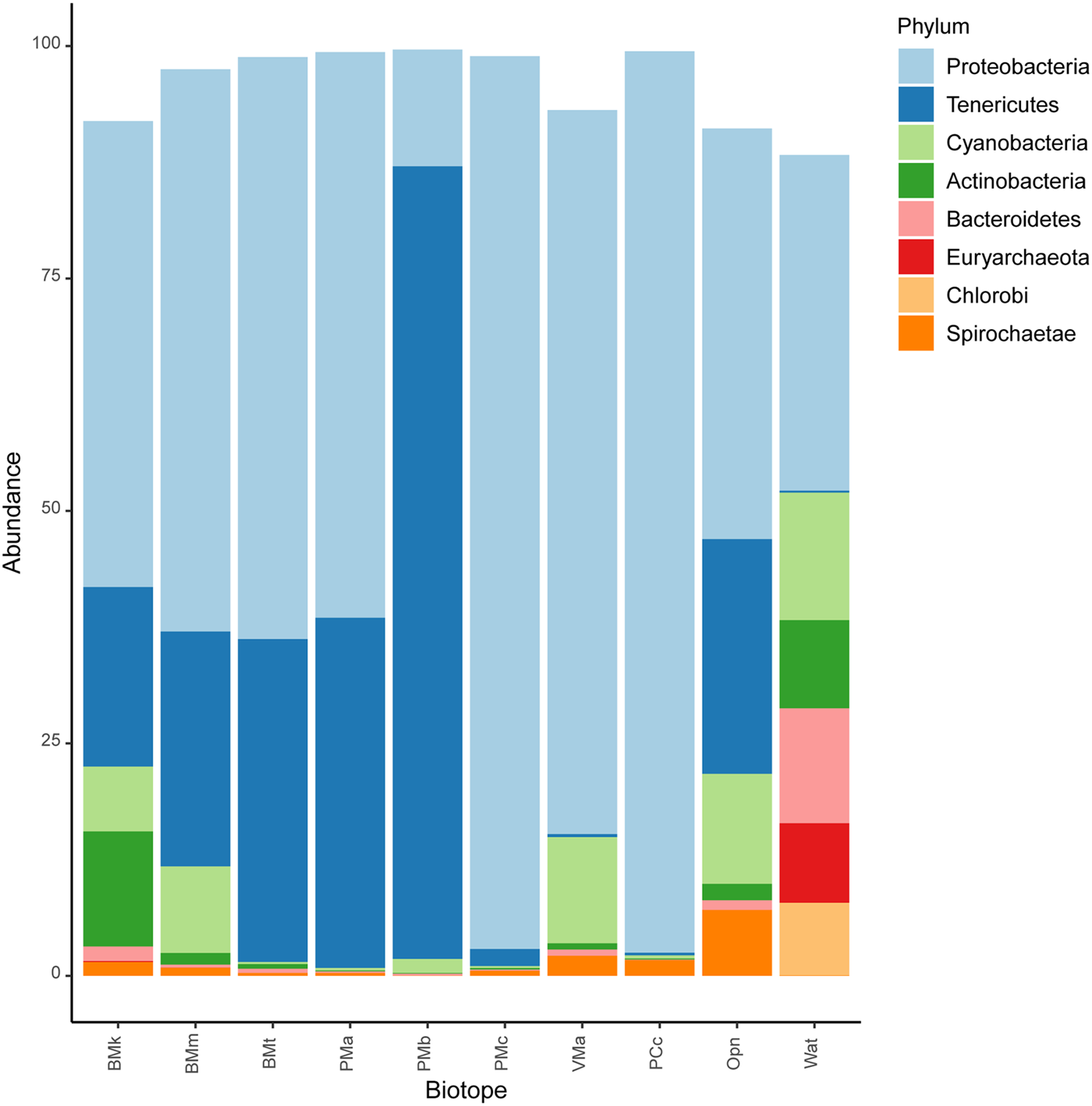
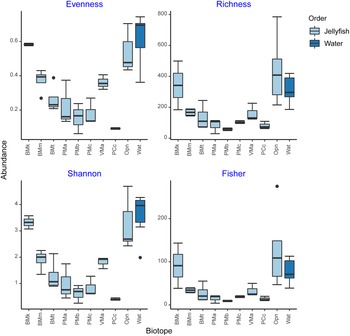
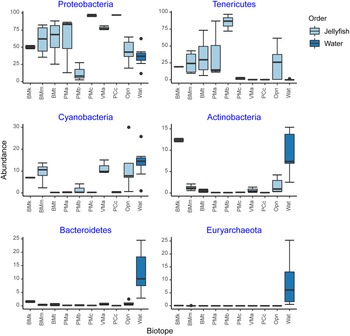
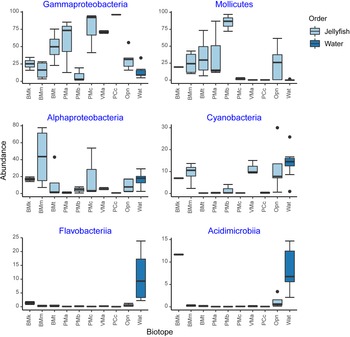
The dataset in the present study consisted of 175,500 sequences, assigned to 3765 OTUs after quality control, OTU picking and removal of chimeras, chloroplasts and mitochondria. The most abundant taxa were Proteobacteria (97,080 sequences; 1700 OTUs) and Tenericutes (35,231 sequences; 35 OTUs) (Electronic Supplementary Material 2) (Figure 1). Of the proteobacterial OTUs, 70,358 were assigned to the Gammaproteobacteria class and of these 52,142 to the Oceanospirillales order (Figure 1). OTU richness and evenness (Figure 2) were both significantly higher in open water jellyfish and M. papua from lake Kakaban than M. papua and C. ornata from the remaining marine lakes, although the difference was at the margin of significance for M. papua from Bui Xam, Vietnam (Electronic Supplementary Material 3). Mastigias cf. papua from Berau and the open-water jellyfish also had significantly higher relative abundances of Actinobacteria, Bacteroidetes, Deltaproteobacteria and Rhodospirillales than remaining marine lake populations of M. papua and C. ornata (Figures 3 and 4). This difference was most pronounced and significant for the Actinobacteria. There were also pronounced differences in the relative abundance of Tenericutes among jellyfish populations (Electronic Supplementary Material 3). The relative abundance of Tenericutes was highest in the M. papua population from lake Ms01 in Papua at 85.24 ± 12.51% and lowest in the M. papua and C. ornata populations from lake Ms17 in Papua and the M. papua population from Bui Xam, Vietnam (<2%) (Figure 1).
Stacked barplots showing the relative abundances of the eight most abundant phyla in each group of M. papua samples from marine lakes in Berau: marine lake Haji Buang (BMm), marine lake Kakaban (BMk) and marine lake Tanah Bamban (BMt), Papua: (Kr02: PMa), (Ms01: PMb), (Ms17: PMc), in Vietnam (Bui Xam: VMa), for C. ornata samples from marine lake Ms17 in Papua (PCc), for jellyfish species sampled in open-water habitat in Taiwan and Vietnam (Opn), and from water samples (Wat).

Values of (a) evenness, (b) richness, (c) Shannon's ‘H and (d) Fisher's alpha diversity indices of M. cf. papua samples from marine lakes in Berau, Indonesia: Kakaban lake (BMk), Haji Buang lake (BMm) and Tanah Bamban lake (BMt), in Papua: (Kr02: PMa), (Ms01: PMb), (Ms17: PMc), and in Vietnam (Bui Xam: VMa), for C. ornata samples from marine lake Ms17 in Papua (PCc), for jellyfish species sampled in open water habitat in Taiwan and Vietnam (Opn), and for water samples (Wat).

Relative abundance of the most abundant prokaryotic phyla of M. cf. papua samples from marine lakes in Berau, Indonesia: Kakaban lake (BMk), Haji Buang lake (BMm) and Tanah Bamban lake (BMt), in Papua: (Kr02: PMa), (Ms01: PMb), (Ms17: PMc), and in Vietnam (Bui Xam: VMa), for C. ornata samples from marine lake Ms17 in Papua (PCc), for jellyfish species sampled in open-water habitat in Taiwan and Vietnam (Opn), and for water samples (Wat).

Relative abundance of the most abundant prokaryotic classes of M. cf. papua samples from marine lakes in Berau, Indonesia: Kakaban lake (BMk), Haji Buang lake (BMm) and Tanah Bamban lake (BMt), in Papua: (Kr02: PMa), (Ms01: PMb), (Ms17: PMc), and in Vietnam (Bui Xam: VMa), for C. ornata samples from marine lake Ms17 in Papua (PCc), for jellyfish species sampled in open-water habitat in Taiwan and Vietnam (Opn), and for water samples (Wat).

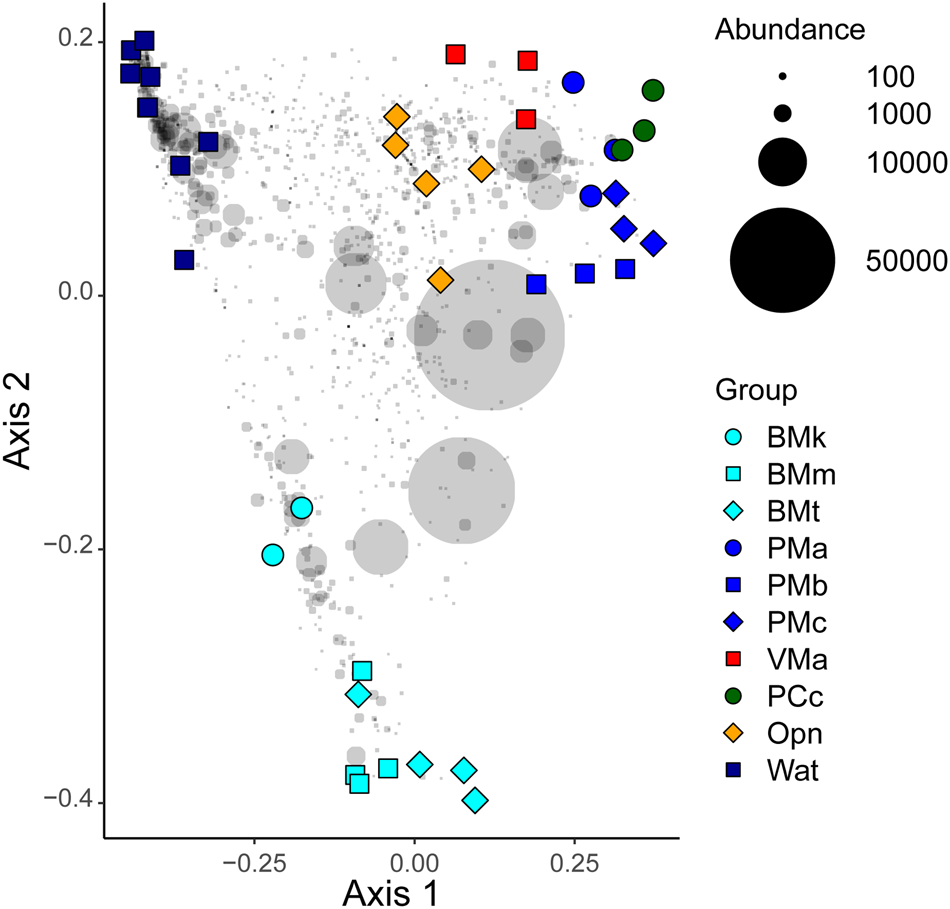
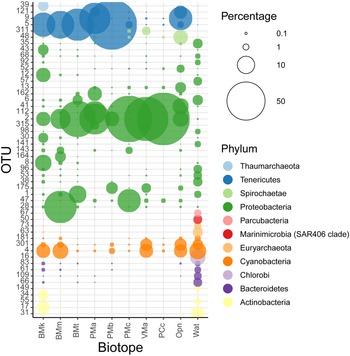
There were significant differences in composition among groups (adonis: F 9,29 = 4.39, R 2 = 0.577, P < 0.001). The first PCO axis separated jellyfish samples from water samples while the second axis separated samples of jellyfish from Papua, Vietnam and open water from M. papua samples from Berau (Figure 5). Note that jellyfish populations formed distinct clusters based on habitat (e.g. marine lake vs open water) and lake origin. M. Papua from all Berau lakes had high relative abundances of OTU-5 as did M. papua from lake Ms01 in Papua. (Figures 5 and 6). This OTU, assigned to the order Entomoplasmatales, was recorded in 28 of 30 jellyfish samples, but was most abundant (>19%) in M. papua specimens from all Berau lakes and lake Ms01 in Papua (85.01 ± 12.48%). In the other lakes, its relative abundance varied from 0.02 ± 0.02% in Bui Xam lake to 1.40 ± 1.52% in lake Ms17 in Papua. OTU-5 had 96% sequence similarity to an organism obtained from the jellyfish Cotylorhiza tuberculata and 92% sequence similarity to an organism from a jellyfish enrichment experiment (Electronic Supplementary Material 4). The other dominant Tenericutes OTU, OTU-9, had a highly variable abundance, but was most abundant in M. papua from lake Kr02 (32.67 ± 47.20%) and open water jellyfish (18.04 ± 26.11%) compared with the other jellyfish populations in which it accounted for less than 0.09% of sequences; it was also not recorded in any of the Berau populations. This OTU only had 88.9% sequence similarity to an organism obtained from a chiton and 88.6% sequence similarity to an organism obtained from an anemone. Of the abundant OTUs, the lowest sequence similarity (<86%) was obtained for OTU-175, assigned to the genus Wolbachia, and related to organisms obtained from a tick and various nematode species. This OTU was present in all specimens from lakes Bui Xam and Ms01 (Electronic Supplementary Material 4).
Principal coordinates analysis (PCO) ordination of the first two axes. Coloured symbols represent the sample sites for M. cf. papua samples from marine lakes in Berau, Indonesia: Kakaban lake (BMk), Haji Buang lake (BMm) and Tanah Bamban lake (BMt), in Papua: (Kr02: PMa), (Ms01: PMb), (Ms17: PMc), in Vietnam (Bui Xam: VMa), for C. ornata samples from marine lake Ms17 in Papua (PCc), for jellyfish species sampled in open-water habitat in Taiwan and Vietnam (Opn), and for water samples (Wat). The circle size of the OTU is proportional to their abundance (number of sequences) as indicated by the symbol legend in the bottom.

Relative abundance of significantly discriminating OTUs (P < 0.01) identified using Simper. Symbols are colour-coded according to prokaryote phylum. Abbreviations represent the sample sites for M. cf. papua samples from marine lakes in Berau, Indonesia: Kakaban lake (BMk), Haji Buang lake (BMm) and Tanah Bamban lake (BMt), in Papua: (Kr02: PMa), (Ms01: PMb), (Ms17: PMc), in Vietnam (Bui Xam: VMa), for C. ornata samples from marine lake Ms17 in Papua (PCc), for jellyfish species sampled in open-water habitat in Taiwan and Vietnam (Opn), and for water samples (Wat). The circle size of the OTU is proportional to the mean percentage of sequences per biotope. The y-axis shows the OTU id number.

Of all the OTUs, OTU-2, assigned to the genus Endozoicomonas, was, by far, the most abundant with 49,441 sequence reads. It was the only OTU recorded in every jellyfish sample, thus across sampling sites and species. It reached its greatest abundance in M. papua and C. ornata from lake Ms17 in Papua at 73.17 ± 29.73% and 94.40 ± 0.39% of all sequences, respectively. Its mean abundance exceeded 6% in all other jellyfish populations. In Berau, it increased in abundance from 6% in lake Kakaban to 13% in Haji Buang and 44% in lake Tanah Bamban. In the open water jellyfish, it had a mean abundance of 7.67 ± 8.75%. It was also recorded in water where it had a relatively low abundance of 0.05 ± 0.09%. It had very high sequence similarity (>99%) to bacterial symbionts obtained from a range of hosts including an anemone, octocoral, cuttlefish, lionfish, and comb pen (Electronic Supplementary Material 4).
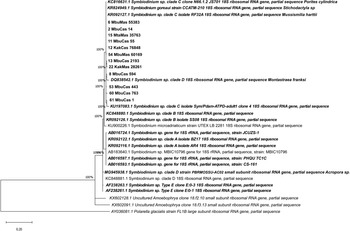
In addition to the prokaryotic analyses, we also assessed microeukaryotic composition from samples of M. papua and C. ornata from lakes in Berau. In both populations, more than 99% of all sequences were assigned to OTUs classified as Symbiodinium including a dominant OTU. This OTU had 100% sequence similarity to a number of organisms including an organism identified as Symbiodinium sp. clade C from the corals Montastraea franksi, M. digitata, Siderastrea siderea and Stylophora pistillata. All three of these were closely related (sequence similarities varying from 98.05 to 98.77%) to the same organism identified as Symbiodinium (Cladocopium) sp. clade C clone N60.3.4_JS626 obtained from the coral Montipora digitata at Heron Island, Australia. The phylogenetic tree (Figure 7) supported the BLAST sequence similarities with OTUs from our study clustering in a main group with sequences from Symbiodinium sp. clade C and one from clade D. Sequences from Symbiodinium sp. from other clades (A, B, D and E) all formed small clusters for each clade.
Phylogenetic tree inferred using the maximum likelihood method and General Time Reversible model with aligned 18S sequences of Symbiodinium OTUs recovered from the studied biotope (jellyfish). The bootstrap values are shown next to each branch when this exceeds 50%. This value represents the percentage of replicate trees in which the associated taxa clustered together. Symbiodinium sequences retrieved from this study are highlighted in bold, sequences from invertebrate hosts (e.g. corals, anemones, bivalves) are in bold italic, and sequences from outgroups are in italic.

Discussion
In the present study, we assessed the prokaryotic communities associated with populations of Mastigias cf. papua inhabiting geographically distant marine lakes, the marine lake jellyfish species Cassiopea ornata, and jellyfish species from open water habitat. The two dominant bacterial taxa observed in this study, Gammaproteobacteria and Mollicutes, were already reported as dominant in M. papua specimens from other marine lakes in the Berau region of north-eastern Borneo, Indonesia (Cleary et al., Reference Cleary, Becking, Polónia, Freitas and Gomes2016). Gammaproteobacterial members have been associated with different jellyfish species including Aurelia aurita (Weiland-Bräuer et al., Reference Weiland-Bräuer, Neulinger, Pinnow, Künzel, Baines and Schmitz2015; Daley et al., Reference Daley, Urban-Rich and Moisander2016), Aurelia solida (Kramar et al., Reference Kramar, Tinta, Lučić, Malej and Turk2019), Nemopsis bachei (Daley et al., Reference Daley, Urban-Rich and Moisander2016) and Chrysaora plocamia (Lee et al., Reference Lee, Kling, Araya and Ceh2018). The presence of Mollicutes members was only observed in Aurelia aurita specimens, and it was suggested that they may be part of jellyfish-specialist bacterial lineages (Weiland-Bräuer et al., Reference Weiland-Bräuer, Neulinger, Pinnow, Künzel, Baines and Schmitz2015; Daley et al., Reference Daley, Urban-Rich and Moisander2016). For example, Daley et al. (Reference Daley, Urban-Rich and Moisander2016) observed a higher abundance of Gamma- and Alphaproteobacteria and Bacteroidetes in the hydrozoan Nemopsis bachei (class: Hydrozoa), while Cyanobacteria, Tenericutes and unclassified bacteria were more abundant in the moon jellyfish Aurelia aurita; note that these two species belong to different classes within the Cnidaria.
In this study, the most abundant OTU (OTU-2), was assigned to the family Endozoicimonaceae (Oceanospirillales order). Members of this family have also been observed in several marine organisms, e.g. annelids, cnidarians, fish, molluscs, Porifera and tunicates (Neave et al., Reference Neave, Apprill, Ferrier-Pagès and Voolstra2016, Reference Neave, Michell, Apprill and Voolstra2017a, Reference Neave, Rachmawati, Xun, Michell, Bourne, Apprill and Voolstra2017b; van de Water et al., Reference van de Water, Voolstra, Rottier, Cocito, Peirano, Allemand and Ferrier-Pagès2018), and have been considered as ‘core’ symbionts of corals (Neave et al., Reference Neave, Rachmawati, Xun, Michell, Bourne, Apprill and Voolstra2017b; van de Water et al., Reference van de Water, Voolstra, Rottier, Cocito, Peirano, Allemand and Ferrier-Pagès2018). Here, this OTU may also be considered a ‘core’ symbiont, given its presence in all samples from all jellyfish hosts inside and out of marine lakes in Vietnam, Papua and Taiwan. Despite their abundance and distribution, the function of Endozoicomonas members is still uncertain, and it has been suggested that depending on the host, the function could differ (Neave et al., Reference Neave, Michell, Apprill and Voolstra2017a). These bacteria may be involved in three major roles: nutrient acquisition and provision, modulation of the host microbiome (influencing bacterial colonization) and influencing host health (Neave et al., Reference Neave, Apprill, Ferrier-Pagès and Voolstra2016, Reference Neave, Michell, Apprill and Voolstra2017a, Reference Neave, Rachmawati, Xun, Michell, Bourne, Apprill and Voolstra2017b; Shiu & Tang, Reference Shiu and Tang2019). Previous studies also suggested that Endozoicomonas members may establish relationships with algal symbionts such as Symbiodinium spp., which may be mutualistic or antagonistic (Morrow et al., Reference Morrow, Moss, Chadwick and Liles2012; Neave et al., Reference Neave, Rachmawati, Xun, Michell, Bourne, Apprill and Voolstra2017b). Symbiodinium members are known to provide, through photosynthesis, a large part of the energy required by the host (Neave et al., Reference Neave, Rachmawati, Xun, Michell, Bourne, Apprill and Voolstra2017b).
In the present study, OTUs assigned to Symbiodinium sp. were recorded in jellyfish from marine lakes, which also had high abundances of Endozoicomonas OTU-2. This finding suggests that in line with other marine organisms (e.g. corals, Neave et al., Reference Neave, Michell, Apprill and Voolstra2017a), Endozoicomonas–Symbiodinium interactions may also contribute to jellyfish fitness. It is important to note that sequences related to the jellyfish host were removed from the eukaryotic dataset and that other eukaryotes may have remained undetected due to a high number of Symbiodinium reads. Here, selected OTUs had high sequence similarities (>99%) to sequences in the NCBI database assigned to Symbiodinium sp. clade C. In the phylogenetic tree, these OTUs all clustered together inside a major cluster with organisms assigned to Symbiodinium sp. clade C, supporting the BLAST sequence similarity results and with one sequence from Symbiodinium sp. clade D. Previous studies have also identified Symbiodinium spp. in M. papua (Shirahama & Kakinuma, Reference Shirahama and Kakinuma1985) and Cassiopea spp. (Freeman et al., Reference Freeman, Stoner, Easson, Matterson and Baker2017). Zooxanthelate jellyfish are also known to depend on their symbiotic dinoflagellates for nutrition and metabolic function (Pitt et al., Reference Pitt, Welsh and Condon2009). However, given the short length of the sequences used in the present study, a more in-depth study will be needed to confirm the suggested relationship between Endozoicomonas and Symbiodinium in jellyfish hosts. Previous studies, however, have also described this association in coral hosts, and observed that OTUs assigned to Endozoicomonas co-occurred with Symbiodinium from both clades C and D (Bernasconi et al., Reference Bernasconi, Stat, Koenders and Huggett2019).
In lake Ms01 in Papua, OTU-5 was the most abundant OTU (Mollicutes class, Entomoplasmatales order). The Mollicutes comprises small bacteria devoid of cell walls, which are widespread commensals of eukaryotic organisms, and may be pathogens of plants, animals and humans (Weiland-Bräurer et al., Reference Weiland-Bräuer, Neulinger, Pinnow, Künzel, Baines and Schmitz2015; Chernov et al., Reference Chernov, Chernova, Mouzykantov, Medvedeva, Baranova, Malygina, Aminov and Trushin2018). The Entomoplasmatales order and genus Mycoplasma (Mollicutes class) have previously been associated with jellyfish, namely with M. papua and Aurelia aurita species (Weiland-Bräuer et al., Reference Weiland-Bräuer, Neulinger, Pinnow, Künzel, Baines and Schmitz2015; Cleary et al., Reference Cleary, Becking, Polónia, Freitas and Gomes2016). In addition to this, OTU-9 was one of the most abundant OTUs in M. papua from Kr02. OTU-9 had low sequence similarity (88.86%) to known sequences in the NCBI database. Cleary et al. (Reference Cleary, Becking, Polónia, Freitas and Gomes2016) suggested that an OTU assigned to the Entomoplasmatales order observed in M. papua from marine lakes in Berau may be a species-specific jellyfish symbiont (Cleary et al., Reference Cleary, Becking, Polónia, Freitas and Gomes2016). OTU-175, assigned to the genus Wolbachia, also had low sequence similarity (<86%) to known sequences in the NCBI database and was detected in all jellyfishes in Lakes Bui Xam and Ms01. These results indicate that this taxon may represent a novel lineage within the order that may be specific to Mastigias jellyfishes. Members of the genus Wolbachia are known as obligate intracellular bacteria infecting arthropods and nematodes, which can establish parasitic, mutualistic or commensal relationships with their hosts (Werren et al., Reference Werren, Baldo and Clark2008). It should, however, be noted that taxonomic assignment to the genus level is unreliable given the small fragment size of the 16S rRNA gene used in the present study. More detailed research is needed to obtain a more reliable taxonomic assignment of this organism.
Conclusion
Our results showed that samples from jellyfish species collected outside marine lakes housed more diverse prokaryotic communities than samples collected inside marine lakes, with the exception of M. papua from lake Kakaban. The most dominant members of the jellyfish prokaryotic communities were assigned to the classes Gammaproteobacteria and Mollicutes. Our results also identified a single ‘core’ OTU, which was found in every jellyfish sample. This OTU was assigned to the genus Endozoicomonas and closely related to other symbiotic bacterial OTUs previously detected in a range of different marine organisms including specimens of cuttlefish, octocoral, lionfish, anemone and comb pen. Interestingly, a preliminary analysis of the microeukaryotic community also revealed high relative abundances of Symbiodinium sp. members. The co-occurrence of Endozoicomonas and Symbiodinium sp. has been recently reported in other marine organisms (e.g. corals), however, this is the first study, to our knowledge, in which this relationship is reported in jellyfish. Further studies are needed to confirm possible symbiotic interactions between Endozoicomonas and Symbiodinium in jellyfish and if they jointly provide fitness benefits to their hosts.
Supplementary material
The supplementary material for this article can be found at https://doi.org/10.1017/S0025315422000777
Acknowledgements
We are grateful to students and colleagues from the Department of Marine Biodiversity and Conservation, Research Institute for Marine Fisheries in Vietnam that assisted in the field. We are grateful to the Indonesian State Ministry of Research and Technology (RISTEK) for providing research permits. We would like to thank Lisa Becking for collecting the Papua specimens in the field and Ristek and LIPI, Indonesia, for supporting the fieldwork.
Author contributions
Marina R.S. Ferreira contributed to laboratory work and writing the manuscript. Daniel F.R. Cleary came up with the idea for the manuscript, and contributed to fieldwork, data analysis, and writing the manuscript. Nguyen K. Bat contributed to fieldwork. Ana R.M. Polónia contributed to laboratory work and writing the manuscript. Newton C.M. Gomes contributed to writing the manuscript.
Financial support
This work was a contribution to the LESS CORAL [PTDC/AAC-AMB/115304/2009] and the Ecotech-Sponge [PTDC/BIAMIC/6473/2014 – POCI-01-0145-FEDER-016531] projects funded by FEDER, through COMPETE2020 – Programa Operacional Competitividade e Internacionalização (POCI), and by national funds (OE), through FCT/MCTES. FCT/MCTES contributed financial support to CESAM (UIDP/50017/2020 + UIDB/50017/2020 + LA/P/0094/2020), through national funds. Marina R.S. Ferreira was supported by a PhD scholarship (SFRH/BD/114809/2016) and Ana R.M. Polónia was supported by a postdoctoral scholarship (SFRH/BPD/117563/2016) funded by the Portuguese Foundation for Science and Technology (FCT)/ national funds (MCTES) and by the European Social Fund (ESF)/EU.
Conflict of Interest
The authors declare that they have no conflicts of interest.
Data
The DNA sequences generated in this study can be downloaded from the NCBI SRA: PRJNA479655 (SRP153146) and PRJNA397182 (SRP133415).