INTRODUCTION
Similar to experiences of European farmers, farmers in the United States (USA) have gone through a period of unprecedented volatility in milk, meat and crop prices as well as large increases in input costs such as fertilizer and concentrates (NASS 2010). The milk to feed ratio, an indicator of the profitability of milk production, has been on a general downward trend since 2005 and has dropped below 3·0, the ratio at which it is generally considered profitable to buy feed and produce milk (NASS 2010). With these developments came the desire among producers to better manage limited resources, reduce costs of production and stabilize or increase output.
In addition to economic drivers, a growing awareness of agriculture's contribution to the deterioration of rivers and lakes, coastal waters and groundwater (USEPA 2000, 2007, 2009), and, more recently, airsheds (geographic areas in which air is confined or channelled and that are subject to similar air pollution challenges, USEPA 2011), has contributed to the development of regulations at federal and state levels.
In response to federal regulations, a permitting process was put in place in 1999 (USDA & USEPA 1999). This process required concentrated animal feeding operations (CAFOs) to develop a comprehensive nutrient management plan (CNMP) that includes a nutrient management plan prepared in accordance with standards developed by the Natural Resources Conservation Service (NRCS). The standard referred to in the CAFO permit is the NRCS 590 nutrient management standard, a standard that was renewed at the national level in 2012 (NRCS 2011) and in New York (NY) in 2013 (NRCS 2013a ).
In NY, dairy farming is the largest agricultural industry generating almost 0·60 of all direct agricultural income in the state according to the 2007 Agricultural Census (NASS 2009). The NY NRCS 590 standard (past and present) refers to Cornell University nutrient management guidelines but in the new NRCS 590 standard it is also recognized that these guidelines are a starting point for management (NRCS 2013a ). The new standard allows for continued adjustments to the recommendations (the starting point) to achieve better nutrient use efficiency over time through a process of ‘adaptive management’ (the desired outcome).
The current study discusses the concept of adaptive management for resource management, looks back on the progress made over the past 10 years in NY, features three examples of implementation of an adaptive management approach to management of nutrients by/on dairy farms in NY that led to documented improvements in nutrient management over time, reflects on lessons learned and lists key ingredients for a successful adaptive approach to management of nutrient resources on dairy farms.
ADAPTIVE MANAGEMENT AS NATURAL RESOURCE MANAGEMENT CONCEPT
Adaptive management is described as ‘a process of developing improved management practices for efficient production and resource conservation by use of participatory learning through continuous systematic assessment’, by the NEERA1002 Coordinating Committee on Adaptive Nutrient Management (Tom Morris, personal communication). Adaptive management as described in NRCS (2013b ) has four steps: (1) development of the plan for evaluation; (2) implementation of the nutrient management plan; (3) evaluation of the plan based on lessons learned; and (4) adjustment of the nutrient management. Often, a first step is added: characterization of the current farm status or practice. An example of the additional step is the use of a whole farm nutrient mass balance (NMB), an assessment tool that can be used as a monitoring tool for whole farm nutrient management over time (Soberon et al. Reference Soberon, Ketterings, Rasmussen and Czymmek2013).
Adaptive management is not a new concept, introduced more than 25 years ago (Holling Reference Holling1978; Walters Reference Walters1986) as a means to address environmental management of ecosystems typically associated with a high level of uncertainty (Gregory et al. Reference Gregory, Ohlson and Arvai2006). The basic idea is that there is not currently enough knowledge to manage complex ecosystems and that learning by doing (experimenting) can be a way to become more effective with environmental management over time. Thus, management policies can be seen as experiments with the people who interact with the ecosystem (‘active’ adaptive management as identified by Walters & Holling Reference Walters and Holling1990). The process of adaptive management requires the involvement of all interested parties including the end users. The participants take part in the collection of data through simple experiments, and in the learning process. As described by Lee (Reference Lee1993) adaptive management is a process of learning that ‘is information-intensive and requires active participation from those most likely to be affected by the policies being implemented’.
The ultimate goal of adaptive management strategies is improved nutrient use efficiency and reduced losses to the environment (resource conservation), obtained by net reduction of nutrients applied to crop land, increased outputs or both. Inclusion of adaptive management language in the NRCS 590 standards (NRCS 2011, 2013a ) and development of a technical note on adaptive management by NRCS (NRCS 2013b ) reflect recognition by government agencies of the need for continuous improvement in managing agricultural systems to enhance productivity and environmental protection. It also reflects the need for effective approaches to development and transfer of knowledge and a partnership-based process, to achieve timely impact at the farm, watershed and state levels.
The adaptive management technical note of NRCS (NRCS 2013b ) recognizes three general approaches for setting up the learning portion of a farmer-based adaptive management programme: (1) learning by individual farmers when only their evaluations and field histories are available; (2) learning by individual farmers when summaries of evaluations and field histories from other farmers in the county, region or state are available and (3) meetings of farmers in groups to learn from the results of the evaluations of their practices. Examples of the first two approaches are shown in the present paper. The third and last approach is much more difficult to implement when farms are located long distances from each other, as is often the case in NY, which is c. 141 300 km2.
NEW YORK ADAPTIVE MANAGEMENT: SINGLE FARM APPROACH
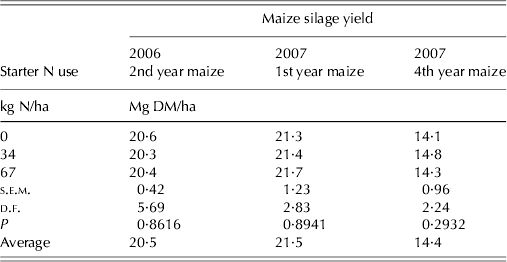
In 2005, the crop management staff at Table Rock Farm, producing maize (Zea mays L.), alfalfa (Medicago sativa L.) and grass hay forage for 850 confined milking cows in Castile, NY, approached Cornell University's Nutrient Management Spear Program (NMPS; http://nmsp.cals.cornell.edu) with a request for help with setting up on-farm research. At that time, the average milk production was 11 329 kg of milk per cow. The farm crew was questioning its practice of band-application (placement of fertilizer 5 cm below and 5 cm to the side of maize seeds) of 34 kg nitrogen (N)/ha and wondered if additional N should be used at planting. At that time, the whole farm N balance was 180 kg N/ha surplus N, and the farm was interested in learning how to reduce the balance and cut production costs as well. Typical management included spring application of liquid manure 1–2 weeks prior to seeding of maize, depending on the wetness of the fields. The farmer implemented strip trials, with three replicates, comparing a no-starter control, i.e. 34 and 67 kg N/ha for a 1st, 2nd and 4th year maize field in 2006 and 2007. Manure was injected in the spring at a rate of 84 m3/ha for the 2nd and 4th year fields, supplying an estimated 105 kg plant-available N/ha. For the 1st year maize field, manure was applied in the autumn at a rate of 39 m3/ha, resulting in an estimated 42 kg plant-available N/ha assuming 0·35 availability of organic N and 0 v. 0.65 availability of inorganic N upon autumn application and spring injection, respectively (Ketterings et al. Reference Ketterings, Klausner and Czymmek2003, Reference Ketterings, Godwin, Barney, Lawrence, Aldrich, Kilcer, Czymmek and Gloy2013a , Reference Ketterings, Godwin, DeGolyer and Czymmek b ). These trials were continued for 2 years, in three different fields. Yield data were analysed for each individual trial using PROC MIXED (Littell et al. Reference Littell, Milliken, Stroup, Wolfinger, Little, Milliken, Stroup and Wolfinger1996) with N treatment as fixed effect and block as random effect using the Statistical Analysis System (SAS Institute, Cary, NC). The LSMEANS procedure with TUKEY adjustment at P⩽0·05 was used for mean separation. The results of the studies showed that maize could be planted with manure only (Table 1), saving the farm US$37/ha/yr in fertilizer costs alone, a total savings of c. US$10k across the farm's 263 ha of maize, in addition to a saving of 8853 kg of N fertilizer across the farm.
On-farm strip trials, an important component of adaptive management, showed maize could be planted without starter N fertilizer at a case study dairy farm in western NY
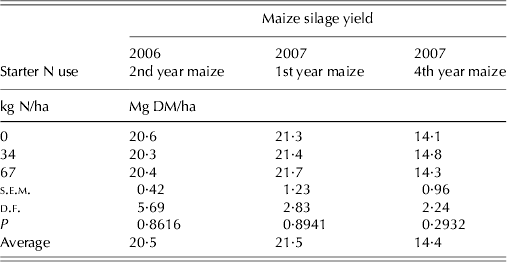
Adapted from Ketterings et al. (Reference Ketterings, Godwin, Swink and Czymmek2013c ).
In subsequent years, the farm crew continued to evaluate other practices using the same approach of implementation of fully replicated on-farm field trials. By means of these trials, the farm crew found that injecting manure in the spring at a rate exceeding 84 t/ha did not improve maize silage yield or quality. In addition, higher rates resulted in high end-of-season soil nitrate levels, maize stalk nitrate test (MSNT) values that exceeded 2000 mg/kg (excess), and increases in soil test phosphorus (P) and potassium (K) levels over time (Ketterings et al. Reference Ketterings, Godwin, DeGolyer and Czymmek2013b ). Therefore, manure injection rates were limited to no more than 84 t/ha.
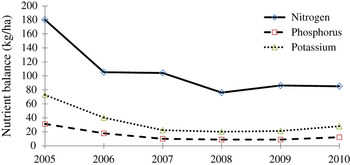
The farmer also implemented an annual NMB assessment, allowing the crew to evaluate the impact of management changes on nutrient accumulation/loss from the farm. The annual assessments showed that N, P and K balances were reduced by more than 50% (Fig. 1), whereas milk production increased to 12 835 kg (2010) from 11 329 kg of milk per cow in 2005. This farming operation could be described as following a ‘high-input/high-output’ production model and needed to develop confidence to reduce fertilizer use, adopt narrow row maize practices, inject manure, plant cover crops, adopt zone-tillage (a form of reduced tillage where zones are tilled but areas between rows are left undisturbed), and increase the proportion of home-grown forage in its dairy rations. The on-farm experimentation approach that the farm crew implemented, combined with a performance analysis in the form of an annual NMB, is one example of an adaptive management approach. Willard DeGolyer, farm manager, concluded: ‘What we've learned has given us new confidence in what we are doing and has showed us our on-farm practice is working well.’
Whole farm nitrogen, phosphorus and potassium balance of a case study dairy farm in NY decreased by 50% or more within 3–4 years, illustrating the effectiveness of the adaptive management approach implemented by the farm crew.

Currently, the university staff are working with the farm crew to evaluate the farm's yield records over the past 13 years to determine the fields with the highest average yields (maize and alfalfa rotations) and the smallest year-to-year variability. The goal of the assessment is to determine what management, soil and weather interactions provide for the greatest yields and the greatest soil biological buffering capacity. The crew has also implemented on-farm trials comparing zone/strip tilling at two depths (17·5 and 35 cm depth) to a control without zone tillage, to evaluate its investment in fuel.
DeGolyer explained in an email why he found it important to work with the university on trials on his farm:
-
(1) Why do you participate in on-farm research projects?
“>knowledge >profit >interest for employees and owners, interaction with college”
-
(2) Have on-farm crop research plots been helpful to your operation? How?
“Yes, reduced fertilizer inputs, reduced fuel use, >yields, again, employee interest in results”
-
(3) What are some key ingredients for a successful project?
“The project should give measured answers to the questions and decisions made on farm.”
-
(4) How much do plot harvests slow down your field crew?”
“There is a little slow down at harvest – 60 acres chopped on study day rather than 75”
-
(5) Replicated studies sound complicated and seem like overkill. What is your response to this statement?
Good answers with low standard deviations justify replicated study.”
Lessons learned through working in this farmer partnership illustrated some key principles of effective and active adaptive management: (1) farmer involvement in topic selection, trial implementation and data collection is essential; (2) selection of experiments should focus on gaining greater economic sustainability (reduction of input costs, increase of exports, etc.) plus protection of environmental resources (nutrients, soil, fuel, etc.); (3) the on-farm trials need to be targeted and simple but scientifically sound; (4) follow-up on the trials by means of annual trial summary reports and farm crew meetings to evaluate the results, draw conclusions and make plans for next year; and (5) a whole farm monitoring tool can help gain confidence that changes made at the field level (or herd level) impact the overall performance of the farm.
NEW YORK ADAPTIVE MANAGEMENT: STATEWIDE ON-FARM RESEARCH PARTNERSHIP APPROACH
Although the example of Table Rock Farm is an illustration of a very effective extension and knowledge transfer model and a partnership that is a solid foundation for progress in future years, the approach initially impacted one farm only. Although farmers do learn from each other even if they do not participate in such projects, the main expansion of the work at Table Rock Farm came through the development of preliminary data that allowed the university extension team in collaboration with other farmers and farm advisors to successfully apply for additional funding to expand the trials beyond Table Rock Farm. Following the studies at Table Rock Farm, 21 starter N trials were completed (Ketterings et al. Reference Ketterings, Godwin, Swink and Czymmek2013c ). The results of these studies showed manure could replace the need for starter N as long as sufficient N was applied with the manure, indicated by MSNT results of between 750 and 2000 mg NO3–N/kg, and introducing a new, soil-test and plant test-based approach to making decisions about starter N fertilizer use on farms in the state (Ketterings et al. Reference Ketterings, Godwin, Swink and Czymmek2013c ).
Another NY example was the state-wide project on starter P fertilizer that resulted in completion of over 70 trials between 2001 and 2003. The results showed that for fields that test high in P and have no manure applications planned for the season, P starter applications could be reduced to <28 kg P2O5/ha. For fields that test very high in P or when manure was applied, P could be eliminated from the starter without a yield or quality penalty (Ketterings et al. Reference Ketterings, Swink, Godwin, Czymmek and Albrecht2005). The state-wide project and its findings contributed to the sharp reduction in P fertilizer use in the state (Swink et al. Reference Swink, Ketterings, Chase, Czymmek and Mekken2009; Ketterings et al. Reference Ketterings, Czymmek and Swink2011; Ketterings & Czymmek Reference Ketterings and Czymmek2012). In a recent survey among certified nutrient management planners in NY, the confidence in management alternatives gained from such on-farm research partnerships was identified as a major driver in reductions in farm and state P balances (Ketterings & Czymmek Reference Ketterings and Czymmek2012).
Although the examples in the current paper show the effectiveness of on-farm research partnerships among farmers, farm advisors, university and agency staff in improving nutrient management over time, the investment of time and resources into such approaches and projects can be large. The use of technology can make it substantially easier to conduct on-farm trials as collection of harvest data is typically the most time-consuming aspect of the on-farm research approach in NY. With the introduction of forage harvesters with yield monitors in recent years, strides in on-farm research can be made in future years, making it easier for farms to implement the on-farm research, and allowing for a great number of farms to participate in the adaptive management programmes and learn from each other's findings (Blackmer & Kyveryga Reference Blackmer, Kyveryga and Khosla2010, Reference Blackmer, Kyveryga and Khosla2012).
NEW YORK ADAPTIVE MANAGEMENT: POLICY APPROACH
The NY CAFO permit requires CAFOs to follow land-grant university guidelines for fertility and nutrient management. This included, in NY, a P runoff index assessment (Czymmek et al. Reference Czymmek, Ketterings, Geohring and Albrecht2003) for all fields at the farm. Recently, CNMP planners in NY were interviewed about P use on farms and the NY P index (NY-PI) as a tool for management evaluation. The interviews revealed that although <0·05 of all farm fields could no longer receive manure, 0·17 of the cropland hectares were planned differently (primarily different rates and timing of application) than would have been the case prior to implementation of the NY-PI (Ketterings & Czymmek Reference Ketterings and Czymmek2012). These findings illustrate effectiveness of a regulatory approach that allowed for adaptive management and focused on outcomes. With the NY-PI, farmers are given options to address high-risk scenarios on a field by field and farm by farm basis. The findings point to two key ingredients for successful on-the-ground impact with a policy approach as identified by Walters & Holling (Reference Walters and Holling1990): (1) ownership among those impacted by the policy changes and (2) local accountability that leaves the farms with greater confidence and options for management.
Farmers and farm advisors recognize the importance of involvement in the process. This was illustrated by two quotes from the planners documented in Ketterings & Czymmek (Reference Ketterings and Czymmek2012):
-
• ‘The history of collaboration and trust between the public, academic and private sector stakeholders in New York State has led to a track record of efficient problem solving. Involve stakeholders in the process and hold them accountable to create real solutions.’
-
• ‘The New York phosphorus index has been the most effective planning tool for evaluating the risks associated with applying manure to cropland. Institution of the CAFO regulatory programme was the main driver for changes in nutrient management and soil conservation, however.’
KEY LESSONS BASED ON NEW YORK EXPERIENCES
The three examples in NY showed that for a successful knowledge transfer programme, the actual message might not be as important as the trust-based partnership and understanding of farmer reality that leads to asking the right questions, and an adaptive management process that leads to answers and on-the-ground impact. Based on the experiences in NY, key ingredients for farm level impact are: (1) understanding of the concerns and recognition that change is necessary among all involved; (2) identification of win–win situations first; (3) posing of relevant questions, generation of believable results based on reliable data (replicated trials where feasible); (4) farmer involvement and accountability in the process (farmers as drivers of the adaptive management process); and (5) development and maintenance of a trust-based farmer, farm advisor, university researcher relationship. The latter takes time to develop but once established as a three-way partnership, such relationships can result in state-wide coverage of on-farm trials and an effective adaptive management process. It will also contribute to development of relevant, trusted and effective land-grant university guidance for nutrient management for use at the farm level and to inform policy makers.
FUTURE POLICY DEVELOPMENT
With the release of the new national NRCS 590 standard and its recognition of the potential effectiveness of an adaptive management approach to addressing environmental management on dairy farms, new approaches can be developed. Current NRCS guidelines define adaptive nutrient management as ‘a process to be carried out by producers themselves, in cooperation with the land-grant university, or with other agencies and industry partners following prescribed protocols developed by the State NRCS, land-grant university, or other appropriate technical agencies and industry. The results of adaptive nutrient management testing that meet the established protocols and are concurred with by NRCS and the land-grant university may be used in nutrient planning where appropriate. For adaptive nutrient management projects supported by NRCS, a final report of results must be provided to the NRCS State Conservationist.’ Future discussions need to include development of a state regulatory process that allows for implementation of change via policy, incentives, measuring and monitoring; hold people accountable but allow for flexibility and evaluate and document outcomes though an adaptive management approach.
CONCLUSIONS
For the sustainability of agriculture anywhere, it is important to find ways to reduce the cost of production, increase yields and/or outputs, and enhance profitability while minimizing environmental loss of nutrients. This requires straightforward communication with farmers and agri-business about how their activities impact the environment and ownership of the issues and challenges. It requires believable examples that show constituents that science can help identify viable, directionally correct practices (trust-building; the Table Rock Farm example), and it requires research plots on working farms across a region to gain rapid, widespread adoption (the On-Farm Research Partnership approach). The examples of NY discussed here illustrate key ingredients for adaptive management approaches and on-farm success: (1) state-wide awareness of the issues driven by regulations and extension programming; (2) science-based tools that allow for farm-specific responses to the environmental challenges (not one approach fits all); (3) demonstrated risk (relevant questions and credible answers obtained through an on-farm research partnership); (4) accountability for all players; (5) enforcement of regulations; and (6) economically feasible solutions. The farmers and farm advisors in the examples given in the present paper recognized the potential for improvement and explored alternative management through on-farm research in collaboration with university staff while looking for win–win approaches (such as reduced starter N or P fertilizer use). Future adaptive management models should start from the viewpoint of the farmer and hold farmers, their advisors and the research community accountable for finding solution and documenting progress, as a partnership.
The on-farm research trials were supported with funds from the New York Farm Viability Institute (manure studies), Northern New York Agriculture Development Program (starter N project and NMB assessments), Federal Formula Funds (starter N project), and an NRCS Conservation Innovation Grant (NMB assessments). Thanks to Willard DeGolyer and the crop management crew at Table Rock Farm for taking the lead in implementation of an adaptive management approach at the farm, and the many NY dairy farmers and farm advisors that have participated in the On-Farm Research Partnership over the past decade.