Introduction
Bipolar disorder is a chronic and debilitating illness, characterized by episodes of mania and/or depression. Kraepelin first noted that the course of bipolar disorder tends to worsen over time, a finding that has been replicated (Zis et al. Reference Zis, Grof, Webster and Goodwin1980; Roy-Byrne et al. Reference Roy-Byrne, Post, Uhde, Porcu and Davis1985; Kessing et al. Reference Kessing, Andersen and Mortensen1998; Rosa et al. Reference Rosa, González-Ortega, González-Pinto, Echeburúa, Comes, Martinez-Àran, Ugarte, Fernández and Vieta2012). Bipolar patients with earlier onset and/or more mood episodes often experience a more chronic and continuous course of illness (Leboyer et al. Reference Leboyer, Henry, Paillere-Martinot and Bellivier2005), diminishing response to pharmacological treatment (Franchini et al. Reference Franchini, Zanardi, Smeraldi and Gasperini1999; Leboyer et al. Reference Leboyer, Henry, Paillere-Martinot and Bellivier2005; Ketter et al. Reference Ketter, Houston, Adams, Risser, Meyers, Williamson and Tohen2006), significant psychiatric co-morbidity (Leboyer et al. Reference Leboyer, Henry, Paillere-Martinot and Bellivier2005), more frequent hospitalizations (Goldberg & Ernst, Reference Goldberg and Ernst2002, Leboyer et al. Reference Leboyer, Henry, Paillere-Martinot and Bellivier2005), higher rates of disability (Magalhães et al. Reference Magalhães, Dodd, Nierenberg and Berk2012a ), more medical morbidity (Angst et al. Reference Angst, Stassen, Clayton and Angst2002; Magalhães et al. Reference Magalhães, Kapczinski, Nierenberg, Deckersbach, Weisinger, Dodd and Berk2012b ), lower cognitive functioning (Lewandowski et al. Reference Lewandowski, Cohen and Ongur2011), elevated rates of suicide attempts and completions (Angst et al. Reference Angst, Stassen, Clayton and Angst2002; Leboyer et al. Reference Leboyer, Henry, Paillere-Martinot and Bellivier2005), and impaired interpersonal relationships and quality of life (Magalhães et al. Reference Magalhães, Dodd, Nierenberg and Berk2012a ).
Several psychosocial treatments, adjunctive to pharmacotherapy, have been designed to treat acute mood symptoms, prevent relapse and mitigate functional impairments in patients with bipolar disorder. These include family-focused therapy (FFT), psycho-education, cognitive–behavioral therapy (CBT), as well as interpersonal and social rhythm therapy (IPSRT) and there ar emerging data for mindfulness, dialectical behavior therapy and Internet-based approaches (Lauder et al. Reference Lauder, Chester, Castle, Dodd, Berk, Klein, Austin, Gilbert, Chamberlain, Murray, White, Piterman and Berk2013; Perich et al. Reference Perich, Manicavasagar, Mitchell, Ball and Hadzi-Pavlovic2013; Van Dijk et al. Reference Van Dijk, Jeffrey and Katz2013). When combined with pharmacotherapy, these treatments have been shown to hasten recovery from episodes, delay mood episode recurrences, reduce residual mood symptoms, and improve psychosocial functioning (Miklowitz, Reference Miklowitz2008). Similar to treatment with pharmacotherapy (Franchini et al. Reference Franchini, Zanardi, Smeraldi and Gasperini1999, Ketter et al. Reference Ketter, Houston, Adams, Risser, Meyers, Williamson and Tohen2006; Berk et al. Reference Berk, Brnabic, Dodd, Kelin, Tohen, Malhi, Berk, Conus and McGorry2011), failure to intervene early in the course of illness may affect outcomes with psychotherapy. For example, Scott et al. (Reference Scott, Paykel, Morriss, Bentall, Kinderman, Johnson, Abbott and Hayhurst2006) compared 20 sessions of CBT with treatment as usual among patients with recurrent bipolar disorders (two or more prior episodes of mania or of hypomania). A post-hoc analysis demonstrated that patients with fewer than 12 episodes were less likely to relapse with adjunctive CBT, whereas patients with more than 12 episodes were less likely to relapse with treatment as usual (Scott et al. Reference Scott, Paykel, Morriss, Bentall, Kinderman, Johnson, Abbott and Hayhurst2006). Similar findings were reported by Colom et al. (Reference Colom, Reinares, Pacchiarotti, Popovic, Mazzarini, Martínez-Arán, Torrent, Rosa, Palomino-Otiniano, Franco, Bonnin and Vieta2010) in a trial of psycho-education for euthymic bipolar patients, who found that psycho-education did not delay time to recurrence in patients with a history of more than seven past episodes. Patients with more than 14 past episodes did not experience a reduction in time spent ill, whereas individuals with between nine and 14 episodes experienced fewer days ill in mood episodes when treated with psycho-education (Colom et al. Reference Colom, Reinares, Pacchiarotti, Popovic, Mazzarini, Martínez-Arán, Torrent, Rosa, Palomino-Otiniano, Franco, Bonnin and Vieta2010). However, a meta-analysis of 10 psychotherapy trials did not find a predictive or moderating effect of the number of episodes on relapse (Lam et al. Reference Lam, Burbeck, Wright and Pilling2009).
The Systematic Treatment Enhancement Program for Bipolar Disorder (STEP-BD) was a multisite study of naturalistic course and randomized treatments. Embedded in the STEP-BD was a randomized controlled trial of intensive psychotherapy (either CBT, IPSRT or FFT) plus pharmacotherapy versus collaborative care (a three-session psycho-education intervention) plus pharmacotherapy for the treatment of acute bipolar depression. Results showed that patients in intensive therapy recovered from depressive episodes more rapidly than patients in collaborative care (Miklowitz et al. Reference Miklowitz, Otto, Frank, Reilly-Harrington, Kogan, Sachs, Thase, Calabrese, Marangell, Ostacher, Patel, Thomas, Araga, Gonzalez and Wisniewski2007a , Reference Miklowitz, Otto, Frank, Reilly-Harrington, Wisniewski, Kogan, Nierenberg, Calabrese, Marangell, Gyulai, Araga, Gonzalez, Shirley, Thase and Sachs b ), and were more likely to recover if they had co-morbid anxiety disorders (Deckersbach et al. Reference Deckersbach, Peters, Sylvia, Urdahl, Magalhães, Otto, Frank, Miklowitz, Berk, Kinrys and Nierenberg2014). In the present study we examined data from the STEP-BD trial of psychotherapy to explore the role of prior illness course and age at onset in treatment outcome. Specifically we investigated whether prior illness course and age at onset (a) predict the likelihood of recovery or time until recovery from depression, and (b) moderate the response to treatment (i.e. intensive psychotherapy versus collaborative care). We hypothesized that (1) individuals with fewer mood episodes, shorter illness duration and later age at onset would have higher recovery rates and take less time to recover; and (2) intensive psychotherapy would be more effective than collaborative care among chronic patients with more mood episodes.
Method
Study design
The STEP-BD was a National Institute of Mental Health (NIMH)-funded multisite study designed to investigate the naturalistic course and effectiveness of treatments for bipolar disorder. The detailed methods of the research program have previously been described elsewhere (Sachs et al. Reference Sachs, Thase, Otto, Bauer, Miklowitz, Wisniewski, Lavori, Lebowitz, Rudorfer, Frank, Nierenberg, Fava, Bowden, Ketter, Marangell, Calabrese, Kupfer and Rosenbaum2003). Embedded in the STEP-BD was a randomized controlled treatment arm of psychotherapy for acute bipolar depression (Miklowitz et al. Reference Miklowitz, Otto, Frank, Reilly-Harrington, Wisniewski, Kogan, Nierenberg, Calabrese, Marangell, Gyulai, Araga, Gonzalez, Shirley, Thase and Sachs2007b ). Participants in the psychotherapy treatment trial were randomly assigned to 9 months of manualized weekly treatment with intensive psychotherapy (up to 30 sessions) of FFT, CBT or IPSRT, or to 6 weeks of treatment (up to three sessions) with collaborative care (Miklowitz & Otto, Reference Miklowitz and Otto2007). All four psychotherapies shared the common ingredients of psycho-education, relapse prevention planning and illness management. Collaborative care was a brief intervention that drew on a variety of the most common evidence-based psychosocial strategies for bipolar disorder with a focus on psycho-education (Miklowitz & Otto, Reference Miklowitz and Otto2007). The three intensive psychotherapies were designed as enhanced versions of fundamental psycho-education interventions with specific theoretical foundations and treatment strategies. FFT involved educating the family about bipolar disorder and the impact of the family system on its course of illness, as well as enhancing communication and problem solving between family members and patients (Miklowitz et al. Reference Miklowitz, Simoneau, George, Richards, Kalbag, Sachs-Ericsson and Suddath2000). CBT included restructuring cognition distortions, challenging negative thoughts, problem solving and activity planning (Lam et al. Reference Lam, Hayward, Watkins, Wright and Sham2005). IPSRT emphasized stabilizing social rhythms that are common antecedents of mood episodes and addressing interpersonal problems including grief, role disputes and relationship difficulties (Frank et al. Reference Frank, Swartz and Kupfer2000, Reference Frank, Kupfer, Thase, Mallinger, Swartz, Fagiolini, Grochocinski, Houck, Scott, Thompson and Monk2005). A detailed description of the nature, scope, study design and participants in the psychosocial pathway of the STEP-BD can be found in Miklowitz & Otto (Reference Miklowitz and Otto2007).
Participants
Eligible participants (n = 293) met the Diagnostic and Statistical Manual, 4th revision (DSM-IV) criteria for bipolar I or II disorder and an acute episode of depression, as confirmed by the Mini-International Neuropsychiatric Interview (Sheehan et al. Reference Sheehan, Lecrubier, Sheehan, Amorim, Janavs, Weiller, Hergueta, Baker and Dunbar1998), and were enrolled in the randomized trial of psychotherapy. To be eligible for the trial, participants had to be taking or willing to initiate treatment with a mood-stabilizing or atypical antipsychotic medication. Participants with rapid cycling bipolar disorder were excluded from the larger STEP-BD pharmacotherapy trial with which this study was affiliated, because of the possible association between rapid cycling and antidepressant use. Of the 293 participants, 205 provided information at their baseline visit regarding the number of previous lifetime episodes of mania and depression, age of illness onset and illness duration. Patients who did not provide this information did not differ from those who did on any patient characteristics (all p's > 0.126), with the exception of level of education [χ 2(1, n = 271) = 5.14, p = 0.023], which was higher among individuals not included in this subsample.
Measures
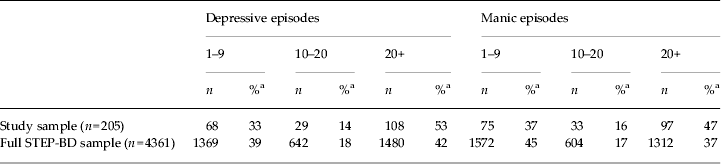
Course of illness and onset were assessed using the Affective Disorders Evaluation (ADE) (Sachs et al. Reference Sachs, Thase, Otto, Bauer, Miklowitz, Wisniewski, Lavori, Lebowitz, Rudorfer, Frank, Nierenberg, Fava, Bowden, Ketter, Marangell, Calabrese, Kupfer and Rosenbaum2003). In the ADE, episodes of depression and mania were reported separately in categorical fashion (e.g. 10–20 depressive episodes), and thus did not allow for the analysis of continuous data. Also, due to the separate categorization of manic and depressive episode frequency, the effects of these two clinical states were investigated separately. For this study, subcategories of number of episodes were defined a priori as one to nine, 10–20, or >20 lifetime episodes each for depression and mania. The distribution of our subsample, as well as that of the full STEP-BD study enrollment according to mood episode history, are presented in Table 1.
Distribution of mood episode history in the study sample (n = 205) and full STEP-BD sample (n = 4361)

STEP-BD, Systematic Treatment Enhancement Program for Bipolar Disorder.
a Percentages for the full STEP-BD sample are calculated based on percentage of valid cases.
Age at onset was assessed by inquiry into DSM-IV-defined episodes of mania, hypomania, depression and mixed states. Subjects were then asked to identify the age at which they first experienced such episodes. Age at onset for bipolar disorder was defined as the earliest age at onset of a manic, hypomanic or mixed episode. Illness duration was computed by subtracting the ADE age of bipolar disorder onset from age at time of study enrollment, reflecting the length of time with a bipolar diagnosis at study entry.
At each treatment visit, mood symptoms were assessed using the Clinical Monitoring Form (CMF) (Sachs et al. Reference Sachs, Guille and McMurrich2002). Inter-rater reliability coefficients (referenced to ‘gold standard’ ratings for CMF depression and mania items) of the blinded physician ratings ranged from 0.83 to 0.99 (intraclass r's). Participants were considered ‘recovered’ if they experienced ⩽2 moderate mood symptoms for ⩾8 consecutive weeks. Participants were considered ‘not recovered’ if they failed to meet these criteria for either number or duration of mood symptoms (Sachs et al. Reference Sachs, Thase, Otto, Bauer, Miklowitz, Wisniewski, Lavori, Lebowitz, Rudorfer, Frank, Nierenberg, Fava, Bowden, Ketter, Marangell, Calabrese, Kupfer and Rosenbaum2003).
Data analyses
Predictor analyses
To evaluate whether previous mood episodes, age at onset and illness duration predicted likelihood of recovery and time until recovery, we conducted logistic regression and Cox proportional hazard (survival) models. All analyses were by intention to treat. Patients were included until their final assessment point, with a maximum of 365 days in the study (mean = 166.48, s.d. = 102.58) (Sachs et al. Reference Sachs, Thase, Otto, Bauer, Miklowitz, Wisniewski, Lavori, Lebowitz, Rudorfer, Frank, Nierenberg, Fava, Bowden, Ketter, Marangell, Calabrese, Kupfer and Rosenbaum2003). The proportionality of risk assumption was met for all survival analyses. Mood episodes, age at onset and illness duration were evaluated independently in separate regression models. To evaluate the ability of these variables to predict recovery status after adjusting for the effects of treatment, treatment condition (psychotherapy or collaborative care) was included as an independent variable. Patients with 1–9 or 10–20 manic or depressive episode variables were compared with those who had more than 20 episodes to evaluate recovery status relative to the most chronic patients. In a previous study, we found that the presence of a lifetime co-morbid anxiety disorder moderated the effects of psychotherapy in the STEP-BD (Deckersbach et al. Reference Deckersbach, Peters, Sylvia, Urdahl, Magalhães, Otto, Frank, Miklowitz, Berk, Kinrys and Nierenberg2014). Therefore, we included anxiety and other co-morbidities as covariates. Specifically, effect size estimates [odds ratios (ORs) and R 2] for each course of illness variable (i.e. number of depressive/manic episodes, illness duration, age at onset) are presented before and after adjusting for these covariates. Covariates were added individually to examine the effect of each covariate, and then added as a group of covariates to test their combined effect. Because of missing data, the sample was reduced with the addition of each control variable.
Moderator analyses
To evaluate whether mood episodes, age at onset or illness duration moderated the likelihood of or time until recovery, we added an interaction term with treatment condition to the models. Our moderator analysis follows the methods outlined by Kraemer & Kupfer (Reference Kraemer and Kupfer2006), who recommend that effect sizes define exploratory moderators of treatment because of the potential for the statistical significance of the moderator to change with sample size. Consistent with previous studies (Fisher, Reference Fisher1970; Nickerson, Reference Nickerson2000; Kraemer, Reference Kraemer2008; Pincus et al. Reference Pincus, Miles, Froud, Underwood, Carnes and Taylor2011; Vitiello et al. Reference Vitiello, Riddle, Yenokyan, Axelson, Wagner, Joshi, Walkup, Luby, Birmaher, Ryan, Emslie, Robb and Tillman2012), our exploratory analyses of the moderating effects of prior illness course used a less stringent α threshold of 0.10. Moderators meeting this threshold were then explored in respect of the magnitude of the treatment effects at each level of the proposed moderators (Kraemer & Kupfer, Reference Kraemer and Kupfer2006).
The measure of treatment effects that may best reflect clinical significance is the number needed to treat (NNT) (Cook & Sackett, Reference Cook and Sackett1995; Altman & Andersen, Reference Altman and Andersen1999). Computational procedures for NNT have been previously described. The value can be interpreted as the number of patients one would expect to treat with the investigation treatment (intensive psychotherapy) to have one more responder (or one fewer non-responder) that if the same number were treated with the control condition (collaborative care). NNT is presented with 95% confidence intervals (CIs) for sensitivity and specificity using the Newcombe–Wilson score method without continuity correction (Newcombe, Reference Newcombe1998). An NNT of 2 is considered large, an NNT of 3.5 is considered medium, and an NNT >9 is considered small (Kraemer & Kupfer, Reference Kraemer and Kupfer2006).
Results
Study sample
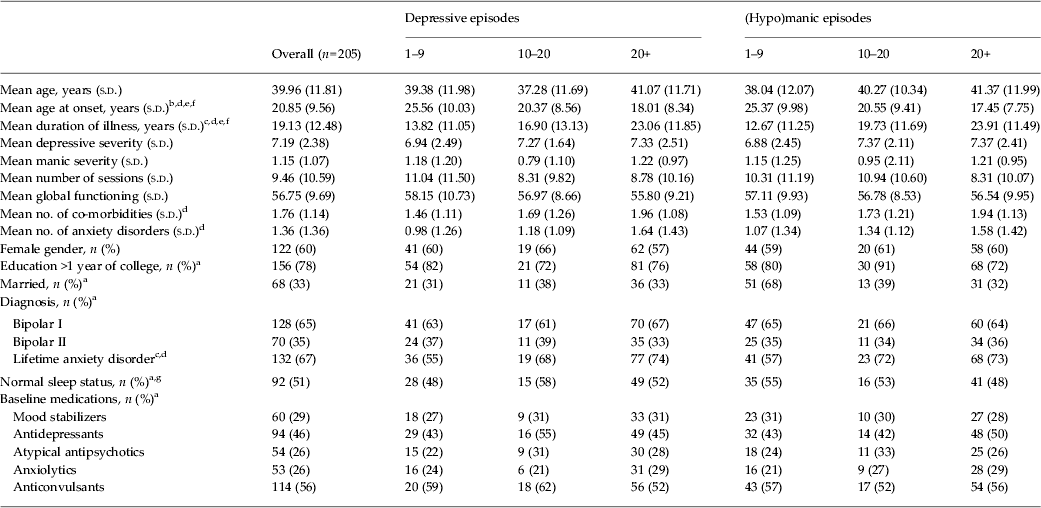
Demographic and clinical characteristics for the total sample (n = 205), stratified by number of episodes for both depressive and (hypo)manic episodes, are presented in Table 2. Associations between mood episodes and age at onset and illness duration are also displayed in Table 2.
Demographic and clinical characteristics according to number of lifetime depressive and (hypo)manic episodes

s.d., Standard deviation.
a Where data points were missing, percentages were calculated out of total number of available cases.
b Difference between one to nine and 10–20 depressive episodes (p < 0.05).
c Difference between 10–20 and 20+ depressive episodes (p < 0.05).
d Difference between one to nine and 20+ depressive episodes (p < 0.05).
e Difference between one to nine and 10–20 manic episodes (p < 0.05).
f Difference between one to nine and 20+ manic episodes (p < 0.05).
g Sleep status refers to being a short (<6 h/night), normal (6–8 h/night) or long (>8 h/night) sleeper in the week prior to the baseline visit.
Psychosocial treatment outcome
The overall superiority of psychotherapy relative to collaborative care in the full sample (n = 293) has been previously reported (Miklowitz et al. Reference Miklowitz, Otto, Frank, Reilly-Harrington, Wisniewski, Kogan, Nierenberg, Calabrese, Marangell, Gyulai, Araga, Gonzalez, Shirley, Thase and Sachs2007b ). Consistent with these results, in this subsample (n = 205), intensive psychotherapy yielded significantly faster time until recovery (b = 0.42, p = 0.021, OR = 1.53, 95% CI 1.07–2.19) and greater likelihood of recovery (b = 0.66, p = 0.024, OR = 1.94, 95% CI 1.09–3.45) relative to collaborative care.
Course of illness
Frequencies, means and standard deviations for previous depressive and (hypo)manic episode groups are reported in Table 2.
Patients with 1–9, 10–20, and 20+ previous depressive episodes differed with respect to their age at onset (F 2,202 = 14.84, p < 0.001), illness duration (F 2,202 = 13.44, p < 0.001), number of lifetime anxiety disorders (F 2,194 = 5.07, p = 0.007), number of lifetime co-morbidities (F 2,202 = 4.34, p = 0.014) and proportion of individuals with at least one lifetime diagnosis of an anxiety disorder [χ 2(2, n = 197) = 6.31, p = 0.043]. All other comparisons were non-significant (all p's > 0.146; see Table 2).
Patients with 1–9, 10–20, and 20+ prior (hypo)manic episodes differed with respect to their age at onset (F 2,202 = 16.80, p < 0.001), illness duration (F 2,202 = 20.53, p < 0.001), and at the trend level, the number of lifetime anxiety disorders (F 2,194 = 2.94, p = 0.055), co-morbid conditions (F 2,202 = 2.74, p = 0.067), any lifetime anxiety disorder [χ 2(2, n = 197) = 5.21, p = 0.074] and education [χ 2(2, n = 202) = 5.49, p = 0.064]. All other comparisons were non-significant (all p's > 0.184; see Table 2). In general, pairwise contrasts indicated that more lifetime mood episodes were associated with earlier onset, longer illness duration, the likelihood of having one or more co-morbid anxiety disorders, and other co-morbidities (see Table 2). Logistic and Cox regression models for recovery and time until recovery, respectively, indicated that having a lifetime anxiety disorder, number of anxiety disorders, number of co-morbidities, and education were unrelated to recovery rates or time to recovery (all p's > 0.10).
Predictor analyses
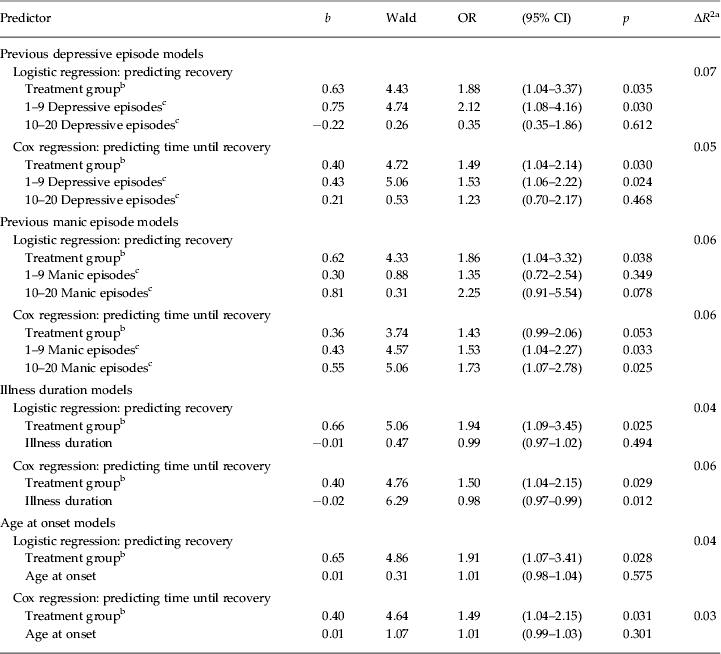
Results of the modeling sequence, including regression coefficients, ORs, p values, effect sizes and CIs are presented in Table 3.
Logistic regression and Cox regression analyses evaluating previous mood episodes, illness duration and age at onset as predictors of likelihood of recovery and time until recovery

OR, Odds ratio; CI, confidence interval.
a R 2 for logistic regressions represents Nagelkerke R 2, an estimate of the increment in variance in the probability of recovery accounted for by the predictors tested. R 2 for Cox regressions represents Cox–Snell R 2, an estimate of the relative association between survival and the predictors tested.
b Treatment group = intensive psychotherapy (1) versus collaborative care (0).
c Depressive and manic episodes: dummy coded with the group with 20+ episodes coded as the reference group; therefore only coefficients relative to the reference group are presented.
Mood episodes
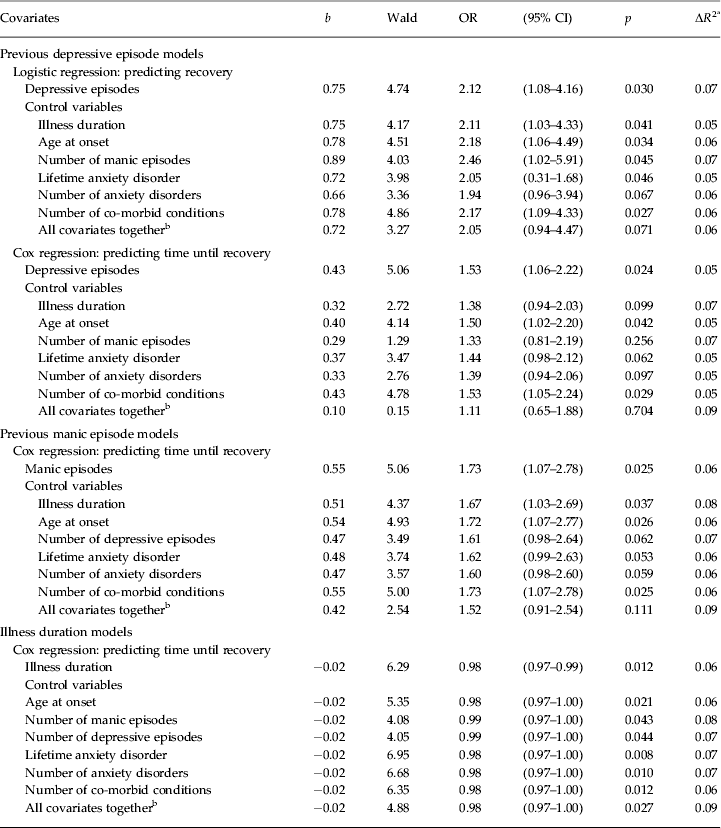
Individuals with one to nine previous depressive episodes were more likely to recover (OR = 2.12, p = 0.030) and had faster time to recovery (OR = 1.53, p = 0.024) than those with more than 20 previous episodes of depression. The likelihood of recovery and time until recovery for individuals with 10–20 previous episodes of depression was intermediate between those with one to nine and 20+ episodes (Table 3). Previous depressive episodes remained a significant predictor of recovery likelihood after adjusting for illness duration (p = 0.041), age at onset (p = 0.034), number of manic episodes (p = 0.045), lifetime anxiety (p = 0.046) or number of co-morbidities (p = 0.027), but was reduced to a statistical trend after adjusting for number of anxiety disorders (see Table 4). Although p values were slightly reduced following the inclusion of all covariates, the effect size estimates (OR and R 2) remained almost identical despite reductions in sample size.
Effect of previous mood episodes and illness duration as predictors of likelihood of recovery and time until recovery after adjusting for clinical covariates

OR, Odds ratio; CI, confidence interval.
a R 2 for logistic regressions represents Nagelkerke R 2, an estimate of the increment in variance in the probability of recovery accounted for by the predictors tested. R 2 for Cox regressions represents Cox–Snell R 2, an estimate of the relative association between survival and the predictors tested.
b All covariates denote a model where all covariates listed above for a given model were entered as a set of variables into the model. Covariates were added first individually to examine the effect of each covariate, and then added as a group of covariates to test their combined effect.
Previous depressive episodes remained a significant predictor of time to recovery after adjusting for age at onset (p = 0.042) and number of co-morbidities (p = 0.029), but the significance was reduced after controlling for illness duration (p = 0.099), lifetime anxiety (p = 0.062), number of anxiety disorders (p = 0.097) or number of manic episodes (p = 0.256). Illness duration and previous depressive episodes were positively correlated (r = 0.35, p < 0.001). When all predictors were entered in one model, number of previous depressive episodes was no longer a significant predictor (Table 4).
Previous (hypo)manic episodes did not predict the likelihood of recovery (p's > 0.078; see Table 3). However, individuals with one to nine previous manic episodes (OR = 1.53, p = 0.033) and with 10–20 previous manic episodes (OR = 1.73, p = 0.025) recovered faster than those with 20+ manic episodes. Manic episodes remained a significant predictor of time to recovery after adjusting for number of co-morbidities (one to nine episodes, p = 0.038; 10–20 episodes, p = 0.025). Having 10–20 previous manic episodes was associated with time until recovery after adjusting for illness duration (p = 0.037) and age at onset (p = 0.026). The significance of both one to nine and 10–20 previous manic episodes was reduced when controlling for lifetime anxiety (one to nine episodes, p = 0.051; 10–20 episodes, p = 0.053), number of anxiety disorders (p = 0.065) and previous depressive episodes (p = 0.387). When all covariates were entered in one model, the significance of previous manic episodes was reduced (see Table 4).
Illness duration
Illness duration did not predict the likelihood of recovery (OR = 0.99, p = 0.494; see Table 3), but increases in illness duration were associated with longer time until recovery (OR = 0.98, p = 0.012), even after adjusting for previous depressive episodes (p = 0.044), previous manic episodes (p = 0.043), age at onset (p = 0.021), lifetime anxiety (p = 0.008), number of anxiety disorders (p = 0.010), number of co-morbidities (p = 0.012) and all predictors in one model (see Table 4).
Age at onset
Finally, age at illness onset neither predicted likelihood of recovery (OR = 1.01, p = 0.575) nor time until recovery (OR = 1.01, p = 0.301) (Table 3).
Moderator analyses
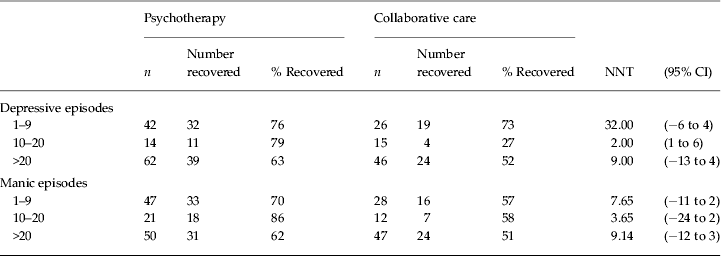
To investigate whether number of previous episodes, illness duration or age at onset moderated treatment outcome, we added an interaction term with treatment condition to the models predicting likelihood of and time to recovery. Number of previous episodes demonstrated a treatment interaction term predicting likelihood of recovery (p = 0.10). The treatment interaction terms for number of previous manic episodes, age at onset and illness duration did not exceed the set α threshold of 0.10 for further investigation of NNT (all p's > 0.282). The differential NNTs of psychotherapy versus collaborative care for patients with one to nine, 10–20, and > 20 lifetime depressive episodes (and for comparison purposes, also manic episodes) are shown in Table 5.
Moderator effects of number of lifetime mood episodes on recovery rates with collaborative care and psychotherapy for bipolar depression

NNT, Number needed to treat; CI, confidence interval.
For patients with 10–20 lifetime depressive episodes, 79% (n = 11) recovered with intensive psychotherapy, whereas only 27% (n = 4) recovered with collaborative care. These recovery rates corresponded to a large NNT (2.00). That is, one would need to treat two patients with intensive psychotherapy compared with collaborative care to see one additional patient recover with psychotherapy. By contrast, there was no difference in recovery rates to psychotherapy versus collaborative care for patients with one to nine lifetime episodes of depression, or for patients with >20 lifetime episodes of depression. For patients with one to nine lifetime depressive episodes, 76% (n = 32) recovered with psychotherapy and 73% (n = 19) recovered with collaborative care (NNT = 32.00). For patients with >20 lifetime episodes of depression, 63% (n = 39) recovered with psychotherapy and 52% (n = 24) recovered with collaborative care (NNT = 9.00). This moderator effect was not affected by having a lifetime anxiety disorder, number of anxiety disorders or number of co-morbidities, as these variables were not associated with increased or decreased likelihood of recovery within any subcategory of depressive or manic episodes (χ 2, all p's > 0.10).
Discussion
To our knowledge, this is the first study investigating the role of course of illness and age at onset in the outcomes of adult depressed patients with bipolar disorder undergoing different forms of psychotherapy. The number of previous depressive episodes and illness duration emerged as the strongest predictors of recovery rates and/or time to recovery from depression. Collectively, our findings suggest that depressed bipolar patients with a longer duration of illness and more episodes are less likely to recover from depression and, if they do, take longer to recover compared with patients with fewer episodes and shorter illness duration. This was true independently of which type of therapy (intensive psychotherapy or collaborative care) that patients received or when controlling for other factors that tend to accompany a chronic illness course.
The findings from the predictor analysis are consistent with the results of pharmacotherapy studies that show better response earlier in the course of illness (Berk et al. Reference Berk, Berk, Dodd, Cotton, Macneil, Daglas, Conus, Bechdolf, Moylan and Malhi2013). However, it is unclear whether patients with fewer episodes and a favorable response are (1) in an earlier stage of illness, where they have not yet experienced as many mood episodes, or (2) less prone to experiencing recurrences of mood episodes over the duration of their illness. In this study, patients with the most episodes had both the earliest age at onset and longest illness duration. However, we could not investigate recurrence rates of mood episodes in relation to a patient's illness duration because mood episodes in the STEP-BD were assessed in distinct subcategories, grouping the number of mood episodes (e.g. 10–20). Future studies are needed to investigate whether our findings reflect stage of illness or proneness to recurrence. Of note, patients with the rapid cycling bipolar subtype were excluded from this STEP-BD study, so that our results do not reflect effects of this particular subgroup with a high frequency of episodes.
In contrast to mood episodes and illness duration, age at onset was unrelated to recovery from an acute depressive episode. This is somewhat surprising, given that previous studies in first-episode patient cohorts have reported effects of age at onset in psychosocial treatment outcomes (McMurrich et al. Reference McMurrich, Sylvia, Dupuy, Peckham, Peters, Deckersbach and Perlis2012). However, in these studies, psychotherapy was largely uncontrolled, and the effects of age at onset pertained to relapse prevention and functional recovery rather than acute recovery of symptoms. Therefore, it is possible that age at onset is relevant to psychotherapy outcome with regard to mood episode recurrence and day-to-day functioning, but may not play a role in the acute stabilization and syndromic recovery of depressive symptoms.
We also investigated course of illness as a moderator of treatment response. As per Kraemer's recommendations, the analysis focused on the magnitude of treatment differences, rather than significance (Kraemer & Kupfer, Reference Kraemer and Kupfer2006). Patients with 10–20 prior episodes of depression were more likely to recover with psychotherapy than collaborative care. Patients with less than 10 lifetime depressive episodes responded at equally high rates to both treatments, whereas patients with more than 20 episodes experienced the lowest recovery rates with both treatments. These findings suggest that intensive psychotherapy for acute depression may be more successful for adult patients with 10–20 episodes, supporting the utility of a personalized medicine approach for tailoring treatment selection and delivery. However, a degree of caution is advised when interpreting the results of this moderator analysis. First, the interaction between number of mood episodes and type of psychotherapy (intensive psychotherapy versus collaborative care) did not reach conventional statistical thresholds (p = 0.05). Second, as shown in Table 2, the subgroup of patients with 10–20 depressive episodes was smaller than those with one to nine or 10–20 previous depressive episodes. Therefore, these results provide initial support for an advantage of intensive psychotherapy among patients with 10–20 prior depressive episodes, but replication of the findings in larger samples is recommended before drawing firm conclusions about the difference in response rates between the two treatment conditions.
Findings in several studies suggest that repeated mood episodes are associated with increasing treatment resistance (Franchini et al. Reference Franchini, Zanardi, Smeraldi and Gasperini1999; Leboyer et al. Reference Leboyer, Henry, Paillere-Martinot and Bellivier2005; Ketter et al. Reference Ketter, Houston, Adams, Risser, Meyers, Williamson and Tohen2006; Scott et al. Reference Scott, Paykel, Morriss, Bentall, Kinderman, Johnson, Abbott and Hayhurst2006; Colom et al. Reference Colom, Reinares, Pacchiarotti, Popovic, Mazzarini, Martínez-Arán, Torrent, Rosa, Palomino-Otiniano, Franco, Bonnin and Vieta2010). It is possible that individuals with 10–20 previous depression episodes have reached a level of chronicity where the collaborative care intervention is too brief to provide benefit, but the ‘extra dose’ (i.e. more sessions) and additional treatment ingredients unique to intensive psychotherapies [e.g. enhancing family communication, activity planning, challenging negative thoughts, addressing interpersonal difficulties (Miklowitz et al. Reference Miklowitz, Simoneau, George, Richards, Kalbag, Sachs-Ericsson and Suddath2000; Frank et al. Reference Frank, Swartz and Kupfer2000, Reference Frank, Kupfer, Thase, Mallinger, Swartz, Fagiolini, Grochocinski, Houck, Scott, Thompson and Monk2005; Lam et al. Reference Lam, Hayward, Watkins, Wright and Sham2005)] are enough of a boost to achieve recovery. The relative advantage of intensive psychotherapy, however, was diminished among the most chronic patients with more than 20 episodes. This finding diverges from findings in relapse prevention studies (Scott et al. Reference Scott, Paykel, Morriss, Bentall, Kinderman, Johnson, Abbott and Hayhurst2006; Colom et al. Reference Colom, Reinares, Pacchiarotti, Popovic, Mazzarini, Martínez-Arán, Torrent, Rosa, Palomino-Otiniano, Franco, Bonnin and Vieta2010). These found that CBT is more effective than treatment as usual in preventing relapse for patients with less than 12 episodes (Scott et al. Reference Scott, Paykel, Morriss, Bentall, Kinderman, Johnson, Abbott and Hayhurst2006) and that beneficial effects of psycho-education (versus no psycho-education) for relapse prevention can be observed in patients with up to 14 lifetime mood episodes. Although there are methodological differences in these studies to consider when interpreting the results, it is possible that the windows of time where therapies work best are different for acute depression and relapse prevention.
There are several limitations of this study. First, we could only assess the effects of prior illness course on recovery from depression. Although we examined how prior manic episodes were related to recovery from depression, it remains to be investigated how prior illness course may relate to recovery from acute mania. Second, data on the number of prior lifetime episodes of mania or depression were collected retrospectively at study entry, were coded in categories, and may have been subject to recall bias. Third, by virtue of recruiting an adult sample, the majority of participants had several prior mood episodes, whereas first-episode individuals may have been under-represented. Additionally, the sample size of the group of participants with 10–20 prior episodes was comparatively small. Future designs would benefit from stratifying assignment to treatments as a function of mood episode history. Fourth, average age at onset in this subsample was older than that reported in the full psychosocial trial (Miklowitz et al. Reference Miklowitz, Otto, Frank, Reilly-Harrington, Kogan, Sachs, Thase, Calabrese, Marangell, Ostacher, Patel, Thomas, Araga, Gonzalez and Wisniewski2007a ,Reference Miklowitz, Otto, Frank, Reilly-Harrington, Wisniewski, Kogan, Nierenberg, Calabrese, Marangell, Gyulai, Araga, Gonzalez, Shirley, Thase and Sachs b ), which may have introduced a bias. Finally, the primary outcome of the study was durable recovery (at least 8 weeks) within a 1-year window after the start of treatment; we do not have longer-term follow-up data beyond this primary outcome. Therefore, we cannot attest to the long-term effects of intensive psychotherapy versus collaborative care on longer-term outcomes, such as recurrences, quality of employment or life satisfaction.
These limitations notwithstanding, our findings suggest that prior illness course in bipolar disorder is a factor contributing to the likelihood and speed of recovery from acute depression with a psychosocial intervention adjunctive to medication. Results from this study, as well as two previous relapse prevention studies (Scott et al. Reference Scott, Paykel, Morriss, Bentall, Kinderman, Johnson, Abbott and Hayhurst2006; Colom et al. Reference Colom, Reinares, Pacchiarotti, Popovic, Mazzarini, Martínez-Arán, Torrent, Rosa, Palomino-Otiniano, Franco, Bonnin and Vieta2010), suggest that the needs of the most chronically ill patients may differ from those with a remitting prior illness course. Patients with multiple recurrences and long illness duration may need a tailored, personalized approach, as this may be the most treatment-resistant group. Traditional forms of intensive psychotherapy may not be able to address prevailing cognitive and functioning issues. According to Berk et al. (Reference Berk, Berk, Udina, Moylan, Stafford, Hallam, Goldstone and McGorry2012), such patients may benefit from tailored ‘palliative’ programs that focus on setting attainable goals, reducing side-effects, rebalancing the risks and benefits of intervention, and attaining the best quality of life within the patients' limitations (Berk et al. Reference Berk, Berk, Udina, Moylan, Stafford, Hallam, Goldstone and McGorry2012). Equally, given the unique psychosocial needs of people who have had a first episode of illness or are early in their illness course, their particular profile may merit specific and tailored approaches (Macneil et al. Reference Macneil, Hasty, Cotton, Berk, Hallam, Kader, McGorry and Conus2012).
Acknowledgements
The STEP-BD was funded in part by the NIMH (no. N01MH80001). Support for the development of the psychosocial treatments was provided by grants from the NIMH (no. MH29618 l, MH43931, MH55101) and by the National Alliance for Research on Schizophrenia and Depression (NARSAD).
The authors assert that all procedures contributing to this work comply with the ethical standards of the relevant national and institutional committees on human experimentation and with the Helsinki Declaration of 1975, as revised in 2008.
Declaration of Interest
L.G.S. was employed by the Massachusetts General Hospital (MGH), served as a consultant for Bracket Global and Clintara, received research support from the NIMH, is a former stockholder in Concordant Rater Systems, and has received support from New Harbinger Publishers. D.J.M. has received research support or honoraria from the NIMH, Brain and Behavior Research Foundation, Danny Alberts Foundation and Attias Family Foundation. He has received other financial or material support from Guilford Press and John Wiley and Sons. E.F. has served as a consultant for Servier International, and has received other financial or material support from Guilford Press and the American Psychological Association Press. M.W.O. has served as a consultant for MicroTransponder, Inc., receives research support from the NIMH, and royalties from Oxford University Press and Routledge. D.D.D. has served as a consult to Medtronic; has received grant/research support from Medtronic, Eli Lilly and Cyberonics, travel/research support from Roche and has received honoraria from Reed Elsevier. M.B. is an employee of Barwon Health and Deakin University; he has received research support from the National Institutes of Health, National Health and Medical Research Council, Cooperative Research Centre, Rotary, Beyond Blue, Stanley Medical Research Institute and the Simons Foundation; he has received honoraria from Lundbeck, Astra Zeneca, Servier, Lilly, Janssen, Pfizer and Merck; he has served as a speaker or on the advisory board for Astra Zeneca, Lundbeck, Lilly and Janssen; and he has received financial or material support from Allen & Unwin and Cambridge University Press. A.A.N. has served as a consultant to Appliance Computing Inc. (Mindsite), Brain Cells, Inc., Brandeis University, Bristol Myers Squibb, Clintara, Dianippon Sumitomo (now Sunovion), Eli Lilly and Company, EpiQ, Forest, Novartis, PamLabs, PGx Health, Shire, Schering-Plough, Sunovion, Takeda Pharmaceuticals, Teva and Targacept. He has consulted through the MGH Clinical Trials Network and Institute (CTNI) to Astra Zeneca, Brain Cells, Inc., Dianippon Sumitomo/Sepracor, Johnson and Johnson, Labopharm, Merck, Methylation Science, Novartis, PGx Health, Shire, Schering-Plough, Targacept and Takeda/Lundbeck Pharmaceuticals. A.A.N. received honoraria or travel expenses including continuing medical education activities from the American Professional Society of ADHD and Related Disorders (APSARD), Belvoir Publishing, Boston Center for the Arts, University of Texas Southwestern Dallas, Hillside Hospital, American Drug Utilization Review, American Society for Clinical Psychopharmacology, Bayamon Region Psychiatric Society, San Juan, PR, Baystate Medical Center, Canadian Psychiatric Association, Columbia University, Douglas Hospital/McGill University, Imedex, International Society for Bipolar Disorders, Israel Society for Biological Psychiatry, John Hopkins University, MJ Consulting, New York State, Massachusetts Association of College Counselors, Medscape, MBL Publishing, Physicians Postgraduate Press, Ryan Licht Sang Foundation, Slack Publishing, SUNY Buffalo, University of Florida, University of Miami, University of Wisconsin, University of Pisa and SciMed. A.A.N. is a presenter for the MGH Psychiatry Academy (MGHPA). The education programs conducted by the MGHPA were supported through Independent Medical Education grants from the following pharmaceutical companies: in 2008, Astra Zeneca, Eli Lilly and Janssen Pharmaceuticals; in 2009, Astra Zeneca, Eli Lilly and Bristol-Myers Squibb. No speaker bureaus or boards since 2003. A.A.N. owns stock options in Appliance Computing, Inc. and Brain Cells, Inc. Additional income is possible from Infomedic.com depending on overall revenues of the company but no revenue has been received to date. Through the MGH, A.A.N. is named for copyrights to the Clinical Positive Affect Scale and the MGH Structured Clinical Interview for the Montgomery Åsberg Depression Scale exclusively licensed to the MGH CTNI. He has received grant/research support from AHRQ, Cephalon, Forest, Mylin, NIMH, PamLabs, Pfizer Pharmaceuticals, Takeda and Shire. In the next 2 years, it is possible that he will receive grants from Dey Pharmaceuticals, Sunovion and Targacept. T.D. has been funded by the NIMH, NARSAD, Tourette Syndrome Association (TSA), International OCD Foundation (IOCDF) and Tufts University. He has received honoraria, consultation fees and/or royalties from the MGH Psychiatry Academy, BrainCells Inc., Systems Research and Applications Corporation, Boston University, the Catalan.