Introduction
The new mineral levantite was found in gehlenite–esseneite–wollastonite hornfels at the northern slope of the Har (Mountain) Parsa (31°12'29”N, 35°16'45.6”E) in the Negev Desert, near Arad, Israel. Har Parsa is located within the biggest field of pyrometamorphic rocks of the Hatrurim Complex known as the Hatrurim Basin (Bentor, Reference Bentor1960; Gross, Reference Gross1977, Reference Gross1984; Vapnik et al., Reference Vapnik, Sharygin, Sokol and Shagam2007). Levantite (IMA2017-010, Galuskin et al., Reference Galuskin, Krüger, Galuskina, Krüger, Vapnik, Pauluhn and Olieric2017) was approved by the Commission on New Minerals, Nomenclature and Classification (CNMNC) of the International Mineralogical Association (IMA) with the chemical formula KCa3Al2(SiO4)(Si2O7)(PO4). However, as the main building element in the structure of levantite (as in the minerals of the latiumite group) is a hybrid zweier double layer [(Si,Al)5O11], the formula is better expressed as KCa3(Al2Si3)O11(PO4).
Pyrometamorphic rocks of the Hatrurim Complex are distributed widely along the Dead Sea Rift in the territory of Israel, Palestine and Jordan and consist of rocks formed under high-temperatures and the products of their low-temperature alteration (Bentor, Reference Bentor1960; Gross, Reference Gross1977, Reference Gross1984; Vapnik et al., Reference Vapnik, Sharygin, Sokol and Shagam2007; Novikov et al., Reference Novikov, Vapnik and Safonova2013). Spurrite marbles, larnite rocks and gehlenite hornfels are predominant among the pyrometamorphic rocks. The high-temperature formation of the rocks corresponding to the sanidinite facies has been related to the result of combustion processes on a sedimentary protolith (Matthews and Gross, Reference Matthews and Gross1980; Sokol et al., Reference Sokol, Novikov, Zateeva, Vapnik, Shagam and Kozmenko2010, Reference Sokol, Kozmenko, Kokh and Vapnik2012; Geller et al., Reference Geller, Burg, Halicz and Kolodny2012; Novikov et al., Reference Novikov, Vapnik and Safonova2013). A more detailed description of the two main hypotheses on the genesis of these rocks can be found in Galuskina et al. (Reference Galuskina, Vapnik, Lazic, Armbruster, Murashko and Galuskin2014).
Levantite is a new mineral in the latiumite group, which also includes latiumite, tuscanite and queitite. Levantite (P21, a = 12.1006(9), b = 5.1103(4), c = 10.8252(9) Å and β = 107.237(8)°) is a PO4-analogue of latiumite (P21, a = 12.06, b = 5.08, c = 10.81 Å and β = 106°; Tilley and Henry, Reference Tilley and Henry1953; Cannillo et al., Reference Cannillo, Dal Negro and Rossi1973). The crystal structure of latiumite was refined from the holotype sample by Cannillo et al. (Reference Cannillo, Dal Negro and Rossi1973) with an empirical formula (K0.85□0.15)Ca3(Si2.15Al2.85)O11(SO4)0.7(CO3)0.3. Consequently, the formally approved chemical formula of latiumite is (Ca,K)4(Si,Al)5O11(SO4,CO3) (Pasero et al., Reference Pasero2018). However, because of the analogy with levantite, the end-member formula of latiumite could be written as KCa3(Al3Si2)O11(SO4).
The mineral tuscanite (P21/a, a = 24.036(14), b = 5.110(3), c = 10.888(8) Å and β = 106.95°) has a related unit cell (doubled a parameter) and has been described with the empirical formula [K0.88Sr0.04(H2O)1.08](Ca5.25Na0.51Fe3+0.10Mg0.11)(Si6.34Al3.66) O22(SO4)1.38(CO3OH)0.55(O4H4)0.11 (Orlandi et al., Reference Orlandi, Leoni, Mellini and Merlino1977; Mellini et al., Reference Mellini, Merlino and Rossi1977). Accordingly, the simplified formula of tuscanite is KCa6(Si,Al)10O22(SO4,CO3)2(OH)·H2O (Pasero et al., Reference Pasero2018). Latiumite and tuscanite were found in ejected blocks of carbonate rocks within andesite tuffs (pumice-stone deposit) in the Latium and Tuscany regions, Italy (Tilley and Henry, Reference Tilley and Henry1953; Orlandi et al., Reference Orlandi, Leoni, Mellini and Merlino1977) and both show impurities of CO3-groups substituting for (SO4)2– (Cannillo et al., Reference Cannillo, Dal Negro and Rossi1973; Mellini et al., Reference Mellini, Merlino and Rossi1977).
In addition, the Pb–Zn analogue of latiumite, named queitite (P21, a = 11.362, b = 5.266, c = 12.655 Å and β = 108.16°) is currently listed with the formula Zn2Pb4(Si2O7)(SiO4)(SO4) (Pasero et al., Reference Pasero2018). This formula should also be rewritten as PbPb3(Zn2Si3)O11(SO4) due to the hybrid zweier double layers. Queitite was discovered in a Pb–Zn ore deposit in Tsumeb, Namibia (Keller et al., Reference Keller, Dunn and Hess1979) and later found in rock dumps at the Pb–Zn Red Gill Mine, Caldbeck Fells, Cumbria, England (Braithwaite et al., Reference Braithwaite, Cooper and Hart1989) and Horner's Vein, Leadhills, Lanarkshire, Scotland (Jackson, Reference Jackson1990).
Besides the above mentioned minerals, a synthetic compound LaAlSiO5 (P212121, a = 11.0525(7), b = 5.2261(3) and c = 23.7049(21) Å) is known, which exhibits the same type of tetrahedral hybrid zweier double layers [(Al,Si)5O11] (Kahlenberg and Krüger, Reference Kahlenberg and Krüger2004).
Type material of levantite is deposited in the mineralogical collection of the Fersman Mineralogical Museum, Russian Academy of Sciences, Moscow, Russia, with the registration number 4898/1.
The minerals latiumite and tuscanite are named after the regions Lazio (lat. Latium) and Tuscany, respectively. Consequently, the new mineral is named levantite after the Levant area. The Levant is an approximate historical geographical term referring to a large area in the eastern Mediterranean. The Levant includes territories of Israel, Jordan, Palestine, Lebanon, Syria, Iraq, Cyprus and parts of Turkey. In this paper we report data on the composition and structure of the new mineral levantite.
Experimental methods
The crystal morphology and chemical composition of levantite and associated minerals were examined using optical microscopes, as well as the analytical electron scanning microscopes Philips XL30 and Phenom XL (Faculty of Earth Sciences, University of Silesia, Sosnowiec, Poland). Chemical analyses of minerals of the levantite–latiumite series and associated minerals were obtained with a CAMECA SX100 microprobe analyser (Institute of Geochemistry, Mineralogy and Petrology, University of Warsaw, Warszawa, Poland) at 15 kV and 10–20 nA using the following lines and standards: BaLα and SKα, baryte; PKα, apatite; CaKα, wollastonite; MgKα and SiKα, diopside; FeKα, hematite, AlKα and KKα, orthoclase; TiKα, rutile; NaKα, albite; CrKα, Cr2O3; and MnKα, rhodonite.
Raman spectra of levantite were recorded on a WITec alpha 300R Confocal Raman Microscope (Department of Earth Science, University of Silesia, Poland) equipped with an air-cooled solid laser (532 nm) and a CCD camera operating at –61°C. The laser radiation was coupled to a microscope through a single-mode optical fibre with a diameter of 3.5 μm. An air Zeiss LD EC Epiplan-Neofluan DIC-100/0.75NA objective was used. Raman scattered light was focused onto a multi-mode fibre and a monochromator with a 1800 mm–1 grating. The power of the laser at the sample position was ~30 mW. Fifteen scans with an integration time of 3 s and a resolution of 1.5 cm–1 were collected and averaged. The spectrometer monochromator was calibrated using the Raman scattering line of a silicon plate (520.7 cm–1).
Single-crystal diffraction experiments were performed at the beamline X06DA of the Swiss Light Source, Paul Scherrer Institute, Villigen, Switzerland. Data were collected using the multi-axis goniometer PRIGo (Waltersperger et al., Reference Waltersperger, Olieric, Pradervand, Glettig, Salathe, Fuchs, Curtin, Wang, Ebner, Panepucci, Weinert, Schulze-Briese and Wang2015), a PILATUS 2M-F detector and radiation of λ = 0.70848 Å. The detector was set at 120 mm from the sample position, with a vertical offset of 67 mm. A single 180° omega-scan was employed to collect 1800 data frames in three minutes. The data collection was controlled by the DA+ software (Wojdyla et al., Reference Wojdyla, Kaminski, Panepucci, Ebner, Wang, Gabadinho and Wang2018), reduction of the data was performed with XDS (Kabsch, Reference Kabsch2010), and unit-cell parameters were refined with CrysAlis (Rigaku, 2015).
Geological setting and holotype sample description
At the north-eastern slope of the Har Parsa small combs of gehlenite hornfels are distributed in a field with larnite pseudoconglomerates (Vapnik et al., Reference Vapnik, Galuskina, Palchik, Sokol, Galuskin, Lindsley-Griffin, Stracher, Stracher, Prakash and Sokol2015). Yellow–brown hornfels usually consist of gehlenite, wollastonite, Ti-bearing andradite, larnite or flamite and contain accessory magnesioferrite and fluorapatite.
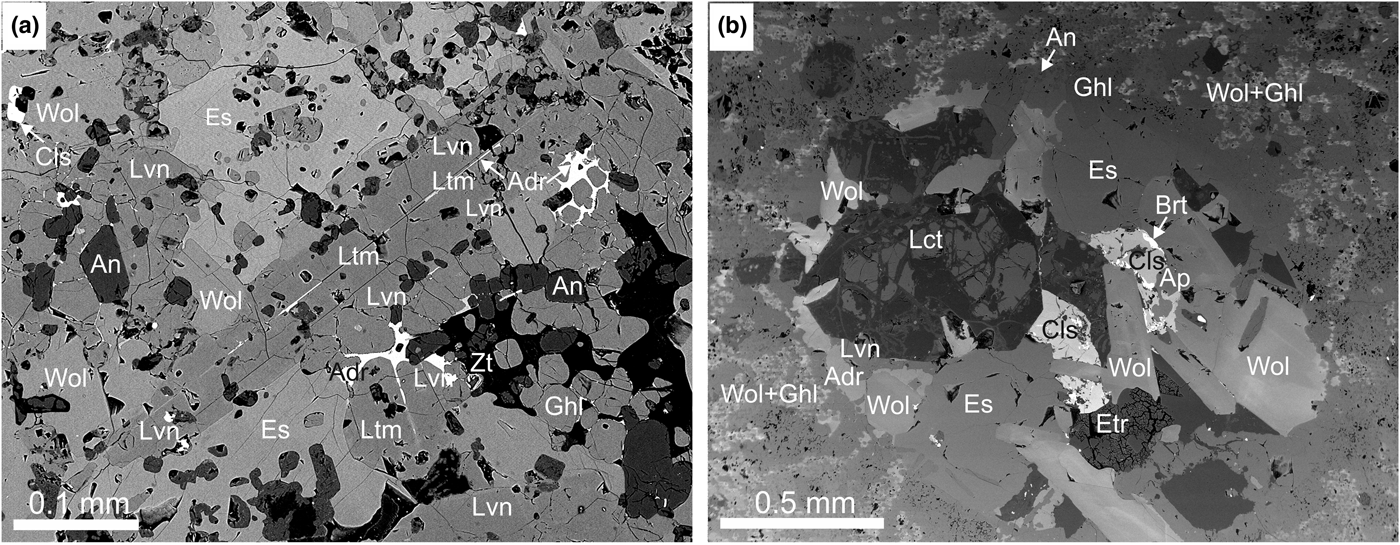
One individual specimen (number ZPP12, co-type) of gehlenite fine-grained hornfels collected in this area (spring 2015) drew our attention to the presence of rare amygdales, which are not characteristic for gehlenite hornfels (Fig. 1a). The rock-forming minerals of this rock are esseneite, anorthite and minerals of the latiumite–levantite series together with gehlenite, wollastonite and Ti-bearing andradite. The latter three are typical for hornfels (Fig. 2a). Accessory minerals are celsian, baryte, magnesioferrite and albite. Fine-grained hematite spherules are scattered throughout the rock. Amygdales are filled with zeolite-like Ca- and Ca–K-minerals (Al > Si) and ettringite; and sometimes leucite relics are noted in them (Fig. 2b).
(a) Fine-grained wollastonite–gehlenite–andradite–esseneite hornfels (ZPP12, co-type) with rare amygdules filled with zeolite-like minerals, ettringite and rarer leucite, where levantite is a rock-forming mineral. (b) Porous esseneite–gehlenite–wollastonite–andradite rock (GZ12, holotype) with areas enriched in hematite and relatively large levantite, esseneite, gehlenite and andradite crystals (dark area).

Back-scattered electron (BSE) images of fine-grained rock (ZPP12), where levantite is widespread and usually forms later zones on long-prismatic crystals of the latiumite–levantite series minerals (~50/50) up to 0.6 mm long. (a) Twinning crystal of latiumite–levantite with thin inclusion of garnet on the twinning boundary. (b) Aggregate of relatively large crystals of partially altered leucite, wollastonite, celsian and esseneite. Levantite in these aggregates is rare and contains <30–35% of the latiumite end-member. Adr = schorlomite–andradite, An = anorthite, Ap = fluorapatite, Brt = baryte, Cls = celsian, Es = esseneite, Etr = ettringite–thaumasite, Ghl = gehlenite, Lct = leucite, Ltm = latiumite, Lvn = levantite, Wol = wollastonite and Zt = K-bearing zeolite.

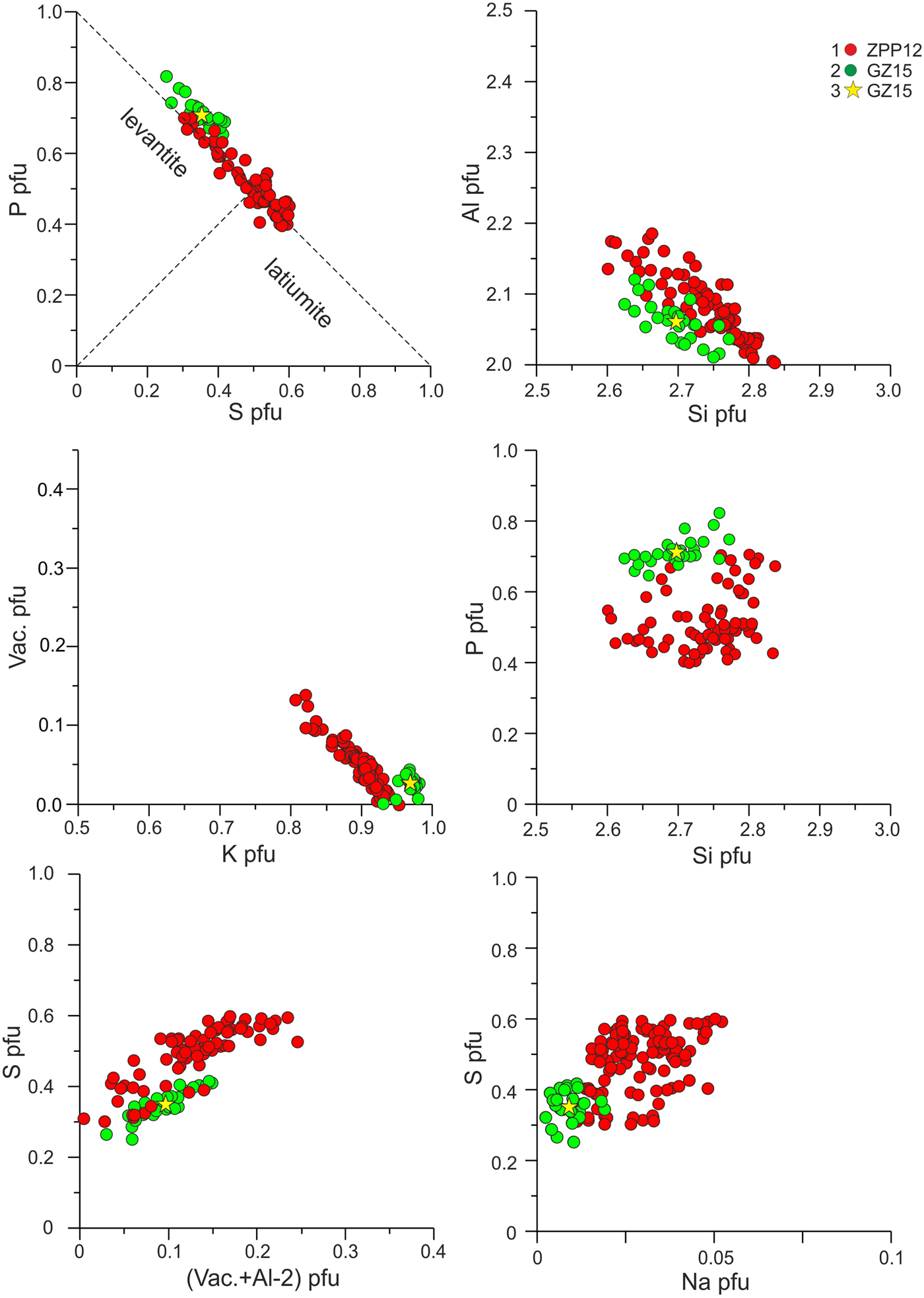
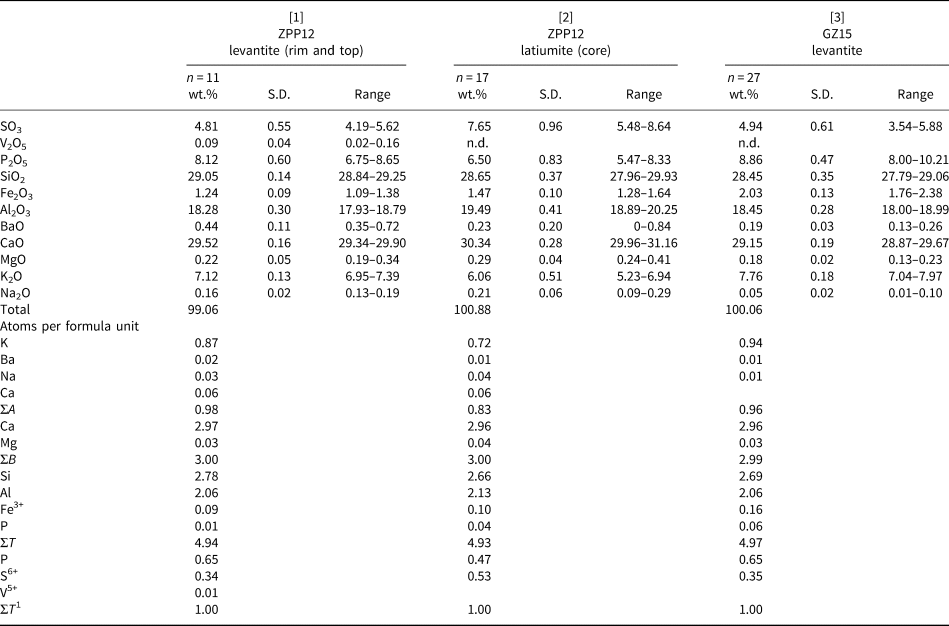
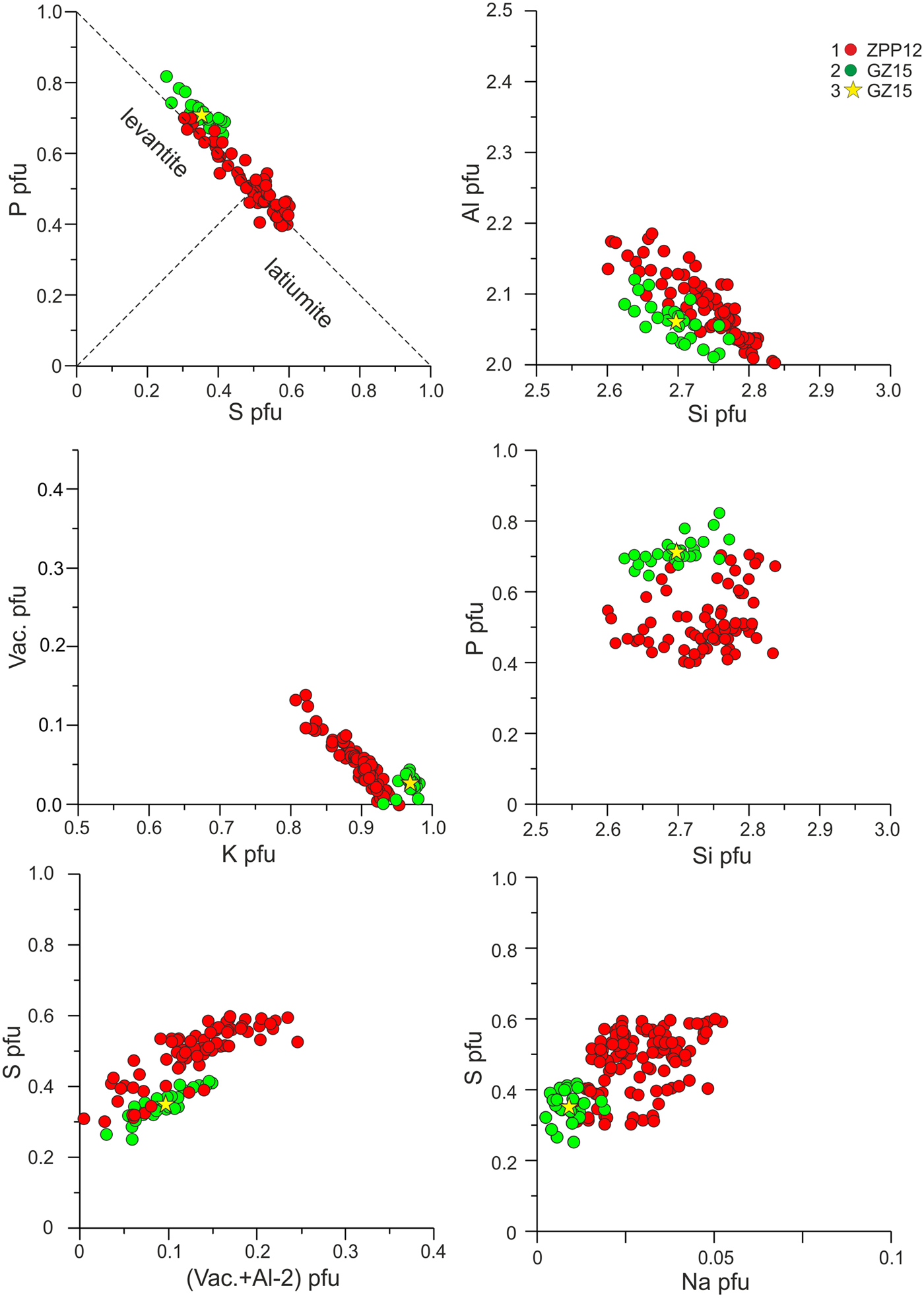
The composition of minerals in the levantite (Lvn)–latiumite (Ltm) series varies from ~Lvn70Ltm30 to Ltm60Lvn40 (Fig. 3a). Zoned crystals are typical. A generalised zonation is written as follows: levantite with mean composition (K0.87Ca0.06Na0.03Ba0.02□0.02)Σ1.00(Ca2.97Mg0.03)Σ3.00{(Si2.78Al2.06Fe3+0.09P0.01)Σ4.94O11}[(PO4)0.65(SO4)0.34(VO4)0.01]Σ1.00 forms late zones on latiumite crystals, (K0.72Ca0.06Na0.04Ba0.01□0.17)Σ1.00(Ca2.96Mg0.04)Σ3.00{(Si2.66Al2.13Fe3+0.10P0.04)Σ0.93O11}[(SO4)0.53(PO4)0.47]Σ1.00 (Table 1, analyses 1, 2; Fig. 2a).
Microprobe analyses data on the latiumite–levantite mineral series in diagrams: P vs. S pfu (some points of microprobe analyses are located above the P + S = 1 line because of a small quantity of P that enters the tetrahedrons of double layers); Al vs. Si; Vac. vs. K (vacancies (Vac.) were calculated as 4 – (K + Ca + Na + Mg + Ba); P – Si; S vs. Vac. + Al-2 pfu; S vs. Na pfu.
Composition of latiumite–levantite series minerals from Har Parsa, Negev Desert.

n = number of analyses; S.D. = standard deviation, n.d. = not detected.
The composition of rock-forming minerals of hornfels was also investigated. Clinopyroxene with mean composition Ca1.04Fe3+0.49Mg0.33Al0.09Ti4+0.06(Si1.29 Al0.71)Σ2.00O6 contains ~50% of esseneite end-member (CaFe3+AlSiO6) and ~30% diopside end-member (CaMgSi2O6) (Supplementary Table S1, analysis 1). The mean composition of gehlenite investigated is: (Ca1.86Na0.12K0.02)Σ2.00(Al0.51Mg0.25Fe3+0.10Ca0.06)Σ1.00(Si1.41Al0.69)Σ2.00O7. The calculation shows that two main end-members prevail: gehlenite (CaAl(AlSi)O7) ~50% and åkermanite (Ca2MgSi2O7) ~25% (Supplementary Table S2, analysis 1). Garnet is represented by andradite, Ca3.03(Fe3+1.06Ti4+0.84Mg0.09)Σ1.99(Si2.18Al0.62Fe3+0.18V5+0.01)Σ2.99O12, in which Ti-bearing end-members amount to ~40% (hutcheonite ~30%, schorlomite ~10%) (Supplementary Table S3, analysis 1). Rim zones on garnet are composed of andradite with TiO2 content close to 5 wt.% (Supplementary Table S3, analysis 2). Minerals of the feldspar group are represented by anorthite and celsian (Supplementary Table S4). We were unable to select separate grains of levantite from the ZPP12 specimen for structural investigation because of the small size of the levantite–latiumite crystals (Fig. 2).
Relatively large levantite crystals up to 0.2 mm were found within inhomogeneous dark zones, enriched in esseneite and hematite, in brown fine-grained esseneite–wollastonite–andradite–gehlenite rock (specimen GZ15, holotype; Figs 1b, 4). Accessory minerals are fluorapatite and Fe-bearing spinel with corundum exsolution. This brown rock type forms separate fragments 5–10 cm2 in areas along cracks at the external part of a big boulder (~50 kg), found in autumn 2015 in Wadi Bokek near Har Parsa at ~250–300 m from the location of the first find of levantite. The boulder was composed of green fine-grained esseneite–anorthite–gehlenite–wollastonite rock belonging to the ‘olive unit’ of melted rocks (Vapnik et al., Reference Vapnik, Sharygin, Sokol and Shagam2007).
The levantite crystal shown in Fig. 4 was used for single-crystal X-ray diffraction, Raman and optical investigations. This crystal has relatively homogeneous composition — Lvn60–80Ltm20–40 (Fig. 3a), its mean composition corresponded to the empirical formula (K0.94Ba0.01Na0.01□0.04)Σ1.00(Ca2.96Mg0.03)Σ2.99{(Si2.69Al2.06Fe3+0.16P0.06)Σ4.97O11}[(PO4)0.65(SO4)0.35]Σ1.00 (Table 1, analysis 3).
Relatively homogenous levantite crystal in esseneite–wollastonite–anorthite paralava (boulder from wadi Bokek near Har. Parsa, GZ15), which was used for microprobe measurements, structural and optical investigation (Table 1, analysis 3). Gehlenite has andradite reaction rims. BSE image. See Fig. 2 for key; Hem = hematite.

Levantite is associated with clinopyroxene with composition Ca1.01Fe3+0.58Mg0.22Fe2+0.08Ti4+0.06Al0.02Cr3+0.02(Si1.26 Al0.74)Σ2.00O6 (Supplementary Table S1, analysis 2), in which the esseneite end-member amounts to ~58%. Gehlenite is characterised by the mean composition (Ca1.94Na0.05K0.03)Σ2.02(Al0.58Mg0.21Fe3+0.10Fe2+0.10)Σ0.99(Si1.37Al0.63)Σ2.00O7, where two end-members prevail: gehlenite ~58% and åkermanite ~21% (Supplementary Table S2, analysis 2). Ti-bearing andradite, (Ca2.95Mg0.05)Σ3.00(Fe3+1.36Ti4+0.52Fe2+0.05Cr3+0.04Al0.03Mg0.01)Σ2.00(Si2.52Al0.47P5+0.01)Σ3.00O12, contains the main end-members: andradite ~68% and hutcheonite ~23% (Supplementary Table S3, analysis 3).
Levantite is represented by colourless, long-prismatic crystals with vitreous lustre. The main simple forms are {100}, {101}, {102}, {10 $\bar 1$}, {10
 $\bar 2$}, {001}, ~{111} and ~{010}. The measured micro-indentation hardness of levantite gave VHN50 = 580(19) (mean of 14), range 550–611 kg/mm2, which correlates with 5 on the Mohs scale. A good cleavage on (100) is noted, parting is absent. Polysynthetic or simple twinning on (100) has been observed. The calculated density is 2.957 g cm–3. Levantite is an optically negative mineral, α = 1.608(2), β = 1.618(2) and γ = 1.622(2) (λ = 589 nm), 2Vmeas. = 70(5)° and 2Vcalc. = 64.3°. Dispersion of the optical axes r > v is weak; the optical orientation is: Z = b, X ^ c = 22–27°; and it is non-pleochroic.
Raman spectroscopy of levantite
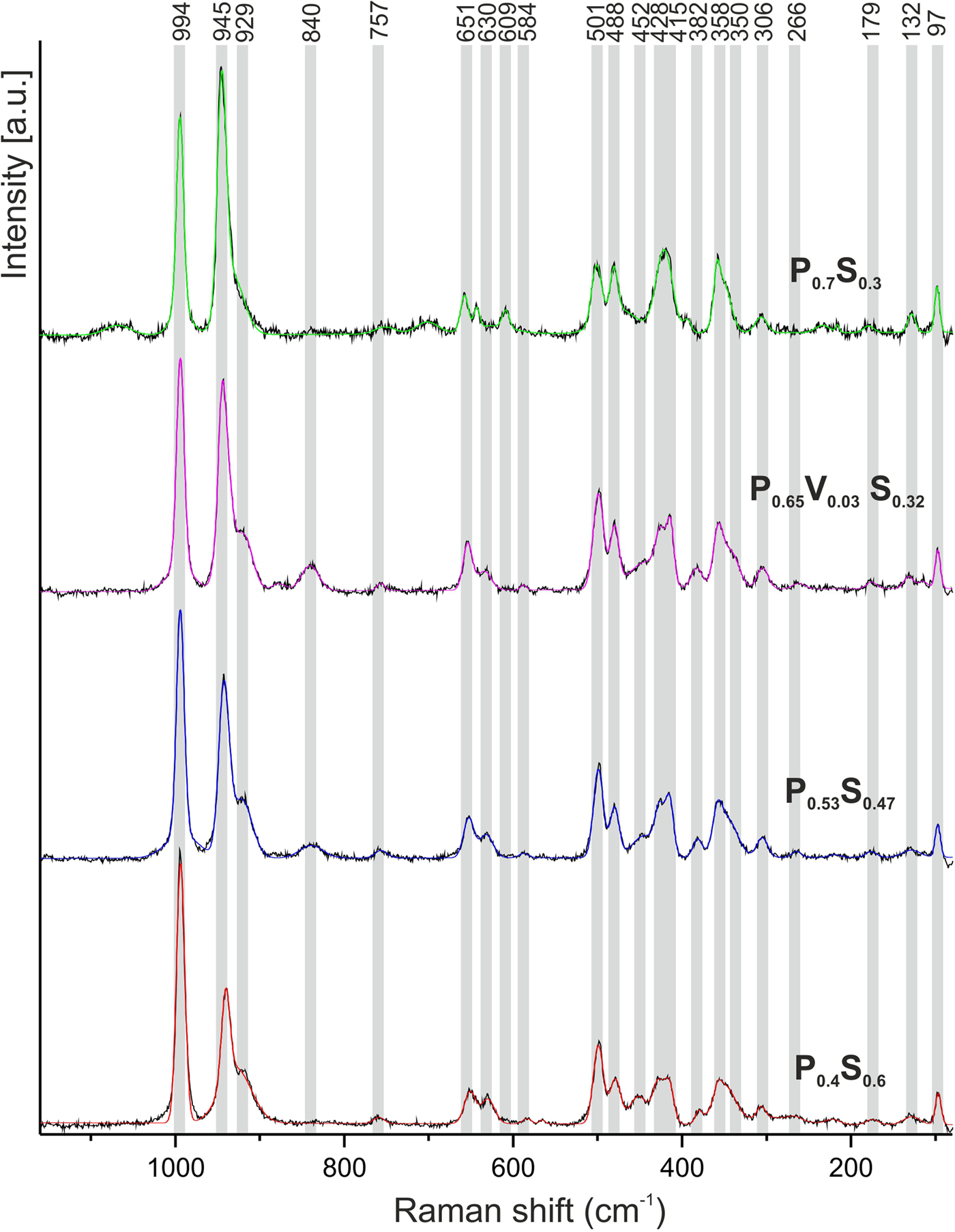
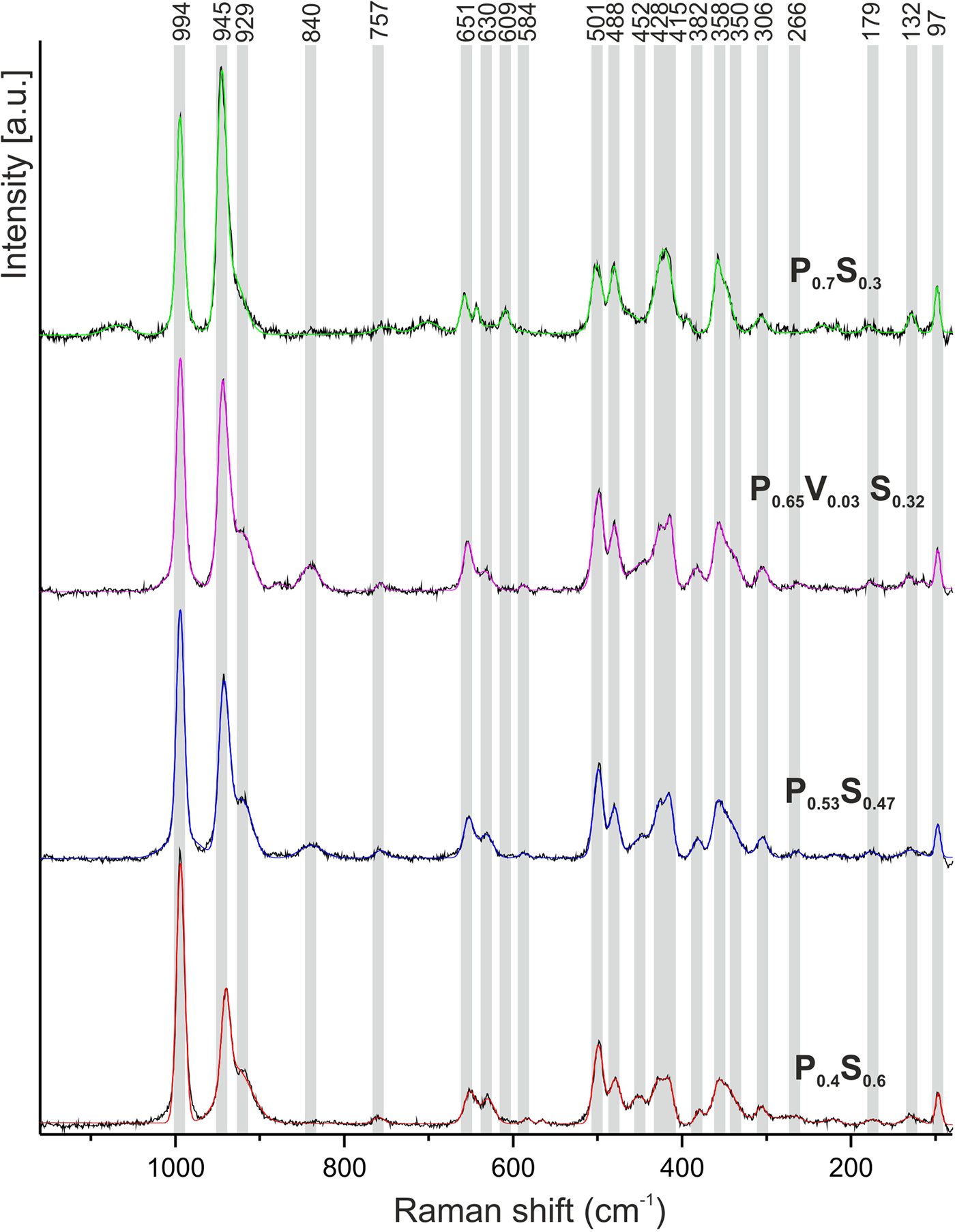
Minerals of the latiumite–levantite series show characteristic Raman spectra (Fig. 5). Strong bands are mainly related to vibrations in isolated (PO4)3– and (SO4)2– tetrahedra (Galuskin et al., Reference Galuskin, Galuskina, Gfeller, Krüger, Kusz, Vapnik, Dulski and Dzierżanowski2016). Weaker bands originate from the structural units of the zweier double layers: (SiO4)4–, (AlO4)5– and (Si2O7)6–. The main bands in the latiumite–levantite series are (cm–1): 994 ν1(SO4); 945 ν1(PO4); 929 ν1(SiO4); 840 ν1 (SiO4) + ν1(VO4); 757 ν1(AlO4); 651 ν4(PO4) and (Si–O–Si); 630 ν4(SO4); 501 ν2(SO4), 488 ν2(PO4); 428 and 415 ν2(PO4) + ν2(SO4); 358 and 350 ν2(SiO4) + ν2(AlO4); 306 ν(Ca–O); and 97 ν(K–O) (Fig. 5). The intensity ratio of the bands at 994 ν1(SO4) and 945 ν1(PO4) correlates with the P/S ratio in the minerals studied (Fig. 5). The typical vibrational (СО3)2– band at ~1080 cm–1 is absent (Fig. 5).
Raman spectra of minerals of the levantite–latiumite series with different P/S ratio. The upper spectrum is from sample GZ12, the lower three from ZPP12.
Structure of levantite
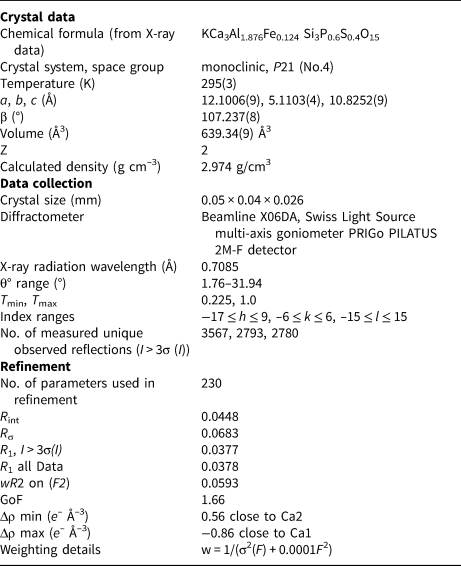
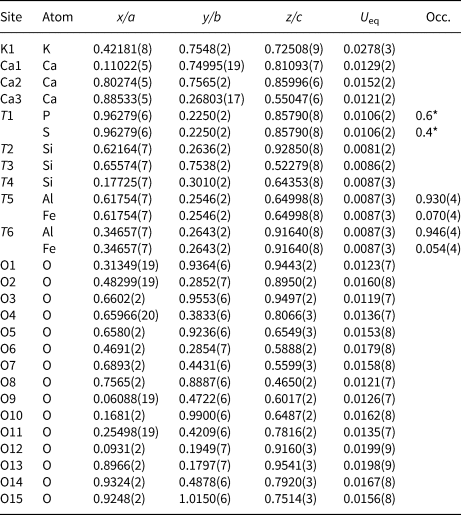
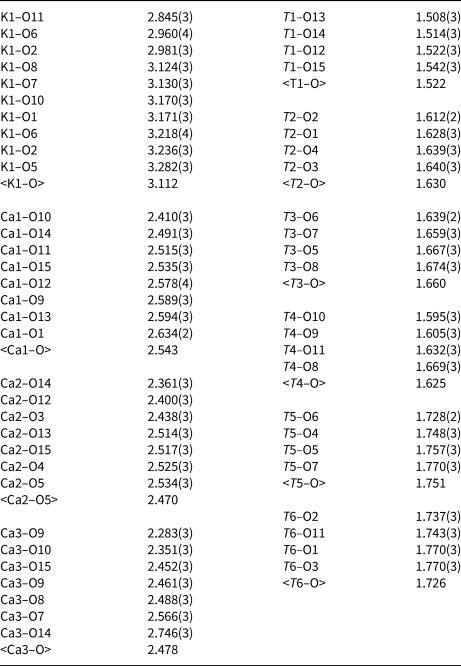
The crystal structure of levantite was refined from single-crystal synchrotron diffraction data using the software Jana2006 (Petříček et al., Reference Petříček, Dušek and Palatinus2014). Details of data collection and structure refinement are given in Table 2, final atomic coordinates are summarised in Table 3 and anisotropic temperature factors are given in Supplementary Table S5. Selected bond lengths are listed in Table 4 and bond-valence sums are shown in Supplementary Table S6. The powder diffraction pattern was calculated from the obtained structure model (Supplementary Table S7). The crystallographic information files have been deposited with the Principal Editor of Mineralogical Magazine and are also available as Supplementary material.
Crystal data, X-ray measurement and refinement parameters for levantite.

Atomic coordinates and equivalent isotropic displacement parameters (Å2) for levantite.

*P/S ratio at T1 fixed according to results of chemical analyses; Occ. = occupancy
Selected interatomic distances (Å) for levantite.

Inversion twinning was accounted for in the model and was proven to be present. Inspection of the reciprocal space revealed another type of twinning. Within layers parallel to h0l, twinning by partial merohedry could be observed (Fig. 6). Additional reflections can be seen in lines parallel to a*, except in those with l = 3n. This can be explained by two reciprocal lattices, which are equivalent by a 2[001] rotation. Introducing this type of twinning into the refinement significantly improves R 1 from ca. 0.05 to 0.038. Furthermore, one-dimensional diffuse scattering along a* proves that this type of twinning also generates a stacking-fault mechanism, e.g. is present at the nanoscale.
Reciprocal space layer h0l. The red lattice is generated by the 2[001]-twinning and exhibits almost perfect overlap at lattice nodes with l = 3n. One-dimensional diffuse scattering parallel to a* is present.

Tetrahedral hybrid zweier double layers, [(Si,Al)10O22], are the main structural elements of levantite as well as of latiumite and tuscanite (Fig. 7, Cannillo et al., Reference Cannillo, Dal Negro and Rossi1973). Potassium occurs in the cavities of these layers, whereas Ca atoms and (PO4)/(SO4) groups are located between them (Fig. 7a,c). In levantite, as in the case of latiumite, the apices of the tetrahedra of the double layer are pointing in one direction (–b), whereas in tuscanite they point in opposite directions (Fig. 7b,d; Cannillo et al., Reference Cannillo, Dal Negro and Rossi1973; Mellini et al., Reference Mellini, Merlino and Rossi1977). The structures can be addressed as members of an OD (order–disorder) family as described by Merlino (Reference Merlino2009).
Levantite structure (a, b) compared to the tuscanite structure (c, d). (a, c) projection on (010); (b, d) projection of separate tetrahedral zweier double layer on (100). Tuscanite polyhedra are named according to Mellini et al. (Reference Mellini, Merlino and Rossi1977). The main cation in the tetrahedra are: P – green; S – yellow; Si – dark blue; and Al – blue.
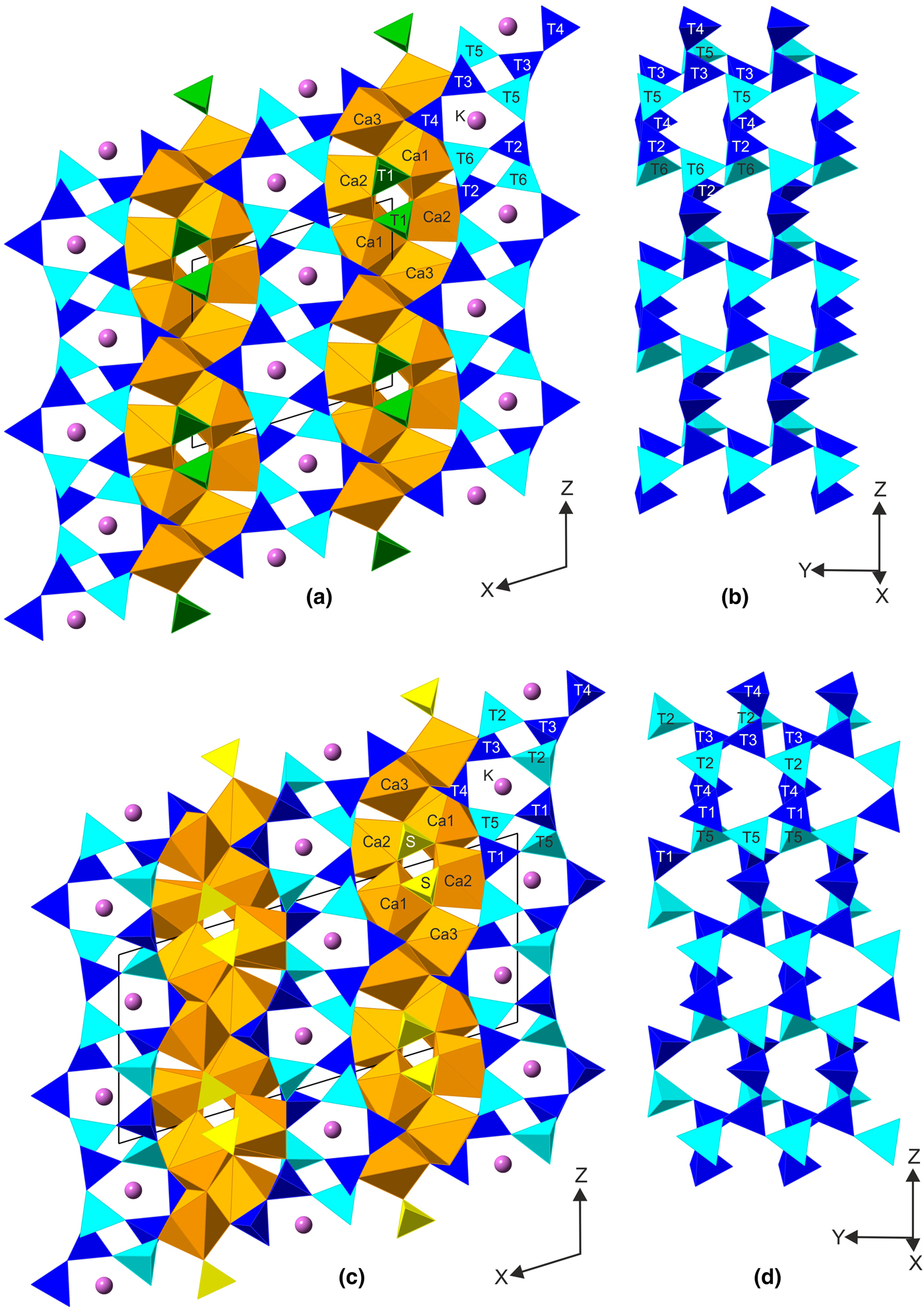
In the double layer of levantite, the tetrahedra T2 and T4 are occupied by Si with mean Si–O distances of 1.630 Å and 1.625 Å, respectively (Table 4). In tuscanite and latiumite the corresponding tetrahedra (T1 and T4) exhibit mean Si–O distances of 1.62–1.63 Å (Cannillo et al., Reference Cannillo, Dal Negro and Rossi1973; Mellini et al., Reference Mellini, Merlino and Rossi1977; Fig. 7). Tetrahedra occupied by Al (in levantite T5 and T6) show mean Al–O distances equal to 1.751 Å and 1.726 Å (see Table 4), whereas in tuscanite and latiumite these tetrahedra (T2 and T5) have mean T–O distances of 1.74–1.75 Å (Cannillo et al., Reference Cannillo, Dal Negro and Rossi1973; Mellini et al., Reference Mellini, Merlino and Rossi1977). In levantite the mean T–O distance at T3 is 1.66 Å, which is slightly larger than at the Si sites (T1 and T4). This may indicate that minor amounts of Al substitutes for Si on the T3 site. In tuscanite and latiumite the corresponding tetrahedra (also T3) shows larger T–O distances of 1.636 and 1.68 Å, respectively, which is in agreement with higher Al content in latiumite compared to levantite and tuscanite (Cannillo et al., Reference Cannillo, Dal Negro and Rossi1973; Mellini et al., Reference Mellini, Merlino and Rossi1977; Tables 1, 4). The most significant differences in the size of a tetrahedral site for levantite, tuscanite and latiumite are observed for the T1 site in levantite (corresponding to the S site in latiumite and tuscanite): Т1 = 1.522 Å, S = 1.48 Å (latiumite) and 1.47 Å (tuscanite). Distances of 1.47–1.48 Å at a tetrahedral site correspond to full occupation by sulfur (Cannillo et al., Reference Cannillo, Dal Negro and Rossi1973; Mellini et al., Reference Mellini, Merlino and Rossi1977). At the same time a distance of 1.522 Å is intermediate between the average P–O (≈1.55 Å) and S–O (≈1.48 Å) distance for tetrahedral coordination (Shannon, Reference Shannon1976). Consequently, it is arguable that the T1 site in latiumite has a mixed character, and is occupied by P and S (with predominance of P, Table 3).
Discussion
The empirical crystal chemical formula of holotype levantite (Table 1) and its structural formula (Table 2) are (K0.94Ba0.01Na0.01□0.04)Σ1.00(Ca2.96Mg0.03)Σ2.99{(Si2.69Al2.06Fe3+0.16P0.06)Σ4.97O11}[(PO4)0.65(SO4)0.35]Σ1.00 and KCa3(Si3Al1.876Fe0.124)O11(P0.6S0.4)O4, respectively. These formulas can be easily simplified to the end-member formula KCa3(Si3Al2)O11(PO4).
Microprobe data for latiumite–levantite series minerals plotted in different diagrams (Fig. 3) show a significant negative correlation between P and S (r 2 = –0.95), which is accompanied by negative correlation between Si and Al (r 2 = –0.67). However, the data points of the Si–Al plot exhibits some scatter within 0.2 per formula unit (pfu). Further correlations are observable: (1) a negative correlation between K and vacancies (r 2 = –0.86); (2) a low positive between P and Si (r 2 = 0.22); (3) positive between S and vacancies + Al-2 (Al at the T3 site) (r 2 = 0.56); and (4) positive between S and Na (r 2 = 0.46) (Fig. 3). These correlations indicate that three isomorphic schemes of heterovalent isomorphic substitutions exist, compensating the substitution of sulfur for phosphorus: (1) (SiO4)4– + (PO4)3– → (AlO4)5– + (SO4)2–; (2) K+ + (PO4)3– → □ + (SO4)2–; and (3) Ca2+ + (PO4)3– → Na+ + (SO4)2–. These substitutions lead to the three SO4-bearing end-members: KCa3(Si2Al3)O11(SO4) (latiumite), □Ca3(Si3Al2)O11(SO4) (K-free tuscanite at □ = Н2О) and hypothetical KCa2Na(Si3Al2)O11(SO4).
Levantite from pyrometamorphic rocks of the Hatrurim Complex always contains (SO4)2–, which substitutes for (PO4)3–. The minimal S content does not decrease below 0.2 apfu (Tables 1; Fig. 3). Microprobe analyses and Raman spectroscopy (Fig. 5) show that CO3 groups (a characteristic component in latiumite and tuscanite) are absent in PO4-bearing minerals of the latiumite–levantite series from pyrometamorphic rocks of the Hatrurim Complex.
The rocks addressed as hornfels instead belong to melted (partially or fully) rocks of the ‘olive unit’ (Vapnik et al., Reference Vapnik, Sharygin, Sokol and Shagam2007) as indicated by their mineral composition and presence of amygdaloidal texture (Fig. 1a). Levantite crystals occur as inclusions in esseneite and Ti-bearing andradite and in turn contain inclusions of anorthite and gehlenite crystals.
Levantite crystallises from melt enriched in K, P and S. The temperature of its formation is close to what has been determined for paralava of the ‘olive unit’ ~1250°C (Vapnik et al., Reference Vapnik, Sharygin, Sokol and Shagam2007). High temperature and low pressure close to atmospheric explain the absence of CO3 groups in levantite. Latiumite and tuscanite from Italian volcanic rocks crystallised at lower temperature (<1050°C) and relatively higher pressure involving CO2–H2O–S–F fluids were liberated by magma–wall rock reactions and from ultrapotassic magma (Peccerillo et al., Reference Peccerillo, Federico, Barbieri, Brilli and Wu2010).
Acknowledgements
The authors thank Igor Pekov, Peter Leverett and anonymous reviewer for their careful review that improved the manuscript. The investigations were partially supported by the National Science Centre (NCN) of Poland, grant no. 2016/23/B/ST10/00869. HK acknowledges the assistance of K. Zöll during the data collection at the SLS.
Supplementary material
To view supplementary material for this article, please visit https://doi.org/10.1180/mgm.2019.37