Introduction
Discussion of housing for older people that is combined with provision of various support and care services is confounded by the lack of consistent terminology. More than a decade ago, Anikeeff and Mueller (Reference Anikeeff and Mueller1998a, Reference Anikeeff, Mueller, Anikeeff and Mueller1998b) and Sexton (Reference Sexton, Anikeeff and Mueller1998) found that their efforts to standardise terminology in the United States of America (USA) were frustrated by the diversity and dynamism of the field. Sources of complexity of terminology identified by these authors included funding and regulatory arrangements, the involvement of different professions, the hybrid nature of many products, the rapidly evolving nature of the industry, and the marketing endeavours of private sector and community providers.
Confusion and ambiguity in terminology give rise to difficulties at many levels. Policy makers, programme administrators and service managers require clear terminology for defining the scope of services to which different planning, funding and regulatory systems are to apply. A common language is also needed if governments, providers and users of older persons' housing are to come to a shared view of supply and demand for different types of housing and service developments, and for involving the public, non-profit and for-profit sectors in responding to community need and market preferences. Researchers also require a standard lexicon for tracking the emergence of new arrangements for combining housing and care services, for analysing and classifying current provision, and especially in undertaking international comparative studies. Addressing issues of terminology is thus an important step in advancing the development of knowledge of the field and promoting transfer of international experience.
To this end, this paper reports an analysis of an array of terms and types of housing with services identified in a recent study carried out by the Australian Housing and Urban Research Institute (AHURI) (Jones et al. Reference Jones, Howe, Tilse, Bartlett and Stimson2010). The AHURI study added to the lexicon by adopting the umbrella term ‘service integrated housing’ (SIH) to cover all forms of accommodation built specifically for older people and in which the housing provider took responsibility for delivery of one or more types of support and care services. Two further distinctions were made. First, support services, whether passive, such as barrier-free design, or active, such as property maintenance and organised social activities and meals services, were distinguished from care services, most commonly personal assistance, visiting nursing and home health care, on the basis of the latter services usually being provided on a one-to-one basis and involving personal interaction between the care recipient and provider. Second, service integration was labelled internal when the housing provider delivered services and external when an arrangement was made with another, outside service provider.
The aims of this paper are first to catalogue the numerous terms identified in the literature and second to compare the types of SIH to which they are applied in order to separate terminological similarities and differences from underlying and real variations, within and across countries. The third aim is to examine the match between the international spread of models of SIH and the terminology used to describe them to promote a lingua franca for comparative research and policy analysis.
Methods
Four electronic databases, Social Services Abstracts, Sociological Abstracts, Family and Society Plus and the Australian Public Affairs Information Service, were searched at an early stage of the AHURI project using three sets of search terms individually and in combination, covering (a) housing, accommodation, place, home and village, (b) age, ageing, senior, elder, old and retired, and (c) services, care and support. After reading abstracts and eliminating references that appeared peripheral to the main focus of the research, a total of 181 references remained. Further material was then identified through relevant bibliographies and reference lists of articles retrieved in the database search and newly published literature was added as the project proceeded, guided by the same key terms. A small number of papers published in the last two years were added in preparing this paper.
The search extended back to 1980. Only a small number of papers were found dating from the 1980s, but some early reports are seminal in establishing lasting terminology and documenting early forms of SIH. The volume of literature has increased steadily over time, and more than half dates from 2000 or later.
The search was confined to literature published in English. This paper focuses on terminology used in the USA, the United Kingdom (UK) and Australia as the sources of most of the literature and because recent reviews in each country have consolidated the findings of studies focused on one or other type of SIH. Limited reference to Canada and New Zealand reflects the smaller body of literature from these countries. Historically, these five countries have had broadly similar welfare systems, although with varying scales of state provision of housing for older people, and periodic changes in national governments have brought shifts in policy directions and associated terminology.
The search also covered literature in English from European countries, Japan and Israel. Terminology from these countries is only noted briefly to identify consistency with terminology in English-speaking countries once differences in national welfare systems that shape housing policies in general and specific provision for older people have been taken into account. No attempt has been made to translate terms from other languages although it is recognised that such terms may apply to forms of SIH specific to one country or to forms that are similar across countries. One indicator of the lack of a cross-national lexicon is that the most recent international collection identified in the search was compiled in the mid-1990s by Pynoos and Liebig (Reference Pynoos and Liebig1995).
Three further caveats apply. First, while repeated occurrence in the literature gives confidence that the terms applied to common types of SIH have been identified, some uncommon terms applied to particular niche types may have been missed. Second, not all variants in practice are differentiated by separate terminology. Third, as the focus was on associations between housing and services, terms that described built forms only were not included. Detailed accounts of all the types of SIH identified in the AHURI project, how they have developed in different countries, trends in growth, variety in built forms, and resident satisfaction are given in the full report (Jones et al. Reference Jones, Howe, Tilse, Bartlett and Stimson2010).
Terms and meanings
The total of close to 100 different terms identified in the literature was reduced to 72 when very similar terms were consolidated, but this large number of remaining terms prompted questions about the extent to which different terms applied to equivalent types of SIH, and vice versa. The first step in sorting out relationships between terms and their meanings was to distinguish between (a) terms that have the same meaning across countries, (b) different terms used for the same or similar types of SIH, (c) the same or similar terms used for different forms of SIH, and (d) different terms used for different types of SIH.
In all but the first group of terms, discordant relationships between terms and meanings made it difficult to know how far apparent similarities and differences in SIH were real, and where common approaches or gaps were masked by differences in terminology. To address this confusion, the second step was to separate generic terms covering housing and care services from terms covering specific types of SIH and to group the latter according to the level and mix of support and care services provided.
Only a small number of the same or similar terms were found to apply to the same or similar types of SIH across countries, but a larger number of different terms were applied to similar types of SIH. There were many instances of the converse, that is, of the same terms being applied to markedly different types of SIH. Finally, a few distinctive terms were applied to one or other type of SIH in some countries, and a few of these ‘brand names’ have been taken up in other countries with the adoption of similar models.
The broad timescale of the search enabled the chronology of terminology to be tracked and linked to developments in the field. Some of the many terms that have emerged over the last 30 years remain current and have been extended to apply to a wider range of SIH, while other usually more specific terms have not retained their currency where the housing and services to which they once applied have been by-passed by newer developments.
Generic terms
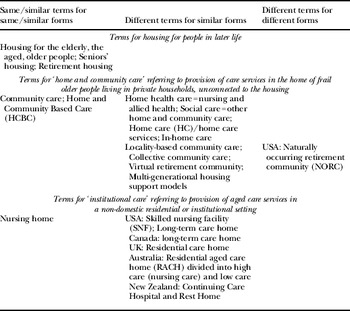
The 20 generic terms applied to housing built specifically for older people, for home and community care, and for institutional care are detailed in Table 1. Strictly speaking, these terms do not refer to forms of SIH as not all housing built specifically for older people includes provision of services, while community care is primarily delivered to people living in private housing in the community rather than in purpose-built housing. In institutional settings, the housing component is non-domestic and not in the form of self-contained dwellings, and licensure is usually required jointly for accommodation and care standards. These sets of terms nonetheless warrant brief reporting on three grounds: they help define the boundaries of what does constitute SIH, many organisations involved in delivery of SIH are also involved in providing community and institutional care, and policies covering the development of community and institutional care have influenced the development of SIH, and vice versa.
Comparisons of meanings of generic terms used for purpose-built housing, community care and institutional care

Housing for people in later life
The generic terms that are widely used to cover housing purposely built for people in later life all draw attention to its age-segregated nature. Declining use of ‘the elderly’ and ‘the aged’ in favour of ‘seniors’ and ‘retirees’ is not only in line with the adoption of these terms in lay and official language, but also signals differentiation of the sub-populations catered for in different types of age-segregated housing with varying levels of service provision. The earlier terms were associated with large-scale public housing estates and some non-profit provision for low-income residents, whereas the more recent terms are associated with market-based provision for a target population defined by positive social status rather than low income. Whereas most residents in housing for low-income older people are tenants, the expansion of older persons' housing for those with greater incomes and assets has triggered a wide variety of forms of occupancy ranging from life-time leases to outright ownership, and different tenure arrangements are themselves an area of increasing terminological confusion for providers, regulators and consumers.
Home and community care
‘Home and/or community care’ is the generic term used in most countries to refer to a range of services provided in the home of a frail or disabled older person or in a community-based setting such as a day centre. In the USA, HCBC has become the accepted acronym covering the range of Home and Community Based Care services. More variation is found in the terminology used to refer to particular types of home and community care services in other countries (Kane Reference Kane1999), with the most common distinction being between home health services vis-à-vis social care services, as in the UK and much of Europe. However, Australia's Home and Community Care programme (HACC) includes both nursing and allied health therapies together with personal care and a range of social support services and the term ‘social care’ is almost unknown in Australia. Generic HCBC services are increasing drawn on to provide support and care services in SIH, and the resultant blurring of boundaries is one of the factors leading to confusion of terminology and the emergence of new terms in attempts to define new types of SIH.
Particular variants of community care terms have emerged to describe communities in which geographic concentrations of older people have led to locality-based arrangements for delivery of home and community care services. As the most notable case, naturally occurring retirement communities (NORCs) in the USA have been a subject of research since the mid-1980s (Bassuk Reference Bassuk1999; Hunt and Gunter-Hunt Reference Hunt and Gunter-Hunt1985; Ormond et al. Reference Ormond, Black, Tilly and Thomas2004; Pine and Pine Reference Pine and Pine2004). Most recently, a special issue of the Journal of Housing for the Elderly with the title ‘Contemporary NORCs: Concepts and Issues’ evidences both the persistence and transformation of these communities, including considerable elaboration of support and care services across a diversity of built forms (Grant-Savela and Schwarz Reference Grant-Savela and Schwarz2010).
Two distinguishing features of NORCs are that the residents are living in close proximity but not necessarily in housing purposely built for older people, and that service provision has evolved separately from housing development, rather than being planned in conjunction with it. Again, these arrangements are not strictly forms of SIH, but they serve to illustrate the dynamics of the field and the terminology used to describe it.
Institutional care settings
‘Nursing home’ stands out as the most commonly used and least ambiguous term with common meaning in all five countries as it is always applied to facilities in which skilled nursing care is available on a 24/7 basis and is received by a high proportion of residents.
The commonality in meaning stems in large part from the formal definition of nursing homes in policies and programmes that require facilities delivering this level of care to be registered and to meet quality standards as a condition of public funding. In addition to regulatory requirements and their non-domestic environment, nursing homes are often differentiated by mandatory pre-admission assessment of residents whose entry is based on care needs and qualification for care benefits, whereas entry to SIH is characterised by a degree of choice on the part of the resident. Limited choices in most aspects of institutional care have seen negative associations attached to the term ‘nursing home’ and, as a consequence, the term has been dropped from official use in Canada in favour of ‘long-term care home’.
Nursing homes are, however, not the only settings in which high levels of nursing care are delivered to highly dependent individuals. In the UK and Australia, the more general term ‘residential care home’ is used for homes that come under the same regulatory regimes, including pre-admission assessment, and in which all residents are covered by the same funding arrangements although only some receive nursing care. New Zealand is conspicuous in using the terms ‘continuing care hospital’ and ‘rest home’ to distinguish the equivalent of nursing homes from a second level of care in its residential care programme.
Terms for different types of SIH
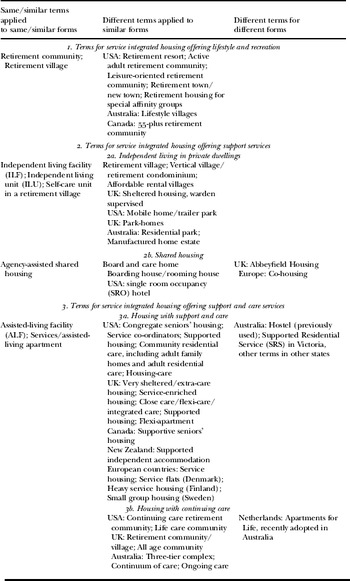
Specific terms for SIH offering different levels of support and care are listed in Table 2. These 52 terms are sorted into three broad groups and two further sub-groups on the basis of the range of services available and their orientation to residents making moves at different points over the course of retirement and later life.
Comparisons of terms for different types of service integrated housing

Only a small number of the same or similar terms were found to be in common usage at each of the three levels. Fewer terms were applied at the two ends of the service spectrum, and while there was some commonality for SIH with services focused on lifestyle and recreation (level 1), different terms were used in each country to label SIH in which a commitment was made to provide continuing care, including care equivalent to nursing home care (level 3b). A greater variety of terms was found at the intermediate levels, reflecting the diversity of provision. Terms for SIH offering support services distinguished housing in the form of private, self-contained dwellings (level 2a) from shared housing (level 2b), rather than on the basis of services. Both built forms encompass a wide mix of physical and social features that are often inherent in purpose-built housing, such as barrier-free design or alarm systems and spaces designed to promote social interaction among residents, as well as the presence of an on-site manager and possibly an in-house transport service.
The most diverse terminology and the least common usage across countries was found for SIH providing support and care (level 3a) but without a commitment to on-going care. Diversity here stems from differences in both the entry level of dependency that is catered for, and the exit level, and from adjustments in service provision to enable residents to age-in-place. As a result, some forms offer a wider spectrum of services than others, and some terms overlap rather than drawing distinct boundaries between levels of care. A clearer but still imprecise boundary arises for the few forms of SIH in which a commitment to on-going care is made (level 3b).
When the underlying forms of SIH were compared, it was evident that a large number of different terms applied to similar forms of SIH. Terminological differences are thus greater than real differences, and the diversity of terms masked substantial similarities within each of the three broad levels of SIH. At the same time, it has to be recognised that identifying greater terminological consistency does not override the potential for variation within SIH projects coming under a common term, notably the influence of factors in the external context such as locality-related variations in socio-economic status.
SIH offering lifestyle and recreation
The first retirement communities built in the USA in the early 1960s were styled as resorts. Catering to the first generation of relatively affluent, post-war retirees, this terminology encapsulated the contemporary view of retirement as a long holiday to be spent in leisure activities, in localities with warm climates and high amenity. The use of ‘village’ or ‘community’ further suggests that residents shared social values and a sense of belonging.
Initially groups of small, relatively inexpensive dwellings located in an environment that offered a range of recreational facilities such as swimming pools, a club house and organised leisure activities, the growth of these resorts in the sun-belt states was accompanied by the addition of more extensive facilities such as golf courses. The largest and best known examples are Leisure World in California and Sun City in Arizona.
As retirement resorts diversified, new terms by way of ‘leisure-oriented retirement community’ (LORC) and ‘active adult retirement community’ (AARC) expanded on the orientation towards leisure and lifestyle goals. During the 1970s and 1980s, some retirement resorts became increasingly luxurious and expensive, offering resort-style amenities, wide choice of architectural styles, master-planned communities and security gating (Folts and Muir Reference Folts and Muir2002: 20–1), while others catered for special interest or affinity groups such as retired military officers or retired university staff (Benjamin and Anikeeff Reference Benjamin, Anikeeff, Anikeeff and Mueller1998: 14–15).
The 1980s saw the development of age-restricted luxury rental apartments with a wide range of amenities targeted at healthy, upper-income couples in the 65–74 age range, labelled as ‘urban adaptations of the LORC model’ by Folts and Muir (Reference Folts and Muir2002: 21). These facilities often offered dining, housekeeping and transport services, as well as entertainment and activity programmes, but few if any health or social care services. Early estimates of demand proved over-optimistic and by the late 1980s, private developers shifted their attention to assisted living and similar products offering health services (Fairchild, Higgins and Folts Reference Fairchild, Higgins and Folts1991). A recent study of LORCs concluded nonetheless that many continue to provide a good quality of life for the small sector of the older population that are attracted to them (Streib, Folts and Peacock Reference Streib, Folts and Peacock2007).
Many of the Australian retirement villages classified by Stimson as ‘resort style’ could be viewed as the equivalent of LORCs (2002: 31–3). The term ‘lifestyle village’ has been increasingly adopted in Australia over the last decade to describe retirement communities that primarily offer recreational, sporting and social facilities and activities to the over-55 s, although some make support and care services available on an as-needs basis. Lifestyle villages vary widely in their level of amenity, and it is too early to assess the level of demand over the longer term. One limitation is that Australia lacks a wealthy retiree population of a sufficient size to sustain development on a large scale at the luxury end of the market. This limitation is even more evident in New Zealand. In Canada, retirement housing with a focus on lifestyle and recreation forms the first of three tiers of housing for older people and is described by terms similar to those in use in the USA, including active adult retirement communities, 55-plus retirement homes and retirement condominiums.
In North America, Australia and New Zealand, LORCs have been developed largely by private-sector providers and terminology reflects their marketing. Although marketed as offering active lifestyles to retirees who are fit and young when they move in, questions arise about how care services will be provided as residents grow older and care needs eventuate.
In the UK, retirement villages have developed more slowly and more recently. Although endorsing current policy themes of independence, active retirement and successful ageing, they have come to cater for residents across the range from fit to frail and coming from more diverse socio-economic backgrounds. Evans (Reference Evans2009) reports that retirement villages now commonly incorporate some support and care services as well as recreational and social facilities, and the UK experience is accordingly discussed further as a form of SIH offering support and care.
SIH offering support
The variety of terms used for SIH that offers independent living through providing some support services divide into two distinct forms. For the major part, residents live in self-contained, private dwellings, but there is a segment of shared housing in which there is little private space other than bedrooms and residents use common facilities for domestic and social activities.
Independent living
‘Independent living facilities’ (ILF) were identified by Anikeeff and Mueller (Reference Anikeeff, Mueller, Anikeeff and Mueller1998b) as the most common descriptor of retirement communities in the USA that provide a supportive living environment for older people who are able to live independently without regular nursing or personal care assistance. It is the more purposeful inclusion of the kind of support services noted above that distinguishes ILFs from SIH oriented to lifestyle and recreation, and instead orients them to older people who are experiencing some limitations in daily living but who are seeking to remain as independent as possible.
In Australia, Independent Living Units (ILUs) were established under the Aged Persons Homes Act 1954, which provided capital grants to match funds raised by non-profit agencies. Occupancy was not restricted to low-income individuals, and a substantial part of the funds that attracted the matching grants was raised by non-refundable payments or ‘in-going donations’ made by residents on entry to their unit (McNelis Reference McNelis2004). This financing arrangement as well as the form of accommodation and support services set the model for the development of fully ‘resident-funded’ retirement villages by both for-profit and non-profit providers from the mid-1970s, and these were well established by the time the capital grants were phased out in the mid-1980s. Independent living villages, usually referred to as retirement villages, are now the main form of SIH in Australia, and while there has been little research compared to the UK and USA into residents' satisfaction, improvements in quality of life and satisfaction with social as well as physical environments have been reported (Gardner, Browning and Kendig Reference Gardner, Browning and Kendig2005). Growth has been accompanied by considerable diversification, the boundaries are blurring as support services are being supplemented with care services. In villages where higher levels of care are provided in separate facilities, ILUs are sometimes distinguished as ‘self-care units’.
Much the same kind of SIH in the UK is called ‘sheltered housing’. Dickinson and Whitting (Reference Dickinson and Whitting2002: 39) define sheltered housing concisely as ‘groups of flats or bungalows with a warden service, designed for older people’, and note wide variations in size, design, accommodation, range of facilities and level of support provided. More expansively, Clapham and Munro describe sheltered housing as a form of accommodation that
consists of a unique, and largely fixed, combination of housing and social support. It combines the provision of a ‘small warm home’ with communal facilities such as a common room and communal laundry. There is also a resident warden whose job is to act as a ‘good neighbour’, and who is linked to the residents' houses by an alarm call system. (1990: 27–8)
These accounts indicate that notwithstanding the differing connotations of the UK terminology of ‘sheltered’ housing supervised by ‘wardens’, and the US emphasis on ‘independent living’, these forms of SIH have much in common.
The persistence of the UK terminology fails to reflect significant changes that have come about over the last three decades not only by way of improvements in the build fabric of sheltered housing but also in its place in policy for older people. Through the 1980s, negative depictions of sheltered housing as a thinly disguised form of institutional care that was expensive and stigmatising, and not in harmony with independent living and personal autonomy, contributed to the shift in policy away from this form of SIH (Oldman and Quilgars Reference Oldman and Quilgars1999: 368–9). The criticisms were also driven by the Thatcher government's objectives of reducing the role of Local Authorities as providers of social services, including sheltered housing. Housing associations took over a substantial part of existing provision at the time and have supported much new development since then, but no new terminology has emerged to differentiate an emerging ‘new wave’ of sheltered housing from the much maligned Local Authority provision.
The extent of contemporary variation is evident in a recent review of sheltered housing in Scotland (Croucher et al. Reference Croucher, Sanderson, Chaplin, Wright and Lowson2008). Historic differences in approaches taken by the 32 local authorities were identified as a source of marked geographic variations in levels of provision, physical standards, services available and charges, and the scale of variation was so great as to preclude the development of a national strategy for sheltered and extra-care housing.
Two variants of SIH aimed at independent living have emerged to cater for residents who cannot afford the capital cost or on-going rent and care fees in standard provision. These variants are differentiated on the basis of the target groups catered for and the built form. One form of diversification seen in the USA and in Australia over the last decade is the emergence of ‘affordable’ rental retirement villages. Operated by both private and non-profit providers, these villages provide low-cost accommodation in small apartments and basic support services. No care services are provided, but generic community care programmes can be accessed by individual residents as needed, in some cases facilitated by village management (Jones et al. Reference Jones, Bell, Tilse and Earl2007).
The second variant is the use of mobile or manufactured homes to provide an affordable form of housing. Although not as widespread as in the USA where specialised mobile home parks for those aged 55 and over are commonly referred to as ‘retirement communities’, manufactured home estates and residential parks in which occupancy is age-restricted are accommodating growing numbers of older Australians. In some cases, low-income residents may qualify for federal rent assistance under tenure arrangements that combine ownership of the mobile home with leasing of the site and charges for use of amenities and facilities.
In the UK, Bevan (Reference Bevan2010) has noted that mobile home is a misnomer for this form of SIH as the dwelling units are rarely moved once they have been sited, and adopts the alternative term park-home. Clustering of these niche developments in coastal and rural areas popular with retirees not only reflects the leisure lifestyle orientation of park-home developments, but also a nostalgic rediscovery of community that engenders a strong sense of belonging among residents. This mutual social support, together with the opportunity to maintain ownership of their dwelling if not the site, meant that the positive attributes of park-home living outweighed the negative effects of tensions and uncertainty that arose from time to time, mostly when operators changed.
Shared housing
Terminology for shared housing separates generic forms of SIH that have come into being largely by default from more specialised forms developed specifically for older people. The former are essentially a residual form of accommodation that now caters for individuals who not only have low incomes but are often socially marginalised, such as those with mental illness, and who may have experienced housing insecurity throughout their lives. The latter forms tend to offer more congenial social environments and more support, and those providing limited personal care to some residents sit on the margin of SIH providing care as well as support, especially where they draw on public funding.
This process of service supplementation is evidenced in the growth of board and care homes that became the most common form of shared housing for older people in the USA in the 1980s. The nature and standards of ‘care’ were uneven, but it has been argued that many provided good quality care in relatively informal contexts, thus providing an important alternative to more institutionalised settings (Eckert, Namazi and Kahana Reference Eckert, Namazi and Kahana1987). Board and care homes are primarily used by older people on low incomes, and residents often rely on government subsidies to help defray housing costs (Kalymun Reference Kalymun1990). Over time, registration of some homes for receipt of Medicaid waivers and for services delivered under states' care plans has seen increasing provision of subsidised care for qualified individuals, moving this form of shared housing over the boundary to SIH providing care as well as support, with care services typically delivered by outside agencies rather than the housing operator. While urban redevelopment has seen a diminishing supply of single room occupancy (SRO) hotels and rooming houses, these forms of SIH continue to provide low-cost accommodation and minimal support to low-income older people.
In Australia, boarding houses provide a similar form of low-cost accommodation for frail older people; levels of support, personal care, and quality vary widely. The increasing vulnerability of residents who cannot find any other accommodation has led to increasing regulation. For example, in the state of Victoria, boarding houses catering solely for disabled residents have to be registered as Supported Residential Services (SRSs) and meet basic health and safety standards. SRSs accommodate residents across a wide age range and while those who qualify can receive federal rent assistance, or access generic community care services, operators do not receive any subsidies for support and care services.
Small group homes were identified in the early 1980s as an option for the poor elderly (Oltman Reference Oltman1981) and small-scale shared housing has continued to attract proponents on the basis of its capacity to generate mutual social support among residents. One such model of shared housing developed specifically for older people in the UK is Abbeyfield Housing. These small group homes are designed to provide an environment that encourages a community atmosphere, mutual aid, and companionship. A housekeeper assists with preparation of main meals and cleaning of shared areas, while residents maintain their own bedrooms and attend to their own laundry (Hallman and Joseph Reference Hallman and Joseph1997). While the Abbeyfield brand name and model has been taken up in Australia, New Zealand and Canada, it remains a niche type of SIH and has not developed on a wide scale.
‘Agency-assisted shared housing’ qualifies as a type of SIH as it involves an independent agency linking older people in need of support with generally younger people prepared to provide assistance in return for inexpensive or free accommodation. The diversity of schemes established to promote this form of shared housing makes it difficult to establish how widespread they are, but it appears that few have been sustained and so meet the needs of only small numbers of older and younger people (Folts and Muir Reference Folts and Muir2002; Pranschke Reference Pranschke1987; Rahder, Farge and Todres Reference Rahder, Farge and Todres1992; Schreter Reference Schreter1985).
Despite the claims of its proponents, shared housing remains the preserve of a small minority of older people and appears unattractive to most in the countries covered in this review. European models of co-housing that involve sharing between generations as well as elements of communal living have not entered the mainstream of SIH in other countries. Rather, an account of one intentional co-housing community in Virginia, USA shows it to be an exception and highly dependent on the commitment of residents to a shared value system (Glass Reference Glass2009).
SIH offering support and care
The proliferation of terms for SIH providing care as well as support services can be linked to trends in development ‘upward’ by way of adding care services to forms of SIH previously providing only support, and ‘downward’ development aimed at providing alternatives to institutional care. One outcome of the former trend especially is that residents who move in at varying levels of dependency can then age-in-place, with a commensurate range of services drawn on as their needs change. In some early developments, ageing-in-place usually involved transfers to separate but co-located accommodation offering higher levels of care and operated by the same provider, but more recently, delivery of higher levels of care in the resident's initial dwelling has been facilitated by building to universal design standards, advances in assistive technology and increasing scale.
Flexibility in responding to the changing needs of individual residents is itself a source of confusion as different terms emphasise different levels in the range of care available across the spectrum from entry to exit. The large number of different terms suggests that there is little in common, but a considerable degree of commonality is found when a division is made between SIH providing care up to a defined limit of resident dependency, and forms in which a commitment is made to continuing provision of care as needs increase up to and including nursing home equivalent care. Being able to stay is also likely to be affected by tenure, with residents who occupy their accommodation as renters or leaseholders being more readily transferred to other care facilities than those who own their accommodation.
Congregate seniors housing
‘Congregate seniors housing’ originally had a formal meaning associated with the introduction of the Congregate Housing Services Program in the USA in the 1980s in response to increasing dependency of ageing residents in public housing. The term is no longer limited to housing and services for low-income older people subsidised under the federal programme and is now widely applied to a large volume of provision through the private sector, with price and quality varying widely. Services identified in accounts of congregate housing developments though the 1990s typically include on-site management, and at least one shared meal per day, housekeeping, property maintenance, transport, organised activities and some assistance with activities of daily living. In some instances, home health services can be arranged through an outside agency (Anikeeff and Mueller Reference Anikeeff and Mueller1998a: 96–7; Heumann Reference Heumann1991: 76).
The diversification of congregate housing beyond public housing has seen the term ‘community residential care’ come into use in the USA to describe forms of care in residential settings located in the community and drawing on community services, as opposed to institutional settings. The term covers a range of settings in which mostly non-nursing care is provided to individual residents on an as-needs basis rather than to all residents, as occurs in nursing homes. Funding may come in part from Medicaid waivers and states' long-term care programmes, and while homes must be registered for residents to receive these benefits, delivery is often through an external agency rather than the housing operator being the care provider. While this use of Medicaid waivers in congregate living settings has increased, Lockhart, Giles-Sims and Klopfenstein (Reference Lockhart, Giles-Sims and Klopfenstein2009) report wide and unsystematic variations in quality outcomes and states’ capacity and inclination to use this source of public support for congregate care options. They observe that public officials, care professionals and prospective residents would be assisted by more consistent cross-state terminology and common understanding of the meaning of terminology.
Registration requirements in some states use terms such as adult family homes (AFH) and adult residential care facilities (ARC) to distinguish these forms of SIH from board and care homes. Both these forms are numerous, but many are small, owner-operated businesses, and only recent growth of larger assisted-living facilities has been more corporatized. In Washington State for example, AFHs are restricted to six residents and only 12 per cent were part of a chain, compared to 38 per cent of ARCs with an average of 48 residents, and 45 per cent of assisted-living facilities with an average of 61 residents (Hedrick et al. Reference Hedrick, Sullivan, Sales and Gray2009). Notwithstanding the varying levels of internal and external service integration, the wide range of resident dependency catered for, and its widespread use in the USA, the term ‘congregate housing’ does not appear to be used elsewhere for similar types of SIH.
Service co-ordinators
An alternative to direct provision of services in congregate housing is the employment of service co-ordinators in older persons' housing projects to assist residents to access home care and home health services provided by other agencies (Sheehan Reference Sheehan1996, Reference Sheehan1999). The service co-ordinator programme began as a federally funded programme in the USA in the 1990s. Holland et al. (Reference Holland, Ganz, Higgins and Antonelli1995) describe the wide roles of co-ordinators in counselling, education and advocacy within housing projects, and an evaluation by Schulman (Reference Schulman1996) found that the presence of service co-ordinators resulted in earlier identification of frail and at-risk residents, more timely provision of support services, and closer links between housing and support services.
By 2003 over 3,000 service co-ordinators were employed in publicly funded housing complexes for older people (Pynoos and Nishita Reference Pynoos, Nishita and Hudson2005: 253). This expansion has been accompanied by increasing provision of assisted-living services in congregate housing, and Sheehan and Oakes (Reference Sheehan and Oakes2006) report that while increased care and support services enabled residents to age in place, there were impacts on co-ordinator's roles. Tensions were associated with additional direct and indirect costs, wide variations in implementation notwithstanding programmes coming under the same state-mandated regulations, and clashes between the philosophical orientations of health and housing professionals.
The central role of service co-ordinators in arrangements for delivering long-term care to low-income older people is apparent in the eight housing-care prototypes detailed by Golant (Reference Golant2008a). In most of these models, the housing providers are not licensed home-care or assisted-living providers, and instead rely on on-site co-ordinators outsourcing service to outside contractors or partnering with other providers. Whereas Golant's account was limited to housing for the elderly poor in the USA, these kinds of arrangements for external service integration are evident across a range of SIH in Australia, from provision catering for low-income older people to luxury retirement accommodation.
Although not designated service co-ordinators, staff with these roles in Australian retirement villages provide a general means of supplementing the level of care services for residents by overseeing use of on-site support services and arranging access to services delivered by outside providers. Such staff roles have also been central to the success of a number of federal and state government initiatives to support low-income residents with complex care needs living in public housing or who are also at risk of homelessness due to unstable accommodation in private boarding houses (Alt Statis and Associates 1996), and in promoting the delivery of publicly funded community care packages to residents of for-profit and non-profit retirement villages (Hales, Ross and Ryan Reference Hales, Ross and Ryan2006).
In the UK, an approach resembling the service co-ordinator model has introduced concierge services in tower blocks of public housing accommodating high concentrations of older people, in conjunction with physical redevelopment and upgrading, on the grounds that ‘with their mature populations and concierges, these … blocks fall between existing concepts of sheltered housing and “normal” flats’ (McGrail, Percival and Foster Reference McGrail, Percival, Foster, Peace and Holland2001: 150). The model has not, however, spread as widely as in the USA. More widespread ‘service housing’ in European countries is based on a variety of models ranging from service co-ordination to full internal integration of service provision by the housing provider, especially where the same local authority is responsible for housing and community care.
Assisted living
‘Assisted living’ has been widely taken up in the USA since the mid-1980s. While similar in many ways to ‘congregate seniors' housing’, assisted living is distinguished mainly though development in the private sector rather than through formal public programmes and catering more for middle- to higher-income residents. The term has been adopted more recently in Australia as retirement village operators have come to offer an increasing range of support and care services. In both countries, assisted living has brought a shift in focus from the housing component to the care component of SIH, especially as assisted-living services have been added to existing purpose-built housing or other forms of accommodation such as board and care homes. Assisted living has also been associated with more medium-density housing and apartment living than lower-density built forms.
Accounts of assisted-living facilities (ALFs) by Benjamin and Newcomer (Reference Benjamin and Newcomer1986), Benjamin and Anikeeff (Reference Benjamin, Anikeeff, Anikeeff and Mueller1998) and Kalymun (Reference Kalymun1990) show how these facilities have come to be distinguished from other forms. Four distinguishing criteria emerge:
• a residential rather than a medical or institutional physical form and operational culture;
• provision of a wide range of services including meals, personal care, medical assistance, housekeeping, social activities, transportation and security;
• residents who are characterised as ‘semi-independent’ in the sense that ‘with assistance, they can complete daily routines in a residential environment without requiring skilled [nursing] care’; and
• making neither an explicit or implied commitment to provide continuing care to meet increasing care needs, nor having the capacity to provide such care.
These criteria have since been used in definitions of ALFs that distinguish them from nursing homes. Thus, Anikeeff and Mueller (Reference Anikeeff and Mueller1998a) refer to ALFs as intermediate care facilities, offering a middle ground between independent living and nursing homes. More recently, Pynoos and Nishita have proposed the definition of assisted living as
a housing option that involves the delivery of professionally managed supportive services and … nursing services, in a group setting that is residential in character and appearance. The intent of assisted living is to accommodate physically and mentally frail older adults without imposing a heavily regulated institutional environment on them. (2005: 254)
A central focus of research into ALFs has been the role of their physical environment in supporting values of autonomy, privacy and opportunities for social interaction (Benjamin and Anikeeff Reference Benjamin, Anikeeff, Anikeeff and Mueller1998; Spitzer, Neumann and Holden Reference Spitzer, Neumann and Holden2004). Many ALFs have incorporated architectural features intended to foster ‘supportive protection’, ‘human scale’ and ‘naturalness’ that are of central importance to a sense of home (Marsden Reference Marsden2001). The physical environment of other ALFs, however, clearly limits their capacity to offer a high level of privacy and autonomy. The 1998 national survey of ALFs found that more than one-third of all ALF units required the resident to share a bathroom and 25 per cent were shared by unrelated persons, and when classified in terms of level of privacy and level of services, only 11 per cent scored highly on both criteria (Hawes et al. Reference Hawes, Phillips, Rose, Holan and Sherman2003). These figures suggest there is a significant gap between the industry ideals and practice realities in many ALFs (Wright Reference Wright2004).
The longer history of ALFs in the USA has seen considerable growth and diversification, and while now contributing a substantial segment of long-term care in residential settings outside nursing homes, many uncertainties associated with their future role has led Golant (Reference Golant and Golant2008b) to label them a complex, moving target. Uncertainty as to the capacity of assisted living to deliver higher levels of care has prompted residents to ask, ‘How long can I stay?’, with providers similarly uncertain as to the answer (Frank Reference Frank2001).
Hostels in Australia
‘Hostels’ were developed in Australia from the mid-1950s under the Aged Persons Homes Act to provide a form of housing with support and care intermediate between independent living and nursing homes. In recognition of demand for a more supportive environment for residents whose dependency meant they were not able to manage in ILUs, non-profit providers began to construct congregate housing comprising small bed-sitter units with more common areas. Provision of hostels grew with the introduction of a Personal Care Subsidy in 1969, and the potential for expanded roles of hostels as alternatives to nursing homes was canvassed in the late 1980s (Howe and Sharwood Reference Howe and Sharwood1989). Development, however, flagged in the early 1990s not only because increasing community care enabled frail individuals to remain at home, but because better quality retirement villages also provided a more attractive and price-competitive alternative.
The balance of the hostel population shifted towards more dependent residents, and this process of institutional drift went further as care subsidies were increased, particularly for dementia care, and culminated in an integrated residential aged care programme under the Aged Care Act 1997, in which hostels provided ‘low care’ and nursing homes ‘high care’. Other changes in planning and funding opened the way for further growth of ALFs outside the formal residential aged care programme, but drawing on generic community care programmes to varying degrees.
Supportive housing in Canada
While Canada has a long history of provision of publicly subsidised housing for seniors, including sheltered housing and congregate housing, and private retirement homes, increasing attention to the interface between shelter and care in the mid-1990s prompted Wistar and Guttman (Reference Wistar and Guttman1997) to call for a universally agreed and understood nomenclature for the various types of projects that fell in the mid-range of the shelter–care continuum. Supportive Housing has since become the formal term used for many provincial programmes providing purpose-built housing and associated services to low-income seniors, and is more widely applied to a broad middle tier of housing offering similar services. There is also some variation in the ways provincial government use similar terms. For example, the Ontario Government distinguishes between supportive housing operated by municipalities or non-profit bodies in which residents may receive public subsidies for accommodation and services, and retirement homes that rely fully on resident fees, but for assisted living (Ontario Ministry of Health and Long Term Care 2011). In British Columbia, a broad Supportive Housing programme covering many population groups includes both Seniors' Supportive Housing and Assisted Living, with a distinction drawn on the basis of the level of assistance that residents require (www.bchousing.org).
Variations in supportive housing arise within as well as between provincial programmes. Two studies in the city of Winnipeg in Manitoba report varied associations between neighbourhoods and resource in senior apartment buildings (Menec et al. Reference Menec, Veselyuk, Blandford and Nowick2009; Smith, Sylvestre and Ramsay Reference Smith, Sylvestre and Ramsay2001). Rather than compensating for a lack of outside services, resources within buildings mirrored those of the neighbourhood: neighbourhood income was positively related to the level of physical and social activity programmes and services available in senior apartments, and buildings with limited activity-related resources were clustered in disadvantaged neighbourhoods; these buildings also experienced high residential instability.
A trends towards more assisted living is evident in a recent framework developed by the City of Ottawa (2007: 9) which adopted the definition of supportive housing as ‘any kind of housing and support arrangement that covers the gaps between housing for completely independent seniors and those living in long term care’. The comprehensive approach of this framework emphasises the combination of supportive elements of housing design, accessible in-home services, timely health services, senior-friendly and safe neighbourhoods, and in both subsidised and non-subsidised developments, increased care services to provide assisted living have come through extensive linkages to outside services as much as through on-site provision.
‘Extra-care’ or ‘very sheltered’ housing in the UK
In the UK, equivalents of congregate housing and assisted living are covered by the terms ‘service-enriched’, ‘extra-care’ or ‘very sheltered’ housing, reflecting the provision of services over and above those provided in sheltered housing. Appleton and Porteus (Reference Appleton and Porteus2003: 2) describe extra-care housing as ‘a style of housing and care for older people that falls somewhere between established patterns of sheltered housing and the accommodation and care provided in traditional residential care homes’. Focusing more on built form, Riseborough and Porteus (Reference Riseborough and Porteus2003) note that extra-care housing typically comprises a small housing development based on self-contained one- or two-bedroom accommodation (usually flats or bungalows) and a resource centre. Croucher, Hicks and Jackson (Reference Croucher, Hicks and Jackson2006) highlight accessible design features and assistive technologies, and the wide range of care services that include 24-hour staff coverage, but not 24-hour nursing. Not all extra-care housing schemes include all of these elements, but a combination of most is the distinguishing mark of extra-care housing. Whereas early models focused on supplementing existing sheltered housing with additional services, newly built developments have included more accessible design features and higher standards of accommodation overall.
Extra-care housing remains more popular than the more basic and older sheltered housing, but concerns have arisen about institutional drift that could see a loss of the commitment to independence, choice and autonomy, and convergence with institutional care. Requirements for some ‘extra-services’ homes to be registered under the Care Homes Act 2000 have been a contributing factor, albeit unintentionally.
Housing with continuing care
‘Housing with continuing care’ refers to forms of SIH which, in addition to offering support and care services, emphasise the capacity to provide continuing care that is responsive to the changing needs of the older person over the whole period of later life and to eliminate further moves. In many cases, continuing care is realised by drawing on subsidised programmes for funding higher levels of care services, but in some cases, special financing arrangements require residents to effectively insure for future use of services.
Continuing care retirement communities in the USA
Sexton (Reference Sexton, Anikeeff and Mueller1998) has defined a continuing care retirement community (CCRC) in the US context as ‘a seniors living complex designed to provide a continuum of living accommodation and care – from independent living through skilled nursing – within a single community’. The distinguishing feature of CCRCs is the form of contract that residents enter into to secure housing, services and nursing care, in the same location although not necessarily the same dwelling unit or building. These contracts usually involve a sizeable entry fee as well as monthly rents/charges and are effectively a form of insurance against the risk of requiring nursing care in later life. In some CCRCs the period of nursing care provided under the initial contract is capped, and in others nursing care and other services incur additional charges. A consequence is that many CCRCs offer less than the promised lifelong housing and care (Alperin and Richie Reference Alperin and Richie1990; Nyman Reference Nyman2000; Williams Reference Williams1985), and more stringent regulation has been required to strengthen consumer protection (Netting et al. Reference Netting, Wilson, Stearns and Branch1990).
Three-tier complexes in Australia
Co-location of different forms of SIH offering increasing levels of care has been the most common way of achieving continuing care in Australia. The longest established model is the three-tier complex of ILUs, hostels and nursing homes developed by non-profit providers developed under the Aged Persons Homes Act, but non-profit and private providers have achieved a similar pattern by establishing retirement villages alongside nursing homes. More recently, apartments with assisted-living services have been developed to provide the level of care once delivered in hostels, and similar services have supplemented the level of care provided in ILUs. Care services in these alternatives are provided by a mix of on-site and generic community care programmes. These models are also labelled as retirement villages providing ‘ongoing care’ or a ‘continuum of care’.
New Zealand models
The development of SIH in New Zealand has many parallels with Australia (Greenbrook Reference Greenbrook2005), including the emergence of retirement villages offering two or three levels of care by co-location of independent living units, rest homes and/or continuing-care hospitals. The diversity in provision has seen a degree of product differentiation (Grant Reference Grant2003), however, the absence of a parallel differentiation in terminology can be attributed in part to the NZ Retirement Villages Act 2003. As the Act imposes a number of requirements on all forms of purpose-built housing provided together with services and facilities for older people, and in which at least a proportion of residents have made a capital payment for their accommodation, the term ‘retirement village’ has come to be applied across a spectrum of SIH.
A recent study of six innovative models proposed the unifying term ‘supported independent accommodation’ rather than drawing distinctions between approaches and consequent differentiating terminology because these models created new blends of existing housing and services (Reid Reference Reid2008). Thus, retirement village operators were developing serviced apartments as an alternative to rest homes, with enhanced provision of community care facilitated by eligible village residents being able to access publicly subsidised services, and by both for-profit and non-profit providers being able to contract with District Health Boards to deliver these services and/or operate rest homes or continuing-care hospitals. Other models involved service supplementation for residents of low-cost rental housing and group housing along the lines of Abbeyfield housing. All these permutations and combinations of housing and services would readily come under a trans-Tasman umbrella term of SIH.
Retirement communities in the UK
Housing providing continuing care has not been part of the UK experience with SIH until quite recently. The terms ‘retirement community’ or ‘retirement village’ that elsewhere describe SIH providing mainly independent living and support services are used in the UK to describe a small number of developments over the last decade or so that reflect the influence of international models, particularly CCRCs in the USA, and provide higher levels of care services and a commitment to continuing care (Bernard et al. Reference Bernard, Bartlam, Sim and Biggs2007).
Detailed studies of two projects that are viewed as important pioneering approaches indicate they are perceived as significant departures from established approaches in the UK. Hartrigg Oaks, opened near York in 1999 as an initiative of the non-profit Joseph Rowntree Housing Trust, is widely described as the first example in the UK of a continuing-care retirement community (Hanson Reference Hanson, Peace and Holland2001; King Reference King2003; Rugg Reference Rugg2000). Berryhill Retirement Village, opened in Staffordshire in 1998, was the first of a number of villages built by the Extra Care Charitable Trust, and high levels of satisfaction reported in a recent evaluation (Bernard et al. Reference Bernard, Bartlam, Sim and Biggs2007) are likely to have contributed to the wider acceptance of the model. These two examples are distinguished by their conscious intent to provide innovative ways of linking housing, support and care for quite different segments of the older population, and they both include features that have wide applicability to the further development of SIH in the UK.
Apartments for life
The concept of ‘apartments for life’ is that once an older person makes their home in a dwelling in purpose-built housing, all their subsequent care needs, including a high level of nursing care and dementia care, should be provided in that home. The term was coined by the Humanitas Housing Foundation based in the Netherlands, and several blocks offering ‘apartments for life’ are operated by the Foundation in Rotterdam and Amsterdam. SIH projects based on the principles of ‘apartment for life’ are now emerging in a number of countries including Australia (The Benevolent Society 2009).
Conclusions
This review of the wide array of terms applied to housing with services for older people sought to answer the question ‘what's in a name?’ Our conclusions draw together five sets of answers. First, the diversity of terms masks considerable commonality in underlying forms of housing in which some arrangement is made for delivery of some level of support and care services. Separation of terminological similarities and differences from underlying and real variations, within and across countries, has found that while some terms have common lay meanings, others have been coined in formal government programmes or by developers seeking to distinguish their products in the marketplace. Adoption in legislated programmes is itself a major factor in stabilising forms of SIH and formalising the terms applied to them. Once terms and meanings have been aligned, it becomes apparent that many forms of SIH are similar across the countries examined here, and that at least some of the variation in provision and associated terminology, such as the balance between SIH funded from public, market-based and mixed sources, stems from wider policy contexts. Distinctive terms applying to forms that are particular to one or other country and developed only on a small scale may, however, warrant further investigation insofar as they may represent the leading edge of new models of SIH.
Second, using ‘service integrated housing’ as an umbrella term enables all types of housing with services to be drawn together to show a composite picture of what is a substantial and growing sector of long-term care. Developing an aggregate view of the size and shape of the sector calls for a marked shift in focus from concerns with differentiating between forms of SIH, and has a number of important implications. ‘Lumping’ like forms of SIH together offers planners and policy makers alternative approaches to regulation by separating housing and care services and allowing different forms of integration in any setting, whereas ‘splitting’ provision into finer and finer categories requires multiple regulatory arrangements to cover particular combinations of housing and care. Bringing like terms and forms of SIH together is also helpful in showing that at least some of the variation that is evident on the ground is not simply due to terminological imprecision but the product of external factors such as social and locational disadvantage. Linking terminology to standards could itself offer a step towards addressing social disadvantage by clarifying forms of SIH that do or do not comply with regulatory arrangements covering matters such as delivery of publicly subsidised services, building and planning, and tenancy. Taking a wider view is also likely to bring types of SIH emerging at the margins of established housing or service programmes into view.
Compilation of composite accounts of SIH is also an important task for researchers that can complement existing approaches to classification, whether based on analysis of empirical data, such as the typology derived by Park et al. (Reference Park, Zimmermann, Sloane, Gruber-Baldini and Eckert2006) in an effort to identify sub-types of residential care and assisted living, or through a priori definition of key attributes and identification of prototypes, as in Golant's analysis of affordable clustered housing care for the elderly poor (Golant Reference Golant2008a). The dynamic nature of both terminology and forms of SIH means that any typology has to be reviewed and revised over time.
Focusing on change over time, the third conclusion is that forms and terms do not always change in concert. One factor contributing to discordant change is the greater flexibility of services compared to the housing component of SIH. In early forms of SIH, fairly narrowly defined sets of services were provided to all residents in the housing development, and usually by the housing operator. Changes in terminology indicate that these fixed arrangements have given way to a considerable extent in the USA, and increasingly in Australia, but less so in the UK. Increasing flexibility has blurred the boundaries between previously distinct forms of housing with set service menus, and widened the range of services available to residents in any one housing setting but not necessarily used by all. Increasing contracting with outside agencies has also brought new mixes of public and private funding, for providers and individual residents.
A further aspect of asymmetrical change has been the adoption of terms conveying positive symbolic meanings, and the expansion of these forms of SIH, while less positive associations have seen other terms and forms wane. As well as applying to new provision, providers have in some cases used positive names to rebrand a variety of forms of existing housing offering different ranges of support and care services, and of varying quality. The spread of ‘assisted living’ in the USA is a positive case in point, and in Australia, the growing adoption of ‘assisted living’ signals the ‘unpacking’ or ‘repackaging’ of care and accommodation components both within and across different housing provision, in name and form, and realisation of consumer preferences and policy goals that have been espoused for many years (Howe Reference Howe1992). In contrast, the persisting terminology of warden supervision, sheltered housing and extra-care housing in the UK tends to mask substantial changes in built forms and service functions across the spectrum of SIH and seems at odds with wider policy goals of healthy ageing couched in the language of independence and choice.
An interesting question for the future is how new terms for emerging forms of SIH incorporating high levels of assistive technologies will present the contribution of depersonalised robots and remote-controlled devices to age-friendly living environments.
Fourth, it is evident that a more consistent terminology would have considerable benefits for older people and consumer information services. Accessing material via the internet in the course of this review raises the question as to whether it will serve as a powerful tool for promoting a common lexicon, or instead enable links to even more diverse terms than exist at present. The outcome is likely to depend on whether those placing information on the web, especially government and provider bodies, perceive the users of such information as needing more standardisation and consistency, or access to the fullest possible array of choice.
Finally, clarification of terms and meanings can contribute to comparative research and international transfer of knowledge. Those involved in this discourse need to know what they are talking about, and whether they are talking about the same or different concepts and phenomena. The primary need is not for a technically exact and exhaustive compendium, but for recognition of common terms with common meanings, and different terms with different meanings, that can advance a lingua franca for the field.